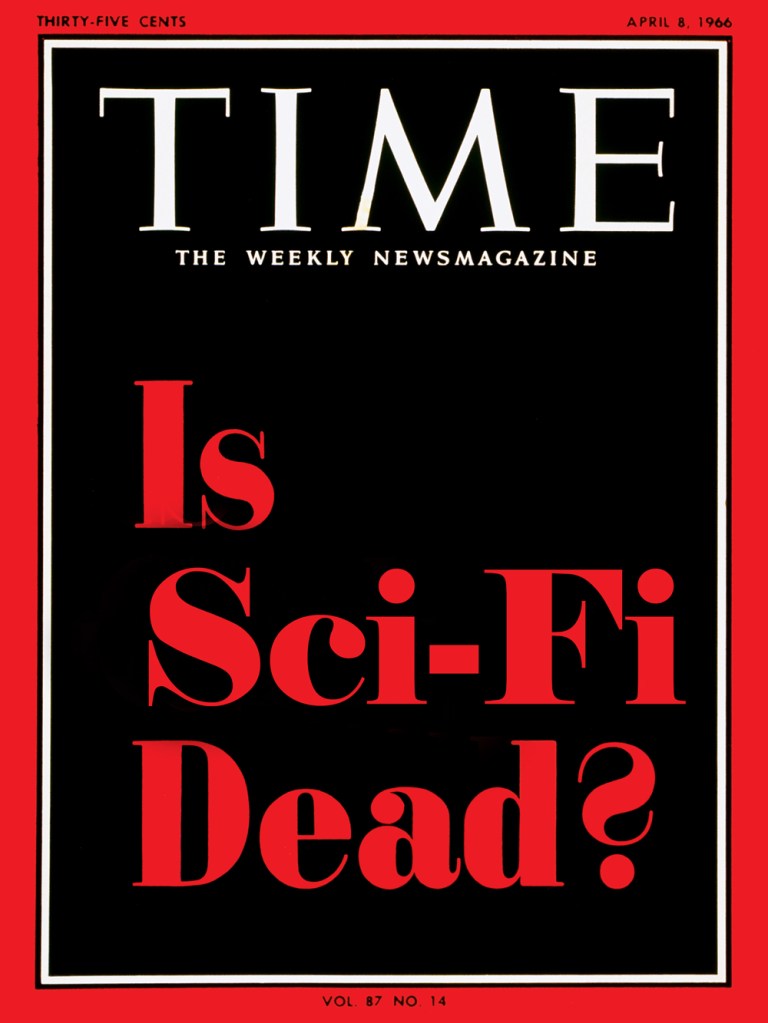
The April 8, 1966, cover of Time Magazine asked in large letters: Is God Dead? I would have answered yes, because starting in late 1963, when I turned twelve, I began to struggle with the idea of believing in God. Before I turned fourteen in late 1965, I had decided I was an atheist. It wasn’t an easy decision. Decades later, I realized that I had given up God and had embraced science fiction as a substitute for religion.
If someone had told me that at the time I would have vehemently denied it because I passionately believed I couldn’t be fooled by make believe concepts. I was for science all the way. Of course, when you’re thirteen years old you’re a dumb ass but don’t know it. I couldn’t see I was substituting one set of wishes for another.
If you look at the concept of God as a hypothesis to explain reality, then we would have to say that concept has been rejected long ago by well educated people thinking in complex and multiplex terms. That doesn’t mean that people have stopped believing in God. Nearly every concept every imagined still has its believers. For explaining reality, science surpassed religion a long time ago.
I believe science fiction as a concept that emerged in the 1920s, 1930s, and 1940s proposed a central hypothesis. That humanity was destined to explore the solar system, the galaxy, and even the universe. Science fiction has proposed many possible concepts that may or may not exist or will exist, but space travel is its big idea.
I believe science fiction’s core belief is space is the final frontier, that space travel is humanity’s manifest destiny, and our existential purpose. I was a true believer in that assumption for most of my life. I now doubt it. I’m becoming an atheist to my chosen religion, science fiction.
If you study science, intergalactic travel will be almost impossible. And even the colonization of the solar system really isn’t practical or in the end, desirable. The claim that we need to get all our genetic eggs off one planet really isn’t practical either as we learn just how adapted humans are to Earth.
Science fiction also proposed another hypothesis, that we will build intelligent machines. That looks like it will be proven correct. And it’s obvious that intelligent machines are suited to explore the solar system and even the galaxy.
Like God and religion, there will always be believers because they’re beliefs that appeal to people. I think the Star Trek/Star Wars type believers will keep the space travel belief and the genre alive. However, I think science fiction’s core concept of humanity conquering space is dead for a growing number of once believers.
Where does that leave readers who love reading science fiction? It makes science fiction about zooming around the galaxy into fantasy, and people still love reading fantasy novels. There will always be simplex true believers who refuse to give up their belief in the final frontier, and there will be complex thinkers who argue the pros and cons. But for some, like people who have rejected God as the cause of reality, there are a growing number of people who consider science fiction about space travel dead.
Ever since the French revolution, the idea of creating a society rejecting God and religion has been considered. I think it’s time for the science fiction faithful to consider a future where humans never colonize the planets or go to the stars. I think it’s time to clean out many cherished science fictional concepts. Space travel and time travel appear to be dead or dying. We’ll probably make it to the Moon again, and even Mars, but we’ll discover that neither place is what science fiction promised. It won’t be a big adventure. Religion promised heaven, while science fiction promised the stars as a substitute. Neither will come true. Neither will be our existential purpose. Everywhere we can go in the solar system is just rocks existing in extremely harsh environments unsuitable for humans.
We need to ask: What can we do best in reality? More than likely that means staying on Earth. Ironically, we’re doing everything we can to make it uninhabitable for humans.
The other big hypothesis of science fiction is first contact with aliens. That might happen via SETI and observational astronomy.
The oldest science fictional concept is surviving an apocalypse. That’s a possibility. Science fiction has frequently explored the idea of civilization collapsing, or humans mutating. Since our species has a history of evolving, that’s a practical consideration.
Religion evolves and mutates. Science fiction will too. But I think the core concept of each has died. Religion and science fiction offer comforting beliefs to people who need them. But that doesn’t mean they are realistic or part of reality.
I don’t think most modern readers of science fiction consider it being anything other than entertainment. Hugo Gernsback, John W. Campbell, and Robert A. Heinlein didn’t think that. They believed science fiction was a kind of philosophy, an approach to understanding reality. That belief is dying out.
I feel like a Jesuit who rejects God and religion late in life.
James Wallace Harris, 7/20/24
The 55th anniversary of Apollo 11 landing on the Moon
 Classics of Science Fiction
I don’t think SF is dead, partly because I don’t think it’s completely dependent on the themes of space travel and ETs, as central as these were to earlier eras. Also, I don’t think devoted reading or even writing of SF on these themes is dependent on their reality or even plausibility. I’ve always loved SF about space travel, but was never a strong believer of space travel in real life.
LikeLike
I agree. Just look at what everyone thought in July 1969 with regard to what would be achieved in the fifty years after that: permanent bases on the moon and Mars, lavish space habitats, and much more. Yet as far as the human penetration of space is concerned, we’ve achieved pretty much nothing. I hope to live for many more years, but I no longer think anybody’s going to Mars in my lifetime. The moon? Sure, we’ll reach the moon again, but people underestimate how insignificant the moon is in celestial terms.
And I would go further: we’re never going to meet aliens. Nor are we going to receive any communication from them, ever. That doesn’t mean I don’t believe aliens exist. Sure they do. But the mathematical odds against being close enough to an alien civilization that wants to make contact are mind-boggling.
I always illustrate the point with this conjecture: Suppose you and I go to the nearest beach to where I live (or even the nearest beach to where you live—it doesn’t matter). I pick up a single grain of sand and record its unique properties under a microscope, so that no other grain of sand can be mistaken for it. Then I alone fly to the Sahara Desert and drop the grain of sand in some random location in the desert. I fly back to where I left you and ask you to go and find that grain of sand and bring it back to me. Now, here’s the point: I haven’t done the math, but I’ll bet a dollar that your chances of finding that grain of sand are probably millions of times greater than the chances of humanity encountering aliens. That’s how vast the universe is.
But you know what? I’ll still read science fiction. The operative word is fiction. Science fiction has always included concepts and plotlines that are, to the best of our knowledge, impossible. I maintain that “possibility” isn’t a definitional requirement of science fiction, and never has been. But that’s another discussion.
LikeLike
Nice metaphor/analogy for conveying something almost impossible.
LikeLike
I sympathize and empathize with all of your crises of faith.
LikeLike
Religion looked backwards to believe in something transcendent. It imagined we had fallen from an earlier, higher origin. But then science disenchanted the world and demythologized the past. It turns out the deep past was not a golden age of gods and miracles but rather the opposite. The further back we look the simpler and cruder things were. We did not descend from a supernatural height, we arose out of crude matter.
How to deal with this disenchantment and alienation? We are probably evolved to believe in an elevated, higher level to life. Science fiction came to the rescue and filled the religion-shaped hole in our psyches. We may no longer be able to believe that the past was super-human, but the future can be! We may no longer be able to believe that the past was filled with dragons, and gods and magic, but the future can be filled with robots and flying cars and thinking machines.
It’s true that science fiction also looked outwards (to space) as well as forwards, and maybe that part of the vision has faltered. But the dream of progress and future wonders remains. After all, after the death of God, where else can the need for transcendence be projected, except the future?
LikeLike
Excellent way of putting it.
The major theme of 1940s and 1950s science fiction was transcendence. It promised we’d find paradise/Eden in the sky, but it also promised that speeded up human evolution was just around the corner. That’s why in the 1950s that ESP/psionic stories were so common. Heinlein created the pinnacle of that promise in STRANGER IN A STRANGE LAND telling us we are God, and that we could all have godlike powers if we only practiced certain mental disciplines. That’s why John W. Campbell went off the deep end with Dianetics and the Dean Drive — he was searching for attainable transcendence.
Science fiction also promised technology would uplift society into new heights.
We’ve never went back to the Moon after 1972 or tried to go further. Despite all the New Age promises of the 1970s, we’re still the same old humans we’ve been for 200,000 years. Yes, technology has transformed society, but all over the world the political will is to return to an earlier state of affairs.
Science fiction has always been full of dreams, but it’s mostly become adventure stories set in exotic fantasy locales.
I think the techniques of science fiction could be used to imagine realistic possibilities, but that seldom happens. Like people wanting Old Time Religion, most readers want Old Time Science Fiction. We love the dreams they promised and can’t let them go.
LikeLike
Oh ye of little faith…
Remember the physicians who proved trains and cars would never go over 60 miles per hour because of the stress on the human body? When “Going like sixty.” was an expression indicating extreme accomplishment? Remember when since the USA focused on mineralization and reduced mass to get rockets up, but the Soviets focused on bigger rockets, the experts said we would neve catch up? By 1966, things had already gotten as small as they could. Remember those serious articles that sci-fi mentioning or showing flat screen TVs, flatscreen would be forever fiction because of cathode ray tube limitations. “and even if they did, it wouldn’t change anything important.” No flat screen, no modern smartphone. Advance tech changes what man can do because it enlarges our dream possibilities. The Martian was hard sci fi that focused on the same thing that all “stranded on a deserted island” stories have focused on, even the focus of Old Man & the Sea : the challenge of one against nature & surviving against all odds..
No one knows what tech or social change will increase human presence in space, but until then we need good Sci Fi to emotionally prepare us for the struggles that will surely happen.And we need them in a larger variety than currently printed. Where there is need, there will be starry-eyed need-fillers. The best Sci Fi is in our future.
Fran Tabor
PS Shameless self promotion here. My To Own Two Suns is called “a badly needed breath of fresh air into the first contact genre.” Like many who read your essay, I think my book, and others, will prove you wrong.
LikeLike
Fran, I hope your book does well. I don’t think my science fiction doubts will hurt anyone’s sales.
I do think more science fiction needs to be written to help us deal with the present and near future. It needs to promote realistic optimism.
LikeLike
mineralization should be miniaturization
Missed that “correction” when proofreading. Love the many spell check programs & AI , except when I don’t.😁
LikeLike