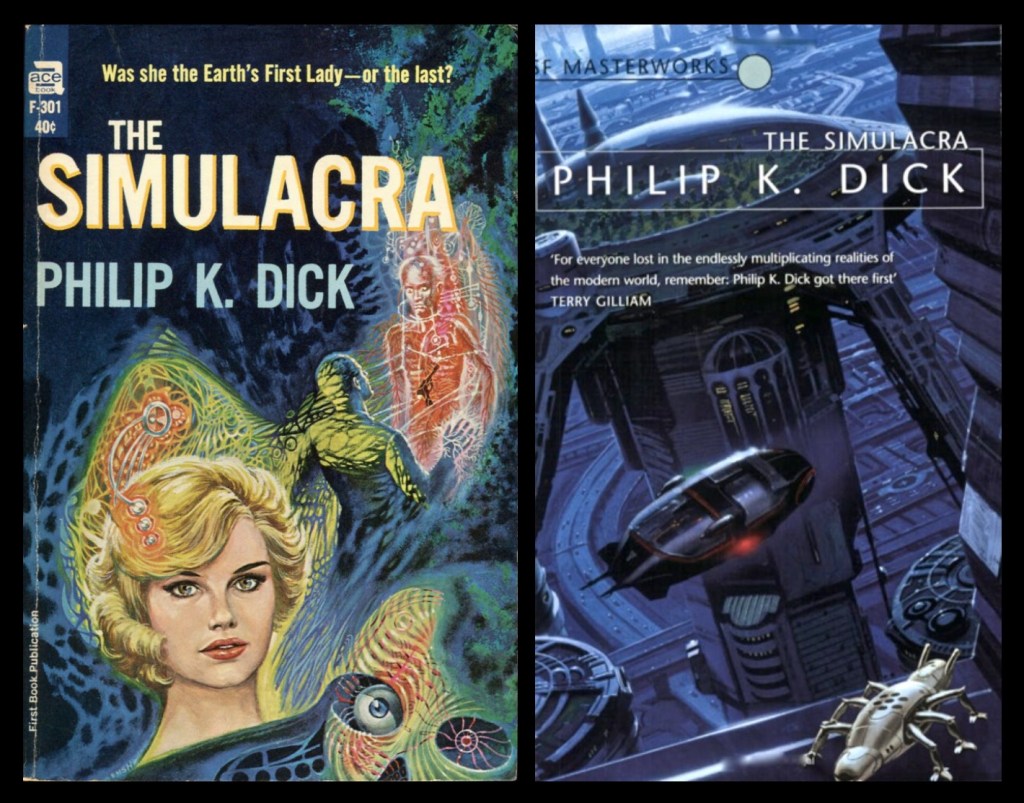
How do literary scholars of Philip K. Dick’s fiction determine which of his novels are masterpieces and which are his hackwork? They all seem equally bizarre, and even confusing. Library of America selected four novels for their first volume in 2007 devoted to PKD. The years given are when they were (written, published).
- The Man in the High Castle (1961,1962)
- The Three Stigmata of Palmer Eldritch (1964,1965)
- Do Androids Dream of Electric Sheep? (1966, 1968)
- Ubik (1966, 1969)
The second volume came out in 2008 recognized:
- The Martian Time-Slip (1962, 1964)
- Dr. Bloodmoney (1963, 1965)
- Now Wait for Last Year (1963, 1966)
- Flow My Tears, the Policeman Said (1970, 1974)
- A Scanner Darkly (1973, 1977)
The third volume in 2009 highlighted:
- A Maze of Death (1968, 1970)
- VALIS (1978, 1981)
- The Divine Invasion (1980, 1981)
- The Transmigration of Timothy Archer (1981, 1982)
Are we to assume these are Dick’s best novels? My personal favorite, Confessions of a Crap Artist wasn’t included. Neither was The Simulacra which I just read and found fascinating and fun. I think some of the Library of America selections are better than The Simulacra, such as The Man in the High Castle, The Martian Time-Slip, and VALIS, but I’d also claim The Simulacra is not a lesser novel to the others. However, using our citation database system, it gets only one citation. Twelve of the twenty-seven PKD novels in our database only got one citation. The novels in the first LOA volume received 9 to 32 citations, which supports the LOA editors.
The only reason The Simulacra received one citation is because it was part of the SF Masterworks series. All the science fiction magazine reviewers ignored it when it came out. As far as I can tell, none of the reprint editions got reviewed either. The Simulacra just isn’t well-known. It’s often disliked when I see it mentioned.
I liked it. And I want to make a case that it’s worth reading. However, it will be hard to even describe. I’m afraid most readers will be turned off by The Simulacra because it has multiple plot lines with over a dozen main characters. And I can imagine many readers calling it stupid too — but that could be true for a lot of readers coming to PKD work. However, if two of the five novels Dick wrote in 1963 made it into the Library of America, why shouldn’t the other three? What divides them? What makes one novel “good” and another “bad?”
The Simulacra‘s complexity might keep readers from liking it, but that complexity might hide many novelistic virtues. Just because I admired this novel, doesn’t mean others will. I’m writing this essay hoping people will read The Simulacra and give me their opinion. I’m curious if I’m a total outlier. I got a big kick out of the story.
According to Samuel Johnson, “No man but a blockhead ever wrote, except for money.” Dick complained in several 1963 letters found in The Selected Letters of Philip K. Dick: Volume One: 1938-1971, that his wife Anne constantly hounded him to make more money. On the other hand, Dick wrote eleven literary (non-genre) novels from 1952-1960 hoping to become a recognized mainstream writer. All were rejected. He then wrote The Man in the High Castle in 1961 which bridges the literary and science fiction world and won a Hugo award for best novel. Dick then wrote twenty-one science fiction novels from 1962 to 1969, five of them in 1963 alone. He obviously needed money and had to crank out the manuscripts.
After 1970, Dick only published six more novels before he died in 1982. Five of which are included in the Library of America editions. That suggests that the novels he took more time writing fared better with the critics. So, the five novels written in 1963 were among the fastest he wrote, suggesting they shouldn’t be as good. Yet, two were selected for the Library of America.
As much as I like The Simulacra, I do see that it’s flawed. It doesn’t have a main character which most readers prefer. Nor does it jump back and forth between two main characters, which can be quite successful with some readers. And it’s not even one of those experimental stories where we follow several unrelated characters that all come together in the end. Readers find that structure confusing but forgive it if the ending brings everyone together in a satisfying way. I’m not sure The Simulacra wraps up nicely.
We might call the plotting of The Simulacra an example of characters doing parallel play. Dick might have aimed for creating a collage of future American scenes. My guess is Dick banged away on his typewriter, vomiting up The Simulacra onto typing paper. The results are fascinating because the novel is one big pile of imagery from PKD unconscious mind — and what a mind! It begs to be psychoanalyzed. And I’m sure, it parallels his personal life, especially regarding insanity, psychoanalysis, and troubling wives and women.
The Simulacra is not satire even though it often feels like the film Dr. Strangelove, nor is it a fantasy even though everything is unbelievable. And I wouldn’t call it surreal or dreamlike, or avant-garde even though it was written in 1963 when trendy artists were creating pop art and post-modern fiction. It’s straight science fiction, meant to be taken as realistic, even though it’s bonkers. The Simulacra has the existential absurd horror of The Tin Drum or The Painted Bird. I don’t even think Dick was making fun of science fiction with its comic book level wild ideas. Dick had crazy ideas, and he saw the world being just as crazy.
The Simulacra pictures future America where psychic abilities are accepted as real, that time travel has been perfected, where people and animals can be artificially created and the results indistinguishable from real people and animals, that colonies exist on Mars and the Moon, and alien lifeforms can be commercialized. In other words, all the crap ideas that science fiction fans and fans of the occult believed in the 1950s. Everything they thought possible, became possible.
The hardest part of this essay is describing what happens in The Simulacra. I wrote about that trouble already for my Auxiliary Memory blog, where I explained I had to read the book and listen to the audiobook to get the most out of The Simulacra. In fact, I’m still picking up the book, or putting on the audiobook, and enjoying random parts of the novel. I can’t seem to leave this story. I’m still finding new insights into whatever scene I stumble upon. I’ve decided the best way to describe the story is by mind mapping the characters. The number given is the number of times the character is mentioned in the story.
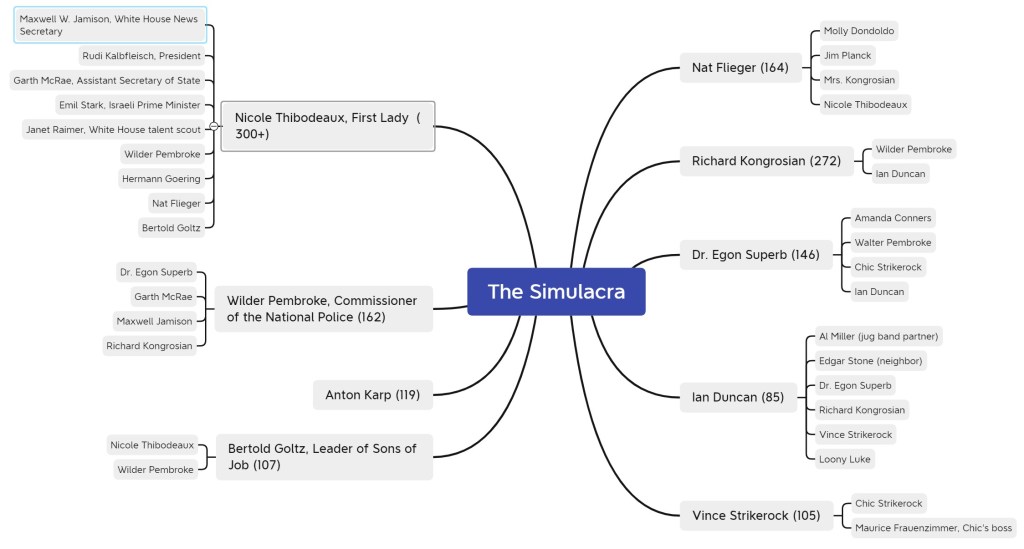
I’m trying not to give away too much of the plot. Each of the first level characters involves a subplot. For example, Dr. Egon Superb is the last legally practicing psychiatrist after the pharmaceutical industry pushed through the McPhearson Act that made drug therapy the only legal form of treatment for mental illness. One of his patients is Richard Kongrosian, a psychic pianist who uses telekinesis to play the piano instead of using his hands. Nat Flieger is a sound engineer who wants to record Kongrosian, but he and his crew of Molly Dondoldo and Jim Planck can never track down the man. Ian Duncan and his old friend Al Miller want to perform classical music as a jug band at the White House for Nicole Thibodeaux. Nicole Thibodeaux, the First Lady, but maybe the true ruler of The United States of Europe and America (USEA) wants to negotiate with Hermann Goering via a time machine to get the Nazis to not kill the Jews. Vince and Chic get involve with making the next president, an android, which will replace Nicole’s current husband. Wilder Pembroke, Anton Karp, and Bertold Goltz all vie for power behind the scenes.
If the novel has a main character, it could be Nicole Thibodeaux. Dick’s original draft was called The First Lady of Earth. Since this book was written in the summer of 1963, I assume Dick was inspired by Jackie Kennedy because Nicole spends most of her time charming people, decorating the White House and gardens, and putting on nightly cultural events. Everyone loves Nicole. Yet, out of the public eye, Nicole is also ruthless enough to have people summarily executed. Evidently, she wields unlimited power because of her access to time travel.
The novel is set in a post-apocalyptic future, decades after China attacked the U.S. with missiles with atomic warheads. This gave rise to a population of mutants, similar in appearance to Neanderthals. People ride in self-driving cars. Ads are living creatures that can invade your home and car and must be killed. Richard Kongrosian believes he has a terrible body odor because a deodorant ad infected him with a jingle. The Sons of Job are a neo-fascist political party. People live in giant communal apartment complexes and are required to take civics tests to stay in them. Many people want to escape this totalitarian society by immigrating to Mars. People buy android nuclear families just to have normal friends.
I could go on. There are several layers of political and corporate intrigue in The Simulacra. Dick evidently thought there were conspiracies everywhere. Later in life, Dick would get into Gnostic religion, which is a very paranoid belief system. This novel has many traits of Gnosticism. The Simulacra was written after The Man in the High Castle, We Can Build You, Dr. Bloodmoney, and The Martian Time-Slip, and before The Three Stigmata of Palmer Eldritch and Do Androids Dream of Electric Sheep? There are many similar themes and obsessive ideas that run through all of them. I wish I had the time and energy to study all those novels and plot all the connections. Why did PKD fixate on certain ideas repeatedly? Was it a lack of imagination to explore unfamiliar territory, or were they ideas PKD just could let go of?
James Wallace Harris, 1/5/24
 Classics of Science Fiction
Evidently, according to my notes, I didn’t like this one much either.
But your review makes me want to re-read it.
LikeLike
I like THE SIMULACRA a lot.
But it’s merely one of a putative *eleven or twelve* novels Dick turned out in one particular amphetamine-fueled twelve-month period during the early 1960s to meet his alimony payments, and others include CLANS OF THE ALPHANE MOONS and THE GAME-PLAYERS OF TITAN which I like at least as much, and which have the same dizzying profusion of Dickian sfnal inventions/obsessions. Then, too, there are yet others from that dozen-odd books that are almost as good –like THE PENULTIMATE TRUTH — and, beyond that, even THE ZAP GUN and THE CRACK IN SPACE not only have their moments, but have more crazy ideas than nine-tenths of Dick’s SF-writing contemporaries.
So that stipulated, Jonathan Lethem made the choice on which Dick novels made the LOA editions, and I think he displayed the right judgment.
Because top tier Dick novels that had to go in to any LOA edition are the likes of HIGH CASTLE, UBIK, MARTIAN TIMESLIP, THREE STIGMATA, but — yes — one of those twelve novels Dick churned out in that one year of extraordinarily inventive production also needed to be represented.
And NOW WAIT FOR LAST YEAR is arguably the best bet there, since besides delivering all the Dickian reality-bending tropes, it has a little bit more of literary-style pathos and insight with the tragedy of protagonist Eric Sweetscent’s drug-addicted, brain-damaged wife and his relationship with her, and the semi-martyrdom of the political leader Gino Molinari.
I like CONFESSIONS (and THE TRANSMIGRATION OF TIMOTHY ARCHER) too, but they’re not SF, and since the LOA was doing a set of volumes essentially marketing PKD as the primary American SF writer of his time, it made sense to stick with the SF.
LikeLike
I just finished NOW WAIT FOR LAST YEAR and thought it more literary too, and essentially better written. I’m now thinking THE SIMULACRA aimed to be something different in style. It’s not badly written, just a bit more confusing. It helps that NOW WAIT FOR LAST YEAR focuses on Eric and Kathy, and especially Eric.
I’m not sure why the LOA would limit its PKD books to just the SF ones. The LOA books with black dust jackets seem to focus on a writer’s career. And didn’t they publish non-SF works for Le Guin?
PKD was married to Anne Williams Rubinstein from April 1, 1959, to October 1965, so alimony might not be the reason he wrote all those books. In his letters, he constantly complained about Anne wanting him to be more successful and buy her more stuff. Although, he might have also been paying alimony to Jeanette Marlin (May to November 1948) and Kleo Apostolides (1950-1959).
I’m still not sure if THE SIMULACRA is a lesser novel than NOW WAIT FOR LAST YEAR. The second book has far more literary descriptions of the characters’ qualities and emotions and is focused on one plot. But THE SIMULACRA is more experimental by using multiple plot threads to convey a bigger picture of what was going on in the America of that story.
LikeLike
When I first read “The Simulacra”, I thought it was brilliant. This was before I read “Do Androids Dream of Electric Sheep”, “Ubik”, Martian Time-Slip”, “Dr Bloodmoney”, “Now Wait for Last Year”, “A Scanner Darkly”, “Valis”, “The Divine Invasion” and “The Transmigration of Timothy Archer”. I think it’s a better written novel than “Ubik”, “Now Wait for Last Year” and “Valis”. Also “Flow My Tears, the Policeman Said”.
Two other 1950s novels that could have been included, were “Eye in the Sky” and “Time Out of Joint”, but were excluded it seems in favour of his later novels. Another later novel that could have been included, is “Galactic Pot-Healer”, which is a better written and funnier novel than “Ubik”. It has a stronger structure and clarity, but like “The Simulacra”, but was probably too different and strange to be taken seriously.
Psychic abilities are acceptable in the Dickian society and are useful to corporations in “The Three Stigmata of Palmer Eldritch” and “Ubik”. The people and animals artificially created, are reminiscent of the strange artefacts in “Do Androids Dream of Electric Sheep”. I thought that planetary colonisation was commonplace in his novels and pieces. Dick was among those people in the 1950s and seems to have brought it to life in this novel.
Dick was supposed to have a negative view of women in his SF, but he liked to portray strong-minded female characters, at a time I think when women were mostly relegated to secondary roles. Nicole Thibodeaux is a fascinating and very unusual character in the genre at this time then. He’s experimenting with gender roles, in this case, a woman in a totalitarian leader’s male role.
The Neanderthals are supposed to be throwbacks as I remember, and provide the focus on his devolution theme, and are our nemesis. Richard Kongrosian’s neurosis affects those near him in typically Dickian fashion, by becoming real. The fact that people are living with android commodities that are more real to them than actual people, is probably due humanity’s increasing psychopathy, but the moral dilemma with empathy doesn’t seem to be realised yet.
To my knowledge, Gnosticism is dualistic and ambiguous. It also has a feminine form of God as far as I know, St. Sofia. I’m aware of it having a strong core in his novels, and pieces like “Faith of Our Fathers”. If the Gnostic theme is present in “The Simulacra”, then the Nicole character probably represents this goddess, although I can’t say what it means. Dick stuck to the same themes and concerns, but they emerged in his SF as remarkably different. If he’d have done anything else, would he have lost his identity and distinction?
This is an excellent article. “The Simulacra” is a sweet, exotic cocktail. This comment has really only been a stub though. I’ll have to read it again to comment more fully. Evan Lampe’s “Philip K. Dick and the World We Live In” is also a good reference guide to research this novel. Have you read it?
LikeLike
I just finished NOW WAIT FOR LAST YEAR and thought it was better written, but that THE SIMULACRA was more ambitious. I was surprised by how different the writing style was for two books written in the same year, even the same summer.
Gnosticism claims there’s a hidden dimension behind ours that is more real, and that the God of that dimension is the real God. It’s more complicated than that. But one of the key elements of Gnosticism is hidden knowledge, and that only special people know about that knowledge. That fits in well with PKD because he liked stories where everything isn’t what it appears to be, and characters discover there’s another reality behind this one. Of course, I’m simplifying things too much. Christian Gnosticism deals with an evil god and that Jesus was an adept in the hidden knowledge.
I just started THE CRACK IN SPACE. I’m going to read/listen to all the novels written in 1963. I’ll check to see which stories were written then too. I hate not having the energy to work on this project because there’s so much to write about. It’s hard to put my thoughts together. I keep dreaming of finding some kind of computer program that could help me. I was fantasizing about developing an AI program that used all of Dick’s work, as well as all the books about Dick and his writing to create a large language model so I could query it.
LikeLike
“Now Wait for Last Year” is better written in a way, because it’s more focused in having fewer characters and plot situations, but I think “The Simulacra” has a fresher, livelier and stronger tonal prose, and in it’s complexity, it seems tighter than “Now Wait for Last Year”, that also has, although smaller, a number of characters and concepts, that however seem to wander aimlessly. “The Simulacra” appears to have a stronger nexus point in the Nicole character because all the strands seem to fixate on her, unlike Molinari in the other novel.
I’ve said I’ve only a very limited knowledge of Gnosticism, and I have to try and be sure I know what I’m talking about within those limits. As I’ve said, it’s morally ambiguous in it’s views about God, very similar to what you said above. It claims, so far as I know, that the world was made by a flawed creator god, which is why it’s imperfect. What you said about hidden knowledge also seems cognizant with it’s facets, as apparently it’s also supposed to be much closer to the truth about theology than orthodox religion, that’s manmade and based on faith. Dick’s vision of a evil face in the sky, that can be attributed to amphetamine use, seemed to be of no doubt, at least to him, that what he beheld was the evil visage of the Gnostic God, just one aspect of him/it. The nightmarish angst and uncertainty in “The Three Stigmata of Palmer Eldritch” was autobiographical in what he thought he experienced and was real to him.
I hope you can find the stamina for your project. I hope to reread “The Simulacra” and related material in Evan Lampe’s book soon so that I can post you a review comment.
LikeLike
I’m not familiar with Evan Lampe. I just bought a PKD biography on Audible, A LIFE OF PHILIP K. DICK by Anthony Peake. There are so many books on PKD that I can’t keep up or remember their names and authors.
LikeLike
Hi James, are you going to publish my review? I don’t know how long it takes to pass moderation.
LikeLike
Sorry Richard. I’m just now checking my comments. I don’t have much energy anymore. Usually, it drains me to finish a post, and I go away and rest up and forget the computer for a while.
Now that I’ve approved one message from you, your messages will automatically be posted.
LikeLike
Hi James, was there something inappropriate in my comment, that you haven’t published it?
LikeLike
Somehow it got in the spam folder. I never saw it. I don’t know why it was marked as spam. Sorry I didn’t discover that sooner because I really appreciate you taking the time to write out such a long detail comment. I reply to that comment.
LikeLike
Thank you James, I didn’t know why it hadn’t been published, your reasons are acceptable though. Thank you for publishing it.
LikeLike
Are you filling in the details to post comments differently each time. It should have remembered you this time.
LikeLike
No, I’m sure I’m not.
LikeLike
For some reason I’m having to approve every message you post. But that’s not true on my Auxiliary Memory site. Usually, if I approve a person once, they can post without approval after that. But that depends on them always using the same name and email address I thought. Maybe something else is involved.
LikeLike
As of now, it should be set to my Facebook account.
LikeLike
Evan Lampe’s book about Philip K. Dick is more focused on his worldly issues, as the title suggests. I don’t know of Anthony Peak.
LikeLike