
Starting September 7th, our science fiction short story group will be discussing the best short science fiction of 1955. Read about the details here if you want to participate. We used CSFquery to identify twenty-two stories to read and discuss. However, I put a challenge to the group to find worthy stories that have gone mainly unrecognized. I found my first forgotten classic today, “The Earth Quarter” by Damon Knight. The only recognition I could find that remembers this story is in a list of 50 SF short stories that were Gardner Dozois personal favorites. (I’m going to have to read more of the stories from that list that aren’t famous.)
I thought “The Earth Quarter” was one of the most cynical science fiction stories I’ve ever read. You know how Campbell and Heinlein were so pro-human? Well, Knight takes the opposite stance. I don’t want to say too much — and you might want to go read the story here before you read on.
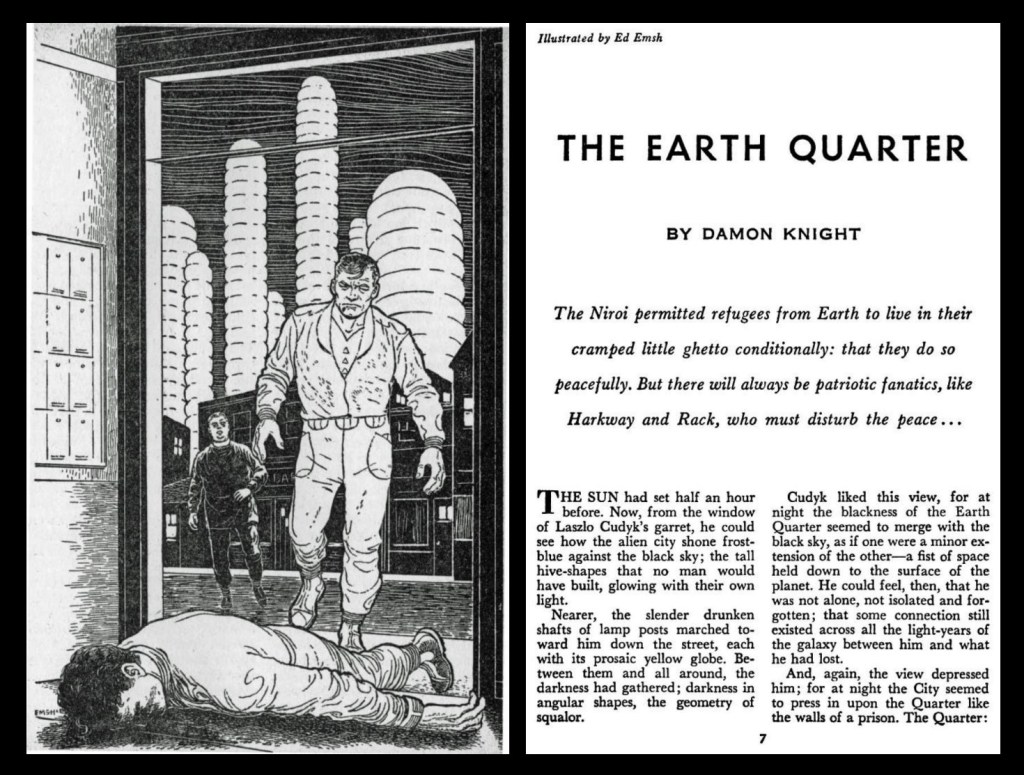
Knight sets up the story where a group of humans live in a ghetto on another planet, one they call Earth Quarter. He pictures humans attaining interstellar flight and spreading out across the galaxy, but discovering it’s well occupied by intelligent beings more advanced than us. Humans can’t handle this. Earth itself falls back into barbarism, while enclaves of humans on various planets bicker amongst themselves.
“The Earth Quarter” is told from the point-of-view of Laszlo Cudyk, a fifty-year old man who tries to stay neutral among several highly polarized political factions. Liberals want to find a way to live peaceably with the aliens, while various conservative groups want to bring back the glory of Earth and conquer the galaxy.
The Earth Quarter is roughly sixteen square city blocks, containing 2,300 humans of three races, four religions, and eighteen nationalities. The human ghetto is sanctioned by a race of aliens called the Niori, but only if they live peaceably, which humans can’t seem to do. Knight makes a case that humans just can’t get along no matter what.
Life in the Earth Quarter reminds me of the prisoner of war camp in J. G. Ballard’s Empire of the Sun, but the Niori are enlightened beings who are kind rather than cruel. In another way, the story reminds me of Katherine Anne Porter’s Ship of Fools.
What I really liked about this story was the characterization — sure it’s pulp fiction, but I think good pulp fiction. Knight creates many distinctive characters who are vivid from little description. Sure, he employs stereotypes, but not too offensively. I can easily picture “The Earth Quarter” being made in a 1950’s noir sci-fi flick with all the standard noir actors like Humphrey Bogart, Robert Ryan, Robert Mitchem, Peter Lorre, Sidney Greenstreet, Barten MacLane, Elisha Cook, Jr. — and it would have to be filmed in black and white.
My guess was Damon Knight got disgusted with humans in 1955 when he wrote this story. We were in the middle of the cold war and humanity was providing just the right inspiration.
UPDATE – 9/4/23
It turns out that Rich Horton also likes “The Earth Quarter.” See his essay about his picks for the 1956 Hugo awards (which cover 1955). But he also reviewed the story when it was expanded and renamed into one-half of an Ace Double called The Sun Saboteurs.

James Wallace Harris, 9/3/23
 Classics of Science Fiction
“The Earth Quarter” is reprinted in Knight’s 1979 Avon collection RULE GOLDEN AND OTHER STORIES, and Knight gets pretty explicit about his intent: ” ‘The Earth Quarter is in part a reaction to the macho science fiction identified in the 50s with John Campbell, who would not publish any story in which another race turned out to be more advanced, smarter, or in any other way better than us. [not quite true, but never mind] Considering the size and age of the universe, the likelihood that the human race is the pinnacle of creation seems to me vanishingly small. The villain of the story, Lawrence Rack, is my version of a hero of a story by L. Ron Hubbard, ‘To the Stars’ [vt RETURN TO TOMORROW], which Campbell published in 1950.”
LikeLike
I need to read more Knight. I completely missed him when I was young. I have a Gateway Omnibus with four of his collections, but without RULE GOLDEN AND OTHER STORIES. In recent years I’ve found a number of brilliant stories by him.
What others do you recommend? And are any of his novels as good?
LikeLike
Knight’s novels generally are not as good as his short work; he didn’t quite catch on to how to structure and pace a novel until the very end, with HUMPTY DUMPTY: AN OVAL, a few years before he died. (The next to last one, WHY DO BIRDS, is also not bad.) Of course Knight’s failures are better than many other writers’ successes. His novels were generally readable and intelligent even when their technical flaws were obvious. Also several of his “novels” were actually novellas occupying half of an Ace Double, like THE EARTH QUARTER.
I would say that the indispensable short works by Knight (aside from the novellas in RULE GOLDEN, a book you should just seek out) are:
The Analogues (also the first section in the novel HELL’S PAVEMENT vt ANALOGUE MEN)
Four in One
The Country of the Kind
You’re Another
Stranger Station
What Rough Beast?
The Handler
An Ancient Madness a/k/a Mary (I think opinion is divided about that one)
Masks
I See You
It would be easy to extend that list quite a way.
Absent from it are his most famous stories, “To Serve Man” and “Not With a Bang,” which are very clever joke stories, but you’ll be hungry again an hour later. There’s much more to chew on in the ones I listed.
LikeLike
Damon Knight’s attack on A E van Vogt left a bad taste in my mouth, which has coloured my view of his work ever since.
No matter how noble one’s cause might be (opposing Campbell’s influence), the ends do not justify the means.
So colour me unsurprised at his disgust at humanity.
I understand his feelings, when emotions are allowed to rule then what you get is what he railed against, but in doing so he fell foul to what disgusted him.
LikeLike
Was it a critical attack on van Vogt’s work or a personal attack?
LikeLike
Knight’s said, “is not a giant as often maintained. He’s only a pygmy who has learned to operate an overgrown typewriter.”
I think that this is where Knight’s criticism became personal.
Knight also used the SFWA to politic against van Vogt.
YMMV.
A link:
https://www.liquisearch.com/a_e_van_vogt/recognition
LikeLike
Knight wrote a fanzine article in 1945 or so arguing that van Vogt’s recently concluded ASTOUNDING serial THE WORLD OF NULL-A didn’t make any sense and was badly written too. Van Vogt made substantial revisions to the serial version for the book’s publication in 1948 by Simon & Schuster, some acknowledgedly in response to Knight’s article. There may have been a later revision of the novel; I’m not sure. Knight has a chapter in his book IN SEARCH OF WONDER titled “A.E. van Vogt: Cosmic Jerrybuilder” which updates his old article to reflect van Vogt’s subsequent revisions. At some point–maybe in the last edition of that book (there were three), he acknowledges that since lots of people are captivated by van Vogt, maybe someone should try to figure out the basis of his appeal.
More recently, Robert Silverberg in his column in ASIMOV’S commented on both the serial version and the subsequent hardcover and liked the serial version better, essentially because it was so exuberantly crazy. Unfortunately I don’t have a title or a cite. (And it may have been two of his columns.)
Worth mentioning in this context is that Knight later said that his own mid-’60s novel BEYOND THE BARRIER, which is arguably an exception to my statement that his novels are at least readable and intelligent, was really intended as a parody of van Vogt. Could be.
LikeLike
Have you read THE WORLD BEYOND THE HILL by Alexei and Cory Panshin? They make a rather compelling case for van Vogt’s strange way of writing?
LikeLike
Jim, I was thinking of reading this story, and your recommendation tips the scales. I have not read most of the post, yet, to avoid spoilers. However, I love that you found a list of “50 favorite stories” by Gardner Dozois. I’ll be looking at that list. Thanks!
LikeLike
Yes, I have read THE WORLD BEYOND THE HILL, though I don’t remember the specific of the authors’ comments about van Vogt. I was not convinced by their view that just about everybody back then was preoccupied with transcendence (though some of them surely were, including van Vogt), but I thought many of their comments about particular works were valuable, and they certainly had a lot of lore to relate.
LikeLike
Jim, one more question. My thanks for the list of 50 of favorite short SFF stories from Gardner Dozois. I see that listed at Classics of SF. What is the source of the list? Thanks.
LikeLike
I believe Piet found it for us. But I’ve forgotten where.
LikeLike