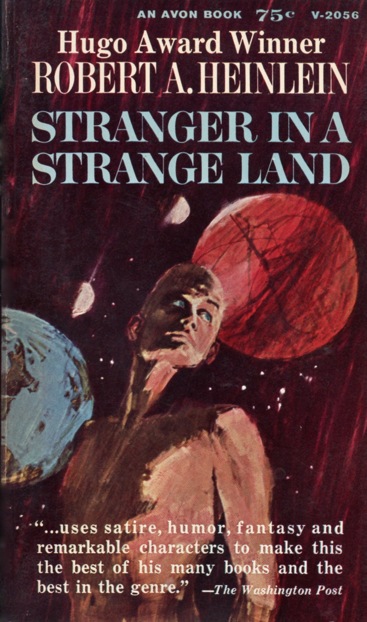
I recently watched a devastating “review” of Stranger in a Strange Land on YouTube. (Watch it below.) The short film summarized the plot of the novel, but in a way that made the story ridiculous. When I first watched it, I didn’t think the sarcasm and satire was unfair. I first read Stranger in 1965 when I was thirteen, and I loved it. I’ve reread it many times over the decades, but with each rereading I became more disappointed with the story. So, the criticisms made by Overly Sarcastic Productions resonated with the memories I have of listening to the audiobook version in 2004, and my last reading in 1991. Even though Robert A. Heinlein is still my favorite science fiction writer; I haven’t liked his books published after 1959 for a long time. However, I’m wondering if I shouldn’t reevaluate that dislike.
Today, I started reading A Martian Named Smith by William H. Patterson, Jr., the man who wrote a two-volume biography of Heinlein and who edited The Heinlein Journal. I wouldn’t call Robert A. Heinlein: In Dialogue with His Century an official biography, but it was written with the support of Virginia Heinlein. Patterson makes a great case that Heinlein was trying something quite different with Stranger, and it shouldn’t be judged like traditional science fiction. Patterson considers Stranger to be a classic satire, and that the satire has a different structural form than the novel.
In the 1960s and 1970s, Stranger in a Strange Land might have been the most famous science fiction novel. It was a cult classic on college campuses and embraced by many in the counterculture. I’m not sure Heinlein liked that. It was also embraced by the growing libertarian political movement. The more Heinlein was embraced by the Right, the more readers on the Left moved away from his works. That put me in a bind. I’m liberal. What eventually happened is I focused on his books published before 1960.
But I thought of something today. Stranger in a Strange Land could be considered an early work of New Wave Science Fiction, at least by some of its goals. The New Wave movement wanted science fiction to move away from pulp writing, escape from the old tropes in science fiction, embrace the latest literary standards, experiment in new forms of writing styles, deal with emerging social issues, and be more relevant. Heinlein was obviously doing all that with Stranger in a Strange Land. The New Wave was mostly out of England, and on the left politically. Heinlein made public proclamations that divided the science fiction community between conservative and liberal, so no one considered him New Wave at the time.
Patterson, in A Man Named Smith makes a very intellectually grounded case that Stranger in a Strange Land works on multiple levels, some of which are deep and seldom observed. What if Patterson is right? What if my liberal leanings are prejudicing me from giving the novel a fair chance? To find out I’ll need to reread the book, even both versions, and read Patterson’s book, along with other critical works and studies on the novel. That will be a huge project. That means this blog post will have another ongoing series — and I have too many of those unfinished right now. I’ve been meaning to get back to my Rereading Heinlein project. I expected to reread Stranger in a Strange Land after I read everything Heinlein wrote before it. I’m still stuck in 1940, where I planned to read “The Devil Makes the Law” (renamed “Magic, Inc.”) next.
I also got inspired to reread Stranger in a Strange Land this week when I watched the above video review. Then I read an essay on Book Riot where the writer was proposing to replace eight classic literary novels, four of which are among my favorites. I wrote about this on Auxiliary Memory, where I criticized younger writers for wanting to replace older books they hated, with newer books they loved. I said, if you want to replace a classic, it should be from the same years as the original work and cover the same thematic territory — that classics are how we view the past.
Then I read Joachim Boaz’s review of Davy by Edgar Pangborn. He called it a masterpiece. That led me to finding my copy of Davy and begin reading. It’s quite an impressive novel, but what’s interesting is its overlap with Stranger in a Strange Land. Both are about young males and their education before they become revolutionaries and try to create new social systems. Both these books precede the counterculture of the 1960s by just a few years. At first, I wondered if modern woke readers would accept Davy as a substitute science fiction classic for Stranger in a Strange Land. But if you read my essay linked above, you’ll see that I don’t believe in removing classics from the canon, but adding works that will supplement that.
I believe Stranger in a Strange Land, Davy, and The Man Who Fell to Earth by Walter Tevis make an interesting trilogy of works that reflect the early 1960s in science fiction. To write that will be another huge writing job that will take a lot of researching, reading, and writing. And I unfortunately have dwindling physical and psychic energy.
When I was growing up in the 1950s and 1960s Heinlein was considered the top science fiction author by most readers, even if they didn’t like his books. He was just that successful. He was made the first Grand Master by the SFWA in 1974.
Ever since Stranger in a Strange Land was first published, it was considered controversial, and even polarizing. Since the 1960s, Heinlein’s reputation has been in decline, but that might be relative. So many new writers have had so much success that Heinlein just had much more competition. However, in the 21st century there does seem to be a growing dislike of Heinlein among younger readers.
I love studying how books become popular and how they are slowly forgotten. Is Heinlein and Stranger on their way out? Or is there something to that novel that will keep people reading it for another century? I want to think about that.
Right now, people focus on Heinlein’s flaws. But what about Heinlein’s virtues?
I also want to think about the differences between what makes a literary novel a classic and what makes a science fiction novel a classic. There is an overlap in reasons, but each form has its unique qualities that determine whether they will become a classic novel. I believe literary novels must give significant insight into their story’s physical setting, and both the time in which the story is set, and when it was written.
We judge science fiction stories over their plots and ideas. But what if what makes a classic science fiction novel the same as what makes a classic literary novel? What does Stranger in a Strange Land say about America in 1961, and the decade before when Heinlein was writing it? My guess is it is something like what Pangborn and Tevis were saying. It’s going to take a lot of deep reading for me to find out.
James Wallace Harris, 8/12/23
 Classics of Science Fiction
I haven’t yet read Stranger in a Strange Land, only some of Heinlein’s earlier works. However, I think SF consists of more than plots and ideas–it’s also a literature of images and visions. These often remain with me when the details (or even the major events) of the plot have faded.
LikeLiked by 1 person
Gardner Dozois always praised Davy, to the point where it may have been his favorite SF novel. I haven’t read it. As for Stranger, You may remember that I wrote you after reading it a year or two ago and saying that I was bored by it. However, I will try some more Heinlein. Maybe I should psych myself up by reading H. Bruce Franklin’s book on Heinlein first. I bought this in the 1980s because I was very impressed by the fact that it was published by Oxford University Press, but I haven’t read it yet.
LikeLiked by 1 person
I read and enjoyed Franklin’s book. He’s a Marxist, so one would expect him to be strongly critical of Heinlein (which he is in some ways), but his book isn’t (in my view) an attack on him–it left me wanting to read more Heinlein.
LikeLike
I too red stranger in a strange Land when I was 12; I loved it. I’ve always liked the idea of having me served for soup just a little bit on my death anniversary for my birthday I can’t remember which but it wasn’t boring it was very uplifting. I remember Dune shortly after that and imagining what it was like to be a god. I always kept these to myself as I believed that my family and friends were to rigid as I grew up and I small southern town. Except maybe a couple who were unconventional.
I remember once when I was reading kozinski and my first wife told me that guy is going to warp you. She red crime and punishment. This stupid computer won’t recognize the guy’s name ,(Dostoevsky) right now and I don’t have time for it anyway I thoroughly enjoyed stranger in a strange Land and thought it was a landmark movie or landmark book and can’t wait to see the movie. Peace out.
JSH
Ach091752@
LikeLike
I think the only way to judge STRANGER IN A STRANGE LAND (1961) is to place it in its exact context, as you hint at, Jim. First, the cover you posted is an exact image of RAH. 😊
I started reading this novel when I was pretty young, I am guessing in my late teens. I couldn’t finish it (and I doubt I even read 50 pages into it). I started reading it because “I had to” — it was a book one MUST READ if you claim you love SF.
In 1961 it’s easy to imagine it as ahead of its time by nearly ten years. I have so much fiction in my ‘To Be Read’ list I doubt I’ll ever read Stranger. However, I will read all the analysis and reviews I come across.
Nice start, Jim! Much appreciated.
LikeLike
I liked the first third or so of “Stranger in a Strange Land.” But I thought the energy ran low with Valentine Michael Smith starting a new church (or, as the video calls it, a sex cult). You asked about Heinlein’s virtues. I would place in those his including big ideas in his books, and the dialogue, which can be fun. I read “The Man Who Fell to Earth” more recently, and thought it was quite sad. I hadn’t thought about the two novels together — even though they are both about experiences about an other on Earth.
LikeLike
Thomas Jerome Newton, the character in Walter Tevis’ novel, The Man Who Fell to Earth was also from Mars, and also had some extraordinary talents. He used his advanced scientific knowledge to start several businesses.
There are other parallels between Newton and Smith. Both observed America, and both hoped to improve things. Which is saying, their creators wanted to improve things. I don’t know why Heinlein was so focused on the sexual revolution. And he is on the forefront of the sexual revolution of the sixties, but then so was Hugh Heffner and many others.
Heinlein had this need to needle people about preconceived notions – such as nudism, cannibalism, and incest. Unfortunately, for him they didn’t become trendy ways of people expressing their freedom. Although he was pro-female, he really didn’t understand feminism, and he was clueless on gay rights.
Still, I believe Heinlein, Tevis, and Pangborn were sensing things were about to change in America and were trying to comment on them. That makes these science fiction novels more interesting than just science fiction about adventures in space. Every decade has its own take on adventures in space, but the uniqueness of each decade is not very noteworthy in the bigger picture of things.
What’s funny is Heinlein is now seen as a conversative, but Stranger is a satire on conservative values. Davy is also an attack on conservative thinking but uses a different writing technique. The Man Who Fell to Earth is in a way, the most vicious attack on the status quo, and has a very depressing ending.
One of Heinlein’s virtues is producing a good setup for a story. Having a person from Earth raised on Mars and then come back to Earth to comment on our culture is a great idea. Heinlein had been judging our culture all through the 1950s in his adult and juvenile novels. So, what made Stranger so different? All the elements in that novel can be found in his previous stories, including nudism, cannibalism, and incest.
LikeLiked by 1 person
Thanks for your thoughtful comparison, as it expands on your blog post. I don’t have a good answer to your question about what made “Stranger” different than Heinlein’s other novels to get such criticism. I haven’t read a lot of his other works, but have heard a few audio versions, such as “Starship Troopers.” Does “Stranger” include more of the controversial topics (nudism, cannabalism, incest) than his other books?
LikeLike
not having read any of the novels you referenced,man,or any of those writers really( i started reading a heinlein novel titled THE DAY AFTER TOMORROW sometime back in the halcyon days of my late adolescence and lost interest after sixty pages or so.) cinematically speaking THE MAN WHO FELL TO EARTH has always been one of my favorite films by nicolas roeg. its weakest link is david bowie; after several viewings over the years, his character remains a cypher. which is frustrating because i’ve always figured it was the sort of role that Tom courtenay or michael york could have done amazing things with; blame it on producers who insist on casting rock stars in pursuit of the ever elusive youth market, which i reckon i’m no longer part of. intriguing essay at any rate,man
LikeLike
Ed, you should read THE MAN WHO FELL TO EARTH by Walter Tevis, it’s far deeper than the movie. I thought the movie ruined the book.
LikeLike
I also love the novel The Man Who Fell to Earth. There are some aspects of the movie I like, especially David Bowie’s performance–he was born to portray an ET! However, I dislike some of the changes the movie made, especially the character of Nathan (I think that’s his name), who in the novel is a rather decent sort, whereas the movie made him dissolute and corrupt. I feel that the filmmakers unnecessarily made the entire story much darker, removing any redeeming or hopeful aspects.
LikeLike
Had anyone seen the new miniseries version?
LikeLike
i’ll check it out. hopefully i’ll get it read in time for the seventy-fifth reunion.
LikeLike
I read it many years ago, if not decades ago, as I did many other Heinlein stories. Watching the video review (the channel is a favorite of my child) did not inspire me to go back and reread it. A few years back I did reread The Moon Is A Harsh Mistress and was floored by the over the libertarian themes. A bit shocking really. If I recall there was also in that story and elderly professor figure who liked to expound on libertarian themes.
LikeLike
afterthought; if you’ve got a soundcard on your computer, check out a firesign theatre bit titled MARK TIME> i remember tracking it for connell around this time fifty-one years ago when i was living on virginia street. his response was, ‘this is harris!’
LikeLike
I used to have that album. Here’s “Mark Time” https://youtu.be/BWC58Osht1w
It makes fun of Buck Rogers/Flash Gordon. Thanks
What was the Firesign Theater routine that made fun of the Lone Ranger and Tonto? The one where one character says to the other, “Wipe that worm off your face.”
LikeLike