I believe young people can’t imagine what life was like before the Internet, smartphones, or personal computers. I can’t imagine what my parents’ lives were like living before television, or my grandmother’s life before airplanes, cars, radios, movies, and all the inventions that my parents grew up with. My mother’s mother was born in 1881.
Lately, I’ve been trying to imagine what life was like before science fiction. There have always been stories that had science-fictional elements. Isn’t Noah’s Ark really a post-apocalyptic tale? I’m talking about science fiction as a defined category, a genre.
Life Magazine had to explain science fiction to its readers in its May 21, 1951 issue. It covered books, magazines, movies, and even fandom. Science fiction as a term had been used for the genre for about twenty years before that, but mainly in pulp magazines, and with a very small group of Americans. It’s like how the internet and network computers were used by a small subset of the population for a couple decades before the public was introduced to the World Wide Web with Mosaic in 1993. (See my essay: “When Mainstream America Discovered Science Fiction.”)
I’m theorizing it was the paperback book that got America to discover science fiction. The technology of the mass-market paperback was like when the technology of the Netscape browser got America to discover the World Wide Web.
I consider the science fiction pulp magazines of 1926-1950 to be like the internet before the World Wide Web when few people used it and all the tools were text-based. In the late 1940s and early 1950s science fiction fans created small-press publishing houses to reprint pulp magazine science fiction stories in hardback. Print runs were typically 1,500-3000, and the books were sold mainly to fans, and some libraries. I consider this era to be like the short-lived Gopher technology on the internet. (See my essay: “Remember Fantasy Press, Arkham House, Primes Press, Gnome Press, Shasta Publishers, and Others.”)
My guess is the American public noticed science fiction when science fiction movies came out in the early 1950s and when Ballantine Books, Ace Books, Pocket Books, and others brought out lines of paperback books devoted to science fiction in 1953. Movies were everywhere, and twirling paperback racks were everywhere. By the way, there was a time before mass-market paperbacks. Paperbacks as we know them began appearing in the late 1930s, were widely distributed to soldiers during WWII, and exploded on the scene in the early 1950s. Read Two-Bit Culture: The Paperbacking of America by Kenneth Davis for an excellent history of the paperback.
My guess is if you asked the average American what science fiction was before 1950 most would not know, and some might say when you mentioned space travel, “You mean that Buck Rogers stuff?” My parents grew up before science fiction. I was born in 1951, and I didn’t understand the term until 1963 when I was eleven. I had encountered plenty of science fiction on television, but I didn’t think of it as a specialized subject, genre, or art form. I didn’t go to a new bookstore until 1967 when I was 16. My first bookstores were all used bookstores, and I didn’t discover them until 1965.
Even though I was born in 1951, after the time I said was the beginning of the time when the American public started to think of science fiction as a thing, I didn’t learn it myself until 1963, and even then I had to figure it out on my own. It wasn’t until 1964 that I discovered science fiction sections in libraries. Because I had trouble comprehending science fiction as a genre in 1963 at age 11, I imagine many people in the 1950s and 1960s still didn’t comprehend it fully either.
I don’t think it was until the 1970s, when shopping malls became common, and chain bookstores were popping up everywhere, that the public began to see science fiction book sections. The used and new bookstores I shopped at in the 1960s had science fiction sections, but the bookstores were tiny, and the science fiction sections were really just two or three shelves of books. Before March 1967 I had no friends who read science fiction. That’s when I met my lifelong friend Jim Connell. Before that, the only science fiction fan I met was on a Greyhound Bus, when I struck up a conversation with a soldier.
I have to wonder what the average American thought when they saw Destination Moon in 1950 or The Day the Earth Stood Still in 1951? Was it mind-blowing? Or just silly kid stuff? I remember talking to my grandmother in 1968 about the space program and the planned Moon landing. She said it wouldn’t happen, that God would stop it.
It’s hard for me to imagine life before I was born in 1951. I think it’s harder for anyone growing up in the 21st century. We get our conception of life before 1950 in old movies, mainly ones in black and white. And think about it — have you ever seen any character in any of those old movies ever mention science fiction, or even talk about a science-fictional subject?
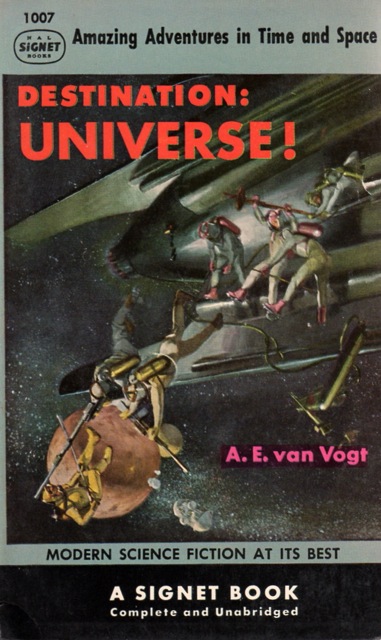
It was a different world back then. A much different world. A world most of us can’t comprehend. But try to imagine people of different ages visiting a drugstore back in 1953 and finding these books on a twirling rack. Especially, people who lived in small towns and suburbs. Imagine young kids, working-class men, and young housewives. What would they think if they picked up one of these books? And what would it do if they bought one, took it home, and read it?
When I read Red Planet by Robert A. Heinlein in 1964 when I was twelve, that was when I knew science fiction was my genre. I was a convert. Even by 1964, the percentage of science fiction converts in the American population was very small. And the conceptual umwelt I experienced from reading that 1949 book in 1964 must have been far different from the mind-expanding experiences of twelve-year-olds reading it in 1949, or even what Heinlein felt writing it. When did you discover science fiction as a genre, and what was the book that converted you?
I picked 1953 as the year America discovered science fiction because that’s when Ballantine Books and Ace Books began publishing science fiction, and near the beginning of the general paperback boom. Science fiction paperbacks existed before 1953, but they were much fewer. 1953 was also a boom year for science fiction magazines. (See my essay: The 1953 SF&F Magazine Boom.)
I wrote this essay because I’m learning that the umwelt of every person is different. Not only for how we perceive reality but how our biological sensory inputs lead to comprehending different abstract concepts. We have a tendency to assume everyone sees and knows what we know, and that’s so wrong. What’s amusing me to contemplate is thinking about how we perceive things at different ages and in different generations. Science fiction is just one example. What’s weird to grasp is authors work to code their umwelt into a story but the umwelt the reader decodes isn’t the same. I wish I could have gotten my parents and grandparents to read one of my favorite science fiction books when I was a kid and then ask each of them how they interpreted it.


James Wallace Harris, 7/15/23
 Classics of Science Fiction
Jim, thanks for a great essay on a subject I had not actively considered. I’m not sure it’s the only answer, but it’s am outstanding answer.
LikeLiked by 2 people
Many thanks for your commentary, as always, Jim! I grew up in the seventies, so for me SF has always been there, even if at times off to one side, out of the corner of my eye. I first discovered SF through Planet of the Apes and Star Trek, and then (or perhaps almost at the same time) through books–not just paperbacks in bookstores, but also books in the public library and elementary school library, and books which my parents gave me. David G. Hartwell, in his book Age of Wonders: Exploring the World of Science Fiction, commented that many young readers, starting some time in the late sixties or early seventies, may have discovered SF initially through movies and TV, etc., as much as through written SF. The names of various SF mags (Galaxy, Astounding, Analog, etc.) have always been legendary to me, but I’ve never had the sustained, direct contact with them that I’ve had with books. I know the mags more through seeing stories from them reprinted in books.
LikeLiked by 2 people
At what age were you first aware of science fiction as a concept? I saw old 1950s science fiction films when I was 7 or 8 but I didn’t know they had a generic label or represented a general concept.
I know I liked movies about spaceships and robots. However, at that age in 1958 I don’t think I could explain them. I would have said a robot was a mechanical man and a spaceship was an airplane that flew in space.
I think more recent generations of kids are better educated and educated earlier than I was. I wasn’t told about the alphabet or counting till the first grade. And I probably didn’t learn the difference between a jet and rocket until about the 6th grade.
I imagine kids today learn the term science fiction by the time they are 4 or 5. And probably talk about science fictional concepts by 9 or 10.
LikeLiked by 1 person
“I would have said a robot was a mechanical man and a spaceship was an airplane that flew in space.” This seems to me as good a description as any.
I may have first come upon the words “science fiction” in a Peanuts strip at the age of seven or eight, and a few years later in a TV Guide blurb about a TV showing of the movie Planet of the Apes (the first one, with Heston). The blurb described the movie as “science fiction with a satirical sting.” Even at that age the description somehow conveyed to me the meanings of both SF and satire. I discovered SF in book form not too long after that, by the age of eleven or so.
LikeLiked by 1 person
Now that’s a good test of the term, the TV GUIDE. I need to find old issues from the 1950s. I didn’t start reading the TV GUIDE until 1965 and I assumed I stayed on the lookout for the science fiction label.
LikeLike
After WWII a few SF stories from select authors appeared in mainstream magazines. The latter 1940’s. This is when SF started appearing in the public consciousness IMO. Not the 50’s. The reason why there started being SF movies in 1950, and paperback SF books, was because of this.
WWII caused a number of then-spectacular technologies, like the atom bomb. This spurred the public to start paying attention to SF in a serious manner IMO. Before then it was part of the public consciousness in a non-serious manner, as pulp magazines on newsstands. The other thing: kids who read those pulps back the 20’s/30’s, by the latter 40’s were grown up.
LikeLiked by 1 person
Oh yes also: the SF written in the early/mid-1940’s in Astounding, was vastly more adult in quality than the stuff written earlier.
LikeLiked by 1 person
To a degree. Asimov’s Foundation stories are on the level of a smart teenager. Heinlein’s stories are a bit more mature, but the concepts mainly appeal to younger people.
EARTH ABIDES is an example of more mature science fiction. I think it came out in 1949.
LikeLiked by 1 person
Good call. I forgot about those SF stories in the slicks. I wonder if the intros to the stories called them science fiction?
My point is there is always a slow build up to any adoption of new technologies or concepts. There’s no real date of popular acceptance.
If you look at the chart in the essay I link to about Mainstream acceptance you’ll see what I mean.
LikeLiked by 2 people
Just a WONDERFUL essay, James. It echoes some of my experiences learning science fiction and reading it starting in late ’60s. My dad was a part-time librarian in the evening and I went to the South Bend public library a lot to read and wait until it closed at 9 pm, go home with him with a book or two borrowed.
Best, Kenneth James Papai, 7/16/2023
LikeLiked by 1 person
I wanted to become a librarian, but it just didn’t work out. It required getting two master’s degrees. I did work as a serial clerk in a library for six years.
LikeLiked by 2 people
1960s science fiction – KJP (approx. 1965 to 1971)
• War of the Worlds movie on TV – scare the hell outta me, didn’t know what science fiction was then, it was just horror to me
• The Wizard of Mars movie on TV – loved it
• Robinson Crusoe on Mars movie – loved it
• Star Trek: TOS on TV, starting for me in ‘69
• The Outer Limits – scariest was THE GALAXY BEING, scared for years
• FIEND WITHOUT A FACE movie, also very scared
• Earth vs. the Flying Saucers movie – loved it!
• First Man Into Space movie – too scary for me!
• The Mushroom Planet books
• The Tom Swift books
• The White Mountains/Tripods trilogy
• Tinker Toys and Erector sets
• Chemistry, Biology, and Geology labs for Xmas presents
That list was my formative years! -Ken
LikeLiked by 1 person
I forgot one
• The approximately ten original series Star Trek books – the short story of each of the 76 or so episodes (this was around ’72)
LikeLike
LOST IN SPACE was also pivotal for me. Extremely so.
LikeLike