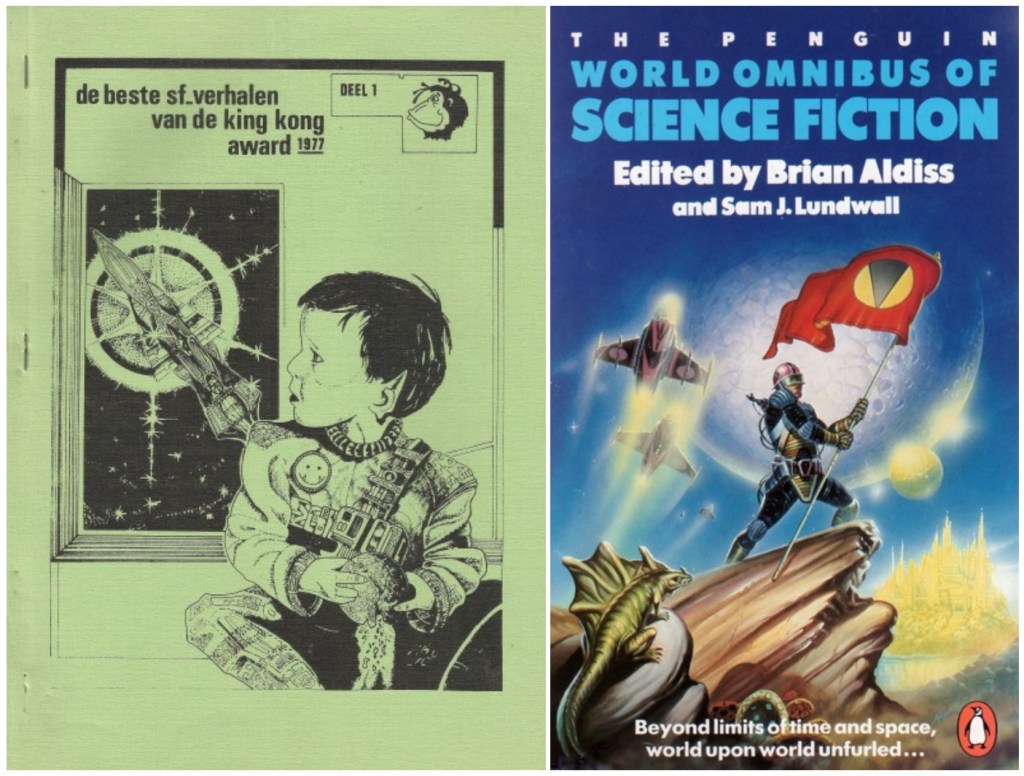
“The Lens” by Annemarie van Ewyck is story #28 of 52 from The World Treasury of Science Fiction edited by David G. Hartwell (1989), an anthology my short story club is group reading. Stories are discussed on Tuesdays, Thursdays, and Saturdays. “The Lens” first appeared in Dutch in De beste sf-verhalen van de King Kong award 1977, deel 1 (Dec. 1977/Jan. 1978). In 1986 it was reprinted in English in The Penguin World Omnibus of Science Fiction edited by Brian W. Aldiss and Sam J. Lundwall.
Annemarie van Ewyck was Annemarie Pauline van Ewijck (1943-2017). She only has three short stories listed in ISFDB and was mainly an editor and columnist. The periodical above where the story first appeared looks like a fanzine to me.
Once again, I find it interesting that my take on a story is different from Hartwell’s. More and more, I’m realizing that The World Treasury of Science Fiction (1989) seems like a precursor to The Big Book of Science Fiction (2016) and that I’m out of touch with both editors. I might just be out of touch with the genre in general. However, with “The Lens” I believe it’s a perfect story for this anthology, and it’s my kind of science fiction.
Here’s Hartwell’s intro:

I thought “The Lens” was quite a nice story, especially effective for being so short, but I didn’t think “The Lens” reflected the mood, tone, or concerns of 1950s science fiction. I don’t know if that era can be generalized, and I wonder if there really is a general style to post-Anglo-American post-New Wave works. “The Lens” doesn’t feel like Bradbury, Zelazny, or Sturgeon to me at all but it does remind me of James Tiptree, Jr., but also Ursula K. Le Guin.
In other words, “The Lens” reminds me of 1970s science fiction written by women, which it is, but can we generalize on that? Is there a common denominator? I don’t think so, other than a female character in an alien society feeling the shock of otherness after undergoing an alien rite. But isn’t that theme also explored by Jack Vance in “The Moon Moth” or Downward To the Earth by Robert Silverberg?
As the years go by, I’m less inclined to believe there was much of a New Wave in science fiction, despite the efforts of Michael Moorcock, Judith Merril, and J. G. Ballard. Yes, there were some experimental efforts, like the kind we saw in New Worlds, England Swings, and Dangerous Visions, but that kind of experimentation had been going on in the literary world for a long time. I believe by the 1960s and 1970s the genre was just getting more diverse writers, and better writers in general, writers who were willing to try different ways to tell a story. By then writing programs were flourishing everywhere.
I also know people get tired of me bellyaching about some stories in these anthologies not being science fiction. That’s not because of how they were written, or by who. I believe science fiction represents a state of mind, and “The Lens” is definitely science fiction, and fits within that state of mind.
The first-person narrator, Dame Ditja, a diplomat, is returning from Earth to Mertcha after visiting their dying mother. We know things are very different when we learn her mother died at age 286. I liked how Dame Ditja described her relationship with their mother and their interaction with the other passengers on the ship. She is returning to the city of Tiel where she is the Head of Cultural Liason.
On Mertcha, the aliens have three arms and three legs, and their architecture and philosophy reflect that difference. Dame Ditja has decided to request a permanent assignment to Mertcha, which she now thinks of as home. She expected to be met at the spaceport by Mik, a local who is her driver and friend, however, a substitute driver meets her instead. That driver thinks she is an ordinary tourist and takes her to a holy place that is a main tourist attraction for people from Earth.
At the Holy Place of Tiel, Dame Ditja has a transcendental experience, one of ecstasy, one that is usually experienced by certain believers in this alien culture. While having this experience, Dame Ditja realizes that radical monks of this faith have trapped some tourists from Earth to hold hostage, and Dame Ditja comes out of her trance and carefully, but forcefully, frees them in a diplomatic coup.
This achievement gets her offered more prestige assignments, and Dame Ditja changes her mind and plans to leave, even though all through the story she wanted to stay.
The ending is strange. Because of the incident at the Holy Place of Thiel, Dame Ditja no longer feels like Mertcha is her home, and thus feels compelled to leave. It appears Dame Ditja wants to die, and she feels she can only die in a place she considers home. I’m not sure why she wants to die or is ready to die, but I wonder if it’s because people live too long in this fictional future?
After reading this story twice I feel it’s closest in style and tone to some stories I’ve read by Brian W. Aldiss. On the first reading, I would have rated this story ***+ but on my second reading, I feel it’s a **** story.
James Wallace Harris, 6/8/23
 Classics of Science Fiction
One thought on ““The Lens” by Annemarie van Ewyck”