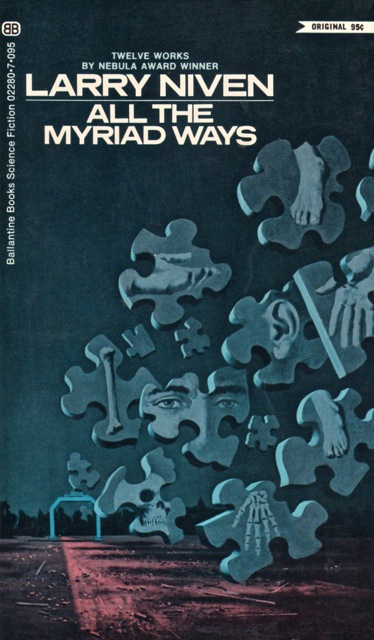
“Inconstant Moon” by Larry Niven is story #23 of 52 from The World Treasury of Science Fiction edited by David G. Hartwell (1989), an anthology my short story club is group reading. Stories are discussed on Tuesdays, Thursdays, and Saturdays. “Inconstant Moon” first appeared in Niven’s 1971 collection, All the Myriad Ways. Currently, the story is available in N-Space, a retrospective collection of Niven’s work from 1990. If you want an ebook version of the story, it’s included in Masterpieces: The Best Science Fiction of the Century edited by Orson Scott Card.
Outer Limits dramatized the story – watch it on YouTube.
“Inconstant Moon” is one of those science fiction stories where the main idea sticks with you even if you don’t remember the plot or characters. “Inconstant Moon” won the Hugo for Best Short Story in 1972, and is the kind of classic SF tale I expected to see in an anthology that remembers the best science fiction of the 20th century.
Stan and his girlfriend Leslie realize something epic is happening when the Moon becomes much brighter than normal. “Inconstant Moon” is an astronomical science fiction story like “Nightfall.” I don’t know if I should tell you anymore, I wouldn’t want to spoil the fun.
“Inconstant Moon” is the kind of short story that inspires readers to ask themselves what they would do in a similar situation.
<<<Beyond Here Lie Spoilers>>>
Most science fiction is geared toward young people with romantic minds who want to fantasize about being action heroes, while “Inconstant Moon” is aimed at adults who take more wistful prosaic paths. The protagonists aren’t young or heroic, and their actions are quite ordinary and mundane. The setting is only slightly in the future from 1971, after the Apollo 19 landing. Niven didn’t know that sadly, Apollo landings would end with 17 in 1972. He even has Stan talking about getting to handle a moon rock, which I don’t know if NASA ever allowed either.
Stan goes out on his balcony one night and the Moon is several times brighter than normal. He starts wondering why and eventually concludes the Sun has gone nova. This is my third time reading this story, but I remember when I read it the first time being quite surprised that people would still be alive after such an event. Until I read “Inconstant Moon” the first time, I imagined if the Sun went nova it would instantly vaporize the Earth.
Niven gives us a more thought-out scenario. Earth is 8.5 light-minutes away from the Sun, and Jupiter is 44.2 minutes. Niven imagines the Earth itself being a barrier that protects people on the side away from the Sun, and that a shockwave travel at the speed of sound would circle the Earth. Stan rushes over to see his girlfriend, hoping to have a few good hours before the end of the world. He doesn’t tell Leslie his theory, but eventually, Stan realizes she came up with it on her own too.
I would love to see an episode of PBS’s NOVA analyze the same situation.
Stan and Leslie assume the shock wave is hours away, and it will kill them before California faces the sun. They go out for ice cream and drinks after having sex. I felt “Inconstant Moon” had an adult vibe not because of the sex, but because of the mental processes Stan and Leslie go through. My guess is young characters and readers, would think and act differently. This age-difference reaction can be seen in “The Last Day” by Richard Matheson (Amazing Stories, Apr-May 1953). Read it here.
Ultimately, Stan figures out the Sun didn’t go nova, and that it must have been a very large solar flare. It means they might live, and that changes the course of the evening.
It’s a shame we don’t get more science fiction that makes us think like this story. Some stories inspire arguments like, “The Cold Equations” by Tom Godwin, but Niven’s story makes readers think about physics and astronomy. Isaac Asimov used to write about how science fiction fans of his generation would tell their parents they were learning science from science fiction. That seldom happens, if ever. But with this story, Niven sets up a scientific situation that makes us think about science rather than science fiction.
Does anyone know what would likely happen to the Earth if the Sun went nova or there was an extremely large flare?
James Wallace Harris, 6/27/23


Jim, that’s quite a hard question. When I did a little searching online, everyone is talking about whether Earth could survive if the Sun went supernova (answer, no way in hell). However, so far, no one is talking about if the Sun went nova, which is a very different thing technically. https://scopethegalaxy.com/nova-vs-supernova/ I still suspect it would not matter much for us, but I have not found any discussions of that specific case yet. For what it’s worth, the greatest majority of discussions note that our sun is not like to go nova or supernova. This is still a great story, one of Niven’s best by me. Thanks for the essay.
LikeLike
Ursula Le Guin had a rather different take on “Inconstant Moon”:
What about the cultural and the racial Other? This is the Alien everybody recognizes as alien, supposed to be the special concern of SF. Well, in the old pulp SF, it’s very simple. The only good alien is a dead alien—whether he is an Aldebaranian Mantis-Man, or a German dentist. And this tradition still flourishes: witness Larry Niven’s story “Inconstant Moon” (in All the Myriad Ways, 1941) which has a happy ending—consisting of the fact that America, including Los Angeles, was not hurt by a solar flare. Of course a few million Europeans and Asians were fried, but that doesn’t matter, it just makes the world a little safer for democracy, in fact. (It is interesting that the female character in the same story is quite brainless; her only function is to say Oh? and Ooooh! to the clever and resourceful hero.)
— “American SF and the Other,” https://www.depauw.edu/sfs/backissues/7/leguin7art.htm
I believe there was a longer expression of this view in another of Le Guin’s writings, but I haven’t managed to find it.
I don’t share her view of the story, though I can certainly see how she got there. But I imagine if Arthur C. Clarke had had the same idea, America would have been fried and Clarke would have happily anticipated the days when the Western Hemisphere would be colonized from Asia, with Sri Lankans playing a leading role.
LikeLike
I don’t think Leslie was brainless. She also figured out what was happening. She was the one who had a telescope and was into astronomy.
And for the story to work, it had to be the opposite of the place being destroyed. Why not write it from the perspective of where you live? In the same way that Niven, a male, chose to write from the perspective of a male.
It’s interesting that Le Guin begins that essay, “One of the great early socialists said that the status of women in a society is a pretty reliable index of the degree of civilization of that society. If this is true, then the very low status of women in SF should make us ponder about whether SF is civilized at all.” In her early stories and books, she had male protagonists. I wondered why didn’t use females for her characters. My guess is writers and publishers preferred male POV because they assumed the readers would be male. Now that there are more female readers, there are more female POVs.
But this is an old essay and discussion. I would have loved to read what Le Guin thought about “Inconstant Moon” before she died when she too was much different than in the early 1970s.
LikeLike
Forschen mostly writes about another Carrington/Mistake event–but Niven had Sol become a Variable (flare) Star.
LikeLike