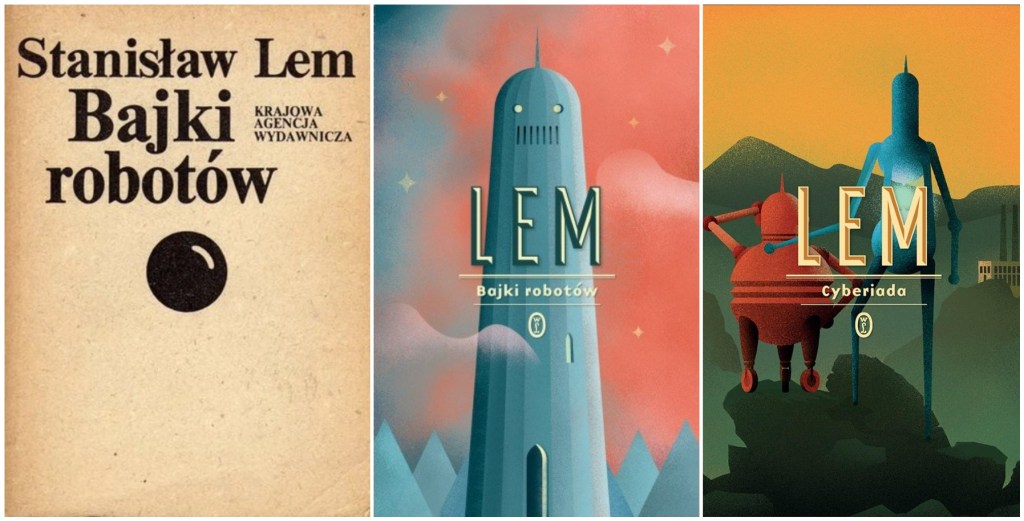
“Tale of the Computer That Fought a Dragon” by Stanislaw Lem is story #18 of 52 from The World Treasury of Science Fiction edited by David G. Hartwell (1989), an anthology my short story club is group reading. Stories are discussed on Tuesdays, Thursdays, and Saturdays. “Tale of the Computer That Fought a Dragon” has a long complicated publication history that I’ll let y’all read at ISFDB.org. It’s part of a series called Robot Fables. But from what I can tell was first published as “Bajka o maszynie cyfrowej, co ze smokiem walczyła” in Zycie literackie (August 1963). It was first translated into English for Other Worlds, Other Seas: Science-Fiction Stories from Socialist Countries edited by Darko Suvin (1970).
“Tale of the Computer That Fought a Dragon” is a very short story that comes across like a fable, and feels like it’s supposed by told by an oral storyteller. I’m afraid I dislike stories that sound like fables. Not because Lem’s tale is bad or uninteresting, but because such stories feel like a quick summary of a novel to me. I feel cheated. Such stories tell what happens instead of dramatizing the plot and developing the characters. A real short story is not a condensed novel. For some reason, many of these translated SF stories are told in this fable-like style. I wonder if that style isn’t normal in other countries because they never had pulp fiction? And thus, never developed the style of short story writing I like?
Basically, “Tale of the Computer That Fought a Dragon” is about a king who computerizes everything and then is threatened by an all-powerful computer. The solution to the king’s problem is silly and childish, much like some of the solutions Captain Kirk used against cybernetic foes in Star Trek. (It also reminds me of a solution Heinlein used against one foe in Glory Road, a fantasy novel.)
Stanislaw Lem has a great reputation, and his stories are widely reprinted. But I’ve yet to read one of his stories which makes me want to read more of them. I believe I read Solaris decades ago, and think I admired it. Need to give it another read.
This brings up an interesting problem. What if storytelling techniques are different from country to country? Are they reflected in the translation? Or, is the fable-feeling structure something that comes out of translation?
I guess it might reveal one of my biases or limitations. Other members of the short story club like these types of stories. They do sound clever, but cleverness can often draw attention away from the story. If you read “Tale of the Computer That Fought a Dragon” how do you visualize it? I visualize it as a Wizard of Id drawing.
Lem wrote a lot of these short satires. I assume, he liked cranking out ideas, but not novels. There’s enough plot content in “Tale of the Computer That Fought a Dragon” to structure a whole novel.
“Tale of the Computer That Fought a Dragon” is obviously a satire, attacking both computerizing everything, but also attacking leaders who feel the need to exert power to inflate their egos. That might have been politically subversive in 1963 in the USSR. It might also explain the childlike fable quality — a politically safer to write.
I wonder what Russians might dare to write about Putin today? Read “Tale of the Computer That Fought a Dragon” and substitute Putin every time you see the word king. It kind of works.
James Wallace Harris, 6/14/23
 Classics of Science Fiction
Maybe it’s that we’re not living in the time when they were written. Sometimes it’s really hard to gauge why people like certain things.
There’s a guy who pulls up old recipes of the past and tries them on video. Some of those recipes I remember being popular and I have no earthly understanding why. 🙂
LikeLike
I often like odd things from the past. It’s not that I dislike the new and modern, it’s just that modern pop culture all too often focuses on themes that have been run into the ground.
The old recipe things sounds interesting. I feel I’ve gotten to the end of the internet because YouTube keeps showing me videos I’ve already seen. That recipe thing would be different.
LikeLiked by 1 person
Well, he’s definitely himself. The recipes are interesting. He’s made a thing out of it.
https://www.youtube.com/@BDylanHollis
LikeLike
You seem to have made a mistake. Lem was Polish, not Russian.
LikeLike
I didn’t mean to imply that. Poland was under Russian domination in 1963 when it was part of the Soviet bloc. Back in the 1970s Lem was considered a Soviet writer.
LikeLike
Lem wrote in a number of quite different modes.
His pomo folk tales of the future — larger-scaled in THE CYBERIAD or Pirx the Pilot stories — please literary critics because, I have to suppose, they allow them to feel clever and knowing. For my personal taste, though, Lem in this mode is fairly trivial and uninteresting.
Conversely, there are Lem works where he wrote at his full intellectual reach and was genuinely deep. Lem’s HIS MASTER’S VOICE is an SF novel that by some lights might be the best ever written, or that you might find a bore as it’s a novel completely about ideas —
https://en.wikipedia.org/wiki/His_Master%27s_Voice_(novel)
Here’s an SFRA review that gives some sense of the book’s depths and difficulties–
If you do stick with it, you’ll come away with a hazy sense of what human contact with civilizational intelligences so advanced that they’ve existed for billions of years might be like — or might not be, because whether the alien signal in the novel isn’t actually a natural phenomenon is never resolved.
“We stood at the feet of a gigantic find, as unprepared, but also as sure of ourselves, as we could possibly be. We clambered up on it from every side, quickly, hungrily, and cleverly, with our time-honored skill, like ants. I was one of them. This is the story of an ant”
Also in this Lem mode is GOLEM XIV, which takes the form of a lecture course given by a superintelligent military computer, Golem XIV, that the Pentagon has created and that has temporarily paused its intellectual development to remain capable of communication with humans before ascending to a level where such intellectual contact becomes no longer possible.
https://en.wikipedia.org/wiki/Golem_XIV
LikeLike
You and John Boston have convinced me to give HIS MASTER’S VOICE another try. This time I’ll listen to it on audio. For certain narrative heavy novels and nonfiction books I have better luck with audiobooks. What you say about HIS MASTER’S VOICE does intrigue me.
LikeLike
Heartily agree with the endorsement of HIS MASTER’S VOICE. The earlier and shorter THE INVESTIGATION is in a similar vein. FIASCO, his next to last SF novel from 1986, is also well worth reading. The list could go on for quite a while. These are all full-fledged novels and not (as Mark aptly puts it) “pomo folk tales,” or as you note, fable-like. Lem lives up to his reputation if you look in the right places.
LikeLike
I used to own a copy of HIS MASTER’S VOICE but gave it away when I purging some books. I couldn’t get into the dense prose. But I see it’s available on Audible.com so I think I’ll try listening to it. I can listen to some books I can’t read. You and Mark Pontin make a convincing case for it.
LikeLike