
It’s been almost six months since I covered the science fiction short stories for 1950. Bleiler and Dikty added a new annual for 1951, Year’s Best Science Fiction Novels — but by that, they mean novellas. It took me a while to track down all three volumes and read them. These annuals are getting expensive on the used market. The Bleiler/Dikty volumes are running $40-75 in the low range with a dust jacket, and the Asimov/Greenberg paperbacks $10-20. I get the feeling there are more old SF fans like me going back and rereading these old best-of-the-year anthologies.
Here are the stories Bleiler and Dikty picked in 1952 for the best of 1951:
- “. . . And Then There Were None” – Eric Frank Russell
- “Appointment in Tomorrow” – Fritz Leiber
- “At No Extra Cost” – Peter Phillips
- “Balance” – John Christopher
- “Brightness Falls From The Air” – Idris Seabright
- “Dark Interlude” Mack Reynolds & Fredric Brown
- “Extending the Holdings” – David Grinnell
- “Flight to Forever” – Poul Anderson
- “Generation of Noah” – William Tenn
- “The Hunting Season” – Frank M. Robinson
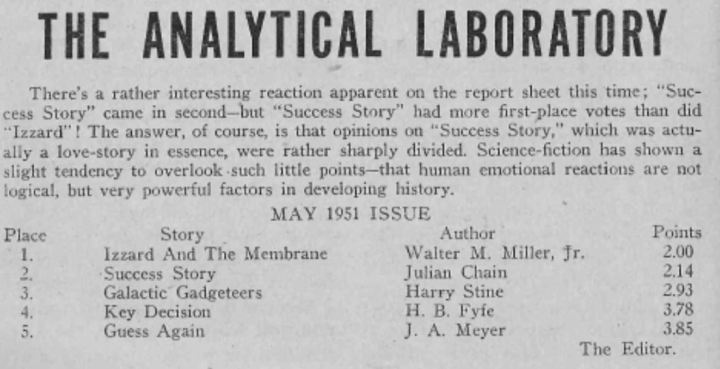
- “Izzard and the Membrane” – Walter M. Miller, Jr.
- “The Marching Morons” – C. M. Kornbluth
- “Men of the Ten Books” – Jack Vance
- “Nine Finger Jack” – Anthony Boucher
- “Of Time and Third Avenue” – Alfred Bester
- “The Other Side” – Walter Kubilius
- “A Peculiar People” – Betsy Curtis
- “The Pedestrian” – Ray Bradbury
- “The Rats” – Arthur Porges
- “Seeker of the Sphinx” – Arthur C. Clarke
- “The Tourist Trade” – Wilson Tucker
- “The Two Shadows” – William F. Temple
- “Witch War” – Richard Matheson
Then in 1985 Isaac Asimov and Martin Greenberg picked these stories as the best of 1951:
- “A Pail of Air” – Fritz Leiber
- “Angel’s Egg” – Edgar Pangborn
- “Breeds There a Man–” – Isaac Asimov
- “Dune Roller” – Julian May
- “The Fire Balloons” – Ray Bradbury
- “I’m Scared” – Jack Finney
- “The Marching Morons” – C. M. Kornbluth
- “Null-P” – William Tenn
- “Pictures Don’t Lie” – Katherine MacLean
- “The Quest for St. Aquin” – Anthony Boucher
- “The Sentinel” – Arthur C. Clarke
- “Superiority” – Arthur C. Clarke
- “Tiger by the Tail” – Alan E. Nourse
- “The Weapon” – Fredric Brown
- “With These Hands” – C. M. Kornbluth
I’ve bolded the single overlap, “The Marching Morons.” Then the current 2020 version of The Classics of Science Fiction Short Stories list only has one story having a minimum of 8 citations to make the list: “The Sentinel” by Arthur C. Clarke. But here’s all the stories in our database with at least 2 citations:
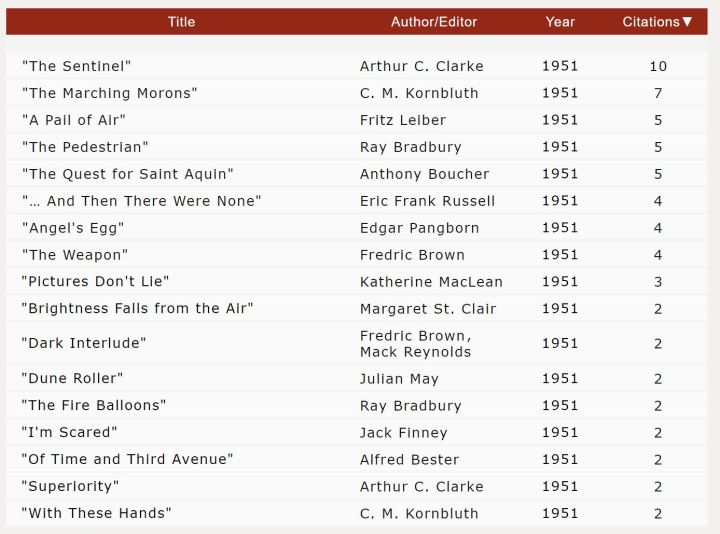
1951 didn’t produce a lot of famous science fiction short stories. Many are familiar to me, but I don’t know about modern, younger science fiction fans. “The Quest for St. Aquin” was voted into the first volume of The Science Fiction Hall of Fame. And “The Marching Morons” and “… And Then There Were None” were voted into The Science Fiction Hall of Fame Volume 2A that was for novellas. And “The Sentinel” is famous because it was the original seed for 2001: A Space Odessy.
Last year I listened to “… And Then There Was None” by Eric Frank Russell when the audiobook of Science Fiction Hall of Fame Volume 2A came out. I thought it okay. At the time it triggered a fond memory. I had two science fiction reading buddies in high school, Jim and George. I remember a day when George told us two Jims about this humorous science fiction story. He was very excited about it and wanted us to read it. Well, it took over fifty years for me to bump into “… And Then There Was None.” This year, when I reread it, it was a good deal funnier. I’m finally getting why George was so amused. It would make a great film because of how colorful Russell had his characters dress and act. And Eric Frank Russell is growing on me.
Each year, I’m becoming more and more impressed with Fritz Leiber. I liked rereading “The Pedestrian” by Ray Bradbury, but it wasn’t as good as I remembered it when I first read it in high school. I was so taken with Peter Phillips “At No Extra Cost” that I reviewed and reprinted it. I was also very impressed by “Angel Egg” by Edgar Pangborn and started collecting his books. And of course, “The Quest for St. Aquin” is a masterpiece that deserves to be remember as a classic. And I liked “Izzard and the Membrane” so much that I gave it its own review.
That’s the thing about all these stories, they are being forgotten, and that makes me sad.
I started reading science fiction short stories systematically with 1939 and I had looked forward to getting to 1951 because that was the year I was born. I had hoped to discover it was a spectacular year for science fiction. It didn’t produce many notable novels either, except for The Day of the Triffids, The Illustrated Man, and Foundation.
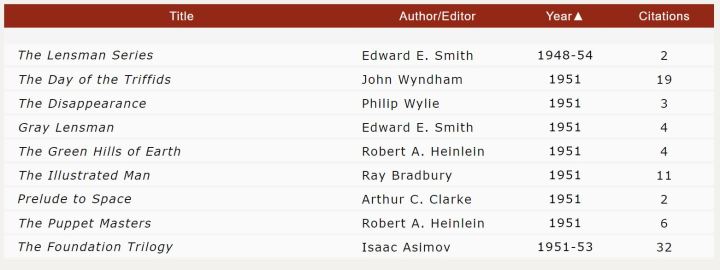
Here’s a list of all the short stories and novels in our database with at least one citation for 1951. Short stories are in double-quotes, and novels are in italics.
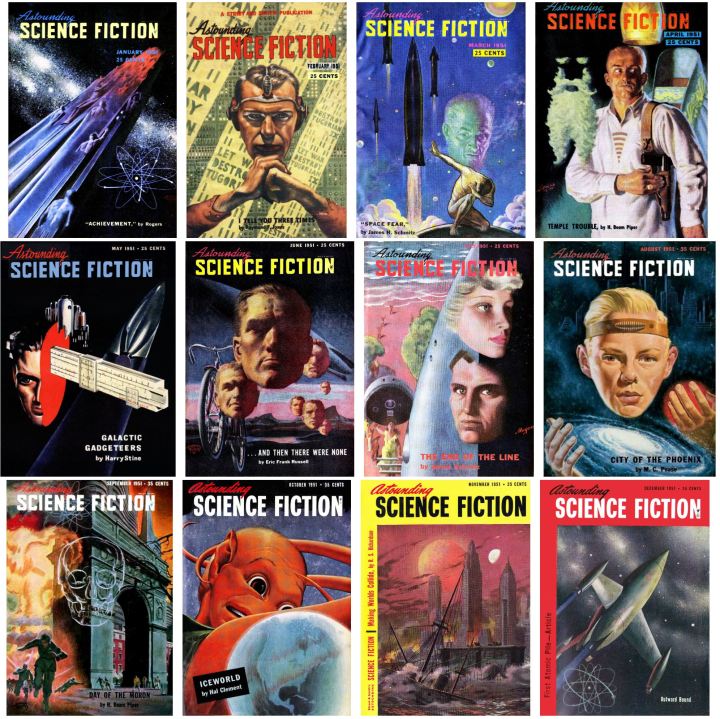
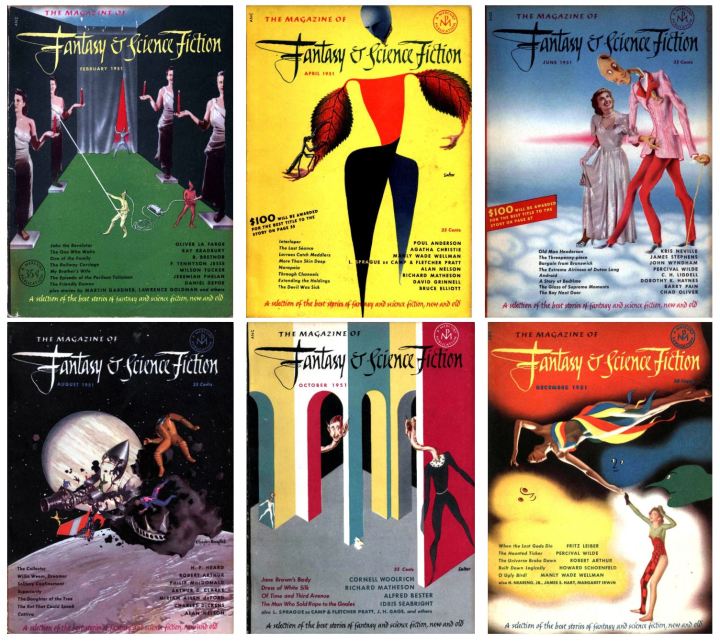
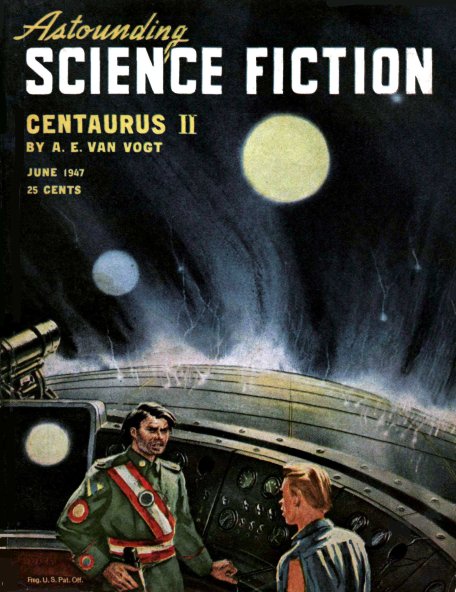
The early 1950s was a boom time for magazine science fiction. I believed the boom peaked in 1953 with some forty SF titles on the newsstands. Here are some of the covers to remember 1951 by:


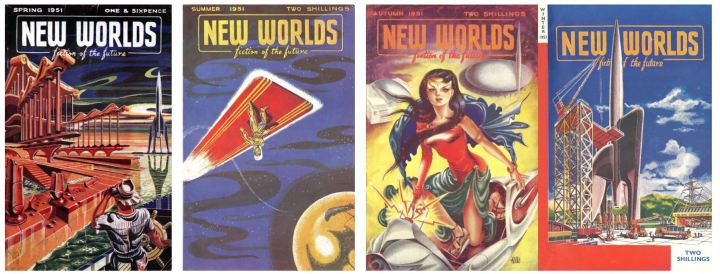
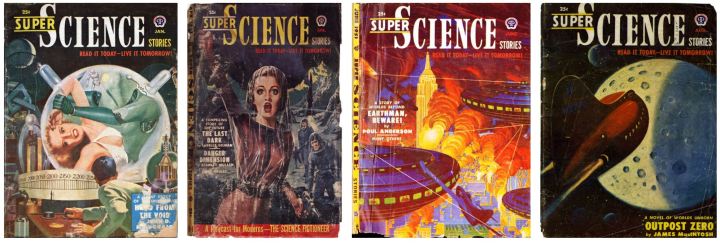
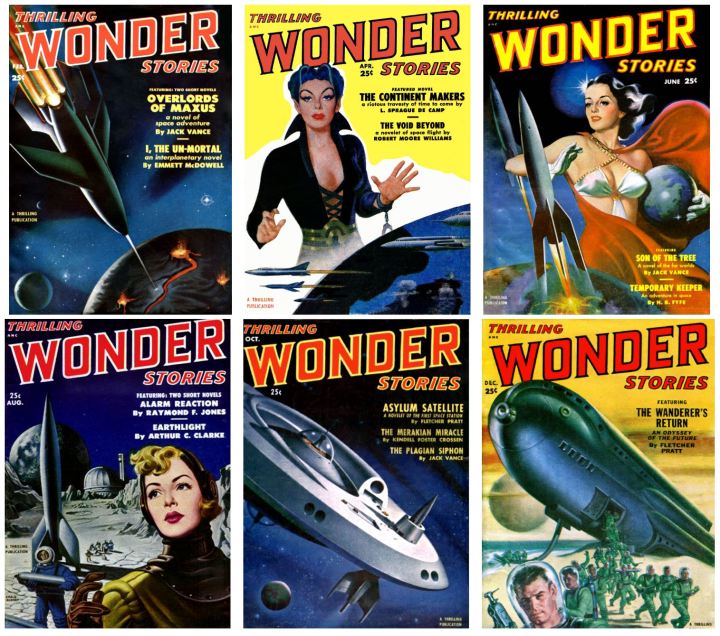

I was disappointed that my birth year 1951 wasn’t a giant year in science fiction, but I get the feeling times are improving and the 1950s are going to produce some great stories. The variety of writing styles and themes have been expanding since the late 1940s. I’m not sure why the 1940s are considered the Golden Age of Science Fiction and the 1950s the Silver Age. As I read through each year it feels like science fiction is getting better and better.
James Wallace Harris, 1/29/20



 Classics of Science Fiction