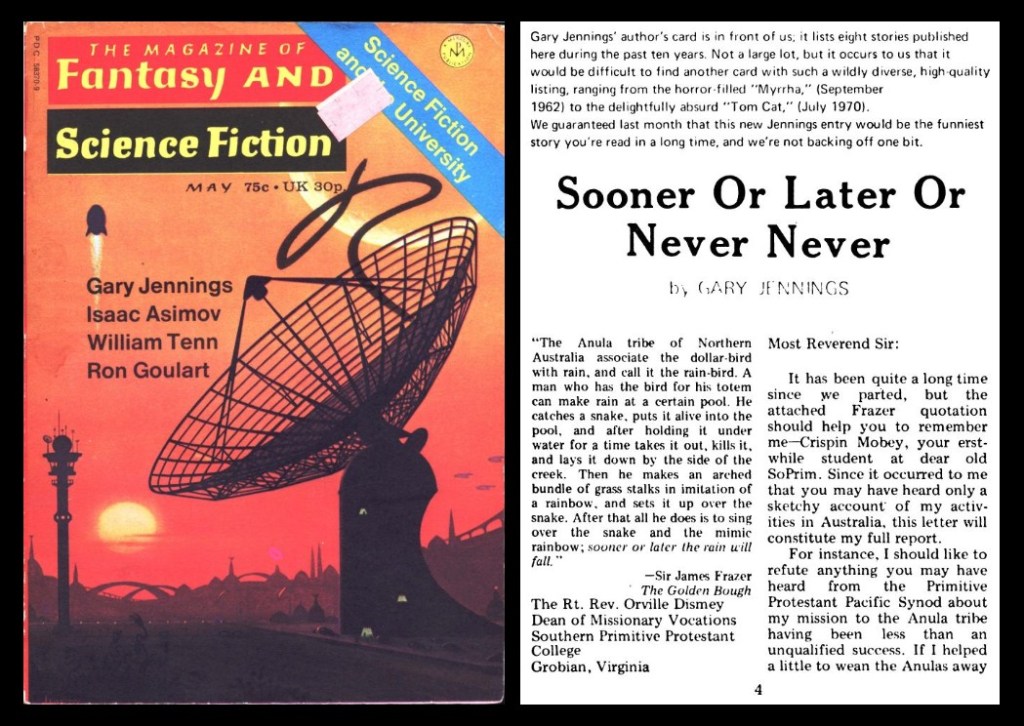
What exactly is fantasy? “Sooner Or Later Or Never Never” by Gary Jennings has no magic, no fantastic creatures. Its setting is present-day Australia. The story is both comic and absurd. Yet, it’s based on a somewhat realistic premise. Yes, the characters and plot are made up, but so is most fiction. I can find no reason to call this a fantasy. I assume Edward L. Ferman published it in the May 1972 issue of The Magazine of Fantasy & Science Fiction because he admired the creative prose — and he had the power to publish it.
“Sooner or Later or Never Never” is told as a letter to The Rev. Orville Dismey, Dean of Missionary Vocations, at the Southern Primitive Protestant Seminary in Grobian, Virginia. Crispin Mobey narrates his effort to bring Christ to the Anula tribe in the Australian outback. Mobey was inspired by a quote from The Golden Bough by Sir James Frazer. The quote describes a ritual Frazer witnessed. Mobey wants to use that ritual to bring Christianity to a rather primitive tribe.
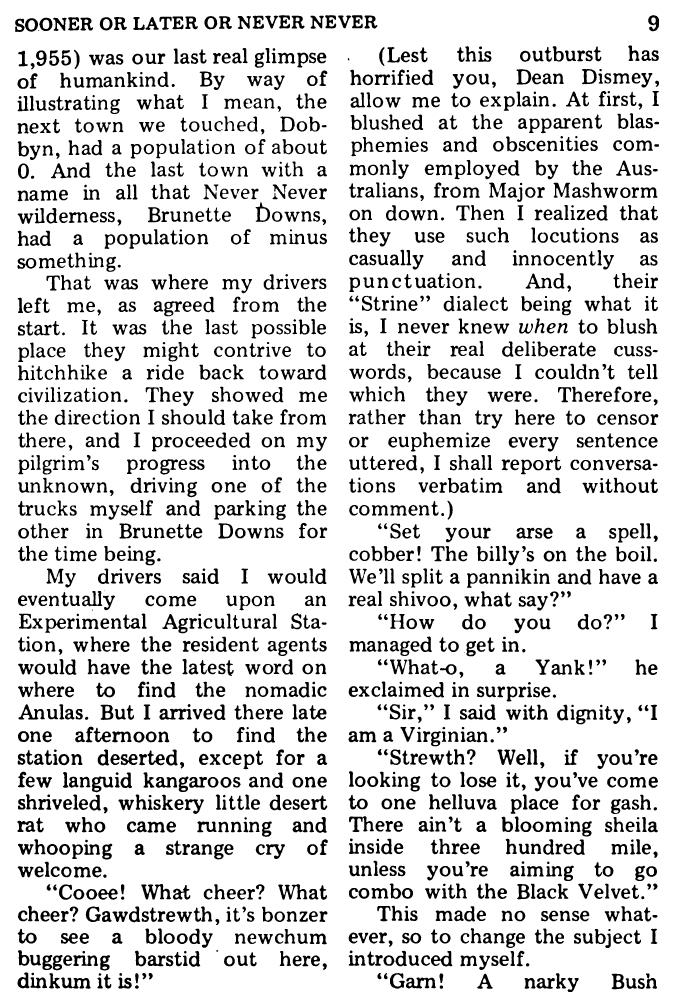
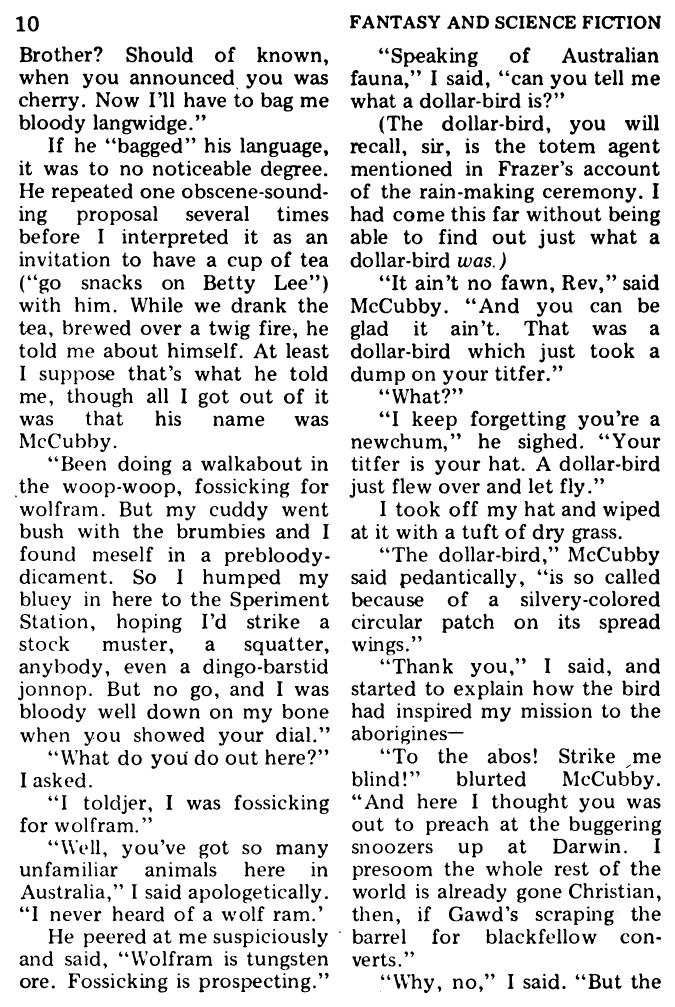
I’ve read “Sooner or Later or Never Never” before, but I’m not sure where and how. I don’t normally read this kind of fiction. However, the prose is quite entertaining. Normally, I dislike dialect, but Jennings captures outback Aussie hilariously. I wish I had an audiobook version.
There is no way I can describe this story, so I’m just going to give you two pages to read as a sample.
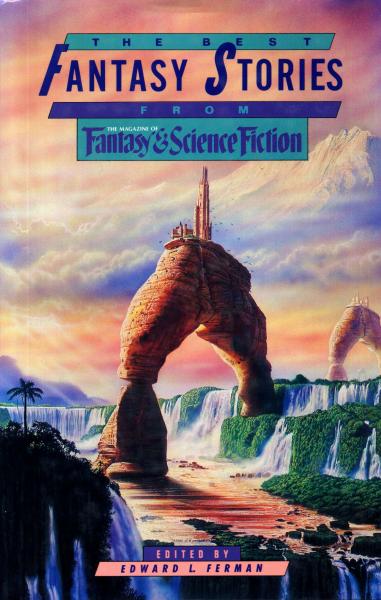
I know this is cheating, but I’m taking the easy way out. I’m posting this merely to encourage people to read this story. I read it today because my Facebook short story club is reading The Best Fantasy Stories from The Magazine of Fantasy and Science Fiction. Reading this 792-page anthology demonstrates the range of what people call fantasy.
I routinely tell people I dislike fantasy. But of the stories we’ve read in this anthology, the ones set in the present about ordinary people have been the most entertaining to read. And the ones that people consider traditional fantasy were no fun to read. I guess when I say I dislike fantasy, I dislike only a subset of the genre.
However, I also think Ferman is cheating to call “Sooner or Later or Never Never” fantasy. It could have been published in almost any kind of fiction magazine.
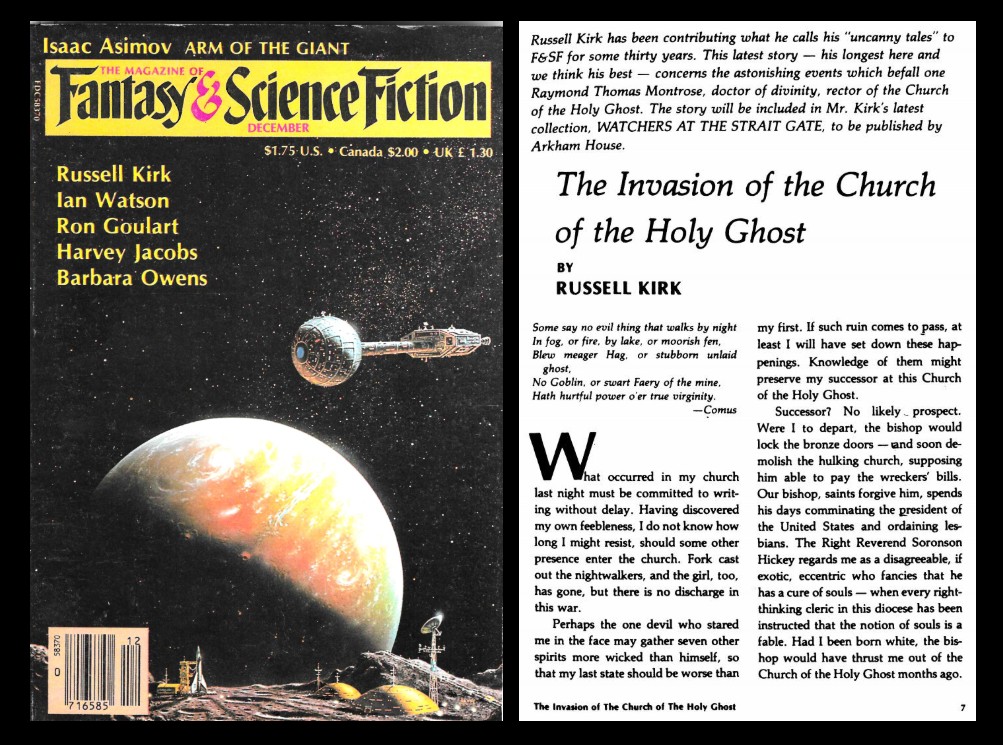
I’m an atheist who doesn’t normally enjoy reading fantasy fiction; however, I found “The Invasion of the Church of the Holy Ghost” by Russell Kirk, a religious ghost story, to be quite entertaining and well-written. The characters of Father Raymond Thomas Montrose and Fork Causland are so well developed that it’s hard not to like this story. Plus, the story is set in a seedy, rundown section of town filled with hustlers, prostitutes, and con men, has all the feel of a Damon Runyon tale.
I had no idea who Russell Kirk was, but after reading about him on Wikipedia, the philosophy behind the story made more sense. Kirk was a major conservative intellectual and a distinguished fellow at the Heritage Foundation. Since I’m a liberal, this doesn’t endear me to him. Kirk was also a convert to Catholicism and enjoyed writing ghost stories.
Kirk’s significant spiritual, political, and philosophical background forces me to look deeper into “The Invasion of the Church of the Holy Ghost.” Kirk was a serious thinker. That makes it hard to dismiss the story as a silly, inconsequential ghost story.
Even while liking “The Invasion of the Church of the Holy Ghost” very much, it proposes ideas I find totally repugnant. Both Father Montrose and Fork Causland are possessed. Kirk suggests that when people do bad things, it’s because they are influenced by evil ghosts, and when they do good things, they are empowered by higher-order beings. He doesn’t specifically say angels, but that’s how I interpreted the story.
In old religious philosophy, good comes from God, and evil from Satan. If humans do good, it’s because of the influence of the divine, and if we do bad, it’s because of the devil working through us. At one point, the normally good Father Montrose starts thinking about raping a young woman. Kirk proposes that those thoughts come from being possessed by an evil spirit.
I don’t believe in free will, but I also refuse to believe that our thoughts and actions originate with ghosts or other metaphysical beings. I don’t know if Russel Kirk believes that either, but “The Invasions of the Church of the Holy Ghost” is based on such a religious foundation. This fantasy is a religious reality to some. On the other hand, it might just be Kirk’s way of scaring us.
However, if I ignore what this story is suggesting, it’s an exceptionally creative work. Russell Kirk does an amazing amount of world-building. When I like fantasy, it’s often because it’s set in our present-day world. For example, It’s a Wonderful Life or The Bishop’s Wife.
Yesterday, I was pondering the value of fiction and nonfiction. Writers of nonfiction strive to be as accurate as possible. We read nonfiction to understand reality. Fiction is elaborate lies, but sometimes fiction writers work to express a truth they perceive at a deep, personal level. Knowing the kind of person Russell Kirk was, I can’t help but believe that he might believe in ghosts and possession.
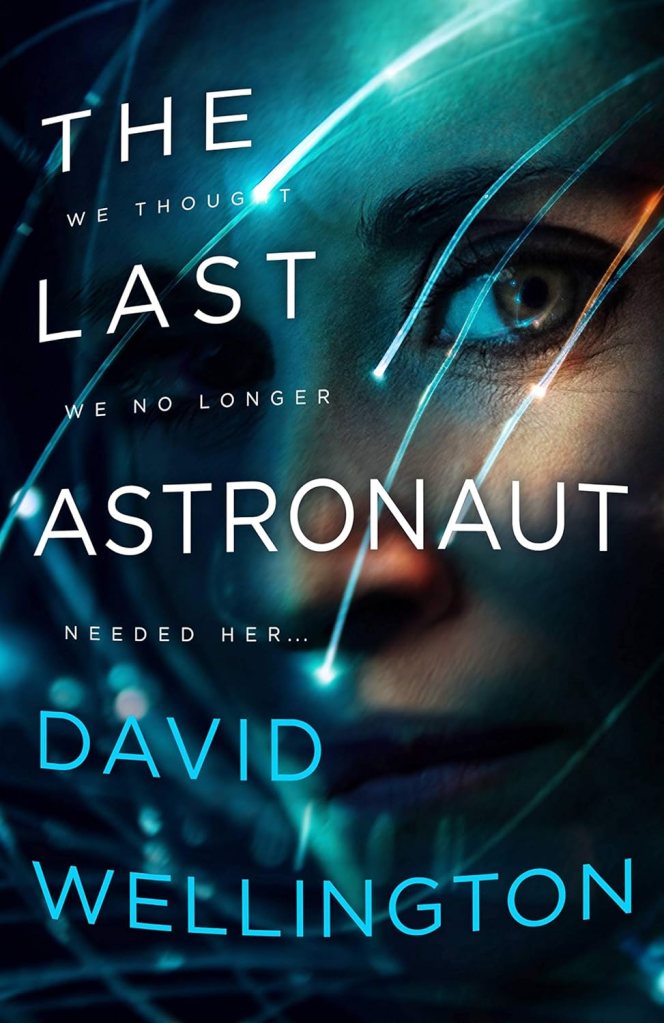
I don’t read many science fiction novels nowadays. I prefer SF short stories. I just don’t read as many books as I used to. However, after my friend Laurie told me about The Last Astronaut by David Wellington, I decided to give it a try. The Last Astronaut is the kind of science fiction thriller that Michael Crichton used to write — fast pace, lots of physical action, and basically fun. The Last Astronaut reminded me how entertaining reading a novel used to be. I wouldn’t call it great, but it does have that page-turning quality.
Now I do have some things to say about it, but what I have to say is full of spoilers. I recommend you go read the novel and then come back here, if you can remember. The Last Astronaut made me think about how science fiction novels change over the years, and how each generation retells old themes in new ways.
The Last Astronaut is about a Big Dumb Object. That’s the official name of a specific science fiction plot device. When I started reading The Last Astronaut, I immediately thought of Rendezvous with Rama. In 2020, The Last Astronaut was nominated for the Arthur C. Clarke Award. Wikipedia even says, “Edward Guimont and Horace A. Smith propose that the origins of the Big Dumb Object trope can be found in H. P. Lovecraft’s novellas At the Mountains of Madness and The Shadow Out of Time, both of which feature human expeditions to immense ancient alien cities in remote parts of our world, and both of which were early influences upon Arthur C. Clarke.”
Funny that they mention H. P. Lovecraft. Because I also thought of Lovecraft while reading The Last Astronaut. Wellington’s novel features horror. Horror like the film Alien, but also horror like Lovecraft’s monstrous alien gods.
The setting, inside the vast alien spacecraft, is dark. Having a story set almost completely in darkness reminded me of Jules Verne’s Journey to the Center of the Earth and The Night Land by William Hope Hodgson.
I’m finally reminded of another story/movie, Fantastic Voyage by Isaac Asimov, along with “Finisterra” by David Moles. This last reminder should give you one huge clue to what’s happening in The Last Astronaut. But I did warn you about spoilers.
My point in this essay is that science fiction is seldom original anymore. The Last Astronaut feels like David Wellington took several of his favorite science fiction themes and blended them into a new SF novel. It succeeds well. I had a lot of problems with the characters because I felt their psychological motivations were too contrived. However, Wellington does use those contrived motivations to wrap up his novel. The ending does make sense and is satisfying.
I was entertained by how Wellington told his story. Wellington places himself in the book as an author in the future, writing a historical novel, but a history that hasn’t happened yet. It’s amusing that one of his characters criticizes the future Wellington for getting his facts wrong. Since we know the story is based on history, there are clues as to who survives and who doesn’t. The audiobook is especially nice because they rig up the audio so that interviews of characters taken after events sound different.
In the 40s and 50s, science fiction writers aimed to create new ideas and themes, but their stories were told without sophistication. In the 60s and 70s, SF writers added literary techniques to their stories. In the 80s and 90s, SF writers upped the ante by going epic. Hyperion is a great example. In the 21st century, SF writers have had to constantly find new ways to tell stories that have already been told.
If you haven’t read old science fiction, new science fiction seems novel. If you have read old science fiction, new science fiction feels recycled. That’s not a bad thing, but it makes the stories feel baroque when you cram so many old ideas into one story. Wellington does streamline his novel, so it feels action-packed like old science fiction. In some ways, his storytelling is as speedy as Edgar Rice Burroughs’ stories or pulp fiction.
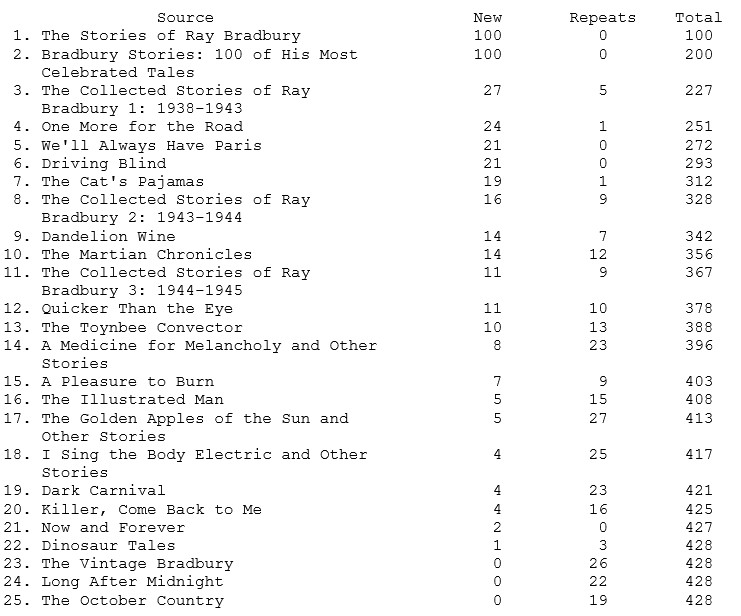
Ray Bradbury published hundreds of short stories over and over again in various collections. Bradbury and his publishers often repackaged his stories into new collections or reprinted older collections with a slightly different lineup of stories. Ray Bradbury’s bibliography at ISFDB.org is so confusing that we’ve decided to select those collections that will provide the most stories by buying the fewest books.
Mike, the programmer for the Classics of Science Fiction website, coded several programs to find the right combinations of Bradbury collections that would give the widest selection of stories to read. The permutations turned out to be excessively large, so we simplified the procedure.
Our solution was to pick the collection that provided the most Bradbury stories. Then add a second collection that provides the most additional stories not in the first collection. Then add the third collection that contributes the next most additional stories, not in the previous two. And so on. Study the table, and the technique will become obvious.
Here are the twenty-five collections we used. We only used collections that are in print, either in hardback, paperback, e-book, or audiobook. Hyperlinks are to Amazon affiliate links.
I have not been writing blogs or reading for a couple of weeks. I lost the habit of reading and writing because of a house guest, many visitors, and a more active social life. However, tonight I felt a wistful urge to read a short story. I chose “The Whole Town’s Sleeping” by Ray Bradbury. It was the first story in Ray Bradbury Stories. You can read a PDF copy online here. “The Whole Town’s Sleeping” is not science fiction or fantasy. And I wouldn’t call it horror, although its purpose is to scare. “The Whole Town’s Sleeping” was published in three magazines, McCall’s (1950), Argosy (1951), and Ellery Queen’s Mystery Magazine (1954), indicating its wide appeal. Finally, the story was incorporated into the fixup novel Dandelion Wine in 1957.
For me, “The Whole Town’s Sleeping” was pure nostalgia. It’s a story that made me think about memory and writing. Sure, Bradbury is trying to tell a scary story, like those he heard camping in the woods, but he’s also remembering his past.
Although the story came out in 1950, “The Whole Town’s Sleeping” is set much earlier, in the era of Bradbury’s youth, because Lavinia, Francine, and Helen go to the theater to see a Charlie Chaplin film. That unnamed film could have been Monsieur Verdoux from 1947, but the story’s mood makes me think it might be The Circus (1928) or City Lights (1931). Bradbury was born in 1920, the same year my father was born. I was born in 1951. It feels nostalgic to the small towns I lived in in the 1950s, but it would have been nostalgic to readers in 1950.
Many of Bradbury’s stories were inspired by his youth growing up in Waukegan, Illinois, which he later fictionalized as Green Town. I believe those little towns I lived in hadn’t changed much in twenty years. Back then, I remember walking with my friends to the theater and talking to people sitting on their porches, which made me identify with the story. I remember walking alone along deserted streets late at night like Lavenia and having the same fears as she did.
My past includes living in small towns where all the stores were set on the square or along Main Street, with all the connecting streets occupied by homes. I had a hard time visualizing the ravine that divides Green Town. Although I do remember living in a little town divided by a small lake. It had a tiny waterfall, which scared me at age nine.
There’s not much I want to say about “The Whole Town’s Sleeping,” because I want to talk about reading. Often in my life, I’ve substituted reading for living. There are times when life is uneventful, so reading is exciting. Life experiences are superior to reading, but idle times are great for reading.
However, there are times when life is full, and I wish I were idle reading. We have two worlds to live in, reality and fantasy. Ray Bradbury created a fantasy world for us to enjoy, and it’s fascinating to think about how and why he did that. On one hand, he’s given us a simple story built to scare us. We even know he’s doing it. Readers know the ending will shock them, but we didn’t know how Bradbury would pull it off. It’s the kind of story that we watched on the old TV show Alfred Hitchcock Presents. (It’s even reprinted in one of Hitchcock’s anthologies.)
But that’s only one level. Fiction usually works on multiple levels. Bradbury also works to describe the past, his past, in the kind of detail that will trigger memories in his readers. And there’s a level beyond that which Bradbury entertains us. It’s the writing.
I have had several intense experiences over the last two weeks. They will stay locked in my head because we seldom share intense experiences. If I were a writer, I would write a story about them. That story might even be read by readers who have had similar experiences.
Isn’t that what Ray Bradbury is doing? Do we read to learn about Bradbury’s experiences, or do we read to remember our own?
Often, we use fiction to escape from boredom. But doesn’t fiction work best when it triggers something inside us? When life is full, I shouldn’t crave reading, but I do. Why? Is reading an essential nutrient of the soul that causes us to fall ill if it goes lacking?
I wish I could fictionalize my experiences so I could understand them. Maybe because I don’t, I read other people’s efforts instead.
My library constantly discards science fiction from its holdings. I know that because I see those books in the Friends of the Library book sale stamped DISCARD. Often, they are books I would consider SF blasts from the past. Evidently, if they aren’t checked out for a certain period, they get discarded. I used to believe libraries were supposed to preserve the past, but I don’t think that’s true anymore.
But that’s not my only clue that science fiction has a shelf life. At the used bookstore I visit every week I see the same old books week after week – no one is buying them. It’s the newer books that come and go so quickly.
For years now, I’ve been watching people review science fiction books on YouTube. I can sense that many authors and their books are falling out favor over time. A major example is Robert A. Heinlein. When I was growing up, he was considered the #1 science fiction author. He was my favorite SF writer. I still love his books published before 1960, but the ones after that haven’t aged well with me. Reviewers generally pan Heinlein nowadays. I often see critical comments about Heinlein on Facebook. He’s just not popular anymore. I see many of his books at the used bookstore, but only a couple at the new bookstore.
Whitney at the YouTube channel Secret Sauce of Storycraft has been reviewing old Hugo winning novels by decades. She didn’t like over half of the winners. Five of the ten (The Wanderer, Stranger in a Strange Land, The Moon is a Harsh Mistress, This Immortal, and Lord of Light) have stopped working for me too.
If I gave the Hugo Award now for the 1960s, my list would be:
1960 – STARSHIP TROOPERS by Robert A. Heinlein
1961 – ROGUE MOON by Algis Budrys ( for A CANTICLE FOR LEIBOWITZ)
1962 – STRANGER IN A STRANGE LAND by Robert A. Heinlein
1963 – THE MAN IN THE HIGH CASTLE by Philip K. Dick
1964 – THE MAN WHO FELL TO EARTH by Walter Tevis (for WAY STATION)
1965 – THE MARTIAN TIME-SLIP by Philip K. Dick (for THE WANDERER)
1966 – DUNE by Frank Herbert
1967 – FLOWERS FOR ALGERNON by Daniel Keyes (THE MOON IS A HARSH MISTRESS)
1968 – no award
1969 – STAND ON ZANZIBAR by John Brunner
I thought there would be hundreds of science fiction books that would be Hugo worthy from the 1960s, but there weren’t. I used CSFquery.com and ISFDB.org to look at each year 1960-1969 and there just was’t that many older books that’s being read today that people still admire.
I love A Canticle for Leibowitz still, but it’s a fixup novel, and I mostly love it for the first story. And reviewers aren’t as wowed as they used to be for it. I kept Stranger on the list even though I no longer like it, because it’s so ambitious for the times, and historically, it is the standout novel of the year. I love Way Station, but I don’t think people still read it much. The Man Who Fell to Earth has grown in popularity since 1963. The Martian Time-Slip is way better than The Wanderer, and people still read it. I definitely think Flowers for Algernon has aged better than Mistress. I’d give No Award over Lord of Light, or any other novel I remember from 1967.
All the books on my list are in print, and all are available as audiobooks. That’s a good indicator that they are still being read.
I was shocked by how few science fiction books from the 1960s I still admire. Twelve years ago I wrote a series about the best SF books from each decade. Looking at my essay for the 1960s shows damn few books that people still read.
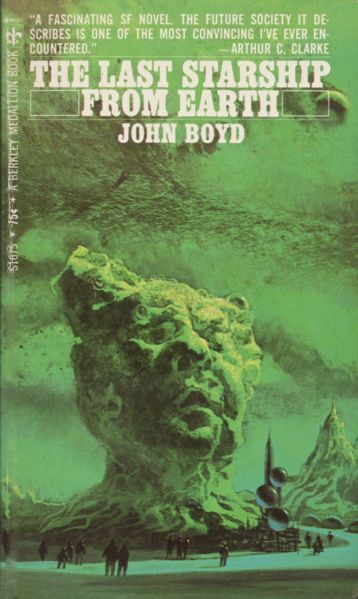
I remember back in the 1960s when old guys would gush about E. E. “Doc” Smith books from the 1920s and 1930s. I tried them, and they were horrible. I guess today’s young readers would feel the same about most of the books I loved back in the 1960s. Is anyone still reading Keith Laumer, John Boyd, Mack Reynolds, A. Bertram Chandler, etc.
What are the best science fiction books from the 1960s that you still read and think young people should try?
You might like to read An Information History of the Hugo Awards by Jo Walton. This was first published at Tor.com and many of the comments from readers are included.
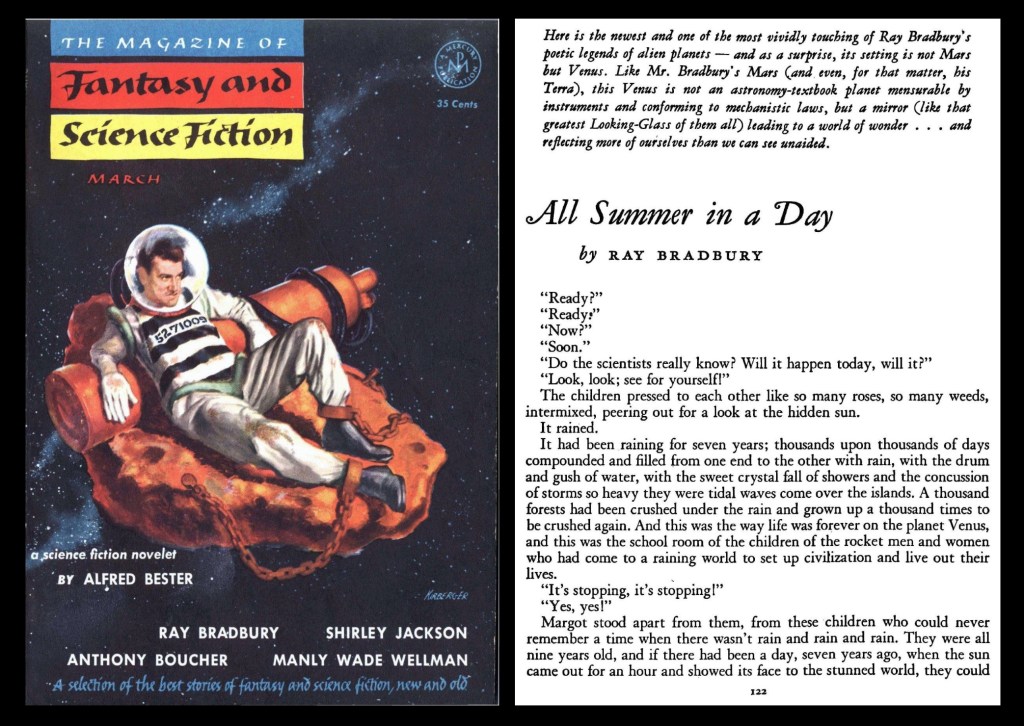
I’ve been rereading Ray Bradbury short stories, and I’m amazed at how well they hold up even when the science is beyond dated. Ray Bradbury is quite cruel to us readers in “All Summer in a Day.” In fact, I had to stop reading when I knew where the story was going, I just didn’t want to go there. I waited a couple of days to finish this fifteen-minute story on audio.
At first the kids in “All Summer in a Day” reminded me of Charles Schultz’s Peanuts characters, but then it was obvious they associated with bad kids from stories by Charles Beaumont or Shirley Jackson.
Remember when Lou Grant told Mary Richards she had spunk? And then Lou said, “I hate spunk.” Well, “All Summer in a Day” has a punch in the gut, and I should say “I hate a punch in the gut,” but when it comes to short stories, a punch in the gut is a good thing. Isn’t that weird. Why do we admire a great punch in the gut from a short story? Why is it so satisfying?
“All Summer in a Day” is set on Venus where it rains continuously except for a two-hour window of clear weather and sunshine every seven years. In a classroom the kids are talking about the impending summer. One girl, Margot, was born on Earth and didn’t come to Venus until she was four. She could remember sunshine and tried to describe it to her classmates who didn’t remember the sun because they were born on Venus. They were just two the previous summer day. They didn’t believe Margot. They resented that she knew something special. So, just before the sun was to come out, they locked Margot in a closet. All the other kids got to see the sun, and it was everything and more that Margot had tried to describe to them.
The children completely forgot about Margot while they cavorted through their brief summer day. When the rain and clouds returned, they remembered Margot and let her out.
This is a simple story about how children are cruel to each other. It’s about being the nail that sticks up. It’s about knowing the undescribable. Does the setting on Venus really matter? It makes the story science fiction so Ray Bradbury can sell it to a science fiction magazine, but does it really matter to the story? Charles Schultz could have done such a story about how the Peanuts gang mistreated Charlie Brown, and may have many times, I just can’t cite a specific panel.
I’m in the process of rereading my favorite science fiction stories and trying to understand why they are my favorites. Writing ability accounts for some of the reasons, but triggered emotions count for many too. I wish I could say I understood every cog in this story, but I don’t. What I do recognize is Ray Bradbury has a set of skills to tell a story in a way that makes it stand out. Not only that, but his stories also endure.
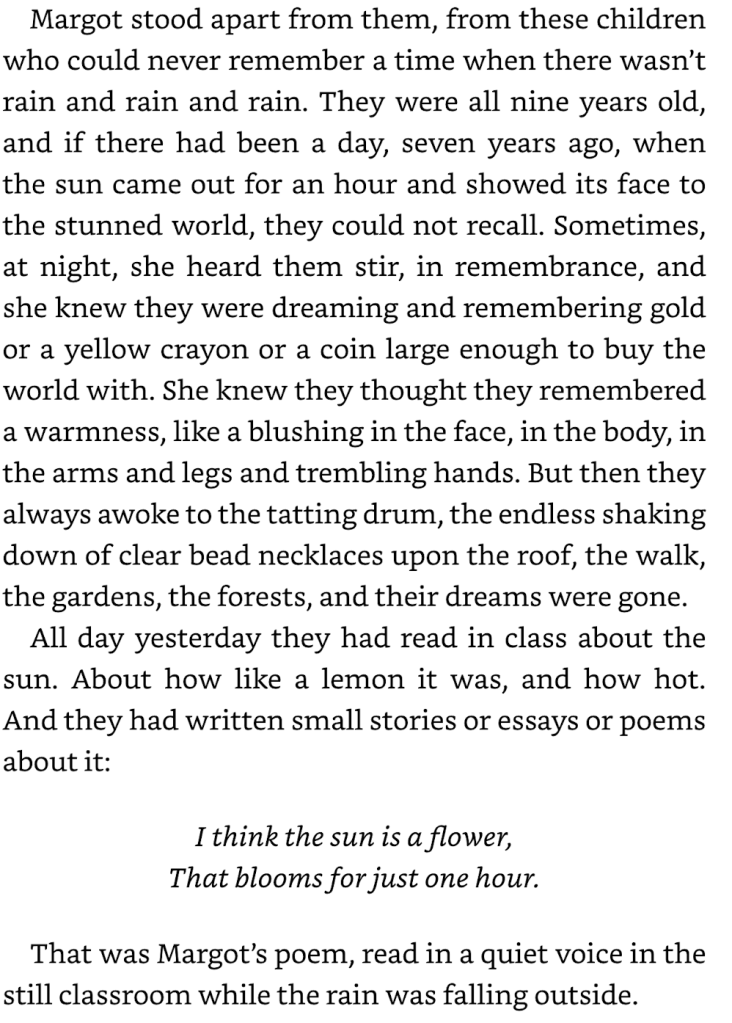
As I reread this story I didn’t remember the details, but either I guessed or remembered what was going to happen to Margot. That’s why I stopped listening to it. But when I returned to the story, I kept thinking to myself: “How is Margot going to react?” I was surprised that Bradbury didn’t give us Margot’s reaction. He left that up to us. That’s another tool in his writing toolbox. Writers don’t have to tell us everything. Bradbury does tell us this about Margot:
Because I just finished reading a biography of Ray Bradbury I know he was an odd child that stood out to his classmates. He also like to write poetry. Bradbury doesn’t have to tell us that this story is for us loners and oddballs, the ones other kids considered weird. When I was growing up, I didn’t know anyone else who read science fiction. Science fiction was like the sun appearing on Venus to me. I tried to explain its appeal to other kids, but they just thought I was a zero. I didn’t make a science fiction reading friend until the tenth grade when I met James Joseph Andrew Connell, III. The experience of meeting another science fiction fan is why Among Others by Jo Walton won the Hugo, Nebula, and British Fantasy Award. Zenna Henderson made a whole writing career out of telling stories about oddballs.
Even in the 1940s Ray Bradbury knew that being labeled a science fiction writer would hurt his career. Bradbury authored stories for all kinds of markets and genres, but when he wrote science fiction, he knew he had to be different. Back in the 1950s he might have been the best-known science fiction writer in America, but many science fiction readers didn’t consider his work science fiction. Bradbury wanted to be a writer like Sherwood Anderson, Ernest Hemingway, or Thomas Wolfe, someone who was just called a writer.
The reason “All Summer in a Day” is good is because of the parts that aren’t science fiction. The reasons why some science fiction fans dismissed him was for the science fiction parts. The obvious lesson here for would-be science fiction writers, is don’t worry about the science fictional aspects but focus on the universal human appeal.
Did science fiction brainwash us into wanting to go to space? I can remember being a little kid in the 1950s and thinking the most exciting thing I could do in life was to go Mars. Before that I wanted to be a cowboy. If you’re old enough to remember television in the 1950s, most of the shows were westerns. That’s why most little boys back then had Santa bring them a six-gun and cowboy outfit for Christmas. But then we discovered science fiction and Project Mercury, and we traded in our cowboy hat for a space helmet.
My most common daydreams in adolescence after the XXX kind, were about going to Mars. Fantasies about becoming a rockstar came in a distant third. Looking back, I realize how unrealistic my teenage hopes for the future were. I was completely clueless as to what girls wanted, couldn’t carry a tune, and I most definitely didn’t have the right stuff. At seventy-three I see the absurdity of my childhood fantasies, so why didn’t I see them then?
Ray Bradbury is often accused of not being a true science fiction writer. Even as he started selling short stories to science fiction magazines in the 1940s, he knew he didn’t want to be labeled a science fiction writer. Yet, somehow, his very unscientific science fiction from back then has the heart and soul of science fiction, especially his stories collected in The Martian Chronicles and The Illustrated Man.
“The Rocket Man” first appeared in The Illustrated Man and Maclean’s in early 1951. It’s about a 14-year-old boy who cherishes the few days his father is home from space. The father is always going off for three-month tours of duty as a rocket man. He tells the boy and his mother that when he’s in space he can’t wait to get home, but when he’s home, he can’t wait to get back to space. “The Rocket Man” deglamarizes space travel. In fact, the dad eventually asks his son to promise to never go into space.
The main reason Bradbury’s science fiction stories are great is because he sees both the fantasy and reality of science fiction. Bradbury is obviously obsessed with remembering childhood, but somehow, he was wise when young too.
By the way, the essence of the story is captured wonderfully in Elton John’s song “Rocket Man.” My favorite version of that song is this bluegrass cover:
But the question I want to explore is why did we all want to go into space? What’s so hot about outer space, the Moon, Mars, etc.? Why did we buy into those dreams that science fiction was selling?
My fantasy was always Mars. But Mars is only a planet that a geologist could love. There ain’t nothing there but rocks and cold. Why did reading The Red Planet by Robert A. Heinlein make me think the best place in existence was Mars? Why does rereading The Martian Chronicles elicit so much intense nostalgia? And why do I think “A Rose for Ecclesiastes” is the epitomy of Martian fantasies?
Over the decades I’ve come to realize that the fantasies we embrace as young children are ones we seldom give up. That’s why kids who embrace religion when little seldom give up God and Heaven no matter how convincing science and logic are at invaliding their faith. Some people never let go of their Christian fantasies, and I never gave up science fiction fantasies. We’re all delusional.
Brian Collins at Science Fiction & Fantasy Remembrance seemed depressed in his current post. His solution is to read old science fiction and fantasy. That’s been my solution too when I think about the state of the world and U.S. politics. Even as a kid, I never really believed I would go into space, but thinking about it was a wonderful way to soothe the stresses of growing up. And now reading science fiction is the balm for growing old.
“The Million Year Picnic” by Ray Bradbury is about as famous to science fiction readers as O’Henry’s “The Gift of the Magi” is to English majors. “The Million Year Picnic” was first published in the Summer 1946 issue of Planet Stories. (Read it online here.)
However, most readers know “The Million Year Picnic” as “October 2026: The Million-Year Picnic” from The Martian Chronicles. Most modern readers think The Martian Chronicles is so out of date scientifically that they don’t consider it science fiction but fantasy. But it is science fiction, and “The Million Year Picnic” is a classic, touching on several iconic themes of the genre.
“The Million Year Picnic” was published just one year after Hiroshima, making it one of the earliest stories about humanity destroying the Earth with atomic weapons. But we don’t know that right away. When we begin reading the story, Bradbury voices his story with a quaint tone, almost like a parable, sounding like Mr. Rogers’ Neighborhood. A father, mother, and their three sons have just landed on Mars. They decide to go fishing. The narrative pacing seems only a few steps up from “See Dick run.”
Back in the 1940s, throughout the 1950s, and even into the 1960s, it was popularly considered that there was life on Mars or had once been, even intelligent life. This is partly due to H. G. Wells and Giovanni Schiaparelli, an Italian astronomer who convinced the world that he saw canals on Mars. Until July 1965 when Mariner 4 showed us a couple dozen grainy pictures of Mars that looked like the Moon, we had so much hope for Mars.
Science fiction writers loved to imagine Mars occupied with all kinds of beings and ancient civilizations. The common belief was Mars was a cold dying cold world and Venus was a hot young jungle world. Ray Bradbury wrote many stories based on these assumptions. In 1950 Bradbury published a collection of his stories about Mars as The Martian Chronicles, a “fix-up” novel. (In 2009, Subterranean Press published The Martian Chronicles: The Complete Edition, which claimed to collect all of Bradbury’s stories about Mars. I’d love to have a copy, but the cheapest copy I can find online is $1,300.) Because “The Million Year Picnic” was so popular it had already been reprinted three times before The Martian Chronicles. And it has been extensively reprinted ever since.
Bradbury also reprinted “The Million Year Picnic” in his collection: S is for Space. Most of Bradbury’s science fiction was found in four collections when I was growing up: The Martian Chronicles, The Illustrated Man, S is for Space, and R is for Rocket. Bradbury quit writing science fiction for the most part in the 1950s and went on to write fantasy, horror, and mainstream fiction after that. I read “The Million Year Picnic” this week because the Facebook group Best Science Fiction and Fantasy Short Fiction is reading 12 science fiction stories by Ray Bradbury that they haven’t read before. Here’s the discussion schedule.
But back to the story. After the family sets out on a boat on a Martian canal to go fishing we slowly learn that “The Million Year Picnic” is a post-apocalyptic tale. But we don’t discover it right away. The three boys are all excited. Timothy, the oldest carefully watches his father, trying to learn what’s happening. As they travel down the canal they pass by countless old cities where Martians once lived. Some cities are just mounds, while others have grand skylines. The dad promises his boys he will show them the Martians, and they get excited.
Along the way, we discover “The Million Year Picnic” follows another hoary old science fiction theme, the retelling of Adam and Eve. This idea had become so overused that by the 1960s writer’s guidelines for magazines would state “no Adam and Eve stories.”
I don’t know how many times I’ve read “The Million Year Picnic.” But back in the early 1960s when I first discovered it, I still believed in Martians on Mars. I was so into Mars, that as a kid, I thought my goal in life was to get there. So when I read the story I focused on the dead Martian civilization. That’s what made the story exciting. I too wanted to see the Martians. And that’s how I always remember this story, especially the surprise ending, which was quite clever.
However, on this rereading, I realized that I had forgotten Bradbury’s serious point. Bradbury was a nostalgic writer, even as a young man. He grew up in the 1920s and 1930s and his stories often have the feel of that era, like watching old black and white Frank Capra movies. Many of his Martian stories transplant small midwestern downs to Mars. But Bradbury wrote “The Million Year Picnic” with an undercurrent of horror and even cynicism. The quaint family on Mars has fled an Earth where humanity has destroyed itself in a nuclear war.
When the Dad realizes the radio signals from Earth have gone silent he tells his boys that one day their grandchildren might hear radio signals again. When I read that I thought about Adam and Eve and their sons and how Biblical skeptics always asked “Where did the wives of Adam and Eve’s sons come from?”
I’m always amused and fascinated by what I remember and don’t remember from stories when I reread them. The gimmick ending of “The Million Year Picnic” overshadows all my memories. I had completely forgotten this was a post-apocalyptic story. In other words, I remembered the positive and forgot the negative. I also forgot how many Biblical allusions where were in the story.
Bradbury solves the wives’ problem. In the end, we learn that another family had also secretly prepared to go to Mars when armageddon began, this one had four daughters.
Now that number is interesting. Bradbury even tells us it will be a problem. I think he’s hinting at the old Cain and Abel conflict. Humans don’t change and even if we start over we’ll have violence and wars again. We know two if not three of the sons will want that extra wife.
The problem is I always go on to read other science fiction. Rereading “The Million Year Picnic” makes me want to delve into Bradbury once again, and read or reread all these books I’ve collected. Even though I’m retired and have all my time free, I can’t seem to find the time to pursue this project. I’m hoping the Facebook group reading of Bradbury will get me going.
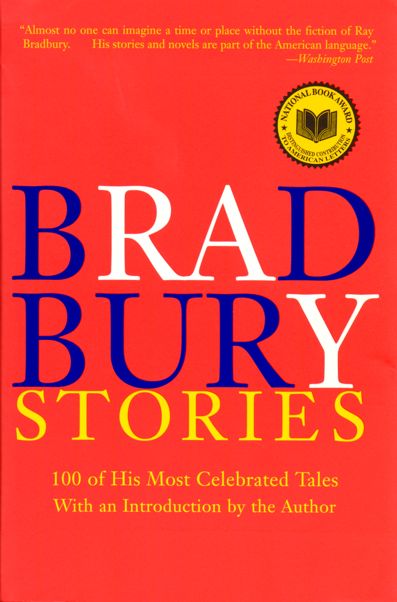
If you’re a fan of listening to short stories, I recommend two giant collections of Ray Bradbury on audio that repackages four of Bradbury’s early collections. #1-32 is The Golden Apples of the Sun and Other Stories (1997), and #33-63 is A Medicine for Melancholy and Other Stories (1998). I wish Bradbury Stories: 100 of His Most Celebrated Stories (2003) were on audio, but it is not. (Table courtesy of Piet Nel.)
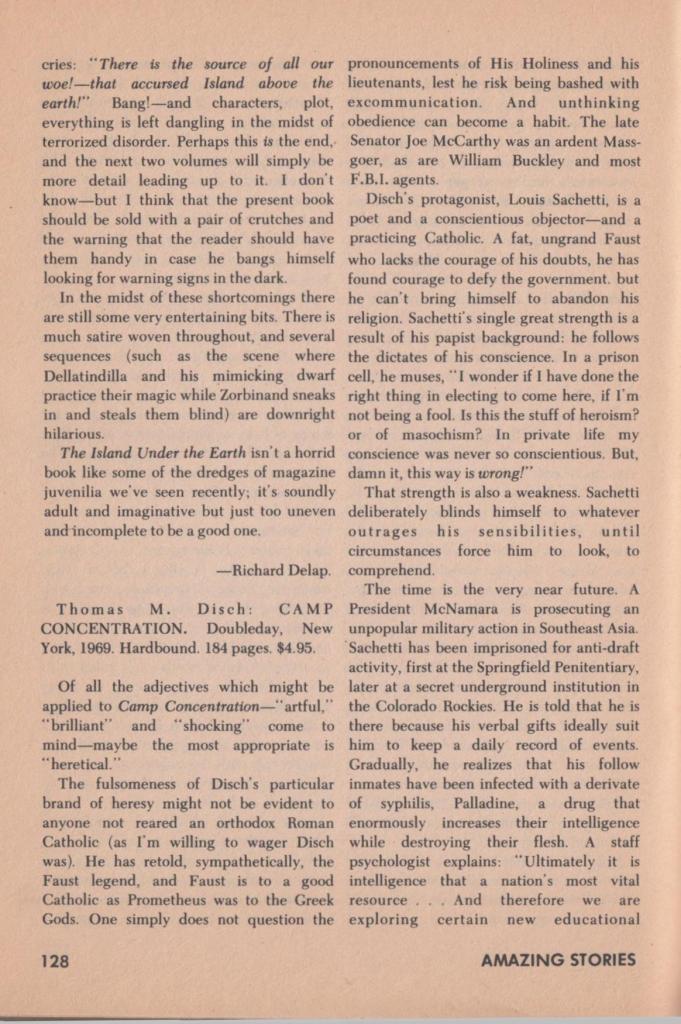
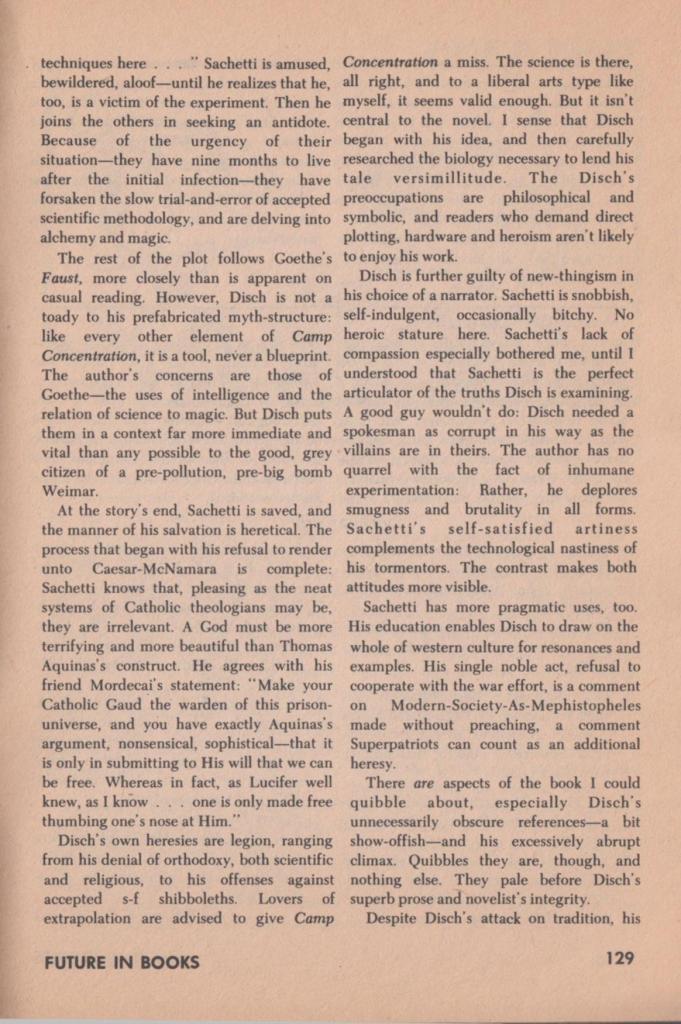
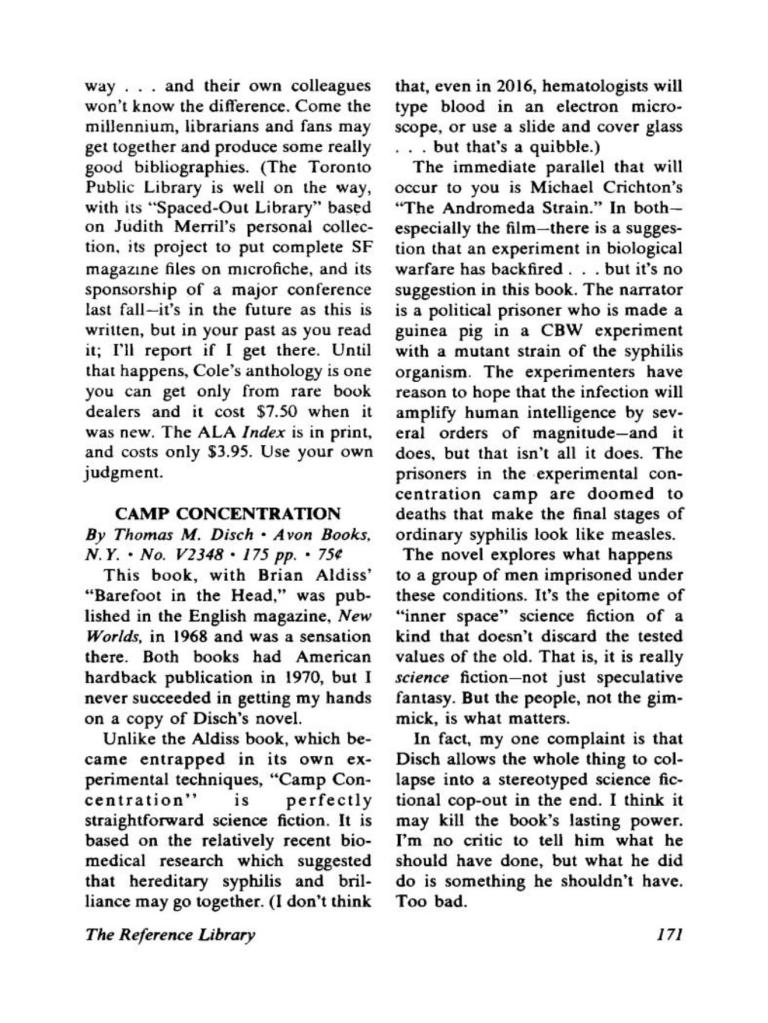
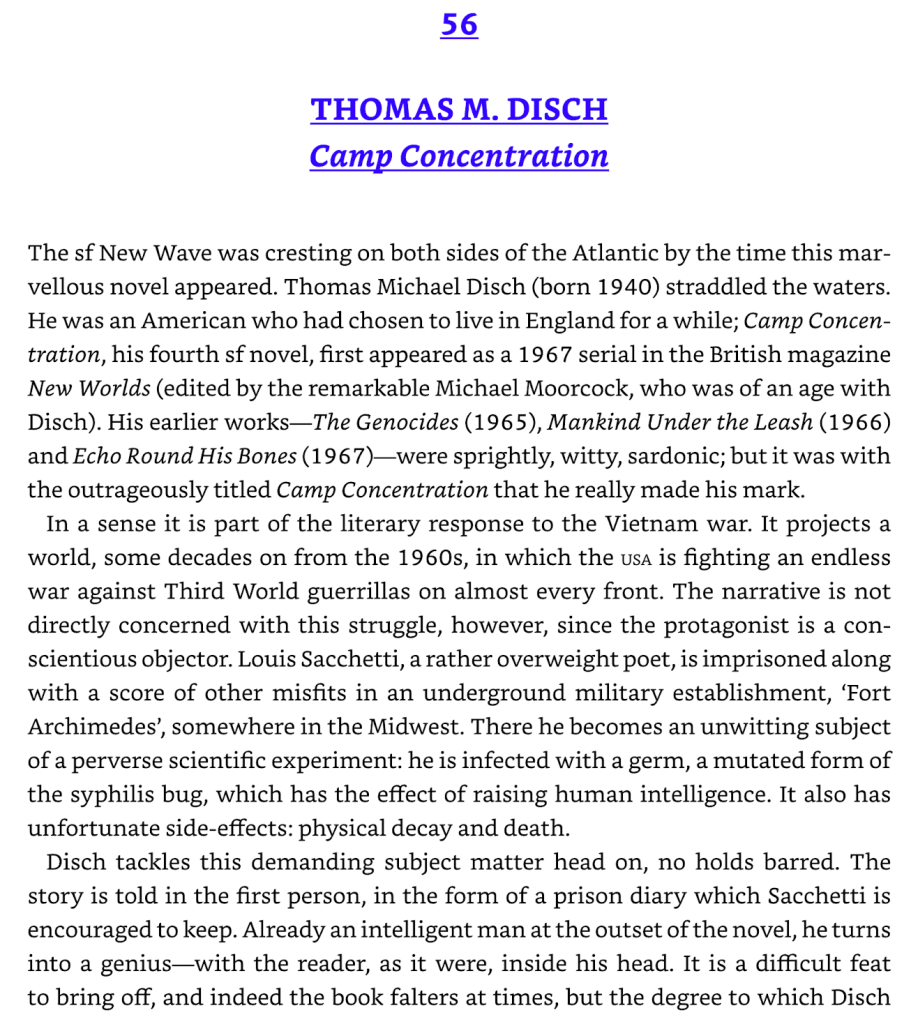
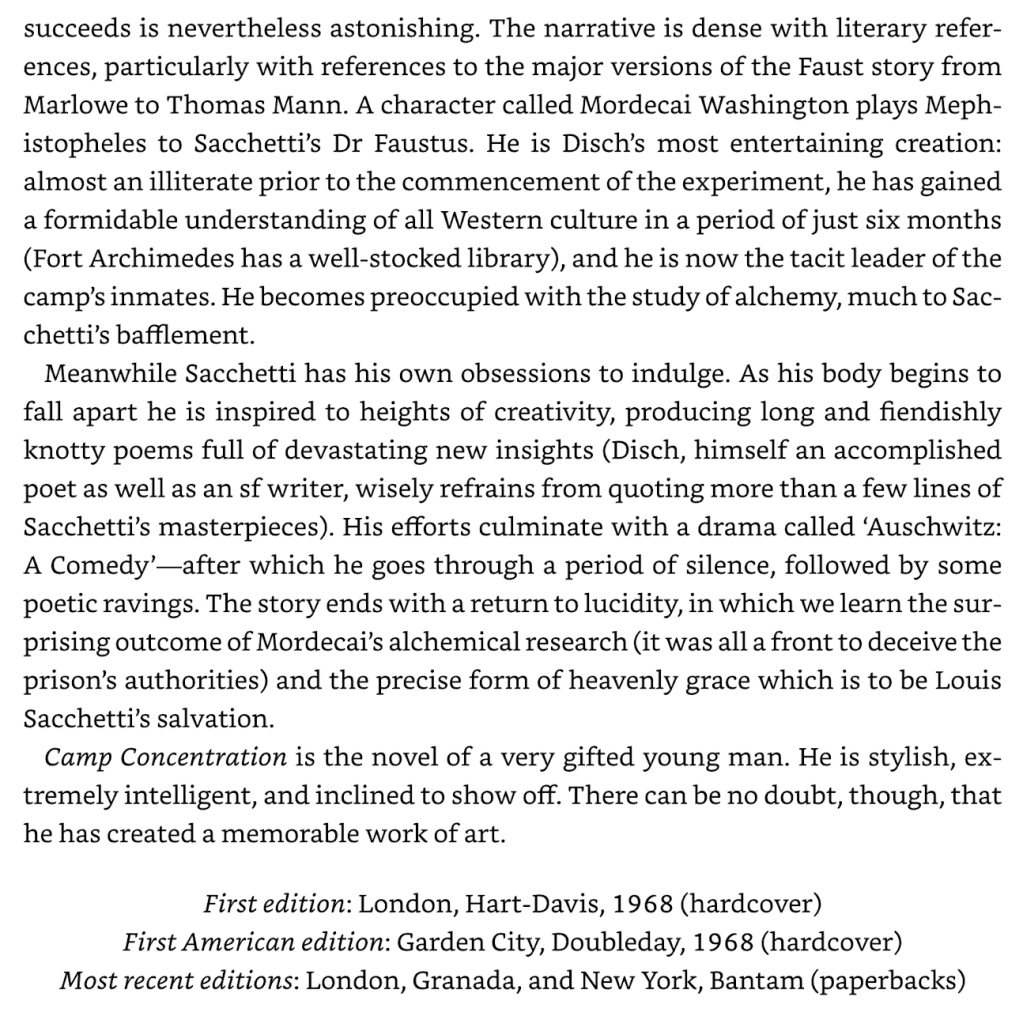
The first time I read Camp Concentration by Thomas M. Disch, I was around 20 and proud of myself for reading one of those New Wave science fiction novels I had been reading about in fanzines. It wasn’t much fun to read. It was overly intellectual – well beyond my level of comprehension. After reading thousands of other books over the last fifty-plus years, Camp Concentration made much more sense. I actually enjoyed the story. I enjoyed it a lot. But please, don’t buy a copy without carefully reading this review.
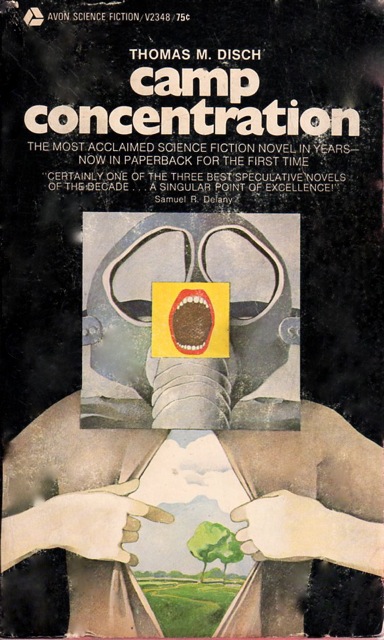
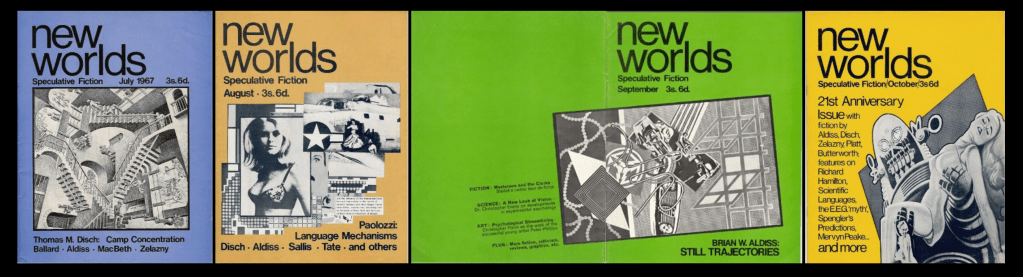
It’s important to know that Camp Concentration first appeared in the July, August, September, and October 1967 issues of New Worlds. It suggests it was written in 1966 or early 1967 and published first in England, in a magazine that promoted the New Wave. To fully appreciate this novel, you must remember when it was written and what happened in the United States in 1966 and 1967. The first hardback came out in England in 1968, and it wasn’t until 1969 when it was published in America. I didn’t read it until after the 1971 Avon paperback, cover shown above.
I’d love to hear an audiobook version of Camp Concentration. However, a highly skilled narrator would be needed to handle all the accents, poetry, foreign language quotes, and characterizations. It would also make a wonderful movie. Unfortunately, the audience for either the audiobook or film would be small.
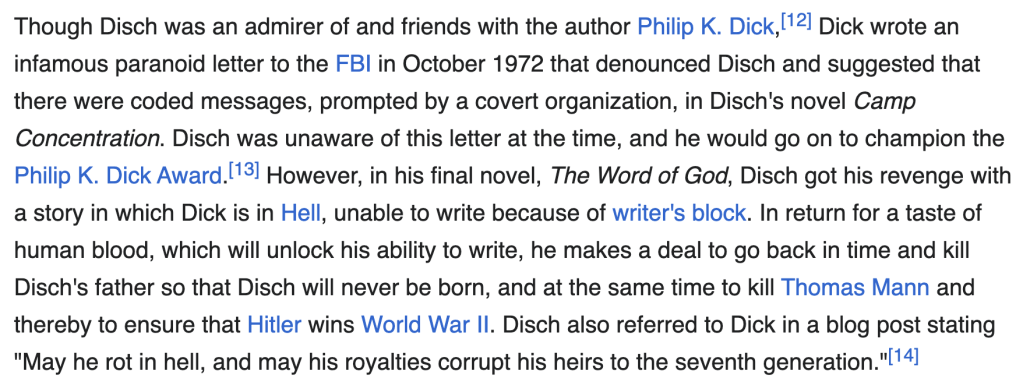
Back in the 1970s Camp Concentration was greatly admired. Philip K. Dick loved the book so much he promoted to friends and suggested it be made into a movie to a producer interested in his own work. But there’s a bizarre story here. Dick, who was paranoid, started seeing things in Camp Concentration and wrote a letter to the FBI claiming it had secret intel. You can read that letter here. Eventually, Disch found out about this and didn’t take it kindly. Wikipedia describes what happened:
I mention this early in the review because it helps set up how strange Camp Concentration is as a novel. It’s quite readable, but it has so many references to literature, music, philosophy, poetry, etc., that you might feel it has some deeper message. Even though I just finished the novel, I’m already looking forward to rereading it again. However, before I can do that, I need to study first. At minimum I should read Christopher Marlowe’s play Doctor Faustus, and Thomas Mann’s novel Dr. Faustus. In fact, I need to go through Camp Concentration, make a list of all the works Disch mentions, and at least read their Wikipedia pages about them.
Louis Sacchetti is a conscientious objector, and Camp Concentration is the journal he writes while imprisoned in two locations. Disch wrote the novel while LBJ was president, and before Nixon. The story is set somewhat in the future, and Robert McNamara is President. McNamara was the Secretary of Defense under JFK and LBJ. McNamara played a major role in promoting the Vietnam War. To get the fullness of Camp Concentration, you need to read the Wikipedia link to McNamara. It also helps to see The Fog of War: Eleven Lessons from the Life of Robert S. McNamara, a 2003 Academy Award winning documentary.
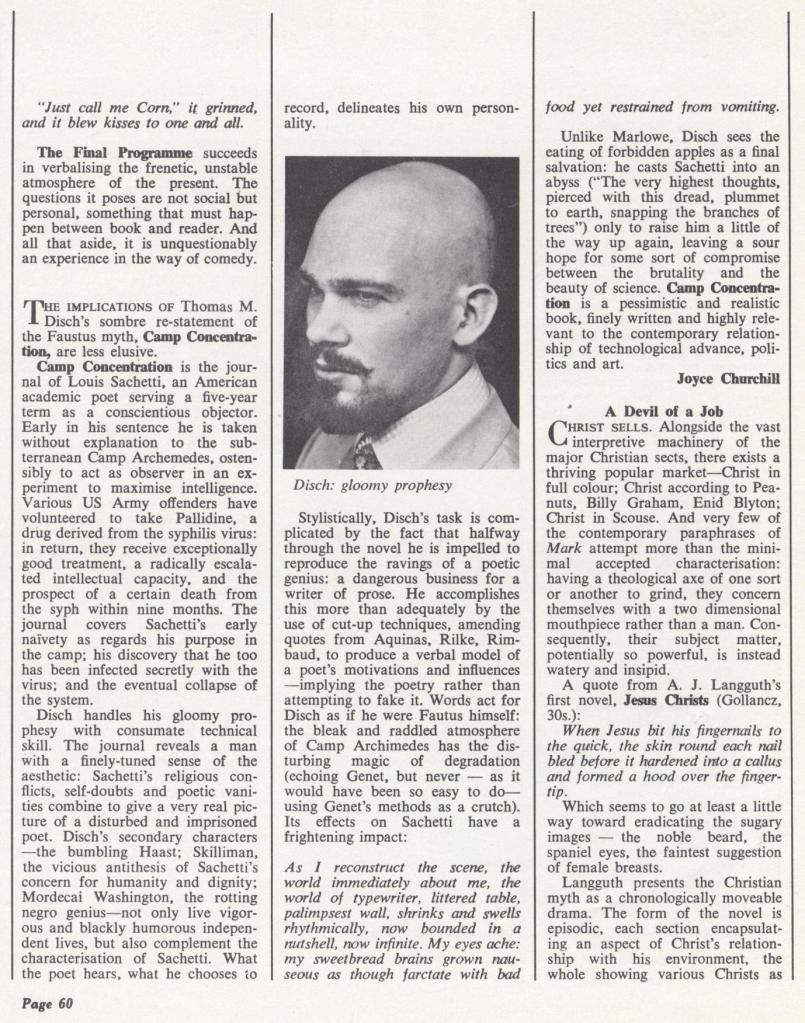
Camp Concentration is a deeply cynical view of the United States in 1967. Louis is a war resister, at first imprisoned in an ordinary prison. He accepts that. But the novel is about when he is transferred to another prison, a military prison, where an experimental drug is used on the inmates by the U.S. Army. Most of the prisoners had committed crimes while in the Army, but Louis is a special civilian prisoner. The army believes it has synthesized a drug that will enhance intelligence. It was derived from a strain of syphilis.
The U.S. Army conducted experiments with LSD from 1955 to 1967. From 1932 to 1972, the U.S. government studied the effects of syphilis on black people after telling them they were being treated. These are just two examples of unethical experiments by our government. It’s not hard to believe the setup for Camp Concentration.
Camp Concentration reminds some readers of Flowers for Algernon because it’s about a treatment that makes people smarter. Over one hundred journal entries, we see Louis and the other prisoners change and become brilliant. I felt the characters did change, but my friend Mike, who got me to reread the novel, says he didn’t. Writers find it hard to describe humans with superintelligence. I’ve written about that recently. I thought Disch pulled it off, Mike didn’t.
Most of the novel is intellectual discussions about art, literature, poetry, theater, music, religion, philosophy, Alchemy, and other medieval beliefs. Mike thought all this discussion was boring, I was fascinated. I feel it helps to have a classical education to appreciate Camp Concentration. I don’t, but I’ve read enough to wish I had.
While reading Camp Concentration I was reminded of another book I read in the 1970s, Where the Wasteland Ends: Politics and Transcendence in Post Industrial Societyby Theodore Roszak. I’m not saying the two books are about the same things, but as the characters evolve intellectually, they start sounding like Roszak.
Read Disch’s Wikipedia entry, you’ll see that Thomas M. Disch and Louis Sacchetti have much in common. Louis is a poet, and Disch wrote The Castle of Indolence: On Poetry, Poets, and Poetastes.
In the novel, the drug makes the test subject smarter, but it also kills them within months. As the characters grow more brilliant, they realize they have much more to live for and become bitter. Disch appears to equate higher IQ with depression and cynicism.
Disch does not suggest that superintelligence leads to super-powers. The test subjects only become more academic in their communication with each other. As they evolve mentally, their use of intellectual ideas to express themselves becomes more dense. This is subtle, and it may be hard to believe they are more intelligent. It seems that most of their references are to ideas covered in Classical studies or Medieval studies.
If you are prone to depression, I would not read this novel. If you are among the faithful, I would not read this novel. If you prefer tightly plotted stories, that are easy to read, and enjoy action, don’t buy this book.
On the other hand, if you’re into the history of science fiction, the New Wave, or the 1960s, Camp Concentration might be a good one to read. Science fiction changed in 1967-1968. I believe several young prodigies like Disch and Delany took the genre in new directions, and older writers like Silverberg, Brunner, and Ellison decided they were tired of where science fiction was going too.



 Classics of Science Fiction