“Contagion” by Katherine MacLean

Contagion by Katherine MacLean

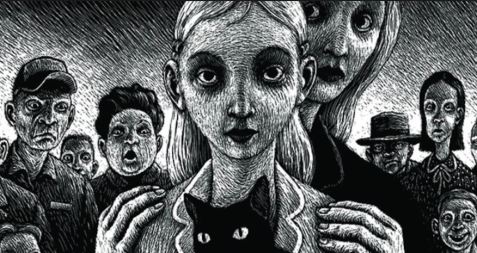
“Contagion” by Katherine MacLean appeared in the very first issue of Galaxy Science Fiction in October of 1950. MacLean was in great company because the first issue also contained stories by Clifford Simak, Richard Matheson, Theodore Sturgeon, Fritz Leiber, Fredric Brown, and Isaac Asimov. If you follow the link above you can read “Contagion” online, as well as the whole first issue of Galaxy. You can also listen to “Contagion” on YouTube from a LibriVox.org recording.

“Contagion” has been reprinted often, most notably in The Best Science Fiction Stories: 1951 edited by Bleiler and Dikty, Women of Wonder (1975) and the expanded Women of Wonder: The Classic Years: Science Fiction by Women from the 1940s to the 1970s (1995) both edited by Pamela Sargent, and most recently in The Future is Female! edited by Lisa Yaszek and published by the prestigious Library of America.

I just read “Contagion” in the Bleiler/Dikty volume as part of my project to read all the best-SF-of-the-year annuals in order starting with 1939. The story was not in The Great SF Stories 12 (1950) edited by Asimov and Greenberg. I wondered why. “Contagion” is not a great story, but it is a lot of fun, and is notable for a number of reasons. Back in 1950, there were damn few women SF writers, so Katherine MacLean stands out. But more importantly, MacLean deals with an idea that I’ve seldom seen other SF writers concern themselves with – can humans landing on other worlds survive their microscopic infections?

Kim Stanley Robinson dealt with this idea in Aurora just a few years ago. but at the moment these two examples are the only ones I can recall. Most SF yarns have their characters worry if they can breathe the air, drink the water, or eat the plants and animals.  However, most humans on Earth, if they were transported to a jungle in South America or Africa, would be at great risk of getting an infection. Why assume other planets are any less dangerous? KSM suggested it might be impossible to colonize any other world with an evolved biology, and I think he’s right. Visiting any other world with life might risk countless forms of dangerous infections like Ebola.

Little is known about Katherine MacLean. She seems to have been into hard science fiction and mostly wrote for Astounding/Analog, but that does include a lot of Psi-stories. I haven’t been able to find out much about her. She only produced three novels and three collections.

The Diploids by Katherine MacLeanThere are many benefits to my reading project. Not only do I get to watch science fiction evolve year by year, but I get to read a huge variety of stories by many authors I’ve never read before or even know about. There was an interview with Katherine MacLean in the July 2013 issue of The New York Review of Books I’d love to read. If anyone has a copy and could send me a scan it would be appreciated. I’m guessing that interview did help Andrew Liptak write “The Fantastic Foresight of Katherine MacLean” at Kirkus Review. That piece has the most information about MacLean I can currently find.

Joachim Boaz reviews her most famous book, Missing Man published in 1975 but based on her Nebula Award-winning 1971 story of the same name. Boaz rated it 5/5 (Near Masterpiece) which I’ve seldom seen him do. He says it’s one of the best sci-fi novels about telepathy ever. (Makes me want to buy a copy.)

<SPOILERS>

What makes “Contagion” so much fun to me is MacLean’s female perspective. The story is told in the third-person but follows June Walton closely. She is part of a team of human explorers landing on Minos that discover it had already been settled by human colonists when they come across a man named Patrick Mead in the jungle. Mead is a head taller than all the space explorers, is red-headed, wears only a loincloth, and has tremendous sexual magnetism. It’s fun as a male reader follow June as she observes Patrick’s impact on her fellow crew members, especially the women. June’s husband Max pales in comparison to Patrick and June feels bad she’s so attracted to the redheaded stranger.

Eventually, Patrick infects all the male space travelers even though they have been extremely careful to avoid infections. They wear spacesuits and use many decontamination methods. Patrick gives the men the “melting disease.” The women eventually save most of the men with antibodies from Patrick, but all the men go through a transformation and end up looking like Patrick – tall, muscular, and redheaded. The women in the crew are freaked out at first but quickly decided that their husbands and boyfriends easily reveal their personalities even though they all look the same. (I don’t know why but many SF writers have a thing for redheads.)  But here’s the kicker. Patrick’s sister shows up and the space explorers realize she will infect the women in the spaceship and they will all end up looking like her. Patrick’s sister is quite a beauty, but all the Earth women refuse to lose their individual looks. Several say they’d rather die. But do they have a choice?

I wondered if MacLean was having fun with all the male science fiction readers of 1950. I’m sure they were just as geeky then as they are today. MacLean has her spacewomen claiming they love their brainy guys, but they go nuts over Patrick. But what is she saying about women in general by having the spacewomen preferring death to all looking alike?

Is MacLean satirizing women’s vanity, or is it another dig at men? Maybe, MacLean is saying women don’t all want to be redheaded sex goddesses, which like I said, is a common ideal in science fiction magazine stories written by men.

</SPOILERS>

I’m not sure it’s politically correct to say female writers have a uniquely different perspective than male writers, but it seems like MacLean does so here, and is specifically targetting that belief in her story. Most older Sci-Fi tales avoided sex and gender issues and usually presented the most common stereotypes. Science fiction writers sometimes would have a hot woman in the spaceship that all the guys went nuts over, but I can’t remember them ever writing a story with a spaceship where the women crew members all going nuts over a hot guy. First of all, very few stories had spaceships where half the crew were women.

In “Contagion” Katherine MacLean anticipates a future in 1950 that’s more like what’s hinted at in Star Trek of 1966, although half the U.S.S. Enterprise’s command crew was not female. In her story, there is great equality males and females, and everyone is a scientist.

Maybe I should reconsider my assessment of “Contagion” being just a light-weight fun story. Now that I think about it, maybe MacLean was saying a lot more than I thought on my first reading. That’s another thing I’m learning from this reading project. Most great stories need 2-4 readings before I can discern all their great attributes.

James Wallace Harris

“At the Fall” by Alec Nevala-Lee

at_the_fall_by_eldarzakirov_dd572fh-pre

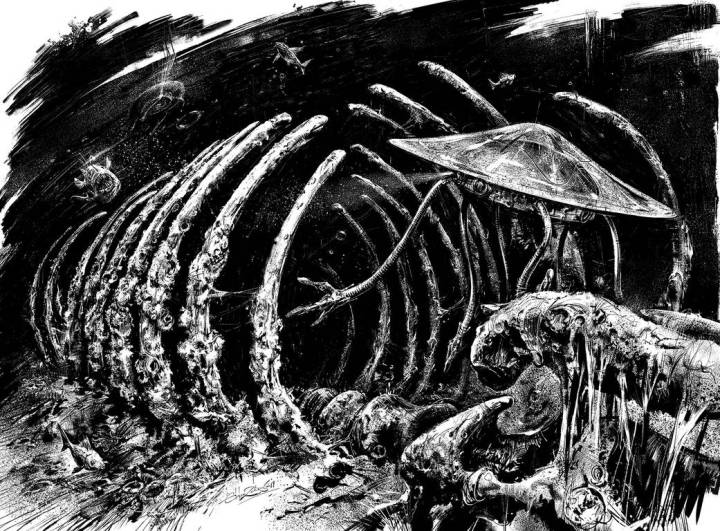
The above illustration by Eldar Zakirov is for “At the Fall” by Alec Nevala-Lee in the May-June issue of Analog. This story is exactly the kind of science fiction I love. I hope Alec Nevala-Lee won’t be offended when I say, “At the Fall” is great old-fashion science fiction. The story is about a little undersea robot named Eunice and its companion support robot named Wagner who travel thousands of miles under the ocean hoping to find their home. I can’t help but think of the City stories by Clifford Simak.

Eunice is a hexapod, a robot with six tentacle-like appendages. It is one of five hexapods “sisters” (Thetic, Clio, Dione, Galatea) each with their own support robot that generates their power. The five hexapods were created to study deep ocean vents. Because these robots work so far below the surface, beyond the range of radio, they were designed to work independently from human monitoring. They take turns returning to the surface to transmit their data and check in with scientists on a yacht. One day the yacht isn’t at the surface, but the little robots keep at their job. Eventually, after waiting a long time for the yacht to return, Eunice decides to return to Seattle where it was created but it has very limited abilities to make this journey. “At the Fall” is about Eunice’s trials and tribulations crossing thousands of kilometers of the ocean bottom. (In many ways Eunice’s efforts to survive, remind me of Mark Watney’s ingenuity in The Martian.)

Writing good robot stories is hard to pull off. All too often writers make their robots too human. Eunice neither looks human or thinks like a human, yet we feel for it as her. At least I did. I don’t know why it is female other than its name. Eunice has no gender traits, but I can’t stop thinking of it as a little girl. I wish Nevala-Lee had avoided this issue with a genderless name, but we humans anthropomorphize everything. And would this little robot be less charming if it had been called Hexapod-5? For myself, I would have been fine with that.

I wasn’t hugely worried about this gender issue in this story, but I do think science fiction needs to eventually teach its readers that robots and AI will not have gender. Even sexbots will be genderless. Gender comes out of biology. No matter how hard we want robots to be like us, they won’t be.

“At the Fall” belongs to the growing sub-sub-genre of cute robot stories, like Wall-E and “The Secret Life of Bots” by Suzanne Palmer. At Nevala-Lee’s blog, he links to more about this story, including a conversation he had with Frank Wu who wrote a story about Karl 3478 who is also an underwater robot. I like this tiny sub-sub-genre. NASA was able to avoid the gender issue with their robots by naming them Spirit and Opportunity. A huge number of people from around the world became fans of these Martian robots and followed their exploits online for years. It’s quite logical to send robots into space and under the ocean, and they will slowly evolve more and more independence. I can easily believe an emergent AI intelligence could evolve in this type of robot.

I expect in the coming years for this sub-sub-genre to grow. It will be a challenge for SF writers to convey the mental view of these AI controlled robots. For decades science fiction writers assumed intelligent robots would think like us, and use our languages. This is completely short-sighted. The chasm between animal consciousness and machine consciousness will be vast. We can see how our minds evolved by looking at animals. We can see earlier forms of intelligence and emotions in their minds. We share their DNA. This won’t be true with robot minds.

Nevala-Lee did a good job at conveying Eunice’s thinking. Science fiction writers are limited by the tools of writing fiction when describing robotic POV. Quite often in “At the Fall” Nevala-Lee says Eunice experiences fear and anxiety. I’m not sure robots will have those emotions. Eunice spends a lot of time analyzing its plans because it knows it only has 30 kilometers of range for each power charge. But where would that fear and anxiety come from in a robot, aren’t those chemical reactions in a biological organism?

Language is another issue that Nevala-Lee skirts. Eunice’s world is very limited, and within the story, its grasp of English is limited too. But Eunice does say and think a few things that would be beyond its practical comprehension. The only way to explain what I mean is to recommend reading Galatea 2.2 by Richard Powers, which is a very serious literary novel about training an AI mind to understand English and literature. Powers uses far more scientific realism than most science fiction writers.

Neither of these issues hurt “At the Fall.” It’s an utterly enchanting story. There’s plenty of science to make it realistic. And it has a rather unique sense of wonder. Reading it suggests there is a growing future for robot stories. I believe stories about robots will unfold in the same way stories about did about space travel. Science fiction before NASA is distinctly different than those after NASA. As intelligent robots emerge in the real world fiction about them will change too. Any SF writer today wanting to write a cutting edge story about robots needs to think long and hard what real-life intelligent robots will be like. We need less anthropomorphizing and a lot more speculation about AI thinking. Nevala-Lee did a good job, but I hope future stories go further.

Spoiler Alert

At Rocket Stack Rank Greg Hullender assumes human civilization in this story collapses because of some sort of EMP apocalypse. I didn’t think that when reading the story. I assume the fall in “At the Fall” meant that humanity went over some kind of edge. I figured the humans in this story all died in chaos from all our societal sins causing a world-wide breakdown. That starvation, disease, environmental catastrophes, economic collapse, and a host of other failures did us in. That’s why I could easily imagine automatic solar-powered recharging stations still working.

I hope before humans do ourselves in, we do create intelligent robots that will replace us.

James Wallace Harris


Beta-test version 5 of The Classics of Science Fiction

On the edge of the galaxy by Virgil Finlay

We’re now testing version 5 of The Classics of Science Fiction that’s completely database-driven and is inherently expandable. We might not need to ever create a new version. Version 5 will automatically create updated lists as we add new data.

Try it out here:  https://csfquery.com

Version 3 was database driven and I always meant to rewrite it so I could add new citation lists on the fly. Version 4 was based on a program that processed a fixed number of citation lists. Mike took on the project to learn new programming languages and has produced an elegant design of simplicity and flexibility. We hope everything is self-evident. You can click on most data fields to get more information. You can click on headings to resort the list. You can click to show the citations, and click again to remove them. And there’s a list builder that allows users to create their own customized list.

We’ve also reset the minimum citations for our versions of the lists. For books, it’s now 12, for stories it’s 8. In the past, we had lower minimums which produced longer lists. We just hated that some of our favorite science fiction wouldn’t make the grade. We’ve eliminated that temptation to meddle and decided to stay close to 100 items for each list. That’s about the perfect length for a list of greats. We think this works out well because the results are all very famous stories. However, you can use the list builder to set your own criteria for generating the lists.

Totals for our lists will constantly change as we add new data and reset the rules.

We feel our lists are the most remembered science fiction books and stories. We don’t claim these are the best science fiction you’ll ever read, that’s up to you. Our goal has always been to identify those stories which are remembered over time. We hope to add new features that will allow users to even specify which citations to use so they can see what books were popular during different time periods.

We’ve also decided to leave all the essays about the project off the new site. We’ll leave version 4 up here, which has the history of the project and the old versions of the list.

Play with this new version and let us know what you think. Leave comments below.

James Wallace Harris

The Year’s Best Short Science Fiction: 1949


Years Best Short Science Fiction 1949

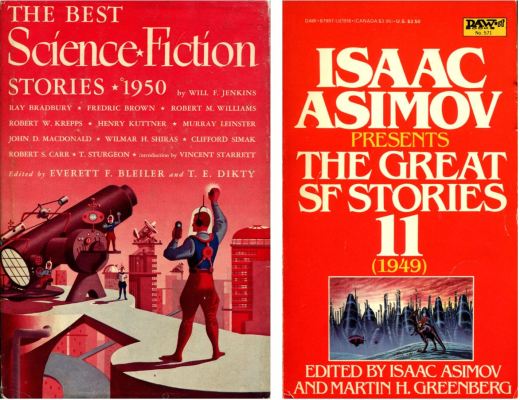
In 1950 Everett F. Bleiler and T. E. Dikty picked the following 1949 science fiction short stories for their second annual anthology The Best Science Fiction Stories – 1950:

  • Private Eye” by Henry Kuttner (Astounding, January 1949)
  • “Doomsday Deferred” by Will F. Jenkins (Saturday Evening Post, 9/24/49)
  • The Hurkle is a Happy Beast” by Theodore Sturgeon (The Magazine of Fantasy, Fall 1949)
  • Eternity Lost” by Clifford Simak (Astounding, July 1949)
  • “Easter Eggs” by Robert Spencer Carr (Saturday Evening Post, 9/24/49)
  • “Opening Doors” by Wilmar H. Shiras (Astounding, March 1949)
  • “Five Years in the Marmalade” by Robert W. Krepps (Fantastic Adventures, July 1949)
  • “Dwellers in Silence” by Ray Bradbury (Planet Stories, Spring 1949)
  • “Mouse” by Fredric Brown (Wonder Stories, June 1949)
  • “Refuge for Tonight” by Robert Moore Williams (Blue Book Magazine, March 1949)
  • “The Life-Work of Professor Muntz” by Murray Leinster (Thrilling Wonder Stories, Jun 1949)
  • Flaw” by John D. MacDonald (Startling Stories,  January 1949)
  • “The Man” by Ray Bradbury (Thrilling Wonder Stories, February 1949)

Astounding Science Fiction is no longer dominating. Why no stories from the Big 3 (Heinlein/Asimov/Clarke)? Robert A. Heinlein, probably the most popular science fiction writer at the time had five stories published in 1949 – “Our Fair City,” “Gulf,” “The Long Watch,” “Nothing Ever Happens on the Moon,” and “Delilah and the Space Rigger.” I’ve read the Heinlein wanted too much money to reprint his stories, or maybe Bleiler and Dikty just didn’t like Heinlein or felt he didn’t need the exposure.

If Heinlein wasn’t the most popular science fiction writer in 1949, then Ray Bradbury might have been because two of his stories were selected, and in 1984, Isaac Asimov and Martin H. Greenberg picked another for their anthology The Great SF Stories 11 (1949):

  • “The Red Queen’s Race” by Isaac Asimov (Astounding, January 1949)
  • Flaw” by John D. MacDonald (Startling Stories, January 1949)
  • Private Eye” by Henry Kuttner and C. L. Moore (Astounding, January 1949)
  • “Manna” by Peter Phillips (Astounding, February 1949)
  • “The Prisoner in the Skull” by Henry Kuttner and C. L. Moore (Astounding, February 1949)
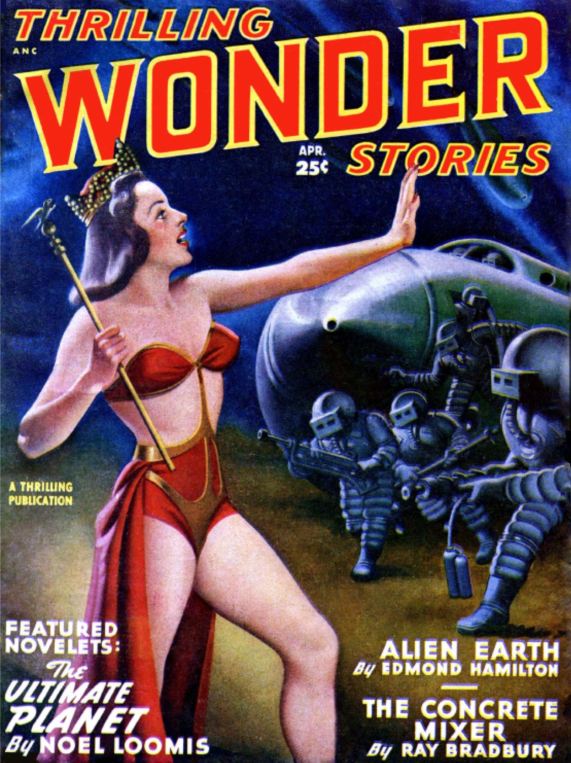
  • “Alien Earth” by Edmond Hamilton (Thrilling Wonder Stories, April 1949)
  • “History Lesson” by Arthur C. Clarke (Startling Stories, May 1949)
  • Eternity Lost” by Clifford D. Simak (Astounding, July 1949)
  • “The Only Thing We Learn” by C. M. Kornbluth (Startling Stories, July 1949)
  • “Private – Keep Out!” by Philip MacDonald (The Magazine of Fantasy, Fall 1949)
  • The Hurkle is a Happy Beast” by Theodore Sturgeon (The Magazine of Fantasy, Fall 1949)
  • “Kaleidoscope” by Ray Bradbury (Thrilling Wonder Stories, October 1949)
  • “Defense Mechanism” by Katherine MacLean (Astounding, October 1949)
  • “Cold War” by Henry Kuttner and C. L. Moore (Thrilling Wonder Stories, October 1949)
  • “The Witches of Karres” by James H. Schmitz (Astounding, December 1949)

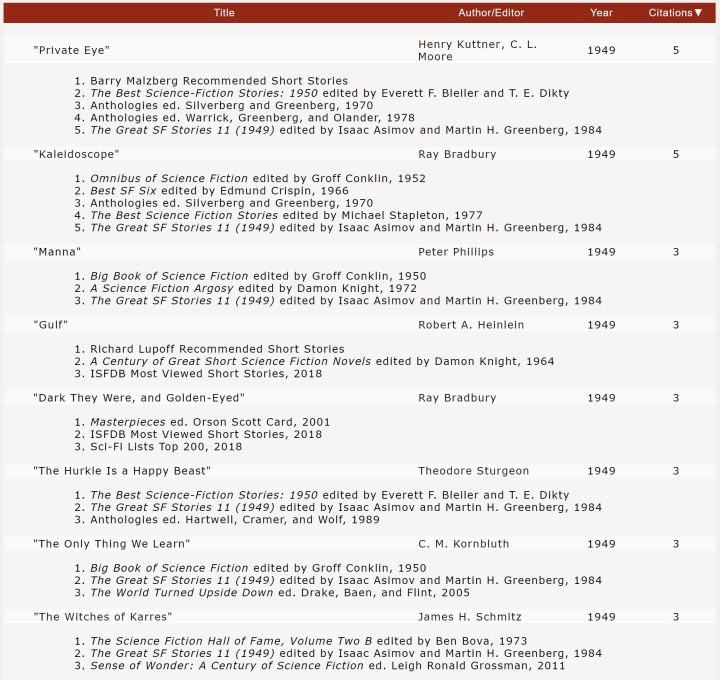
I’ve bolded the four stories that both collections picked. Asimov/Greenberg did add an Asimov and Clarke, but no Heinlein. And our system found even another Ray Bradbury story and picked a Heinlein:

CSFSS-1949.

If you look close, only four stories have had citations from the 21st-century, and only two, “Gulf” by Heinlein, and “Dark They Were, and Golden-Eyed” by Bradbury are remembered by fans recently. Our Classics of Science Fiction project shows how stories are slowly forgotten.

But what about how I felt reading these 1949 stories in 2019? To be honest, I’m struggling to retain them in memory. Most were just okay, even time-wasters. The story that really stuck out for me was “Alien Earth” by Edmond Hamilton, which I’ve already written about. Plus, Hamilton was writing about trees in 1949 that foresees such books as The Hidden Life of Trees (2015) by Peter Wohlleben and The Overstory (2019) by Richard Powers that just won the Pulitzer Prize.

The Ray Bradbury stories still work after all these years. In fact, my admiration for Bradbury is growing. His 1940s stories say so much about that decade and still, they seem relevant in the 2010s.

Most of the 1949 science fiction short stories were fun or clever but will probably offer little to modern readers.

One story, “Private Eye” by Kuttner and Moore, was very impressive but didn’t move me. Paul Fraser at SF Magazines really admired “Private Eye.” I want to reread it in the future because I think it will impress me more with a second reading. I wished someone would do an audiobook of Kuttner/Moore’s collected stories because they dominated the 1940s SF, yet I seldom enjoy their stories like I think I should. I’ve always loved “Vintage Season” but most of their stories seem to be more intellect than heart.

I thoroughly enjoyed “Opening Doors” by Wilmar Shiras, her sequel to “In Hiding” an all-time favorite of mine, but it didn’t have the impact of the first story and doesn’t stand on its own very well.

Nothing-Ever-Happens-on-the-Moon---Robert-A.-Heinlein

What Heinlein stories would I include. “Gulf” is a major story, but it’s subject major is something I find distasteful. I also found the novel Friday, which is a sequel to “Gulf” to be even more distasteful. I guess my favorite Heinlein for 1949 would be “Nothing Ever Happens on the Moon” – a two-part story from Boys Life. (Part 1, Part 2).

Bleiler and Dikty seem to have more stories from the first half of 1949, and Asimov and Greenberg more from the second half. Both looked at several magazines, getting away from Astounding is everything feeling. I’m not sure if I could find other stories worth anthologizing. Nor do I think I could pick enough 1949 SF stories to fill a whole book that’s I’d recommend to modern readers.

Starting last year I began reading the annual best-of-the-year SF anthologies in order. I began with the year 1939. Now that I’ve just finished 1949, it means I’ve covered the whole decade of the 1940s. I’m developing a sense that science fiction is evolving. But I will have to write about that at another time. I’ve started on the 1950 volumes, and the first four stories are already more exciting than any in 1949. My hunch is the 1950s will be the most exciting decade for science fiction.

James Wallace Harris, 6/12/19

“In Hiding” by Wilmar H. Shiras

[This is reprinted from Worlds Without End – originally published 5/11/18]

“In Hiding” originally appeared in the November 1948 issue of Astounding Science-Fiction. You can read it online at the Internet Archive. You can also find this story in these books, which include:

Warning: This column contains mild spoilers

I just finished listening to the new audiobook edition of The Science Fiction Hall of Fame Volume 2B. “In Hiding” turned out to be my favorite story in the collection. I don’t think I’ve read it before, although it feels vaguely familiar. And I had no memory of ever encountering the author, Wilmar H. Shiras, before. It turns out Wilmar was a woman, making her only the third woman writer in the first three volumes of The Science Fiction Hall of Fame.

“In Hiding” is a quiet story about a boy who is so smart that he has to hide his intelligence from other kids and grown-ups. I thought it a remarkable story, and so did the readers of Astounding Science-Fiction back in November 1948. “In Hiding” scored first place in “The Analytical Laboratory,” with an average score of 1.54, meaning most readers put it at the top of their list. That doesn’t happen often. John W. Campbell, the editor had this to say:

Wilmar H. Shiras sent in her first science fiction story, “In Hiding.” I liked it and bought it at once. Evidently, I was not alone in liking it: it has made an exceptional showing in the Lab here—the sort of showing, in fact, that Bob Heinlein, A. E. van Vogt, and Lewis Padgett made with their first yarns. I have reason to believe we’ve found a new front-rank author. Incidentally, there’s a sequel to “In Hiding” coming up in the March issue.

Shiras wrote two more stories for Campbell, “Opening Doors” (March 1949) and “New Foundations” (March 1950). In 1953 Shiras came out with Children of the Atom from Gnome Press by including the three Astounding stories and writing two more to create a collection. Although this book has been reprinted many times over the years, it’s not well-known, and Wilmar H. Shiras only wrote a handful of other stories, including three for Ted White’s Fantastic in the early 1970s. It’s a shame that Campbell was wrong about her, and she didn’t become a major science fiction writer. Wikipedia has damn little about Shiras. She got married at 18, had two boys and three girls. Children of the Atom is the main reason she is remembered, and only by a few old fans.

In Hiding

I found “In Hiding” to be a philosophically insightful science fiction story because of how Shiras dealt with the human mutant theme. There are some who claim (without documentation) that Children of the Atom inspired Stan Lee and Jack Kirby to create X-men comics. After the atomic bomb in 1945, radiation was used for all kinds of miracle mutations in comics, pulps, books, television shows, and movies. Radiation caused insects to grow as big as dinosaurs and for people to develop superpowers. Shiras took a quieter approach. Parents working at an atomic plant conceived mutant children with very high IQs. Normal looking, but very smart. I found that much more appealing than silly stories of oddities with superpowers.

I don’t know why, but science fiction has a long history of imagining Humans 2.0, and they invariably give our replacements telepathy and other psychic powers. I just don’t see that happening. Psi-powers are obviously borrowed from stories of gods, angels, and other magical beings in myths. Isn’t prayer telepathy with God? Don’t angels and demons teleport? Aren’t god-like beings always using telekinesis to act powerfully? I find it psychologically lame that SF writers assume evolution will lead to such talents. Superpowers appeal to the child in us. We want reality to be magical — it’s not.

Shiras takes a different approach, one I feel is more adult. Radiation can cause mutations. Sadly, most would be unwanted physical changes. But, Shiras suggests just a bump in smarts. Not god-like super-knowledge, but children smarter than average. In her stories, it’s implied the orphan children of the atomic plant workers have IQs greater than 150. They are orphans because the plant blows up.

“In Hiding” is about Tim, a boy a school psychologist discovers is a lot smarter than his B average grades imply. Over time the psychologist gains the confidence of the boy and learns Tim pretends to be a normal kid because he discovered at a very early age that other people, young or old, resents intelligence greater than theirs. Tim hides. He is raised by his grandparents who expect him to be well-behaved and quiet, and when he is, allows Tim to have privacy and a workshop in an old barn. By using the mail, and pseudonyms, Tim creates secret personalities that pursue various hobbies, conducts science experiments, breeds cats, completes college correspondence courses, sells stories to magazines, and writes articles for journals.

Science fiction has speculated about Homo superior or superior aliens since the 19th century. Almost always they imagine big heads and ESP. I think evolution is obviously working towards increased intelligence and self-awareness. I believe AI machines will be the next rung on the evolutionary ladder, but I also assume it is possible humans could undergo mutations that will lead to a new and improved biological species. But what is better? Marvel Comics mutants appeal to the child in us. What improvements would rational adults hope for? What new species of humans would have better adaptations for our current reality?

I’d say a species that is smart enough to live in cooperation with nature, one that doesn’t cause endless wars, mass extinctions and poisons the ecosystem. Science fiction and comic books can’t seem to conceive of that. If Wilmar H. Shiras had continued with her series, she might have. Science fiction shines at imagining dystopias but fails at speculating about utopias. Billions plan to go to heaven, but the most complete description of heaven in The Bible sounds like hell to me.

It’s sadly ironic, but Wilmar H. Shiras has been in hiding all these years.

James Wallace Harris

p.s. I found the picture of Children of the Atom on Google. Later I ordered the book from ABEbooks.com – and ended up with that exact copy.

Serious Science Fiction

Galatea 2.2 by Richard Powers (1995)

I first read Galatea 2.2 by Richard Powers back when it came out in 1995. I still have the first edition hardback (I wonder if it’s worth more now because Powers just won the Pulitzer Prize for his latest novel, The Overstory). I’ve been wishing for decades to hear an audiobook production of Galatea 2.2 and one finally came out in April (4/10/19), probably due to Richard Powers’ recent recognition. Galatea 2.2 is a literary science fiction novel of the highest order, although I doubt Powers or his publishers would want that said about it. And it’s doubtful that most science fiction fans will find it fun reading.

Galatea 2.2 is about a character named Richard Powers who is a writer spending a year in residence at a university named U working with computer scientists. Richard Powers the man attended and taught at the University of Illinois at Urbana-Champaign, and for a time he was an adjunct member in the Beckman Institute for Advanced Science and Technology. Within the story, the character Richard Powers talks about writing books with titles that were the same as the real-life Richard Powers wrote. In fact, it’s very hard not to think of Galatea 2.2 as an autobiographical novel. The only trouble is readers don’t know where the line between fiction and fact lies.

Where Galatea 2.2 becomes serious science fiction is when Richard Powers the character is challenged by computer scientists to help them create a computer program that could pass the Master’s comp in literature, the same one Richard Powers the character and the human passed for their MA.

Is Richard Powers the character an AI version of Richard Powers the writer?

Most science fiction novels just tell us computers and robots are intelligent and sentient. They might do some sleight-of-hand waving and give us a few presto-chango words expecting us readers to believe what they say will be possible in the future. Galatea 2.2 is full of then-current scientific details about human cognition, language, and computer science. Powers the real writer builds up his story slowly while using an allegorical tale of his own life as an analogy to explain the complexity of human intelligence. Galatea 2.2 was written during the heyday of neural nets just as machine learning was taking its first baby steps. Why it’s science fiction is because Powers goes well beyond what science is capable of doing even today.

Galatea 2.2 by Richard Powers audiobook cover 2019

In many ways, Galatea 2.2 is closer to the film Her than Ex Machina because it’s so quiet and dry. The story is far more realistic and serious than most popular science fiction books and movies about sentient machines. This novel is about educating its readers of the real challenges of teaching a machine to understand fiction, but also revealing that humans aren’t the miracles our faiths claim. Often what we call brilliant intellect is a trick of the brain. Time and again Galatea 2.2 points out our own delusions and faults. At one point within the novel, several characters criticize the fictional Richard Powers for writing grim novels, advising him he’d sell more books by being upbeat. Powers the character has to explain that his writing goal is not to entertain them but to see a sense of truth in personal revelations. I assume that’s also true for the flesh and blood Powers writing this book. Galatea 2.2 is also meta-fiction.

Galatea 2.2 has a lot to say in the same way The Handmaid’s Tale and Nineteen Eighty-Four have to say. It uses science fiction techniques for serious speculation. Science fiction fans often feel their genre is a serious matter, but all too often science fiction stories aren’t that serious. Science fiction fans are often insulted when literary writers claim they don’t write science fiction when their novels clearly use science fictional techniques. There is a reason why writers like Margaret Atwood or Ian McEwan avoid the label of science fiction – science fiction isn’t taken seriously by serious readers. The label science fiction is slapped on all kinds of books and is often a marketing sorting category for anything far out and not serious. Sorry fellow SF fans, but we’re seen as kooky.

Now writers within the genre have written books they wanted to be taken seriously. Dune by Frank Herbert and The Left Hand of Darkness by Ursula K. Le Guin are two. Robert A. Heinlein tried to leave the genre when he wrote Strangers in a Strange Land but never achieved escape velocity. Ray Bradbury and Kurt Vonnegut were able to make their escape, but the man who bellowed the loudest against the label, Harlan Ellison never did.

There are countless novels written by authors who shun the label “science fiction” writer that write perfectly wonderful science fiction novels. For example, The Evolution of Bruno Littlemore by Benjamin Hale. I doubt many people have ever asserted it was science fiction even though the science fiction genre has been writing about uplifted apes for decades.

Few people will call Galatea 2.2 a science fiction novel even though it’s about an AI that becomes self-aware, clearly the territory of science fiction. What’s the difference between a literary science fiction novel and a genre science fiction novel?

Science fiction fans are especially insulted when people claim it’s the quality of writing. And that’s not my answer, but often it’s true. No, my answer is the difference is often due to the level of characterization. My guess is most science fiction fans will feel most of Galatea 2.2 is boring. Genre science fiction tends to be action-oriented. Literary science fiction tends to contain biographical character detail that overwhelms the science fiction elements.

I often tell friends they can spot literary works because they feel like an autobiography when in the first person, and biography when in the third. Probably most science fiction fans will complain that too much of Galatea 2.2 is about Richard Powers and not enough is about Helen, the AI. And that will also be true of Ian McEwan’s new novel, Machines Like Me, where the story is more about Charlie the human and not about Adam the machine. The reason why The Handmaid’s Tale is literary science fiction is that the story is more about Offred than Gilead. Genre science fiction writers would have focused more on the robots or the details of the theocracy using dramatic action and adventure. For contrast, compare with the characterization of Katniss Everdeen and the society of Panem in The Hunger Games.

Modern science fiction writers have moved more towards the literary by building up their characters, while literary writers are experimenting more with science fictional techniques in their stories. Two examples of meeting in the middle are The Time Traveler’s Wife by Audrey Niffenegger or The Doomsday Book by Connie Willis. I think both literary and science fiction fans could love each of these stories.

I tend to doubt that most science fiction fans will enjoy Galatea 2.2 but I think they should give it a chance, especially the new audiobook edition, which is wonderfully narrated by David Aaron Baker. It was worth the wait for me.

James Wallace Harris


“Alien Earth” by Edmond Hamilton

Alien-Earth-by-Edmond-Hamilton

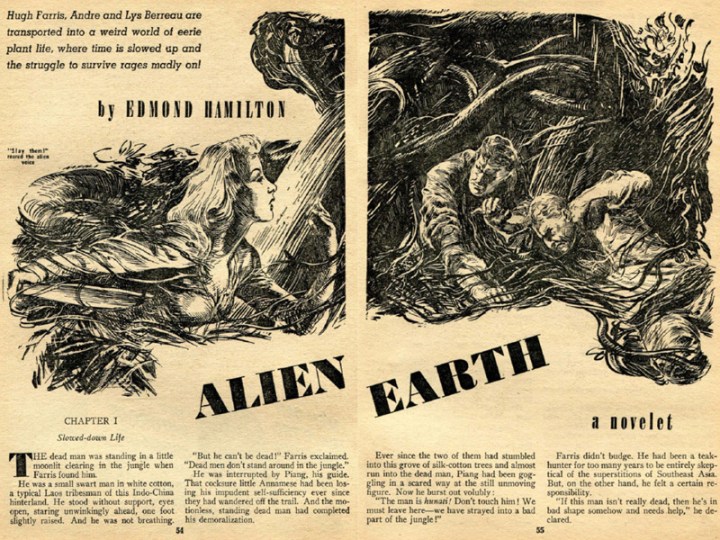
“Alien Earth” by Edmond Hamilton first appeared in the April 1949 issue of Thrilling Wonder Stories. It has seldom been reprinted. I just discovered it in an old copy of The Great SF Stories 11 (1949) which came out in 1984. In other words, this story is mostly forgotten. You can read it online at the Internet Archive.

Edmond Hamilton got his start in Weird Tales in the 1920s but eventually wrote extensively for many kinds of pulps and comics. Today he is mainly remembered, if he’s remembered at all, for his space opera, especially as the primary author of Captain Future. Because of this, when I turned the page of this anthology and saw it was by Edmond Hamilton I groaned inwardly. I wasn’t in the mood for a silly space opera. Instead, I got a contemporary adventure tale that grabbed me and I grabbed back.

I don’t know why “Alien Earth” is not better remembered because I found it very readable and compelling. Within a few paragraphs, I was thinking what a great writer Hamilton was, and impressed he could do something so different. The opening line was just right, “The dead man was standing in a little moonlit clearing in the jungle when Farris found him.” The dead man, described as a typical Laos tribesman, wasn’t entirely dead. I don’t know my 1949 geography, but I’m guessing this is French Indochina. So the story starts out as a jungle adventure in a science fiction magazine. It was both realistic and fantastic, and ultimately, wonderfully speculative.

I can’t describe much of the story without creating spoilers, but let’s say it reminds me of the stories of Carlos Castenada I read back in my New Age phase in the late 1970s. It deals with states of consciousness and could easily have been popular during the New Wave period of science fiction back in the 1960s, something J. G. Ballard could have written.

I have an ongoing fantasy about editing an anthology of forgotten science fiction stories. “Alien Earth” is a story I’d want to include. Read it, and let me know what you think. I fear I might love stories that few others would love too since so often the stories I’d want for my imaginary anthology are not ones many remember. Maybe I should call my anthology Forgotten Science Fiction for Readers Like Me. It might sell 17 copies.

Thrilling Wonder Stories April 1949

James Wallace Harris

The Year’s Best Short Science Fiction: 1948

1948-sf

Is there any reason to read SF short stories from 1948 in 2019? Over at the blog Doomsdayer, Zach read the Bleiler/Dikty anthology and judged it unworthy claiming the experience was “monumentally boring.” He went on to point out there was only one story was completely written by a woman, while another had a woman coauthor. He also noted that 8 of the 12 stories had no women characters at all while ethnicity was barely alluded to once. I can imagine that Zach is young and that most readers from recent generations will have his reaction to these 1948 SF short stories.

Escaping into the past feels like fiddling while Rome burns. We face so many social problems today that we barely have time to think about the countless threats to our future, so why look backward? These 1948 science fiction stories have nothing relevant to say to the people of 2019. So why read them?

I enjoy old science fiction, but I assume these stories won’t appeal to 99.9% of science fiction fans. A few are beautiful if beheld by the right beholder. Odds are, you aren’t that person. But who is? Who is the target reader for these 71-year-old science stories?

We want to believe that art is timeless and enduring, but it’s not. Enjoying these stories often depends on being a pop culture archeologist. Or a student of literary evolution. They are snapshots of our hopes and fears from 1948. Science fiction writers are known for their wild speculations about fantastic possibilities. For example, in “No Connection,”  Isaac Asimov imagines millions of years from now intelligent bears populating North America, and one of them learns that on a distant continent there is a high tech civilization populated by descendants of chimpanzees. Sounds fun, but it’s poorly written.

In 1948 there were many stories about how we’d destroy ourselves with atomic bombs but that’s not something we worry about today — we have other ways of destroying ourselves. Mostly these stories are too talky lacking in drama, structure, and emotion. Science fiction writers were still learning how to tell a story in 1948.

Once you begin sampling science fiction from different generations you realize that we ask the same questions over and over again. Asimov asks: What animal will replace homo sapiens when we fail? L. Sprague de Camp asked it in 1939 with “Living Fossil” and Pierre Boulle asked it again in 1963 with Planet of the Apes. Probably every generation since 1968 has been exposed to that idea via the latest remake of the Planet of the Apes films. To give Asimov extra credit, he gives his bears a superior civilization and suggests the evolved chimpanzees will have our trait of self-destruction.

Several of the stories from 1948 try to imagine superior humans and social structures, but their efforts are clumsy. It seems to me that few science fiction stories today attempt that, and instead imagine all the ways we can live with our bad traits. But is comparing the hopes of today against our hopes in the past make rereading these old stories worthwhile? Why do we continue to remember certain books, short stories, songs, and movies decades after they first appeared?

If I asked you to list the artwork from 1948 that you remember and cherish, could you? Unless you’re a major film buff, it’s doubtful you’d recall many of the top movies from 1948. Unless you’re an aficionado of an art form, it’s doubtful you cherish older works. For every Pride and Prejudice, there are a million forgotten works of fiction. Most people are happier with contemporary artistic escapes, with Game of Thrones or Fortnite.

I’m fascinated by how fiction is remembered over the decades. This website is devoted to identifying how those science fiction stories are retained in our collective memory. Sure, we call them classics, but that’s a loaded term because often readers feel classics should be the best stories of all time. I think of classics as those stories that keep hanging around and getting read regardless of their literary quality. We use statistical methods to search for ways to identify how stories are remembered and don’t deal with their aesthetic value.

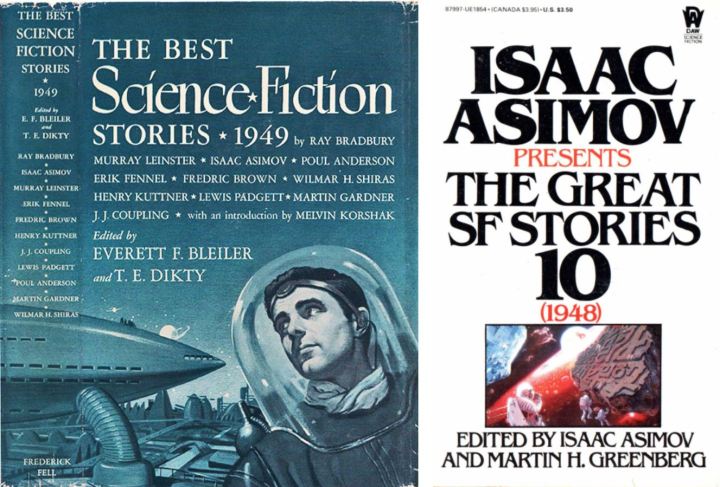
1948 was a special year for science fiction. It was the first year that anthologists evaluated all the stories for a best-SF-of-the-year anthology. Everett F. Bleiler and T. E. Dikty also created an annoying titling standard we still use today. They named their book The Best Science Fiction 1949 but collected stories first published in 1948. WTF?! In 1983, when Isaac Asimov and Martin H. Greenberg retroactively collected their favorite short SF of 1948 they called their volume The Great SF Stories 10 (1948). So I’m reviewing two anthologies that collected the “best” science fiction short stories of 1948, one labeled 1949 and one 1948. That’s confusing. This year we’ll see anthologies called the best stories of 2019 but they will reprint 2018 stories.

I find it fascinating to compare what Bleiler/Dikty liked in 1949 with what Asimov/Greenberg liked in 1983, with the statistical analysis we did in 2018. Unfortunately, there’s no Retro Hugo awards 1949 for the 1948 stories. (Hugo awards are also one year off from the actual publication years.)

Here’s what Bleiler and Dikty picked back in 1949. I’ve bolded the stories the two anthologies have in common.

  • Mars is Heaven!” by Ray Bradbury
  • “Ex Machina” by Lewis Padgett (Henry Kuttner and C. L. Moore)
  • The Strange Case of John Kingman” by Murray Leinster
  • “Doughnut Jockey” by Erik Fennel
  • Thang” by Martin Gardner
  • Period Piece” by John R. Pierce (J. J. Coupling)
  • Knock” by Fredric Brown
  • “Genius” by Poul Anderson
  • “And the Moon Be Still As Bright” by Ray Bradbury
  • “No Connection” by Isaac Asimov
  • In Hiding” by Wilmar H. Shiras
  • “Happy Ending” by Henry Kuttner and C. L. Moore

Asimov and Greenberg pick these stories in 1983 as the best of 1948:

  • “Don’t Look Now” by Henry Kuttner
  • “He Walked Around the Horses” by H. Beam Piper
  • The Strange Case of John Kingman” by Murray Leinster
  • “That Only a Mother” by Judith Merril
  • “The Monster” by A. E. Van Vogt
  • “Dreams are Sacred” by Peter Phillips
  • Mars is Heaven!” by Ray Bradbury
  • Thang” by Martin Gardner
  • “Brooklyn Project” by William Tenn
  • “Ring around the Redhead” by John D. MacDonald
  • Period Piece” by J. J. Coupling
  • “Dormant” by A. E. Van Vogt
  • In Hiding” by Wilmar H. Shiras
  • Knock” by Fredric Brown
  • “A Child is Crying” by John D. MacDonald
  • “Late Night Final” by Eric Frank Russell

I’ve tried to find other sources from the era where fans discuss their favorite stories. If I had time I’d go through the old fanzines to see what fans got excited about back then, but for now, I turned to Alva Rogers and his history A Requiem for Astounding, first published in 1964. I’m sure Rogers first read the stories as they came out in 1948, and then reread them for his book – so it’s not quite a 1948 perspective.

Rogers called the chapter on 1948 “The Threshold of Maturity,” claiming John W. Campbell was finally fulfilling his dream of making science fiction for mature readers. Rogers said Amazing Stories and Fantastic Adventures were serving up adolescent pap that was ignored by mature fans, and that Planet Stories was fun but still immature. He did say that Thrilling Wonder Stories and Startling Stories were the closest in competition to Astounding Science-Fiction. As I’ve read The Great SF Stories 1-9 (1939-1947) I have seen an evolution in storytelling development.

Rogers thought the standout stories of 1948 (from Astounding) were:

  • “Now You See It” by Isaac Asimov
  • “Police Operation” by H. Beam Piper
  • “In Hiding” by Wilmar H. Shiras (one of the real sleepers of the year)
  • “Genius” by Poul Anderson (excellent)
  • “The Rull” by A. E. Van Vogt
  • “That Only A Mother” by Judith Merril (one of the most impressive debuts)

“Now You See It” became part of Second Foundation. “Genius” was a very tedious story in my mind that was based on a good idea. It’s about a future galactic empire ruled by psychologists (shades of Asimov) that experiment with a planet colonized by genetically engineered geniuses. “The Rull” became part of the fix-up novel, The War Against the Rull.

Rogers also mentioned some almost-as-good stories:

  • “There is No Defense,” “The Love of Heaven,” and “Unite and Conquer” by Theodore Sturgeon
  • “He Walked Around the Horses” by H. Beam Piper
  • “West Wind” and “The Strange Case of John Kingman” by Murray Leinster
  • “Her Majesty’s Aberration” and “The Great Air Monopoly” L. Ron Hubbard
  • “Ex Machina” by Henry Kuttner

Only three stories made our Classics of Science Fiction Short Stories list (those getting 5 or more citations) but I’m including the runner-ups, which got 3 or more citations.

  • “That Only a Mother” by Judith Merril (11)
  • “Mars is Heaven!” by Ray Bradbury (7)
  • “In Hiding” by Wilmar H. Shiras (5)
  • “The Lottery” by Shirley Jackson (4)
  • “The Strange Case of John Kingman” by Murray Leinster (3)
  • “Dreams Are Sacred” by Peter Phillips (3)

Only “Mars is Heaven!” and “In Hiding” are on all three lists. Both of those stories, and “That Only a Mother” made The Science Fiction Hall of Fame. So our statistical system works pretty good at identifying stories that are generally remembered.

Read Some of these Stories Online

I’d say the top four stories above are the ones worth reading most. But here’s a sampling to try for yourself. Links are to the stories at Internet Archive using scans of old pulp magazines.

That Only a Mother

That Only a Mother” by Judith Merril is about the fears of mutations caused by radiation. Right after Hiroshima, the public and science fiction worried that atomic research would lead to the birth of either monsters or superhuman mutants. I wasn’t impressed the first time I read this story, but it gets better and better with every new reading. “That Only a Mother” was reprinted again last year for The Future is Female! edited by Lisa Yaszek for the prestigious Library of America. “That Only a Mother” is also about a new superhuman, like “In Hiding.”
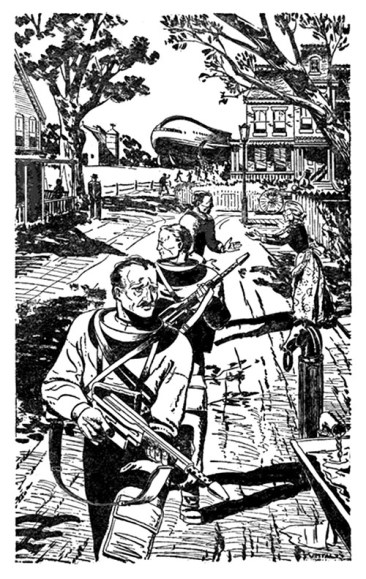
Mars is Heaven

Mars is Heaven!” is preserved in Ray Bradbury’s enduring classic The Martian Chronicles. Bradbury was considered literary back then, and he eventually left the genre, so he straddles two reading worlds. “Mars is Heaven” is so obviously scientifically wrong, yet so wonderfully right in its storytelling. I’ve read this story four or five times now, and it still reveals new pleasures. One of my all-time favorite SF short stories.

Bleiler and Dikty also included “And the Moon Be Still As Bright” – another wonderful story from The Martian Chronicles. Of all the stories here, this story is the most relevant to today. Bradbury wrote nostalgic feel-good stories that recognized the nastiness of the human race.
In Hiding

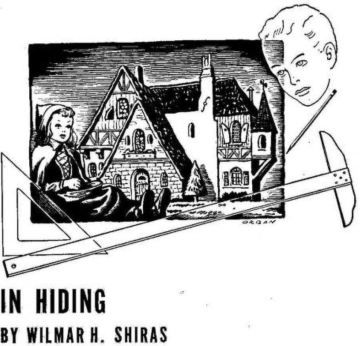
In Hiding” by Wilmar H. Shiras is a forgotten classic. It’s my favorite science fiction story from 1948. “In Hiding” is a gentle story about a child genius that was so different from all the other similar stories from back then using that theme. “In Hiding” was also included in The Future is Female! Shiras wrote four sequels to this story and made them into the fix-up novel Children of the Atom (Gnome Press, 1953). That novel is mostly forgotten today, but I liked it well enough to buy a first edition copy to keep. And I noticed the other day on a  Facebook science fiction book club. people were fondly discussing Children of the Atom, so maybe someone will reprint it soon. Many readers don’t know that Shiras was a woman, which makes two of the three great SF stories from 1948 by female writers. Shiras thought out the consequences of an emergent new species of human far more carefully than any of her male writers.
The Strange Case of John Kingman

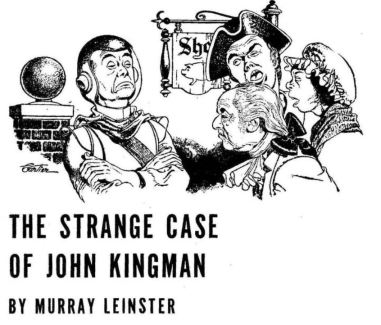
The Strange Case of John Kingman” by Murray Leinster is a very good story but not great, at least not compared to the three above. It’s about an alien that looks mostly human being put away in a mental hospital. It’s still a very readable story but lacks an emotional punch. And I think that’s key for a story to become the kind of classic that is remembered for years and years.

Dreams are Sacred

Dreams Are Sacred” by Peter Phillips still works too, and it prefigures Roger Zelazny’s The Dream Master (“He Who Shapes”) which won the Nebula award in 1966. A writer is in a psychotic coma and his psychiatrist invents a way to send an observer into his patient’s dreams. This is still a cool idea today. Imagine Don Quixote in an Edgar Rice Burroughs nightmare being rescued G.I. Joe.
He Walked Around the Horses

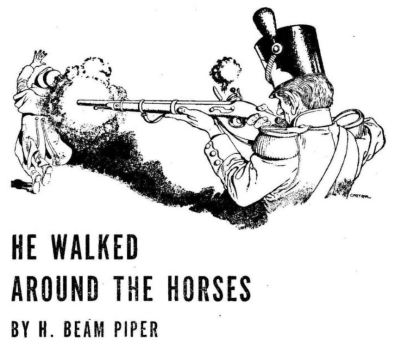
I’m partial to “He Walked Around the Horses” by H. Beam Piper. Campbell and some of the Astounding readers back in the 1930s and 1940s were intrigued by the writings of Charles Fort who collected supposedly true unexplained mysteries. Most readers considered Fort a nutjob and crank. Piper took a real case of a missing person and wrote an epistolary narrative about the man being found in an alternative universe where Napolean didn’t start a war. Piper’s story is still very readable today but isn’t really science fiction, but falls in the sub-genre of alternate history. It probably inspired Piper to write his Paratime series. H. Beam Piper is one of the writers I’ve rediscovered this past year that I think deserves more attention.
Ex Machina intro

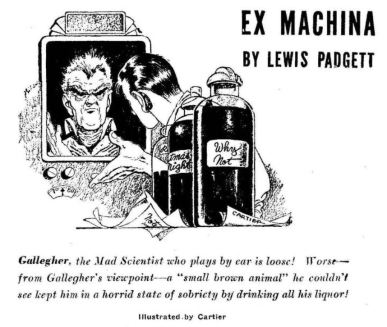
Ex Machina” by Lewis Padgett was probably mostly written by Henry Kuttner and not C. L. Moore. Husband and wife tag team writers regularly wrote under the byline, Lewis Padgett. Back in the 1970s, I ran across a copy of Robots Have No Tails which collected all the Gallegher stories and was enchanted by it, but nowadays I have a hard time enjoying Kuttner’s stories. I found “Ex Machina” rather long and tedious until I came to this paragraph:

The social trend always lags behind the technological one. And while technology tended, in these days, toward simplification, the social pattern was immensely complicated, since it was partly an outgrowth of historical precedent and partly a result of the scientific advance of the era. Take jurisprudence. Cockburn and Blackwood and a score of others had established certain general and specific rules—say, regarding patents—but those rules could be made thoroughly impractical by a single gadget. The Integrators could solve problems no human brain could manage, so, as a governor, it was necessary to build various controls into those semi-mechanical colloids. Moreover, an electronic duplicator could infringe not only on patents but on property rights, and attorneys prepared voluminous briefs on such questions as whether "rarity rights" are real property, whether a gadget made on a duplicator is a "representation" or a copy, and whether mass-duplication of chinchillas is unfair competition to a chinchilla breeder who depended on old-fashioned biological principles. All of which added up to the fact that the world, slightly punch-drunk with technology, was trying desperately to walk a straight line. Eventually, the confusion would settle down.

That’s exceedingly perceptive for 1948, and if you realize by integrators Kuttner meant computers and electronic duplicators he meant 3D printers, it’s still insightful for 2019. I dislike the Gallegher stories today because I’m impatient with the drunk inventor and because Kuttner withholds information from the reader for suspense. However, if I saw this story dramatized for Black Mirror or the new Twilight Zone it’s zaniness might reconstitute itself.
The Lottery

The Lottery” by Shirley Jackson originally appeared in The New Yorker and is one of the most famous short stories ever written. I wouldn’t think most readers would think of “The Lottery” as science fiction, but it made it onto three SF fan polls of favorite stories. It does fall in the realm of speculating about alternate societies that sociological science fiction likes to explore. Ursula K. Le Guin did a much more science fictional version of the theme with her story “The Ones Who Walk Away from Omelas.”

No Connection Isaac Asimov

No Connection” by Isaac Asimov doesn’t fit into his Robot or Foundation series. Without the illustration, I wonder how soon many readers would have figured out the main character was a bear? I guessed gorilla. It’s funny but in all these stories, all intelligent beings smoke, even the bears.

James Wallace Harris

“Living Fossil” by L. Sprague de Camp


Reprinted from Worlds Without End.

Read it now: Astounding Science-Fiction February 1939

You might own “Living Fossil” already in one these anthologies:

Warning: This column contains spoilers.

Let’s imagine we’re a science fiction writer back in the late 1930s. We don’t make much money, so we probably live in a cheap tenement house. There’s no air conditioning, so the windows are open, and the street sounds are pouring in. We have no computer or smartphone, no internet or television. We carefully read the morning and afternoon newspapers, listen to the radio and subscribe to Astounding Science Fiction, Thrilling Wonder Stories, Popular Science, and Scientific American. We often walk to the library in the evening. This is our world of information in 1939.

We’re sitting at the typewriter, smoking a cigarette, planning a story we hope to sell to Astounding Science-Fiction. We want an idea that will wow them and get us the cover. We want to produce the thought variant story. We have a solid knowledge of science fiction published in the pulps back to 1926, and we know the classics like Verne and Wells. Plus, we like to think we’re scientific and visionary.

If you’ve read science fiction short stories from this era you know the variety of wild ideas pitched to science fiction editors. Coming up with something different was essential. Science fiction was mostly idea driven until after the New Wave of the 1960s. Science fiction writers were expected to be as original as research scientists testing a new hypothesis.

“Living Fossil” by L. Sprague de Camp has not been reprinted very often, and I find that surprising. Anyone seeing the interior illustration above will exclaim, “Oh my god, that’s Planet of the Apes!” But it’s 1939, not 1963 when Pierre Boulle’s Planet of the Apes first appeared in English. How did de Camp get that idea? Was it astoundingly original in 1939, or are there older versions of the same idea in pulps I haven’t read?

Anyone who has read The Time Machine (1995) by H. G. Wells already knows about possible evolutionary descendants of Homo Sapiens. That novella also gave us the meme that death will one day come to both to our species and the Earth. And if you’ve read the brilliant Last and First Men (1930) by Olaf Stapledon then you’ve already entertained that 17 possible future species of humans could exist after us.

Is it so hard to imagine that L. Sprague de Camp asked himself, “What if humans became extinct, how long before another species would become intelligent?” This is one of my favorite science fiction themes: Who comes after us? Clifford Simak imagined intelligent dogs and robots in his lovely fix-up novel, City. Today we assume AI machines will replace us. But have you read the wonderful The World Without Us by Alan Weisman, or seen the television documentaries that were inspired by it? I wrote about them back in 2012. What if self-aware intelligence doesn’t rise up again?

Who comes after humans? “Living Fossil” speculates they could be capuchin monkeys from South America after 10 million years. The story opens with Nawputta, a zoologist and his guide Chujee riding their agoutis exploring northeast North America near Pittsburgh. Ten million years have made a lot of smaller species much larger in their world, and now the agoutis are as large as mules.

This is a pleasing idea, at least to me. I love to think if humans go extinct life on Earth will go on. De Camp even has his Jmu (the capuchin word equal to human) complain that humans used up all the metals and other resources. As Nawputta and Chujee cross the country looking for new specimens for their museum back home, they speculate about the dead civilization of man. After finding what remains of a large stone with a partial inscription on it, they start speculating:

Notice the part where they wish they could meet a live human? Well, that comes true, but not for a couple days. First, they meet another one of their kind by a campfire, Nguchoy tus Chaw, and he’s none too friendly. This part of the story reminds me of James Fenimore Cooper and his tales about the French and English using the Native Americas. Like Cooper’s stories, there’s all kind of dishonest shenanigans going on by ambitious colonists wanting to exploit the wilderness.

Nguchoy is a timber scout who is doing something shady. Our guys get suspicious of him. After he leaves they head further into the unknown country. Eventually, they find three dead humans, not fossils, with bullet holes in them. They figured Nguchoy shot them. For some reason, the zoologist decides he wants to find and kill a fresh human for a specimen. My friend Mike thought this ruined the story because earlier they had been wishing to find a human to talk to. I assumed they meant city dwelling humans, not humans who had to devolve back to living in caves. Here’s what happens:

This is where de Camp differs from Pierre Boulle. For the rest of the story, which is mainly an adventure narrative about Nawputta and Chujee fleeing for their lives in a territory of hostiles humans who weren’t afraid of their guns. Our sympathy is with the Capuchins. De Camp portrays humans like Native Americans in old westerns. They are fearless, ferocious, and treacherous. I don’t know if this is ironic or straight. I don’t know if de Camp was being satirical by having monkeys colonize the new world and then treat humans the same way Europeans treated the Native Americans. Or, if the story was to parallel how Cro Magnon killed off the Neanderthal. Or both. In either case, it’s accepted within this story for the monkeys to kill the humans.

In the Planet of the Apes, our perspective is on the side of the humans, and we want them to fight their way back to the top of the evolutionary heap. Boulle plays to our vanity so we want his humans to outwit the evolved apes. In “Living Fossil” de Camp doesn’t take sides but assumes a kind of naturalism where an intellectually advanced species will overcome a less advanced species.

But I have yet another theory. Maybe de Camp wanted to say humans aren’t the divinely chosen, the crown of God’s creation. Science, evolution, and the Enlightenment offer a view of reality where God isn’t needed or wanted. Readers who feel humans are special will object to this story. In fact, the faithful shouldn’t like this story at all, because it says humans aren’t the center of existence, won’t live forever, and are no different from the other animal species. In that sense, I think de Camp is sticking it to our collective egos.

That’s what I love about these old pulp magazine stories. An ordinary writer could have big ideas and get paid a 1/2 cent a word by the top science fiction magazine of the day. Science fiction allows anyone the chance to defy the common belief, the accepted orthodoxy, or even speculate beyond proven scientific knowledge.

Science fiction allowed every writer to become a Darwin, explaining reality in fiction by using their own observations, speculations, and extrapolations. Sure, most science fiction writers came up with craptastic ideas, but so what, some of them were brilliantly imaginative, and often inspired a sense of wonder, at least in adolescent geeky boys of the times.

How would you answer this question today: “Who comes after humans?” Has science fiction already explored all the obvious possibilities? Already, science fiction has suggested endless variations on Superman and mutations. We’ve imagined countless evolved animals and machines taking over. We’ve imagined aliens moving in and kicking us out. But I’m positive, if I keep reading these old pulp magazines, I will find stories that will surprise me.

[I’m surprised “Living Fossil” didn’t get the cover for February 1939.]

James Wallace Harris

Vultures of the Void by Philip Harbottle

Vultures-of-the-Void

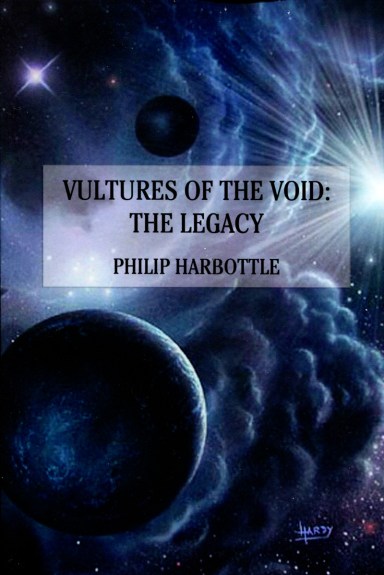
I came across Vultures of the Void: The Legacy by Philip Harbottle by accident. Paul Fraser chided me in an earlier post being too American-centric when talking about science fiction history, so I went looking for more information on British science fiction history. I found a mention of an earlier edition of Vultures of the Void in Mike Ashley’s Transformations: The Story of Science Fiction Magazines From 1950 to 1970 (itself out-of-print.)

Vultures of the Void is a print-on-demand (POD) book, which can be ordered from a number of sources. Here’s how Amazon describes it:

An earlier, very much shorter version of this book was published as VULTURES OF THE VOID in 1992 by Borgo Press, along with a companion bibliographic volume, BRITISH SCIENCE FICTION PAPERBACKS AND MAGAZINES 1949-1956. Now the compiler and editor of those books, Philip Harbottle, here presents the result of his further and ongoing researches into British science fiction publishing history. This greatly expanded version includes entirely new coverage of the generic hardcover titles that briefly and paradoxically flourished alongside the indigenous British paperbacks of the early 1950's, spearheaded by an influx of outstanding American science fiction by such authors as Isaac Asimov, Fredric Brown, Edmond Hamilton, Robert Heinlein, Jack Williamson, and A. E. van Vogt. VULTURES OF THE VOID: THE LEGACY also deals in fascinating detail with related shaping events both before and after the notorious postwar 'mushroom' decade. In particular, it describes how many of the original founders of the pre-war British Interplanetary Society - including fledgling young science fiction writers such as Arthur C. Clarke and Eric Frank Russell - were to become giants and shapers of their field after the war. And how pioneer editors such as Walter Gillings and John Carnell struggled against overwhelming odds to establish British science fiction magazines both before and after the Second World War. In this new book, Harbottle also reveals the astonishing latter-day legacy of the turbulent postwar decade for himself and some of the most prolific authors such as John Russell Fearn, E. C. Tubb, and others, whose work he has been instrumental in returning to print.

The book is almost four hundred pages of fairly small print spiced with black-and-white photos of covers from old British science fiction books, paperbacks, and magazines. While flipping through it I realized Paul was right, I do have an American-centric view of science fiction. Vultures of the Void shows an alternate history of science fiction that I know little about.

This is an obscure book, not because it’s unavailable, but because so little is written about it. There are only three reviews at Goodreads. I was able to find one review by science fiction writer  David Redd.

If you collect old science fiction magazines and books, you might want to buy this one.

James Wallace Harris