Who Were the Korlevalulaw?

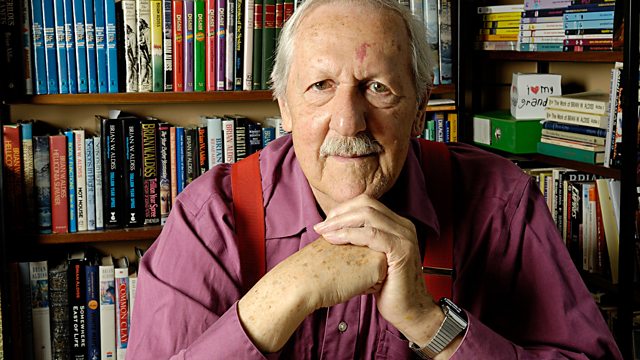
Brian W. Aldiss

A funny thing happened on the way to writing this essay. I sat down to review the short story “Appearance of Life” by Brian W. Aldiss. I thought I’d check Google before I started to see if I could find any history about the story. The first item returned was ‘“Appearance of Life” by Brian W. Aldiss‘ – a review of the story I had written back in 2009. I know my memory is deteriorating, but I found it hilarious that I had completely forgotten something I had written and I was about to write the very same thing then years later. I wish I had finished writing this new review before discovering my old review so I could have compared the two. I know I should be depressed over the existential holes in my memory, but nowadays, I just laugh at myself. I’m going to worry when I stop laughing.

Reading that forgotten review from a decade ago shows I damned the story with faint praise and use it for a jumping-off point to discuss the nature of science fiction. I will quote parts of it in this review. I liked “Appearance of Life” much better this time around. Most stories do get better with rereading. I’ve also learned since 2009, that the more I read works by a single author, the more I can map their range of abilities and interests. Back in the 1960s, Aldiss was among the Big Three of British SF writers: Aldiss, Ballard, and Clarke. His legacy has been fading in recent decades — but then so has most of the science fiction writers I grew up reading. I know I’ve pretty much forgotten about Aldiss since the end of the 1970s.

For the last couple of years, I’ve been gorging myself on science fiction short stories. I haven’t completely logged my 10,000 hours yet, but I’ve acquired a decent sense of the art form. Every SF short story must stand on its own, but it also competes with all other science fiction short stories. Science fiction by its nature is in conversation with itself. Science fiction is about ideas. The challenge to a creative SF writer is to come up with fresh insights to old ideas, and if they want to be cutting-edge, add a new idea to the genre’s repertoire.

Science fiction wants to be infinite in novelty but is often repetitious in routine, improvising on old melodies. Long term readers who have consumed a critical mass of science fiction will understand the genre recycles all the great concepts for each generation of young readers. Neophyte fans often feel they are experiencing a mind-blowing concept for the first time when reading current SF. They believe those ideas are new to them and original with the author they are reading. They can’t tell if the presentation is a brilliant revision or a tired retread. Nor do new SF readers understand that science fiction has evolved over time and gone through many revolutions in writing styles. It isn’t easy to spot the changing prose styles in science fiction as it is flipping through art history textbooks.

I’ve only read four novels by Aldiss, but only vaguely remember two, Hothouse and Non-Stop which I’ve read twice each. (Called The Long Afternoon of Earth and Starship when I read them in their first American editions back in the 1960s.) Over the decades I’ve only read a scattering of his short stories. I’m currently listening to The Best SF Stories by Brian W. Aldiss from Audible.com.

What got me interested in Aldiss again was Joachim Boaz’s review of The 1977 Annual World’s Best Science edited by Donald Wollheim. It contains “Appearance of Life” which Boaz rated 5/5 (Near Masterpiece). How could I resist that? Boaz said of the story, “It is powerful and mysterious. Aldiss at the height of his powers.”

Here is my original description of the story:

“Appearance of Life” can be found in these anthologies, but it’s not a very famous story.  I’m reading it because it’s the opening story from The 1977 Annual World’s Best SF edited by Donald A. Wollheim, a collection we’re reading in the Classic SciFi reading group.

The story opens with two sentences that sum up the story, “Something very large, something very small: a galactic museum, a dead love affair.  They came together under my gaze.”  The story immediately evokes the awe associated with tales about mysterious missing aliens who leave galactic ghost worlds behind, like the Krell that once lived on Altair IV in the film Forbidden Planet, or the strange civilization that once existed on Bronson Beta, from the novel After Worlds Collide. These were my first encounters with the sense of wonder brought on by discovering long dead alien cultures back in the 1960s, but it’s a very common cliché in science fiction that I see over and over again.  It’s odd what Aldiss does with this common idea.  His aliens are called the Korlevalulaw, a tongue-twisting name to say or think.

One cool idea in the story is the Korlevalulaw abandoned written writing, which is something our culture is doing now because of the Internet.  What will aliens discovering our civilization ever make of keyboards and LCD monitors?  Reading this short story also makes me wonder what if anything could be made of my life from the possessions I’ll leave behind.  Think about it.  Photographs tell more than anything else.  How long will this blog endure?

On the planet Norma, humans find a vast building that girdles the planet for sixteen thousand kilometers.  Humans have decided to use this alien construct that is impervious to the electro-magnetic spectrum as a museum to house the history of mankind.  Androids tirelessly store humanity’s artifacts, supervised by twenty human female staff members.  The narrator is a “Seeker” who gets to prowl the collection and develop theories.  The entire structure was left empty by the Korlevalulaw, and after ten centuries humans have filled several thousand hectares of space.

Seekers are specially trained people to intuit understanding from scant evidence, perfect for studying the junk left in this vast Smithsonian like attic a thousand light years away from Earth.  At the current rate it will take 15,500 years to fill the alien structure.  To the Seeker, the human artifacts are almost as alien to him as the Korlevalulaw is to us, because humans have been around for so long that they no longer look like 20th century people.  That’s a nice science fiction speculative concept to come up with, to be a far future anthropologist, and it’s not an uncommon idea.  H. G. Wells’ Time Traveler spent time in a far future human museum trying to figure out that changes that people experienced over 802 millennia.  So far, Aldiss hasn’t presented us with anything new in this story, yet.

The Seeker explores a spaceship from the time when humans were split 50-50 by gender and discovers a wedding ring.  In the Seeker’s time, gender population is 10 to 1 in favor of females.  We readers don’t know why, but it’s an interesting thing for Aldiss to throw out.  Eventually the Seeker discovers two cubes, from different spaceships, that were holographic recording devices.  By unbelievable luck, they are from a married couple that recorded messages to each other fifteen years apart, and were design to only respond to the face of their beloved, so the Seeker sets them together and lets the holograms chat out a long dead love affair in an out of sequence conversation of regret and love that is sixty-five thousand years old.

Jean and Chris’ love story takes a couple of pages to play out, but ultimately it seems completely mundane to me, even though they were separated by interstellar war.  I’m surprise Aldiss didn’t invent something new to add to marriage and love.

Now we come to the intent of the story, called the “secret of the universe” by the Seeker in his epiphany, “Like the images I had observed, the galactic human race was merely a projection.  The Korlevalulaw had created us – not as a genuine creation with free will, but as some sort of a reproduction.”  Then the Seeker decides his flash of intuition is nonsense, but we know that isn’t true by his final actions.

In the end the Seeker flees the world Norma to desperately seek out an isolated world to hide away from humanity, fearing that if he communicated his secret it would doom mankind.  And this is why I’m writing this review.  What is Aldiss really implying?  I think he’s saying something philosophical that’s more than making up a spooky SciFi story ending.  I feel Aldiss wants his story to be disturbing like those Mark Twain stories written in his collection Letters from the Earth, which featured Philip K. Dick paranoia about existence.

Experience SF readers will have read many stories about our species exploring the galaxy. Galactic empires are an over-explored territory. When considering intelligent life in the galaxy stories tend to fall into three camps: humans are the only intelligent beings (Foundation series by Asimov), intelligent beings show up infrequently (“Appearance of Life”) and the galaxy is teaming with life (Star Wars, Star Trek). One of the common assumptions of the infrequent model is intelligent beings evolve, spread through the galaxy, and then die out or evolve into a higher nonmaterial existence leaving the galaxy unoccupied again. Childhood’s End and 2001: A Space Odyssey both take the evolution to a higher plane of existence route.

The stories of alien archaeology where humans only find the material remains of a vast civilization of disappeared inhabitants is one of my favorite themes. Often in these stories, the mystery is to solve why the ancient aliens disappeared. Characters usually feel that will lead to either of three outcomes. First, such as the works of Olaf Stapledon, show humans an evolutionary/spiritual purpose to follow. Second, they feel it’s some kind of test, a rite of passage, to joining the league of advanced beings. Third, there is a drive to acquire the knowledge and technology of these senior beings. I believe Aldiss was trying to come up with something different in “Appearance of Life.”

The famous science fiction editor John W. Campbell didn’t like the idea of humans being inferior to aliens, so we often see Homo sapiens as the top dog in the galaxy. I’d say most science fiction writers assume the galaxy is full of intelligent life, but humans will play a significant role, and no species will truly dominate. Most galactic empire stories are about the high tech potential of humans but fall short of becoming non-physical energy beings.

In “Appearance of Life” Aldiss opens with:

Something very large, something very small: a galactic museum, a dead love affair. They came together under my gaze.

The museum is very large. Less than a thousand light years from Earth, countless worlds bear constructions which are formidably ancient and inscrutable in purpose. The museum on Norma is such a construction.

We suppose that the museum was created by a species which once lorded it over the galaxy, the Korlevalulaw. The spectre of the Korlevalulaw has become part of the consciousness of the human race as it spreads from star-system to star-system. Sometimes the Korlevalulaw are pictured as demons, hiding somewhere in a dark nebula, awaiting the moment when they swoop down on mankind and wipe every last one of us out, in reprisal for having dared to invade their territory. Sometimes the Korlevalulaw are pictured as gods, riding with the awfulness and loneliness of gods through the deserts of space, potent and wise beyond our imagining.

The two opposed images of the Korlevalulaw are of course images emerging from the deepest pools of the human mind. The demon and the god remain with us still.


I believe that opening captures the routine reactions of most science fictions stories about missing ancient aliens. Humanity has spent thousands of years speculating what God and Satan, or gods and demons, are like. How is that any different than speculating about possible superior alien beings? There is an ineffable quality to that problem that we never tire of putting into words.

Most SF stories predict we will be able to communicate with any alien species we encounter. Aldiss has major doubts. In “The Failed Men” also from The Best SF Stories by Brian W. Aldiss Aldiss casts more doubts on our ability to communicate between vastly different cultures. In “Appearance of Life” Aldiss uses a clever analogy with the talking holographic heads of Jean and Chris to explain why humans will never understand the Korlevalulaw. Aldiss’ insight is we can’t talk to each other, so there will be no communication possible between humans and gods, or humans and advanced aliens, or even humans and average aliens.

The Seeker who narrates this story is trained to synthesize ideas and experiences. In the end, he claims to have an insight into the secrets of the universe. However, like his insight at the beginning of the story, it parallels ancient theology, that the Korlevalulaw created us as their art. How is that different from the Biblical idea that we’re created in God’s image?

In my original essay I concluded:

Aldiss doesn’t sell his idea to me.  Having humanity be the art of an alien culture is no more real to me than believing man was made in God’s image, although I find it fascinating that billions of humans desperately refashion their lives to fit three thousand year old writings that shaped the long lost twelve tribes of Israel.

The trouble with science fiction writers is they don’t believe their own ideas, they just like to churn out weird concepts to mess with our heads.  The best science fiction concepts are the ones we want to accept, like space travel and life extension, so I’m surprised this story has even gotten the attention it has.   I’m betting most people liked it for the setup, for the sense of wonder buildup, even though it wasn’t original, and the weird ending didn’t mean much to most readers, but I could be wrong.

Now for the second thoughts a decade later. 

With each science fiction story I read I ask myself a number of question:

  1. Do I want to read this story again?
  2. Is this story worth writing about?
  3. Should I recommend it?
  4. Is it on the Classics of Science Fiction Short Stories list?
  5. Is it a story that contemporary readers will like?
  6. Is it a story that is essential in the history of science fiction?
  7. Would I put it on my all-time favorite SF short story list?

For this review, I read the story, then bought the audiobook collection so I could listen to it, and I’m even reading it again for writing this review because I find it pleasantly compelling. And I’m pretty sure I’ll come back to it again in the future, maybe many times.

Since I’m writing about it, that answers question #2. I do recommend it, but the chance of readers finding a copy is damn small unless they own one of these old anthologies, or is willing to buy it on audio. I can’t find any print or ebook editions for sale.

“Appearance of Life” did not make it to the final Classics of Science Fiction Short Stories list. It only got 2 citations, one for the Wollheim anthology, and one for the Gunn anthology, The Road to Science Fiction Volume 5: The British Way. Currently, the minimum number of citations to get on the list is 8, and that grows over time. It’s extremely doubtful “Appearance of Life” will become a classic, either for our list or with science fiction fans.

Would young new readers of science fiction like the story today? My one data point is Joachim Boaz who is in his early thirties. But Boaz isn’t like most fans, he’s a historian, and also loves the history of science fiction.

Compared to other classic SF short stories, it’s doubtful many will consider “Appearance of Life” significant in the history of science fiction. Part of the problem is it came out in an obscure original anthology, and then it’s never been reprinted in an enduring retrospective anthology. Another factor in hiding its light under a bushel is the Aldiss star is fading.

Two of the definitive retrospective anthologies from recent years  The Big Book of Science Fiction (2016) edited by Jeff and Ann VanderMeer and Sense of Wonder (2011) by Leigh Grossman had a large percentage of stories from the Classics of Science Fiction Short Stories list. Huge anthologies like these come out every few years and help keep SF short stories alive in the minds of new readers. Between them and fan polls, it’s about the only way older stories are remembered. But who knows, maybe between Joachim Boaz and myself we can get more people to read “Appearance of Life.”

Finally, I am considering putting “Appearance of Life” on my all-time favorite SF short story list I’m constructing. However, that list is limited. If I was creating 1,000 Science Fiction Short Stories to Read Before You Die it would be on it. Even if I was creating something like Billboard’s Top 100 All-Time Great SF Stories I might include it. However, I’m not sure if it will fit on my Jim Harris’ Top 40 playlist.

My Top 40 playlist is the science fiction stories I want to keep rereading as I get old and approach checking out. The ones I want to remember as my mind fades away. But what makes a story worth cherishing in your fading memory tontine? Before my friend John Williamson died, he got down to loving only two things: the music of Duane Allman and Benny Goodman. My favorites list is growing now, still below 50 titles, and it might eventually reach 100 before my mind pushes me to start thinning it out.

What ultimately matters with a short story or even a novel, is what lingers in the mind. With “Appearance of Life” the images of a giant museum, two memory cubes of lovers in an endless loop of conversation, and the Seeker running away to find absolute solitude. That ending keeps reminding me of the ending to ” Press Enter ▮” by John Varley.

Isn’t getting old and approaching death also a withdrawal into solitude? Do we keep the stories we understand best, and throw out the rest? Or do we keep the stories we don’t understand, and winnow out those that become obvious? I don’t know what my last novel will be, the one I’ll keep reading to the end. But I do know the short story that will win the tontine, “The Star Pit” by Samuel R. Delany. “Appearance of Life” is still in the rotation for now.

I do believe Brian W. Aldiss had a personal epiphany writing “Appearance of Life.” I’m not sure how well he expressed it, or how well I’m perceiving it. Like the story suggests, communication is not possible. But don’t we always keep trying? This is my second attempt to communicate my reaction to “Appearance of Life.” I don’t know if I’ve done a better job or not.

James Wallace Harris
Science Fiction Art

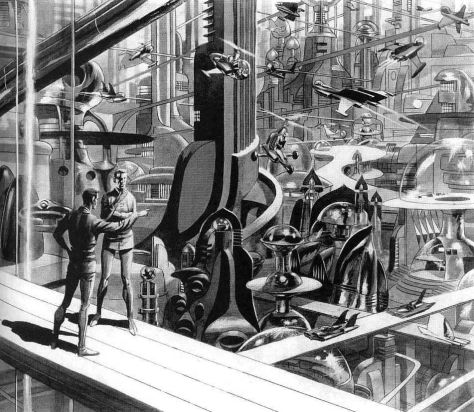
Wally Wood, Creative Artist

Science fiction fans often discuss their favorite science fiction books and movies, but we forget there is another category of creative people who envision the future – artists. I’ve started a page to collect the art that visually illustrates the history of science fiction. I’m using a page rather than a blog post because it’s part of the permanent menu under Essays – see The Classics of SF Art.

There’s no way I can make a statistical case for which works of art are classic, so I’m just going by my own tastes. Right now it has 28 images. I’m going to keep adding to it until the page loading times breaks down. I have many coffee table books for SF art, so this page will be my personal gallery that competes with them. Be sure an leave comments here and there about your own favorite works of science fiction art. I may include them in my gallery.

I’ve tried to size the images so look good on a computer screen, phone, and tablet. Let me know if you have any trouble viewing them.

The above illustration is by Wally Wood, but I can’t locate its original publication. I think it’s from Galaxy Science Fiction. If anyone knows, let me know.

James Wallace Harris

The Stars, Like Dust by Isaac Asimov

The Stars Like Dust by Isaac Asimov

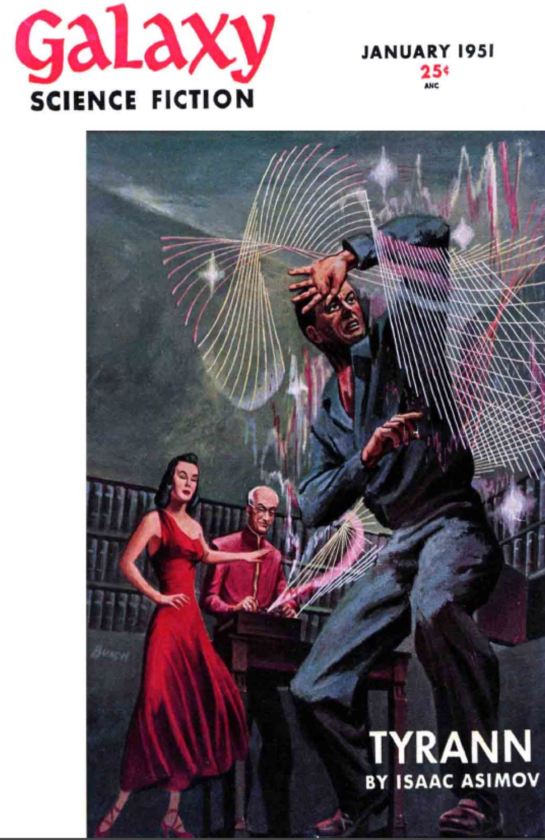
For August, my book club is reading The Stars, Like Dust by Isaac Asimov. It was serialized under the title Tyrann in the first three months of 1951 in Galaxy Science Fiction and later published in hardback from Doubleday that same year. I was born in 1951, so I was delighted to examine a work of science fiction from back then.

I listened to The Stars, Like Dust on an audiobook from Audible.com played on an iPhone. Now that would have been a great prediction to add to a science fiction story for 1951. It’s fun to read old science fiction and think about all the science and technology it missed in hindsight. I always assume the future would be everything we failed to imagine.

The story was mildly compelling, but the finale hokey. The ending struck me funny because I kept wondering the whole story why galactic empires are governed by aristocracies. And why empires? The U.S., E.U., and U.S.S.R. have trouble keeping states and nations together in a cooperative union, how can we expect thousands of planets separated by countless light-years to form a unified government? We can’t scale up to a planetary government here on Earth, so is there any reason to think humans could form a pan-galactic political structure? In the story Nebula Kingdoms are imagined. That name has a nice ring to it, but wasn’t it rather unimaginative of Asimov? Nebula Kingdoms is colorful sounding for a fairy tale, but isn’t it boring to think every planet will be a kingdom thousands of years in the future? Reading this book I got the feeling that George Lucas was a big fan of Isaac Asimov.

The plot of The Stars, Like Dust, is rather simple. Biron Farrill is graduating college on Earth when an attempt is made on his life. He spends the rest of the novel escaping from one planet to the next to find out why. Along the way, he falls in love with the beautiful princess Artimesia of Rhodia, and under the guidance of her cousin, Gillbreth oth Hinriad convinces Biron to seek out the secret rebel planet. Everything is based on foiling the political intrigue of the Tyranni, who are trying to take over the entire galaxy.

I’ve been watching a lot of old pirate movies from the 1940s and they feel very similar to this story and Star Wars. I wondered if Asimov was swayed by the romance of Lords and Ladies because of the swashbuckler flicks he was seeing at the theater? Asimov does come up with a number of different aristocratic titles from various Earth eras that have been used in SF stories ever since. Why do pulp fiction and historical romances love characters with titles so much? Isn’t plain old first names not sense-of-wonder enough for people hyper-jumping across the galaxy?

Also, why would the far future have methods of rule that have fallen out of favor long before Asimov’s own time? Did Asimov and George Lucas feel that thousands of inhabitable planets in a galaxy organized by constitutions would lack grandeur so they spice up their stories with archaic human hierarchies?  Is democracy or socialism just too dishwater gray for 3582 ACE?

What I liked about the story was Asimov’s descriptions of space travel. There is one scene on an interstellar liner where passengers observe going into hyperspace via a large glass wall. That reminded me of the first Star Wars movie when the audience was shown Luke’s first jump through hyperspace.

Asimov spent a fair amount of time trying to describe space navigation, but I doubt his three coordinate systems could work. Although I got the feeling Asimov spent time thinking about it. He tried, that’s more than most SF novelists do. At one point he said it was more complicated than just the three coordinates because they’d have to calculate the motion of the stars. Even if all the stars in the galaxy had the same relationship to each other for an X, Y, Z location, the galaxy would have to have an exact time and date system, and even that assumes the orbits of the stars around the galaxy were perfect and each had a single orbital motion.

The Stars, Like Dust, was a mildly fun escape into the science fiction of 1951, but its science is closer to flying to the moon powered by bottles of dew than real science. (A SF story from a couple centuries ago used that method of escaping Earth.)

It was a fun part of the book when Biron has to fly up to orbit and then make a hyperjump. He’s had a bit of training in college. This gives Asimov a chance to explain how it’s done for the reader. Just how hard could it be for one person with practically no training to pilot a spaceship on the run? Asimov tries, and for me its the highlight of the story, but really it was too simple. I assume Asimov figured readers would only sit still for the tiniest of science lessons. Of course, it shoots down the idea fans learned science from science fiction.

It sure would have been fun in 1966 when Captain Kirk tells Sulu to plot a course to Vulcan if Mr. Spock would have stopped the plot to explain how it was done. I’d like to claim the SF I grew up with 15 years later was more realistic, but I can’t.

        “Set a course to Vulcan Mr. Sulu”

        “Aye, captain.” Sulu turns around. “Which way is that?”

        “Ask Spock, he should know.”

        Sulu turns to Spock

        “When and where are we now? What are our orbital motions?”

        “I don’t know,” Sulu looks annoyed.

        Spock raises one eyebrow. “Just ask the computer, it knows everything and we can keep this script simple.”

NASA has been able to hit asteroids, moons, and planets with precise accuracy, but have you ever wondered how it’s done?

Thus The Stars, Like Dust leaves me thinking about two things. How will interstellar astrogation work, and what kind of governments will develop across star systems. I think Asimov who was a very smart guy but went for gobbledegook political intrigue and romance inspired by Errol Flynn and Oliva De Havilland movies instead of writing about the hard science he was studying at the university.

I’m not sure who to recommend this book to. Asimov fans should enjoy reading one of his early novels. Star Wars fans might get a kick out of it. But readers of modern space opera will find it simplistic compared to current works like The Culture series by Iain M. Banks.

I collected some old reviews of The Stars, Like Dust and put them in a pdf file. It shows that Asimov’s book didn’t impress many even when it came out. But every reviewer saw something different. One long review by Ted White in 1970 gives his perspective of remembering reading it when he was 13 in 1951, and then rereading it years later as an adult.

Nowadays I often find reading about science fiction more interesting than reading science fiction. The Stars, Like Dust, fits on an evolutionary branch of science fiction where movies like Star Wars and books of Lois McMaster Bujold appear later on in its evolution.

Tryann by Isaac Asimov

James Wallace Harris

Fear of Giant Robots

FandSF-07-08-2019

There’s a fun story in the latest issue of F&SF, “The Legend of Wolfgang Robotkiller” by Alex Irvine. It’s about a near-future where giant robots invade the earth and systematically work to exterminate humans with death rays. I’ve had dreams about huge robots, where us humans had to constantly hide from them. And this story reminded me of the 1954 Sci-Fi flick, Target Earth, I saw as a kid where robots terrorized a nearly deserted Chicago. That story really got me and my sister back then.

This makes me wonder if writers aren’t keying into a deep psychological fear of attack by large threats? One of my essays “Do You Dream About Dinosaur Attacks?” is usually at the top of my stats each day. I wonder if it’s not just dinosaurs but any bigger-than-us attacker that trigger a deep-rooted fear inside us? I’ve also had dreams about giant humans and large aliens stomping around outside while I and others hide inside buildings. We stay away from windows because sometimes the monsters reach in an grab us like King Kong did with Fay Wray. Could this specific fear be why that old film is such a classic? Giant ape, giant robot, giant T-Rex, are they all the same fear?

Irvine’s story about Wolfgang Robotkiller fits into this psychological programming, but it’s also about how stories and legends are spread. On one hand, it’s about the last surviving humans in New York struggling to find food like rats (remember Of Men and Monsters by William Tenn?). Wolfgang Robotkiller is also about how the memes of hope are communicated. I’m not sure about its ending yet. I’ll need to reread it again. In some ways it makes me think of Joseph Campbell and in other ways, it makes me think about our pop culture.

Target Earth 1

“The Legend of Wolfgang Robotkiller” reminds me of another science fiction theme – that of being the last person or persons on Earth. A lot of people fear that situation too, but for some reason, I find it fun and appealing. Movies like The World, The Flesh and the Devil, and The Quiet Earth or books like The Day of the Triffids and Earth Abides, where a character wakes up and finds everyone gone is very intriguing to me. Target Earth is about four people waking up separately, finding themselves absolutely alone, and then pounding the streets of Chicago hoping to find anyone else, especially someone who could explain what happened.

In the movie, it’s an invasion of huge robots, but the people don’t discover that right away. In the novelette that Target Earth was based on, “Deadly City” by Ivar Jorgenson from If (March 1953), it’s something else. The movie is dark, but the printed story is even grittier, more realistic, and darker. It’s Noir Science Fiction, even including sex, which was almost impossible to find in old science fiction magazines of the 1950s. You can download a pdf here, or read it online here.

One appeal of stories about the last humans on Earth is it makes readers ask what they would do in that situation. Generally, in all these tales it starts out with one person, who then finds a few others, leading to a battle to survive. “Deadly City” is about four loser misfits who miss the evacuation order. The story focuses on their personalities and how each handle’s the situation. In “The Legend of Wolfgang Robotkiller” the story is more about how survivors learn about what’s going on because without civilization there’s no TV news, iPhones or internet. In Earth Abides, The World, the Flesh, and The Devil, Target Earth, and “Deadly City” the characters eventually find the last newspaper published.

Lack of access to the news might be a third psychological factor in these stories. I just remembered David Brin’s The Postman. That character became a hero by delivering mail and news. Alex Irvine is also concerned with this need in Wolfgang Robotkiller.

Evidently being left alone, with a large predator, and no news is a wonderful plot device for storytelling. I wonder if it’s an ancestral memory from our cave-dwelling days — the fear of being left behind, having large animal stalking us and not know what happened to the rest of the tribe?

Target Earth 2

A wonderful variation on this theme is “Giant Killer” by A Bertram Chandler. But don’t look at the illustrations or read any descriptions before reading it.

James Wallace Harris


Why I See SF and Fantasy as Distinctive Genres


Fantasy

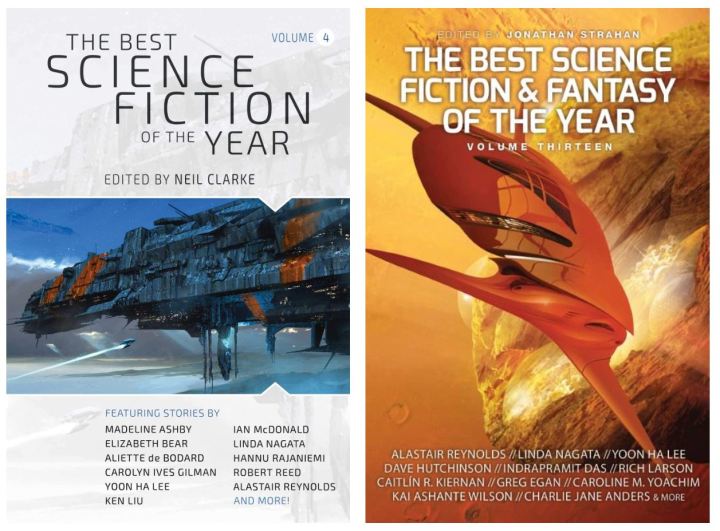
Fantasy fiction is not a language I normally speak, I’m mostly fluent in science fiction. I avoid the fantasy genre but I often end up reading fantasy stories. I’d prefer to only read science fiction, but for some reason, many editors and publishers mix the two together as though they were the same. When I read an anthology of SF/F stories it feels like I’ve gone to a rock concert but every other song is a chamber music quartet. Normally, I only buy science fiction, but the only best-of-the-year anthology on audio this year is Jonathan Strahan’s The Best Science Fiction and Fantasy of the Year Volume 13. Since I love listening to science fiction short stories on audio, I bought the audiobook. I’ve now patiently listened to more fantasy than science fiction. I think I’m starting to understand fantasy’s lingo better even though I’m trying not to.

Distinguishing between science fiction and fantasy is more than dividing stories with magic and dragons in one pile and starships and aliens in another. I admit that sometimes fantasy and science fiction have similar goals, and even motifs and settings. I also admit that the qualities that make me shun many fantasy stories are also contained in many science fiction stories. Trying to discern those specific elements is the goal of this essay. But it’s very hard to point to what I feel by instinct.

The word fantasy can have different meanings. We often use it for the genre that includes magics, elves, wizards, dragons, etc. But the word also means something that is made up. All fiction is made up, but some fiction is philosophical about real life, while other stories are just stories. Trying to define genre labels is an impossible effort, but if we don’t work to precisely define our words we can’t communicate our feelings. What I call science fiction are stories that speculate about the future or the possibilities of what science has yet to discover. Stories about spaceships, aliens, and galactic empires that aren’t speculative or philosophical I call also fantasy. But that’s confusing because most people use the word fantasy for stories about magic, dragons, etc. To confuse the matter more, some stories labeled fantasy do seriously speculation about the past, or about alternative views about now or the future. Should that kind of story be labeled fantasy?

There is a third way to define the word fantasy. It is believing in something that’s not real or reacting to the world based on false assumptions. We often tell such people they are living in a fantasy world. Any genre can produce fantasy stories under this definition. In other words, we can have a fantasy tale, set in a fantasy genre, that is a philosophical fantasy.

Some people say all fiction is fantasy, and I can see their point. But we don’t need two words that mean the same thing. Yes, fiction is made up, but sometimes it’s about something, and sometimes it’s not. All the best fiction, regardless of genre, helps us model reality. At my stage in life, I want to avoid certain kinds of fantasy. But pointing to exactly what that means is difficult.

I have to even admit that some of the best stories in Strahan’s volume thirteen were the ones some people would label fantasy tales. Most reviewers consider The Magazine of Fantasy & Science Fiction to contain the best writing of all the printed SF/F magazines. It’s just damn hard to avoid fantasy. Yesterday, I read “Girls Who Never Stood a Chance” by Deborah Coates in the July-August issue of F&SF. It was a good, well-written, entertaining story. My friend Mike complained it ended abruptly as if it was the opening of a novel. I could see that. I did want to read more. But thematically, it was self-contained.

“Girls Who Never Stood a Chance” is a post-apocalyptic type story, and they are among my favorites. But here’s the problem for a science fiction reader – South Dakota has to be abandoned because of an infestation of dragons. WTF? Civil authorities issue a mandatory evacuation order for a good portion of the state, and this story is about a handful of girls who get left behind. The dragons are never developed or explained in this story other than to occasionally land on rooftops and look menacing. They do a fair amount of damage to the houses in their landings and take-offs, but they don’t breathe fire or show a desire to consume people.

Now here’s one difference between fantasy stories and science fiction. The threat in a fantasy story doesn’t have to have a real-world foundation. Something imaginary that’s scary is all that’s required. In science fictional after-the-collapse stories, science fiction writers take pains at providing a believable explanation. Science fiction readers want to believe what they fear can really happen in our world. If Deborah Coates had used an Ebola outbreak or radiation leakage as the cause of people fleeing South Dakota I would have been happier, and this story would have been science fiction because it contains no magic or other magical creatures.

In translating fantasy tropes for science fiction readers I think it’s important to understand fantasy uses ancient memes. Because these ancient memes have all been discredited by science it feels reading fantasy isn’t reality-based. Dragons, ghosts, malevolent fairies, pesky ancient deities, etc. are all part of make-believe or play-acting. Anything imaginative will spice up a fantasy story. And if you think about, science fiction is overrun with unbelievable aspects too. However, in Coates’ story, the real point of her post-apocalyptic story is to get her characters into a collapsed society. A storyteller needs a reason to eliminate 99.9% of the population to create a post-apocalyptic story. I guess a dragon infestation would run off most people.

I often wonder if fantasy writers are being symbolic. Is Coates using dragons as stand-ins for climate change, the return to ancient ways, unexplained chaos, or the revenge of Mother Nature? Or is she just wanting to tell a story without getting hung up on details?

If we ignore the cause of why 99.9% of the population rush out of South Dakota, we have the main theme of the story – abandoned young girls having to survive on their own. Coates gives realistic backstories to her girls. They were rejected by society, mistreated by parents and peers, abused by specific males, and oppressed by a male-dominated society. Guys do not come off well in this story. They are the evil threat, not the dragons.

Coates carefully develops the characters of Bess, True, Mallory, Shade, Liv and Jamie, and why each is left behind. We feel for them. We wonder how they will survive. Then the girls encounter a bunch of guys hunting dragons. Their real threat to their survival are males with guns running wild with no laws. Dragons no longer matter at all.

Part of the story’s solution involves the girls getting guns too. In a way, this makes the story a western, another distinctive genre. In westerns, violence is the solution. Threats are solved with guns. The reason why I love westerns is the same reason why I love post-apocalyptic science fiction – few people, no laws, and the survival of the fittest. (To be honest, I’d get my ass decommissioned pretty quick in a western or post-apocalyptic scenario.)

My problem with “Girls Who Never Stood a Chance” is not with the fantasy dragons, but with a fantasy ending. Coates wraps up her story is a realistic way if civilization still prevailed, but not for the normal post-apocalyptic ways of science fiction or westerns. Most male writers telling this story would have had the girls kill the guys. It would have been logical under the circumstances and given the story a finality. Mike and I probably felt the story didn’t end because we knew the guys would immediately come back – thus the lack of an ending. Maybe Coates is going to turn this into a novel and there will be a real ending in this story down the road a piece. I’ll be anxious to read it. (I wrote Coates and she said she’s thinking about it.)

The lesson here for translating fantasy motifs into something science fiction readers can understand. I could ignore the dragons because the core of the story was realistic.

The real reason why I avoid the fantasy genre is it uses magic. Sure, a lot of bad science fiction has techno-magic. Faster-than-light spaceships are no different from broom riding witches. I’m an atheist, so I don’t believe in God, gods, mythological creatures, magic, vampires, fairies, miracles, FTL, time travel, and so on. I don’t know why fantasy writers love those imaginary beings and concepts. I have to chalk it up to artistic aesthetics and personal style. But what I’ve learned from finding fantasy stories I like is to look for a core of realism. That language speaks to me.

One of my favorite stories in The Best Science Fiction and Fantasy of the Year, Volume Three is “A Witch’s Guide to Escape: A Practical Compendium of Portal Fantasies” by Alix E. Harrow. I’ve read it twice now. It’s moving. It makes me cry. It’s inspiring. But to be honest, the fantasy turns me off philosophically. But it’s going to take some explaining, and I hope I don’t offend any hardcore fantasy fans.

Often when I tell people I dislike fantasy they take it personally. They act like I’m prejudiced against fantasy. Many of my science fiction friends are baffled because they consider science fiction and fantasy to be one thing. But that blows my mind. I see them as distinctively different. Don’t get me wrong, I enjoy fantasy stories all the time. I prefer not to read them not because they are bad stories, but because they have a different philosophy on reality than I do.

When I first started reading I got hooked on the Oz books by L. Frank Baum. I was ten, and I read maybe all the Baum books and even some of the ones written by other writers after he died. Then when I was in college, and nineteen I decided to reread them. I couldn’t find them at the library. I found an article in an old issue F&SF that said some librarians had turned against Oz books because they promoted unrealistic expectations about life. I ended up buying a set and reread them. I realized those books had given me unrealistic expectations about life. (But I still love Baum’s fantasy world. I can’t let it go even though I know it was fantasy fentanyl.)

<spoiler>

In “A Witch’s Guide” a black foster kid discovers books. He obviously has a miserable real life, and the librarian sees he needs hope. She is a witch and is able to use her powers to help him find the right fantasy books to escape into. Eventually, the librarian gives him a book of magic that lets him actually escape this reality. The message is we need the right books to forget our miserable life and with the help of magic, we could escape to a better reality. Nice sentiment, but a complete rejection of this existence.

</spoiler>

I had a childhood that would have psychologically damaged many kids. I found happiness (and escape) in science fiction. It was the same kind of solution that Alix Harrow writes about. I guess that’s one reason why I love her story – I identify with it. However, after a lifetime of escaping, I’ve discovered there is no escape. There is no magic. We have to come to terms with this plane of existence. There is probably no other.

Most science fiction is just as escapist as fantasy stories. And most science fiction embraces magical thinking too. <i>Star Wars</i> is pure fairytale and magical thinking. We need to start growing up.

What I want is science fiction that offers hope for living on planet Earth, and maybe Mars, our Moon, and a few other rocks in this solar system. The world is full of kids leading tragic lives like the one in “A Witch’s Guide.” I can accept reading fiction, even fantasy as a possible cure for unhappiness. I can’t accept, even within a story, that magic could save us. That rubs me the wrong way.

We all want to save that lonely kid with the red backpack. The solution is not portals to fantasy lands. It’s friends and hobbies. It’s learning to survive in this world. Jo Walton’s book Among Others covered the same kind of problem, but that book’s solution was joining a book club and making friends.

To me, the difference between science fiction and fantasy genres is an attitude towards what’s really possible. The best fantasy stories are symbolic of living in this world, and the worst science fiction books are those that promote a fantasy about what super-technology might give us someday.

When I read the Oz books as a child, I really wanted to go to the land of Oz. I loved fantasy and science fiction books so much I never wanted to grow up. It’s probably why started smoking dope and dropping acid a few years later. I was looking for a portal out of this world. Now that I’m on the home stretch of this life I don’t want to waste any more time with dreams that can’t come true. Even for fun.

Many of the stories in the Strahan collection are quite wonderful to read, but very few of them, even the so-called science fiction stories offer an old man much hope about my fellow humans surviving this reality in the next century.

I sometimes wonder if fantasy writers also ache for more realism. In “Field Biology of the Week Fairies” by Naomi Kritzer we have a fantasy story where fairies exist, but they confront a very down-to-earth fourteen-year-old girl, Amelia. I loved this story for its realism (even though it had fairies). By the way, there were an awful lot of fairies in this anthology, and not all of them came from the popular 2018 original anthology Robots vs Fairies.

There weren’t many science fiction stories of the kind I want. Some were more realistic than others. “Okay, Glory” by Elizabeth Bear was about an overly protective smart house. More of a realistic horror story.

“The Only Harmless Great Thing” by Brooke Bolander took historical incidents and turned them into a fantasy tale. However, I have to wonder why she just didn’t go for straight literary realism. It was the historical details that made this story stand out, not the fantasy add-ons.

“When We Were Starless” was a good science fiction story, but set too far in the future to be relevant about today’s problems. I still enjoy far-future science fiction, but I respond to SF about the near future better. The further in the future an SF story is set, the more it feels like a fantasy to me.

“Nine Last Days on Planet Earth” by Daryl Gregory has the kind of realism I like. It wasn’t completely realistic, but it had a grittiness that I appreciated. I also liked it because it spanned a life-time, of never giving up.

“You Pretend Like You Never Met Me, and I’ll Pretend Like I Never Met You” by Maria Dahvana Headley is another darkly realistic fantasy tale. I would have loved this story even more if it had had no fantasy at all.

“Quality Time” by Ken Liu is the kind of near-present science fiction story I like best. It riffs just enough on reality to make it relevant.

Strahan’s anthology ends with “Firelight” by Ursula K. Le Guin. I’m not even sure what genre this story is supposed to be. On the surface, it feels like generic fantasy, but I think something lurks below the surface. Is Le Guin working in a genre beyond fantasy or science fiction — maybe adult allegory. Even though “Firelight” is full of tired fantasy motifs I get the feeling Le Guin is trying to tell us something personal, something beyond genre.

All the stories in Strahan’s anthology this year are creative and entertaining. The question for readers: Will every story speak the language of what they like to read?  I can imagine I’m not alone in wanting just my favorite genre stories. I imagine some fantasy fans plowing through the science fiction entries wondering why they are in the wrong genre pigeonhole.

James Wallace Harris

Update:

I know this essay is going to come across as schizophrenic. I’m struggling to explain why reading some fantasy stories feels like consuming a cubic meter of cotton candy while other stories feel like I’ve eaten a healthy meal. Writing these essays is a kind of self-psychoanalysis. I often fail to express the exact nature of my feelings. Part of this is due to poor writing, and part of this is due to hitting a wall of complexity. I often end up writing on a subject many times over the years to find clarity. I will certainly have to work on this one again.

“True Names” vs. “Press Enter ▮”

True Names and Press Enter

Science fiction explores several landscapes. Outer space is the most widely known of these. Inner space has been the setting for a tiny fraction of science fiction, for example, The Dream Master (1966) by Roger Zelazny and The Lathe of Heaven (1971) by Ursula K. Le Guin. However, within my lifetime a whole new fictional territory emerged with cyberspace, the digital landscape. Neuromancer (1984) by William Gibson is usually credit with starting the cyberpunk movement which made cyberspace famous, but many digital landscape stories existed before that.

The digital landscape needs both computers and networks to exist, so it’s easy to think that science fiction about cyberspace couldn’t exist before them. However, “The Machine Stops” (1909) by E. M. Forster essentially imagines cyberspace and machine intelligence without knowing about computers, binary mathematics, or stored data. It’s not hard to give some credit to Edwin A. Abbott’s Flatland as an early explorer of the digital landscape, although we could consider mathematics to be a whole landscape itself.

“True Names” (1981) by Vernor Vinge prefigures everything that will become cyberpunk. Sadly, it’s never been reprinted much. In 1996 it was included in David Hartwell’s Visions of Wonder, a major retrospective anthology, and in 2001 it was reprinted in True Names and the Opening of the Cyberspace Frontier edited by James Frenkel which collected many essays by famous computer scientists to introduce the story and explain why it blew their minds.

“Press Enter ▮” by John Varley came out in the May 1984 issue of Asimov’s Science Fiction, a few months before Neuromancer. That story is much more famous, winning the Hugo, Locus, and Nebula awards and being often reprinted.

Both “True Names” and “Press Enter ▮” presented science fiction readers with early visions of the digital landscape and both were horror stories about a machine intelligence emerging out of the internet. There have been so many stories about cyberspace and malevolent AI since then. It’s hard to remember these two stories are the Jules Verne and H. G. Wells tales of the subgenre. Both are available online, probably illegally, but you can read “True Names” and listen to “Press Enter ▮.”

“True Names” is the more fanciful of the two, really a fantasy story, because the protagonist, Roger Pollack (“Mr. Slippery”) enter cyberspace in a rather unbelievable way. Roger and his partner Debbie Charteris (“Erythrina”) paste sensors to their skulls and go into a trance to traverse the digital landscape using fantasy motifs of warlocks and magical powers. Vernor Vinge asks his readers to believe they can experience massive amounts of data in cyberspace as a form of expanded consciousness. It’s really just a fantasy portal no more realistic than C. S. Lewis’ back of a wardrobe. It’s an exciting story and moves extremely fast for being a novella, but unfortunately, neither Roger or Debbie are deeply developed as real humans or as their hacker alter egos Mr. Slippery and Erythrina. However, I was moved by the scene when we get to see who Debbie is as a real person.

Press-Enter-from-Asimovs

“Press Enter ▮” is far more realistic. Victor Apfel is a character of complexity. He is a semi-invalid Korean war vet living next to Charles Kluge, a master hacker. Kluge commits suicide and tricks Victor into discovering his body. The police hire Lisa Foo, another master hacker to process Kluge’s house full of computers and software. Victor and Lisa become friends, then lovers. Lisa is a Vietnam refuge, so she and Victor have a complex shared background with several Asian countries.

Neither Kluge or Lisa enter cyberspace, both just sit at terminals hours on end. They live in this reality and the cyber landscape can only be deciphered by data dredged from computer screens. This makes the horror of an emerging AI intelligence far scarier, and the ending particularly vivid.

I reread these two stories yesterday because I’m working on a list of my 35 favorite science fiction short stories. Piet Nel suggested limiting ourselves 35 stories because if they were published as a book it would be about the size as one of Gardner Dozois’ big anthologies. That means I’m going to have to leave out a lot of fondly remembered tales. I’ll have to decide between “True Names” and “Press Enter ▮” – because of their overlapping themes. I suppose I could argue back with Piet that we should consider 109 the limit. Jeff and Ann VanderMeer’s The Big Book of Science Fiction proves it is possible to go truly gigantic with an anthology.

In the end, I’ve decided to use “Press Enter ▮” for my list. “True Names” was more colorful and fantastic. But I have to consider it cyberfantasy, rather than cyber-SF. More than that, I envisioned Victor and Lisa way more than I could with Roger and Debbie.

Comparing the two stories helped me with my problem of picking favorite stories. As I’ve been going over the SF stories I love most and rereading them, I’ve discovered certain aspects inherent in stories are what makes me like them. These qualities are hard to label. All fiction must hook us, must contain a thread of suspense to keep us reading. I’ve been trying to identify those elements within a story that hooks me and keep me reading. Here’s what I’ve got so far:

  1. The main character has to feel real. In fact, the more real the better. I have to identify with the character, even if I don’t like them. Stories that feel like I’m reading about a person experiencing a real event, even if I know it’s fictional or fantasy, is what grabs me most.
  2. The subject matter is next in importance. I can read a masterpiece of fiction about any subject, and admire it tremendously, but I only develop a psychic love affair with stories that involve my life-long pet topics.
  3. The story needs to explore philosophical problems I want to understand. I love stories the most that give me philosophical/spiritual/personal insight.

I’ve also learned there are elements in stories that make me want to stop reading.

  1. I’m turned off by prose that calls attention to the writer. I don’t want to be reminded that I’ve entered fiction-space.
  2. I don’t like artificial constructs. I know writers love to play around with how they tell a story, but if it jars my attention that detracts from my reading pleasure.
  3. Unbelievability is a reading buzzkill. I know when I reading the literature of the fantastic, but even it has to have a feel of believability.

Cyberspace and artificial reality are concepts that have emerged in our lifetime. We’ve watched writers work to make them believable, to create portals into this new digital landscape. The most realistic stories are those where humans wear goggles and suits. It is quite popular now to have stories where brains are recorded and people’s minds are transferred into artificial realities. I don’t accept brain downloading. I can accept it as a fantasy portal, but not as science fictional speculation.

We use to say the universe was everything, but now with multiple universes becoming accepted, I call the whole enchilada reality. Earth, outer space, inner space, and the digital landscape are all part of a single reality. Both inner space and digital space must be explained by the laws of reality.

Fiction space can work outside the laws of reality. However, I prefer stories that do.

I prefer “Press Enter ▮” to “True Names” because it confirms more with reality. But I also resonate better with the John Varley story because Victor and Lisa are compelling characters that come with realistically detailed biographies. Both stories deal with the same philosophical problem though — the threat of computer intelligence. And even here, I give the nod to Varley. Not that Vinge hasn’t created a powerful imaginative story, I just resonate better with Varley’s realism. I imagine other readers will prefer Vinge because his cyberspace is more colorful, and they accept that fiction space can work outside those laws of reality.

JWH


Best Short Science Fiction 2018

Best Short Science Fiction 2018

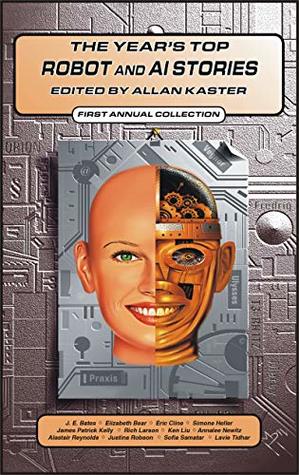
1It’s the season for best-of-the-year anthologies. The Best Science Fiction & Fantasy of the Year Volume Thirteen edited by Jonathan Strahan and The Best Science Fiction of the Year Volume 4 edited by Neil Clarke are already here, and Rich Horton’s The Year’s Best Science Fiction & Fantasy 2019 should be out next month. Sadly, Gardner Dozois died last year, so we won’t be seeing the Thirty-Sixth volume of his series. But we do have a new annual, The Year’s Top Robot and AI Stories edited by Allan Kaster.
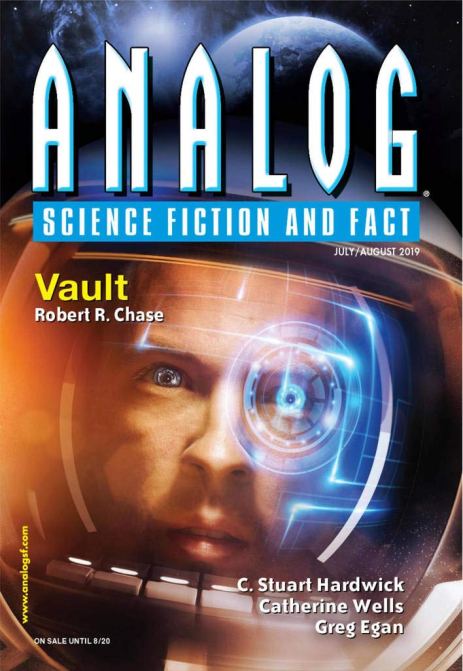
For years, Kaster has edited a best-of-the-year audiobook SF anthology at Audible.com, so I hope this new title is in addition, rather than replacing the old series. The Strahan and Kaster volumes are available at Audible.com now. I love hearing great short science fiction read by professional readers.

I’ve created a spreadsheet that tracks all the stories from the four anthologies and added information about the Hugo, Nebula, and Locus awards for short stories and novelettes. I’ll add more stories and details as additional anthologies are published and awards are given. And if I get ambitious, I might even add links to those stories available online.

The most comprehensive guide to short science fiction for 2018 is Rocket Stack Rank’s “2818 Best SF/F.” My spreadsheet is more of a visual quick reference guide. I’m still learning to use all of RSR’s extensive features.

James Wallace Harris

“Finnegan, Bring the Pain” by Joe M. McDermott

Analog Jul-Aug 2019

I read “Finnegan, Bring the Pain” by Joe M. McDermott because Greg Hullender gave it 5-stars at Rocket Stack Rank, saying it was “Hard-Hitting Tale of Different Kinds of Loss.” The story is in the latest issue of Analog (Jul-Aug 2019).

I believe a powerful short story often succeeds because it identifies a specific emotional insight. James Joyce called such storytelling moments epiphanies. I’m not sure I like Joyce’s label. I wish each literary emotion had its own identifiable noun. It would certainly help with reviewing fiction. Maybe if I thoroughly read The Dictionary of Obscure Sorrows I could find it.

In “Finnegan, Bring the Pain” the emotion is what one feels when being left behind while someone you know, someone often much like yourself, gets away. In “Finnegan, Bring the Pain” Finnegan is a teenager who is a loser in school, who knows he’s going to have a shitty life, but his friend Wind, a girl who keeps his unrequited love at arm’s length, is leaving for Alpha Centauri.

Joe M. McDermott is aiming point-blank at science fiction fans who want to go into space but feel left behind. As a kid, I wanted to go to Mars. I’m sure most SF fans dream of traveling somewhere beyond Earth, so “Finnegan, Bring the Pain” should resonate well with its readers. My all-time favorite short work of science fiction is “The Star Pit” by Samuel R. Delany, a novella that farms this emotion perfectly. (This emotion might also explain why my favorite science fiction movie is Gattaca.)

However, the essence of the “left behind” emotion applies in endless ways. I’ve read literary stories with characters who knew they could never escape their small-town life and make it in the big city, or with a low-level ball player watching a friend move up to the majors, or a poor soul desperately wanting to be rich, or an assistant professor realizing they’re never going to achieve their version of The Origin of Species or a would-be novelist who’d never write the great American novel.

After I realized I’d never go into space, I dreamed of writing science fiction, but the older I get the more I knew that dream has passed me by too. I read stories today like this one to inspire me to write. The dream isn’t completely dead, and I do feel left behind by young writers succeeding with ideas I wanted to explore.

Generally, science fiction is about people who achieve escape velocity. We want to live vicariously through characters who reach the stars. McDermott and Delany remind us that we don’t have the right stuff. That’s painful, but also cathartic.

I’ve always wanted to write a science fiction novel set in the future where all humans experience the “left behind” emotion when we discover that space travel isn’t practical for humans, but is perfect for robots. In this case, I want to be Wind, but I’m still Finnegan.

Finnegan resigns himself to mundane life, even one that has little successes. There is a secondary insight into the “left behind” emotion, and that is we do have a life that is ours, one that we have to accept and enjoy. My acceptance is by promoting SF stories I like and wish I had written.

Getting 5-stars at RSR doesn’t guarantee I’ll love a story, but it does inspire me to track them down. And to be balanced in my reporting, I have loved stories that Greg gave only 1-star. The real take-away of ratings and reviews: subscribe to the science fiction magazine, you won’t know what you’ll find until you read them. Don’t worry about all the stories you don’t like, find the ones you do. Analog has a great of variety among its stories. And if you do subscribe, as you read the stories, think about what each offers in terms of emotional insights. I believe the stories that deserve the most stars are the ones that resonate with your own deep emotions.

James Wallace Harris


I Miss Martians

Martians - The Martian Chronicles

I think we can divide science fiction fans into two eras – before and after July 15, 1965. Before NASA’s Mariner 4 spacecraft flew by Mars there was a certain amount of hope that Mars could have been inhabited, or once inhabited. But those 22 grainy pictures that Mariner 4 sent back shocked us. Mars looked like the Moon, full of craters, a dead world. I was fourteen years old and devastated. I wanted Mars to be like Heinlein and Bradbury imagined.

I’m not sure SF readers today can know what it felt like before Mariner 4. Of course, science fiction was full of Martians, but so was popular culture. The Twilight Zone regularly featured Martians and Venusians. Martians were memes that appeared widely in newspapers, magazines, TV, comics, and movies. There was even a sitcom My Favorite Martian. People back then, even people who didn’t read science fiction, wanted to believe that Mars was an old world, occupied by intelligent beings.

Stranger in a Strange Land

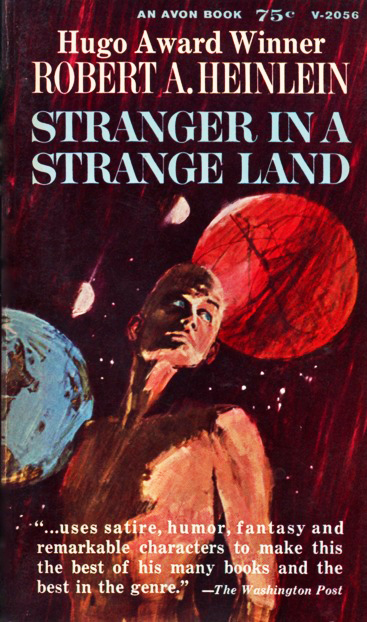
Everyone remembers the menacing Martians of H. G. Wells, and many people remember the exotic Martians of Edgar Rice Burroughs, but I remember the Martians of Robert A. Heinlein. The first Heinlein novel I read was The Red Planet which came out in 1949 but I didn’t discover until 1964. Jim Marlowe its protagonist had a pet Martian he called Willis. It was round with three eyes and could parrot human speech. We eventually learn that Willis is a nymph and would metamorph into what the human settlers called the Old Ones. Heinlein later used these Old Ones in his classic novel Stranger in a Strange Land. They were wise, ancient, and had yogi like psychic powers.

Starting in the 1940s with short stories, later collected into a fix-up novel in 1950, Ray Bradbury gave the world The Martian Chronicles. His Martians were also old, wise, with great mental powers, but they were a dying race. Ray Bradbury’s science fiction never felt realistic, even back in the 1940s. His stories felt more like magical realism, or allegory, yet his Martian chronicles hold up better today than those by Heinlein, Clarke, and Asimov.

A Rose for Eccelesiastes

Today Mars is a hostile environment for life. Kim Stanley Robinson’s Mars trilogy is the SF standard model for Mars. But I miss Martians. I want Mars to be like Heinlein, Bradbury, and Roger Zelazny imagined.

“A Rose for Ecclesiastes” by Roger Zelazny came out in the November 1963 issue of The Magazine of Fantasy and Science Fiction. I’m pretty sure that Zelazny knew Mars would be like what Mariner 4 would show us, but he also loved the old Martians and wrote this beautiful eulogistic tale about them. I consider it the best story about Old Mars ever written.

Martians Go Home by Fredric Brown

Sure, Martians weren’t always nice. Sometimes they were evil, and other times they were annoying pests, like in Fredric Brown’s Martians, Go Home.

But I still miss Martians. I wish that Mariner 4 had sent us back 22 different pictures, ones with ancient cities visible. I’d love to write an alternative history novel about that, but I’d rather it had happened for real. Wikipedia has a long article about Martians in fiction. We can still read those stories, but wouldn’t it had been great if we had discovered Martians in 1965?

This solar system is too lonely, don’t you think? I wish the planets and moons were inhabited like Leigh Brackett and Stanley Weinbaum imagined. The universe is far out. Reality is so much more than we can ever discover, yet sometimes, I wish it was closer to fiction than fact.

Leigh Brackett

Weinbaum_Odyssey_1

James Wallace Harris

The Year’s Best Short Science Fiction: 1950

The Years Best Short Science Fiction - 1950

1950 was a great year for SF short stories. Along with 1966 and 1982, they tie for having the most stories in one year on the updated Classics of Science Fiction Short Stories. Four memorable stories in one year is outstanding since many years have none, and only 1-2 is common. Also, before I read the two anthologies pictured above I was already familiar with 7 of the stories. That’s the most since I started this reading project of systematically reading through the best-SF-of-the-year anthologies starting with 1939.

1950 represents an evolution in mature science fiction writing. It also reflects the influence of magazines besides Astounding Science Fiction. The old timers in my youth considered the 1940s the Golden Age of Science Fiction, but for my generation, the 1950s is our Golden Age. I’m very excited to finally arrive in 1950 and look forward to reading through the decade.

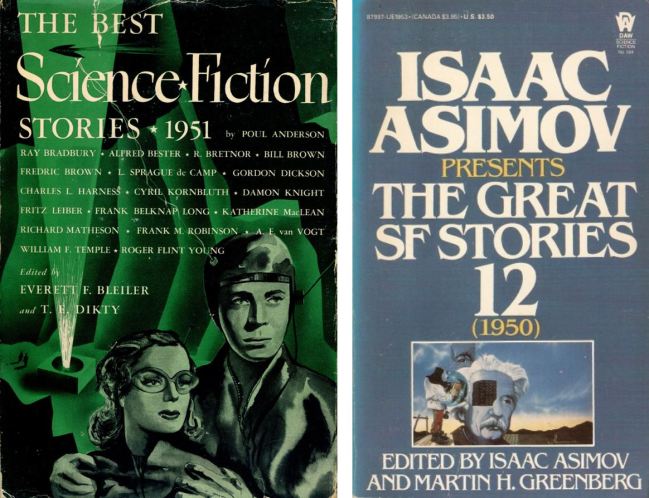
In 1951 Everett F. Bleiler and T. E. Dikty selected the following 1950 science fiction short stories for The Best Science Fiction Stories 1951:

  • “The Santa Claus Planet” by Frank M. Robinson (original)
  • “The Gnurrs Come from the Voodvork Out” by Reginald Bretnor (F&SF)
  • The Mindworm” by C. M. Kornbluth (Worlds Beyond)
  • “The Star Ducks” by Bill Brown (F&SF)
  • “Not to Be Opened” by Peter Grainger (as Roger Flint Young) (Astounding)
  • Process” by A. E. van Vogt (F&SF)
  • “Forget-Me-Not” by William F. Temple (Other Worlds)
  • “Contagion” by Katherine MacLean (Galaxy)
  • “Trespass!” by Poul Anderson and Gordon R. Dickson (Fantastic Story Quarterly)
  • Oddy and Id” by Alfred Bester (Astounding)
  • To Serve Man” by Damon Knight (Galaxy)
  • “Summer Wear” by L. Sprague de Camp (Startling Stories)
  • “Born of Man and Woman” by Richard Matheson (F&SF)
  • “The Fox and the Forest” by Ray Bradbury (The Illustrated Man)
  • “The Last Martian” by Fredric Brown (Galaxy)
  • The New Reality” by Charles L. Harness (Thrilling Wonder)
  • “Two Face” by Frank Belknap Long (Weird Tales)
  • Coming Attraction” by Fritz Leiber (Galaxy)

In 1984 Isaac Asimov and Martin H. Greenberg picked these stories for The Great SF Stories 12 (1950):

  • “Not with a Bang” by Damon Knight (F&SF)
  • “Spectator Sport” by John D. MacDonald (Thrilling Wonder)
  • “There Will Come Soft Rains” by Ray Bradbury (Collier’s)
  • “Dear Devil” by Eric Frank Russell (Other Worlds)
  • “Scanners Live in Vain” by Cordwainer Smith (Fantasy Book)
  • “The Little Black Bag” by C. M. Kornbluth (Astounding)
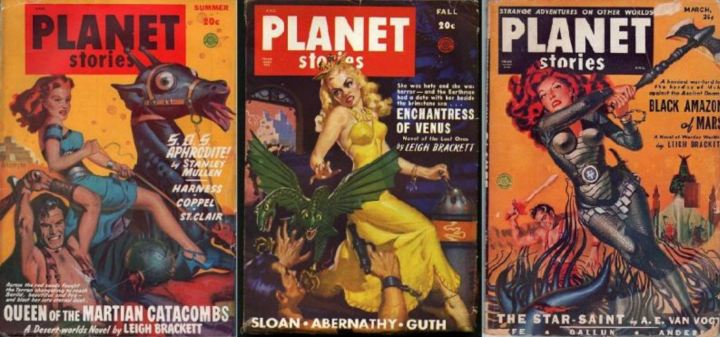
  • “Enchanted Village” by A. E. van Vogt (Other Worlds)
  • Oddly and Id” by Alfred Bester (Astounding)
  • “The Sack” by William Morrison (Astounding)
  • “The Silly Season” by C. M. Kornbluth (F&SF)
  • “Misbegotten Missionary” by Isaac Asimov (Galaxy)
  • To Serve Man” by Damon Knight (Galaxy)
  • Coming Attraction” by Fritz Leiber (Galaxy)
  • “A Subway Named Mobius” by A. J. Deutsch (Astounding)
  • Process” by A. E. van Vogt (F&SF)
  • The Mindworm” by C. M. Kornbluth (Worlds Beyond)
  • The New Reality” by Charles L. Harness (Thrilling Wonder)

I’ve bolded the overlap. I’ve often wondered when Asimov and Greenberg made up their anthology did they consider what Bleiler and Dikty had done in the past? The Bleiler/Dikty books would have been rare even back in 1984, so I assume they didn’t. Or did they imagine that one day readers would judge the two books together for what they collectively say about the short science fiction of 1950?

And why did Bleiler and Dikty miss “There Will Come Soft Rains,” “Scanners Live in Vain,” “The Little Black Bag,” and  “The Silly Season” which all have become classics since then? Or do later readers discover value in stories that readers back in 1950 missed? “There Will Come Soft Rains” was included in The Martian Chronicles so it was being widely read as Bleiler and Dikty were assembling the volume. “The Little Black Bag” and “Scanners Live in Vain” were included in the first volume of The Science Fiction Hall of Fame in 1970, selected by the popular vote of science fiction writers, so it seems odd they weren’t recognized as instant classics. I think “The Silly Season” is an important miss, but they did include Kornbluth’s “The Mindworm.” Maybe Bleiler/Dikty didn’t want to use two of his stories?

If you look at the 60 short stories from 1950 that’s in our database order by total citations you’ll see both anthologies got most of the most remembered stories. But each anthology also recognized a few classics the other missed. I think the story they both missed which stands out the most is Ray Bradbury’s “The Veldt.” It’s always remembered on fan polls but that’s probably because schools teach it.

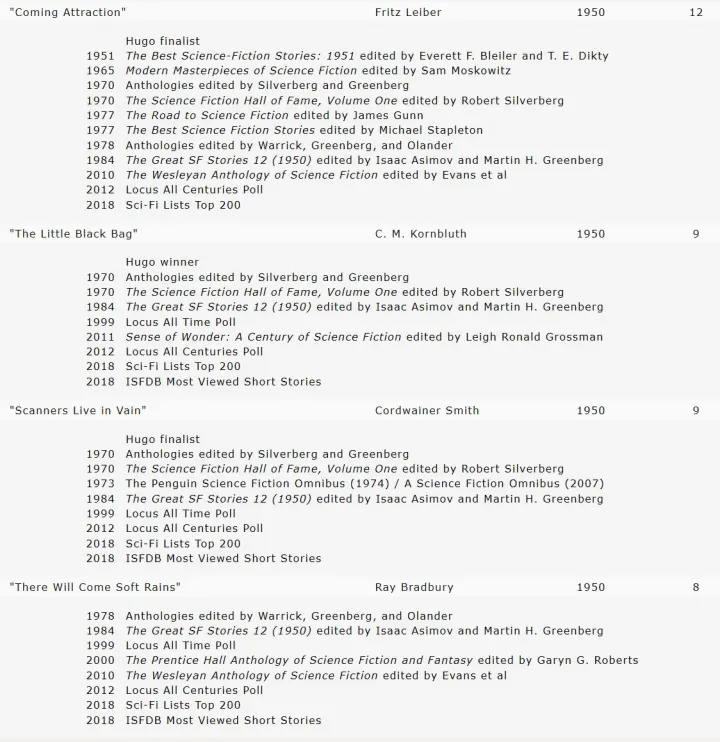
Here are the stories that made it to the Classics of Science Fiction Short Stories list:

CSF-SF-1950

Notice that the top three stories won Retro Hugo Award for 1951. The only short stories/novelettes the fans voting for the retro Hugo that the two anthologies missed were “The Helping Hand” by Poul Anderson and “Okie” by James Blish. Neither anthology included any of the novella nominations. If you study the citation sources for the above stories you’ll see how each has remained popular in fan polls.

For these four stories, this was at least my fourth reading for each of them since the 1960s. Each time they get better and I notice more details. These stories should be read by any would-be writers wanting models to study. They are rich in ideas, dense with details, yet very told dramatically. These four stories are so obvious and famous that there’s little reason to discuss them. And I think the voters for the 1951 Retro Hugo Award also picked the obvious novella choice: “The Man Who Sold the Moon” by Robert A. Heinlein.

The fun question to ask now: What is the best of the forgotten stories? I’m partial to “Contagion” by Katherine MacLean which I’ve already reviewed separately. I thought it a standout story for the time because MacLean was poking fun at male SF fans and gender issues.

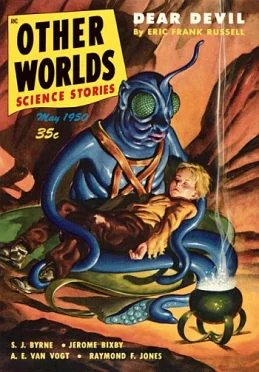
Dear Devil by Eric Frank Russell - cover storyDear Devil” is my favorite Eric Frank Russell story so far in this reading project. It’s about another Martian invasion, but this time a very positive one. Don’t you miss Martians? Sure the story is sentimental and unrealistic, but if you loved the movie E.T. you’ll probably love “Dear Devel.”

“The New Reality” by Charles L. Harness reminds me somewhat of Greg Egan’s novel Quarantine because it’s about how our ideas of reality shape reality. The story is a gnarly philosophical fantasy about ontology. The story itself is a kind of a mess, lacking in structure and realistic dramatic action, but it’s filled with the kind of ideas that mess with your head, the kind that pot smokers and science fiction fans love.

The Sack” by William Morrison is not a great story, but it is a fun read. Explorers find an intelligent creature on an asteroid. It is the last of its kind, and it looks like a sack of potatoes. However, the Sack is so smart and willing to answer questions, that humans sell time with it like we do scheduling a supercomputer. The Sack is so effective at answering questions that nations and criminals want to kidnap it. The Sack claims it is always honest, but warns the human questioners that its knowledge might not always be beneficial.

“Misbegotten Missionary” by Isaac Asimov was later renamed “Green Patches” but I like the original name better. Asimov later realized that this story is similar to “Who Goes There?” by John W. Campbell, his mentor. Space explorers visit a planet where all life is part of a single unified consciousness and this lifeform thinks humans are tragically incomplete since they are isolated individuals. The gestalt organism has a way of possessing humans to make them part of their whole. When the Captain of the first space ship lands on this planet and discovers his crew has been infected he blows his ship up. The story is about the second ship returning from the planet with a very clever hitchhiker. Because this tale has more story and less lecture, it’s one of Asimov’s more entertaining tales.

That’s one of the big problems of older science fiction, authors are inspired by far out ideas, but they don’t know how to present them dramatically. Many of these stories in these two anthologies are often interrupted by mini-lectures. That’s why “Scanners Live in Vain” and “Coming Attractions” were such standouts. Each is dense with ideas, but throw off their dazzling concepts as part of the action. They are dramatic and emotional.

Most of the stories in these two anthologies are still entertaining, but I believe most modern readers will find most of the second-string stories slight, clunky, outdated, or primitive. Aficionados of old SF will probably get a kick out of them.

Galaxy Oct Nov 1950

The first two issues of Galaxy, October and November 1950 contains
“Contagion,” “The Last Martian,” “Misbegotten Missionary,” “Coming Attraction,” and “To Serve Man” –  four stories for Bleiler/Dikty and three for Asimov/Greenberg. That’s a pretty impressive debut.

The impact of the new magazines F&SF and Galaxy is particularly impressive when you realize they were competing with Astounding’s 12 issues with just 4 and 3 issues respectively.

Off to read 1951 – the year I was born.

James Wallace Harris