Is Science Fiction Just Fairy Tales?

When I first started reading science fiction, I thought it superior to ordinary fantasy because science fiction prepared readers for the future. I never believed science fiction predicted the future, but I did believe science fiction could seriously ponder future possibilities. To me, the best science fiction was philosophical, speculative, and extrapolated on current trends. Both the fixup novel The Dying Earth by Jack Vance and the anthology The New Space Opera edited by Gardner Dozois and Jonathan Strahan ponders the far future. But do their stories say anything serious about the future? Do any of their stories speak specifically to the adult mind? Or are they just fairy tales for grown up readers?

The Dying Earth is a collection of six related short works of fantasy that imagines life on Earth after the sun grows old, which is a wonderful science fictional concept. The stories are a cross between fantasies about magicians and science fiction about dying civilizations that barely remembers technology. In a vague way, its stories remind me of the stories in One Thousand and One Nights, but that’s because I just read “Ask Yourself Which Books You Truly Love” by Salman Rushdie in The New York Times. Rushdie was writing about our love of stories, especially the ones we first encounter as children. But I thought the Arabian Nights stories imagined when humanity and history were young, and the Jack Vance stories imagine humanity and history when old.

The Dying Earth contain these six stories:

  • “Turjan of Miir”
  • “Mazirian the Magician”
  • “T’sais”
  • “Liane the Wayfarer”
  • “Ulan Dhor”
  • “Guyal of Sfere”

The first three stories feel like Aesop, Homer or Grimm, simple fable or fairy tale in tone, while the later ones grow in sophistication feeling more like Dante or Chaucer. “Ulan Dhor” comes across the most like science fiction, but science fiction from the 1930s out of Weird Tales.

After “The Time Machine” by H. G. Wells, and The Night Land by William Hope Hodgson, other writers began expanding the end of time theme, but Vance got to name it with this book. Normally, I don’t like fantasy stories, but I did like The Dying Earth. This book was so successful that Vance wrote more stories about living under the dark red sun that were collected in three different volumes. I haven’t read them yet, but I bought Tales of the Dying Earth for the Kindle which puts all four into one book.

Normally, I avoid fantasy, preferring science fiction, but I started life as a bookworm with the Oz books by L. Frank Baum. If you only know Oz from the 1939 film, The Wizard of Oz, then you don’t know Oz. Not that the film isn’t wonderful, but it doesn’t convey the vastness of Baum’s fantasy worldbuilding. I’m not a scholar on children’s fantasy books, but is there any fictional world building before the 20th century that can compete with the Oz books?

I know pop culture has pretty much forgotten Baum’s fantasyland, but for children growing up in the early decades of the 1900s, the Oz books were as popular as the Harry Potter books are today. Many classic science fiction writers grew up reading Oz books, including Robert A. Heinlein, who referenced them in his later World as Myth novels.

I bring up the Oz books here because Baum’s basic plotting device is often used by fantasy and science fiction writers. It works like this. Introduce one or more normal characters, and maybe some exotic or magical characters. Give them a quest. Take the group from one strange location to the next, where they meet wonders and far out beings. Keep it up until you’ve filled a book’s worth of pages. Tie things up with a satisfying insight. Ringworld by Larry Niven is a great example of this, and so is some of the stories in The Dying Earth, especially “Ulan Dhor” and “Guyal of Sfere.” The later story even has an Oz like wizard that explains things at the end.

The Dying Earth theme is powerful because writers usually explore two visions: the end of man, and the end of Earth. Just to meditate on that idea generates a powerful sense of wonder. However, I don’t think Vance’s stories say any more about the future than One Thousand and One Nights says about the past. They are just fairy tales for grownups. Modern fantasy has vastly evolved past these stories in sophistication. I will keep reading in this series because I’ve been told Vance eventually gets more sophisticated too, but I wonder if he ever gets more adult.

I wonder if the 20th century trend of writing stories set in an ever-growing fantasyland might have begun with Baum? That kind of never-ending world building appeals to both children and adolescents, and has apparently seduced many an adult reader too, because it seems like all genre writers are churning out countless books in series. And doesn’t our hunger for story series and complex world building comes from our childhood love of fantasy series?

The Dying Earth as a theme keeps expanding with new writers and new readers. Science fiction writers and readers also love the Far Future as a similar setting for a theme, although the name for that theme seems to have become The New Space Opera. Fans of this theme don’t worry about the end of the Earth or humankind, because they believe humanity has plenty of places to go. And like Baum inventing endless fantasy beings for Oz, the New Space Opera writers have invented endless far out aliens, robots, AI, transhuman, and posthumans to populate stories using this theme.

But to be honest, I’m not that fond of the New Space Opera theme. Oh, the ideas they come up with have a wonderful sense of wonder, but these stories are often presented as hard science fiction, which imply their science fictional inventions could be possible, and I don’t believe that. The opening of “Glory” by Greg Egan is dazzling. It sounds so scientific yet I can’t believe it’s no more realistic than magic. It begins:

An ingot of metallic hydrogen gleamed in the starlight, a narrow cylinder half a meter long with a mass of about a kilogram. To the naked eye it was a dense, solid object, but its lattice of tiny nuclei immersed in an insubstantial fog of electrons was one part matter to two hundred trillion parts empty space. A short distance away was a second ingot, apparently identical to the first, but composed of antihydrogen.

A sequence of finely tuned gamma rays flooded into both cylinders. The protons that absorbed them in the first ingot spat out positrons and were transformed into neutrons, breaking their bonds to the electron cloud that glued them in place. In the second ingot, antiprotons became antineutrons.

A further sequence of pulses herded the neutrons together and forged them into clusters; the antineutrons were similarly rearranged. Both kinds of cluster were unstable, but in order to fall apart they first had to pass through a quantum state that would have strongly absorbed a component of the gamma rays constantly raining down on them.

Left to themselves, the probability of them being in this state would have increased rapidly, but each time they measurably failed to absorb the gamma rays, the probability fell back to zero. The quantum Zeno effect endlessly reset the clock, holding the decay in check.

The next series of pulses began shifting the clusters into the space that had separated the original ingots. First neutrons, then antineutrons, were sculpted together in alternating layers. Though the clusters were ultimately unstable, while they persisted they were inert, sequestering their constituents and preventing them from annihilating their counterparts. The end point of this process of nuclear sculpting was a sliver of compressed matter and antimatter, sandwiched together into a needle one micron wide.

The gamma ray lasers shut down, the Zeno effect withdrew its prohibitions. For the time it took a beam of light to cross a neutron, the needle sat motionless in space. Then it began to burn, and it began to move.

You can finish the whole story here.

The stories in The New Space Opera are exactly what I wanted to believe in growing up. I desperately wanted humanity to have all this potential. I knew I’d never live to see such successes in space, but I wanted to die confident that humanity would go on to achieve these wonders. Now that I’m approaching seventy, I realize my childhood dreams were wishful fantasies, no more realistic than the far-out promises of religion. Sure, we will explore space, but not like the epic super-science visions produced by the New Space Opera stories. We’re not going to transfer our minds into other bodies, whether biological or digital. We’re not going to build spaceships the size of Jupiter. We’re not going to have galaxy spanning civilizations. All those ideas are just fairy tales for adults.

However my problem with the New Space Opera stories is not that they imagine impossible futures, but how the stories are often told. Many of the stories in this anthology cram too many ideas into one plot. Their authors love to jam in so many speculative concepts that basic story gets crushed. Characterization and plotting take a back seat to worldbuilding. And it’s not that these writers are constantly infodumping ideas, but instead they throw out endless hints assuming readers can fill in the details mentally. Often those hints require cognitive decryption which for me distracts from the story. Sometimes stories combine a dozen science fictional concepts into one futuristic setting as if every science fictional speculation to date will come true. The cumulative effect is a goulash of cliché science fiction. That’s why when I got to Kage Baker’s “Maelstrom” it felt refreshingly different. Her speculation about colonizing Mars took a backseat to plot and character. That’s why I prefer Robert Reed’s “Good Mountain” to “Hatch,” his entry in the anthology.

I’m afraid too many of the stories in The New Space Opera depend too much on the big standard theories of current SF. I love science fiction for its ideas, but I also need a good story. Dense worldbuilding isn’t good enough for me. But hey, that might just be me. Maybe my aging brain can’t handle modern science fiction. Maybe that’s why I preferred Vance’s fantasy stories, even though I prefer science fiction over fantasy. Evidently, there’s something in how storytellers need to tell adult fairy tales that count.

Paul Fraser in our science fiction short story discussion group on Facebook makes a distinction between dense stories and story stories in modern SF fiction. I agree. I think the editor Gardner Dozois liked to promote dense stories, and we see that in The New Space Opera. Our group has seen dense stories popular in Asimov’s Science Fiction too. See their list of finalists for their 35th annual reader awards. One example of an overly dense story is Ray Nayler’s “Return to the Red Castle,” where he takes a simple plot of a woman wanting to help her old teacher, an android, recover her memory, by throwing in enough ideas for a half-dozen science fiction stories. I wanted the story to be more about Irem and Umut’s issues with memory, and less about the world building for the Istanbul Protectorate. But obviously, plenty of readers loved it just the way it is.

But whatever you prefer, dense or story, aren’t these stories still adult fairy tales? Isn’t the problem how the story is told rather than issues with the content? Is Little Red Riding Hood and her problems with the wolf any different in true age appeal than Irem’s problem with her android? I’m sure James Joyce and Proust’s novels are aimed at adult minds. But how much science fiction is truly adult in nature? And I’m not talking about X-rated content. If young children and young adults had the readings skills, wouldn’t they find most science fiction and fantasy fiction appealing? Can you name any science fiction novel that only appeals to a mature mind?

I wonder now if The Dying Earth and The New Space Opera stories aren’t aimed at the child in me. That I still read such stories because I never grew up. Or maybe, the wonders we imagined in childhood never leave us. As a ten year-old I wanted to live in Baum’s Oz. As a thirteen year-old I wanted to live on Heinlein’s Mars. It’s taking me sixty-nine years to accept the only place for humans is Earth, but I’m not sure if I will ever grow up and accept that. I have to wonder if I’ve never outgrown fairy tales.

James Wallace Harris, 6/3/21

Lords of the Psychon by Daniel F. Galouye

Daniel F. Galouye (1920-1976) was never a famous science fiction writer, but back in the 1950s and 1960s his shorter work appeared regularly in many of the SF magazines with the notable exception of Astounding/Analog. Galouye published five novels, three of which made it to my list of SF novels of the 1960s (Dark Universe, Lords of the Psychon, and Simulacron-3). Over the years, I’ve seen several mentions of his work and have meant to read them, but it hasn’t been until I got Lords of the Psychon in a batch of old paperbacks from eBay that I’ve had a chance. Galouye’s books aren’t rare, but they aren’t widely known either. Dark Universe and Simulacron-3 are currently in print, and Dark Universe is even available on Audible.com. Simulacron-3 inspired both a TV miniseries (World on a Wire) and a movie (The Thirteenth Floor), and some have called it an early cyberpunk novel. Not a bad legacy for a writer who is mostly forgotten.

Lords of the Psychon was a lot of fun to read, but not as much fun as I had with Of Men and Monsters by William Tenn, the SF book I read before it. Both of these 1960s novels deal with alien invasion. Both novels are set years after the aliens have conquered Earth. Both novels deal with a small group of humans hoping to overthrow the aliens. Both novels have a unique take on showing the alienness of the invaders.

Don’t read beyond this point if you hate any kind of spoilers.

In this section I’ll give you a bit more of the details but still try to avoid all plot spoilers. The 1950s was a time when many science fiction stories, especially in Astounding Science Fiction, explored psychic powers, ESP, or sometimes called psionics. I’ve always thought Stranger in a Strange Land (1961) was the pinnacle of that trend which quickly faded from popularity. I now see that Daniel F. Galouye had something more to add in 1963 with Lords of the Psychon. Actually, I feel the novel was inspired by Heinlein, and even feels somewhat like a 1950s Heinlein novel in tone. Galouye was a test pilot during WWII, so he also has a military background like Heinlein.

The setup for Lords of the Psychon is the speculation that the fundamental subatomic building blocks of reality can be controlled by thought, and this 1963 novel predates such woo-woo physics books as The Tao of Physics (1975) by Fritjof Capra and The Dancing Wu Li Masters (1979) by Gary Zukav. Basically, Galouye tortunes quantum mechanics to come up with a fun science fictional idea. Instead of swinging East like Capra and Zukav, Galouye keeps a western view of psychic powers.

Today, we think of such psionic themes as malarky, but I believe Galouye worked hard to pull off his speculative fiction. Eventually, the story moves towards Theodore Sturgeon and gestalt minds. In other words, I give Galouye credit for producing an evolutionary science fictional work.

I won’t go into plot details because I really don’t like any such spoilers myself, but I will reprint two reviews from 1963 that do, so read them at your own risk. The first is from Analog, November 1963 by P. Schuyler Miller.

I love reading reviews of books from when they first came out to see how my reaction is different. Miller praises Lords of the Psychon but claims Galouye’s first novel, Dark Universe, is the real standout. That means I need to read it soon.

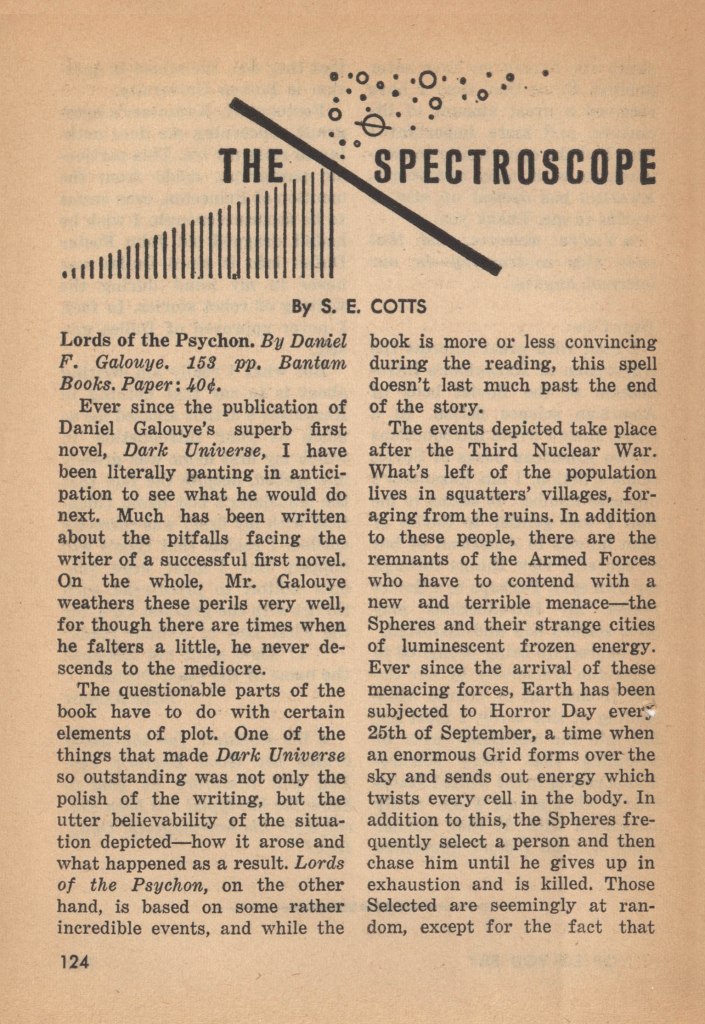
S. E. Cotts reviews the novel in the August 1963 issue of Amazing Stories. I know nothing about Cotts, but I like her review. If you know anything about S. E. Cotts, leave a comment.

Cotts also gives away way too much of the plot for my taste. I’m still figuring out how to review fiction. I like the details of a story to unfold as the author intended. Both Miller and Cotts reveal things I prefer to learn for myself. However, I suppose they believe that a certain amount of plot details need to be given to hook the reader into buying the novel.

Rosemary Benton writing for Galactic Journey gives this novel 4.5 stars. Her 2018 review pretends to have been written in 1963. She also gives away quite a few plot points. Unlike Miller and Cotts, Benton seems to prefer Psychon over Dark Universe.

I believe Lords of the Psychon is a 4-star out of 5-star novel for those readers who delight in reading science fiction novels from the 1960s. I admire Galouye’s speculation even though I don’t think it’s scientific. I feel the novel is plotted tighter than modern SF novels, and is told with far fewer words, which is one of the reasons why I prefer older science fiction. Hopefully, that’s enough information for people who don’t like spoilers, but if it’s not, just read the three reviews above.

James Wallace Harris, 5/31/21

Monologues of Remembrances

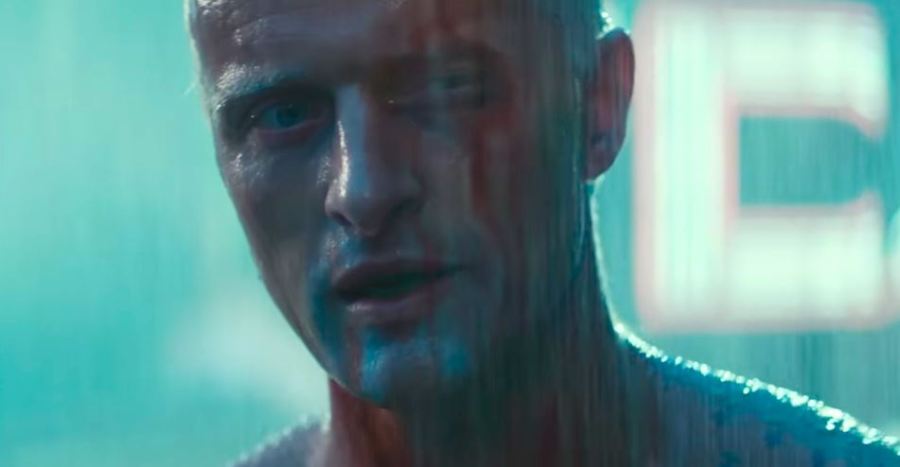
Everyone remembers Roy Batty’s monologue from the end of Blade Runner, sometimes called “Tears in the Rain.” Wikipedia even has an entry for it. It’s very short but when you hear Rutger Hauer speak it in the film, it feels timeless.

I've seen things you people wouldn't believe. Attack ships on fire off the shoulder of Orion. I watched C-beams glitter in the dark near the Tannhäuser Gate. All those moments will be lost in time, like tears in rain. Time to die.

Well, today I was listening to The Dying Earth by Jack Vance, and in particular, to the short story “Ulan Dhor Ends a Dream,” and it reminded me of Roy’s monologue. It evoked the same emotion. Aren’t these monologues so much more impressive when performed/spoken?

I have known the Ampridatvir of old; I have seen the towers glowing with marvellous light, thrusting beams through the night to challenge the sun itself. Then Ampridatvir was beautiful — ah! My heart pains when I think of the olden city. Semir vines cascaded from a thousand hanging gardens, water ran blue as vaul-stone in the three canals. Metal cars rolled the streets, metal hulls swarmed the air as thick as bees around a hive — for marvel of marvels, we had devised wefts of spitting fire to spurn the weighty power of Earth … But even in my life I saw the leaching of spirit. A surfeit of honey cloys the tongue; a surfeit of wine addles the brain; so a surfeit of ease guts a man of strength. Light, warmth, food, water, were free to all men, and gained by a minimum of effort. So the people of Ampridatvir, released from toil, gave increasing attention to faddishness, perversity, and the occult.

This made me wonder how many stories have a monologue of remembrance in them? It’s a very powerful trick of fiction, don’t you think? Charles Dickens used it very effectively as the opening to A Tale of Two Cities.

It was the best of times, it was the worst of times, it was the age of wisdom, it was the age of foolishness, it was the epoch of belief, it was the epoch of incredulity, it was the season of Light, it was the season of Darkness, it was the spring of hope, it was the winter of despair, we had everything before us, we had nothing before us, we were all going direct to Heaven, we were all going direct the other way—in short, the period was so far like the present period, that some of its noisiest authorities insisted on its being received, for good or for evil, in the superlative degree of comparison only.

I believe Heinlein must have been inspired by Dickens when he wrote the opening to Glory Road.

I know a place where there is no smog and no parking problem and no population explosion...no Cold War and no H-bombs and no television commercials...no Summit Conferences, no Foreign Aid, no hidden taxes—no income tax. The climate is the sort that Florida and California claim (and neither has), the land is lovely, the people are friendly and hospitable to strangers, the women are beautiful and amazingly anxious to please—

I could go back. I could—

I can’t recall any others at the moment. Can you? If you can, post them in the comments.

James Wallace Harris, 5/29/21

Ever Been Chased by Giants in Your Dreams?

The most read essay on my personal blog is “Do You Dream About Dinosaur Attacks?” Evidently, I’m not the only person who runs from dinosaurs in their dreams, because 25-50 people daily find my essay on Google. I recently realized that I sometimes run from both human giants as well as giant space aliens in my dreams too. This obviously reveals my personal philosophy about the big dangers of life – keep a low profile. In my dreams the solution to avoiding being killed is to be quiet and hide from all the big monsters.

Warning: Don’t read this review. Just go read the book below to have the maximum fun. Don’t even read the blurbs on the cover. However, if you need more convincing, keep reading, I’ve kept the spoilers to the bare minimum.

Keeping a low profile is exactly what Eric the Only doesn’t do in Of Men and Monsters, a classic science fiction novel by William Tenn. It’s an expansion of Tenn’s October 1963 story for Galaxy Science Fiction magazine, “The Men in the Walls.” I vaguely remember reading the novel back in the early 1970s, but decided to reread it yesterday because of reviews by Joachim Boaz and MarzAat. Luckily, I didn’t read their entire reviews ahead of time because they both have spoilers. I just got caught up with MarzAat’s enthusiasm responding to Joachim’s review, and grabbed my copy of book and started reading. In fact, it’s the first novel in decades that I’ve read in less than a day. Just fun, good old fashion science fiction. Joachim gives it four stars out of five, and that’s what my initial assessment was too, however…

Of Men and Monsters has a simple backstory. Giant aliens from space have conquered Earth and humans are thrown into a kind of dark age, living in the walls of alien buildings. The story is well told, and surprisingly engaging for such a simple premise. Eric the Only, is a member of one of many tribes trying to survive by stealing food from the aliens they call monsters. Each tribe has a competing philosophy about existence, and Eric the Only is a bright young man trying to figure out reality from many contradictory beliefs.

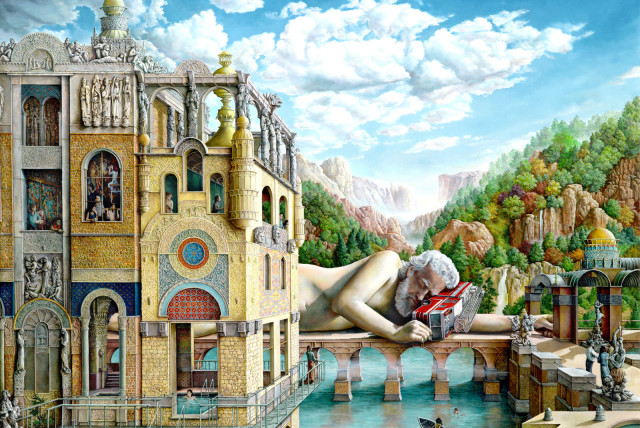
Think about giants in the Bible, or “Jack and the Beanstalk,” or the big and little episodes in Gulliver’s Travels, or “Giant Killer” by A. Bertram Chandler, or J. G. Ballard’s “The Drowned Giant” (now animated for season 2 of Love, Death & Robots). And if you remember, the 1968 TV show Land of the Giants. I wonder if Willian Tenn was given any credit or money for his idea? He probably wasn’t as pugnacious and litigatious as Harlan Ellison. Well, the Land of the Giants is somewhat different, with castaway humans on the planet of giant aliens. Anyway, giants make up a tiny sub-sub-sub-genre that I believe triggers a certain psychological appeal. For some reason, pop culture returns to it fairly often.

Of Men and Monsters also reeks of another minor motif I’ve seen in science fiction, and that’s about life in the corridors. I remember reading the “Tumithak of the Corridors” stories in Before the Golden Age edited by Isaac Asimov, an anthology of his favorite science fiction stories he loved reading growing up in the 1930s. But life in the corridors was also the setting in Heinlein’s Orphans in the Sky (1963), a fixup novel based on “Universe” and “Common Sense” first published in Astounding Science-Fiction in 1941, and in Brian Aldiss’ 1958 novel Non-Stop (called Starship in the U.S.). This motif often connects to the theme of forgotten civilization which we find in many science fiction and fantasy stories about the far future. Not only do we love stories about running from big beings like dinosaurs, King Kong, 50-foot high women, and giant space aliens, but we also love stories about forgetting who we were as a society.

The corridor motif also runs parallel with the back to the primitive theme in post apocalyptic stories of the 1950s. Science fiction writers have suggested in both books and movies that after a nuclear war civilization could be reduced to living like hunters and gathers again. Writers imagine our descendents forgetting the past, and picture these future humans like cavemen or 19th century native Americans. I vaguely remember some Andre Norton novels like this. Eric the Only wears just a leather jock strap, and the women of his tribe only wear their hair, but very long. His tribe use spears for weapons and live by rigid customs created by superstitions. Some readers might consider this aspect of the story satire on humanity, but I didn’t. It just felt logical to the plot.

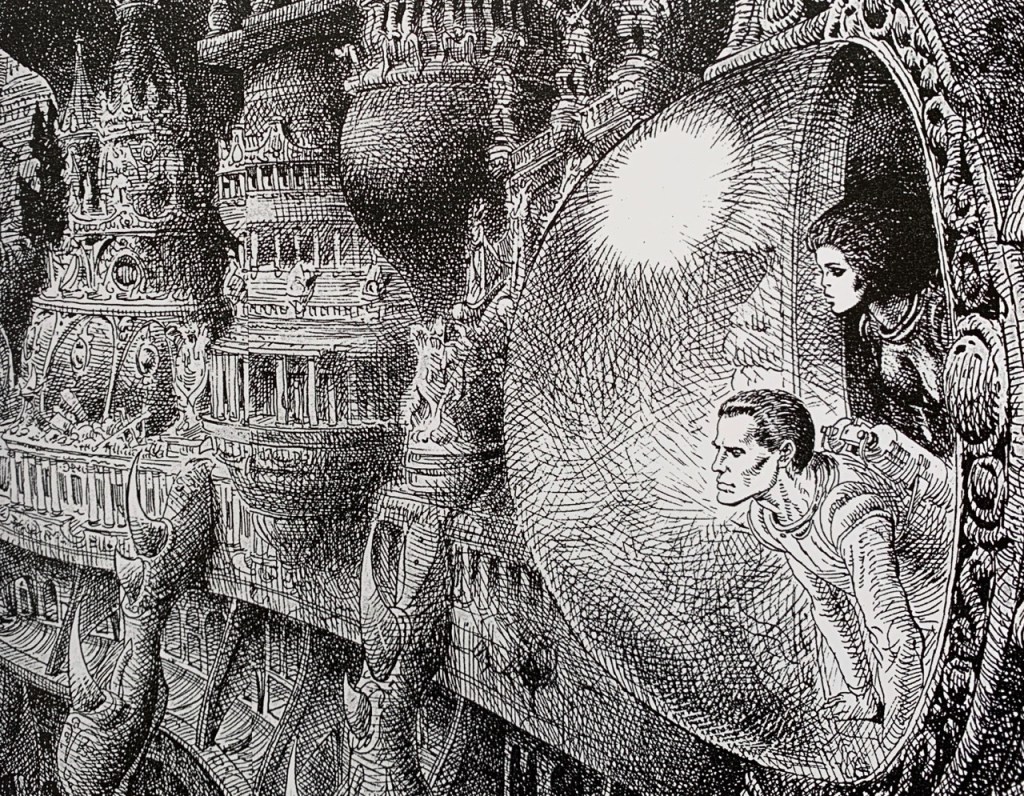
I’ve tried very hard not to give the details here to Of Men and Monsters because I thoroughly enjoyed how the story unfolded. I wouldn’t have told you about the monsters being aliens but that tends to be in all reviews and on the cover blurbs. I will give one tiny spoiler that I found fascinating. The tunnels the humans live in are the air spaces of the insulation used by aliens in their buildings. That should give you an idea of relative size. All the cover art on the many book editions gets this wrong drawing the aliens only three or four times the size of humans. The aliens are immensely larger.

Probably reading Of Men and Monsters was so entertaining for me because I need some escapism. I had a CT scan Friday and I’m waiting the results. In other words I’m hiding from a big monster. But I also loved this book because it is so 1950s science fictional. It’s a retreat into my childhood and contained so many themes, ideas, motifs, and speculations that I loved when first discovering science fiction. Because of that I’ll give it 5-stars when I rate it for Goodreads. I’m sure a reader less prejudiced by nostalgia wouldn’t be so generous.

One last thing. Towards the end of the story William Tenn intrudes in the novel by allowing one of the characters to philosophize about humanity. That character says we’re kin to rats and roaches and we’ve not been kind to each other or to the other species we share the planet. I agree with what Tenn is preaching, but I felt this bit of philosophy dumping marred the story. The story itself had already inspired me to think of these things without being told. If this novel has a flaw it’s how modern knowledge that should have been forgotten was worked into the story. Either that, or Tenn should have developed the backstory of the Aaron tribe to explain how they could have retained that knowledge.

James Wallace Harris, 5/23/21

All Is Ineffable, But Some Writers Try Anyway

I divide fiction into two types: stories about reality, and stories that are make believe. Words are not cameras, but some writers use words to paint what they see. Most writers use words to trigger artificial realities in our mind’s eye. Their stories might feel reality based, but they are not. Some writers use such fantasies as analogies to comment on real world, which can be confusing. We never can distinguish the unreal from any slight implications about reality.

What do you do when you encounter an absurd story that feels like it has something to say about life but is impossible to decipher? Do you stick with it, hoping understanding will come? Do you study critical works hoping for insight? Do you take notes and ponder the possibilities? Or do you get disgusted and throw the book against the wall? One Goodreads reviewer claimed that’s what he did with Past Master by R. A. Lafferty. I thought about it.

The title, Past Master, can be interpreted in a number of ways. One approach is to accept how it’s used in the story. Thomas More is retrieved from the past to become the president of a colony planet in the future, a decaying utopia. The characters in the story call More the past master and hope he will save their society. Throughout the novel, we get many allusions to literary past masters because their words encrust Lafferty’s prose like barnacles. Third, and maybe finally, or maybe not, we sense that Lafferty himself is the past master. His soul is swollen with past experiences he recasts onto clean typewritten pages like Jackson Pollard throwing paint at a canvas.

As a reader I ache to make sense of Lafferty’s first novel. I hope it has a point, because swimming across a lake of his Baroque prose I can’t tell if Past Master is a shallow tall-tale, or The Divine Comedy. I find Lafferty’s voice not much fun to read, but I do perceive his work as creative and unique. I keep reading because I’ve been pushing myself to read more science fiction by admired writers I ignored because I didn’t like them.

Past Master was selected by the Library of America as one of the significant science fiction novels of the 1960s. It was a finalist for the Hugo and Nebula awards. And over the years Lafferty has had many champions promoting his work, including: Neil Gaiman, Harlan Ellison, Robert Silverberg, Michael Dirda, Nancy Kress, Samuel R. Delany, Ursula K. Le Guin, etc.

It would be helpful if I knew more about R. A. Lafferty. He’s sometimes referred to as an engineer, but he never finished college. After serving in the South Pacific in WWII, he worked as a salesperson in an engineering supply house until 1980 when his writing could support him instead. He never married, supposedly lived with his sister, and was a Catholic who went to daily communion. Lafferty was very prolific, publishing many novels, hundreds of short stories, and leaving a tall stack of unpublished novels and stories at his death. He probably leaned towards the conservative politically, but not completely.

Because of Lafferty’s prose, especially his word choices, I assume he was widely read, probably from old books. The narrative voice in many of his stories often feels like some translations of Homer or even writers from Elizabethan England. His characters lack an inner landscape like those in classical literature, and are often presented as archetypes. Yet, Lafferty writes science fiction, even though it sometimes feels as it was written by Virgil, Apuleius, or Petronius.

Past Master is a story about a utopia, but one set five hundred years from now on the planet Astrobe. Lafferty claims civilization is recreated every five hundred years, and Astrobe is the third great attempt at creating a utopia after the failures in the Old World in Europe, and the New World in the Americas. Near the beginning of Past Master we learn:

The three men gathered in the building were large physically, they were important and powerful, they were intelligent and interesting. There was a peculiar linkage between them: each believed that he controlled the other two, that he was the puppeteer and they were the puppets. And each was partly right in this belief. It made them an interlocking nexus, taut and resilient, the most intricate on Astrobe. 

Cosmos Kingmaker, who was too rich. The Heraldic Lion. 

Peter Proctor, who was too lucky. The Sleek Fox. 

Fabian Foreman, who was too smart. The Worried Hawk. 

“This is Mankind’s third chance,” said Kingmaker. “Ah, they’re breaking the doors down again. How can we talk with it all going on?” 

He took the speaking tube. “Colonel,” he called out. “You have sufficient human guards. It is imperative that you disperse the riot. It is absolutely forbidden that they murder this man at this time and place. He is with us and is one of us as he has always been.” 

“The colonel is dead,” a voice came back. “I am Captain John Chezem the Third, next in command.” 

“You be Colonel Chezem now,” Kingmaker said. “Call out what reinforcements you need and prevent this thing.” 

“Foreman,” said Peter Proctor softly within the room. “Whatever you are thinking this day, do not think it so strongly. I’ve never seen the things so avid for your life.” 

“It is Mankind’s third chance we have been throwing away here,” Kingmaker intoned to the other two in the room, speaking with great serenity considering the siege they were under. Even when he spoke quietly, Kingmaker was imposing. He had the head that should be on gold coins or on Great Seals. They called him the lion, but there were no lions on Astrobe except as statuary. He was a carven lion, cut out of the Golden Travertine, the fine yellow marble of Astrobe. He had a voice of such depth that it set up echoes even when he whispered. It was part of the aura of power that he set up about himself.

Lafferty, R. A.. Past Master (pp. 14-15). Library of America. Kindle Edition. 

These three decide to send someone back in time to fetch Thomas More. They want to run him for president of Astrobe as the only solution to save themselves and their utopian society. To get a bit more of the flavor of this story, let me quote the beginning of chapter two.

THE PILOT chosen by Fabian Foreman to bring Thomas More from Earth to Astrobe was named Paul. Paul was two meters of walking irony, a long, strong, swift man, and short of speech. His voice was much softer than would be expected from his appearance, and had only a slight rough edge to it. What seemed to be a perpetual crooked grin was partly the scar of an old fight. He was a compassionate man with a cruel and crooked face. From his height, his rough red hair and ruddy face, and his glittering eyes he was sometimes called The Beacon. 

For a record of irregular doings, classified as criminal, Paul had had his surname and his citizenship taken away from him. Such a person loses all protection and sanction. He is at the mercy of the Programmed Persons and their Killers, and mercy was never programmed into them. 

The Programmed Killers are inhibited from killing a human citizen of Astrobe, though often they do so by contrived accident. But an offender who has had his citizenship withdrawn is prey to them. He has to be very smart to survive, and Paul had survived for a year. For that long he had evaded the remorseless stiff-gaited Killers who follow their game relentlessly with their peculiar stride. Paul had lived as a poor man in the Barrio, and in the ten thousand kilometers of alleys in Cathead. He had been running and hiding for a year, and quite a bit of money had been bet on him. There is always interest in seeing how long these condemned can find a way to live under their peculiar sentence, and Paul had lived with it longer than any of them could remember. And he was ahead of those stiff killers. He had killed a dozen of them in their brushes, and not one of them had ever killed him. 

An ansel named Rimrock, an acquaintance of both of them, had got in touch with Paul for Fabian Foreman. And Paul arrived now, remarkably uncowed by his term as fugitive. He arrived quite early in the morning, and he already had an idea from the ansel of what the mission was. 

“You sent for me, Hawk-Face?” he asked Foreman. “I’m an irregular man. Why should you send me on a mission? Send a qualified citizen pilot, and keep yourself clean.” 

“We want a man capable of irregular doings, Paul,” Foreman said. “You’ve been hunted, and you’ve become smart. There will be danger. There shouldn’t be, since this was decided on by the Inner Circle of the Masters, but there will be.” 

“What’s in it for me?” 

“Nothing. Nothing at all. You’ve been living in the meanest circumstances on the planet. You are intelligent. You must have seen what is wrong with Astrobe.” 

“No, I don’t know what is wrong with our world, Inner Circle Foreman, nor how to set it right. I know that things are very wrong; and that those who use words to mean their opposites are delighted about the whole thing. You yourself are a great deal in the company of the subverters. I don’t trust you a lot. But you are hunted by the killers. You slipped them yesterday by a fox trick that nobody understands, so you enter the legendary of the high hunted. There must be something right about a man they hate so much.” 

“We are trying to find a new sort of leader who can slow, even reverse, the break-up, Paul. We’ve selected a man from the Earth Past, Thomas More. We will present him to the people only as the Thomas, or perhaps, to be more fanciful, as the Past Master. You know of him?” 

“Yes, I know him as to time and place and reputation.”

Lafferty, R. A.. Past Master (pp. 23-24). Library of America. Kindle Edition. 

The program killers are robots, maybe androids. In Lafferty everything is mythical, so people can be a product of human and machine, or animal and human, etc. You get the feeling that Lafferty dreads the coming technological changes, and the social transformations he’s experiencing in the mid-1960s. Lafferty’s science fiction might even be anti-SF.

Astrobe is only partly utopian, where its citizens can have anything. Yet, many people are leaving the utopian cities, choosing to live instead in outlaw territories, even when forced to work as slaves or worst. In the chapters where Thomas More is studying Astrobe, we encounter many strange places and people. These picaresque parts of the novel feels like something out of Lewis Carroll or L. Frank Baum. In the later chapters, where More is running for president and then ruling, the story becomes more metaphysical and surreal. It’s about fate and who really rules reality. In the last chapters, Lafferty becomes philosophical, but in a religious/spiritual way.

What is Lafferty saying about reality? We know Lafferty was devoutly Catholic, and the story strongly mirrors Christ and the crucifixion. At one point Thomas More asks to attend Mass on Astrobe, but he’s shown a horrible mechanical freak show. Another time he gets to meet the Pope, who is barely alive. Lafferty began Past Master around 1964 or earlier, during the changes of the Vatican II Council. Lafferty hated the new direction the church was taking. I’m guessing that Lafferty didn’t like the way the world at large was going either, and Past Master is his commentary on those upheavals. The novel essentially predicts a reboot of society, something some crazy people desire today.

On one level, Past Master feels like the humor of Robert Sheckley or Avram Davidson. Lafferty is just writing weird shit to amuse science fiction readers who are mostly adolescents. On the other hand, Lafferty is a mature man writing what will become his first novel published when he’s in his early fifties. I’m not sure, but he may be an old white guy with something to say.

Just how sophisticated is Lafferty’s novel? Is he no better than a Qanon reposter or something closer to Gore Vidal? If we’re to believe the Library of America, Neil Gaiman, or Andrew Ferguson, Lafferty is a literary wonder. Go to Amazon and read Gaiman’s introduction to The Best of R. A. Lafferty or Ferguson’s introduction to Past Master in the “Look inside” feature. On the other hand, just reexamine the quotes above.

I can’t decide. Since the 1960s I’ve read three of Lafferty’s novels, and maybe a couple dozen short stories. Sometimes I’m amused, sometimes I’m annoyed. If Past Master is commentary on the mid-20th century by a grumpy old Catholic guy from Tulsa, then I’m kind of impressed. But if it’s just an absurd play for the theater of our minds, I’m mostly unimpressed.

There’s another way to judge this story. We learn next to nothing about Thomas More or his Utopia, or utopias in general. Nor do we learn anything significant about Catholicism or Christianity. Past Master is satire, but not very sophisticated, closer to SNL. Sometimes it’s amusing like “More Cowbell” but other times it’s moronic like the Bassomatic. All too often science fiction takes a half-ass approach to its philosophizing. The level of humor in Past Master is closer to Sheckley’s Dimension of Miracles or The Hitchhiker’s Guide to the Galaxy by Douglas Adams, two comic SF novels I enjoyed. However, Lafferty uses an archaic voice for his humor which I didn’t enjoy. Because Lafferty is riffing on many serious subjects, we get the whiff of serious literature. But is it? To tell the truth, I don’t know. I think not, but Lafferty’s out of print books are now rare, expensive, and hard to find because of his faithful fans.

I do believe R. A. Lafferty was protesting reality by writing Past Master back in the 1960s, but his fiction is ineffable, giving us only hints at what he really thought. And you know what’s funny? Reading Past Master makes me want to read a memoir by Lafferty, or a good biography. Lafferty fiction can be entertaining, but I actually wish I knew what he actually thought and experienced, and that’s easier to come by in nonfiction. Satire sometimes feels like its from a superior intellect, but just as often, I get the feeling it hides a lack of knowledge, or is just anger and snideness.

James Wallace Harris, 5/22/21

Will Climate Change Crush Our Science Fictional Dreams?

Science fiction true believers have such big hopes for the future but I have to wonder if climate change is going to derail their cherished extrapolations. Science fiction is mostly fantasy but it’s byproduct has been certain faiths in the future. At minimum, we believe humanity will colonize the Moon and Mars, and spread out to the asteroids and outer moons. At maximum, we hoped to explore the galaxy. We also assumed we’d transform the Earth into a sustainable technological civilization with many wonders, including life extension, sentient machines, genetically improved humans, uplifted animals, clones, cyborgs, and even posthumans. Sure, science fiction has produced many fears about tomorrow, but for the most part people expect Star Trek as our destiny.

Can we reach the promised land if we don’t reduce the concentration of carbon dioxide in the atmosphere back to 350ppm? Because we show no real signs of slowing the increase of CO2 should science fiction writers start rewriting the future? Was Kim Stanley Robinson’s The Ministry for the Future the last great hope of the genre saving its cherished futurisms?

If we had all jumped in and worked together starting in the 1980s and 1990s when we first learned about the problems of CO2 pollution we might have saved ourselves. But greedy people who preferred wealth for themselves over a sustainable future for everyone convinced enough people not to try. Some people still have hope we can divert the worst scenarios from coming true. However, the momentum of adding all that CO2 beyond 350ppm is too great to stop now. Those delays have doomed us.

The only way to avert the countless looming disasters would be to ban air travel, immediately replace all fossil fuel engines with electric motors powered by clean electricity, and probably get rid of the meat industry and maybe the pet industry, and pursue the the kind of austerity that terrifies the capitalists. That won’t happen, will it? We’re on a runaway train with such tremendous momentum that nothing can stop us but the crash. People still talk of changing things by 2030 and 2050, but I fear that’s delusional dreaming. We could still avert the worse disasters, but I doubt we will, and even the minor effects of climate change we’ll see in the next couple of decades will be enough to transform society in ways we’re regret bitterly.

Elon Musk might get people to Mars but we’ll discover two things. Living on Mars will not be the romantic fantasy that science fiction fans have always dreamed, and leaving Earth won’t save us. We’ll probably also return to the Moon, but we’ll discover trying to colonize it will be nearly impossible and we’ll learn the true value of the Earth and its biosystem that was so perfect for us.

As the years progress and the concentration of CO2 in the atmosphere increases and the percentage of habitable land decreases I believe our desire for space travel will wane. We won’t have to wait for dramatic sea level rise for everyone to be convinced, heat waves will start to kill millions. Just read the first chapter of The Ministry for the Future to understand. I expect events like it will come true sometime this decade. We won’t need to see drowned cities to know the disciples of Ayn Rand have doomed us. Increasing weather catastrophes, declining food production, and mass migrations of refuges will make it plain enough we made the wrong decisions and believed the wrong people.

But I’m not forecasting complete gloom and doom. Science fiction will just have to create new futures that we’ll want. It will require a new faith in big government. We need to consciously design society so that it’s sustainable and egalitarian. Of course, that might be just as much a fantasy as interstellar travel. But do we really want a minimal government when everything is falling apart? We’re in this mess because we chose to ignore the problem. The only way to solve it will be to manage the hell out of it.

Science fiction writers can work towards two futures. One, where everyone is out for themselves, winners take all. Or, they can imagine futures created by cooperation, where we design creative and enjoyable societies, ones that control the invisible hand of the marketplace. No matter how bad it gets, we still have unlimited possibilities.

When you read new science fiction think about what the story implies. Is it based on old fantasies or new possibilities? Or is it just the same old mental escapes? We don’t need science fiction to be virtual realities to hide out from a reality we’ve ignored for too long already.

James Wallace Harris, Earth Day 2021

What Was The Big Bang Beginning to Science Fiction?

The feeling I get when I contemplate the origins of science fiction is similar to what I felt as a kid when I asked, “Then, who created God?” And whenever I read a very old science fiction story I wonder if its science fictional ideas were original to that story, or had an even earlier writer originated those concepts? So far, it’s been like the famous Carl Sagan story, it’s turtles all the way down. Was there ever a Big Bang beginning to the science fiction universe? Go read The Book of Genesis. Isn’t the story of Noah a post-apocalyptic tale of science fiction? Don’t the stories of the Garden of Eden feel like science fictional speculations?

People and writers have always pondered the past and future in ideas that are now considered the domain of science fiction. I used to believe that science fiction couldn’t have existed before science, but then when did science begin? I’m sure flint chipping took a lot of experiments, statistics, and testing to perfect, which makes me wonder about our cave dwelling ancestors and what they imagined.

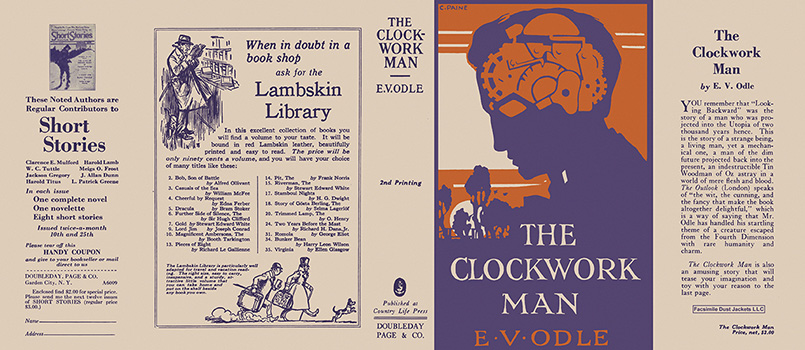
When I read an older science fiction novel now I like to imagine how the readers of its time thought about the ideas used within the story. For example, I just finished The Clockwork Man by E. V. Odle, first published in 1923. The story is about a creature that appears suddenly at a cricket match. It looks human but acts strange. During the course of the story we learn its from eight thousand years in the future and it’s something we’d call an android or cyborg today.

From my Scribd subscription I listened to the HiloBrow audiobook edition of The Clockwork Man, part of their original Radium Age of Science Fiction Series. A Summer 2020 note to the site promised to new series from MIT Press beginning in 2022, but there are several editions on Amazon now.

The intro to 2013 edition by Annalee Newitz is here. However, the novel is in the public domain and can be read at Project Gutenberg. Below is a reproduction of the original dust jacket from the 1923 American edition from Doubleday.

At first, when we are introduced to the clockwork man, I believe most modern readers will wonder if he is a robot. But as the story goes on, we realize the people of the period see him as human looking, with an odd bulge on the back of his head, which he hides with a hat and wig. Readers eventually learn that bulge is a clockwork mechanism that controls his biological processes. Not only does it give him superhuman senses, but great physical power, and even the ability to transport itself in time, space, and other dimensions.

E. V. Odle evidently believed in 8,000 years a lot can happen to the human race. The story feels like a comedy of errors at the beginning when this strange creature interrupts the cricket match, but gets more serious and philosophical as the story progresses. By the end of the tale, we have two twentieth century men arguing over whether evolution and technological progress has gone too far.

The essence of science fiction is exploring certain types philosophical questions. However, in every age the current scientific knowledge limits that exploration because the analogies and metaphors to describe the future depend on current technology. In 1923 Odle’s future man is imagined with clockwork technology. This is long before computers. L. Frank Baum imagined a similar mechanical man in Tik-Tok of Oz in 1914. The concept of robots emerged in 1921 with R.U.R., a Czech play about androids, but the idea of a mechanical being soon followed in science fiction in the 1930s. The idea of human created beings goes way back, each using the best technology of the day to imagine its creation.

Today we would consider it silly to build an AI being with clockwork technology. In the 1950s Philip K. Dick imagined robots made with vacuum tubes and tape loops, which we now groan at. Nowadays, we imagine AI beings constructed with computer silicon circuits. Fifty years from now, readers might consider using silicon circuits just as silly as clockwork or vacuum tubes. Remember, God made man with dust, and Mary Shelley had Frankenstein assembled his creature from stolen body parts. Our speculation about the future is always tied to what we know at the time. Reading The Clockwork Man made me think about what E. V. Odle had to work with in 1923.

We’re all quite familiar with all the philosophical issues surrounding robots, AI, cyborgs, and androids since science fiction has dwelled on them our entire lifetime in books, television, movies, and other art forms. But can you imagine how someone in 1923 could have contemplated the concept? Odle imagines new beings emerging from human machine combinations, which we since defined as the territory of cyborgs.

Yet, The Clockwork Man goes well beyond that. This visitor from the future finds 20th century humans rather limited, stuck in one three-dimensional dimension, whereas it can travel in time, space, and through multiple dimensions at will. It sees reality as a multiplicity of states. This is hard for us to imagine, but science fiction has often considered such possibilities.

Reading The Clockwork Man I can feel E. V. Odle struggling to imagine the potential of humanity. The story itself ranges from quaint to quixotic. During the course of the story the visitor from the future is both admired, feared, and pitied. It’s only towards the end does Odle give us a larger vision of the future, one that’s even more science fictional, closer to Stapledon than Wells.

"But must you always be like this?" he began, with a suppressed crying note in his voice. "Is there no hope for you?"

"None," said the Clockwork man, and the word was boomed out on a hollow, brassy note. "We are made, you see. For us creation is finished. We can only improve ourselves very slowly, but we shall never quite escape the body of this death. We've only ourselves to blame. The makers gave us our chance. They are beings of infinite patience and forbearance. But they saw that we were determined to go on as we were, and so they devised this means of giving us our wish. You see, Life was a Vale of Tears, and men grew tired of the long journey. The makers said that if we persevered we should come to the end and know joys earth has not seen. But we could not wait, and we lost faith. It seemed to us that if we could do away with death and disease, with change and decay, then all our troubles would be over. So they did that for us, and we've stopped the same as we were, except that time and space no longer hinder us."

I wanted to know more about the Makers. For most of the novel we thought the clockwork man was the epitome of humanity from eight thousands years in the future, but now we learn there are other beings, even greater. I must assume Odle is warning us against taking the cybernetic path, and hints that a greater spiritual one is possible.

I’m not sure 21st century humans have such fears, because we’re racing as fast as we can to invent both creatures of silicon and to evolve ourselves into posthumans. This reminds me of the ending of the film Things to Come (1936) inspired by H. G. Wells:

PASSWORTHY: “My God! Is there never to be an age of happiness? Is there never to be rest?”

CABAL: “Rest enough for the individual man. Too much of it and too soon, and we call it death. But for MAN no rest and no ending. He must go on–conquest beyond conquest. This little planet and its winds and ways, and all the laws of mind and matter that restrain him. Then the planets about him, and at last out across immensity to the stars. And when he has conquered all the deeps of space and all the mysteries of time–still he will be beginning.”

PASSWORTHY: “But we are such little creatures. Poor humanity. So fragile–so weak.”

CABAL: “Little animals, eh?”

PASSWORTHY: “Little animals.”

CABAL: “If we are no more than animals–we must snatch at our little scraps of happiness and live and suffer and pass, mattering no more–than all the other animals do–or have done.” (He points out at the stars.) “It is that–or this? All the universe–or nothingness…. Which shall it be, Passworthy?”

The two men fade out against the starry background until only the stars remain.

The musical finale becomes dominant.

CABAL’S voice is heard repeating through the music: “Which shall it be, Passworthy? Which shall it be?”

I read The Clockwork Man because of reading Yesterday’s Tomorrows: The Story of Classic British Science Fiction in 100 Books by Mike Ashley. British science fiction feels like it’s always been more philosophical than American science fiction, which has usually focused on the adventure and action side of Sci-Fi implications. Many of the books Ashley describes from the late 19th and early 20th century are ones I haven’t read. But Ashley shows those books explored science fictional concepts I thought originated in American science fiction during the 1940s and 1950s. I was wrong. I have to wonder, were those ideas original to the British in this earlier era of science fiction? I have another book that I haven’t read by Brian Stableford, The Plurality of Imaginary Worlds: The Evolution of French Roman Scientifique that explores French science fiction in the 1800s. Was France the Big Bang beginning of science fiction? Or will I find another turtle beneath the French?

James Wallace Harris, 4/20/21

When Does a Bad Movie Become Great? Well, Maybe Pretty-Good. Okay, Weirdly Compelling

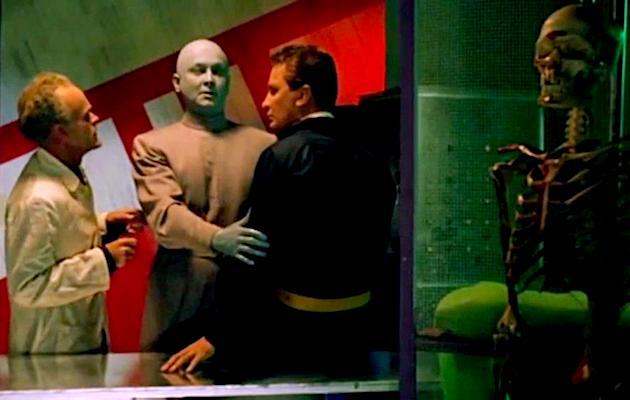
I’ve seen a lot of science fiction movies since I began watching them back in the 1950s, so I seldom catch an old movie that I haven’t seen or at least read about. Well, last night I caught The Creation of the Humanoids on Amazon Prime. The film supposedly came out in 1962, but maybe 1961, and maybe made in 1960. The poster for it on Amazon made it look dreadful. I can’t believe I even tried watching it. However, The Humanoids by Jack Williamson is one of my favorite old SF novels, meaning that one keyword got me to give the flick a view. And since then, the more I think about it, the more I think about it.

My initial reaction made me think the screenplay cribbed ideas from Isaac Asimov, Jack Williamson, and Philip K. Dick. The story and acting are very talky, but then a lot of classic science fiction from the 1940s and 1950s is overburdened with infodumps and preach dialog, so this movie has both the feel and philosophy of old pulp science fiction. And the cinematography reminded me of old science fiction magazine covers. The sets look like three different backdrops from an avant-garde theater play, but this cheapass movie was filmed in Technicolor. And the costumes and makeup are really good for the time. So there are levels of quality weaved into its low-budget production. I think they did the maximum they could with their budget.

Now don’t get me wrong, if you try watching this film, you’ll probably think, WTF??!! at the beginning. The acting is very wooden. If you stick with it, it might start growing on you until you’re thinking: “Okay, this is weirdly interesting” And if you stay until the end, you might even wonder “Is this some forgotten gem.” Or maybe not.

If you don’t have Amazon Prime, a 360p print is available on YouTube, watchable, but far from sharp.

What makes you forgive the weaknesses of The Creation of the Humanoids is the ideas it presents. I recently read and reviewed Klara and the Sun by Kazuo Ishiguro, a recent 2021 novel that covers some of the same themes dealing with androids. Android related speculations have been popular in movies and television shows for several years now, so it’s impressive that this 1960 B-movie is so ahead of its time.

The setup for this story is about a future after a nuclear war. The human population is dwindling, while the robot population is increasing. Robots are slowly taking over all human jobs and some humans resent that. Even the anti-robot crowd accepts robots at a certain intelligence level because society needs them, but doesn’t want robots produced with anything like human-level intelligence. The main character in this story is Capt. Kenneth Cragis is a leader in the racist organization called The Order of Flesh and Blood. He and his buddies wear Confederate uniforms and call robots “clickers,” so it’s pretty obvious that this early 1960s movie is not just about robots. At one point in the plot, Cragis learns his sister has married a robot and is furious.

But don’t think this film is just a thinly disguised story about civil rights. It covers all the ideas of modern science fiction on artificial intelligence and more. Don’t want to say too much that will reveal plot twists in the second half of the movie, which is far better than the first half. But those extra themes are frequently used in SF today.

Wikipedia has a positive write-up about The Creation of the Humanoids. They even let us know this was Andy Warhol’s favorite film. The Projection Booth has a ninety-minute podcast where three film buffs admit they’ve been converted to fans too. And over at Galactic Journey, a site that pretends to exist 55-years ago reviews the film with quite a bit of love and detail.

Don’t get me wrong. Probably, 99 people out of 100 who stream this movie are going to click the back button rather quickly. My initial reaction was “Yuck!” but I’m glad I stuck with it.

Finally, I think I got into The Creation of the Humanoids because the movie felt like reading a story out of Astounding or Galaxy. That says a lot about my nostalgia, but it also says something about the writing quality in the 1940s and 1950s science fiction magazines. I hate to think of it, but if I gave some of my old SF magazines to my friends to read, they’d probably react to my favorite stories just the way most audiences react today to The Creation of the Humanoids.

James Wallace Harris

Checklists for Reading Science Fiction Short Stories

We often see lists of best novels to read on the internet, but how many lists are there for reading short stories? Regarding science fiction, here are some of the major lists.

However, if you use our List Builder feature and click on Show Citations you can see which stories are on multiple lists. We haven’t added the sfadb list yet, but will. By using the year ranges, checking short story, and finding the right number of citations, you can easily see how these lists overlap. Unfortunately, you’ll also see the citations from other sources. Maybe we’ll program a way to limit by citation source type in the future. On the other hand, you’ll see how some stories are remembered by different kinds of citations: polls, awards, anthologies, scholars, etc.

Here is the List Builder set to 1939-2021 with 5 citations. That generates 863 stories. You can up the citation count to make the list shorter. Our v. 2 list uses 8 citations which reveals just 98 stories.

Reviewers of Short Science Fiction:

James Wallace Harris 3/21/21

“The Star” by H. G. Wells

When I was young, reading science fiction thrilled me by giving me new ideas to ponder, ones I wasn’t getting from school. For example, when I was twelve, I read the When Worlds Collide/After Worlds Collide double decker by Edwin Balmer and Philip Wylie. It provided three new wonders to inflame my mind. First, planets from outside the solar system could fly through our interplanetary space and even collide with the Earth. Imagining the end of the world provides no end of chilling speculation. People have been entertaining that vision since the Great Flood. Second, I was introduced to the idea that people could escape the end of the world. Wow, what a concept! And third, what if we found a dead city that was once occupied by aliens? What would it be like to walk among their ruins and imagine their lives from the clues they left?

What’s remarkable about “The Star” by H. G. Wells, published in 1897, is its science fictional setup would work just as well today in 2021. The story describes people’s reactions from from around the world at that time, but the astronomical events and effects upon the Earth would be the same today. And I’m not sure people now would react much differently than they did then. What has changed is how the news is spread.

Nowadays I am fascinated by how science fiction short stories gain popularity and then fade from pop culture memory. They are usually remembered by anthologies. An editor of a good retrospective anthology knows the genre and tries to keep older stories alive. Every few years a new large retrospective anthology of short science fiction appears. Over time, the weakest older stories are left out of the latest anthology, and the best newer stories are added, revealing a kind of evolution.

Readers who buy genre retrospective anthologies are shown a kind of photograph of the history of short science fiction, with each new anthology trying capture the genre in a pose by how the editors want their readers to see its history. I’ve been dipping into The Big Book of Science Fiction edited by Jeff and Ann VanderMeer since it came out in 2016. Its oldest story is “The Star.” The Big Book of Science Fiction has nearly a hundred stories and I’ve read maybe a quarter of them. The VanderMeers worked to diversify the history of the genre by including more stories by women writers and translated stories by non-English speaking writers.

Their family portrait of science fiction looks somewhat different than Leigh Ronald Grossman’s group photo, Sense of Wonder, taken in 2011. Grossman’s oldest pick was “Mellonta Tauta” by Edgar Allan Poe from 1849. Grossman’s anthology is even larger than the VanderMeers’, but it includes a novel, novel extracts, and introductory essays. It’s meant to be a textbook for teaching the history of science fiction, but Grossman’s photo of the genre revealed a more traditional pose for the genre.

Right now, I’m less concerned the overall image of the genre’s legacy than I am with understanding the evolution of science fictional ideas. I’d love to create a taxonomy of science fictional ideas and themes. When Groff Conklin assembled his first retrospective anthology back in 1946, The Best of Science Fiction, he divided the stories into six theme sections. Over the decades many anthologists have created theme anthologies. But it’s impossible to grasp all the far-out ideas of science fiction in just one anthology, or even a shelf of them. So, I’m going to work my way through several large retrospective anthologies, take notes, and plot my findings. Maybe I can come up with some way of showing an evolutionary tree of science fictional ideas.

I’ve decided “The Star” was inspired by astronomy, so the first theme I’m going to work on is Astronomical Science Fiction. However, did H. G. Wells think up his idea? Had Wells read Omega: The Last Days of the World by French astronomer Camille Flammarion which came out in 1894? When did the English edition first appear? Wells could also have read Olga Romanoff or, The Syren of the Skies by George Griffith serialized in Pearson’s Weekly (12/30/1893 – 8/4/1894). Both these stories are impact event stories. And then we must ask where did Flammarion get his idea? Jules Verne wrote Off on a Comet in 1877 about a comet that gives the Earth a glancing blow. Wells was savvy enough to know his planet didn’t need to impact the Earth, but it’s gravitation influence coming near us could wreak havoc on our planet.

I want to develop a classification scheme, a taxonomy, or even a mind map of how science fiction ideas evolve. Earlier writers imagined a comet hitting the Earth. Wells imagined a planet from outside the solar system, which is a much newer idea if you think about it. People were aware of comets, but how many Earthlings imagined a planet visiting the solar system? Then in the 1930s Balmer and Wylie imagined two visiting planets. By the way, Wells interstellar visitor is called a star in the title, but referred to as a planet in the story. People see it as a star in the sky.

Once you start considering the theme, thinking about astronomy can inspire all kinds of science fictional ideas. Wells used astronomy again at the end of The Time Machine when he used the Sun expanding into a red giant, and the Earth slowing its rotation.

I wish I had a better memory than I do so I could recall all the science fiction stories that used astronomy as the inspiration of its science fiction. Fred Hoyle used it for The Black Cloud a story about a dust cloud blocking the sun. But sometimes its fanciful astronomy. Poul Anderson imagined the solar system orbiting the Milky Way in Brain Wave and wondered what if the solar system passes through different kinds of radiation fields. Now this is unbelievable but fun, but what if the solar system had been in a radiation field that retarded intelligence and it moved out of that field? In Brain Wave humans and all living things become a bit smarter. Even more fanciful is Robert Charles Wilson’s Spin, where he imagines the Earth encased in a spin membrane that slows time down. Of course, this moves outside the realm of Astronomical Science Fiction because the membrane was artificially created.

Getting back to real astronomy, consider the short story “Inconstant Moon” by Larry Niven from 1971. People notice the Moon is glowing strangely one night. Our narrator theorizes the Sun has gone nova and the world is about to be destroyed, but then figures a massive solar flare has occurred, which might be survivable. Notice how these Astronomical Science Fiction stories usually involve the destruction of the Earth.

Larry Niven and Jerry Pournelle returned to the comet impact in 1977 with Lucifer’s Hammer. Comet and asteroid strikes seem to be the most common inspiration on Astronomical Science Fiction. But here is a list created by Andrew Fraknoi in 2019 that lists more recent science fiction based on astronomy and physics. Wells or “The Star” wasn’t mentioned. That’s the problem with creating a SF theme taxonomy, it’s like the biological world there are millions of examples to be classified.

One interesting aspect of “The Star” (and When Worlds Collide) is it depends on astronomers to let the people of Earth know that something is about to happen. How often are astronomers the heroes of science fiction stories?

It was on the first day of the New Year that the announcement was made, almost simultaneously from three observatories, that the motion of the planet Neptune, the outermost of all the planets that wheel about the sun, had become very erratic. Ogilvy had already called attention to a suspected retardation in its velocity in December. Such a piece of news was scarcely calculated to interest a world the greater portion of whose inhabitants were unaware of the existence of the planet Neptune, nor outside the astronomical profession did the subsequent discovery of a faint remote speck of light in the region of the perturbed planet cause any very great excitement. Scientific people, however, found the intelligence remarkable enough, even before it became known that the new body was rapidly growing larger and brighter, that its motion was quite different from the orderly progress of the planets, and that the deflection of Neptune and its satellite was becoming now of an unprecedented kind.

Few people without a training in science can realise the huge isolation of the solar system. The sun with its specks of planets, its dust of planetoids, and its impalpable comets, swims in a vacant immensity that almost defeats the imagination. Beyond the orbit of Neptune there is space, vacant so far as human observation has penetrated, without warmth or light or sound, blank emptiness, for twenty million times a million miles. That is the smallest estimate of the distance to be traversed before the very nearest of the stars is attained. And, saving a few comets more unsubstantial than the thinnest flame, no matter had ever to human knowledge crossed this gulf of space, until early in the twentieth century this strange wanderer appeared. A vast mass of matter it was, bulky, heavy, rushing without warning out of the black mystery of the sky into the radiance of the sun. By the second day it was clearly visible to any decent instrument, as a speck with a barely sensible diameter, in the constellation Leo near Regulus. In a little while an opera glass could attain it.

At the end of the 19th century the common person did not have access to television or the internet. This news would have been spread by telegraph and newspapers. Also, I doubt many citizens of the world understood much about astronomy back then. Since we know so much about astronomy now, and science fictional concepts, so I would think a science fiction writer would have a hard time coming up with a good new concept to set off people’s sense of wonder.

H. G. Wells worked imagine in his story the discovery of the event on different minds around the world. I think that’s why new writers get to retell old stories. Many science fictional concepts are quite old, so it’s the current culture that changes in new stories, not the science fiction.

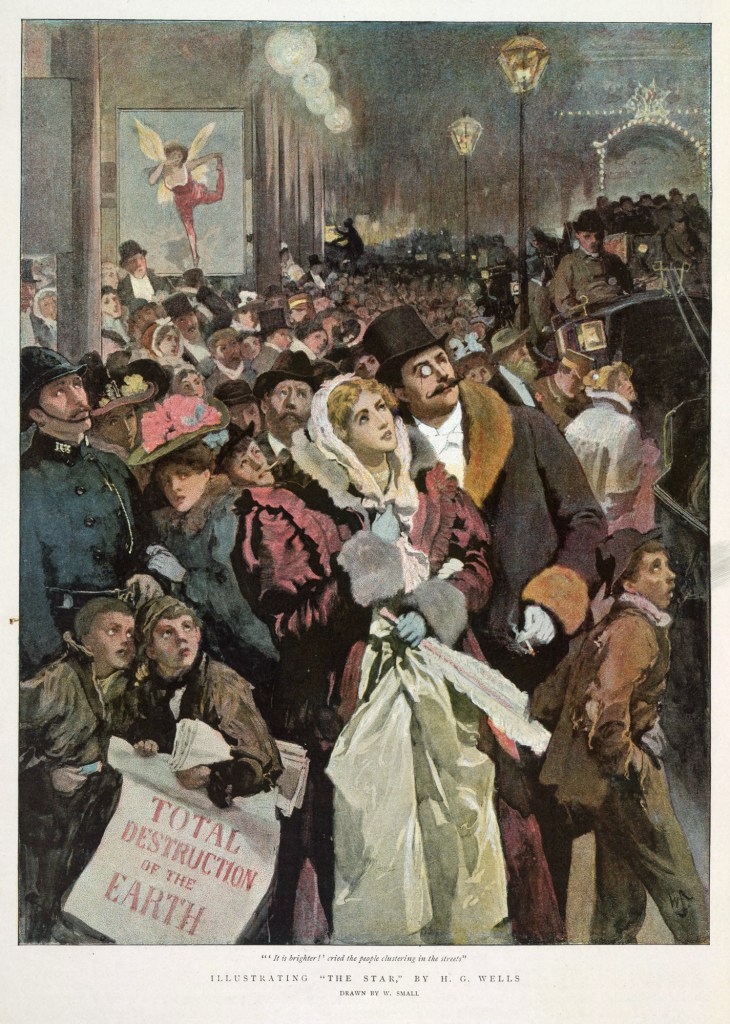
And when next it rose over Europe everywhere were crowds of watchers on hilly slopes, on house-roofs, in open spaces, staring eastward for the rising of the great new star. It rose with a white glow in front of it, like the glare of a white fire, and those who had seen it come into existence the night before cried out at the sight of it. "It is larger," they cried. "It is brighter!" And, indeed the moon a quarter full and sinking in the west was in its apparent size beyond comparison, but scarcely in all its breadth had it as much brightness now as the little circle of the strange new star.

"It is brighter!" cried the people clustering in the streets. But in the dim observatories the watchers held their breath and peered at one another it is nearer," they said. "Nearer!"

And voice after voice repeated, "It is nearer," and the clicking telegraph took that up, and it trembled along telephone wires, and in a thousand cities grimy compositors fingered the type. "It is nearer." Men writing in offices, struck with a strange realisation, flung down their pens, men talking in a thousand places suddenly came upon a grotesque possibility in those words, "It is nearer." It hurried along wakening streets, it was shouted down the frost-stilled ways of quiet villages; men who had read these things from the throbbing tape stood in yellow-lit doorways shouting the news to the passersby. "It is nearer." Pretty women, flushed and glittering, heard the news told jestingly between the dances, and feigned an intelligent interest they did not feel. "Nearer! Indeed. How curious! How very, very clever people must be to find out things like that!"

Lonely tramps faring through the wintry night murmured those words to comfort themselves--looking skyward. "It has need to be nearer, for the night's as cold as charity. Don't seem much warmth from it if it is nearer, all the same."

"What is a new star to me?" cried the weeping woman kneeling beside her dead.

The schoolboy, rising early for his examination work, puzzled it out for himself--with the great white star shining broad and bright through the frost-flowers of his window. "Centrifugal, centripetal," he said, with his chin on his fist. "Stop a planet in its flight, rob it of its centrifugal force, what then? Centripetal has it, and down it falls into the sun! And this--!

"Do we come in the way? I wonder--"

The light of that day went the way of its brethren, and with the later watches of the frosty darkness rose the strange star again. And it was now so bright that the waxing moon seemed but a pale yellow ghost of itself, hanging huge in the sunset. In a South African City a great man had married, and the streets were alight to welcome his return with his bride. "Even the skies have illuminated," said the flatterer. Under Capricorn, two negro lovers, daring the wild beasts and evil spirits, for love of one another, crouched together in a cane brake where the fire-flies hovered. "That is our star," they whispered, and felt strangely comforted by the sweet brilliance of its light.

The master mathematician sat in his private room and pushed the papers from him. His calculations were already finished. In a small white phial there still remained a little of the drug that had kept him awake and active for four long nights. Each day, serene, explicit, patient as ever, he had given his lecture to his students, and then had come back at once to this momentous calculation. His face was grave, a little drawn and hectic from his drugged activity. For some time he seemed lost in thought. Then he went to the window, and the blind went up with a click. Half way up the sky, over the clustering roofs, chimneys and steeples of the city, hung the star.

I would think in my taxonomy of science fiction for this theme I’d have to also classify the state of the world that received the story. Yet, isn’t the possibility of a roving body visiting out system still possible? Isn’t that why new SF writers in every generation can retell the story? Just research all the speculation the first known real interstellar visitor named Oumuamua caused? It reminded me of Clarke’s Rendezvous with Rama.

James Wallace Harris, 3/19/21