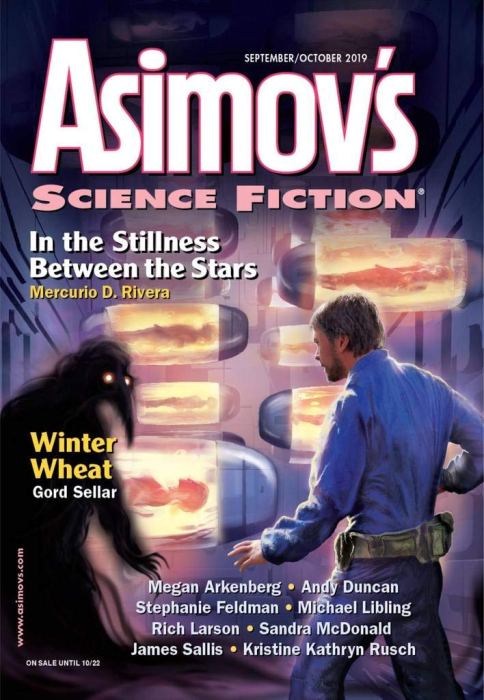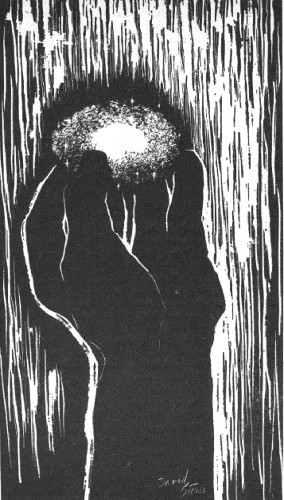
“Tani of Ekkis” by Aladra Septama

Tani of Ekkis by Aladra Septama

[This is part of a blogging group discussion of generation ships in science fiction.]

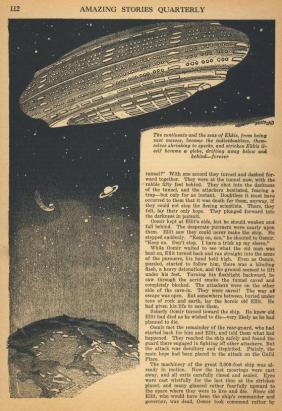
“Tani of Ekkis” by Aladra Septama from Amazing Stories Quarterly (Winter 1930) might be the first example of a generation ship story in science fiction. I can’t take credit for finding it, that goes to Brian Brown, a reader of old pulp magazines who told me about it. The Generation Starship in Science Fiction: A Critical History 1934-2001 by Simone Caroti claims “The Living Galaxy” by Laurence Manning in the September 1934 issue of Wonder Stories is the first. Patrick Baker in “Generation Ships: The Science and Fiction of Interstellar Travel” credits “Proxima Centauri” by Murray Leinster in Astounding Stories (March 1935) as the first example. Although the SF Encyclopedia says the idea was suggested by a character in A Trip to Venus (1897) by John Munro, they also point to “Proxima Centauri.”

Tani of Ekkis generation shipI can find very little about Aladra Septama. ISFDB.org says its the pen name for Judson W. Reeves. He wrote six science fiction stories for Amazing Stories Quarterly in 1929 and 1930. Reeves is barely mentioned in The Gernsback Days by Mike Asley and Robert A. W. Lowndes. That book summarizes those Gernsback magazines, story by story and issue by issue, and says practically nothing about Reeves. One comment said Reeves’s stories needed cutting. That’s certainly true of this one.

That’s too bad I couldn’t find more about Reeves, because “Tani of Ekkis” is historically interesting for science fiction. It is not about humans building a generation ship, but about aliens from another star system building one to come to Jupiter. But all the elements of a generation ship story are there. A voyage of five hundred years. The fears of the people who start a voyage they won’t finish. Discussions about how the ship must be self-sufficient. Worries about people who are born during the voyage. Asking if ship born can even comprehend life on a planet when they arrive. And, the fear of not finding a habitable planet at the end of the voyage.

The story did have some twists. The crew develops suspended animation during the voyage. At first for just short periods of ten years to help preserve the food and supplies in case they needed to visit another solar system. Eventually, they perfect the process and people sleep for up to a hundred years at a time. This allowed the original crew to survive the entire trip. Tani is the wife of their leader, and mother of two children born during the voyage. She becomes the keeper of the calendar. Because she isn’t a scientist she regularly asks others for explanations of how things work, and we the readers receive the lessons. In other words, lots of infodumps.

“Tani of Ekkis” is not much of a story, at least for modern readers. It’s loaded down with out-dated science blather, and a bunch of tedious pseudo-science speculation. The author still talks about “the ether,” a concept that had already been disproven well before 1930. He imagines storing food by reducing the size of atomic structures. Reeves throws out many gobbledegook science-fictional concepts during this tale, but sadly, the story itself doesn’t have much in the way of a plot or drama. It is not a story I would recommend reading or anthologizing, and no one else has either.

Still, it’s very cool that “Tani of Ekkis” reveals early ideas about generation ships and suspended animation. Gernsback discovered few SF writers that are still remembered today. I guess E. E. “Doc” Smith and Jack Williamson are his big discoveries like Campbell lays claim to Heinlein, Asimov, and van Vogt. Most of his stable of writers just aren’t remembered today at all. And few stories from Amazing are reprinted retrospective SF anthologies, even though Amazing is famously remembered as being the first science fiction magazine. There’s no telling how many SF concepts premiered in the Gernsback magazines of the late 1920s and early 1930s. because those stories just aren’t being read and remembered. Brian Brown told me he is systematically reading them, and that’s how he discovered “Tani of Ekkis.” But I doubt many other readers will follow in his eye tracks.

You can read “Tani of Ekkis” here.

James Wallace Harris, 12/28/19


“Thirteen to Centaurus” by J. G. Ballard

Thirteen to Cenaurus by J. G. Ballard

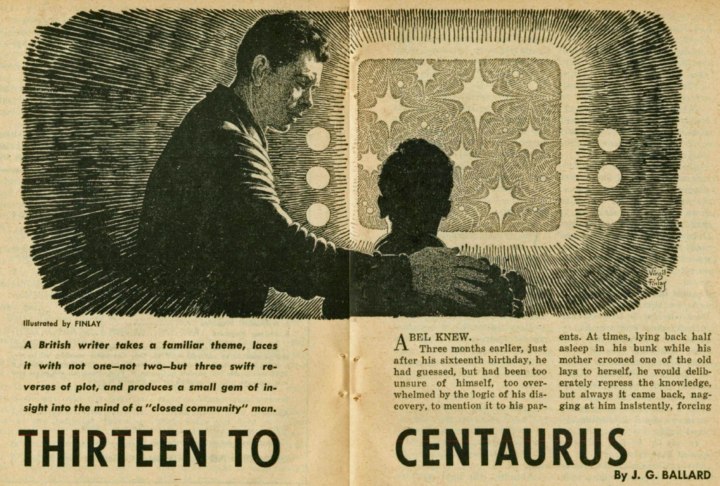
“Thirteen to Centaurus” by J. G. Ballard is the fifth story in the Generation Ships in Science Fiction discussion originated by Joachim Boaz. You can read the story online here. I consider “Thirteen to Centaurus” a superior story. However, none of the generation ship stories we’ve read so far have been popularly anthologized, so they aren’t classics. Maybe it’s time to reconsider that.

I don’t want to say much about “Thirteen to Centaurus” since I don’t want to spoil any of its several plot twists and turns. However, in my previous reviews in this series, I mentioned an idea I had for a generation ship story, and it turns out Ballard already used it back in 1962. Of course, I wouldn’t have developed the idea the same way Ballard did. It does make me wonder if science fiction writers should read all the major stories from a theme before trying to take on a theme? On the other hand, if the average reader isn’t well-read in a theme, does it matter?

I want to believe that J. G. Ballard had read “Lungfish” by John Brunner when writing “Thirteen to Centaurus” because there is a certain synergy between them. The two stand out of the five stories we’ve read. Ballard and Brunner began their science fiction careers in Great Britain in the 1950s. Ballard was being published in New Worlds around the time of “Lungfish” so he probably read Science Fantasy too. I’m not so sure Ballard would have read the Judith Merril, Chad Oliver, or Clifford Simak stories in the American SF magazines, but “Thirteen to Centaurus” seems to reply to them. I have to assume there is a progression of logic when thinking about the consequences of humans living on a generation ship and all the writers are reaching the same or similar conclusions.

So far these SF writers believe humans can’t handle a generation ship mission psychologically. Is that why we mostly read about FTL travel? Several writers have suggested we’ll need to condition or even brainwash the generation ship crew. And all the stories have had an element of conspiracy in them, that for one reason or another the crews don’t know everything. More than one story worries that the ship born generations, the ones who didn’t volunteer for the mission will feel resentment or rebel against the mission. Would you be pissed in such a situation?

I’m hoping to see in future reads a sense of progression past these fears. I’d like to see positive stories about how humans adapt and even create new philosophies, perspectives, and hopes while living on a generation ship mission.

We’ve seen two kinds of story problems so far. First, the writers imagine the kinds of problems crews might encounter on real generation ship missions. Second, writers have imagined problems for the crews to make interesting plots. Before reading these stories I never considered the psychological problems generation ship crew would face. Now that I have, I can see a whole array of further speculation along those lines. Has Philip K. Dick ever written a generation ship story? PKD could have done some weird shit with this idea.

And there are all kinds of considerations the writers haven’t explored. The other day while brushing my teeth I wondered how many toothbrushes and tubes of toothpaste must be stored on a generation ship for a mission that will last a hundred years. If a ship has 1,000 passengers, that’s a lot of toothbrushes. Or do they send along a factory that can make them? It’s certainly helped that we’ve developed 3D printers since these stories were written. But really, how do you equip a voyage for a century or millennia?

If the voyage begins with 1,000 crew members and they start having kids, grandkids, and great-grandkids, how many sleeping births will be needed? It sounds like a kind of algebra problem, doesn’t it?

None of the stories we’ve read so far had the ship stay in communication with Earth. Is it possible to have radio contact with Earth on a spaceship moving at one-tenth the speed of light? If a one-minute radio message is sent from Earth, how long does it take to record it at relativistic speeds on the ship? Heinlein created a wonderful setup in Time for the Stars with telepathic twins, one staying home and one leaving. If telepathy was possible, how does relativity effect it?

If a generation ship had a large telescope could it be networked with those on Earth or in the solar system to create a really large interferometer? If so, how much detail will we be able to observe in destination solar systems? In these early generation ship stories, the crews travel blindly to other systems hoping to find habitable planets. Knowing what we do about exoplanets and with telescope development, would that ever be true of real generation ship missions? Haven’t we passed the point where the 1940s, 1950s, and 1960s story problems wouldn’t exist? I’m really looking forward to generation ship stories from the 1970s, 1980s, 1990s, and so on.

Can we create a generation ship that won’t bring along most of the diseases that plague us on Earth? And if the crew does carry on colds or strains of flu, will they die out because the passengers all develop immunity, or will they mutate in such a small population? What happens to a generation ship crew if they encounter diseases at their destination?

I wonder what shipboard novelists would write about. What if they try to write about life on Earth without ever living on Earth. Can the ship born ever develop a realistic picture of life on a planet from movies and books? What kind of myths will they have about us?

Once we start thinking about the possibilities they are endless. So far, I think the stories we’ve read have been very good but limited in their speculation and imaginations. I’m looking forward to reading more.

I’m surprised that we don’t see more generation ship stories. I guess writers want FTL travel because they want a bunch of interstellar action. In Star Wars they can obviously travel between star systems faster than needing to pee because some of the Star Wars spaceships aren’t large enough for bathrooms. Basically, modern science fiction has made FTL spaceships the new fantasy portal, but they are no more realistic than the wardrobe in the C. S. Lewis stories.

Interstellar travel is probably impossible, but our best chance will be generation ships. I’m surprised we don’t see more of them in science fiction.

Remember, here’s the list of the posts in this discussion so far. Joachim Boaz at Science Fiction and Other Suspect Ruminations leads the group. He will announce the next story.

James Wallace Harris, 12/18/19


“Lungfish” by John Brunner

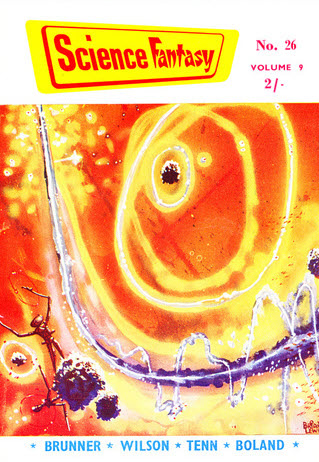
Science Fantasy 26 1957

This is part 3 [Part 1, Part 2] of a group discussion reviewing science fiction stories about generation ships in science fiction. “Lungfish” by John Brunner is the fourth story we’ve discussed and probably the most realistic so far. Reading these stories one after another is both delightful and enlightening. They are an education in writing science fiction. Not only are we learning about a sub-genre, but we see how one writer after the next sets up their version of a generation ship society and contrives a plot. It feels like each story is a reply to previous stories where writers are communicating across time with one another.

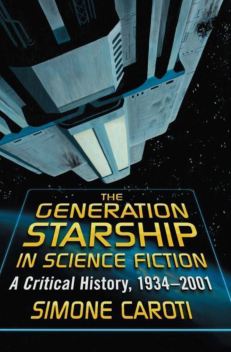
The Generation Starship in Science Fiction A Critical History 1934–2001While researching “Lungfish” I found The Generation Starship in Science Fiction: A Critical History, 1934–2001 by Simone Caroti, a whole book analyzing this theme. I’ve gotten so intrigued by generation ship stories that I sprang for the $9.99 Kindle edition. Even though this work started out as an academic paper it’s very readable, and I’m learning a lot. It makes a great companion to our reading group. Caroti brings realistic considerations to topic. For example, it will probably be too expensive to ever build a generation ship.

I wonder if I’m developing an obsession on this theme. But the generation ship has always been one of my favorite sense-of-wonder ideas I found in science fiction. Of course, much of that sense-of-wonder came from reading Orphans of the Sky by Robert A. Heinlein and it’s particular plot surprise.

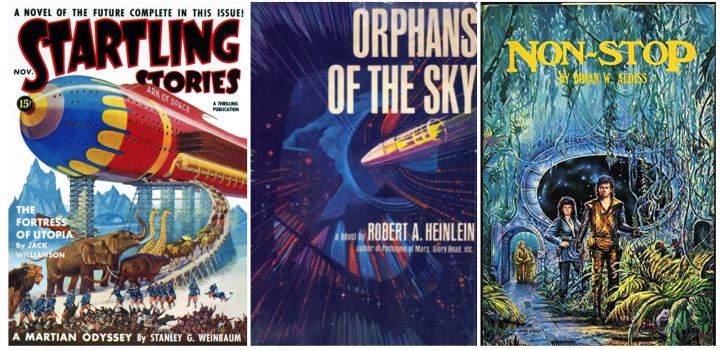
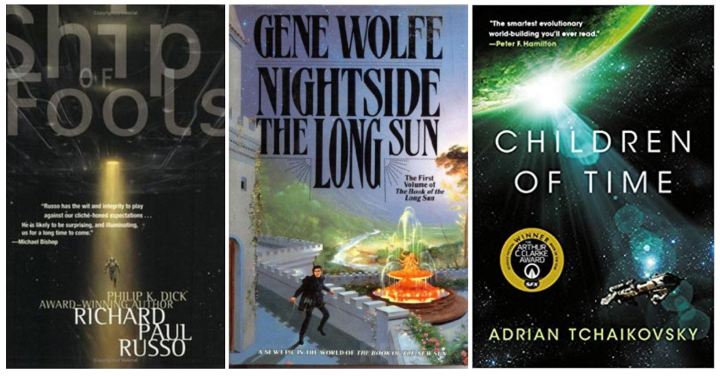
If asked before starting this group discussion, how many generation ship stories I’ve read, I would have replied “A bunch.” But thinking about it since then, I realize it hasn’t been that many. I recall reading three novels, Orphans of the Sky, Non-Stop by Brian Aldis, and The Children of Time by Adrian Tchaikovsky, but only one short story came to mind, “The Voyage that Lasted 600 Years” by Don Wilcox. When I saw Joachim Boaz’s list of generation ship stories it showed I wasn’t really that well-read after all, having read just eleven of the dozens of titles. Joining this group discussion has added four more. I don’t know how long Joachim will keep this project going, but I’m in for the long haul.

John Brunner uses his title “Lungfish” as a metaphor for comparing humans leaving Earth to live on other worlds to when fish first came out of the ocean to live on dry land. He also compares it to the pain of giving birth and being born. As a life-long science fiction fan, I always assumed going to another planet would be a thrill, but after reading these four stories I see that I haven’t thought things through. I’m an introvert with a touch of agoraphobia and would probably adapt well to shipboard life, but for most people, it would be mentally damaging. And if I’m honest with myself, starting life over on another planet would be terrifying and traumatic.

Heinlein, Simak, Oliver, Merril, and now Brunner show that leaving Earth won’t be easy. And there are two deeply psychological issues here that have taken me five stories to even start to see. One, folks growing up on a generation ship will not want to leave. And two, landing on another planet will not be as easy as Star Trek/Star Wars leads us to believe. I wonder if these early stories reveal anxieties about space travel before the time of real space travel? I’m curious to see if modern SF writers still consider such fears valid.

How many science fiction fans would enjoy living their science fictional fantasies?

I’ve reached an age where I hate to leave my house. I’ve made my home very comfortable and secure. Going places is uncomfortable and insecure. I completely understand why people raised on a generation ship would refuse to exit at end-of-voyage.

“Lungfish” feels the most realistic of the generation ship stories we’ve read so far, but even it has another conspiracy that I find unrealistic. Thirty-seven years isn’t that long, so we don’t have the problem of people forgetting their mission. But we again have the resentment of the second generation against the original crew. Brunner imagines the ship run like a corporation with a board of directors and a chairman. For 1957, Brunner is farsighted enough to make the chairman a woman, and many of the officers are women. But the original crew have retained their positions in the upper ranks of management to the resentment of their children born on the ship. Brunner recognizes the same kind of resentment between generations we see if the world today.

We readers can’t imagine what life outside the environment of Earth would be like. People raised inside a spaceship will have different mental perspectives on reality. “Lungfish” brings new insights to the generation ship theme. Overall, this story is top-notch, but I didn’t like the resolution of the problem. Reading these stories together I get the feeling that writers want a trick conclusion to their stories to entertain their readers and avoid a realistic solution that could be boring.

Anthology of Generation Ship SF Stories

I’ve been poking around and can find no evidence for an anthology of generation ship science fiction stories. I think our reading discussion should at least create a virtual anthology. It would be great to see a theme anthology like The Time Traveler’s Almanac by Jeff and Ann VanderMeer for generation ship stories. Here are the stories I’d recommend so far:

I’m hoping to find many more.

Visit Science Fiction and Other Suspect Ruminations to join the discussion.

JWH – 12/11/19


“Wish Upon A Star” by Judith Merril

1958-12 The Magazine of Fantasy and Science Fiction

“Wish Upon A Star” by Judith Merril is the third story for Joachim Boaz’s discussion about generation ships in science fiction. See my original post for more details. Here are the reviews so far:

  • Science Fiction and Other Ruminations – Joachim Boaz gives the story a 4.25/5 (Good) rating and says: A radical story but a quiet one—a slice-of-life rumination where the action stays in the distance, in the board rooms and classrooms of the female crew, the places where men cannot go. Recommended.
  • MPorcius Fiction Log – MPorcius says: This story is successful–entertaining and interesting enough–but no big deal.  I have to admit I was expecting a more hardcore feminist or leftist story which trumpeted the benign rule of women and/or argued that gender roles are socially constructed and could easily be changed for the better by an enlightened elite.
  • Expendable Mudge Muses Aloud – Richard said: I gave this story three and a half stars because it’s not the revelation that it would’ve been sixty-one years ago to have women in charge. There’s a decent chance that’ll happen in the USA in 2020, or so I hope. It’s also a very small story, a slice of adolescent life; that’s not all that interesting to me personally. It’s fine as a story, it has good things to say about equality and the arbitrary nature of society and the fairness doctrine is far fleshier for its 1958 readers than it would’ve begun by being.
  • Also, there are some interesting comments at Young People Read Old SFF.
  • I’d rate it 4 out 5 stars. Not a classic, but a better-than-average story for the time. It’s worth reading for the generation ship angle, and for the feminist poke at male readers in 1958.

You can read “Wish Upon A Star” at the Internet Archive, or in these anthologies. It’s currently in print in Science Fiction by Women (1958-1963).

Update: After writing this essay I discovered an earlier story that describes the launch of the mission in "Wish Upon A Star." I strongly recommend reading it first.  It's called "Survival Ship" and you can read it here. It's a quick read and answers some of my questions I had with "Wish Upon A Star."

What I enjoy about reading generation ship science fiction is how each writer imagines a society adapting to the long voyage. What’s funny is none of the stories I’ve read have things working out like I imagine. I assume generation ships will have carefully planned societies, even utopian. The Simak story tells us at the end that the planners intended what happened, and I get the feeling Merril’s matriarchal society was carefully planned as well but neither writer talks about the planning details and the whys.

To build a ship and society that will voyage for a century or a millennium implies a kind of planned perfection. You’d think the designers of such a ship would build an experimental community on Earth to test out their ideas. That would make an interesting novel too. (And DAW just announced they are open to submissions from writers without agents.) Of course, Biosphere 2 failed rather spectacularly. Space colonies, in general, might be very difficult to pull off.

Setup for “Wish Upon A Star”

A generation ship named Survival, propelled by ion drives is approaching its destination after just one generation. The ship traveled at a good fraction of lightspeed. None of the original crew are older than 45. Some of their children have reached adulthood, while most are still teens and younger. In this ship, the command crew is female, while men work the gardens, take care of the children, and do other support work. The original crew consisted of twenty women and four men. As the ship approaches a time of landfall the men wonder if their roles will change. There is resentment among the males because the females have all the opportunity.

Merril’s story came out in January 1958, well before the second wave of feminism began in the 1960s. At this time job ads in the newspapers were divided between Men – Wanted and Women – Wanted, with nearly ever job type going to men.

Characters

  • Toshiko (Sheik) – 13-year-old boy protagonist
  • Sarah – the girl that Sheik wants for his girlfriend but resents her crew training
  • Naomi – 12-year-old girl Sheik resents because she’s in advance crew training and he’s not
  • Harendra (Hari) – 3-year-old boy in Sheik’s care
  • Abdur (Ab) – one of the four original male crew members in charge of plants, and fatherly mentor to Sheik
  • Bob – Sheik’s father and one of the four original male crew members
  • Lieutenant Johnson – an older second-generation woman in charge of Sheik and Sarah, who might have an eye out for young Sheik.

Story

The story begins with Sheik thinking “I WISH, I WISH, I WISH . . . .” Sheik, a young teen hiding in the shady shrubs, shirking work and daydreaming. We know he’s a passenger on a generation starship because of how we came to the story. Plus the editor tells us when introducing Judith Merril, “Here she turns her compassionate eye on the problems and inner conflicts of an adolescent boy who has lived his life on a starship commanded by women.” (Doesn’t that sound bias?)

I wish I had read this story dead cold. How soon would readers know the story is set on a starship? And when would they know what Sheik was wishing for. Sheik is upset, crying even, because Naomi, a girl younger than him had just left for “Special Sessions” getting to learn something he’s not allowed to study. We learn Sheik is destined to replace Abdur who runs the botanical room. He will have to take orders from Naomi, as Abdur now takes orders from Lieutenant Johnson – another woman.

We hear him think: “It just wasn’t fair! I wish I wish I was …”

Was he about to say he wish he was a girl? Then Sheik starts thinking about Sarah, a girl he wishes would ask him something. (Ask him out?) Sheik longs to have Sarah under the bushes, the shady escape he loves. But since he’s thirteen we have to assume he needs more than some company in his hide-out.

We slowly learn about the generation ship. Merril is more creative with the details than the previous stories. Evidently, it’s a large cylinder that spins along its axis to create artificial gravity. Too bad these stories don’t come with diagrams of the ship, because each writer has an image in mind, but I’m not sure they are good at conveying their ship’s design with words.

The ship’s farm is on the inside of the outside wall. There are artificial lights on the outside wall of an inner cylinder that provides their sky and quarters. Children are expected to spend a certain amount of time under these artificial lights for health reasons. This area of the ship belongs to the men who raise the crops. We quickly learn that men also raise the ship’s children. Sheik has two and three-year-olds under his charge, both girls and boys. The younger girls seem precocious, learning faster than the boys.

Merril provides gender role reversals for 1958. The story isn’t blatantly feminist. And this might be showing my ignorance, but I can’t recall any famous feminist books from the 1950s. Wikipedia only lists two books and an article. I do know from reading the outstanding When Everything Changed (2009) by Gail Collins that women had very few job choices in the 1950s. Plus Merril knew that most of the readers of F&SF then were teenage boys. There were some female readers and writers, but not many. It’s interesting in this story that the men never claim the women can’t pilot and navigate the ship. They just want better jobs too.

I really would have loved to know the readers’ reactions to this story when it came out in 1958. F&SF didn’t have a letter column. I wonder if any fanzines from the time discuss it? Fanac.org does have a chronological list of fanzines. (A few random reads tell me it will be quite a job to find any reaction to the story. Someone needs to build an index to fanzines.)

As “Wish Upon A Star” develops we learn the starship is nearing its destination. Its goal is a colony scoutship. They are looking for worlds to help depopulate an overcrowded Earth.  The men hope after they land they can have more involvement in decision making and diversity of work. They fear the women are secretly plotting to hold onto their power, or even choose not to land. We don’t know if this is true or not, or just a conspiracy theory of Bob’s.

Merril imagines more details of shipboard life than Simak and Oliver did for the two previous stories we discussed. Shiek is part of the second generation. Only half the crew quarters are used in the ship because they assumed they might need to travel longer, producing a third and fourth generation.

Merril sets up a very interesting situation in this story. She tells us: “This much was common knowledge and one further fact: that the original crew of twenty-four had included twenty women and four men for obvious biological race-survival reasons.”

Merril doesn’t go into the genetic diversity needed to start a colony, but we can read a lot into these numbers. We know that Sheik’s father is Bob, but we don’t know if Bob has four other wives. Why didn’t Merril go into these details? Sheik never mentions a sibling or having half-siblings. He does list several girls who he doesn’t want to mate with and calls them nasty. Could they be siblings? There’s a hint that he might have to mate with more than one girl and even considers Lieutenant Johnson.

The first generation is way out of whack when it comes to the female-male balance, but the second generation will have a 50-50 ratio. Sheik realizes this will bring change. I’m not a rocket scientist, but I wonder if starting with one-fourth of crew capacity on a generation ship saves on reaction mass? (The ship doesn’t gain mass with larger generations.)

Was Merril suggesting the colony will have more genetic diversity if the first generation had more mothers? She could have increased the diversity if the first 20 women were pregnant by men not from the ship, or got pregnant the first time by sperm donors from back on Earth. If that was true, did they need any men in the original crew? Maybe for “men’s” work, and then only four were needed. Did Merril ever write about writing this story? I’d love to know what she was thinking.

Because the men resent the women for their status and jobs we assume Merril meant this story to be a role-reversal story, and it is. But it might be more. Maybe the women run the ship because Merril thinks they would be better. Merril doesn’t go into that, though. I need to reread it and read between the lines. When you have twenty Eves and four Adams, that seems to imply the men’s roles are less important. Was Merril criticizing traditional women’s roles in the 1950s? I’m surprised Merril didn’t imagine an all-female crew in the first generation. That would have been radical. Maybe too much even for her.

I also wondered if Merril had an idea that more women on a generation starship are more practical. But she didn’t make her case.

Before the story is over, things get more complicated. I’ll leave that for readers to discover. But we learn that Sheik wishes for more than Sarah even though Sarah is the main thing on his mind. I can’t help but wonder if Merril is making additional comments about men’s role in space colonies, or of science fiction fans.

On the other hand, Merril might not have thought a lot about her setup. It might have been a quick inspiration and she didn’t think through the implications. The story is mainly about Sheik wanting to hook up with Sarah and the complications he encounters. Those complications hint at what the society on the ship is like. I wish this had been a whole novel.

I do like the fact that the Clifford Simak story, like the Merril, considered the idea that the crew might prefer living on the ship living on a planet. Merril’s story is a little different. The men worry that the women might prefer it.

JWH – 12/8/19

New Appreciation for Isaac Asimov

I just finished Robot Dreams by Isaac Asimov. I first thought this would be another repackaging of his robot stories, but it was really another best of Isaac Asimov volume, including many of his most famous short stories except “Nightfall.” I’ve always thought of Asimov as an entertaining but mediocre writer. While listening to Robot Dreams, I realized my impression of Asimov came mostly from I, Robot and The Foundation Trilogy, stories he wrote when he was very young in the 1940s, and I read as a teenager in the 1960s. After reading a handful of his books back then I mostly ignored Asimov except for his nonfiction, which I liked a lot.

Several years ago I reread The Naked Sun and really admired it. I had read it and The Caves of Steel in the SFBC edition of The Rest of the Robots and hadn’t particularly liked them. I’m not a fan of mysteries. But when I reread The Naked Sun I really got into it, not for the murder mystery, but for the tale of agoraphobia, something I could relate to in my old age. Now that I just finished a huge book of short stories and novelettes I realize I was wrong about Asimov being a bad writer. Several of these stories showed a good deal of storytelling finesse.

It was George Guidall, the narrator of the audiobook edition of Robot Dreams that really helped me see Asimov in a new light. I always felt Asimov was an idea writer who avoided writing emotional scenes, but Guidall’s reading revealed the feelings in these tales. I thought Asimov was a tone-deaf stylist, but Guidall showed me Asimov did have a sense of drama (sometimes). I now have to assume that Asimov was not a bad writer, but I was a bad reader. That’s not to say Asimov didn’t write a lot of forgettable science fiction. Logic tells us, not all of Asimov’s zillions of short stories are gems.

I still believe Isaac Asimov will never be considered a literary writer except that I came across “My Five Star Books.” It’s a long list of books from a lifetime of reading by a very serious reader. The Foundation Trilogy is on it. And it’s not a list of SF books. The list feels like a list of books that Harold Bloom would recommend, most of them were once part of Great Books collections. I guess I really need to reread the trilogy.

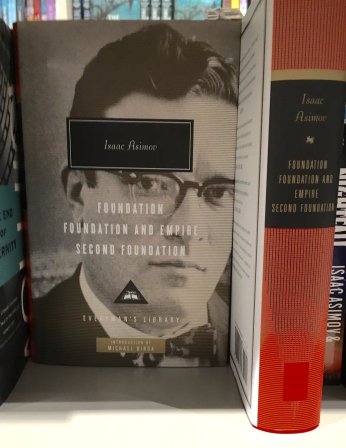
The Foundation Trilogy Everymans LibraryThen last year when PBS had it’s Great American Read The Foundation Trilogy was one of the few science fiction books that America voted in. It came in at #49 of the top 100 books. Even for a popular vote, not many genre science fiction titles made the list. Dune was #35. The Hitchhiker’s Guide to the Galaxy was #39.

The Foundation Trilogy has even gotten an Everyman’s Library edition. But it’s kind of expensive at Amazon. Barnes and Nobel also have a similar priced deluxe hardback version. Amazon does have a Kindle edition of the trilogy on sale for $4.95 right now.

One problem with Asimov was he was so damn prolific. He wrote hundreds of books and hundreds of short stories, and I imagine thousands of essays. It’s very hard to pick out his best work, or even read through all his work to find the best. Actually, it’s painful to just read his bibliography.

Yesterday I was discussing with my online friend Piet about which books were Asimov’s best. What would we recommend to new readers? We came up with the idea of the minimum set of books needed to showcase Asimov’s work. What’s the smallest number of volumes needed to convey Asimov’s best work.

Another problem with recommending Asimov is I doubt young readers will like a lot of his stories because they feel too old fashioned. Which novels and stories do you think have lasting value that resonates with the youngest generations? Leave a comment.

The first book we both recommend is a one-volume edition of The Foundation Trilogy. That used to be one of the main enticements to the old Science Fiction Book Club. I reread the first book, Foundation a few years ago and was very disappointed. After discovering so much positive press I want to give the trilogy another chance. However, the Foundation series is huge. I assume only Asimov’s most fanatical fans will read all of it.

After the trilogy, Piet recommended The Complete Robot next. It’s a one-volume of all the robot short stories but lacks the two classic robot novels. I’m reading through that volume now. I wished I had an audio edition, but no such luck. I’m not so sure I’d recommend it to new readers anyhow because it’s a very large collection with too many stories that aren’t Asimov’s best. However, it is considered the first book to read if you want to read the entire merged Robot/Foundation series.

But I’m thinking more about a volume to give people that would convince readers that Asimov was a better writer than his reputation suggests. Being prolific is a significant distinction, but not one when it comes to quality. Asimov had many collections of short stories, several labeled his best, but none were the right mix of stories, and often they were Costco pallets of stories that would overwhelm new readers

Our CSFquery list-builder tells me Asimov had 54 stories from all our citation sources. Only three made it to our Classics of Science Fiction Short Story list: “Nightfall,” “The Bicentennial Man” and “The Last Question.” One of my favorites, “The Ugly Little Boy” was popular with fans being on the 1999 Locus All-Time Poll, 2012 Locus All Centuries Poll, ISFDB Most Viewed Short Stories, and Sci-Fi List Top 200 Stories. Other popular stories were “Reason,” “Robbie,” and “Liar!” his famous older robot stories, as well as “Robot Dreams” a newer robot story and his most remembered space story, “The Martian Way.”

Readers would get most of Asimov’s most admired stories if they bought Robot Dreams and Robot Visions. Links are to Wikipedia that has lists of their contents and links to essays about each short story. They are available as ebooks and audiobooks. They have more stories than most readers need, but they contain almost all of Asimov’s best stories except “Nightfall.”

I’ve read that Asimov considered “The Last Question” his best story, and “The Ugly Little Boy” his second and third best story. “The Last Question” is a total idea story, and even though it’s far out, it doesn’t have much heart. “Nightfall” is Asimov’s most famous story but I’ve read it so many times I can’t judge it anymore. Again, it’s an idea story. I’d pick “The Ugly Little Boy” as Asimov’s top story. It does have emotional impact, almost too much.

The reason why I admire “The Ugly Little Boy” so much is how brilliantly Asimov sets up the ending. I could feel it coming from his careful groundwork and he cut us off perfectly leaving readers with a great deal to ponder. I think Asimov’s best stories were the ones where he put his characters through much suffering, even to the point of being cruel or evil. Timmie and Edith’s fate is particularly horrific.

I also thought “Lest We Remember” had an emotional wallop too. In it John Heath, an average guy is given a drug that improves his memory and he becomes exceptional. Susan Collins his fiancée who was smarter than John doesn’t like the new John, and neither does John’s co-workers and employers. The story has some nice dramatic twists I didn’t expect from Asimov.

I believe it is when Asimov plots a dramatic story with emotional realism that I feel he’s a much better writer. And some of these stories prove he has that skill. That’s why I like his story “Hostess” about an alien invasion with a horrifying twist. These three stories have strong women characters. In the early days of his career, Asimov was known for leaving women out of his stories. When Asimov was a teen he even wrote fan letters to Astounding advocating a no girls allowed policy in science fiction. (See Partners in Wonder by Eric Leif Davin as the source of this juicy bit of info.) So it’s ironic that the mature Asimov discovered feminine empowerment.

Asimov did create Susan Calvin for his robot stories, and she was a fascinating character, but I was shocked by Susan Calvin in “Robot Dreams” where she’s “Cold Equations” murderous.

Rereading Asimov’s short stories make me think about his literary legacy. I feel The Foundation Trilogy will last a while longer, but I don’t know about Asimov’s short stories. For a man who wrote almost 500 books, I’m finding it very hard to pick which works that will have lasting power. I haven’t read The Gods Themselves, so I can’t say anything about it yet, but it’s probably Asimov’s most popular standalone novel.

I know several people that admire the Foundation stories a great deal, plus I’ve been reading a lot about it in recent months. I figure I need to really give The Foundation Trilogy another chance and read it carefully. I believe after I read Robot Visions I’ll be finished with Asimov’s stories. I will have read maybe three dozen out of more than 200. I don’t think I’ll need to be a completest.

Useful Links:

James Wallace Harris, 12/3/19


Would Generation Ship Crews Ever Forget Their Mission?

Generation ships 1
Generation ships 2

Joachim Boaz at Science Fiction and Other Suspect Ruminations is running a series of reviews on generation ship stories. He even compiled a list of such SF tales. I’ve decided to read along. So far he’s covered “The Wind Blows Free” by Chad Oliver and “Spacebred Generations” by Clifford D. Simak (later renamed “Target Generations”). Joachim plans to do “Wish Upon a Star” by Judith Merril next. Science fiction has explored this theme often. Imagining a self-contained society that spends hundreds or thousands of years between the stars presents a wonderful challenge to writers.

I’ve loved the concept of generation ships since 1965 when I was 13 and read Orphans of the Sky (1963) by Robert A. Heinlein. This book was assembled from two magazine stories, “Universe” and “Common Sense” first published in 1941. At the time I thought Heinlein and science fiction must have invented the idea of generation ships, but I was wrong.  I highly recommend reading Wikipedia’s entry on the topic. Both the rocket pioneer Robert H. Goddard, and the space explorer theorist Konstantin Tsiolkovsky came up with the idea in America and Russia. And it was also described by J. D. Bernal in a 1929 nonfiction book speculating about the future, The World, The Flesh, & the Devil.

Because I’m going to discuss the ideas in the stories this essay will have spoilers.

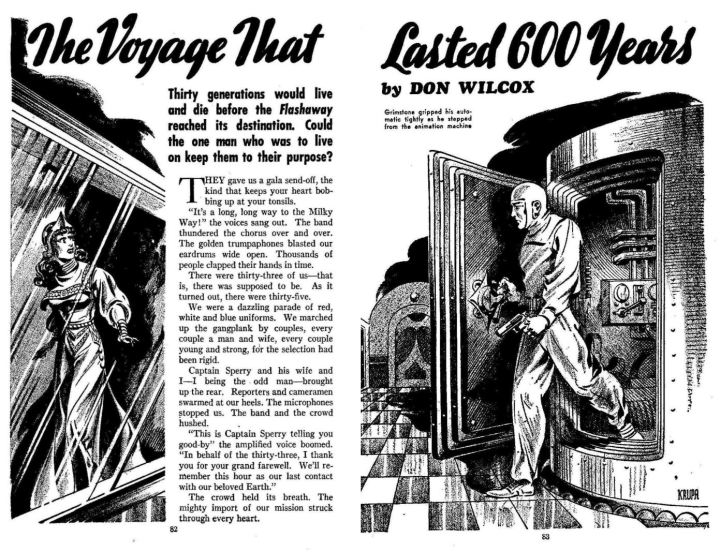
Quite often in the early science fiction stories about generation ships, the crews forget they are on an interstellar mission. This makes for a sense-of-wonder climax based on characters experiencing what The Encyclopedia of Science Fiction calls a conceptual breakthrough. That’s an exciting plot device for the reader but would any generation ship crew ever forget their mission? Right from the beginning of the idea of generation ships in science fiction with “The Voyage that Lasted 600 Years” (1940) by Don Wilcox writers have been intrigued by the idea that the passengers would forget.

The Voyage that Lasted 600 Years by Don Wilcox 1940

A generation ship is a spaceship that travels slower-than-light and takes many generations to reach its destination. Heinlein hit one into orbit by imagining the crew forgetting their mission. Their society collapses to the point where they believe the ship is their entire universe. Because the crew can’t see outside the ship they don’t know about the stars and the cosmos. This is such a delicious idea that Brian Aldiss reexamines it in his novel Starship (1958) (first called Non-Stop in the U.S.).

Now that I’m much older I find it very hard to believe the crew would forget they were on a generation ship. Such forgetting makes for a bang-up plot, but if you think about it, doesn’t make a lot of sense. To forget their mission would require a complete collapse of the ship’s society. Is that even possible? How could the ship continue to function? Writers tell us the ship is fully automatic, but I can’t believe that either.

Evidently, science fiction writers assume such forgetting is a powerful McGuffin to wow their readers. And I loved these plots when I first encountered them. However, I now believe such situations to be too contrived to be realistic. Such tricks by the writer are much like an O’Henry ending. The reader is set up from the get-go. Not that such storytelling shenanigans are bad, but I do think it gives readers the wrong impression about generation ships.

Of course, I haven’t read all science fiction stories about generation ships. Now that Joachim Boaz is systematically reading them for his blog, I’m wondering if any science fiction writer imagined a realistic generation ship. It’s fun discussing this at his site.

Slower-than-Light Travel

Even though Einstein has been validated time and again, science fiction writers have us zipping around the galaxy at several thousand times the speed of light (300,000 kph). The spacecraft Voyager 1 and 2, our only efforts to leave the solar system, poke along at 1/18,000th that speed. Some engineers have theorized we might achieve 1/10th to 1/5th lightspeed with our present and expected knowledge, however, even their ideas are extremely theoretical.

If we could travel at ten percent of the speed of light it would take a whole lifetime to get to the nearest star. Since it will probably take hundreds or thousands of years to travel the nearby stellar neighborhood we’d need the crew using suspended animation or build a ship where humans could live out several generations.

Suspended animation is probably no more realistic than faster-than-light travel.

Building an artificial world that is completely self-contained, self-sufficient, and can travel a significant fraction of the speed of life is not impossible but probably so. Still, it’s a very exciting idea to contemplate. Can we build a machine that works perfectly for 1,000 years? What is the optimal crew size? How do you design a society that can thrive in such a limited environment? How will this civilization get its energy? Will water and air leak out? Will the passengers find meaning in their lives? How would successive generations react when learning they have been forced into a limited role by their ancestors? What if you don’t like where you’re going?

The generation ship would have to contain a minimum viable population (MVP). We must assume it will be a colony ship. Any scientific exploration should be done by intelligent machines – why waste all those lives on just information? In my reading, I’ve seen MVP numbers ranging from 160-5,000. We often see stories now about sending frozen embryos or building machines that can sequence DNA from raw material but I’m going to assume frozen embryos can’t last 1,000 years, and building people from digital blueprints is a fantasy. If we could, it would invalidate the need for a generation ship. By the way, raising artificial children at the end of a long space voyage is a new theme science fiction writers are exploring.

Orphans in the Sky imagines a generation ship where the ship’s civilization collapses and the inhabitants forget they are on a spaceship. I love that idea as a science fiction story, but doubt it would happen. Crews on a generation ship would have lots of time on their hands and education would have a significant appeal. They would have a library of our entire history. They would be in contact with Earth. They would know everything about astronomy and cosmology. For Heinlein’s story to work the original passengers would have to be clueless dumbasses who didn’t care about anything intellectual and refused to teach their children. The original crew would be brilliant with a passionate hope for the mission. They would pass that on. For Heinlein and Wilcox to be right, their descendants would have de-evolve. How that could happen would make a great SF story. I wish Heinlein had written it before writing “Universe” and “Common Sense.”

Clifford Simak came up with a different idea in “Target Generations.” He tells us the original mission designers feared the crew would not psychologically survive knowing why they were on the ship, so hid the knowledge from them. That’s absolutely ridiculous if we think about it, but at least Simak’s realized Heinlein’s idea had problems. That’s what’s wonderful about science fiction, it evolves. It’s a dialog by writers over time.

Chad Oliver offers another twist in “The Wind Blows Free.” The passengers know they are on a spaceship but they haven’t been told it landed hundreds of years earlier. Selective crew members decide the generation ship’s inhabitants are too adapted to shipboard life to leave it. That’s a very compelling idea, but still not realistic. I don’t see how they could hide landing a ship, but more than that, it’s based on maintaining an absurd conspiracy theory. The practical solution to such a problem would be to land the ship and let people slowly migrate to the new world. I do buy that generation ship passengers might not want to leave the ship. I’m an old guy who has become very attached to my house. I wouldn’t want to start over either.

Too often science fiction ignores Occam’s razor to create a compelling plot. I’m hoping we’ll be reading stories where generation ships succeed, or if they fail, fail for realistic reasons. Aurora by Kim Stanley Robinson was an outstanding example of a space exploration failure that made sense.

Children of Time (2015) by Adrian Tchaikovsky did come up with a very real generation ship problem. Successive crew generations became resentful for having their lives committed to a project they didn’t choose. Some even want to abort the mission and return to Earth. This is the kind of realistic challenges I hope science fiction writers will imagine. There’s nothing wrong with coming up with a plot that wows the readers but ultimately makes no sense. A story is a story. But I like science fiction that imagines something that might be possible.

I like to think it’s science fiction’s job to consider all the possibilities before we actually build a generation ship. From early science fiction, we know not to create a society that will forget the mission. I also like the idea we have to worry about the resentment of the later generations. And we do have to worry about getting people comfortable living on a ship to living on a planet again.

We science fiction fans daydream of traveling in space. But can you imagine a future where children born in space wished they lived on Earth like us?

James Wallace Harris, 12/2/19

Ever Wonder Why You Read Science Fiction?

Angel's Egg by Edgar Pangborn

Ever psychoanalyze your own reading choices? Ever wonder about the unique appeal of science fiction? Ever wonder if your personal daydreams overlap with the authors’ own fantasies? Are stories just stories or do they the trigger synapses storing your hidden desires?

Every science fiction story has at least one weird idea in it. Some stories are subtle with one slight bit of strangeness. Others are overflowing with the fantastic. Each bit of added weirdness is like an ingredient in a recipe. Most of the ingredients are common off the science fiction spice rack. I’m developing a new theory. I’m realizing each writer brings their own special flavor of weirdness to the genre. Think about all your favorite science fiction writers, don’t their collective work leave a unique aftertaste in your mind? Just recall Philip K. Dick or Ursula K. Le Guin as examples.

To be completely holistic, we should consider our own weird interests and how we resonate with the pet themes of the writers. Most sense-of-wonder aspects of science fiction are not part of our everyday reality. What science fiction fans love are far-out concepts presented as mundane. We want reality to include our pet fantastic, weird, strange, and unbelievable concepts. If asked, we might say we’re only pretending, but I can’t help but believe that deep down we all want science fiction to come alive. And all of us are psychically drawn to our own hidden daydreams reflected in the fiction we read.

Maybe all readers are Walter Mittys, leaving writers to the hard work of generating fantasies. Books are VR machines powered by our own CPU-brains. If you start thinking about fiction this way, you become a connoisseur of hidden emotions.

I used to assume it was the science fictional tropes that shaped science fiction stories, the spaceship, the robot, the alien, but I’m now wondering if authors’ own inner obsessions and philosophies sculpt SF stories more, and the stories we love most are the ones that resonate with our own emotions. I’m even wondering if writers don’t go into science fiction because it offers the tools to promote their own weird hopes, desires, and fears better than any other literary form.

The story I’m going to discuss as my example is “Angel’s Egg” by Edgar Pangborn. Not because it’s special, but simply because it’s the last story I read and it’s stuck in my mind. “Angel’s Egg” was Pangborn’s first published science fiction story, appearing in the June 1951 issue of Galaxy Science Fiction. Since Galaxy began publishing in October 1950, Pangborn was essentially a new SF writer for a new SF magazine, and “Angel’s Egg” is different from the SF norm Astounding Science-Fiction had established. Times were changing. Although, I do wonder if Pangborn had submitted “Angel’s Egg” to John W. Campbell first? Was it a reject, or had Pangborn been inspired by the new magazine H. L. Gold was publishing? It actually feels more like an F&SF story, a magazine that launched in 1949.

Another part of the flavor of science fiction is where and when it’s published. “Angel’s Egg” presents a kind of weirdness for America in 1951. People were still freaking out over atomic bombs, plus the flying saucer craze was stirring up the crazies in the late 1940s. The early 1950s were a boom time for science fiction with dozens of magazines, new hardback publishers, TV shows and movies. America and the world feared total annihilation. Earthlings dreaded invasion by superior beings. We thought the human race was being judged and we all knew we weren’t going to pass the test.

Edgar Pangborn (1909-1976) got his first novel published in 1930, a mystery. His father and sister were also authors, and they all often wrote about the supernatural. All that went into the weird flavor of “Angel’s Egg.” If you follow the link you can read the story at Project Gutenberg. You can also read the story at the Internet Archive, in digital editions of the original June 1951 Galaxy Science Fiction magazine.

I wonder if H. L. Gold’s lead-in is how Gold really saw Pangborn’s story:

When adopting a pet, choose the species that
is most intelligent, obedient, loyal, fun to
play with, yet a shrewd, fearless protector.
For the best in pets—choose a human being!

If I had been Pangborn, I would have been pissed and insulted. Actually, I think it’s also insulting to the science fiction reader. Maybe “Angel’s Egg” was too weird for H. L. Gold, or maybe Gold just had a non-serious attitude towards science fiction. His mag was often filled with satire and humor. Yet, in some ways, it is hard to take Pangborn’s story seriously. “Angel’s Egg” is really about a savior from another world who asks one human to sacrifice life to save our species. That’s heavy. Pangborn is actually telling a spiritual story using the language of science fiction.

How serious should we take Pangborn? Is he inventing a weird story just to make a few bucks? How Freudian or Jungian is this story? Is “Angel’s Egg” a message from Pangborn’s unconscious mind about the state of humanity in 1951? If you haven’t read the story you have no idea what I’m talking about. I’ll try to include enough quotes to make sense, but you might want to read it first.

The story starts with a frame. A letter from an FBI agent to a local police captain who had asked the agency to investigate the death of a person named Dr. David Bannerman who died in 1951. Attached to the letter is a note from a librarian who found the letter in 1994. Included with the letter is Dr. Bannerman’s journal dated from June 1, 1951, to July 31, 1951.

The story is Bannerman’s journal extract. Writers use this kind of framework to give their tale a greater feel of authenticity. It’s also a trick to allow a first-person narrator to die in the story. Pangborn also wanted to use the first-person narrative to make the story feel as real as possible. But such techniques were also common in older, especially 19th-century science fiction. We know Pangborn came to science fiction rather late, so he might not have known the conventions of the genre.

How “Angel’s Egg” is told has a kind of archaic flavor that I enjoy. Pangborn leans toward the sentimental, more like Bradbury and Simak, his contemporaries. Here’s how the story begins and where the egg comes from in the title.

It must have been at least three weeks ago when we had that flying saucer flurry. Observers the other side of Katahdin saw it come down this side; observers this side saw it come down the other. Size anywhere from six inches to sixty feet in diameter (or was it cigar-shaped?) and speed whatever you please. Seem to recall that witnesses agreed on a rosy-pink light. There was the inevitable gobbledegookery of official explanation designed to leave everyone impressed, soothed and disappointed.

I paid scant attention to the excitement and less to the explanations—naturally, I thought it was just a flying saucer. But now Camilla has hatched out an angel.

I have eight hens, all yearlings except Camilla; this is her third spring. I boarded her two winters at my neighbor Steele's farm when I closed this shack and shuffled my chilly bones off to Florida, because even as a pullet she had a manner which overbore me. I could never have eaten Camilla. If she had looked at the ax with that same expression of rancid disapproval (and she would) I should have felt I was beheading a favorite aunt. Her only concession to sentiment is the annual rush of maternity to the brain—normal, for a case-hardened White Plymouth Rock.

This year she stole a nest successfully, in a tangle of blackberry. By the time I located it, I estimated I was about two weeks too late. I had to outwit her by watching from a window; she is far too acute to be openly trailed from feeding ground to nest. When I had bled and pruned my way to her hideout, she was sitting on nine eggs and hating my guts. They could not be fertile, since I keep no rooster, and I was about to rob her when I saw the ninth egg was not hers, nor any other chicken's.

Doesn’t this seem like a very strange way to begin a science fiction story? A mysterious ninth egg? Then Pangborn tells us:

That was ten days ago. I know I ought to have kept a record; I examined the blue egg every day, watching how some nameless life grew within it, until finally the angel chipped the shell deftly in two parts. This was evidently done with the aid of small horny out-growths on her elbows; these growths were sloughed off on the second day.

I wish I had seen her break the shell, but when I visited the blackberry tangle three days ago she was already out. She poked her exquisite head through Camilla's neck feather, smiled sleepily, and snuggled back into darkness to finish drying off. So what could I do, more than save the broken shell and wriggle my clumsy self out of there?

I had removed Camilla's own eggs the day before—Camilla was only moderately annoyed. I was nervous about disposing of them even though they were obviously Camilla's, but no harm was done. I cracked each one to be sure. Very frankly rotten eggs and nothing more.

In the evening of that day I thought of rats and weasels, as I should have earlier. I hastily prepared a box in the kitchen and brought the two in, the angel quiet in my closed hand. They are there now. I think they are comfortable.

Three days after hatching, the angel is the length of my fore-finger, say three inches tall, with about the relative proportions of a six-year-old girl. Except for head, hands, and probably the soles of her feet, she is clothed in feathery down the color of ivory. What can be seen of her skin is a glowing pink—I do mean glowing, like the inside of certain seashells. Just above the small of her back are two stubs which I take to be infantile wings. They do not suggest an extra pair of specialized forelimbs. I think they are wholly differentiated organs; perhaps they will be like the wings of an insect. Somehow I never thought of angels buzzing. Maybe she won't. I know very little about angels.

Angels? Really, in a science fiction story? Are we reading a tall tale, or is this science fiction? Where are the rockets and robots? Why does Pangborn couch his alien in religious garb?

I made no entry last night. The angel was talking to me, and when that was finished I drowsed off immediately on a cot which I have moved into the kitchen to be near them.

I had never been strongly impressed by the evidence for extrasensory perception. It is fortunate that my mind was able to accept the novelty, since to the angel it is clearly a matter of course. Her tiny mouth is most expressive, but moves only for that reason and for eating—not for speech. Probably she could speak to her own kind if she wished, but I dare say the sound would be above the range of my hearing as well as my understanding.

Last night after I brought the cot in and was about to finish my puttering bachelor supper, she climbed to the edge of the box and pointed, first at herself and then at the top of the kitchen table. Afraid to let my vast hand take hold of her, I held it out flat and she sat in my palm. Camilla was inclined to fuss, but the angel looked over her shoulder and Camilla subsided, watchful but no longer alarmed.

Now we have an angel that’s telepathic. What we quickly learn is the angel is really an alien from a very advanced civilization. But its physical form is more like Disney’s Tinkerbell than modern angels. In Biblical times angels were a non-human species that came from another realm to visit Earth. In modern times, angels are people who have died and gone to heaven. Why is Pangborn recasting a Biblical image?

Angel's Egg 2 by Edgar Pangborn

There is also a slight undercurrent of sexuality to Bannerman’s angel even though there is no possibility of sex. Bannerman is a lonely man, who is crippled from the war, living away from other people out in the country. The angel saves him.

I don’t know why Pangborn made his tiny alien into an angel. Maybe he considered an ordinary alien cruising around in a flying saucer too common and ugly. I’m also wondering if Pangborn has the same theory as I do, that science fiction is a modern replacement for religion? Instead of dying and going to heaven we build a rocket and fly up into the heavens to other planets and stars. Instead of God(s), we imagine super-intelligent aliens. Instead of being saved and given everlasting life, we develop scientific ways to achieve immortality. Instead of the power of prayer, we evolve telepathy.

Pangborn’s little alien with wings is really a wise being from an ancient civilization that wants to save humans from self-destruction. Her father and nine siblings came to Earth to uplift us. And she asks Bannerman to sacrifice himself to save all of us. This is a very Christian story. Pangborn’s second SF novel, A Mirror for Observers (1954) has pretty much the same theme. It won the International Fantasy Award in 1955. Pangborn isn’t well-remembered today, but he had a certain level of success in the 1950s and 1960s.

Reading “Angel’s Egg” and A Mirror for Observers are my only experiences with Edgar Pangborn’s work. I own three more of his novels, but they are unread. Yet, from this small sample, I detect a rather unique mind using science fiction for its philosophical purposes. I feel Pangborn yearning for humanity to be saved from itself, and that was a very common hope in science fiction of the 1940s and 1950s.

If you think about it, there are two ways to be saved. One is to be rescued, the other is to overcome. Christianity is all about being saved by a higher power. And it’s rather strange that so many science fiction stories in the 1940s and 1950s had humanity being rescued by a higher power, not God(s) but aliens. The most famous example is 2001: A Space Odyssey (1968) by Arthur C. Clarke. But that story is really a retelling and refinement of his 1953 novel Childhood’s End.

Personally, I don’t like the idea of humanity being rescued by outsiders. I’m a pull-yourself-up-by-your-bootstraps kind of guy. But after Hiroshima, many people felt humans were children with a dangerous toy they couldn’t handle. Remember the old film The Day the Earth Stood Still (1951)? It was saying we needed guardian robots. I admire the Prime Directive from Star Trek.

Pangborn imagines his aliens as gentle guiders of the uncivilized. But isn’t that still being uplifted? If we’re reshaped by an outside force are we really ourselves? I never understood the basic tenet of Christianity, that we should be forgiven of our sins. I believe we should overcome our sinful ways, not be saved.

You’d think I’d dislike this story because it conflicts with my personal philosophy. But I still loved “Angel’s Egg” even though it’s rather clunky with religious imaginary and I’m an atheist. Although I kept thinking of the little angel as a more sophisticated Tinkerbell. What I loved were Pangborn’s emotions. What I loved was Bannerman’s sacrifice and how it was made. But then memory is a pet theme of mine.

The angel offered him two choices.

I made plain that I would never willingly part company with her, which I am sure she already knew, and she gave me to understand that there are two alternatives for the remainder of my life. The choice, she says, is altogether mine, and I must take time to be sure of my decision.

I can live out my natural span, whatever it proves to be, and she will not leave me for long at any time. She will be there to advise, teach, help me in anything good I care to undertake. She says she would enjoy this; for some reason she is, as we'd say in our language, fond of me.

Lord, the books I could write! I fumble for words now, in the usual human way. Whatever I put on paper is a miserable fraction, of the potential; the words themselves are rarely the right ones. But under her guidance—

I could take a fair part in shaking the world. With words alone. I could preach to my own people. Before long, I would be heard.

I could study and explore. What small nibblings we have made at the sum of available knowledge! Suppose I brought in one leaf from outdoors, or one common little bug—in a few hours of studying it with her, I'd know more of my own specialty than a flood of the best textbooks could tell me.

She has also let me know that when she and those who came with her have learned a little more about humanity, it should be possible to improve my health greatly, and probably my life expectancy. I don't imagine my back could ever straighten, but she thinks the pain might be cleared away, entirely without drugs. I could have a clearer mind, in a body that would neither fail nor torment me.

I think this is the choice we’d all jump at. But Pangborn wants to give us a science-fictional Christ. I might need to remind you that Camilla was the hen who sat on the angel egg.

Then there is the other alternative.

It seems they have developed a technique by means of which any unresisting living subject, whose brain is capable of memory at all, can experience total recall. It is a by-product, I understand, of their silent speech, and a very recent one. They have practiced it for only a few thousand years, and since their own understanding of the phenomenon is very incomplete, they classify it among their experimental techniques.

In a general way, it may somewhat resemble that reliving of the past which psychoanalysis can sometimes bring about in a limited way for therapeutic purposes. But you must imagine that sort of thing tremendously magnified and clarified, capable of including every detail which has ever registered on the subject's brain.

The purpose is not therapeutic, as we would understand it; quite the opposite. The end result is—death.

Whatever is recalled, by this process is transmitted to the receiving mind, which can retain it, and record any or all of it, if such a record is desired; but to the subject who recalls, it is a flowing away, without return. Thus it is not a true "remembering," but a giving. The mind is swept clear, naked of all its past, and, along with memory, life withdraws also. Very quietly.

At the end, I suppose it must be like standing without resistance in the engulfment of a flood tide, until finally the waters close over.

That, it seems, is how Camilla's life was "saved." When I finally grasped that, I laughed, and the angel of course caught the reason. I was thinking about my neighbor Steele, who boarded Camilla for me in his henhouse for a couple of winters.

Somewhere safe in the angelic records there must be a hen's-eye image of the patch in the seat of Steele's pants. And naturally Camilla's view of me too; not too unkind, I hope. She couldn't help the expression on her rigid little face, and I don't believe it ever meant anything.

At the other end of the scale is the saved life of my angel's father. Recall can be a long process, she says, depending on the intricacy and richness of the mind recalling; and in all but the last stages it can be halted at will. Her father's recall was begun when they were still far out in space and he knew that he could not long survive the journey.

When that journey ended, the recall had progressed so far that very little actual memory remained to him of his life on that other planet. He had what must be called a deductive memory—from the material of the years not yet given away, he could reconstruct what must have been, and I assume the other adult who survived the passage must have been able to shelter him from errors that loss of memory might involve. This, I infer, is why he could not show me a two-moon night.

I forgot to ask her whether the images he did send me were from actual or deductive memory. Deductive, I think, for there was a certain dimness about them not present when my angel gives me a picture of something seen with her own eyes.

Jade-green eyes, by the way. Were you wondering?

In the same fashion, my own life could be saved. Every aspect of existence that I ever touched, that ever touched me, could be transmitted to some perfect record—the nature of the written record is beyond me, but I have no doubt of its relative perfection. Nothing important, good or bad, would be lost. And they need a knowledge of humanity, if they are to carry out whatever it is they have in mind.

It would be difficult, she tells me, and sometimes painful. Most of the effort would be hers, but some of it would have to be mine. In her period of infantile education, she elected what we should call zoology as her life work; for that reason she was given intensive theoretical training in this technique. Right now I guess she knows more than anyone else on this planet not only about what makes a hen tick, but how it feels to be a hen.

Though a beginner, she is in all essentials already an expert. She can help me, she thinks, if I choose this alternative. At any rate, she could ease me over the toughest spots, keep my courage from flagging.

For it seems that this process of recall is painful to an advanced intellect—without condescension, she calls us very advanced—because, while all pretense and self-delusion are stripped away, there remains conscience, still functioning by whatever standards of good and bad the individual has developed in his lifetime. Our present knowledge of our own motives is such a pathetically small beginning! Hardly stronger than an infant's first effort to focus his eyes.

Of course, we know which one Bannerman chooses.  The rest of his journal is about forgetting as his memories are peeled away. In some ways, this part of the story reminds me of Charlie Gorden from Flowers for Algernon when Charlie was on his decline.

I have read science fiction my whole life. Often just for escapism and entertainment, but I must admit I wished reality was different and sometimes science fiction reflected an alternate reality I preferred. Pangborn’s dream isn’t mine, but I feel great sympathy for him. His story draws me back to how some people felt during the year I was born.
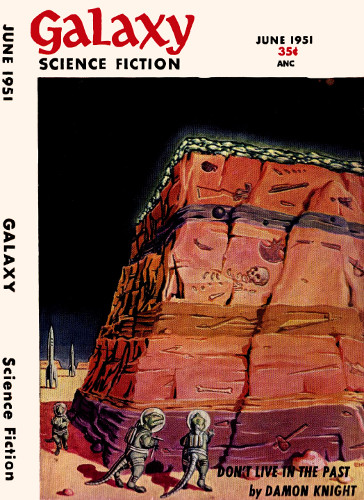
Galaxy June 1951

[The above illustrations are the ones that first appeared with the story in Galaxy Science Fiction.]

James Wallace Harris, 11/26/19
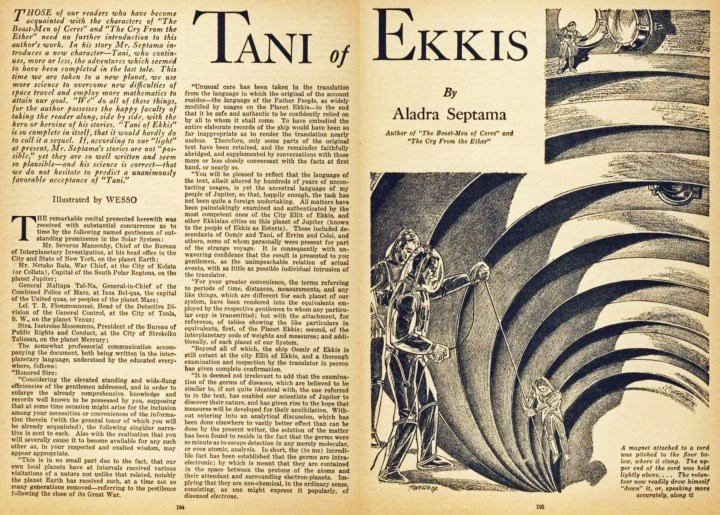
“Then, When” by Eric Del Carlo

Asimovs SF Sep-Oct 2019

Mike, the guy who does the computer programming for this site, and I often talk about science fiction short stories. We both subscribe to Analog, Asimov’s, and F&SF. Whenever one of us reads a story we like we tell the other to give it a try. To be honest, we don’t often find stories we really like, but when we do, we often like the same story. What’s rather fascinating when discovering a story you really love is assuming everyone will love it too, and discovering they don’t.

“Then, When” by Eric Del Carlo from Sept/Oct issue of Asimov’s Science Fiction was a big hit with both Mike and myself. I thought the story had a very clever science-fictional invention and Eri Del Carlo created a very moving story to showcase that idea. I thought the story so good that I wondered why it wasn’t the cover story, however, Carlo didn’t even get his name on the cover with the other authors.

Looking around the web “Then, When” is getting mixed reviews. Rocket Stack Rank called it an “Honorable Mention” but dinged the idea I thought so clever as being “pretty gross.” That made me consider the appeal I have to the idea. Sam Tomaino at SFRevue said “Really interesting idea and a great story.” Michelle Ristuccia over at Tangent Online  said, “Carlo expertly weaves Barrett’s first-person narrative to breathe new life into themes of self-actuation and introspection, bringing these existential questions down from the hypothetical heights of cloning and AIs to the personal connection of everyday decisions and our ability to redirect our own personal growth.”

I mention these different reviews not to justify my own opinion about the story, but to point out that stories aren’t good or bad, but whatever the beholder sees in them. It must be hard to be a magazine editor and try to guess what your readers will like. Or even see what your readers will see.

I love science fiction stories that have a cool imaginary invention in them. Eric Del Carlo imagines a fad in the future where a computer program can make a “mirror” of a person by observing their behavior. Think of a cross between Amazon’s Alexa and a deep fake video of yourself that talks and acts just like you on a computer or TV screen. In Carlo’s future, these mirrors have gone out of fashion. When Barrett, the main character, finds out his ex-girlfriend illegally made a mirror of him while they were together he’s annoyed. She kept it for companionship. Barrett at first thinks he will sell his mirror to a marketing research group but then decides to keep it. Of course, he is embarrassed to own what popular culture has decided is a narcissistic toy. This is probably why Greg Hullender thought it was a gross idea too. But I’m not so sure.

Wouldn’t hanging out with ourselves be enlightening? It’s very hard to know our own virtue and flaws. I’d probably be horrified talking to myself. I know if I had to listen to me make the stupid jokes my wife complains about I’d probably stop. Maybe I’d even learn how to pronounce all the words I stumble over. I’m a rather quiet person, so I’m not sure how much a mirror could learn from just watching me. Of course, if it read my blogs it would become a rather verbose bastard. If I had to listen to all the ideas I like to write about would I bore the crap out of myself?

What I really liked about the idea of mirrors is they are more realistic than mind downloading/uploading, which is a very popular concept in science fiction right now. I believe our minds are tightly integrated with our bodies and far too complex to ever be recorded. The idea of mind uploading is about as silly to me as when E. E. “Doc” Smith had his characters hurling galaxies at each other. But I can imagine an AI program studying people and imitating them so well that their speech and opinions would be very close to the original.

In the story, “Then, When” we are told that scientists don’t think the mirrors are sentient, but the ending leaves us thinking they might be. But like the mirror said, does it really matter if we can fool you into thinking we are?

Carlo comes up with a very nice emotional story where Barrett grows and changes by communicating with his mirror. However, I think the idea of mirrors is so good that I can imagine it catching on and other science fiction writers using the idea. Like I said, I think mirrors are a much better idea than mind-uploading and it seems zillions of stories are being written about that. Since reading, “Then, When” I’ve thought about a couple of ideas for stories using the concept of mirrors.

Think about how popular self-help books are today. Wouldn’t mirrors be instant feedback to how well a self-help book is working? Say, you’re a professor and you watch your mirror lecture would it inspire you to become a better lecturer? Or would people with low self-esteem be bummed out by their mirrors?

Brian Aldiss invented something similar to a mirror for his 1976 story “Appearance of Life.” In his far future people can create memory cubes to give to other people like letters. In the story, a man finds two memory cubes from a divorced couple who hadn’t seen each other in years. Both wanted to get back together. He set the memory cubes next to each other so they talked back and forth within the limits of their recorded ability. After a while, each began to subtly repeat itself in their expressions of regret, love, and memories.

I believe if we had mirrors we might all find that our personalities are rather shallow. I don’t think there’s that much mind to upload. Our personalities are really mirrors of culture, and mainly a collection of likes and dislikes. We don’t do that much original thinking. Really, what we are, is a sentient bubble of consciousness that reacts to our bodily experiences, the environment, and culture.

Couldn’t a mirror become a microscope that lets us look into our soul? Would we agree with ourselves? Or would a mirror help us spot our dumbass behaviors and beliefs? I am reminded of a Bob Dylan song, “Positively 4th Street” and its last refrain:

I wish that for just one time you could stand inside my shoes
And just for that one moment I could be you
Yes, I wish that for just one time you could stand inside my shoes
You’d know what a drag it is to see you

I wonder if Dylan ever imagined seeing himself.

James Wallace Harris, October 31, 2019

OA (Older Adult) Science Fiction

Man in His Time by Brian W. Aldiss

Science fiction is youthful literature. Its bestsellers are often YA titles. Overall SF fans are mostly young, as are the protagonists in SF. My hunch is most science fiction readers discover science fiction early in life and eventually put it away for other interests as they get older. There’s a certain percentage of SF fans that stay loyal their whole life, but often they stick with the kind of science fiction they grew up reading. We just don’t see much science fiction aimed at readers in their last third of life, or feature lead characters in their waning years. There’s a reason for this – science fiction is future-oriented, and old readers don’t have much of a future.

Last year I started reading anthologies that collect the best SF of the year. Annual best-of-the-year anthologies first appeared in 1949, but Isaac Asimov and Martin Greenberg produced a retrospective annual series starting with 1939. So far, I’ve read the best stories for 1939-1950, a time period often referred to as The Golden Age of science fiction when John W. Campbell reigned as supreme editor of the genre with his magazine Astounding Science-Fiction. I feel less than a quarter of these stories still work in 2019 and for a reader my age. For the most part, the genre was youthful, the writers youthful, and the readers were youthful. There was an abundance of optimism back then.

After a lifetime of reading science fiction, I feel the genre has a problem with maturity. However, that might be because I’m 67 and I’m having trouble finding science fiction that’s relevant in my waning years. Science fiction doesn’t want to grow up. Even when science fiction deals with a serious subject the treatment is often YA. In the past, I guess the editors and writers knew most of their readers were under 25. Campbell was acclaimed in the 1940s for producing a science fiction magazine for adults. Well, at least readers in their twenties and thirties.

The genre matured in the 1950s when The Magazine of Fantasy and Science Fiction and Galaxy Science Fiction appeared, and the major New York publishers began publishing science fiction in hardback. The New Wave in the 1960s pushed the genre even further into growing up. Then in the 1970s academics started teaching about the genre, boosting the maturity a bit more. On average, science fiction books have gotten larger, more ambitious, better written, and a bit more adult. The genre left the young adult stage, but most adult science fiction today is still aimed at readers in their restless twenties or maturing thirties. I seldom find SF books that reflect the maturity of middle-age, much less old age.

Since 1977 science fiction has been taken over by movies and television, and readership for the magazines has dwindled. At one time Analog had 130,000 paying readers, but now it’s one-sixth or one-seventh of that. Star Wars has lowered the maturity of science fiction, and science fiction based on comics reduces its concepts to childishness. There is little movie science fiction that appeals to the mature mind. I’m not saying there is anything wrong with Star Wars or superhero movies, but from my age perspective, they are for children. Too much of science fiction suffers from arrested development, especially the films and television SF. I have to admit that I didn’t tire of being a YA until my forties.

I write this because I just listened to The Best SF of Brian W. Aldiss from Audible, which I believe is based on the collection Man in His Time: The Best Science Fiction Stories of Brian W. Aldiss which came out in 1988. These stories have completely derailed me from my best-of-the-year reading project. His stories have grabbed my attention because they are different and for the most part serious and adult. I read a couple of Aldiss novels and a handful of short stories way back when but have mostly forgotten about him and his work. In researching Brian W. Aldiss, I think most SF fans have forgotten him too. Three of the books I bought were library discards and they had date-due paper glued in their back. None of them seem to have ever been checked out.

If you look at the entry for Brian W. Aldiss in Wikipedia, most of his bibliography has no separate linked entries, and the content for those that do are often skimpy. That implies that he doesn’t have the fans to keep his work alive, which is a terrible shame. If you look at the bibliography for Robert A. Heinlein at Wikipedia nearly every last novel and short story has a link to its own entry in the encyclopedia, and often they are extensive.

Part of the problem is Aldiss is English, and English science fiction writers other than Arthur C. Clarke have never been hugely popular in the United States. Aldiss and J. G. Ballard achieved a certain level of success. And readers have always loved the odd novel from John Wyndham or John Christopher, but for the most part, I don’t see these names mentioned when people state their favorite SF writers today. Sure, some of the New Space Opera writers from Great Britain have gained a swelling of new fans in the last two decades, but I really don’t know how big their fanbase is compared to American SF writers.

1I assume part of my attraction for Aldiss right now is he’s both serious and British. I’ve gotten into Aldiss so much that I bought and read his memoir about writing, Bury My Heart at W. H. Smith’s. Aldiss does a lot of name dropping in that book, referring to British science fiction and literary writers, and to be honest, I know of only a small percentage of those supposedly famous people. It’s like an alternate universe of science fiction. I’m incredibly thankful for pulp scanners because I can now look up works in New Worlds, Science Fantasy, and Interzone.

Brian Aldiss isn’t OA, but he is MA (Middle Adult Science Fiction), and his stories feel like they are more serious and adult than most SF that was written by his American contemporaries. The stories I listened to were:

  • “Outside” (1955)
  • “The Failed Man” (1956)
  • “All the World’s Tears” (1957)
  • “Poor Little Warrior!” (1958)
  • “Who Can Replace a Man?” (1958)
  • “Man on Bridge” (1964)
  • “The Girl and the Robot with Flowers” (1965)
  • “The Saliva Tree” (1965)
  • “Man in His Time” (1965)
  • “Heresies of a Huge God” (1966)
  • “Confluence” (1967)
  • “Working in the Spaceship Yards” (1969)
  • “Super-Toys Last All Summer Long” (1969)
  • “Sober Noises of Morning in a Marginal Land” (1971)
  • “The Dark Soul of the Night” (1976)
  • “Appearance of Life” (1976)
  • “Last Orders” (1976)
  • “Door Slams in Fourth World” (1982)
  • “The Gods in Flight” (1984)
  • “My Country ‘Tis Not Only of Thee” (1986)
  • “Infestation” (1986)
  • “The Difficulties Involved in Photographing Nix Olympica” (1986)

Aldiss published over 300 short stories, and his collected short stories run 5 volumes just for the 1950s and 1960s. Except for “The Saliva Tree” which won a Nebula, and “Super-Toys Last All Summer Long” which was the inspiration for Spielberg’s film A.I., these tales aren’t that well known, at least with American readers and anthologies. Aldiss has 41 short stories in our database with at least one citation, but none of them made it to our list Classics of Science Fiction Short Stories which required a minimum of 8 citations.

This is an exciting change for me and reading science fiction, I’m really digging Aldiss. I even bought Apertures: A Study of the Writings of Brian W. Aldiss by Brian Griffin and David Wingrove. Aldiss says in his memoir that they did a good job covering his work. My copy is also a library discard and no one had ever checked it out either.

Of these stories I wish “Appearance of Life” which I’ve written about twice already, and “The Saliva Tree” were on the Classics of Science Fiction Short Stories list. I’ve also written about “The Saliva Tree.”

There’s a story in The Best SF Science Fiction of Brian W. Aldiss that divides his work, “The Girl and the Robot with Flowers” from 1965. In this story, a character named Brian W. Aldiss is talking to his wife about his struggle to write his latest science fiction story. He tells his wife the plot and she said it sounded like a pretty good run-of-the-mill SF story, but it also felt like something from Poul Anderson, and Brian replies, it also sounded like something from an anthology edited by Harry Harrison. Brian the character tells his wife that he’s pretty sure Michael Moorcock at New Worlds or Fred Pohl at Galaxy would buy it. Then the Brain W. Aldiss character goes on to narrate to the reader why he didn’t want to write anymore 1950s kind of science fiction. All that interplanetary stuff wasn’t about real-life or his life.

Could this be Aldiss’ conversion to the New Wave? Could this have been when Aldiss decided to become a grown-up SF writer? Of course, his novels after that seem to have lost readers in America. It wasn’t until his Helliconia Trilogy in the 1980s did he make a comeback, and even then only with limited popularity among the average American SF fan.

Science fiction has gotten more exciting in the last two decades as it has gotten more diverse writers and readers. It is taken seriously. I believe The Calculating Stars which just won the Hugo is a serious novel that has an adult appeal. But its heroine Elma York is just in her twenties. I loved her story. Yet, it’s about an alternate past that I wished had happened (except for the reason the world changes) that might appeal to people my age. But it’s POV still focuses on the very young. Philosophically it asks why we didn’t go to Mars. That’s what I asked too when I was young. Now I ask, why did so many of us have that Mars fantasy?

I’m looking for science fiction aimed at people in their seventh decade of life that takes reality deadly serious and explores realistic possibilities. Modern science fiction books like The Calculating Stars still work well for me, but I still want something different. Something philosophically deeper. I might need to leave the genre, but for now, I’m picking up the trail where Brian Aldiss and J. G. Ballard diverged in the 1960s.

James Wallace Harris, 9/11/19

Be sure and read MarzAat’s review of this book, “Man in His Time; or, Adventures in Reviewer Parallax,” which gives each story its own review. That’s what I sat down to do when I started writing this essay. But my memory forgets stories almost as fast as I read them, so it’s a real struggle for me to review anthologies and collections. I wish I could have reviewed <i>Man in His Time</i> like MarzAat.

Untying a Knotted Plot

Yali on the Bosporus

I hope you have read “The Ocean Between the Leaves” by Ray Nayler from the July-August issue of Asimov’s Science Fiction. I’ve read this story four times trying to follow all the plot twists so I’ll be giving away spoilers describing my thoughts from each reading. If you’ve read the story, it will be more fun to follow my bumbling efforts to figure things out. “The Ocean Between the Leaves” is not free to read online, but it was made into a free podcast read by the author. The story is about a young woman who works at a yali on the Bosphorus, maybe like the one pictured above. Ray Nayler has lived all over the world, so this tale is full of exotic details.

I hope Nayler doesn’t mind that I dissect his story. I’m doing it for several reasons. First, my friend Piet asked me to read the story to see what I thought about the plot. He was confused but got some help from Greg Hullender’s review at Rocket Stack Rank. Piet wondered if I would get the story in one reading. I didn’t. I also looked at Greg’s review, and then read it again. After two readings, I thought I got it. But there were many lingering plot questions that kept popping into my head. I then found the audio version and listened to it. Okay, I thought when I finished it this time, I’d gotten everything for sure now and laid down to take a nap. I woke up with more questions. (That pesky subconscious.) That’s when I thought about writing down my convoluted journey through this story.

I’m going to explain all my reading reactions to the story while I still remember them. I hope I don’t hurt Ray Nayler’s feelings. I’m trying not to criticize his story because I don’t know if the problems are with me the reader or with him the writer. The plot of the story is both simple and complicated. It’s simple in that not a whole lot happens, but it’s complicated by how the story is told. It’s intended as a mystery, one meant to make the reader keep guessing. By the way, the story is full of colorful details that make the story enjoyable on other levels, but ones I won’t comment on.

First Reading

Read it the first time on my iPhone 6s Plus while lying on a couch. To be honest, I read it somewhat fast and I just missed the whole issue of mindswapping. That’s a huge plot point to pass over. In my defense though, it wasn’t ever explicit. It was hidden to create a mystery.

I liked how “The Ocean Between the Leaves” started out about a young woman gardener, Feride, on a rich person’s estate. She pricks her finger and it gets infected. Three months later she’s still in intensive care. Nayler describes the infection in gruesome detail.

We’re now introduced to the doctor Melek and Feride’s brother Fahri. Fahri visits his sister every day and flirts with the doctor each time with a 5-minute date. On this day Fahri has a cut that the doctor fixes. Then he goes out to work. We learn that he isn’t rich and his sister’s bills are high. We learn that he makes money tagging skips. I assume this is attaching some kind of signaling device to people who are skipping out on something. His boss Tarik is shady and wears VR glasses. We also learn that Tarik is shaking Fahri down for a lot of money.

Fahri tries to catch three slips in one day to get ahead on the bills but is knocked out by the third slip.

Then the story jumps back in time. Feride is told she is going to die, but the state is going to transfer her mind to another body so she can wrap up her life and say goodbyes. I thought that was rather odd. She/we are told she will be an experiment. At the time, I thought it was an uncommon procedure.

Feride goes back to the yali where she worked but tells people she is her brother. The first time I read this I didn’t realize we had jumped back in time and didn’t realize this Fahri was the same as the Fahri we had already met. Feride/Fahri hears a story from the old head gardener Suat about fighting the system. The first time I read this, I didn’t understand how the story changed Feride into Fahri. I was confused by the pronouns of describing her in his body. I focused on Fahri’s effort to make money and the action surrounding him. I wondered if Feride had died and had been transferred to another becoming Fahri. I was totally confused by the plot. The two similar names Feride and Fahri kept tripping me up, and I didn’t understand why they were the same person. At first, they seemed to be two separate people, and then they were the same person. Probably all of this confusion was due to me reading too fast. But I think some of the confusion was due to information behind withheld from the reader. But I also considered I’m getting old and I’m not sure if I can keep enough of the story in my head to make all the puzzle pieces reveal the overall picture.

Second Reading

This time I read the story on my iPad mini while in my reading chair. I was more determined to read slowly, understand the story, and concentrate on the details. This time around I noticed several references to Fahri being a prince. I also admired the rich background details more in the story.

On my second reading, I paid more attention to the first line, “It began just like a fairy tale; an orphaned young woman pricked her finger on the thorn of a rose, and fell asleep.” With this reading, I only figured this line linked Feride pricking her finger and getting infected. I didn’t try to imagine what it might mean for the whole story.

I also noticed this time we’re told Feride means “the only one.” Now that’s an obvious clue, but only in hindsight. But we’re also told Feride believes it means “the lonely one.”

I had read Greg Hullender’s review with spoilers. The keyword he gave was androids. I remembered from the first reading there had been androids, but I assumed they looked artificial and were just slave workers on the docks. I didn’t realize that androids could look just like people. I realized I was reading a story much like Mindswap by Robert Sheckley where technology allowed people to easily swap minds between bodies. In the first reading, I thought Feride was being put into a clone body. Nor did I realize that the skippers Fahri chased were minds in rented bodies trying to run away with them.

In the second reading, I realized that Feride was given a three-day rental body to wrap up her life, and she decided to keep it and work to pay her medical bills to save herself. I still didn’t understand some things. Did she skip out with the three-day body, or got a third body on the black market.

However, the story simplified into one of a person saving themselves. That’s a pretty neat idea of paying for your own medical bills by working in another body while your sick body remained in a coma. Pretty cool. Happy ending.

However, more questions kept popping into my mind.

Third Reading

This time I listened to the podcast version. I love listening to science fiction stories. I would have made my second reading a listen if I had known about the podcast. This time I just “read” the story to enjoy it. I thought I had all the plot twists down. However, after the podcast was over, I put the story out of my mind. But once again new questions started bubbling up.

When we see Dr. Melek talking to Fahri in a man’s body the first time we don’t know that Feride is inside, but she would — wouldn’t she? The reader thinks the brother and doctor are flirting with each other. Doesn’t the doctor know that it’s her patient? But did she talk to Fahri like Feride was inside? Was this the same three-day body the Institute bought for Feride? If Fahri had been working for Tarik for a third of a year as a skip chaser, was Feride in a different rented body, or had she skipped out with the three-day body, or had she merely taken up the payments on the three-day body?

Why was Feride given a male body to close out her life? That seemed rather insensitive. And why didn’t Feride tell Suat that it was her? Why did she make up the story about her brother? Obviously, swapping bodies was common in this time period, so Suat shouldn’t have been shocked. Feride was given a chance to say goodbye to the only people she knew and loved. But she didn’t, why? Obviously, Nayler liked the idea of a sister and brother because it diverts the reader’s attention so they will think they are two different people in the story. But that confused me and almost ruined the story.

What happened to Fahri, or his body?

We are told it’s three months later when Melek and Fahri agree to go on daily 5-minute dates. But we also know Fahri has been using the body for a while as a skip tracer. We are told later he’s been doing it for months. Is it the same three months? When did Feride almost die and Melek buy her three days to wrap up her affairs? At the beginning of the three months. Why would a doctor spend so much money on a patient she didn’t know? Or had she gotten to know Feride well enough to fall in love with her? And like Greg Hullender asked, how did the hospital keep a nearly dead woman without her mind in stasis for months?

Fourth Reading

This time I read my physical copy of Asimov’s Science Fiction. I’m currently buying both the Kindle and paper copies. I’m trying to decide which I prefer. I still don’t know, each has their pluses and minuses. However, I’m annoyed as hell that the Kindle version doesn’t display on my Kindle for the PC. That sure would make reviewing stories so much easier. There are times when I’m tempted to buy an OCR program so I can grab quotes without retyping.

With this fourth reading, I’m starting to feel like Phil Conners from Groundhog Day. Opening line: “It began just like a fairy tale; an orphaned young woman pricked her finger on the thorn of a rose, and fell asleep.” This time around I remember the fairy tales Sleeping Beauty and Snow White and read about them at Wikipedia. But both involved pricked fingers and women who sleep in a spell. However, in Snow White, it’s the evil witch that pricks her finger, so I guess we’re talking Sleeping Beauty here. That means Fahri is going to be her own Prince or is it, Dr. Melek? Melek saves her from permanent sleep but only intending it to be for three days. Feride saves her own life, so is Feride her own Prince Charming? If Melek is in love with Feride and not Fahri, is she the rescuing Prince of this story?

Here’s the thing, Ray Nayler knew what he wanted to do with this story and then contrived to make it happen. Readers don’t know that intention, so they read the story guessing as they go what might be happening. I now wonder at the sequence of inspirations Nayler got for this story. Did he first intend for it to be about a woman who gets a three-day chance to close out her life with a mindswap and then gets the idea of Feride saving herself? Or was that the plan all along? Was the love story an afterthought, and the three-day mindswap added in to make a better ending?

Ah-ha! When we’re first told about Fahri and Dr. Melek, Melek asks, “How is your sister?” The POV is following closely to Fahri and it says, “They had met the first night Fahri came in to see his sister. Melek had sat across from him the same way, nearly three months ago now, when they first met.” This is all very definite, and probably why I was so confused in the first reading. At the beginning of the story, we were told that Feride had a brother she never had met. It’s three months after she falls ill. But Fahri has been visiting her for three months. This leads the reader to believe that Fahri is a real person, found out right away about Feride’s illness and came to see his sister.

In the first scene with Fahri and Melek, there is no foreshadowing of things to come. And there’s an indication that Fahri has been a skip chaser for some time because he’s worn out. Knowing what we know from previous readings for this story to work Feride nearly died immediately after entering the hospital and Dr. Melek bought her a three-day rental on a body right after she arrived. We are told that the Institute did this as an experiment, but the very ending of the story suggests that Melek spent her own money. Why?

This also suggests that Melek never saw the rental body, or Feride got a third body. But this now brings up another interesting question. Did Melek ever know that Fahri was really Feride? The last two paragraphs are:

     "But the expense. It must have been ... I remember struggling to pay ... it's thousands of lire a day ... you can't possibly afford ..."

     "Hush." Melek presses a finger to Feride's lips. "It's my choice to make, Fahri. And where else would I find such a hero? And who would I go on my five-minute dates with? Are you trying to make me drink my coffee alone?"

Notice Melek touches Feride but addresses her as Fahri. I assume, and that’s dangerous with this story, that Feride survives and Feride/Fahri is back in her original body. But when did Melek realize that Fahri was Feride? If Feride had stolen the three-day body, didn’t Melek know? When Feride is visiting Suat she’s already thinking of the body as Fahri. Wouldn’t Melek have seen this rental body? Feride in her new body awakes with Dr. Solmaz Haznader explaining things. But there’s another clue on page 105. Feride/Fahri asks Tarik about the Institute who rented the three-day body when Tarik offered him a job chasing skips. (I don’t know why it says Tahir in this paragraph and not Tarik. Is it another person, or a name change not corrected?)

"I'll deal with the institute," Tahir said, "That's what you'll be paying me for. That' and your nice new body not full of poisonous bacteria. And your other body, drifting on the edge of death. And the price for all three together is going to be very, very high."

He’s paying off the Institute, the rental on the new body, and the medical care of the original body. But we don’t know if he keeps the three-day rental or gets a new body.

Because of Tarik/Tahir conversation with Dr. Haznader I think the Institute story is real, and wonder about Melek’s involvement. Then why does Feride think at the end of the story that Melek paid for everything? But the lengthy discussion of the Institute’s research suggests that they planned all along for Feride to use the rental body for an extended period. So Feride/Fahri stayed in the same body.

But now I have a whole new theory. Feride thanks Melek for the three additional days. Maybe Melek didn’t pay for mindswap, but just three more days of healthcare. And that all the story about mindswapping was in Feride’s feverous mind. Oh no, do I need to read this story again? But wait, Melek thinks about Fahri and mentions their 5-minute dates, so that can’t be right either.

This could go on forever, but it stops here.

(I hope.)

Asimovs Science Fiction July-August 2019

James Wallace Harris, 9/1/19

p.s. – To further explain how hard it was to read this story and write this essay I wrote: “Quantifying My Cognitive Decline.” I believe aging is affecting my reading ability.