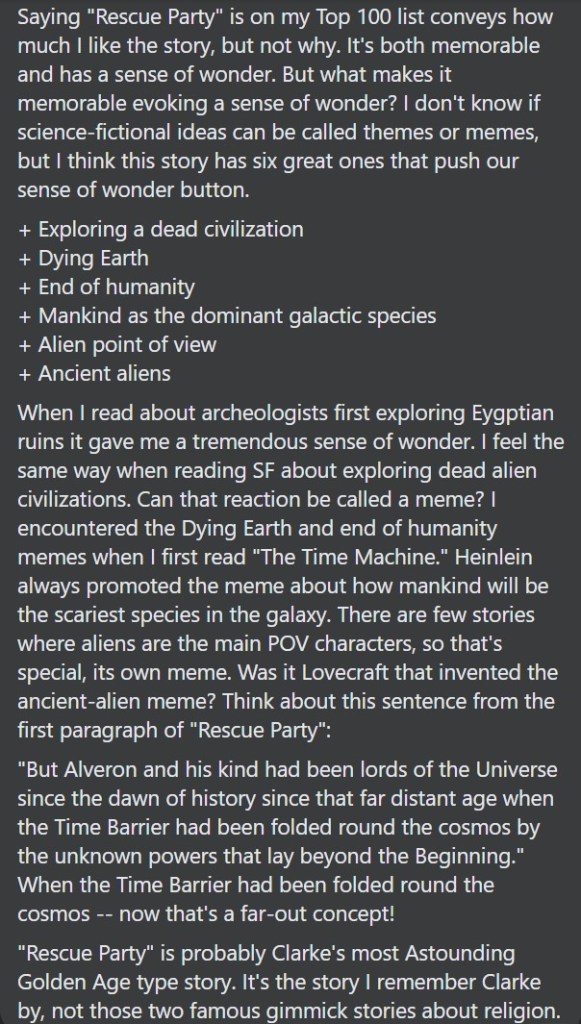
Project Hail Mary by Andy Weir

All people crave romance and sex, accomplishments and adventures, possessions and travel. Most of us settle for marriage and work while living our fantasies out vicariously in fiction. We use books, TV shows, movies, video games, or VR as substitutes for our desires. When fiction fails to satisfy we dine out, party, exercise, or travel. What we really want is to live a different life.

Knowing this should enlighten us about the fiction we choose. Are the stories we love most the ones we wished we were living?

Andy Weir’s latest book Project Hail Mary, left my eyes watery and my nose runny while listening to the last chapter on audio. I loved it. Is that the life I wished I was living? At 70, I know it’s an absurd fantasy and should answer that question with no. But when I was a teenager I would have said yes with great enthusiasm.

Nowadays, few science fiction books move me like that. And, I have to ask myself why. Did Project Hail Mary impact me in the same way the Heinlein juveniles did in the 1960s when I was twelve? Getting close to the end of life, I’m not sure I have much of a sense of wonder left, at least not the kind I had when reading science fiction in that golden age of being young.

When I discovered science fiction sixty years ago almost every story blew my mind with far-out ideas, giving me a tremendous sense of hope for the future, especially for the possibilities for my personal potential. Now, that I’m living in the future, with what little potential I have left, I see science fiction from a different vantage.

Project Hail Mary is one hell of a hopeful book and I enjoyed the hell out of it. I highly recommend reading it. If I had read it in 1964, or if I was 12 years old today, it would have made me a true believer in the science fiction faith. This week I read Weir’s novel and forgot about the world we see every evening on the NBC Nightly News, and I entered into a wonderful virtual reality created by Andy Weir’s skillful worldbuilding with words.

The entire time I listen to Project Hail Mary I marveled at Weir’s storytelling skills. He blended many of my favorite SF themes into an enchanting first-person narrative. Weir obviously imagined his novel as a movie, creating a lovable hero that will save the Earth. For some reason, science fiction blockbusters always seem to put Earth in final jeopardy. And many of them love having an average guy overcome an endless series of obstacles. Kurt Vonnegut gave some famous advice to would-be writers. He said: create a likable character and then do mean things to them. Andy Weir gives Ryland Grace a long series of impossible problems to solve.

The story begins with Ryland waking up in a strange hospital bed, not knowing who he is, where he’s from, or where he’s at. This is a neat storytelling trick. The novel breaks down into two tracks: the now and the past. Amnesia is the perfect excuse for creating flashbacks. Normally, I hate flashbacks, but Weir’s gimmick made me look forward to them.

I don’t want to tell you much about the novel and I want to beg you to get the audiobook version. The narrator acts out each character with a different voice, including accents for different nationalities. For the alien, Rocky, who speaks in musical tones which the audiobook plays, the narrator creates a charming accent for his English. The audiobook should have way more impact than just reading with your eyes.

Looking at reviews on Facebook, Goodreads, and Amazon, some readers loved this novel, while many others complain it’s too tedious. Weir tells this story in one long series of problems that Ryland Grace solves, many of which involve science. I assume the readers who love this story are problem solvers. If you’re not, this book might not be for you.

Ryland Grace is the ultimate competent man who can do everything. This character attribute is why I loved the Heinlein juveniles as a kid. It’s why I also loved the recent Bobiverse books. That’s one of my big personal fantasies, being a generalist that knows everything and can do anything. I’m not. I’m half-ass at doing a lot of things, and I vaguely know a little about a lot.

Ryland Grace is the modern manifestation of Tom Swift. That might be another clue for you if you’re thinking about reading this book.

Another fantasy Project Hail Mary tunes into is being alone in the world. I love the last man on Earth type stories, the Robinson Crusoe types. Ryland Grace is alone in space for a lot of this story. He even meets his Man Friday. (I hope I’m not giving too much away.)

Ryland Grace is the hero that saves Earth, and that’s one fantasy this book promotes that’s not mine. I don’t like attention. However, because of the way Andy Weir presents Ryland Grace’s achievements, I didn’t feel getting attention was a theme of this story. In flashbacks, we learn that Ryland Grace loved being a junior high school teacher who enjoyed promoting science with his students. That’s another theme that Heinlein and Weir are into that doesn’t resonate with me, but I imagine it will for teachers. Project Hail Mary would be a great book to teach in an English or science class.

Now to the negatives – which I just ignored because I was enjoying the story so much. Ryland Grace pulls a rabbit out of the hat every time, and his mental abilities are unrealistic. Plus, the invented science for this story is too good to be true. If people love Superman for his fantasy physical feats, Ryland Grace is a Superman of intellectual feats. In other words, the reality of this story is closer to a comic book than literary fiction.

That brings us back to my original psychobabble. Why do we choose the fiction we do? Why do we love some stories way better than others? Do the same themes appeal to us our whole life, or do they change as we age?

The Heinlein juveniles made the biggest impact on me of anything I read as a teen. That’s because I wanted to be like the characters in those books, and I wanted to grow up and live adventures similar to those in the stories. I wanted those fantasies to become real.

I can’t possibly believe that at 70. I’m a great deal more aware of reality now. I shouldn’t buy into anything in Project Hail Mary. I should be too old to enjoy it, but I did. A simple answer is I know too much about reality, and yet, I loved reading this book because it help me escape from reality that’s becoming all too harsh and hard. And that might have been the reason I loved science fiction as a kid too. The 1960s were tough times for anyone to grow up in, and I had feuding alcoholic parents who dragged me and my sister from state to state. That made things worse. Is it any wonder I wanted a science fictional fantasy to be real? Is it any different today?

Project Hail Mary is not a young adult novel, but it has that kind of appeal. As a kid, I knew science fiction was fantasy but reading science fiction made me hope that reality would become more like science fiction. It didn’t. We have science-fictional technology, but not science-fictional lives. That’s what we wanted. That’s what I wanted then, and now. And I can only find that life in books, books like Project Hail Mary.

James Wallace Harris, 8/7/22
The Challenge of Writing a Significant Time Travel Tale

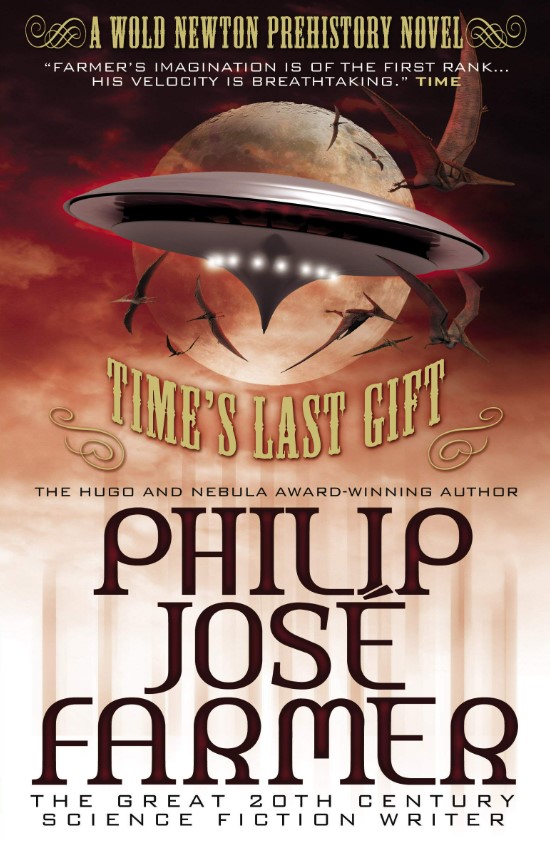
My aim is to review a time travel novel, Time’s Last Gift, by Philip José Farmer, but I need to explain my attitude towards time travel stories before I can pass judgment. I bought Time’s Last Gift because I read on the cover blurb that four scientists from the year 2070 travel back to 12,000 BC to study the Magdalenian culture. Since I’ve recently read a number of books on prehistory that plot appealed to me. I even read a large book just on locating the origin of the people who produced the proto-Indo-European language.

Within Time’s Last Gift, one character, Robert von Billmann is obsessed with finding the people who created the Proto-Indo-Hittite language. If you’re not interested in pre-history or the origins of language you might not want to bother with Time’s Last Gift – unless another factor appeals to you, but I want to wait and mention that after the spoilers warning. Let’s just say that John Gribardson, who was made leader of the expedition at the last minute has a very interesting backstory.

Does Time’s Last Gift stand on its own as a solid story and as a good addition to the time travel theme despite any details related to actual history or literary plot gimmicks? To me, a worthy time travel story has to add something different to the theme, otherwise, it’s just a romance, thriller, or historical novel that jumps around in time.

There have been countless science fiction books about time travel, but for me, I find very few of them worthy of using the theme. Most throw their characters into the past or the future and develop a story about that new setting. What I love is a time travel adventure that also explores the wonder of time and time travel. H. G. Wells set the bar very high with The Time Machine in 1895. I’m not sure any work has ever surpassed it for its sense of wonder.

There are so many time travel stories that Michael Main has created The Internet Time Travel Database. Town & Country Magazine listed their top 35 time travel books but only three of my top favorites make their list. Read This Twice found 92 favorite time travel books, and they do list many of my favorites. About Great Books lists 30-time travel books they think are great, and seven of my favorites are there, but I don’t consider many of those books really time travel stories. But that brings up another issue.

What is time travel? Replay by Ken Grimwood is one of my all-time favorite novels, but does Jeff Winston time travel? He repeats his life over and over. I call such fiction time loop stories. Stories such as The First Fifteen Lives of Harry August by Claire North, and The Midnight Library by Matt Haig are really time loop stories too, which I consider a different theme than time travel stories. I’ve written about it before.

Are such literary classics as The Time Traveler’s Wife, Kindred, Slaughterhouse-Five, A Christmas Carol, and Woman on the Edge of Time really about time travel? Don’t they just use the gimmick of time travel to reveal deep characterization or explore social issues in a clever way? These are great novels, but I don’t really want to lump them into the kind of science fiction novel I’m pointing to. Nor do I want to consider all the novels that use time travel to hook people up romantically.

Real science fiction about time travel should make us think about the nature of time travel. Time’s Last Gift does do this. Time travel has always been plagued by paradoxes, but I believe Farmer has found a neat way around them. If a time traveler goes into the past and changes the future, it’s already happened. Whatever exists now, whether affected by time travel or not, is what is. Speculations about what might be changed are no different from what was changed. If a time traveler shows up in 12,000 BCE there was never a 12,000 BCE without a time traveler. Of course, that means everything that happens is fixed. Or is it? Does this theory about time travel require predestination? It could mean everyone has free will, but whichever way history plays out it only plays out once.

Most of Time’s Last Gift is about living in 12,000 BCE. The four scientists immediately befriend a small tribe of humans and learn their language. John Gribardsun even wears their clothing and hunts with their weapons, although he often uses his rifle when necessary to help feed the tribe. The main conflict of the story deals with the two scientists who are married, Rachel and Drummond Silverstein, and their breakup. Farmer suggests that time travel has a psychological effect, like a larger case of jet lag, and it wears on three of the scientists. Gribardsun seems immune. In fact, he thrives in the past, and his vitality attracts both Rachel and the young women of the tribe. Much of the novel is about whether or not Drummond is out to kill Gribardsun because of jealousy. I didn’t care for this part of the story. It felt like a contrived conflict to move the novel along. However, the story is very readable and kept me reading.

Beyond Here Lie Spoilers

In the 1950s Philip José Farmer wrote some very innovative science fiction stories – “The Lovers,” “The Alley Man,” “Sail On! Sail On!” and others. Then he created two series that were fairly successful, the Riverworld series and The World of Tiers. Farmer won the Hugo award for best novel for the first Riverworld story, To Your Scattered Bodies Go (1971). I loved that novel when it came out because the main character was Sir Richard Francis Burton, the 19th-century explorer, and translator. And I loved the second book, The Fabulous Riverboat (1971) because it featured Mark Twain. I had read biographies of both men and that made me partial to those Farmer’s novels.

Over the decades I have come to feel that using a famous historical person as a character in a novel is a cheat, a way to sell books. But I also consider writing book series as a crutch for writers. For the rest of his life Farmer mostly churned out books for various series, and they were just so-so. He later refined the famous person gimmick by switching to writing about famous fictional characters, and this is where Time’s Last Gift comes in. John Gribardsun is Tarzan. It’s never said within the novel, but I guess it fairly quickly. If you’ve ever read a Tarzan novel, Time’s Last Gift feels like one and could have been Tarzan’s Time Machine.

There’s nothing wrong with book series, they do help writers to pay bills, but each book feels like just another episode in a TV series to me. If you love a series, that’s great. But for me, usually, only stand-alone novels can be great.

I assume Farmer didn’t use the name Tarzan in the book because of being sued by the Edgar Rice Burroughs estate, but ISFDB even lists Time’s Last Gift among the Tarzan novels. Philip José Farmer wasn’t the only writer to continue the character. More importantly, it’s part of Farmer’s Wold Newton series where he brings many famous characters from literature into the real world. If you really like this kind of publishing gimmick, then Time’s Last Gift might excite you.

I find the Wold Newton idea fascinating in conception, but lackluster in execution. It capitalizes on the readers’ love of famous books and characters and I consider that exploitation. Heinlein did the same thing in his later books bringing back his own favorite characters and tieing them into his favorite fictional worlds. The idea is neat, but again, the execution was horrible.

As a time travel novel, Time’s Last Gift is mediocre – readable and somewhat interesting. The plot moves along well enough. The John Gribardsun character is appealing but his adventures back in 12,000 BCE aren’t that significant. If you enjoy the idea that it’s an alternate origin story for Tarzan, and Farmer makes him immortal, then you might enjoy the book more.

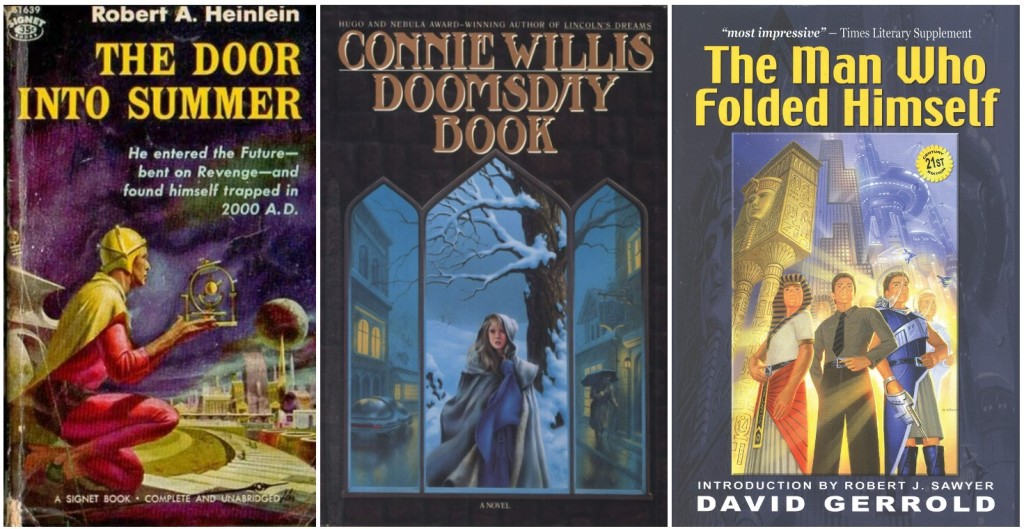
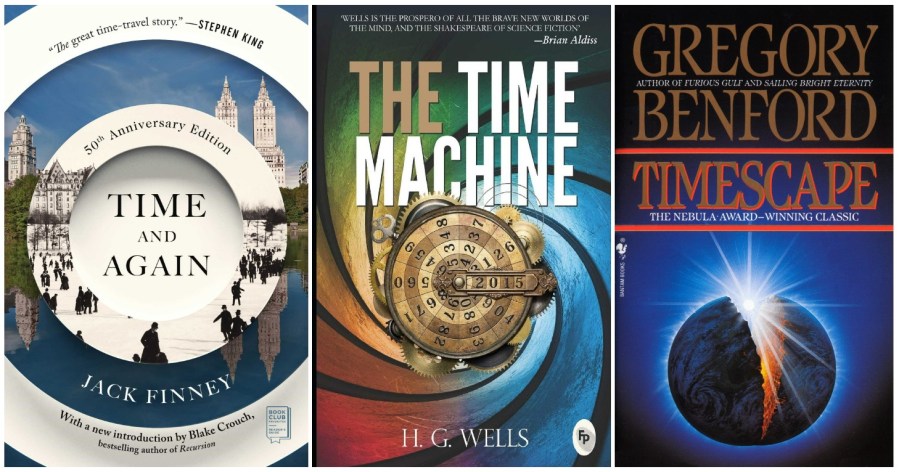
I judge time travel stories by how creative they are at dealing with time travel. For example, Heinlein’s “All You Zombies—” uses time travel and gender reassignment in a unique way. David Gerrold uses The Man Who Folded Himself to allow a time traveler to really get to know himself. Jack Finney in Time and Again used historical photographs to enhance his novel. Kurt Vonnegut combined memoir and fiction brilliantly. Connie Willis has explored both drama and comedy in her time travel novels. Of course, Wells illustrated both evolution and cosmology to his 19th-century readers. Wells inspired the Dying Earth genre and the idea that humanity will spin off different new species. Olaf Stapledon ran away with that idea with his novel Last and First Men.

With time travel stories, writers need to go big or go home. Philip José Farmer knew this. This is why he tacked on the Wold Newton afterward in a 1977 later edition. If you think Wold Newton is cool, then that might make Time’s Last Gift a good time travel story. If not, you might want to pass on it.

Here's a list of my favorite time travel stories.

1895 - THE TIME MACHINE by H. G. Wells
1934 - "Twilight" by John W. Campbell
1935 - "Night" by John W. Campbell
1941 - "Time Wants a Skeleton" by Ross Rocklynne
1941 - "By His Bootstraps" by Robert A. Heinlein
1943 - "Mimsy Were the Borogoves" by Henry Kuttner and C. L. Moore
1946 - "Vintage Season" by Henry Kuttner and C. L. Moore 
1951 - "I'm Scared" by Jack Finney
1952 - "A Sound of Thunder" by Ray Bradbury
1952 - "Hobson's Choice" by Alfred Bester
1953 - "Who's Cribbing" by Jack Lewis
1956 - "A Gun for Dinosaur" by L. Sprague de Camp
1956 - "The Man Who Came Early" by Poul Anderson
1957 - THE DOOR INTO SUMMER by Robert A. Heinlein 
1957 - "Soldier from Tomorrow" by Harlan Ellison
1958 - THE TIME TRADERS by Andre Norton
1958 - "Poor Little Warrior!" by Brian Aldiss
1958 - "The Ugly Little Boy by Isaac Asimov
1958 - "The Men Who Murdered Mohammed" by Alfred Bester
1959 - "All You Zombies---" by Robert A. Heinlein
1964 - FARNHAM'S FREEHOLD by Robert A. Heinlein
1964 - "When Time Was New" by Robert F. Young
1965 - "Traveller's Rest" by David I. Masson
1966 - "Behold the Man" by Michael Moorcock and BEHOLD THE MAN (1969)
1967 - "Hawksbill Station" by Robert Silverberg
1968 - THE LAST STARSHIP FROM EARTH by John Boyd
1969 - SLAUGHTERHOUSE-FIVE by Kurt Vonnegut, Jr.
1970 - TIME AND AGAIN by Jack Finney
1970 - THE YEAR OF THE QUIET SUN by Wilson Tucker
1971 - DINOSAUR BEACH by Keith Laumer
1973 - THE MAN WHO FOLDED HIMSELF by David Gerrold
1976 - "The Hertford Manuscript" by Richard Cowper
1967 - "Infinite Summer" by Christopher Priest
1980 - TIMESCAPE by Gregory Benford
1982 - "Firewatch" by Connie Willis
1985 - "Sailing to Byzantium" by Robert Silverberg
1988 - "Ripples in the Dirac Sea" by Geoffrey A. Landis
1992 - DOOMSDAY BOOK by Connie Willis
1995 - THE TIME SHIPS by Stephen Baxter
1995 - FROM TIME TO TIME by Jack Finney
1998 - TO SAY NOTHING OF THE DOG by Connie Willis
2003 - THE TIME TRAVELER'S WIFE by Audrey Niffenegger

Time Travel Anthologies

The Mammoth Book of Time Travel SF and The Time Travel MEGAPACK is currently 99 cents at Amazon for the Kindle edition.

James Wallace Harris, 7/30/22

“The Curse of the Mhondoro Nkabele” by Eric Norden

What if our pleasure in life is wallowing in the minutiae of our favorite subject? I follow a lot of YouTubers and most of their channels are about going deeper and deeper into a beloved special interest. When we are young we pursue pleasures of the flesh, but as we get older we follow our Alice of interest down a rabbit hole. This lets us find our true tribe, our people.

I feel like I’m among a few survivors of a tribe that is dying out. I lament that our culture and language are disappearing. My tribe is those beings who grew up reading science fiction magazines in the mid-20th century. I know that tribe was never very large and that all the various tribes of pop culture eventually fade from the collective memory of the present. But this sense of passing is why I find myself enjoying recursive science fiction so much now. Recursive science fiction is science fiction about science fiction, and quite often it remembers the genre’s past. And to enjoy such stories requires either a direct experience of the past or a good education about that past.

One of the funniest recursive science fiction stories I’ve ever read is one that seems to parody/remember more of the genre than any other recursive science fiction story I’ve read. The story is “The Curse of the Mhondoro Nkabele” by Eric Norden (Eric Pelletier 1899-1979). Unfortunately, it’s been a long time since this story has been reprinted, meaning if you want to legally read it, it will require tracking down a used copy of F&SF for September 1980, The Best from Fantasy and Science Fiction 24th Series edited by Edward L. Ferman in 1982, or Inside the Funhouse: 17 SF Stories about SF edited by Mike Resnick in 1992. If you have a free account with the Internet Archive you can check out The Best of F&SF 24th for one hour. Since this story hasn’t been reprinted in 30 years, and its author has been dead for 43 years, I hope their heirs won’t mind me offering you a pdf copy. (If you do, let me know and I’ll take it down, but I doubt if six people will read it.)

Of course, not everyone will find this story funny or meaningful. It depends on you knowing a good deal about the genre’s history. I thought I’d review the story by providing links to the pertinent bits of history that knowing will let the reader appreciate the story.

The story is an exchange of letters between Oginga Nkabele, a young man from Africa studying in America, and Edward L. Ferman, the editor of The Magazine of Fantasy and Science Fiction (F&SF). Nkabele, from the tribe of Diolas in Senegal, Africa, was educated by French and Belgian missionaries who he refers to as the Holy Ghost Fathers. One of his teachers, Father Devlin brought three steamer trunks containing over five hundred pulp science fiction magazines from 1936-1952. Nkabele has read these magazines so thoroughly that he’s even memorized some of his favorite stories. Nkabele feels he’s an expert on science fiction and decides to become a rich science fiction writer while in America.

Unfortunately, the stories he submits to Ed Ferman are modeled on the writing styles that were heavily criticized for bad writing when they were new and are now so out of fashion as to be glaringly awful. Ferman is appalled by Nkabele’s stories and rejects them immediately. Nkabele feels the rejection letter is a mistake and keeps pestering Ferman with more letters. In fact, he never accepts any rejection and keeps trying to convince Ferman his stories are brilliant and will make him famous and promises they’ll help sell more copies of F&SF.

Through the exchange of letters, two fun plots emerged. One is a horror tale for SF magazine editors which is hilarious if you’re not an editor, and the other is about how the genre has changed drastically from its past which is still wistfully nostalgic for some.

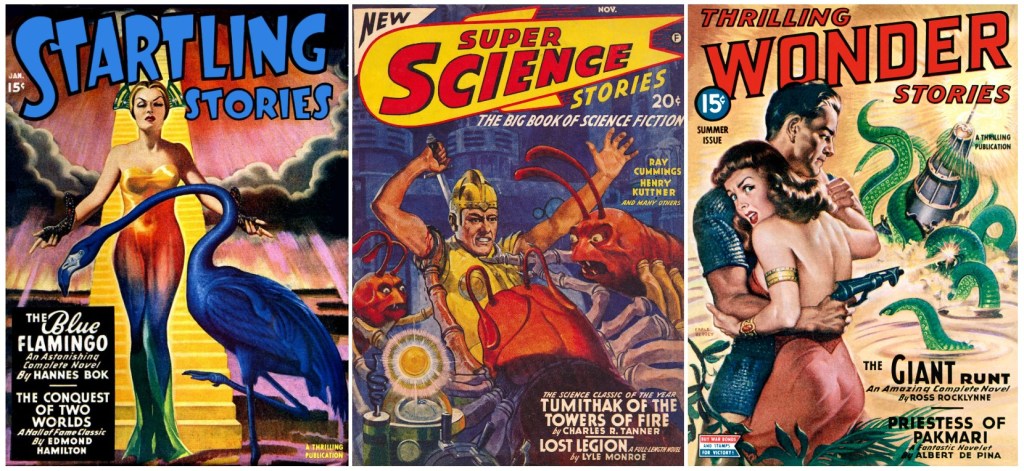
First, it’s important to know the magazines Nkabele admires. It’s notable that Father Devlin did not subscribe to Astounding Science-Fiction, the magazine revered until recent decades (another irony of this tale). Nkabele’s favorites are:

Nkabele’s favorite writers are Richard Shaver, L. Ron Hubbard, and Stanley G. Weinbaum, but is also a fan of Robert Moore Williams, E. E. “Doc” Smith, Nelson Bond, Ray Cummings, Eric Frank Russell, P. Schuyler Miller, and Raymond Z. Gallum. Although not specific to this story, if you know about The Shaver Mystery you’ll have a sense of the kind of thinking fans of these magazines pursued.

Most telling of all is that Nkabele’s favorite editor is Raymond A. Palmer. That’s quite revealing. Young science fiction writers today want to erase the memory of John W. Campbell, but when I was growing up, science fiction fans wanted to forget Ray Palmer’s impact on the genre.

To understand Nkabele’s taste in science fiction, even more, is to know the names of the three stories he keeps submitting:

  • “Astrid of the Asteroids”
  • “Slime Slaves of G’Harn”
  • “Ursula of Uranus”

The magazines Nkabele loved were the ones that appealed most to adolescents featuring exotic interplanetary adventure stories told in purple prose. The exact kind of science fiction John W. Campbell was fighting against in our Golden Age of Science Fiction. But Nkabele considers his science fiction the actual Golden Age of Science Fiction. Over the decades, different generations have defined their own Golden Age of Science Fiction. Youth always reject the past. Nkabele can’t fathom why Ferman is rejecting his Golden Age.

It helps to know a little about Edward L. Ferman since he’s a major character, but it’s very important to know about Harlan Ellison. Ferman panics and gives Nkabele Ellison’s address and phone number to get rid of him. Ferman tells Nkabele about Ellison’s legendary SF anthology Dangerous Visions. Now Harlan Ellison starts writing letters and Eric Norden parodies Ellison’s writing style in an over-the-top style that wasn’t far from Ellison’s own. They even rope in Isaac Asimov. Norden does a great job of making each letter writer sound like a distinct personality. Sometimes the epistolary caricatures aren’t so flattering and it’s a wonder Norden didn’t get sued by Ellison who was known for his litigious wrath.

It also helps to know about BEMs – Bug Eye Monsters – especially SF covers that showed BEMs running off with mostly naked Earth women. BEMs in SF anticipated the whole abductee theme of UFO fanatics. And Ray Palmer turned his SF magazines into UFO fanaticism.

Parodying science fiction has been around for a long time, and Norden mentions a classic, Venus on a Half Shell by Kilgore Trout. Kilgore Trout is a character in many of Kurt Vonnegut’s novels. But I’ll have more to say about such other fun novels and stories soon.

I’m not sure how many current SF readers will enjoy “The Curse of the Mhondoro Nkabele” by Eric Norden. Is the pop culture that it skewers too oldy moldy? I tend to think the people who will enjoy it most are the people of my tribe.

James Wallace Harris, 7/24/22

Mainstream Science Fiction

Emily St. John Mandel’s Sea of Tranquility is straight-ahead science fiction but it doesn’t feel like a genre novel. Explaining why will be hard. Science fiction has always avoided clear definition and trying to discern the difference between hardcore genre science fiction and literary science fiction might prove equally elusive. For most readers, it doesn’t even matter.

Sea of Tranquility was both entertaining and well-written. I liked it quite a lot. Many readers at Goodreads loved this short novel and gave the story five stars. However, the story was missing something for me. It lacked the intense impact I get from classic genre science fiction I love, even ones not as well told as Sea of Tranquility.

Most modern science fiction aims to be as dashing as Hans Solo but Sea of Tranquility was as mundane as a computer programmer. I considered that a positive but I have to admit the story had a certain blandness even though it dealt with many big science fictional concepts.

I do not want to tell you about those concepts because the way Mandel rolls them out makes it fun to explore the plot clue by clue. If you don’t want to read the novel but want to know a precise summary, Wikipedia has a blow-by-blow overview. However, I do want to tell you enough to want to read it. In the year 2401 Gaspery-Jacques learns about three anomalies in history. In the years 1912 a man named Edwin, in 2020 a woman named Mirella, and in 2203 a woman named Olive had the same bizarre experience that they’ve recorded in various ways in their own times. Historians in the 25th century find those records and decide they might be clues to an amazing hypothesis. Gaspery-Jacques decides he wants to be the person that solves the mystery even though he’s only an uneducated house detective for a hotel in a colony on the Moon. Lucky for Gaspery-Jacques, his sister is a brilliant scientist with connections.

BEWARE – Spoilers Ahead

To get into my discussion of mainstream science fiction versus genre science fiction will require giving away the story. The structure of Sea of Tranquility is much like another mainstream science fiction novel, Cloud Atlas by David Mitchell. Cloud Atlas was far richer and more intense than Sea of Tranquility, more like a genre novel. Both deal with epic concepts, but only Cloud Atlas felt epic in the storytelling. Mandel gives us a much quieter story and that’s often a trait of mainstream science fiction. Its tone is like two other recent mainstream science fiction novels, Klara and the Sun by Kazuo Ishiguro and Machines Like Me by Ian McEwan.

Sea of Tranquility explores the idea that our reality is a simulation. In the 25th century, scientists have a very carefully controlled type of time travel. They theorize the anomalies experienced by Edwin, Mirella, and Olive might be glitches in the simulation software. After five years of training, they send Gaspery-Jacques back to interview each of these people. We don’t know that right away, because Mandel at first tells each of their stories chronologically in time. I’m thinking of reading the book again to see if knowing that they are being interviewed by a time traveler changes how I experience the story. I guessed this might be happening because loose-lips by some reviewers said the book is a time travel novel. It would have been more fun not knowing that.

That’s another difference between mainstream science fiction and genre science fiction. Their stories often begin ordinarily and feel mundane and the science-fictional concepts creep into the tale. Genre science fiction often begins like the opening of a heavy metal concert, while mainstream science fiction begins with a quiet chamber quartet before a cerebral symphony.

Genre science fiction writers love to crank the volume to 11 and keep it there, while mainstream science fiction unfolds gently at volume 4 and politely increases to 6 or 7 at carefully chosen moments. If you compare Hyperion by Dan Simmons to Sea of Tranquility you’ll know what I mean.

Sea of Tranquility is science fiction for PBS Masterpiece. Station Eleven was Mandel’s polar opposite of Mad Max: Fury Road. Even though Sea of Tranquility explores such a deafening concept as the simulation hypothesis it does so in a whisper. A genre novelist writing the same story would have had epic rents in the fabric of reality, killing millions while its heroes save the universe at the last minute. Mandel’s hero eerily validates the hypothesis with a kind of “Ummm, that’s weird.”

Sea of Tranquility is also a pandemic novel about a writer writing a novel about a pandemic just before a pandemic hits. Olive Llewellyn is a novelist who lives on the Moon but tells of her publicity tour on Earth just before a brutal plague spreads across Earth in 2203. I assume Olive’s details and feelings about promoting a book came from Mandel’s own experience. Some of the characters in this novel were in Mandel’s previous novel, The Glass Hotel, and Edwin’s full name is Edwin St. John St. Andrew. Since he shares a middle name with Mandel I have to wonder if he was an ancestor of hers? Now I have to read The Glass Hotel. One of my favorite writers, Larry McMurty liked to recycle characters in other novels.

Finally, I wonder if fans of science fiction by Margaret Atwood, Hilary St. John Mandel, or Kazuo Ishiguro would also be fans of Dan Simmons, Iain M. Banks, and James S. A. Corey? Or vice versa? Let me know how you feel.

James Wallace Harris, 7/4/22

Science Fiction Writers in Conversation with Each Other

Imagine a world where science fiction had never been invented. Could you have written the first science fiction story? Be honest now, and think hard about yourself and what I’m asking. Before Galileo, did anyone think the Moon was a world that could be visited? Once people heard Galileo saw mountains on the Moon with his telescope they began to imagine going there. Science fiction needed certain kinds of seed ideas to begin. When the seeds come from reality I’ll call that Stage 1 science fiction. We don’t see a lot of that kind of science fiction anymore. Maybe The Martian by Andy Weir when he tried to realistically portray growing potatoes on Mars or when a writer extrapolates on current events like John Brunner did in Stand on Zanzibar back in 1968 or what Kim Stanley Robinson did in The Ministry for the Future in 2020.

Once the genre got rolling, science fiction seeded itself. One story about a trip to the Moon inspired an infinity. I call that Stage 2 science fiction. In Stage 2 writers try to stick to reality but work off the collective knowledge of the genre. Eventually, science fiction was making copies of copies, where the inspiration had no connection with reality. I’ll call that Stage 3 science fiction.

Early stories about traveling to the Moon were Stage 1 because it’s not likely the authors had read each other’s work. But when Verne and Wells wrote their novels of lunar exploration a lot of their inspiration was Stage 2. When John Varley wrote his stories about a lunar colony, most of the science-fictional concepts within those stories had been germinating for generations in the genre – Stage 3.

I believe science fiction writers have an ongoing conversation that never ends. To take part in this conversation, publish a story. It can be Stage 1, 2, or 3. To be heard and answered requires writing something in Stage 1 or 2, or a very creative Stage 3.

This is why I’ve become fascinated by the forgotten writer Walter F. Moudy. The 1950s and 1960s were a fertile time for Stage 1 and Stage 2 stories. By the second half of the 1960s and early 1970s writers who made themselves noticed were writing a baroque Stage 3 science fiction to attract attention. For example, the works of Samuel R. Delany, Roger Zelazny, and Robert Silverberg were based on old SF ideas told with new writing styles. Unfortunately, Moudy wrote Stage 3 stories in the same prose style that the classics of Stage 2 were written. His 1964-65 stories feel like they were written in 1954. One reason the New Wave writers of the 1960s were so important is they recognized that retelling Stage 2 stories in the same way, would get them ignored. The reason why Heinlein blazed onto the scene in 1939 is that he wrote Stage 1 stories with a new writing style, making his stories stand out.

I enjoy reading Walter F. Moudy in 2022 because I doubt I could write any better than he did, and he was responding to the stories I admired back then. His writing ability and knowledge of the genre were just good enough to get five works published and then become forgotten. As a would-be science fiction writer, I greatly identify with that. He wanted to join the conversation and made the effort to have his say. He just wasn’t heard, but now after decades, I’m listening.

While reading Walter F. Moudy’s meager output of science fiction I kept feeling his stories were inspired by the science fiction he and I both read. They made me wonder what he was trying to say in the ongoing conversation.

Of the five science fiction stories, I’ve read by Walter F. Moudy, “The Search for Man” is my favorite, although if I reread “The Survivor” or No Man On Earth I might change my mind. All were good fun, old-fashion science fiction, the kind my nostalgia loves. As I read “The Search for Man,” I kept wondering what science fiction Moudy had read that inspired this story. I can’t say for sure but this story about robots speculating about long-dead or gone humans reminded me of City by Clifford Simak. That “The Search for Man” set hundreds of years into the future speculated about our times and turned us into a religion reminded me of A Canticle for Leibowitz. That both the protagonists of No Man On Earth and “The Search for Man” were about a super-human and a super-robot reminded me of The Hampdenshire Wonder, Slan, Odd John, Chocky, Stranger in a Strange Land, and all the other science fiction stories about next-stage beings. Reading those two Moudy stories made me think about how I would have written a story on that theme. How much could I base it on reality, and how much would be inspired by other science fiction?

“The Search for Man,” begins with a baby being born, but it’s a strange birth, a kind of decanting that made me think of Brave New World. Then we learn the baby will only have three senses, and it will be put into a robotic baby’s body, the first of four body types it will use.

Moudy sets up a good mystery for us. Humans died out hundreds of years earlier, with all other animal life. The humans had tried to travel to the stars, but it appears their three missions had failed. The robot brains have improved their brains with genetics found in 12 human brains that had been preserved. The robots have found long-dead humans in various kinds of chambers that tried to create suspended animation. Their hope is to find a chamber with a viable human to resurrect. There are classes of robots that are archeologists and others that are priests that teach a strange religion based on their theories about humans. All of that is a very appealing setup for a story, at least for me.

I’m not sure Walter F. Moudy would have written “The Search for Man” without reading a lot of science fiction. Part of the conversation science fiction writers have is about science fictional ideas, but the other part is about how to present those ideas in a story. I felt “The Search for Man” was Moudy’s reply to both but in the language of 1950s science fiction. I wonder if he had been more of a stylist would he have made a greater impact?

“The Search for Man” was published in an original anthology In The Wake of Man that’s never been reprinted. I’ve been trying to get a copy, but it’s expensive, starting at $75 used. I had found a $10 copy for sale, but my order was canceled a couple days after I ordered it. Right now the only source for this story is a copy of In The Wake of Man at Archive.org. If you are a member, which is free, you can check it out for an hour to read online. Thanks to Joachim Boaz for finding that link.

Joachim Boaz and Rich Horton have also been writing about Walter F. Moudy. Rich is planning to review all of Moudy’s work soon.

James Wallace Harris, 6/30/22

Blowing Your Chance to Speak to the Future

Writers cherish the myth that their work will make their names immortal. And it is true we have remembered some authors for thousands of years. However, if you want to be heard across time, you have to write something timeless.

My friend Mike and I are fascinated by forgotten writers, especially forgotten science fiction writers. We can’t help but wonder why a writer quits after their initial success of selling a few stories or maybe a novel. Mike texted me the other day about such a writer he discovered in an interview with Geraldine Brooks in The New York Times.

It was part of their By the Book series, where all writers are asked the same standard questions. My favorite question: “What’s your favorite book no one else has heard of?” Often this makes for an interesting title to chase down. Brooks said: “‘No Man on Earth,’ by Walter Moudy. The only other person I know who has read it is my son because I pressed it on him.”

So one well-regarded literary writer resurrects Walter F. Moudy 49 years after he died. That one little mention in the Times got me to read his novel. Maybe a few other people will too. And it’s a pretty good science fiction story for 1964. The question is, could it have been better? What would have made that novel stay in print? Is it worth reprinting? And do I recommend you read it?

You can read a pdf copy of No Man On Earth here.

It turns out that No Man On Earth is a forgotten science fiction novel by a forgotten science fiction writer, Walter F. Moudy (1929-1973). His ISFDB entry lists one novel and four short stories. This novel appeared in October of 1964, and then three of his four stories appeared in April and May of 1965, two in Fantastic and one in Amazing, both edited by Cele Lalli (Goldsmith). Moudy would have been in his mid-thirties. In 1966 he published another novel, The Ninth Commandment, probably not science fiction, and one I can’t track down. Finally, in 1975, after his death, Moudy had one more story, a novella, published in an original anthology, In the Wake of Man. The other two authors in that book were Gene Wolfe and R. A. Lafferty, pretty impressive company.

Besides No Man On Earth, I’ve read his three stories in Fantastic and Amazing, but it would cost me $75 to read his final story and that’s too much. For me, Walter F. Moudy’s science fiction legacy is that one novel, two short stories, and a novelette. Not much to go by, but still, I’m terribly envious since I’m a lifelong would-be science fiction writer. I’d give anything to have contributed even that much to the genre.

Why after his initial success in 1964-1966 did Moudy quit writing? And how did Roger Elwood get his last story? I guess Moudy tried one more time before he died to say something in print. But maybe Elwood had been holding it for years, and it was written in the mid-sixties. Reviewers haven’t been kind to it.

I was able to track down a few biographical details. Moudy was from Missouri, served in the Air Force from 1950 to 1953, got a degree in 1954, and then a law degree in 1957. He was Phi Beta Kappa. Moudy was married and had three children. In other words, he had a successful life and didn’t need to be a writer. Still, as I read his work over the last few days, I felt he had something to say. At least in No Man On Earth.

His three short stories were rather minor. The first, “The Dreamer,” was about a young man who wanted to get rich and famous as a space trader. The story was told like a fable. Its redeeming feature was a super-intelligent parrot. The second, “I Think They Love Me,” is about rock stars going to extreme lengths to survive hordes of screaming teenage girls. This was written a year after The Beatles hit America and was kind of cute, but not really worth remembering. The last, and the one most anthologized, is “The Survivor,” about a televised war game between America and Russia. It reminded me of The Hunger Games. This story came out in 1965 and was probably inspired by the 1964 Olympic games and the films Dr. Strangelove and Fail-Safe. “The Survivor” was gritty, detailed, and suggested each country sacrifice 100 men every four years in a fight to the death rather than risking total national annihilation.

Those three stories were somewhat entertaining, especially the last one, but they don’t leave the kind of impression that Moudy was making a statement. However, No Man On Earth does. Writers can make different kinds of statements. They can aim to write a better story than what’s written before. Or they can capture their times realistically in words. And common with science fiction writers, they can say something philosophical about reality. And there are so many other ways.

For example, I believe Robert Heinlein was influenced by the success of Atlas Shrugged by Ayn Rand in 1957, and that’s why he aimed so high with Stranger in a Strange Land. In his later years, Heinlein repeatedly tried to convince fans that Starship Troopers (1959), Stranger in a Strange Land (1961) and The Moon is a Harsh Mistress (1966) were books that he wanted to be remembered for because they expressed his philosophy on freedom and responsibility.

My guess is Moudy was inspired by Stranger in a Strange Land when he wrote No Man On Earth. Heinlein’s main character Valentine Michael Smith is a human raised by Martians who taught him psychic powers. Moudy’s main character, Thad Stone, had a human mother and alien father and was a super-genius. Both novels are told with picaresque plotting. Both books comment on sex and society. Moudy has Stone tour many planets and visits many kinds of societies and civilizations. No Man On Earth ran 176 pages in its first publication, a slim paperback original to Stranger’s 408 pages in the G. P. Putnam’s Sons first-edition hardback. Heinlein was obviously trying to hit one out of the genre after over twenty years of being a big fish in a small pond. Frank Herbert also aimed sky high with Dune in 1965. It was also over 400 pages.

There are a lot of one-hit wonders in the book world but few writers struggle with their masterpieces like Harper Lee or John Kennedy Toole. My guess is Moudy knocked this novel out quickly and was probably paid around $750 for his paperback original and when it disappeared on the twirling wire racks after a couple of months felt his time was better spent being a lawyer. If he had written a 400-page monster and got it published by a major hardback publisher No Man On Earth might have had a better chance. He just didn’t aim high enough.

It would have also helped if he had written No Man On Earth in an innovative style that made the genre take notice, like Dune and Stranger in a Strange Land. Moudy’s story and writing reminded me a bit of Leigh Brackett’s The Long Tomorrow (1955), Edgar Pangborn’s A Mirror for Observers (1955), and Walter Tevis’s The Man Who Fell to Earth (1963), all books he could have read and could have inspired No Man On Earth.

Obviously, if Geraldine Brooks fondly remembers No Man On Earth in 2022 so it can’t be a stinker. I liked it quite a lot and rushed through it in two days because it was compelling in the old-fashion kind of science fiction I love. It’s great that Tevis’s 1963 novel is still remembered, and I think it’s a shame that Moudy’s book isn’t more remembered.

James Wallace Harris, 6/21/22

Does Our Memory of Favorite Science Fiction Skew To Older Science Fiction?

James Patrick Kelly gives a plug for our Classics of Science Fiction database site (csfquery.com) in his column “On the Net” in the July-August 2022 issue of Asimov’s Science Fiction. He mentions us as a jumping-off point to talk about famous science fiction stories made into movies. In passing, Kelly says our v.5 list is skewed to older works. I’ve worried about that myself, and I’ve tried to come up with a system configuration that would promote newer works.

However, I’m starting to think that our memories naturally skew towards older books. Our lists are generated from a system. We’ve collected all the ways we can find where people remember books – awards, fan polls, recommended lists, anthologies, books used in schools, lists created by magazines and websites, etc. Each one we call a citation. There are two lists of citations, one for books and one for short stories. Older books have more citations than newer books because they’ve been around longer. Our citation lists go back to 1943, but most of them have been from the past 25 years. But even when we come up with systems to give newer books a little edge, older novels and stories still have more citations.

Pop culture has just found more ways to remember The Left Hand of Darkness since 1969 than Ancillary Justice since 2013. 49 ways to 13. Even when I limited citations from the 21st century it’s still 33 to 13. This makes me wonder if collectively we just remember older books better. Although, if we could get 1,000 college students to read The Left Hand of Darkness and Ancillary Justice would they still favor the book from 1969 over the 2013 novel?

At our site, we avoid saying books with more citations are better – because there’s no way to prove that. But what if some books are better than others at being remembered? The Left Hand of Darkness has never been one of my favorite SF novels, but it is one I admire for its ideas and writing, and maybe that’s why it’s remembered. Many English professors will tell you, that Ulysses by James Joyce is the #1 novel in the English language. I’ve tried to read it several times but never could finish it. But I’m willing to admit that it’s legendary.

A while back we came up with a solution to help people find newer novels and stories to read. We created the List Builder. If you want the most remembered SF novels published since 2000 just use that tool. Here’s a list of 51 21st Century SF Novels with at least 5 citations.

On the other hand, if you are in the mood for something from the fifties just put in 1950 to 1959. If you think our cutoffs are too stringent, lower them. I’m still thinking of adding a feature to the List Builder that would allow our users to delimit the citations by date. Would citation sources only from the 1990s pick different books from the 1940s than citation sources from the 1960s?

We’re trying to keep CSFquery as simple to use as possible yet offer the maximum flexibility for generating lists that users might want. Our v.5 and v.2 lists are just canned lists based on our cutoffs of 12 and 8 citations for novels and short stories. We chose those cuff-offs to produce lists of around 100 titles. The List Builder lets the user decide if they want more or less but pop culture has decided what to remember.

We’re open to suggestions. If you know of other citation sources that we don’t use, let us know.

James Wallace Harris, 6/12/22

The 1953 SF&F Magazine Boom

For some very interesting reasons, 1953 was a year when over forty different science fiction and fantasy magazine titles appeared on newsstands in English-speaking countries. I haven’t tried to research non-English countries. And I’m not even sure I’ve found all the magazines published in English. Some of the titles below are reprint titles, but most of these magazines published new fiction.

Links are to Wikipedia. It’s amazing (astounding, authentic, fantastic, startling) how many of these magazines have extensive entries in that online encyclopedia.

For fun, I’ve collected the covers from 194 SFF magazines from 1953. You can view them at the Internet Archive. If you download the Comic Book Zip file you can change the .cbz extension to .zip and have a compressed folder of those covers. Unzip it and set your desktop background to a slideshow using that folder. It’s a fun way to view those covers over days and weeks. Or load the .cbz file onto your tablet if you have a program to read .cbz files. They look great on a tablet. As you flip through the covers pay attention to the authors. Notice how many are still famous today – such as Philip K. Dick – and how many are forgotten. Also, study the artwork. A lot of 1953 comes through those images, but it’s like interpreting dreams. Not very reliable, but strange and weird.

Many of these magazines are available on the Internet Archive. Reading them will show the future, but usually not this future – the times we live in now. Nor do they show the future young people seek today. Yet, there are lots of overlapping themes. Space travel, robots, posthumans, catastrophes, the end of the world, and so on. Writers and readers just saw it differently back in 1953.

I’ve been fascinated by the 1953 science fiction boom for years, but recently our short story club voted to group read the best stories from one year. I nominated 1953 but it didn’t win. I’m afraid the average age of our group members is now too young to be interested in science fiction from so long ago. 1976 won.

I have a theory about science fiction readers. I believe they bond for life with the science fiction stories that came out in the decade before their teen years, the decade of their teen years, and the decade of their early twenties. My teen years were in the 1960s, so I resonate best with science fiction from the 1950s, 1960s, and 1970s. I’m guessing most of our members are in their 50s, and twenty years younger than me. So they will lean toward science fiction from the 1970s, 1980s, and 1990s. The ones closer to 60, will enjoy science fiction from the 1960s, 1970s, and 1980s.

The readers who were teens in the 1940s are dying off, and the ones from the 1950s are getting pretty old. If my theory is correct, science fiction short stories from the 1950s should be fading away from pop culture memory.

I had hoped my favorite science fiction short stories I loved reading when growing up would become eternal classics. But ask yourself how many people remember SF stories before John W. Campbell? Science fiction isn’t like rock music from the 1960s and 1970s, which many young people today are embracing over their own generation’s current music. But why not?

Science fiction in 1953 spoke to a generation and it’s fascinating to think about why. The number of science fiction readers before WWII was so small that it didn’t register in pop culture. The war brought rockets, atomic bombs, computers, and nuclear power. The late 1940s brought UFOs – the flying saucer craze. The 1950s began with science fiction movies and television shows. By 1953, science fiction was a fad bigger than the hula-hoop would ever be, we just never thought of it that way. I do wonder if the fad will ever collapse, but I see no sign it will.

Science fiction themes and ideas don’t change that much, but how they are presented does. Today, the short story club read “Beyond the Tattered Veil of Stars” by Mercurio D. Rivera which appeared in the March/April 2020 issue of Asimov’s Science Fiction. It’s a great story, but it’s also just a modern version of “Microcosmic God” by Theodore Sturgeon, from the April 1941 issue of Astounding Science Fiction. I’m not saying Rivera copied Sturgeon, but he took a similar theme and made a story for his generation.

I imprinted on 1950s science fiction because that’s what I first read. I embraced the 1960s and 1970s science fiction because that was my generation’s science fiction while I was going to high school and college. Now that I’m old, my mind is returning to the science fiction of the 1950s. I was born in 1951, so I don’t remember 1953 except through old books, movies, music, and TV shows I discovered in the 1960s.

Sometimes I think I’ve doubled back along the trail to see where I took a wrong turn. 2022 is the future of who I was in 1962. But it’s not the future science fiction promised. Maybe I reread old science fiction to get back to the future I wanted.

James Wallace Harris, 5/13/22

Update: Thanks to John Boston

In 1954, these best-of-the-year anthologies chose these stories as the best from all those magazines:

Portals of Tomorrow ed. August Derleth (Rinehart LCC# 54-6523, 1954, $3.75, 371pp, hc)

  • ix · Introduction · August Derleth · in
  • 3 · The Hypnoglyph · John Anthony · ss F&SF Jul 1953
  • 17 · Testament of Andros · James Blish · nv Future Jan 1953
  • 47 · The Playground · Ray Bradbury · ss Esquire Oct 1953
  • 69 · Gratitude Guaranteed · R. Bretnor & Kris Neville · nv F&SF Aug 1953
  • 101 · Rustle of Wings · Fredric Brown · ss F&SF Aug 1953
  • 109 · The Other Tiger · Arthur C. Clarke · vi Fantastic Universe Jun/Jul 1953
  • 113 · Civilized · Mark Clifton & Alex Apostolides · ss Galaxy Aug 1953, as “We’re Civilized”
  • 129 · Stickeney and the Critic · Mildred Clingerman · ss F&SF Feb 1953
  • 139 · The Word · Mildred Clingerman · ss F&SF Nov 1953
  • 147 · Hermit on Bikini · John Langdon · ss Bluebook Mar 1953
  • 167 · Jezebel · Murray Leinster · ss Startling Stories Oct 1953
  • 189 · D.P. from Tomorrow · Mack Reynolds · ss Orbit #1 1953
  • 201 · The Altruists · Idris Seabright · ss F&SF Nov 1953
  • 221 · Potential · Robert Sheckley · ss Astounding Nov 1953
  • 241 · Eye for Iniquity · T. L. Sherred · nv Beyond Fantasy Fiction Jul 1953
  • 273 · Kindergarten · Clifford D. Simak · nv Galaxy Jul 1953

The Best Science-Fiction Stories: 1954 ed. Everett F. Bleiler & T. E. Dikty (Fredrick Fell, 1954, $3.50, 316pp, hc)
In England as The Best Science Fiction Stories: Fifth Series.

  • 9 · Editors’ Preface · Everett F. Bleiler & T. E. Dikty · pr
  • 13 · Icon of the Imagination · Fritz Leiber · in
  • 19 · DP! · Jack Vance · ss Avon SF&F Reader Apr 1953
  • 41 · The Big Holiday · Fritz Leiber · ss F&SF Jan 1953
  • 50 · The Collectors · G. Gordon Dewey & Max Dancey · ss Amazing Jun/Jul 1953
  • 65 · One in Three Hundred [Bill Easson] · J. T. McIntosh · nv F&SF Feb 1953
  • 108 · Wonder Child · Joseph Shallit · nv Fantastic Jan/Feb 1953
  • 136 · Crucifixus Etiam · Walter M. Miller, Jr. · ss Astounding Feb 1953
  • 159 · The Model of a Judge · William Morrison · ss Galaxy Oct 1953
  • 172 · The Last Day · Richard Matheson · ss Amazing Apr/May 1953
  • 190 · Time Is the Traitor · Alfred Bester · nv F&SF Sep 1953
  • 217 · Lot [David Jimmon] · Ward Moore · nv F&SF May 1953
  • 249 · Yankee Exodus · Ruth M. Goldsmith · ss F&SF Jul 1953
  • 262 · What Thin Partitions [Ralph Kennedy] · Mark Clifton & Alex Apostolides · nv Astounding Sep 1953
  • 298 · A Bad Day for Sales · Fritz Leiber · ss Galaxy Jul 1953

Year’s Best Science Fiction Novels: 1954 ed. Everett F. Bleiler & T. E. Dikty (Fredrick Fell, Mar ’54, $3.50, 317pp, hc)
In England as The Year’s Best Science Fiction Novels: Second Series.

  • 9 · Introduction · Everett F. Bleiler & T. E. Dikty · in
  • 15 · The Enormous Room · H. L. Gold & Robert Krepps · na Amazing Oct/Nov 1953
  • 81 · Assignment in Aldebaran · Kendell Foster Crossen · na Thrilling Wonder Stories Feb 1953
  • 146 · The Oceans Are Wide · Frank M. Robinson · na Science Stories Apr 1954
  • 224 · The Sentimentalists · Murray Leinster · na Galaxy Apr 1953
  • 269 · Second Variety · Philip K. Dick · nv Space Science Fiction May 1953

Then in 1986 Isaac Asimov and Martin H. Greenberg looked back over 1953 and found these stories worth remembering:

saac Asimov Presents the Great SF Stories: 15 (1953) ed. Isaac Asimov & Martin H. Greenberg (DAW 0-88677-171-4, Dec ’86 [Nov ’86], $3.50, 352pp, pb) Anthology of 17 stories first published in 1953 plus a summary of the year in and out of sf plus remarks on the various writers. Recommended (CNB).

  • 9 · Introduction · Martin H. Greenberg · in
  • 13 · The Big Holiday · Fritz Leiber · ss F&SF Jan ’53
  • 24 · Crucifixus Etiam · Walter M. Miller, Jr. · ss Astounding Feb ’53
  • 48 · Four in One · Damon Knight · nv Galaxy Feb ’53
  • 86 · Saucer of Loneliness · Theodore Sturgeon · ss Galaxy Feb ’53
  • 102 · The Liberation of Earth · William Tenn · ss Future May ’53
  • 123 · Lot [David Jimmon] · Ward Moore · nv F&SF May ’53
  • 155 · The Nine Billion Names of God · Arthur C. Clarke · ss Star Science Fiction Stories #1, ed. Frederik Pohl, Ballantine, 1953
  • 164 · Warm · Robert Sheckley · ss Galaxy Jun ’53
  • 176 · Impostor · Philip K. Dick · ss Astounding Jun ’53
  • 194 · The World Well Lost · Theodore Sturgeon · ss Universe Jun ’53
  • 216 · A Bad Day for Sales · Fritz Leiber · ss Galaxy Jul ’53
  • 224 · Common Time · James Blish · ss Science Fiction Quarterly Aug ’53
  • 250 · Time Is the Traitor · Alfred Bester · nv F&SF Sep ’53
  • 277 · The Wall Around the World · Theodore R. Cogswell · nv Beyond Fantasy Fiction Sep ’53
  • 308 · The Model of a Judge · William Morrison · ss Galaxy Oct ’53
  • 322 · Hall of Mirrors · Fredric Brown · ss Galaxy Dec ’53
  • 331 · It’s a Good Life · Jerome Bixby · ss Star Science Fiction Stories #2, ed. Frederik Pohl, Ballantine, 1953 

5/14/22

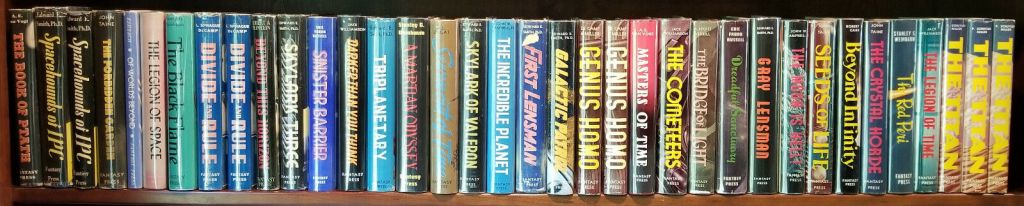
Remembering Fantasy Press, Arkham House, Prime Press, Gnome Press, Shasta Publishers, and Others

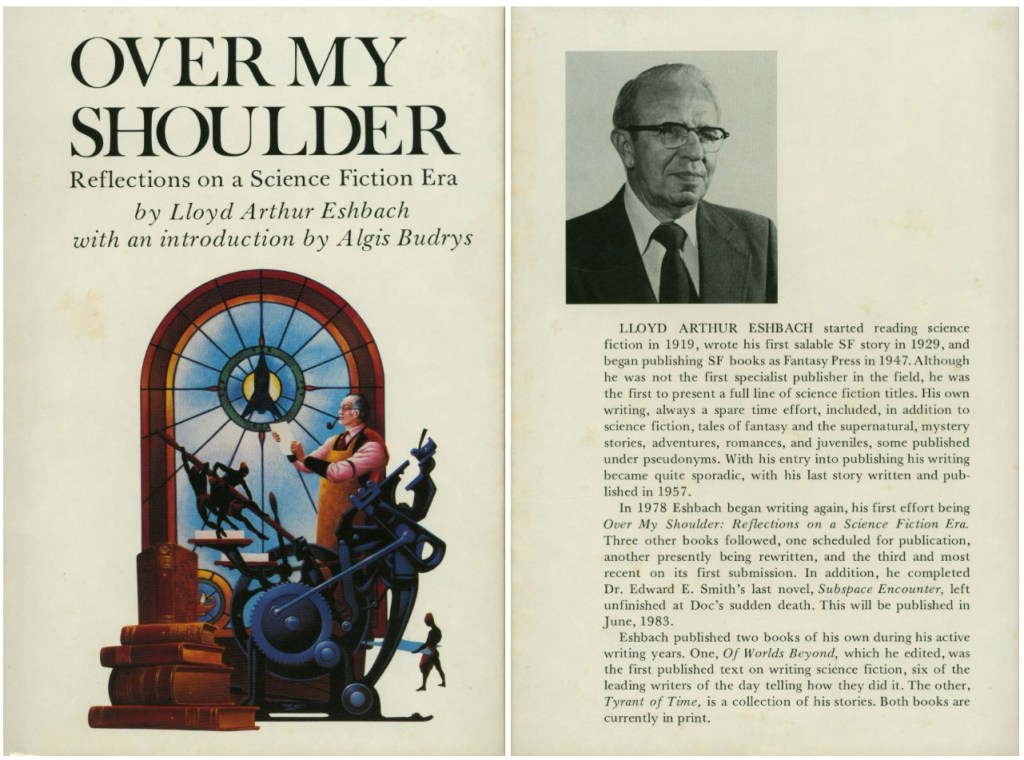
Over My Shoulder: Reflections on a Science Fiction Era is a memoir by Lloyd Arthur Eshbach recollecting his involvement in writing, editing, and publishing science fiction. It was published in 1983 and covers the good old days of the 1930s, 1940s, and 1950s (although there is some brief updating to 1980 when it was written). This is a book that only collectors of old science fiction hardbacks will appreciate, or maybe SF fans interested in the history of science fiction publishing, writers, and fandom. I can’t imagine it appealing to anyone else. Eshbach was one of the founding members of First Fandom.

There are young people today who can’t remember a time before smartphones. There are slightly older young people who can’t remember a time before video games. I can remember the time before personal computers, but I’ve always known a world with television sets. My parents knew a world before TVs, and their parents knew a world before radio.

I’ve never known a time without science fiction, but there was one. Eshbach grew up in such a time. My parents probably didn’t hear the term until their thirties in the 1950s. The label ‘science fiction’ emerged in the 1930s with pulp magazine readers. (Read: “How Science Fiction Got Its Name” by Sam Moskowitz, F&SF Feb 1957). Before WWII very few science fiction books appeared and they weren’t labeled science fiction.

After WWII, pulp magazine science fiction began being reprinted in hardback books, and eventually in paperbacks. For about a decade before large publishing houses embraced the genre, small publishers promoted science fiction. In a handful of locations around the country, a few ardent fans would pitch in a few hundred bucks each and start a publishing company reprinting their favorite stories and novels from the pulps.

Print runs were often just 1,000-3,000, but this jump-started the genre, especially as libraries bought these books. Seeing the cover images today triggers memories of when I checked out these books from libraries in the 1960s. Even today, I’ve seen these old specialty publishers as beat-up and rebound library discards. There’s no telling how many young readers found sense-of-wonder in their pages.

Most of these legendary small press publishers went out of business because of poor management, competition from the big publishers, and paperback reprints, but especially because of the Science Fiction Book Club which began in 1953.

Lloyd Arthur Eshbach writes about those small publishers in Over My Shoulder. What’s funny is I just bought this 1983 first edition from Amazon sold as new in 2022. Amazon even said “Only 2 left in stock (more on the way).” Now only 1 left in stock. There are plenty of used copies on ABEbooks.

My copy arrived in plastic shrink-wrap in an old shipping box sent to Amazon, inside an Amazon shipping box. It’s not an actual new book, and I doubt they’ll be getting any more soon. I bought this title decades ago, and never read it, and gave it to the library book sale. I bought it again last week when I ran across a mention of it on the internet.

I now know more about the people and histories that Eshbach writes about, and I read it with great pleasure. It was written over forty years ago, and it’s Eshbach’s memoir of discovering science fiction magazines in the 1920s, writing it in the 1930s, and publishing it in the 1940s and 1950s. He remembers First Fandom, the First Worldcon and other early Worldcons, and many big-name fans and pros from the 1940s and 1950s. The book is full of anecdotes about science fiction books that are now collector items, such as how Eshbach finished stories for John W. Campbell and E. E. ‘Doc’ Smith, or how Hannes Bok, the wonderful cover artist, barely survived by painting SF and fantasy subjects, ended up writing about astrology and selling horoscopes, which paid better. The book is filled with loving memories, some regrets and apologies, some gossip, and even some setting the records straight. It also has a nice section of photographs.

Fantasy Press (1946-1961)Wikipedia, ISFDB, eBay, ABE, Biblio

Eshbach was the main mover behind Fantasy Press. I own its first edition of Beyond This Horizon by Robert A. Heinlein. I couldn’t afford to buy it today, but I was lucky enough to afford it over 50 years ago. It was $3 when it came out in 1948, maybe $10 when I bought it in 1970, probably 10x the cover price when Eshbach published his memoir, and often 100x or more today. Some of the other titles are now 1000x.

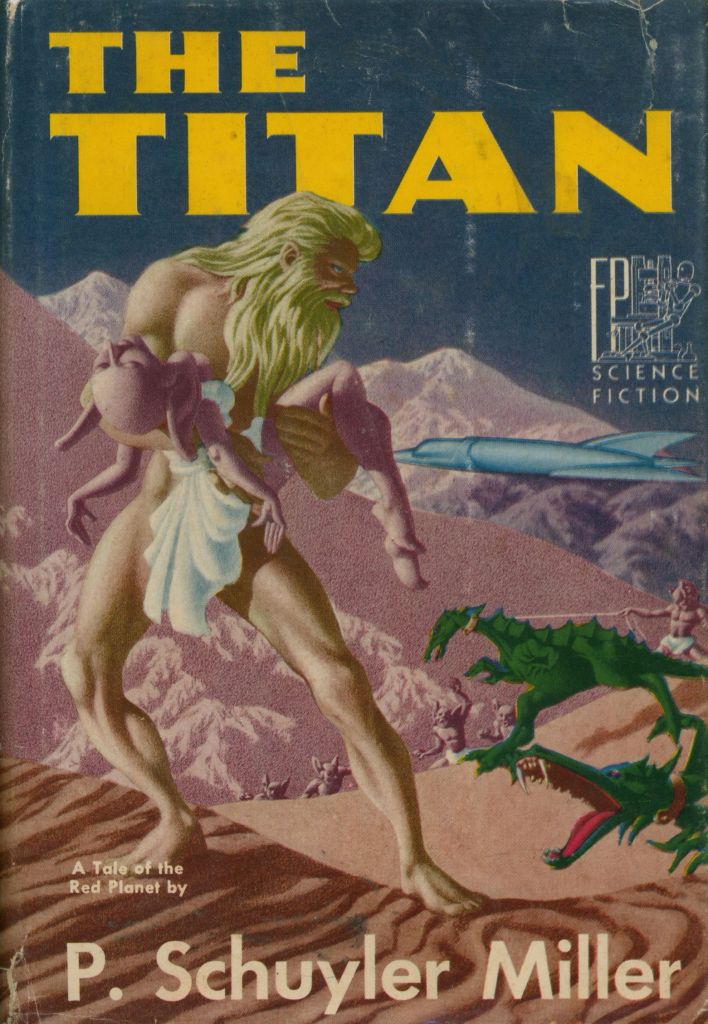
The only other Fantasy Press book I own is the first edition of The Titan by P. Schuyler Miller. I bought it a few years ago for the Hannes Bok cover. I could afford it because Miller is not famous. I’d love to own most of the books that Eshbach published but they are rare and expensive today. Follow the links above. I’d especially love to own Assignment in Eternity by Heinlein. Probably the most famous of the Fantasy Press books were the original Lensmen books by E. E. ‘Doc’ Smith. A complete set of Fantasy Press books is currently listed on eBay for $34,000.

I avoid thinking about collecting rare science fiction books because I need my retirement savings for future vital expenses. Still, it’s pleasurable to read about the early history of science fiction publishing. And every now and then I’ll treat myself to one of these books published by these early publishers if I can get it cheap enough. (And only if I love the cover.)

Gnome Press (1948-1962)Wikipedia, ISFDB, eBay, ABE, Biblio

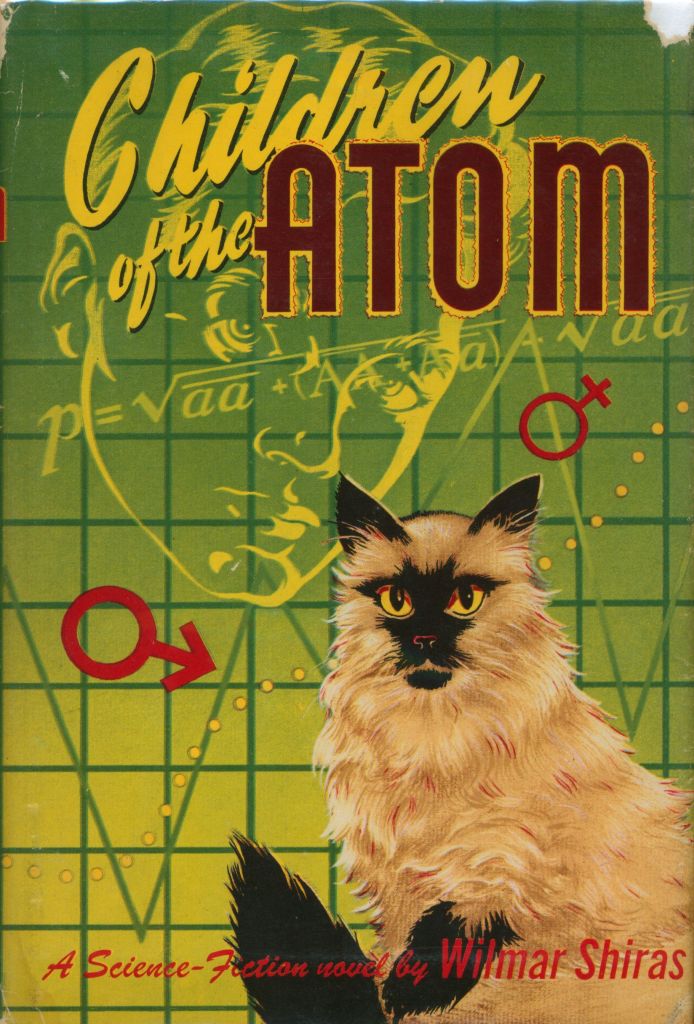
Eshbach also relates a short history of some of his competitors because he knew everyone in the business. Gnome Press is probably the most famous of the early SF publishers. I only own three of them, Children of the Atom by Wilmar Shiras, The Seedling Stars by James Blish, and The Mixed Men by A. E. van Vogt. Gnome is most famous for the first editions of Foundation, Foundation and Empire, and Second Foundation in book form. Currently, a signed set of the trilogy is going for $32,000 on eBay. They also published I, Robot, and a signed copy is going for $7,895.00 on eBay right now.

I remember reading four books by Robert Heinlein back in 1964, at the Homestead Air Force Base library, that were Gnome Press editions. I remember it because their covers are burned into my memory. They weren’t great covers, but I’d love to own them for nostalgic reasons.

That was one of the important impacts of Fantasy, Gnome, Shasta, Arkham, and other small publishers. They were bought by libraries and that’s how many readers in the 1950s and 1960s discovered these science fiction classics.

Eshbach has chapters on these publishers but I don’t own any of these books:

Plus Eshbach does a chapter that quickly covers several smaller publishers. If you collect books, Eshbach does mention a lot of interesting little publications that might be worth tracking down, many of them with some inside information. I was disappointed that Eshbach didn’t give a book-by-book history of his acquiring all the Fantasy Press titles. He does have a final chapter that lists all the books published by each publisher with the print run for each first edition.

Further Reading:

Here’s a photo of a complete set of Gnome Press from Hydraxia Books:

James Wallace Harris, 5/8/22

The Problems with Classic Science Fiction

The first problem I face with assembling my Top 100 Science Fiction Short Stories list is that I’m partial to crusty old SF stories that younger readers will feel are badly dated. Our discussion group read “Rescue Party” by Arthur C. Clarke for today. Here’s my comment:

Some members of the group, and not always the younger ones, have pointed out how dated parts of this story are today, and that the characterization is rather poor. Clarke was never a particularly good writer when it came to characterization, but this story was on par for 1946. Most of our group are older fans, and we’re used to older stories, so even with them, this story might not be a great story. Generally, people liked it, rating it 3-4 stars, with one person giving it 2.

You can read “Rescue Party” for yourself if you want. Here is the story in the original publication, and here it is again at Escape Pod with both audio and text. The group read the story from The Arbor House Treasury of Modern Science Fiction that came out in 1980. Evidently, Robert Silverberg and Martin H. Greenberg considered “Rescue Party” a modern classic 42 years ago even though most anthologies back then were remembering Arthur C. Clarke with “Nine Billion Names of God” and “The Star.” One of our members said Clarke might be remembered for “A Meeting with Medusa” which came out in the 1970s and is a much more polished story by contemporary standards.

“Rescue Party” was anthologized in The World Turned Upside Down edited by David Drake, Eric Flint, and Jim Baen in 2004, but that anthology was promoted as collecting stories that we old SF fans loved when we were growing up. That’s certainly true for me because it has many old science fiction stories I love that I use for my Top 100 list of SF short stories.

In other words, I can make a list of the short science fiction stories I love, but if younger readers read those stories would they be disappointed? First, do I care? It’s my list. Actually, I do. I don’t want to waste readers’ reading time. Nor am I interested in trying to be a teacher pushing young people to read the SF classics.

I realize there are two solutions for me to pursue. One is to find the stories that are great science fiction and are well written that aren’t dated. There’s certainly plenty to choose from. And I might do that. But I had a different idea when I started work on this list. I wanted to show the evolution of science fictional ideas and my evolution as a science fiction reader. It’s not about recognizing the best stories. I no longer believe in the best of anything. This world is too complex and multiplex to order in ranks and ratings. I’ve already bogged down trying to rank my favorites numerically.

I want to start in the 19th century and progress to the 21st by reviewing the science fiction stories that evolved the genre. Contemporary readability or social correctness won’t matter. Figuring this out has given me a direction.

James Wallace Harris, 5/1/22