Could I Write a Science Fiction Story at 72?

In my teens, twenties, and thirties I desperately wanted to be a science fiction writer. At least I thought I did until I got married and got a job I liked. I still took creative writing classes and even attended Clarion West in 2002 when I was fifty-one. However, I never could stick with writing until I had a polished story. I’m just too lazy. Writing science fiction has always been more of a fantasy than a reality. I turn seventy-two next month, and I wonder if I’m too old to even dream that old dream. Why hasn’t it just faded away? (I wish it had — I could use the peace of mind.)

In recent years, I’ve often wondered if I could make myself write one story worthy of an editor’s acceptance? I have ideas, lots of ideas. Lots of finished but unpolished stories. I don’t know if I have any talent, but I do know I lack focus and perseverance to stick with writing a story until it’s worth submitting. But let’s imagine if I could muster up some discipline, what would I write about?

I no longer like science fiction the way I liked it when I was younger. For the most part, I don’t even like reading modern science fiction. And I’m not talking about plot ideas or prose styles. I always assumed I could never completely finish any of my stories because I didn’t like them enough.

It looks like I have two desires: one to write a story I love, and second to write a story an editor will buy. But that’s wrong too. Maybe I shouldn’t be thinking about editors and instead just try to please myself.

Putting it that way, I can see why I’ve always given up. I love very few stories. Writing something I loved will take a huge effort, maybe even an impossible one. Is this an ego problem I’m having, or am I just chicken about rejection? Probably all writers who got published just wrote stories until they found an audience and didn’t worry about who would like them. I should do that too, but I don’t know if I can. Knowing that advice is not enough to inspire me to keep working.

I’ve read many books advising would-be writers. They all say to not wait for inspiration, but just develop the discipline to write daily. This probably explains my failure. I don’t like writing fiction, it’s demanding work. The people I know that became successful fiction writers started writing stories early in life and always kept at it. They couldn’t stop writing. Evidently, wanting to do something is much different from doing something.

I’ve tried to forget this desire to write fiction for most of my life. It won’t go away. It just keeps gnawing at me. I knew one woman who had a science fiction story published and then never tried again. I wonder if that would free me too.

When I was young, I wanted to be a successful writer to make money, so I wouldn’t need to work a 9 to 5 job. But I’m retired now, and money and jobs aren’t an issue. At 72, I’d be writing just to write. I do write by blogging. Evidently, there’s something special about fiction that blogging doesn’t satisfy.

Is it an urge to create? To leave something behind? I’ve always been fascinated by those writers I find on ISFDB.org that have just a few stories listed. A fitting example is “The Short Life” by Francis Donovan which I wrote about last time. Donovan has one published story. Did he encapsulate everything he wanted to say about reality with that one fictional statement? That might come closest to explaining my urge to write a science fiction story. I want to say something that will be remembered.

Of course, having a science fiction story published isn’t like writing hieroglyphics on a pyramid. Still, I think I’ve dug up a clue about my life-long hankering to crank out a science fiction story. And it might also explain why I’d need to love it. Who wants to write a crappy epitaph for themselves?

I wish I could write something like “The Star Pit” by Samuel R. Delany. Or “An Appearance of Life” by Brian W. Aldiss. Or “Vintage Season” by C. L. Moore. Or even something short, like “The Light of Other Days” by Bob Shaw. Those would all be epitaph-worthy stories.

[Thank you for being my psychiatrist or priest and listening to my confessions.]

James Wallace Harris

“The Short Life” by Francis Donovan

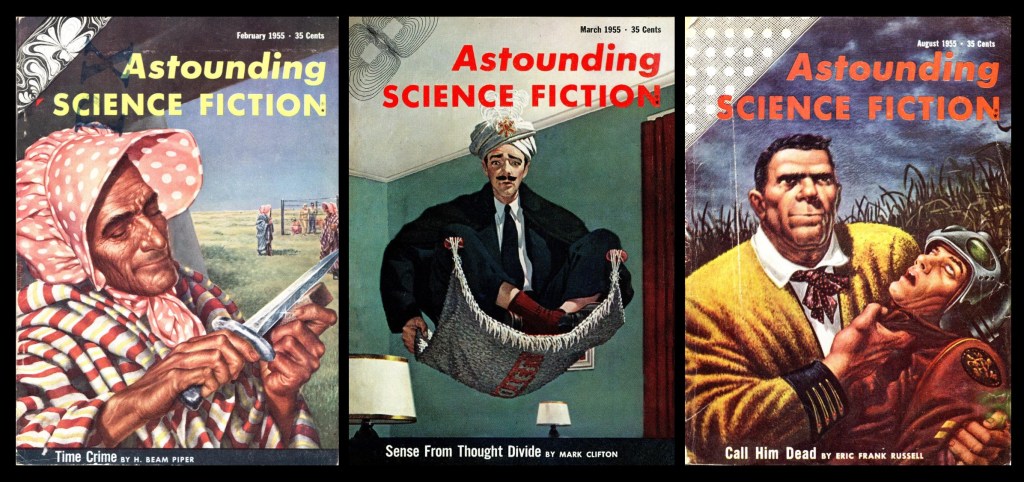
Who was Francis Donovan? He has exactly one story listed in ISFDB, this one, “The Short Life.” That story first appeared in the October 1955 issue of Astounding Science Fiction. It was reprinted in three editions of Best SF Four edited by Edmund Crispin, and in a large retrospective anthology, The Best Science Fiction Stories (1977) – no editor listed. Since both of those anthologies were published in England, I assume Donovan may have been English.

You can read “The Short Life” online at Project Gutenberg and on the Internet Archive. You might want to get an EPUB version for your ebook reader since it’s a novella.

I’m recommending this story to my reading group who are discussing the best short science fiction of 1955. I was asking the group which novelettes or novellas they thought should have won the Hugo award back then if they didn’t like “The Darfsteller” by Walter M. Miller, Jr. I think “The Darfsteller” is an outstanding story, but then so is “The Short Life.”

I find it quite fascinating when I discover a great science fiction story by a forgotten science fiction writer, especially one that published only a handful of stories. Donovan only published one. If you know anything about Francis Donovan, please post it in the comments? And if you’ve read “The Short Life” leave a comment about what you think of the story, and how you discovered it.

“The Short Life” is about telepathy. I’m not going to tell you the plot, there’s not much of one, and all the explanations are withheld to the end, but it really gets into the ramifications of telepathy. It’s also about Homo Superior. And it’s about first contact. I hope that’s enough to entice you into trying it.

“The Short Life” reminds me a bit of “In Hiding” by Wilmar H. Shiras and The Man Who Fell to Earth by Walter Tevis. It belongs among the best short science fiction of 1955.

p.s.

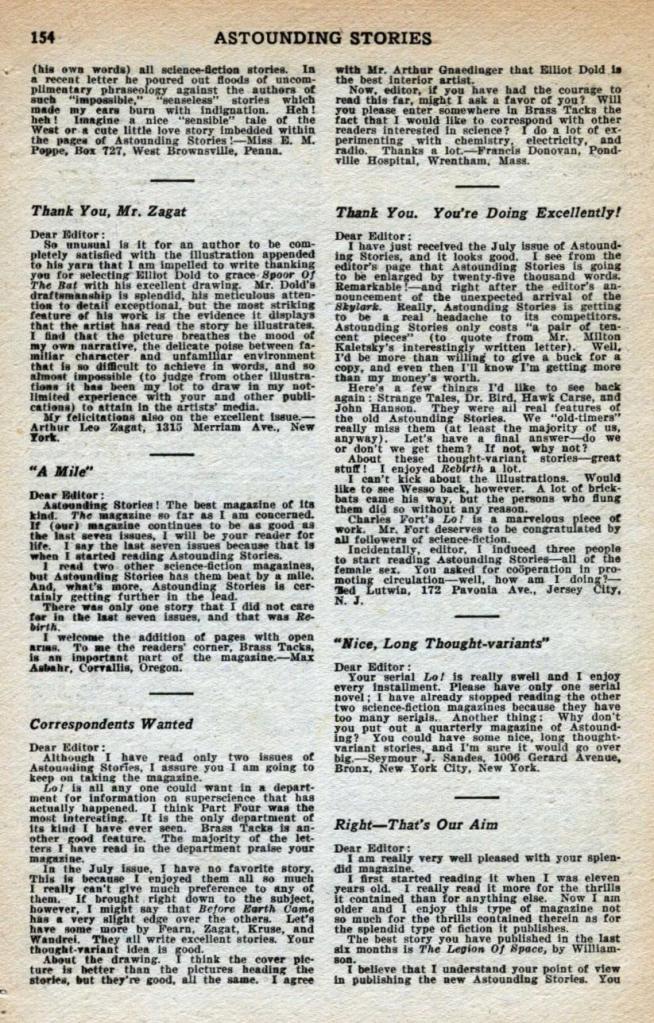
I did find one other clue to Francis Donovan, a letter to the editor in the September 1934 issue of Astounding Science Fiction. Evidently, he wasn’t English if this is the same Francis Donovan.

James Wallace Harris, 9/23/23

1955 Astounding Overview

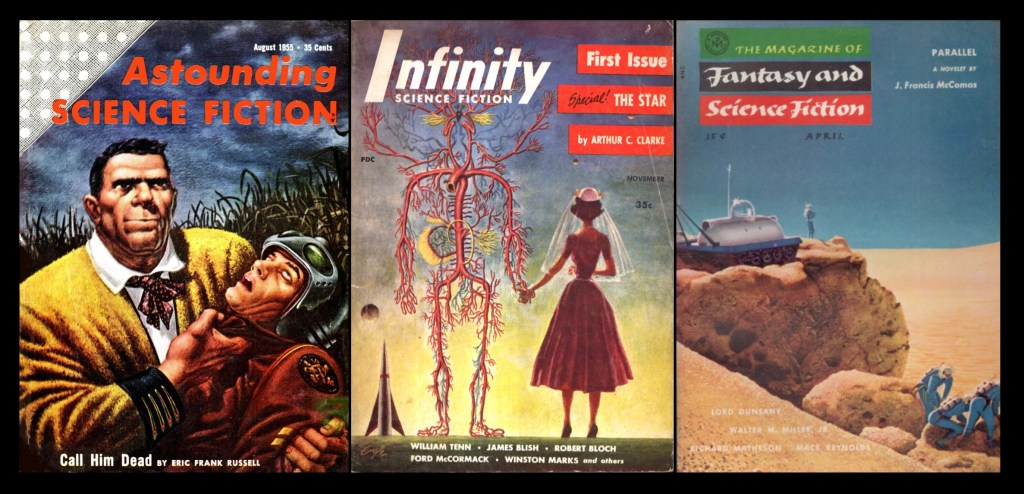
As I’ve described before, our reading group is covering the best science fiction short stories of 1955. To supplement the discussion, I’m creating .pdf files for each science fiction magazine that includes their cover, table of contents, and some departments such as book reviews, fanzine reviews, and letters to the editor. Sometimes I even include interesting ads or other artifacts that add to the discussion of science fiction in 1955. I just created “1955 Astounding Overview” to go with the ones for Amazing and IF. I’ll be doing more magazines in the future. You can download what I’ve done so far here:

The general belief was Astounding Science Fiction was in decline in the 1950s but looking through the 1955 issues I’m not so sure. Our group wondered why “Allamagoosa” by Eric Frank Russell won the Hugo for best short story in 1955 when there were so many other great short stories. It was in the May issue. I noticed when going through the issues of Astounding that Russell had four short stories in that magazine for 1955, and one 3-part serial, meaning he was in seven of the twelve issues. The guy was just popular and that might have gotten him votes. However, “Allamagoosa” is a fun story.

Astounding also published the Best Novelette winner too, for “The Darfsteller” by Walter M. Miller, Jr. in the January issue. Astounding also had the winning novel, They’d Rather Be Right, which was serialized in 1954. “The Darfsteller” is magnificent, but They’d Rather Be Right is considered by many to be the worst novel to win the Hugo Award. See “Hugo Nominees: 1955” by Jo Walton about that controversy. (You can get both the Mark Clifton novels discussed in that essay at Amazon for ninety-nine cents.)

Of the fourteen stories we’ll be reading for Group Read 63, five were from Astounding, three from Galaxy, and four from F&SF. The other two were from other sources. We have already read eight other stories from 1955 in other group reads, but I’ve forgotten their sources.

For me, the best thing about the “1955 Astounding Overview” that I created are the book reviews by P. Schuyler Miller. His column, “The Reference Library” is my favorite way to look back over science fiction in the 1950s. Not only did Miller review books, but often wrote about the state of science fiction and publishing. Some of the books he reviewed that I’ve read, or own and hope to read are:

  • Science-Fiction Thinking Machines edited by Groff Conklin
  • Born of Man and Woman by Richard Matheson
  • One in Three Hundred by J. T. McIntosh
  • Brain Wave by Poul Anderson
  • The Immortal Story by Sam Moskowitz
  • The Best Science-Fiction Stories: 1954 edited by Bleiler & Dikty
  • The Stars Are Ours by Andre Norton
  • The Forgotten Planet by Murray Leinster
  • The Star Beast by Robert A. Heinlein
  • Star Short Novels edited by Frederik Pohl
  • The Best from Fantasy and Science Fiction: Fourth Series edited by Anthony Boucher
  • Shadows in the Sun by Chad Oliver
  • Earthlight by Arthur C. Clarke
  • More Adventures in Time and Space edited by Healy & McComas
  • Earthman, Come Home by James Blish
  • The Mouse That Roared by Leonard Wibberley
  • Northwest of Earth by C. L. Moore
  • Assignment in Tomorrow edited by Frederik Pohl
  • To Walk the Night by William Sloane
  • The Exploration of the Moon by Arthur C. Clarke
  • Of All Possible Worlds by William Tenn
  • Hell’s Pavement by Damon Knight
  • Who Goes There? by John W. Campbell
  • The Body Snatchers by Jack Finney
  • Re-Birth by John Wyndham
  • The Edge of Running Water by William Sloane
  • Solar Lottery by Philip K. Dick
  • The Martian Way and Other Stories by Isaac Asimov
  • The Fittest by J. T. McIntosh

Each of Miller’s columns begins with several pages on a generalized topic. This also conveys a lot about science fiction in 1955.

James Wallace Harris, 9/9/23

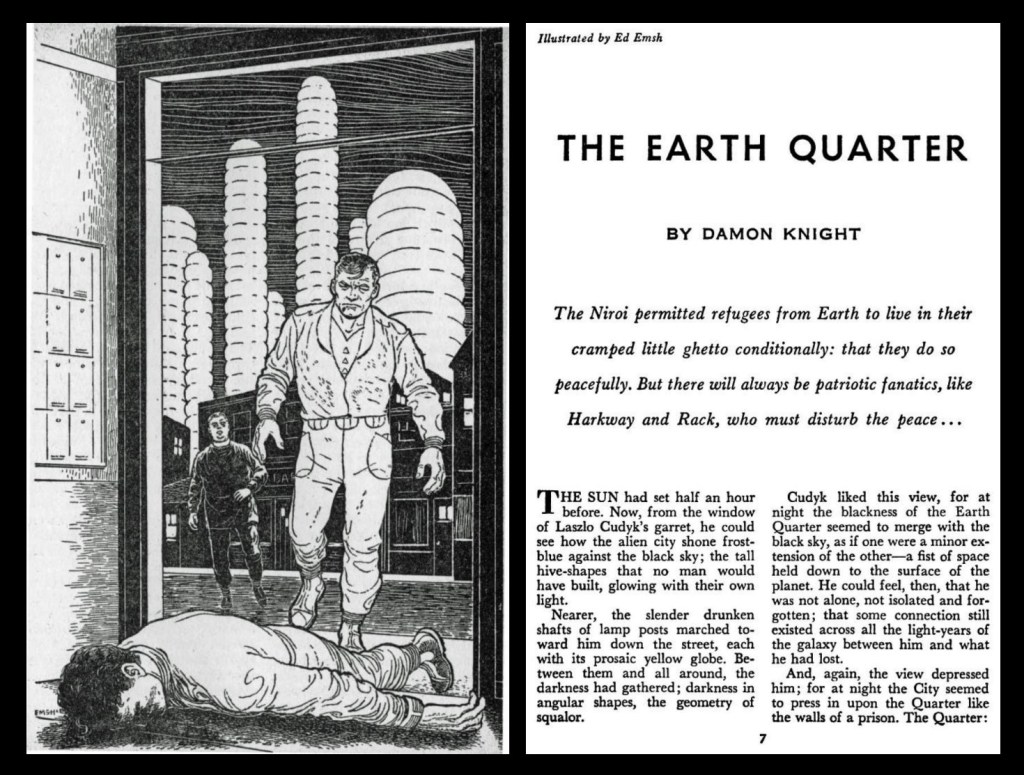
“The Earth Quarter” by Damon Knight

Starting September 7th, our science fiction short story group will be discussing the best short science fiction of 1955. Read about the details here if you want to participate. We used CSFquery to identify twenty-two stories to read and discuss. However, I put a challenge to the group to find worthy stories that have gone mainly unrecognized. I found my first forgotten classic today, “The Earth Quarter” by Damon Knight. The only recognition I could find that remembers this story is in a list of 50 SF short stories that were Gardner Dozois personal favorites. (I’m going to have to read more of the stories from that list that aren’t famous.)

I thought “The Earth Quarter” was one of the most cynical science fiction stories I’ve ever read. You know how Campbell and Heinlein were so pro-human? Well, Knight takes the opposite stance. I don’t want to say too much — and you might want to go read the story here before you read on.

Knight sets up the story where a group of humans live in a ghetto on another planet, one they call Earth Quarter. He pictures humans attaining interstellar flight and spreading out across the galaxy, but discovering it’s well occupied by intelligent beings more advanced than us. Humans can’t handle this. Earth itself falls back into barbarism, while enclaves of humans on various planets bicker amongst themselves.

“The Earth Quarter” is told from the point-of-view of Laszlo Cudyk, a fifty-year old man who tries to stay neutral among several highly polarized political factions. Liberals want to find a way to live peaceably with the aliens, while various conservative groups want to bring back the glory of Earth and conquer the galaxy.

The Earth Quarter is roughly sixteen square city blocks, containing 2,300 humans of three races, four religions, and eighteen nationalities. The human ghetto is sanctioned by a race of aliens called the Niori, but only if they live peaceably, which humans can’t seem to do. Knight makes a case that humans just can’t get along no matter what.

Life in the Earth Quarter reminds me of the prisoner of war camp in J. G. Ballard’s Empire of the Sun, but the Niori are enlightened beings who are kind rather than cruel. In another way, the story reminds me of Katherine Anne Porter’s Ship of Fools.

What I really liked about this story was the characterization — sure it’s pulp fiction, but I think good pulp fiction. Knight creates many distinctive characters who are vivid from little description. Sure, he employs stereotypes, but not too offensively. I can easily picture “The Earth Quarter” being made in a 1950’s noir sci-fi flick with all the standard noir actors like Humphrey Bogart, Robert Ryan, Robert Mitchem, Peter Lorre, Sidney Greenstreet, Barten MacLane, Elisha Cook, Jr. — and it would have to be filmed in black and white.

My guess was Damon Knight got disgusted with humans in 1955 when he wrote this story. We were in the middle of the cold war and humanity was providing just the right inspiration.

UPDATE – 9/4/23

It turns out that Rich Horton also likes “The Earth Quarter.” See his essay about his picks for the 1956 Hugo awards (which cover 1955). But he also reviewed the story when it was expanded and renamed into one-half of an Ace Double called The Sun Saboteurs.

James Wallace Harris, 9/3/23

“The Way to Amalteia” by Arkady Strugatsky and Boris Strugatsky

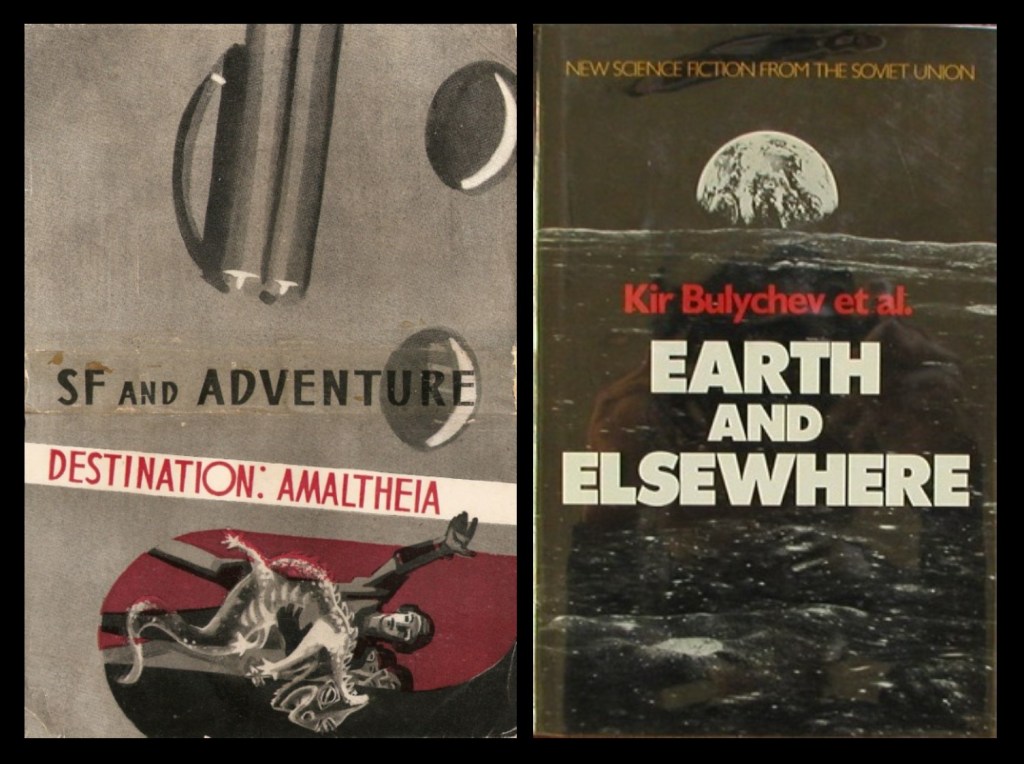
The Way to Amalteia” by Arkady Strugatsky and Boris Strugatsky is story #52 of 52 from The World Treasury of Science Fiction edited by David G. Hartwell (1989), an anthology my short story club is group reading. Stories are discussed on Tuesdays, Thursdays, and Saturdays. “The Way to Amalteia” was first published in Russian in Путь на Амальтею in 1960.

“The Way to Amalteia” was first translated into English in 1963, and later in 1985, before the 1989 translation for The World Treasury of Science Fiction. Finding those other editions will be difficult, and since there have been no English reprints since 1989, it shows the value of owning a copy of The World Treasury of Science Fiction. Collecting retrospective anthologies of science fiction is one way of preserving literary history.

“The Way to Amalteia” starts out on J-Station, a research settlement on Amalthea, the fifth moon of Jupiter. The Strugatsky brothers describe the beautiful site of Jupiter from that moon. But we learn that the station is running out of food, and everyone is on strict rations. The settlement is desperately waiting for the freighter, Takhmasib, to deliver supplies, but it’s running late, and they’ve lost contact with the ship.

The story then cuts to the freighter, where we learn why. The Takhmasib has suffered several mishaps and has fallen into Jupiter. The Strugatsky brothers have set up an almost impossible situation and we don’t know if the crew can save themselves.

This is a hard science story, especially for 1960. Hartwell, in his introduction said it would fit right in an issue of Astounding, and that’s true. Hartwell said it also reminded him of Clarke’s “A Meeting with Medusa,” which I thought too. I also thought the story sounded like something Hal Clement would write, and it turns out Arkady Strugatsky translated Mission of Gravity into English.

There’s a lot going for “The Way to Amalteia,” but unfortunately, on this first reading, the story didn’t thrill me. I vaguely sensed it was an outstanding story, but something kept me at a distance. Having so many things go wrong spoiled it for me on one level. Having the cause of the major catastrophe be due to meteorites seemed cheesy. And I wondered if I was missing the flavor of the story because it was a translated work. Finally, there were places where figures were given, and they just seemed impossible to believe.

On page 1027 the photon drive pushes the ship to sixty-seven thousand kilometers a second. That’s about a fourth of the speed of light (299,792 kps). On page 1058 we learn the pressure on the ship as it descends into Jupiter’s atmosphere is three hundred atmospheres. This is after the ship had several holes punched in it from meteors and was patched with resin and metal plates. And there was another mention of the crushing pressure of Jupiter’s atmosphere that was much higher than three hundred atmospheres, but I can’t find it. All these problems remind me of old science fiction movies of the 1950s where science was often mumbo jumbo. But were these errors the writers’ fault, or the translators?

I also feel if I read “The Way to Amalteia” a couple more times in the future I might get to like it quite a bit. I don’t think one reading does the story justice. The story comes across like an episode of Star Trek, where a valiant captain is forced to deal with a series of ever escalating problems, but then at the last minute saves the day.

The Strugatskys spend a lot of time developing the characterization of the international crew and filling the story with textural details. I couldn’t tell if they were realistic or stereotypes because I wondered if some of the flavor was lost in translation.

“The Way to Amalteia” was an interesting story to close the anthology, especially since it’s a novella. Hartwell must have thought highly of the story. That’s why I think it might improve on rereading. But most readers don’t reread. I would have put “The Way to Amalteia” where Hartwell put “A Meeting with Medusa” on page 146 and closed with “A Meeting with Medusa.” The Clarke story offers way more hope for the future.

James Wallace Harris, 9/2/23

The World Treasury of Science Fiction edited by David G. Hartwell

The World Treasury of Science Fiction edited by David G. Hartwell came out in 1989 and contains over one thousand pages of short science fiction. I call this kind of science fiction anthology a retrospective anthology because it collects fiction that covers a time period rather than theme. Reading it should give SF fans a good sampling of science fiction published around the world from the late 1930s through the 1980s. For other retrospective anthologies see “The Best Science Fiction Short Stories.”

Unfortunately, most of the great retrospective anthologies of science fiction are out-of-print. Our database at CSFquery lists the most frequently reprinted and cited stories. If you click on the title in the list, it will take you to ISFDB and show you all the places a story has been reprinted. This way you can create your own virtual retrospective anthology.

Only 9 of the 52 stories from The World Treasury of Science Fiction made it to our list of Classics of Science Fiction Short Stories. That suggests that most of the stories were Hartwell’s favorites and not popular picks. The anthology is a good read for discovering diverse science fiction.

You can see how many citations each of the 52 stories received here. To see which anthology has the highest percentage of cited stories, see “The SF Anthology Problem Solved.” A list of all the citation sources for short stories is here.

I’ve hyperlinked the stories I’ve reviewed from The World Treasury of Science Fiction.

  1. Harrison Bergeron • (1961) • short story by Kurt Vonnegut, Jr.
  2. Forgetfulness • (1937) • novelette by John W. Campbell, Jr.
  3. Special Flight • (1939) • novelette by John Berryman
  4. Chronopolis • (1960) • novelette by J. G. Ballard
  5. Triceratops • (1982) • short story by Kono Tensei
  6. The Man Who Lost the Sea • (1959) • short story by Theodore Sturgeon
  7. On the Inside Track • (1986) • novelette by Karl Michael Armer
  8. The Golem • (1955) • short story by Avram Davidson
  9. The New Prehistory • (1983) • short story by René Rebetez-Cortes
  10. A Meeting with Medusa • (1971) • novelette by Arthur C. Clarke
  11. The Valley of Echoes • (1973) • short story by Gérard Klein
  12. The Fifth Head of Cerberus • (1972) • novella by Gene Wolfe
  13. The Chaste Planet • (1975) • short story by John Updike
  14. The Blind Pilot • short story by Nathalie-Charles Henneberg]
  15. The Men Who Murdered Mohammed • (1958) • short story by Alfred Bester
  16. Pairpuppets • (1976) • short story by Manuel van Loggem
  17. Two Dooms • (1958) • novella by C. M. Kornbluth
  18. Tale of the Computer That Fought a Dragon • (1977) • short story by Stanislaw Lem
  19. The Green Hills of Earth • (1947) • short story by Robert A. Heinlein
  20. Ghost V • (1954) • short story by Robert Sheckley
  21. The Phantom of Kansas • (1976) • novelette by John Varley
  22. Captain Nemo’s Last Adventure • (1973) • novelette by Josef Nesvadba
  23. Inconstant Moon • (1971) • novelette by Larry Niven
  24. The Gold at the Starbow’s End • (1972) • novella by Frederik Pohl
  25. A Sign in Space • (1968) • short story by Italo Calvino
  26. The Spiral • (1968) • short story by Italo Calvino
  27. The Dead Past • (1956) • novelette by Isaac Asimov
  28. The Lens • (1984) • short story by Annemarie van Ewijck
  29. The Hurkle Is a Happy Beast • (1949) • short story by Theodore Sturgeon
  30. Zero Hour • (1947) • short story by Ray Bradbury
  31. Nine Lives • (1969) • novelette by Ursula K. Le Guin
  32. The Muse • (1968) • short story by Anthony Burgess
  33. The Public Hating • (1955) • short story by Steve Allen
  34. Poor Superman • (1952) • novelette by Fritz Leiber
  35. Angouleme • (1971) • short story by Thomas M. Disch
  36. Stranger Station • (1956) • novelette by Damon Knight
  37. The Dead Fish • (1955) • short story by Boris Vian
  38. I Was the First to Find You • (1977) • short story by Kirill Bulychev
  39. The Lineman • (1957) • novella by Walter M. Miller, Jr.
  40. Tlön, Uqbar, Orbis Tertius • (1962) • short story by Jorge Luis Borges
  41. Codemus • (1976) • short story by Tor Åge Bringsvaerd
  42. A Kind of Artistry • (1962) • novelette by Brian W. Aldiss
  43. Second Variety • (1953) • novelette by Philip K. Dick
  44. Weihnachtsabend • (1972) • novelette by Keith Roberts
  45. I Do Not Love Thee, Doctor Fell • (1955) • short story by Robert Bloch
  46. Aye, and Gomorrah … • (1967) • short story by Samuel R. Delany
  47. How Erg the Self-Inducting Slew a Paleface • (1977) • short story by Stanislaw Lem
  48. Nobody’s Home • (1972) • short story by Joanna Russ
  49. Party Line • (1976) • novelette by Gérard Klein
  50. The Proud Robot • (1943) • novelette by Henry Kuttner
  51. Vintage Season • (1946) • novelette by Henry Kuttner and C. L. Moore
  52. The Way to Amalteia • (1984) • novella by Arkady Strugatsky and Boris Strugatsky

James Wallace Harris, 9/1/23

“The Proud Robot” by Lewis Padgett

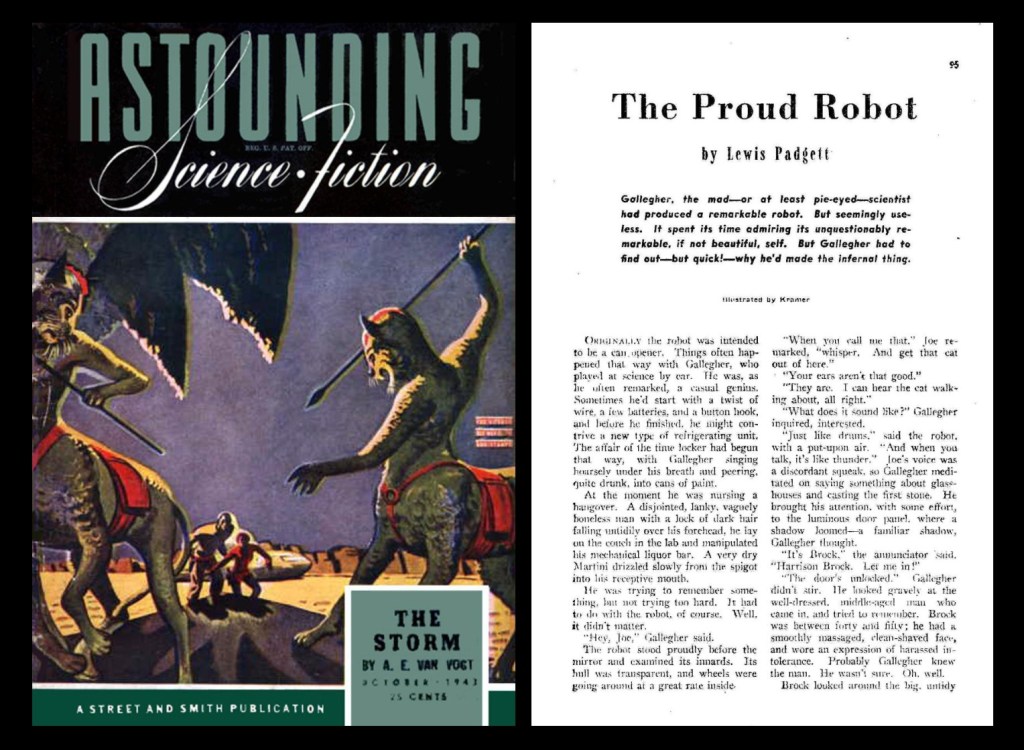
The Proud Robot” by Lewis Padgett is story #50 of 52 from The World Treasury of Science Fiction edited by David G. Hartwell (1989), an anthology my short story club is group reading. Stories are discussed on Tuesdays, Thursdays, and Saturdays. “The Proud Robot” was first published in Astounding Science-Fiction (October 1943). Lewis Padgett was the pen name of husband-and-wife writers Henry Kuttner and C. L. Moore, but most fans think it was written by Kuttner.

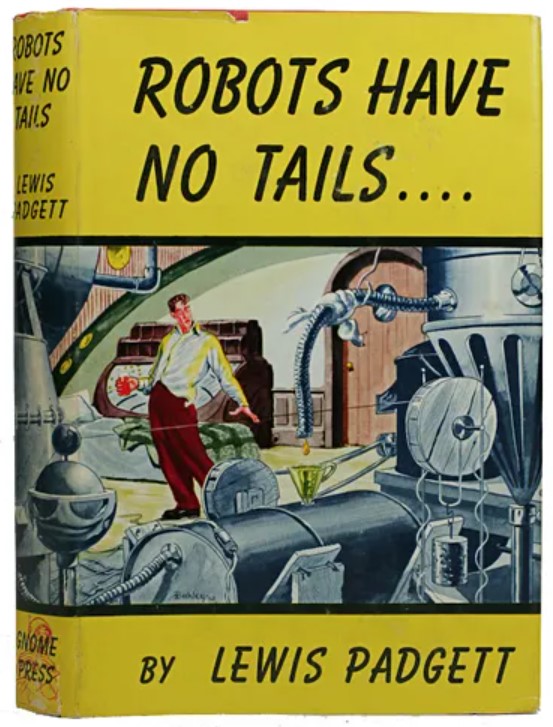
Back in the mid-1970s I discovered Robots Have No Tails in an old library downtown. It was a rebound copy of the original Gnome Press edition without a dustjacket. I read the first story, “The Proud Robot” and loved it because I was also a recent fan of The Thin Man movies with William Powell and Myrna Loy. I mention this because Kuttner obviously based the zany alcoholic mad-scientist Galloway Gallegher on the movie version of Nick Charles. I think most people might agree with me on that. However, I have another theory. I believe Joe, the vain robot was based on Bungle, the glass cat from The Patchwork Girl of Oz by L. Frank Baum. Both the robot and cat had transparent bodies so you could see their insides, and both were obsessed with looking at themselves.

I’ve read “The Proud Robot” several times over the years. Sometimes I like it, and sometimes I don’t — it all depends on my mood. Sometimes a drunk protagonist is amusing, and other times, Gallegher is just too damn annoying. Joe the robot is always annoying — but he was meant to be.

Harrison Brock, a television/movie mogul hires Gallegher to invent technology that will bypass patents that bootleg theaters are using to put his Vox-View Pictures out of business. Gallegher has accomplished the task but doesn’t remember how. Gallagher works when he’s drunk using his subconscious mind as a creative power. Most of the story is about Gallegher trying to remember what he did. All he knows is he came to after building a vain robot. Kuttner wrote a lot of pulp mysteries besides writing science fiction, so this story is really a SF mystery.

The central plot of the story lets Kuttner speculate about the future of television in 1943. He imagines the television industry paying for itself through household subscriptions, which was a path taken in England. He didn’t anticipate the power of commercials. Kuttner also imagined how the movie industry would fight back against television by offering viewers greater technological features to leave their homes. The speculation about the future of TV is fun but isn’t enough to carry the story.

How Gallegher solves the mystery is silly but logical enough within this silly story. Like I said whether this will be amusing will depend on your mood. I wished that I had an audio version of “The Proud Robot” because a good narrator would help me to hear this story in its funniest light.

I’m not keen on Kuttner. My hunch is I like the C. L. Moore part of the team, that’s Lewis Padgett. If a Lewis Padgett story is serious and moving, I assume Moore did most of the writing. If it’s intellectual, silly, or pulpy, I tend to think it’s Kuttner. Our next story, “Vintage Season,” was written by the same team. Because that story is so wonderful, I feel it was mostly written by Moore.

I feel “The Proud Robot” was Kuttner’s hack work, and sometimes, if the mood strikes me, it’s amusing hack work.

James Wallace Harris, 8/29/23

“Party Line” by Gérard Klein

Party Line” by Gérard Klein is story #49 of 52 from The World Treasury of Science Fiction edited by David G. Hartwell (1989), an anthology my short story club is group reading. Stories are discussed on Tuesdays, Thursdays, and Saturdays. “Party Line” was first published in French in Fiction (March 1969). It was translated into English in 1976 for The Best from the Rest of World: European Science Fiction edited by Donald A. Wollheim.

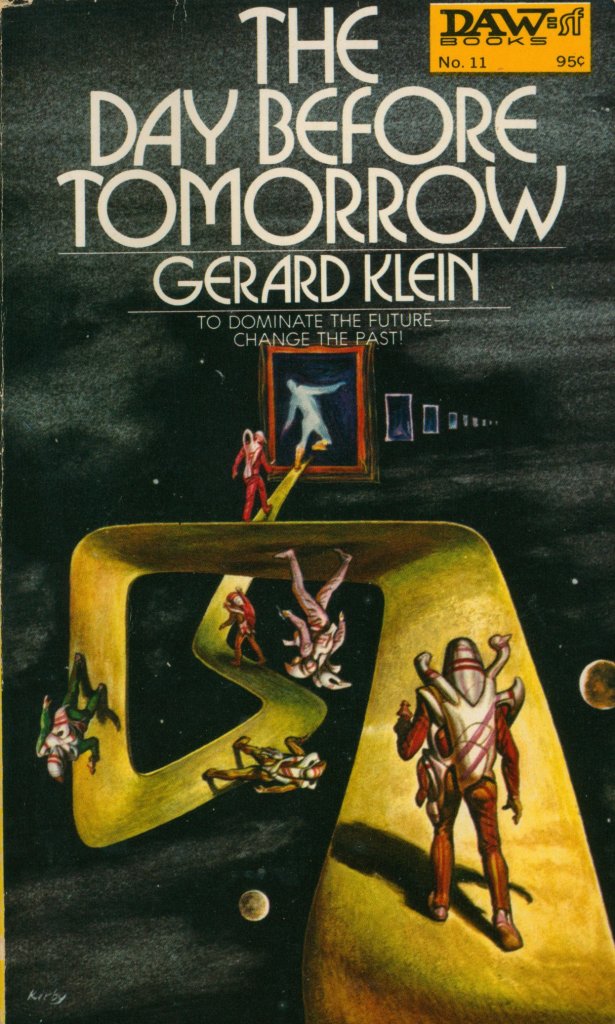
This is the second appearance of Gérard Klein in The World Treasury of Science Fiction. See my earlier review of “The Valley of Echoes.” After I read that story, I bought two of Klein’s novels, but I haven’t read them yet. I’m not sure I would have done that after only reading “Party Line.” However, one of those novels, The Day Before Tomorrow has a blurb that could fit with “Party Line” — “To Dominate the Future — Change the Past.”

“Party Line” uses one of my favorite science fictional concepts — having a future older-self influence a younger-self. Jerome Bosch is working in his office when he receives two phone calls on two separate phones. The phone in the left hand tells him he’s going to receive a terrific opportunity, and the one is the right warns against taking it.

Jerome Bosch is also a writer. He fantasizes at work about having all his time free to write. And I must wonder if Klein was working in his office one day, daydreaming this idea about himself and deciding to work it into a story. At first, it felt like “Party Line” was something Philip K. Dick would write. But then the dominant mood of the story shifted to indecision, paranoia, and fear, which is still PKD’s territory, but the story felt weirdly different, more like Kafka.

The first caller calls back and tells Jerome if he will only do what he says, his books will be made into movies, he will become rich and famous, and have lots of women. Then the other caller calls back and tells him something terrible will happen. For the rest of the story Jerome can’t decide.

I liked “Party Line” until I got to the end. Unfortunately, it’s one of those stories that promises a lot, but doesn’t know how to deliver on its promises. “Party Line” does have an ending, but one, I thought Klein had to scrounge up when he discovered he had painted himself into a corner.

I wrote an older self advises younger self story when I was at Clarion West. The problem is people seldom take advice. I wondered if someone would take advice from themselves. Klein complicates the idea by having two versions of his future self give him advice. That created a lot of tension for the story, but I wonder if “Party Line” would have been better if Jerome had only gotten one phone call from the future. How many people would jump at getting everything they wanted if they got a message from their future self?

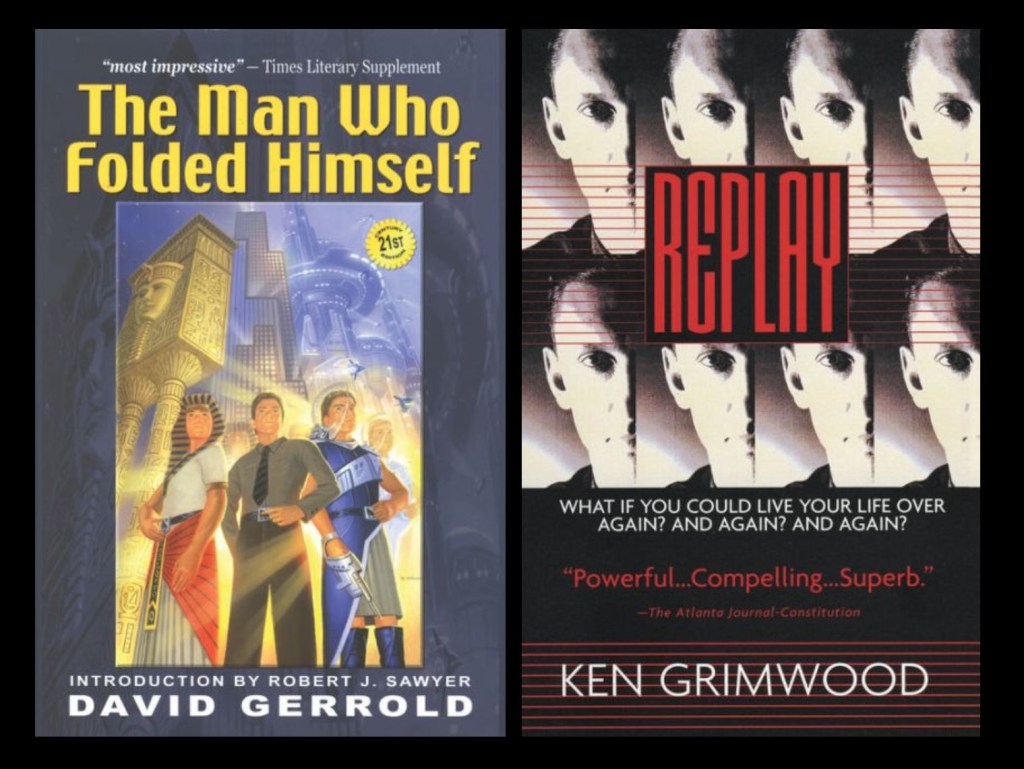
The idea of an older version of a person trying to influence their younger self is a challenging problem for writers. David Gerrold did an excellent job with it in The Man Who Folded Himself. But to fully explore the idea, I think people should read Replay by Ken Grimwood. It’s not the same exact idea, but it works out the same philosophical problem. The idea needs novel length to work out.

I believe my disappointment with “Party Line” is because Gérard Klein should have made it into a novel and worked out a satisfying ending. However, I might reread “Party Line” in the future and see it differently. Maybe my future self will understand it better.

James Wallace Harris, 8/26/23

Group Read 63: The Best SF Short Stories of 1955

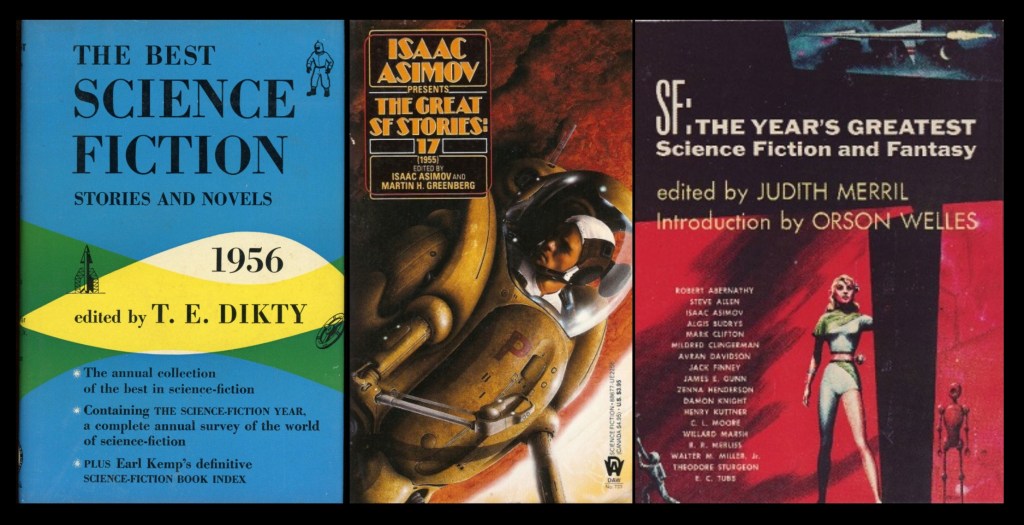
Over at the Facebook group Best Science Fiction and Fantasy Short Fiction I’m about to lead Group Read 63 starting September 7th. It will be devoted to the best short SF stories from 1955. We have four moderators, of which I’m one. We take turns leading our Facebook group in reading an anthology, or other collections of SF short stories. I’ve decided my group reads will become an ongoing project of reading the best short SF of the year starting in 1955 (which was when the Hugo Awards began). We won’t use a specific anthology but use the Classics of Science Fiction database. Most of the stories will come from the anthologies pictured above, but we hope they are widely found in many anthologies and online. Participation often depends on the availability of stories.

To keep Group Read 63 reading list short, to around 15-20 stories for each year, the minimum number of citations in the database was set to 2. You can use the List Builder to see the stories for each year. Set the Start Year and End Year to the same year (in this case “1955”), the Minimum Citations to “2,” and Citation Type to “Story.” If you set the citation to one, you’ll see all the stories in the database from 1955. If you click on “Show Citation” you will see the citation sources.

Here’s our reading list for 1955 ordered by number of citations. That gives us twenty-two stories, of which we’ve previously read and discussed seven. For Group Read 63, we’ll read the fifteen we haven’t discussed before. Here they are with their start discussion dates:

  • 09/07/23 – “Allamagoosa” by Eric Frank Russell
  • 09/09/23 – “Nobody Bothers Gus” by Algis Budrys
  • 09/12/23 – “The Tunnel Under the World” by Frederik Pohl
  • 09/14/23 – “A Canticle for Leibowitz” by Walter M. Miller, Jr.
  • 09/16/23 – “One Ordinary Day, with Peanuts” by Shirley Jackson
  • 09/19/23 – “The Cave of Night” by James E. Gunn
  • 09/21/23 – “The Darfsteller” by Walter M. Miller, Jr.
  • 09/23/23 – “The Dead Fish” by Boris Vian
  • 02/26/23 – “Delenda Est” by Poul Anderson
  • 09/28/23 – “Dreaming Is a Private Thing” by Isaac Asimov
  • 09/30/23 – “Home There’s No Returning” by Henry Kuttner, C. L. Moore
  • 10/03/23 – “Judgment Day” by L. Sprague de Camp
  • 10/05/23 – “The Short Life” by Francis Donovan
  • 10/07/23 – “The Short-Short Story of Mankind” by John Steinbeck
  • 10/10/23 – “Who?” by Theodore Sturgeon

The seven previously discussed stories will be reviewed on 10/12/23. They are (with previous discussion link):

My turn to lead a group read comes up about four times a year, which means the years 1956-1959 will be covered next year in 2024. That’s assuming the group likes this idea.

I plan during the weeks we’re discussing the stories from 1955 to have an ongoing thread where people can write about any story they’ve read and admired from 1955. And I will have another thread discussing what was happening with science fiction in general in 1955, with a focus on SF magazines.

What I’m hoping to achieve is an ongoing study of the evolution of science fiction starting with the year 1955. The Facebook group is open to anyone, but if you join, please answer the two questions. We use those two questions to weed out spammers and let people know our group is focused on science fiction short stories. (For people who hate Facebook, we try hard to police the group and keep out spammers, trolls, self-promoters, and off-topic comments that ruin the atmosphere of the group.)

Here are the posts we’ve made planning the project. As we discuss stories they will be automatically added to that link.

To get you interested in 1955, here’s Rich Horton’s review of the 1956 Hugo Award. He goes over the winners, finalists, and stories he thought should have been considered.

I also hope to review the stories individually here for this blog.

James Wallace Harris, 8/24/23

“Nobody’s Home” by Joanna Russ

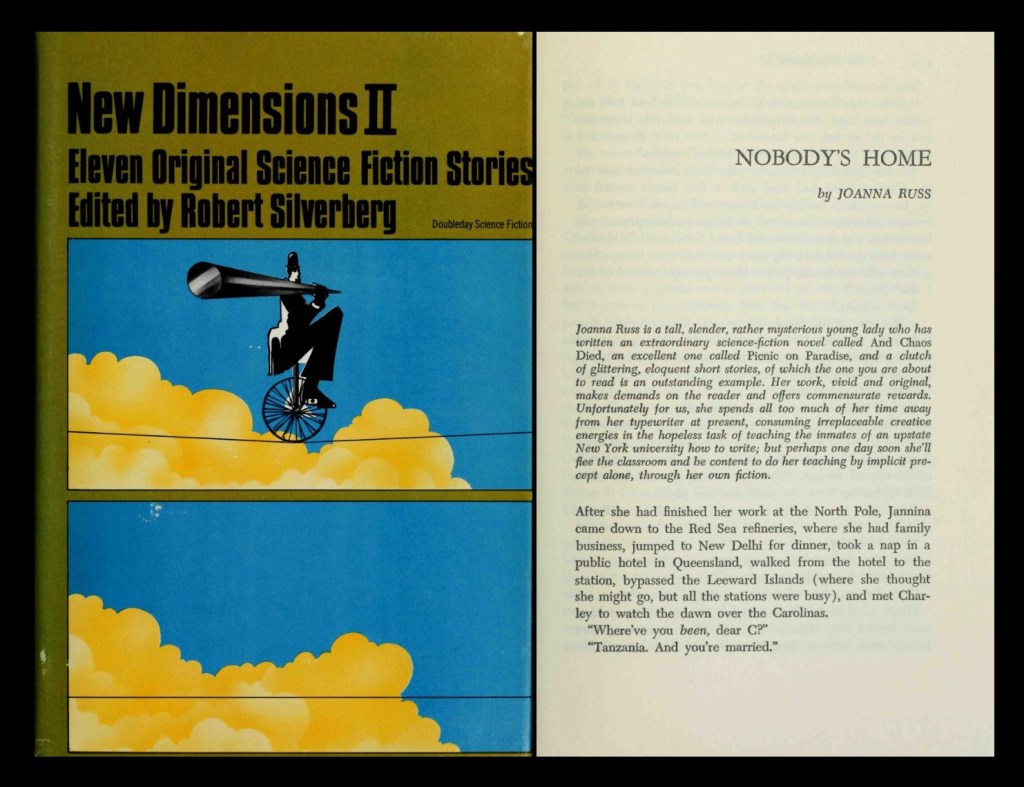
Nobody’s Home” by Joanna Russ is story #48 of 52 from The World Treasury of Science Fiction edited by David G. Hartwell (1989), an anthology my short story club is group reading. Stories are discussed on Tuesdays, Thursdays, and Saturdays. “Nobody’s Home” was first published in 1972 in New Directions II, an original anthology edited by Robert Silverberg.

“Nobody’s Home” is one of those science fiction stories where the author tries to cram in as many speculative ideas into each sentence and paragraph as possible. Joanna Russ paints us a picture of a utopian future where the Earth’s population is vastly smaller, and everyone is rich enough to do whatever they want. The whole of humanity routinely wanders across the face of the Earth via teleportation booths, seeing sites, having casual affairs, pursuing hobbies, whims, and vocations. If they wanted, they could view twenty-five sunsets from various locations around the world in one twenty-four-hour period. And they can choose any environment, no matter how extreme, in which to build their abodes.

Janina, our main character, is highly intelligent and lives in a family commune that includes numerous kinds of marriage arrangements, hookups, and parent-child relationships. Their family name is Komarov. This reminded me of the group marriages in “The Star Pit” by Samuel R. Delany. Household members speak in clever repartee that challenge each other in verbal games. The parents are all geniuses, and their children are even smarter.

So, what kind of problems mar this bright future? Well, the commune gets a visit from a young woman named Leslie Smith, who is ordinary. I assume Leslie is like one of us from the 21st century. She’s not that smart, not that good looking, not that clever. She can handle monotonous work tasks and enjoys herself by pursuing boring solitary activities. She can’t play the verbal games, nor can she pick up on the household’s carefully crafted social customs. Leslie is a bringdown to have around. The group tries to be kind to her, but in the end, they decide to pass Leslie on, like so many others have done with her before.

I’m curious why Russ wrote this story. Russ was a highly intelligent woman, so I wondered if the story was inspired by having to deal with a dull house guest. Or did she imagine a far-out future and wanted to point out that present-day plebians like us wouldn’t fit in with the hoi polloi of the future.

I know I couldn’t keep up with the future world of “Nobody’s Home.” I struggled to read the story slow enough to decipher all the alluded to ideas that Russ presented.

But, what about the title “Nobody’s Home?” Could Russ have intended something different? Could the unease the Komarov family felt when Leslie shows up be caused by them recognizing their own lack of purpose? That instead of no one being at home in Leslie’s head, that there’s no one home in their commune, or even Earth?

Joanna Russ is famous for her feminist fiction, but I didn’t feel this story was about feminism. This is the third time I’ve read this story and I’m still not sure what it’s about. It could be an attack on the high-tech fantasies science fiction writers love to give to the future. I imagine if you’re a science fiction reader who feels like a Slan, then maybe you see there’s nobody home regarding Leslie. But if you’re a critic of science fiction, you might think there’s nobody home with these Eloi-like beings of this future.

James Wallace Harris, 8/23/23