What Motivated Heinlein to Write Science Fiction?

To get the most out of my rereading Heinlein project, I figure I need to hold up on reading the stories and get an idea of why Heinlein wanted to write. There are two schools of thought on studying literature. One holds that a work of fiction must stand on its own. I can buy that. But second, believes in knowing as much as possible about the context in which the work was created. And I can buy that too. For my rereading Heinlein project, I’ve decided to get to know as much about Heinlein as possible and to study what others have written about Heinlein.

This effort is going to be rather haphazard because I don’t plan to devote all my time to studying and reading Heinlein. Nor am I scholarly or disciplined enough to systematically collect and analyze data. I shall alternate between reading about Heinlein, reading a story by Heinlein, and writing about my reaction to the two. I will probably revise what I blog as I go along and learn more.

Over the years I’ve had a love-hate relationship with reading Heinlein. As a kid, I wanted to grow up and be like him, a science fiction writer. He was my hero. But, by the time I graduated high school and started college, I realized Heinlein was on the far side of the 1960s generation gap. He was now the enemy. Heinlein was pro-Vietnam war. I was against it. Heinlein was in the Old Wave of science fiction writers. I sided with the New Wave writers. When I was young, Heinlein felt like a liberator of thoughts, but by my late teens, he seemed like an oppressor. What really turned me off to Heinlein was I Will Fear No Evil which came out in 1970. He had changed. But then, so had I.

My father died in 1970 when I was 18. We often locked horns over the same social and political issues that turned me against Heinlein. When I got older, I often wondered what my dad was really like because I eventually realized I had never gotten to know him. I had rebelled against his older self, and one I judged too quickly because I was young and impatient. I had no clue about my dad’s younger self. The same was true for Heinlein. Now that I’m old myself, I believe I need to go back and figure out these men. What did they originally want? I don’t have much evidence for who my father was, but I do for Heinlein.

While reading Heinlein’s early stories I get the impression he wasn’t like the other science fiction writers. I assumed he had grown up reading science fiction and science fiction was the obvious choice when Heinlein decided to make money by writing. Samuel Johnson is famous for saying, “No man but a blockhead ever wrote except for money,” but that doesn’t explain what they choose to write about. I’m starting to doubt if Heinlein was a trufan of science fiction because he had so many other interests. I wondered if he considered writing in other genres or even writing nonfiction? I know Heinlein read science fiction, but he also read lots of other kinds of fiction and especially nonfiction. Heinlein had diverse interests, and even though he read and wrote science fiction, and occasionally interacted with fandom, I’m not sure if he really thought of himself as a science fiction fan and writer.

All the details I cite below about Heinlein’s life come from Robert A. Heinlein: In Dialogue with His Century, Volume 1 by William H. Patterson.

From 1925 to 1934 Heinlein’s goal was to be a naval officer. In 1934 he was forced to retire because of TB. This military experience provided great knowledge for his later writing career, but I don’t think he would have become a writer while in the Navy. Although he did get experience writing for his ship’s newspaper. Heinlein trained as an engineer at Annapolis and became a ballistic officer with special training on a new computing machine. Heinlein like doing.

In the 1920s Heinlein started reading science fiction when The Skylark of Space was serialized in Amazing Stories. Over the years he read various SF magazines, but I don’t know how often. Heinlein was widely read in other areas. But most writers end up writing what they like to read, so I assume Heinlein had a science fiction addiction too.

In 1930 Heinlein became the 22nd member of The American Rocket Society. Right from the beginning, they were thinking about traveling to the Moon. Quite a few of Heinlein’s stories were set on the Moon.

In 1932 Heinlein met and married Leslyn MacDonald, who was 26, and he was 23. Leslyn had a master’s in philosophy, was very liberal politically, acted in local theatrical productions, directed workshops in experimental theater, was a published writer, had a job as Assistant Director of the Music Department at Columbia Pictures, and maybe even did some script doctoring for them. The Heinleins had an open marriage, and belong to nudist colonies in Colorado and California. Leslyn was an equal partner, even though she was probably better educated, smarter, and far more philosophical. And she probably had more worldly experience. Leslyn also had an interest in mystical and spiritual traditions, and her mother was a Theosophist. Heinlein read to her The Time Stream by John Taine which was being serialized in Science Wonder Stories (December 1931- March 1932). She got him to read Tertium Organum by P. D. Ouspensky, a student of George Gurdjieff. Leslyn had a tremendous impact on Heinlein becoming a science fiction writer, and even the subjects we wrote about. At the time both were left-leaning socialists who shared progressive political ideas and New Age and occult philosophies.

Heinlein’s ambition after leaving the Navy was to start on a master’s and work up to a Ph.D. in physics or astronomy at Caltech. Unfortunately, at the time he graduated from the Navy college at Annapolis, it didn’t confer bachelor’s degrees, so he couldn’t go directly into graduate school. If he could have followed this path he might have eventually become an SF writer on the side, but I tend to doubt it. Again, Heinlein’s drive was to do. However, the failure to become a scientist seems to be a common trait among science fiction writers.

Next, Heinlein and Leslyn threw themselves in the 1934 election for California’s governor. The Heinleins backed Upton Sinclair, the famous muck-raking writer and socialist turned democrat to run for governor of California. The Republicans launch an all-out smear campaign against Sinclair. This taught Heinlein a lot about dirty politics. After Sinclair lost, he pushed ahead with EPIC (End Poverty in California) and the Heinleins joined that crusade. They worked with Sinclair and got to know him, and Sinclair admired their dedication to the cause and put Heinlein in some higher-up positions. Heinlein got to work with Oakies and immigrants, as well as Hollywood star do-gooders. He saw the horrors of how the poor were treated. Heinlein even ran for a local position and lost, but learned a great deal about grassroots politics. All of this was grist for the meal of his first novel, For Us, The Living. Heinlein had gotten more writing experience working on EPIC publications. That experience was starting to add up.

The Heinleins had bought a small house in Laurel Canyon, but one they really couldn’t afford on just his military retirement paycheck. Heinlein’s health depended on a low-stress life, so he couldn’t handle regular work. This is when he decided to try writing for a living. He wrote For Us, The Living, but it failed to sell. That novel really wasn’t science fiction, even though it was about the future. It was Heinlein presenting ideas on how to create a better America. The novel promoted concepts like guaranteed incomes and psychiatric rehabilitation instead of prison for criminals. Heinlein could have become a nonfiction writer instead of a fiction writer. This explains why there is so much infodumping, lecturing, and even preaching in his books.

There was practically no science fiction being published in book form in the 1930s. Heinlein wanted to be a futurist, but they didn’t exist back then. Being an officer in the Navy, or a politician meant being a leader, a man of action, and a doer. I felt from the biographical material I’ve read, that Heinlein wanted to lead, influence, build, and especially, invent. However, he was out of options. Maybe he could at least be an influencer by writing.

All along, Heinlein had been reading science fiction, but I’m not sure how much. When he sold “Life-Line” to Astounding for $70, he discovered he had a platform for his progressive ideas and a way to pay his mortgage. John W. Campbell, Jr. had higher ambitions too. Both men wanted to do something real but found their niche in writing and publishing fantasies about the future.

As I reread Heinlein’s fiction I need to remember what Heinlein really wanted. I’m sure this bled out in his stories. Samuel Goldwyn is famous for a quote he probably didn’t say, “If you have a message, call Western Union.” Heinlein always had a message. Sometimes I’ve held that against him, but I realize now, all the best stories do have a message.

Some fiction is just a story. Something entertaining to occupy your time. But all the best writers have something to say. The true art of fiction is to communicate a great deal without the reader feeling they are being lectured.

In judging Heinlein’s stories as I read them, I need to decide how well he wove his message into his fiction. I need to come up with a method to evaluate stories on several levels at once. But that’s another essay.

James Wallace Harris, 10/8/22

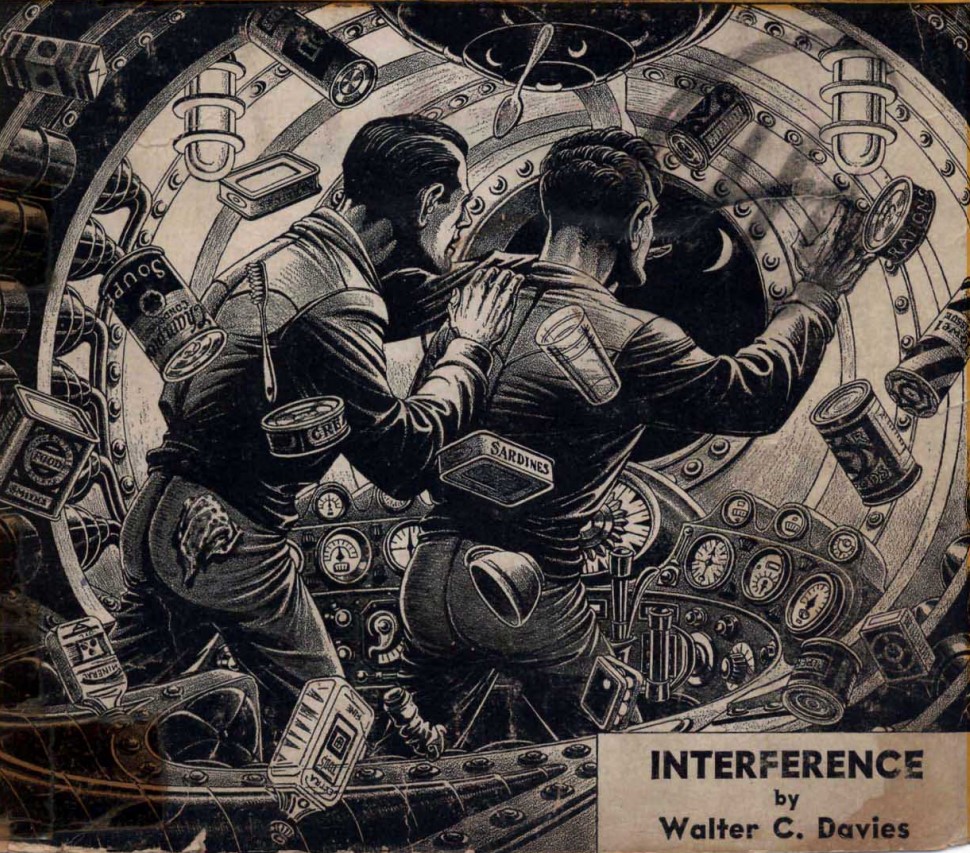
“Misfit” by Robert A. Heinlein

“Misfit” (Astounding, Nov. 1939) was Heinlein’s second published story and his first about space travel. It’s also his first work of juvenile fiction, or what we call YA today. Heinlein renamed FDR’s New Deal Civilian Conservation Corps (CCC) the Cosmic Construction Corps for this future space adventure. I thought that was a really neat idea. And Heinlein created one of his favorite characters, Andrew Jackson Libby, who would reappear in Methuselah’s Children in 1941, and yet again in four of Heinlein’s 1970s and 1980s novels. Eventually, Libby would become a woman, Elizabeth Andrew Jackson Libby, but we won’t get into that for a very long time. Some fans even consider Max Jones of Starman Jones a repackaging of the Libby character, but I don’t.

I never liked the way Heinlein reused his characters because he eventually turned characters I loved into characters I hated. But that’s another subject to deal with in future essays.

The plot of “Misfit” isn’t very complicated. Libby is a young man who we follow into space. Like many of the boys on the ship, Libby experiences space sickness at first but eventually adapts to living in free fall. His crew arrives at a small asteroid called HS-5388, or just Eighty-Eight. Their job is to build habitats and rocket engines into the rock. Their goal is to reposition the asteroid into an orbit between Earth and Mars to make it into an emergency shelter for space travelers.

There’s little conflict or drama in the story. The only surprise in the story is we learn that Libby has a savant’s ability for mathematics, and saves the day when their “computer” conks out. Heinlein calls Libby a lightning calculator and gives him the nickname “Slipstick” – a slang term for a slide rule. In this1939 story, the word computer was not used. They called their computer an “integral calculator.” Boy, wouldn’t Heinlein have wowed us today if he had imagined a handheld calculator instead of a slide rule? (I loved using my slide rule in my math classes back in the 1960s and 1970s. I wish I had kept it.)

This is why I said in my review of “Life-Line” that I thought “Life-Line” was a much better story than “Misfit.” In “Life-Line” Heinlein gets us hooked right away on whether or not Hugo Pinero’s invention is real, and the whole story focuses on that plotline. “Misfit” is a story where this happens, then this happens, and then another thing happens until we reach an end. It’s still a good story, but it doesn’t have a tight plot. Even the dramatic scene of Libby saving the day when putting the asteroid into its new orbit isn’t done with much drama. Still, the “Misfit” is readable and likable, but its deadpan style makes me think of the old TV show Dragnet.

Heinlein had a side to him that just enjoyed explaining how things worked. My favorite part of the story was Heinlein showing us what weightlessness would be like. I thought he got it very right for 1939. And I checked to see if he hadn’t updated the story later, but he hadn’t. I don’t know if any writer back then worked out what living in microgravity would be like. I was very impressed. They call Libby Pinky, I guessed because of his red hair and complexion.

The ship’s loudspeaker blatted out, “All hands! Free flight in ten minutes. Stand by to lose weight.” The Master-at-Arms supervised the rigging of grab-lines. All loose gear was made fast, and little cellulose bags were issued to each man. Hardly was this done when Libby felt himself get light on his feet—a sensation exactly like that experienced when an express elevator makes a quick stop on an upward trip, except that the sensation continued and became more intense. At first it was a pleasant novelty, then it rapidly became distressing. The blood pounded in his ears, and his feet were clammy and cold. His saliva secreted at an abnormal rate. He tried to swallow, choked, and coughed. Then his stomach shuddered and contracted with a violent, painful, convulsive reflex and he was suddenly, disastrously nauseated. After the first excruciating spasm, he heard McCoy’s voice shouting. 

“Hey! Use your sick-kits like I told you. Don’t let that stuff get in the blowers.” Dimly Libby realized that the admonishment included him. He fumbled for his cellulose bag just as a second temblor shook him, but he managed to fit the bag over his mouth before the eruption occurred. When it subsided, he became aware that he was floating near the overhead and facing the door. The chief Master-at-Arms slithered in the door and spoke to McCoy. 

“How are you making out?”  

“Well enough. Some of the boys missed their kits.”  

“Okay. Mop it up. You can use the starboard lock.” He swam out.  

McCoy touched Libby’s arm. “Here, Pinkie, start catching them butterflies.” He handed him a handful of cotton waste, then took another handful himself and neatly dabbed up a globule of the slimy filth that floated about the compartment. “Be sure your sick-kit is on tight. When you get sick, just stop and wait until it’s over.” Libby imitated him as best as he could. In a few minutes the room was free of the worst of the sickening debris. McCoy looked it over, and spoke: 

“Now peel off them dirty duds, and change your kits. Three or four of you bring everything along to the starboard lock.” 

At the starboard spacelock, the kits were put in first, the inner door closed, and the outer opened. When the inner door was opened again the kits were gone—blown out into space by the escaping air. Pinkie addressed McCoy, “Do we have to throw away our dirty clothes too?” 

“Huh uh, we’ll just give them a dose of vacuum. Take ’em into the lock and stop ’em to those hooks on the bulkheads. Tie ’em tight.” 

This time the lock was left closed for about five minutes. When the lock was opened the garments were bone dry—all the moisture boiled out by the vacuum of space. All that remained of the unpleasant rejecta was a sterile powdery residue. McCoy viewed them with approval. “They’ll do. Take them back to the compartment. Then brush them—hard—in front of the exhaust blowers.” 

The next few days were an eternity of misery. Homesickness was forgotten in the all-engrossing wretchedness of spacesickness. The Captain granted fifteen minutes of mild acceleration for each of the nine meal periods, but the respite accentuated the agony. Libby would go to a meal, weak and ravenously hungry. The meal would stay down until free flight was resumed, then the sickness would hit him all over again. 

On the fourth day he was seated against a bulkhead, enjoying the luxury of a few remaining minutes of weight while the last shift ate, when McCoy walked in and sat down beside him. The gunner’s mate fitted a smoke filter over his face and lit a cigarette. He inhaled deeply and started to chat. 

“How’s it going, bud?” 

“All right, I guess. This spacesickness—Say, McCoy, how do you ever get used to it?” 

“You get over it in time. Your body acquires new reflexes, so they tell me. Once you learn to swallow without choking, you’ll be all right. You even get so you like it. It’s restful and relaxing. Four hours sleep is as good as ten.” 

Libby shook his head dolefully. “I don’t think I’ll ever get used to it.” 

“Yes, you will. You’d better anyway. This here asteroid won’t have any surface gravity to speak of; the Chief Quartermaster says it won’t run over two per cent Earth normal. That ain’t enough to cure spacesickness. And there won’t be any way to accelerate for meals either.” 

Libby shivered and held his head between his hands.

Heinlein, Robert A.. Revolt in 2100 (pp. 191-193). Spectrum Literary Agency, Inc.. Kindle Edition. 

You can compare the current Kindle edition to the 1939 magazine edition:

This is pretty amazing when you think that most Americans at the time only knew science fiction from Buck Rogers and Flash Gorden newspaper comic strips, radio shows, and serials. But even in the hardcore science fiction of Astounding Science-Fiction, I just don’t remember reading anything from that era that dealt with this kind of realism. Over the years I’ve paid attention to illustrations of free fall in old science fiction magazines, and one of my favorites is the July 1941 cover of Cosmic Stories.

A fun essay to write for the future would be chronicling the history of how writers imagined weightlessness in space. I think even 19th-century writers knew about it, but I just don’t think any writer dealt with space sickness before. If you know otherwise, leave a comment.

Another example of Heinlein just explaining things is when he tells us how they found the asteroid:

Locating one asteroid among a couple of thousand is not as easy as finding Trafalgar Square in London—especially against the star-crowded backdrop of the galaxy. You take off from Terra with its orbital speed of about nineteen miles per second. You attempt to settle into a composite conoid curve that will not only intersect the orbit of the tiny fast-moving body, but also accomplish an exact rendezvous. Asteroid HS-5388, ‘Eighty-eight,’ lay about two and two-tenths astronomical units out from the sun, a little more than two hundred million miles; when the transport took off it lay beyond the sun better than three hundred million miles. Captain Doyle instructed the navigator to plot the basic ellipsoid to tack in free flight around the sun through an elapsed distance of some three hundred and forty million miles. The principle involved is the same as used by a hunter to wing a duck in flight by ‘leading’ the bird in flight. But suppose that you face directly into the sun as you shoot; suppose the bird can not be seen from where you stand, and you have nothing to aim by but some old reports as to how it was flying when last seen?

Heinlein, Robert A.. Revolt in 2100 (p. 193). Spectrum Literary Agency, Inc.. Kindle Edition. 

Where did Heinlein learn this? Were there popular science books that speculated on space travel back then? Or did he just imagine it? Later on in the story, when they are trying to position the asteroid in its new orbit, we get a lesson on celestial mechanics. I believe Heinlein was a ballistics officer when he was in the Navy, so that makes sense. And I believe he was an amateur astronomer. Heinlein loved to have his characters use mathematics, and I remember Heinlein in interviews telling how he and his wife would get out butcher paper and calculate orbits for his stories.

As a kid, Heinlein made me want to study math and science. I wished I could have been like Kip Russell in Have Space Suit–Will Travel who applied himself vigorously with disciplined self-study. I can say Heinlein made me wish that about myself, but I never did. I took a bunch of math classes, but I only applied myself in a half-ass fashion. I also bought a telescope and read popular science books, but I just never worked hard at learning what Heinlein expected of his characters. As I got older, I even wished I could live my life over so I could be more like the characters in Heinlein’s juveniles. When I retired, I even planned to study math again, and go back to college and get a master’s in computer science. I didn’t. I bought a bunch of math books and realized I had forgotten nearly everything I had once known about mathematics. I got onto the Khan Academy website and started over with third-grade math. By the time I got to six-grade math, I realized it just wasn’t going to happen. But that desire came from reading the Heinlein juveniles back in the 1960s.

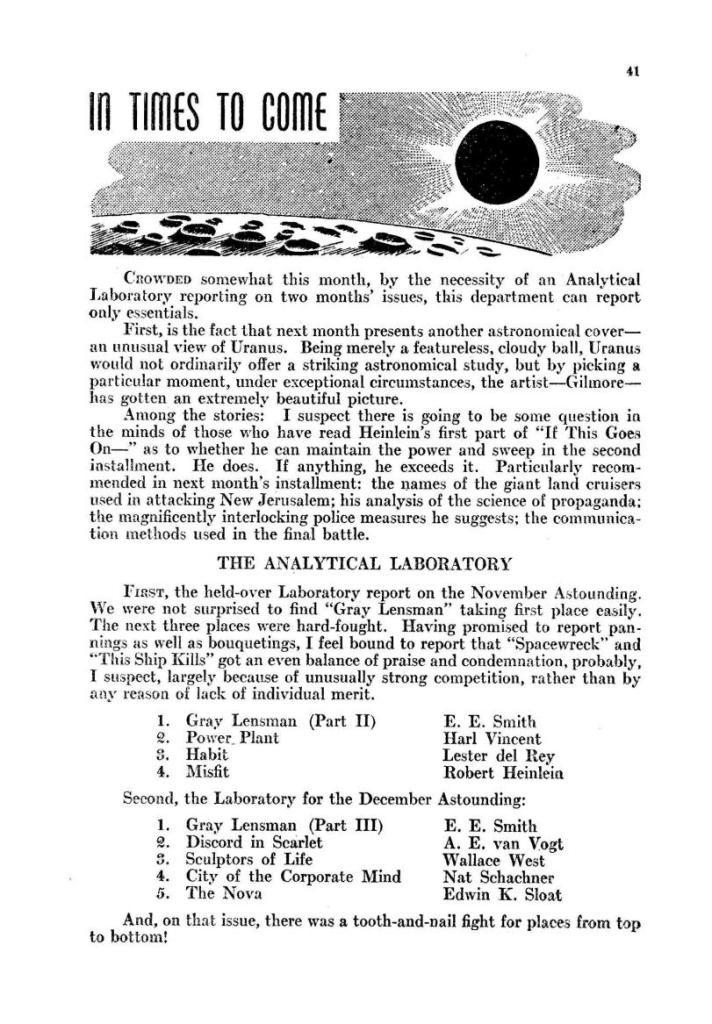
“Misfit” came in dead last in the AnLab (Feb. 1940). But “Misfit” was in an issue with the Gray Lensmen serial. Evidently, the readers back then weren’t impressed with Heinlein’s speculations about space sickness like I am now. Maybe they never imagined space sickness and didn’t want to believe it. One reader in the letter column wrote to tell Campbell there were people who could math in their heads like Libby. But I didn’t find anyone else that got excited about the story.

Campbell does push Heinlein In Times To Come for his current serial If This Goes On—. That story might be considered Heinlein’s first novel, depending on its length in the magazine. When it was revised and slightly expanded for Revolt in 2100, it was considered a novel-length by ISFDB.

James Wallace Harris, 10/1/22

“Life-Line” by Robert A. Heinlein

The contrast is striking to read “Life-Line” right after reading and reviewing For Us, The Living. Did Heinlein hitchhike over to the Iowa Writers’ Workshop for the 1939 Spring semester? “Life-Line” is a well-structured short story told dramatically, attributes sorely lacking in his trunk novel. How did he make such a quantum leap in writing?

“Life-Line” has a simple plot. Dr. Hugo Pinero invents a device that can give the date of a person’s birth and death. It’s based on the idea that every being exists in time as one long 4th-dimensional organism. Scientists think Pinero is a crackpot. When his machine works and causes havoc with the insurance industry they take him to court to get an injunction from using it. Pinero proposes to the court a scientific test which the judge accepts. One insurance CEO ordered a contract killing on Pinero. But before he dies we see one tear-jerking scene where Pinero tests a young married couple. The wife is pregnant. He refuses to tell the couple their results claiming his machine has become misaligned. He tried to keep them from leaving, but they eventually do and are killed outside his office by a speeding car. The scientists finally admit that Pinero’s technique was real when they find he accurately predicted his own death, and they destroy all the test predictions based on their own lives.

Farah Mendlesohn in her book, The Pleasant Profession of Robert A. Heinlein suggests Heinlein modeled his writing on the movies. I can believe that. The dialog in “Life-Line” feels like MGM films from the mid-1930s. It’s easy to picture Hugo Pinero played by Edward G. Robinson. Robinson sometimes played ethnic characters with accents, and Dr. Pinero has the same bellicose pugnacity that Robinson did in his movies. The gangster Mr. Bidwell of Amalgamated Insurance hired to kill Pinero comes across just like Humphrey Bogart in Kid Gallahad, even though Heinlein gives the gangster character just a couple of lines and a few words of description.

“Life-Line” also has several scenes that also remind me of 1930s movies, and they might be a clue to where Heinlein got his Public Argument writing technique I keep seeing in his stories. The story begins with Pinero arguing with a committee from the Science Academy. Next, he banters around with a group of news reporters. This reminds me of more than one Frank Capra film. Next, we see Pinero argue his case with a judge and lawyer for the insurance companies in court. I can see why he uses the Public Argument technique, it provides drama because it’s often used in movies, especially old movies from the 1930s, ones Heinlein should have seen — and studied.

I know when I first read “Life-Line” because in 1966 I bought a little Ace paperback for 40 cents, The Worlds of Robert A. Heinlein. I got the story again in The Past Through Tomorrow in 1967. It was first collected in Heinlein’s The Man Who Sold the Moon in 1950, but that was the year before I was born. By the way, my Baen Kindle edition of The Man Who Sold the Moon / Orphans of the Sky copy has an important missing section, the one where Bidwell hires the gangster. This time I listened to the Brilliance Audio edition of The Man Who Sold the Moon narrated by Buck Schirner — he did a fantastic job with 1930s-style voicing and accents.

To check the August 1939 Astounding edition to the current edition, I listened to the audio version while eye-reading a digital scan of the magazine. For the most part, the story was the same. Heinlein tweaked a few paragraphs to read better, and he changed one date from 1939 to 1951. I’ll try to use this comparison technique whenever I can. I wished I had used it on the few stories I’ve already reviewed.

The first time I read “Life-Line” I didn’t like the story. In fact, I remember being disappointed. I was used to Heinlein juveniles from Scribners and Starship Troopers and Stranger in a Strange Land from Putnam. And I just didn’t like the idea of a machine that predicts when people would die — it didn’t seem scientific. However, over the years, whenever I’ve reread “Life-Line” the story has gotten better and better. And when I listened to the audio version, with the dramatic reading, I’ve been very impressed with how well-written the story is, and how dramatic Heinlein made the scenes. I also thought the dialog was impressive too because it reminded me of MGM movie dialog. “Life-Line” isn’t James Joyce or even Ernest Hemingway, but it’s pretty damn good 1939 pulp fiction.

I just discovered there’s a student film version of “Life-Line.” It’s just now being released. This suggests the story still has impact and validity. That’s great.

“Life-Line” shows Heinlein could write. And write better than the average writer for science fiction magazines at the time. I have to wonder how much editing John W. Campbell did on the story. It seems whenever Heinlein isn’t reigned in, he pontificates. “Life-Line” does have a few short infodumps, but they are legit, fitting within the story’s logic.

I can’t tell what kind of impact Heinlein made with Astounding readers with his first story. He came in second in the AnLab poll, to a Lester del Rey story. Campbell did not single Heinlein out for any special praise in the editorial content, although in the AnLab (Oct. 1939) he did say there were three first-published writers in the August issue. I found two readers in the letter columns that mention the story. One wished for more stories like “Life-Line,” and the other said the story was well-written and dramatic and wished it had been novel length.

Isaac Asimov and Martin H. Greenberg picked “Life-Line” to include in their The Great SF Stories 1 (1939), but that was decades later. Alexei Panshin was rather hard on the story in Heinlein in Dimension. Of Heinlein’s first two stories, he thought “Misfit” the better of the two, and “Life-Line” wasn’t particularly good. I just read “Misfit,” and disagree. It’s a good story, but I think “Life-Line” is much better. It’s more unified. “Misfit” is a bit episodic.

“Life-Line” is not a favorite in the retrospective anthologies, most editors and readers prefer other Heinlein stories. I’m curious if it holds up with young readers today. It has an average of 3.91 stars out of 5 on Goodreads, with 906 readers rating it. 268 gave it 5 stars, and 338 gave it 4 stars. Not bad.

James Wallace Harris, 9/30/22

Sixth Column by Robert A. Heinlein

Sixth Column first appeared in the January, February, and March 1941 issues of Astounding Science-Fiction. For it, Heinlein used the pseudonym of Anson MacDonald, so it’s not considered part of his Future History series. Sixth Column is generally thought of as one of Heinlein’s bottom-of-the-barrel novels. Critics sometimes try to defend Heinlein by pointing out he wrote Sixth Column based on a story given to him by John W. Campbell, Jr., thus transferring some of the blame for this stinker to his editor. Also, it’s often dismissed as a racist Yellow Peril novel that was common back in the 1930s. Even if you ignore the racism, the story itself is silly and unbelievable. The story’s sense of reality is equal to a comic book.

The basic plot is six American servicemen are the sole survivors of an overwhelming attack on the United States that completely destroys all our military. We are occupied by soldiers from an unnamed Asian country, that Heinlein refers to as Pan Asian. The six surviving soldiers were in a hidden mountain bunker doing secret scientific research, and one of them just happens to be smarter than Einstein who can churn out exotic weapons based on theoretical physics. The story is about how they conquered the invaders and freed America.

Heinlein’s Sixth Column falls into the category of invasion literature. These were an early form of science fiction that began in the last third of the 19th century and ran until WWI. In England, the common fear was Germany would take over. But every country had authors that wrote scary stories about invasions from other countries. The War of the Worlds by H. G. Well is considered inspired by the invasion literature genre.

Since Sixth Column was written in 1940, and Japan had been invading countries since 1931, I have to assume Heinlein meant Japan when he wrote Pan Asian. It’s a shame Heinlein just didn’t write Japan and Japanese instead as he typed. It would seem much less racist now, and probably a bit prophetic at the time. Were there legal issues back then?

The Pan Asians who occupied America in this story completely controlled every aspect of Americans’ lives. They only allowed one freedom – the freedom of religion. Heinlein’s six soldiers invent a religion to spread to all the major cities as a cover and then use secret super weapons to defeat the enemy.

Sixth Column is readable, but that’s about all I can say for it. I did think the idea of creating a fake religion was neat. In another serial Heinlein wrote in 1940, “If This Goes On—” he has the U.S. overthrown by a theocracy. I’m reading that one now. Heinlein sure did like to think big in his plotting. The idea of six men repelling an entire invasion was exciting stuff in 1941, at least to pulp magazine readers. Heinlein loved creating characters that were confident in their abilities and could essentially do anything. Heinlein plotted Sixth Column better than Methuselah’s Children, his second three-part serial of 1941. I think that was due to focusing on fewer characters and a smaller scale if you can envision six men fighting off millions being a smaller setting than the events in Methuselah’s Children. But I do since Heinlein’s imagination ran to even bigger whoppers to believe in that story.

But even with this faint praise, I can’t recommend reading Sixth Column, unless you’re like me and studying all of Heinlein’s work.

James W. Harris

Methuselah’s Children by Robert A. Heinlein

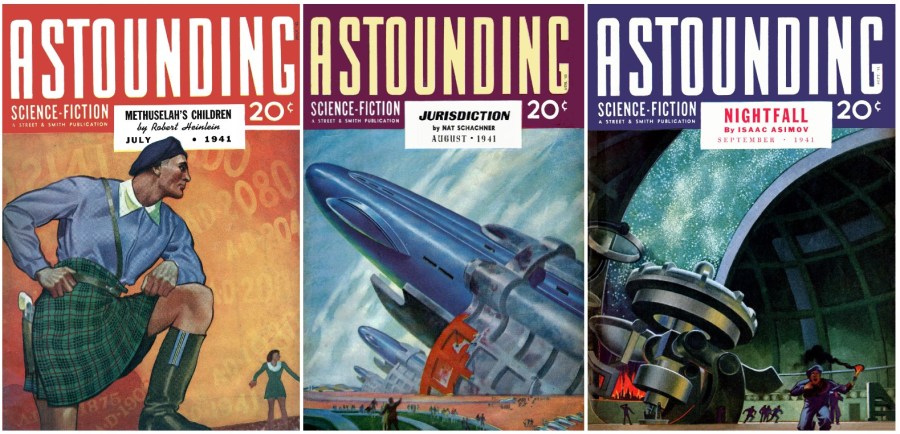
Methuselah’s Children first appeared 81 years ago this summer, in the July, August, and September 1941 issues of Astounding Science-Fiction. In 1948, Erle Korshak gave Heinlein a $200 advance to publish the serial at Shasta Press. The revised and slightly expanded version should have been Heinlein’s third hardback book, but it didn’t get published until 1958. In 1967 Methuselah’s Children was included in The Past Through Tomorrow, Heinlein’s giant collection of Future History stories. The Past Through Tomorrow was widely distributed by the Science Fiction Book Club, so I expect many people have read this novel. Methuselah’s Children was first reprinted in paperback in 1962, having an extensive reprint history.

This past week while convalescing after surgery, I got hooked on reading early Heinlein. I needed reading material I could consume on my iPhone, and I’ve been meaning for years to reevaluate my adolescent love of Heinlein’s fiction. This seemed like a good time, and it made me feel more productive while lying around all day. I’ve finished Methuselah’s Children and The Sixth Column and working on Revolt in 2100. These are Heinlein’s first three novels (depending on how you measure wordage).

I expect to read even more from Heinlein’s pre-war stories. I feel like an academic studying his early work. I used to think that Heinlein had four periods where the stories were distinctively different. I grouped them into the Pre-WWII stories, the 1947-1959 stories, novels from the 1960s, and the later novels. Some of his books from the 1950s I have read many times, and are my favorites. Heinlein’s books from the 1960s I’ve read at least three times each, I think. I read most of the pre-WWII stories only once, except for the more famous anthologized short stories. I’ve read those several times. For his later work, I’ve only read those books either once, or I didn’t finish them.

I’m now realizing that Heinlein changed far less from period to period than I previously thought. A lot of the perceived differences were due to the markets that published the stories. His work at Putnam showed Heinlein at his most verbose. I’m now seeing those personal pet ideas he expounded on at length in his later novels revealed in his earlier works as mere asides. Despite editorial restraint or the limits of length, Heinlein expressed himself one way or another.

Heinlein was incredibly prolific before WWII. One estimate suggested that 20% of Astounding Science Fiction in 1941 was written by Heinlein using his own name or under pseudonyms. After the war, five of those stories were published as novels, even though they were very short, or fix-ups. Most of the famous Future History stories were written during this period. Before Heinlein quit writing to join the war effort in 1942, he wrote five tales that would be published as novels. I’ve read the first and last three times each, but the middle three only once.

  • Beyond This Horizon (1948, Fantasy Press) (Astounding April, May 1942)
  • Sixth Column (1949, Gnome Press) (Astounding, January, February, March 1941)
  • Revolt in 2100 (1953, Shasta) (Astounding, February, March 1940)
  • Methuselah’s Children (1958, Gnome Press) (Astounding, July, August, September 1941)
  • Orphans of the Sky (1964, Putnam) (Astounding, May, October 1941)

When I first started reading Methuselah’s Children I thought I must have first read it when I got The Past Through Tomorrow in 1967. It was considered the last story in Heinlein’s Future History, and the one that was set second furthest in the future. The characters in “Universe” and “Common Sense” (reprinted as Orphans of the Sky) lived the furthest in the future in Heinlein’s fictional universe. When I started writing this essay I remembered borrowing and reading Methuselah’s Children from Homestead Air Force Base Library in 1965 because that library had all of Heinlein’s Gnome, Fantasy Press, and Shasta’s editions. I distinctly remember its cover (see above).

I have not read Methuselah’s Children since then, and I barely remembered it. I can’t say it’s a great story. You can tell Heinlein was just learning how to write a novel. It’s rather episodic, with three main story arcs that go along with being serialized over three issues. And Heinlein hadn’t figured out how to plot a long story yet, nor was he particularly good at developing dramatic scenes. I believe Sixth Column had better plotting, and Revolt in 2100 had some better dramatic scenes. However, Methuselah’s Children is full of exciting science fictional ideas, referencing many of his other early stories that fit within the Future History timeline.

I’m not sure I’d recommend Methuselah’s Children to modern readers, although at Goodreads there were many reviewers who raved about it. Now that I’m rereading old Heinlein I’m also pondering why as I go along.

First, let’s consider the science fictional concepts presented by Heinlein for the readers of 1941.

  • Longevity. The Howard Family (the collective name, there were many surnames) began selective breeding in the 19th century by only marrying spouses that had four living grandparents. By the 22nd century, many of them were living close to two hundred years. The oldest, Lazarus Long, was 213 at the beginning of the novel, and somewhere between 50-75 years older at the end. No one knows for sure because of the time dilation of space travel. In 1941 Americans were still interested in eugenics, but the techniques used to achieve longevity in this story were merely animal husbandry. Heinlein should have known this wouldn’t work because we’ve never bred any long-lived farm animals.
  • Political Utopia. The story is set after the Crazy Years and the Second American Revolution, under a new constitution called The Covenant. Maximum political freedom was guaranteed. However, The Covenant breaks down when the average citizen learns that the Howard Family has longevity and they want to suspend its freedom and torture the Howard Family members into revealing their secret. It’s a shame that Heinlein didn’t flesh out this semi-utopian period.
  • STL and FTL Space Travel. The Howard Family escapes Earth by stealing the sister ship to the one in “Universe” and “Common Sense”. Their ship, the New Frontiers, starts out slow, but Andrew Jackson Libby, a character from Heinlein’s second published story, “Misfit” finds a way to soup up the engines to travel near light speed. Eventually, he learns how to make it go faster than light. That means in two 1941 stories Heinlein explores several ways to achieve interstellar travel.
  • Psychic Powers. Even though the Howard Family breed for longevity they still have birth defects (assumed from all that inbreeding). Heinlein is careful to point out how well they take care of these children. Some of those handicapped offspring had psychic powers, and that figured in the plot in a couple of places. Children with birth defects and psychic powers reminded me of stories by Philip K. Dick from the 1950s and 1960s. Heinlein’s aliens also have various degrees of psychic powers. In one instance, reminding me of Arthur C. Clarke’s stories Childhood’s End and 2001: A Space Odyssey. This is interesting for 1941. SF in the 1950s was known for its ESP stories.
  • Vastly Superior Aliens. The Howard Family refugees first encounter an alien species called the Jockaira, a pleasant, vaguely humanoid people that welcomes them to their planet. Then the Howards meet the real rulers of the planet and it scares the shit out of them. This is very interesting because John W. Campbell supposedly had some kind of unwritten editorial rule that forbade stories with superior aliens. For the rest of his writing career, Heinlein always claimed humans were the meanest, toughest species in the galaxy, but in this story, we run away with our tails between our legs.
  • Lotus Eater Aliens. The next planet has extremely nice aliens. Too nice.

For 1941, this is some impressive science fiction, but is it for 2022? And was the writing all that impressive, even for 1941? Heinlein has a reputation for blazing onto the pulp scene as a far superior writer. I have my doubts in places. This is where I wonder if this story will survive the test of time. Heinlein loved writing stories where people had huge meetings in large halls to argue about their problems using Robert’s Rules of Order. These group meetings happened several times in Methuselah’s Children. To me, this was a cheating kind of infodump. And quite often it allows Heinlein to spout his philosophy using his protagonist. Lazarus Long is a popular character but could be a holier-than-thou know-it-all.

At the beginning of the novel, Mary Sperling is the leader of the Howard Family because of her age. It’s a shame Heinlein didn’t stick with this woman protagonist. Mary was the chairman of the board and the moderator at meetings where the various families send their representatives. But when Lazarus Long admits he’s older Mary gives him the gavel. From then on Lazarus conducts the meetings. Heinlein tries to make him sound like a cross between Mark Twain and Will Rogers, but in my mind, he failed. I never felt Lazarus showed the wisdom that a man of 213 years should have.

Heinlein loved his character Lazarus Long and brought him back in several stories. We’re told Lazarus wears a kilt with a gun (blaster) strapped between his legs. The jokes I could make about that. I was never sure he wore anything besides a kilt, but every chance he gets Lazarus will shuck his skirt. I’ve read that Heinlein was a nudist, and that concept shows up over and over again in his stories. I tried to imagine a hundred thousand naked people in a spaceship in zero-g and it brings out the Puritanical prude in me. The thought of being in a cabin with Lazarus long while floating in free space and being forced to stare at his two guns hurt this story.

Also, Lazarus often acted like he was ready to shoot first and ask questions later. Throughout Heinlein’s fiction, his characters ignore laws and often commit capital punishment for offenses that the law would seldom execute.

Lazarus Long has an ego the size of Texas. I’m sure Heinlein used all the incidents I saw as egotism as a way to prove that Lazarus was a competent man who could do anything. At one point, Lazarus shows how any man with moxie can bully his way through the telephone system to talk to the world leader. I wonder if Heinlein thought he could call up FDR anytime he wanted?

In another story arc, Lazarus steals an interstellar spaceship, buys a giant cargo vessel, and rescues over a hundred thousand people – all by himself. This really hurt the novel because it’s absolutely unbelievable. Methuselah’s Children would have been a much better story if the Howard Families totaled fewer than a thousand people. At one point Lazarus is moderating a meeting of all hundred thousand using televisors. That just seemed ridiculous to me. Try imagining Donald Trump interacting with a hundred thousand of his fans concurrently who wanted their say too.

And maybe Lazarus Long isn’t Heinlein, but I imagine this character is the person Heinlein wished he could be. Ditto for Jubal Harshaw, and all the other characters people think of as standing for Heinlein. The William Patterson biography of Heinlein hints that Heinlein was an unpopular cadet at the Naval academy and that he was very thinned-skinned.

Heinlein fans have often accused critics of not understanding that writers aren’t their characters. But for Heinlein, I believe he created a dominating character that he wished he could be. For some readers, this works. I’m guessing they’d like to be those characters too. And maybe I did too when I was a kid. Now, Heinlein’s supermen are unappealing, to say the least.

Still, I found Methuselah’s Children to be very readable and thought-provoking. The way the story handles the resentment over genetically enhanced humans was done better with Nancy Kress and her novel Beggars in Spain, so I’d recommend it before Methuselah’s Children.

In 1941 Heinlein was dealing with several ways of achieving interstellar travel. That was amazing at a time when most Americans pictured space travel like Buck Rogers and Flash Gordan series, where alien planets seem no further than the Moon. Heinlein worked to get his readers to imagine the immense distance between the stars and the limitations Einstein had put on space travel. Unfortunately, all that has been done countless times since. So I don’t know if young readers need to dig this far back in science fiction to find rewarding stories on those science fictional topics.

My main enjoyment in reading Methuselah’s Children is finding all the easter eggs linking to earlier Future History stories. Also, I liked that Heinlein kept imagining the United States being overthrown by various other forms of government. Even though I believe this 81-year-old story is unworthy of future pop culture recognition, it still entertained me because I’m a life-long Heinlein fan.

But I’m also seeing that I never really paid attention to Heinlein’s philosophy and politics. What mattered to me were the science fictional ideas. When I was young I wanted Heinlein to be read and loved by everyone. I wanted him to become a classic author like Charles Dickens. That just isn’t happening. If 10,000 novels are published every year, 99.999% of them will be forgotten, leaving about ten to fight for a slot in our long-term pop culture memory. If you look at Wikipedia’s list of 1941 fiction, Methuselah’s Children is there (probably because of an editor who is a Heinlein fan), but so are a bunch of books already forgotten. It’s funny, but from the list, the most memorable pieces of 1941 fiction for me were Mildred Pierce by James M. Cain and “Nightfall,” by Asimov. If we look at Wikipedia’s remembered films of 1941, I see far more that have retained some pop cultural vitality – especially Citizen Kane.

People probably wonder why I obsess over remembering the past, worrying about what will be remembered and what won’t. I’m just fascinated by what history and world culture retain from pop culture. What works of art can speak the furthest across time.

I started reading Heinlein when I was twelve, so maybe I’m now finalizing the project twelve years before I die. I’m seeking both closure and exorcism. When I retired I got heavily into reevaluating my past, but I’ve been doing that for a decade and I realize I don’t want to spend my last years looking backward. I want to get back to thinking about the future.

James Wallace Harris, 9/11/22

Red Planet by Robert A. Heinlein

Why read an old science fiction novel? Maybe a friend recommended it. Or maybe you discovered an author you like and you’re reading all of their books. Or it was on a list of great science fiction novels. Or a YouTuber reviewed it. Maybe even, it was assigned in a class. In my case, and I think it’s true of most people my age, we’re rereading old SF novels we loved in our youth.

A better question to ask: Which old science fiction novels should we read? The obvious answer is the true classics. But what makes a book classic? I once calculated there were less than one hundred famous books from the 19th century that are regularly read today. Scholars and fans of 19th-century lit are familiar with more titles but I’m talking about the average bookworm. I’m going to assume as the 21st century progresses, we’ll collectively forget about most of the science fiction published in the 20th century.

I’m reading and rereading old science fiction because of nostalgia and to fill in the gaps in my knowledge about 20th-century science fiction. But as I do this I’m thinking about which books might survive long term. Doing that requires analyzing books for their various qualities. One way to do that is to recall what made me love a book then and try to figure out why it might be loved or hated today.

If I was thirteen years old today and read Red Planet by Robert A. Heinlein which was first published in 1949, would I love it like I did when I read it at thirteen in 1964? I’m not sure I can answer that at 70 because my mind is clouded with nostalgia. Probably any 13-year-old today would laugh at Heinlein’s attitude toward women. But would kids today, especially those science-savvy kids, dismiss the book because Heinlein has Mars populated with life, even with beings more intelligent than humans? Or would they forgive him in the same way we forgive 19th-century writers like Jules Verne, and assume Heinlein was from some pre-scientific dark age and just didn’t know better?

Would the core story in this 1949 science fiction novel still be entertaining to any reader in 2022? People still find Journey to the Center of the Earth immensely entertaining even though they know Verne was full of lala regarding his science.

Red Planet was immensely appealing to me in 1964. It was about a boy, Jim Marlowe, and his friend Frank Sutton, living in a colony on Mars. Jim also had a pet Martian “rounder” that is somewhat intelligent and could speak some English. Because Mars is so cold the colonists must migrate between the south and north to avoid Martian winters. The plot involves Jim and Frank going away to boarding school and learning the corporation that owns the colony secretly wants to end the practice of migration to save money. Jim and Frank sneak away and travel across the Martian landscape to warn their parents, which eventually causes the colonists to revolt against the corporation. The plot also deals with the Martians and the conflict of intelligent species, so it’s very exciting.

In 1965 with the Mariner IV flyby probe we learned that Mars was much closer to being like the Moon than Earth and there would be no advanced life forms found there. Ever since then science fiction writers have been writing quite differently about Mars. Some readers felt NASA invalidated all the older science fiction about Mars, and some readers didn’t mind at all. I wonder what young readers growing up in the 21st century think when reading such stories. I know they are often quick to reject stories for woke reasons, and that’s understandable. I sometimes wonder if they ignore the less evolved attitudes of our ancestors, and the science we know about Mars, could older stories gain fans just because of their storytelling virtues?

I can overlook bad science and some lack of wokeness. I even wrote an essay – “I Miss Martians” because I get a kick out of stories where the solar system is full of life and intelligence. But I remember a time before NASA’s probes when many people hoped that would be true. Will readers growing up after that time feel the same way? Is The War of the Worlds still a popular book with young readers?

Books are like people, they survive death in the memories of folks who loved them. But as those people die, who will keep the memories going? History keeps the memory of significant people alive. For a book to keep being read requires a similar kind of historical significance.

Red Planet was the first Heinlein story I read. That was back in the autumn of 1964 just before I turned thirteen, and before Mariner IV. My eighth-grade English teacher required us to read three books for each six-weeks grading period. Red Planet was on her approved list, and maybe the only science fiction title. I wished I remembered her name because I’ve always been thankful to her for introducing me to Heinlein. By the end of 1965, I believe I had read all of Heinlein that had been published in paperback and hardback up to that time.

The Heinlein juveniles won library awards and were recommended for young adults. In the late 1940s when few science fiction writers got published in hardback, Heinlein sold his young adult novels to Charles Scribner’s Sons, the publisher of Ernest Hemingway, F. Scott Fitzgerald, and Thomas Wolfe. After WWII Heinlein also broke into slick magazines with several SF stories published in Saturday Evening Post, and he even had a Hollywood movie, Destination Moon, made in 1950. And I have met countless people on the web testifying how much they loved the Heinlein juveniles growing up. I think they are why those twelve books stay in print. But after they die, do those twelve books have any literary or historical significance to keep them in print?

Heinlein’s words had a certain amount of respect around the time I was born in 1951 but I’m not sure his same words would be respected today. While liberals shame-censor books with woke concerns and conservatives seek to actually have books banned from school and public libraries I’m not sure how the books I loved as a kid would be judged today.

Red Planet made a great impact on me as a kid. Conservatives today would probably completely approve of Red Planet — the only fault they might find in it is I grew up to be a liberal. I’m afraid my liberal friends would not approve of this novel because Heinlein had a completely 1940s attitude towards the role of women in society. But his attitudes didn’t rub off on me because I completely embraced feminism in the 1960s. I did wince at all of Heinlein’s patriarchal sentiments when I reread Red Planet this weekend. What’s strange is just a few years later, in the 1950s Heinlein changed his attitude completely toward what jobs women could hold. Wonder what made him change? And should we retroactively forgive him for his 1940s attitudes?

I’ve wondered if Heinlein’s third wife, Ginny, changed Heinlein’s mind about women. Or did his science fictional instincts make him ask: What if women had the freedom to be who they wanted? In the 1950s Heinlein made women rocket scientists, spaceship pilots, and combat soldiers. He put them in leadership positions. Did he think of that himself? Or were there feminists in the 1950s who changed his mind? Is a feminist change in SF significant enough historically to keep Heinlein’s 1950s books in print?

My favorite part of Red Planet is the Martians. They appear to be the same Martians Heinlein uses in his 1961 novel Strange in a Strange Land. However, they don’t seem to be the same Martians in his 1956 novel, Double Star. And there’s even a recursive SF joke in Red Planet. Willis turns out might be a princess of sorts, bringing in an Edgar Rice Burroughs allusion. In Red Planet, the Martians have a ceremony with water and call Jim their “water friend” but in Strange in a Strange Land, Mike undergoes the same water ceremony and is called a “water brother.”

In other words, I don’t care if the real Mars is lifeless, but it’s amusing to see how Heinlein gave Mars an intelligent species for his books. Alan Brown in his review of the novel said he thought Stranger was actually a prequel to Red Planet. If Stranger in a Strange Land stays in print, will it help Red Planet be remembered by science fiction scholars as a footnote?

Actually, many themes that Heinlein covered in other books are touched upon in Red Planet. Heinlein was a nudist, and the men in this novel only wear jockey shorts on the inside and describe women wearing what Earth women would wear to the beach. A lot of cheesy 1950s science fiction movies pictured such skimpy attire for the future. Will some science fiction books be remembered for their bad visions of fashion of the future? I doubt Red Planet has enough of those.

The revolution in Red Planet has a lot of similarities to the revolution in The Moon is a Harsh Mistress. Many of Heinlein’s stories involve revolutions or overthrowing some kind of tyranny. And they often have a big committee meeting where everyone argues and abuse Robert’s Rules of Order. And all these stories involve innocents being killed to ramp up the emotions and justify the revolutionaries using deadly force. Heinlein loved replaying the American revolution. I’m pretty sure MAGA people, and even preppers would find Red Planet appealing for its politics.

What’s funny is Jim Marlowe throws fits over minor school rules claiming it violates his freedom. Heinlein loved the Navy Academy and Jim would have been considered a whiner there. The way freedom is defined in Red Planet is the same kind as people who didn’t want to wear masks during the pandemic defined it. Heinlein also spends a fair amount of time promoting gun ownership in this book. He also promotes a kind of frontier justice that many conservatives today would love.

I was disappointed with this rereading of Red Planet because Heinlein failed to make his Martian colony realistic, or even spend much time on how a colony would be built. Heinlein saw Mars as a solution to Earth’s overpopulation and a place for people wanting to be free to be pioneers. Both are absolutely ridiculous assumptions.

The Martians in Red Planet have the same ability to make people disappear as Valentine Michael Smith did in Stranger in a Strange Land. I find that concept extremely unethical in the way Heinlein uses it. It gives his characters a god-like power which Heinlein assumes his characters know what’s right and wrong and can make god-like judgments. In more than one novel Heinlein has stated that bad manners should be a capital offense. Again, this will probably appeal to the MAGA crowd.

In recent decades I’ve developed a theory that Heinlein wanted to be another Ayn Rand, especially after the success of Atlas Shrugged. He switched from writing short YA novels to long preachy adult novels after Ayn Rand became famous. And Heinlein promoted a similar kind of political philosophy. Before he died, Heinlein said in many places he wanted to be remembered for three novels: Starship Troopers, Stranger in a Strange Land, and The Moon is a Harsh Mistress. I see those as his Ayn Rand novels, but the same political sentiments exist in Red Planet. I believe Heinlein knew most of his novels would be forgotten in the 21st century, and he intended to winnow out the ones he wanted and why. I never liked Heinlein’s politics, so as I’ve gotten older, I jettison his 1960s and later novels too. I love a lot of his 1940s work, but I know they have woke problems. And from 1960 on, they have had political and literary problems. That leaves me with his 1950s work. And as I reread it, I might revise my opinions on those stories too.

Heinlein also likes writing stories about advanced aliens judging humanity. Red Planet parallels Have Space Suit-Will Travel in this regard. I’m not sure this theme is strong enough in Red Planet to ensure its long-term survival.

I still enjoyed reading Red Planet this weekend. I’ve read it several times over my lifetime. It’s a nostalgic favorite, but not a top favorite. It’s too quaint for modern readers, but I don’t think it offers enough historical or literary value to last. And I can see why it would offend many readers.

When I was young I loved Heinlein’s books so much that I thought they would become classics, but I doubt that now. I wanted Heinlein to be the H. G. Wells of 20th-century science fiction. I’m starting to think he might be remembered like Edward Page Mitchell.

James Wallace Harris, 8/23/22

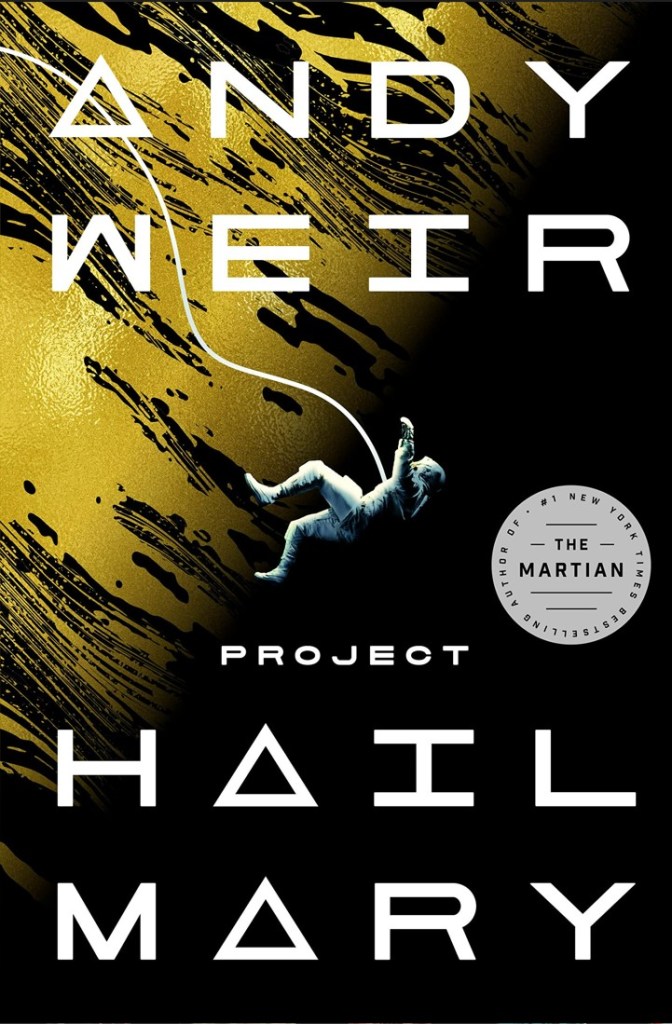
Project Hail Mary by Andy Weir

All people crave romance and sex, accomplishments and adventures, possessions and travel. Most of us settle for marriage and work while living our fantasies out vicariously in fiction. We use books, TV shows, movies, video games, or VR as substitutes for our desires. When fiction fails to satisfy we dine out, party, exercise, or travel. What we really want is to live a different life.

Knowing this should enlighten us about the fiction we choose. Are the stories we love most the ones we wished we were living?

Andy Weir’s latest book Project Hail Mary, left my eyes watery and my nose runny while listening to the last chapter on audio. I loved it. Is that the life I wished I was living? At 70, I know it’s an absurd fantasy and should answer that question with no. But when I was a teenager I would have said yes with great enthusiasm.

Nowadays, few science fiction books move me like that. And, I have to ask myself why. Did Project Hail Mary impact me in the same way the Heinlein juveniles did in the 1960s when I was twelve? Getting close to the end of life, I’m not sure I have much of a sense of wonder left, at least not the kind I had when reading science fiction in that golden age of being young.

When I discovered science fiction sixty years ago almost every story blew my mind with far-out ideas, giving me a tremendous sense of hope for the future, especially for the possibilities for my personal potential. Now, that I’m living in the future, with what little potential I have left, I see science fiction from a different vantage.

Project Hail Mary is one hell of a hopeful book and I enjoyed the hell out of it. I highly recommend reading it. If I had read it in 1964, or if I was 12 years old today, it would have made me a true believer in the science fiction faith. This week I read Weir’s novel and forgot about the world we see every evening on the NBC Nightly News, and I entered into a wonderful virtual reality created by Andy Weir’s skillful worldbuilding with words.

The entire time I listen to Project Hail Mary I marveled at Weir’s storytelling skills. He blended many of my favorite SF themes into an enchanting first-person narrative. Weir obviously imagined his novel as a movie, creating a lovable hero that will save the Earth. For some reason, science fiction blockbusters always seem to put Earth in final jeopardy. And many of them love having an average guy overcome an endless series of obstacles. Kurt Vonnegut gave some famous advice to would-be writers. He said: create a likable character and then do mean things to them. Andy Weir gives Ryland Grace a long series of impossible problems to solve.

The story begins with Ryland waking up in a strange hospital bed, not knowing who he is, where he’s from, or where he’s at. This is a neat storytelling trick. The novel breaks down into two tracks: the now and the past. Amnesia is the perfect excuse for creating flashbacks. Normally, I hate flashbacks, but Weir’s gimmick made me look forward to them.

I don’t want to tell you much about the novel and I want to beg you to get the audiobook version. The narrator acts out each character with a different voice, including accents for different nationalities. For the alien, Rocky, who speaks in musical tones which the audiobook plays, the narrator creates a charming accent for his English. The audiobook should have way more impact than just reading with your eyes.

Looking at reviews on Facebook, Goodreads, and Amazon, some readers loved this novel, while many others complain it’s too tedious. Weir tells this story in one long series of problems that Ryland Grace solves, many of which involve science. I assume the readers who love this story are problem solvers. If you’re not, this book might not be for you.

Ryland Grace is the ultimate competent man who can do everything. This character attribute is why I loved the Heinlein juveniles as a kid. It’s why I also loved the recent Bobiverse books. That’s one of my big personal fantasies, being a generalist that knows everything and can do anything. I’m not. I’m half-ass at doing a lot of things, and I vaguely know a little about a lot.

Ryland Grace is the modern manifestation of Tom Swift. That might be another clue for you if you’re thinking about reading this book.

Another fantasy Project Hail Mary tunes into is being alone in the world. I love the last man on Earth type stories, the Robinson Crusoe types. Ryland Grace is alone in space for a lot of this story. He even meets his Man Friday. (I hope I’m not giving too much away.)

Ryland Grace is the hero that saves Earth, and that’s one fantasy this book promotes that’s not mine. I don’t like attention. However, because of the way Andy Weir presents Ryland Grace’s achievements, I didn’t feel getting attention was a theme of this story. In flashbacks, we learn that Ryland Grace loved being a junior high school teacher who enjoyed promoting science with his students. That’s another theme that Heinlein and Weir are into that doesn’t resonate with me, but I imagine it will for teachers. Project Hail Mary would be a great book to teach in an English or science class.

Now to the negatives – which I just ignored because I was enjoying the story so much. Ryland Grace pulls a rabbit out of the hat every time, and his mental abilities are unrealistic. Plus, the invented science for this story is too good to be true. If people love Superman for his fantasy physical feats, Ryland Grace is a Superman of intellectual feats. In other words, the reality of this story is closer to a comic book than literary fiction.

That brings us back to my original psychobabble. Why do we choose the fiction we do? Why do we love some stories way better than others? Do the same themes appeal to us our whole life, or do they change as we age?

The Heinlein juveniles made the biggest impact on me of anything I read as a teen. That’s because I wanted to be like the characters in those books, and I wanted to grow up and live adventures similar to those in the stories. I wanted those fantasies to become real.

I can’t possibly believe that at 70. I’m a great deal more aware of reality now. I shouldn’t buy into anything in Project Hail Mary. I should be too old to enjoy it, but I did. A simple answer is I know too much about reality, and yet, I loved reading this book because it help me escape from reality that’s becoming all too harsh and hard. And that might have been the reason I loved science fiction as a kid too. The 1960s were tough times for anyone to grow up in, and I had feuding alcoholic parents who dragged me and my sister from state to state. That made things worse. Is it any wonder I wanted a science fictional fantasy to be real? Is it any different today?

Project Hail Mary is not a young adult novel, but it has that kind of appeal. As a kid, I knew science fiction was fantasy but reading science fiction made me hope that reality would become more like science fiction. It didn’t. We have science-fictional technology, but not science-fictional lives. That’s what we wanted. That’s what I wanted then, and now. And I can only find that life in books, books like Project Hail Mary.

James Wallace Harris, 8/7/22

The Challenge of Writing a Significant Time Travel Tale

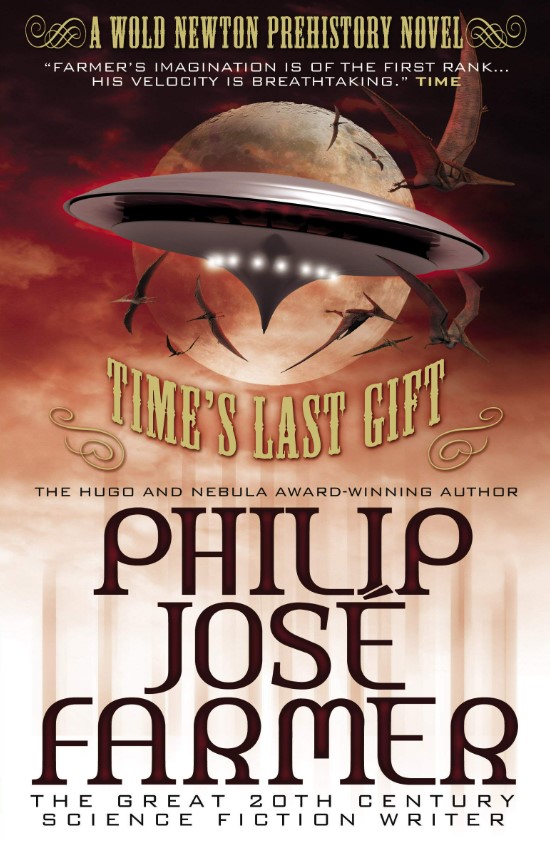
My aim is to review a time travel novel, Time’s Last Gift, by Philip José Farmer, but I need to explain my attitude towards time travel stories before I can pass judgment. I bought Time’s Last Gift because I read on the cover blurb that four scientists from the year 2070 travel back to 12,000 BC to study the Magdalenian culture. Since I’ve recently read a number of books on prehistory that plot appealed to me. I even read a large book just on locating the origin of the people who produced the proto-Indo-European language.

Within Time’s Last Gift, one character, Robert von Billmann is obsessed with finding the people who created the Proto-Indo-Hittite language. If you’re not interested in pre-history or the origins of language you might not want to bother with Time’s Last Gift – unless another factor appeals to you, but I want to wait and mention that after the spoilers warning. Let’s just say that John Gribardson, who was made leader of the expedition at the last minute has a very interesting backstory.

Does Time’s Last Gift stand on its own as a solid story and as a good addition to the time travel theme despite any details related to actual history or literary plot gimmicks? To me, a worthy time travel story has to add something different to the theme, otherwise, it’s just a romance, thriller, or historical novel that jumps around in time.

There have been countless science fiction books about time travel, but for me, I find very few of them worthy of using the theme. Most throw their characters into the past or the future and develop a story about that new setting. What I love is a time travel adventure that also explores the wonder of time and time travel. H. G. Wells set the bar very high with The Time Machine in 1895. I’m not sure any work has ever surpassed it for its sense of wonder.

There are so many time travel stories that Michael Main has created The Internet Time Travel Database. Town & Country Magazine listed their top 35 time travel books but only three of my top favorites make their list. Read This Twice found 92 favorite time travel books, and they do list many of my favorites. About Great Books lists 30-time travel books they think are great, and seven of my favorites are there, but I don’t consider many of those books really time travel stories. But that brings up another issue.

What is time travel? Replay by Ken Grimwood is one of my all-time favorite novels, but does Jeff Winston time travel? He repeats his life over and over. I call such fiction time loop stories. Stories such as The First Fifteen Lives of Harry August by Claire North, and The Midnight Library by Matt Haig are really time loop stories too, which I consider a different theme than time travel stories. I’ve written about it before.

Are such literary classics as The Time Traveler’s Wife, Kindred, Slaughterhouse-Five, A Christmas Carol, and Woman on the Edge of Time really about time travel? Don’t they just use the gimmick of time travel to reveal deep characterization or explore social issues in a clever way? These are great novels, but I don’t really want to lump them into the kind of science fiction novel I’m pointing to. Nor do I want to consider all the novels that use time travel to hook people up romantically.

Real science fiction about time travel should make us think about the nature of time travel. Time’s Last Gift does do this. Time travel has always been plagued by paradoxes, but I believe Farmer has found a neat way around them. If a time traveler goes into the past and changes the future, it’s already happened. Whatever exists now, whether affected by time travel or not, is what is. Speculations about what might be changed are no different from what was changed. If a time traveler shows up in 12,000 BCE there was never a 12,000 BCE without a time traveler. Of course, that means everything that happens is fixed. Or is it? Does this theory about time travel require predestination? It could mean everyone has free will, but whichever way history plays out it only plays out once.

Most of Time’s Last Gift is about living in 12,000 BCE. The four scientists immediately befriend a small tribe of humans and learn their language. John Gribardsun even wears their clothing and hunts with their weapons, although he often uses his rifle when necessary to help feed the tribe. The main conflict of the story deals with the two scientists who are married, Rachel and Drummond Silverstein, and their breakup. Farmer suggests that time travel has a psychological effect, like a larger case of jet lag, and it wears on three of the scientists. Gribardsun seems immune. In fact, he thrives in the past, and his vitality attracts both Rachel and the young women of the tribe. Much of the novel is about whether or not Drummond is out to kill Gribardsun because of jealousy. I didn’t care for this part of the story. It felt like a contrived conflict to move the novel along. However, the story is very readable and kept me reading.

Beyond Here Lie Spoilers

In the 1950s Philip José Farmer wrote some very innovative science fiction stories – “The Lovers,” “The Alley Man,” “Sail On! Sail On!” and others. Then he created two series that were fairly successful, the Riverworld series and The World of Tiers. Farmer won the Hugo award for best novel for the first Riverworld story, To Your Scattered Bodies Go (1971). I loved that novel when it came out because the main character was Sir Richard Francis Burton, the 19th-century explorer, and translator. And I loved the second book, The Fabulous Riverboat (1971) because it featured Mark Twain. I had read biographies of both men and that made me partial to those Farmer’s novels.

Over the decades I have come to feel that using a famous historical person as a character in a novel is a cheat, a way to sell books. But I also consider writing book series as a crutch for writers. For the rest of his life Farmer mostly churned out books for various series, and they were just so-so. He later refined the famous person gimmick by switching to writing about famous fictional characters, and this is where Time’s Last Gift comes in. John Gribardsun is Tarzan. It’s never said within the novel, but I guess it fairly quickly. If you’ve ever read a Tarzan novel, Time’s Last Gift feels like one and could have been Tarzan’s Time Machine.

There’s nothing wrong with book series, they do help writers to pay bills, but each book feels like just another episode in a TV series to me. If you love a series, that’s great. But for me, usually, only stand-alone novels can be great.

I assume Farmer didn’t use the name Tarzan in the book because of being sued by the Edgar Rice Burroughs estate, but ISFDB even lists Time’s Last Gift among the Tarzan novels. Philip José Farmer wasn’t the only writer to continue the character. More importantly, it’s part of Farmer’s Wold Newton series where he brings many famous characters from literature into the real world. If you really like this kind of publishing gimmick, then Time’s Last Gift might excite you.

I find the Wold Newton idea fascinating in conception, but lackluster in execution. It capitalizes on the readers’ love of famous books and characters and I consider that exploitation. Heinlein did the same thing in his later books bringing back his own favorite characters and tieing them into his favorite fictional worlds. The idea is neat, but again, the execution was horrible.

As a time travel novel, Time’s Last Gift is mediocre – readable and somewhat interesting. The plot moves along well enough. The John Gribardsun character is appealing but his adventures back in 12,000 BCE aren’t that significant. If you enjoy the idea that it’s an alternate origin story for Tarzan, and Farmer makes him immortal, then you might enjoy the book more.

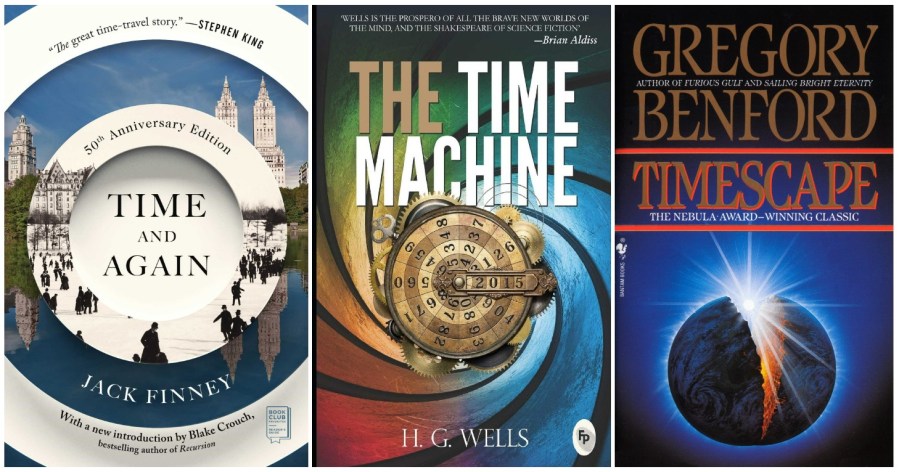
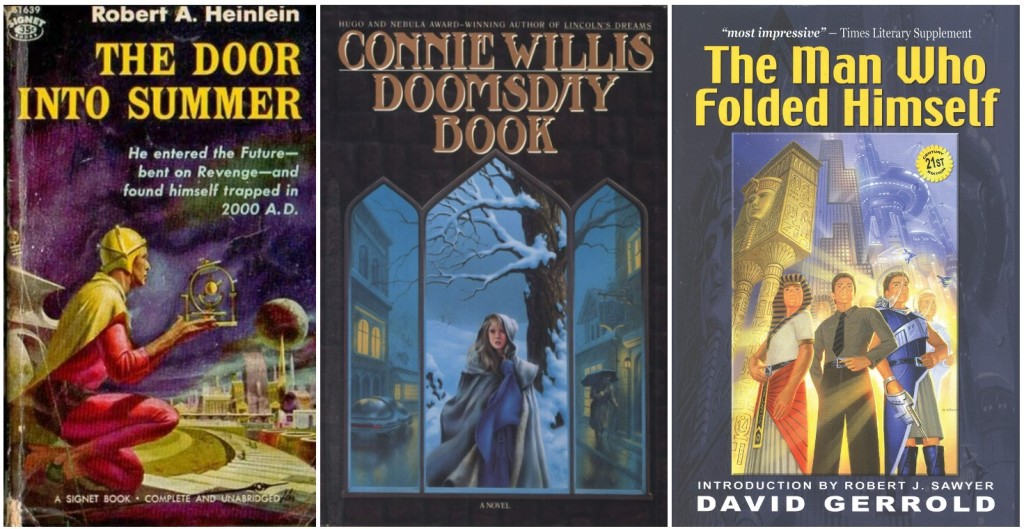
I judge time travel stories by how creative they are at dealing with time travel. For example, Heinlein’s “All You Zombies—” uses time travel and gender reassignment in a unique way. David Gerrold uses The Man Who Folded Himself to allow a time traveler to really get to know himself. Jack Finney in Time and Again used historical photographs to enhance his novel. Kurt Vonnegut combined memoir and fiction brilliantly. Connie Willis has explored both drama and comedy in her time travel novels. Of course, Wells illustrated both evolution and cosmology to his 19th-century readers. Wells inspired the Dying Earth genre and the idea that humanity will spin off different new species. Olaf Stapledon ran away with that idea with his novel Last and First Men.

With time travel stories, writers need to go big or go home. Philip José Farmer knew this. This is why he tacked on the Wold Newton afterward in a 1977 later edition. If you think Wold Newton is cool, then that might make Time’s Last Gift a good time travel story. If not, you might want to pass on it.

Here's a list of my favorite time travel stories.

1895 - THE TIME MACHINE by H. G. Wells
1934 - "Twilight" by John W. Campbell
1935 - "Night" by John W. Campbell
1941 - "Time Wants a Skeleton" by Ross Rocklynne
1941 - "By His Bootstraps" by Robert A. Heinlein
1943 - "Mimsy Were the Borogoves" by Henry Kuttner and C. L. Moore
1946 - "Vintage Season" by Henry Kuttner and C. L. Moore 
1951 - "I'm Scared" by Jack Finney
1952 - "A Sound of Thunder" by Ray Bradbury
1952 - "Hobson's Choice" by Alfred Bester
1953 - "Who's Cribbing" by Jack Lewis
1956 - "A Gun for Dinosaur" by L. Sprague de Camp
1956 - "The Man Who Came Early" by Poul Anderson
1957 - THE DOOR INTO SUMMER by Robert A. Heinlein 
1957 - "Soldier from Tomorrow" by Harlan Ellison
1958 - THE TIME TRADERS by Andre Norton
1958 - "Poor Little Warrior!" by Brian Aldiss
1958 - "The Ugly Little Boy by Isaac Asimov
1958 - "The Men Who Murdered Mohammed" by Alfred Bester
1959 - "All You Zombies---" by Robert A. Heinlein
1964 - FARNHAM'S FREEHOLD by Robert A. Heinlein
1964 - "When Time Was New" by Robert F. Young
1965 - "Traveller's Rest" by David I. Masson
1966 - "Behold the Man" by Michael Moorcock and BEHOLD THE MAN (1969)
1967 - "Hawksbill Station" by Robert Silverberg
1968 - THE LAST STARSHIP FROM EARTH by John Boyd
1969 - SLAUGHTERHOUSE-FIVE by Kurt Vonnegut, Jr.
1970 - TIME AND AGAIN by Jack Finney
1970 - THE YEAR OF THE QUIET SUN by Wilson Tucker
1971 - DINOSAUR BEACH by Keith Laumer
1973 - THE MAN WHO FOLDED HIMSELF by David Gerrold
1976 - "The Hertford Manuscript" by Richard Cowper
1967 - "Infinite Summer" by Christopher Priest
1980 - TIMESCAPE by Gregory Benford
1982 - "Firewatch" by Connie Willis
1985 - "Sailing to Byzantium" by Robert Silverberg
1988 - "Ripples in the Dirac Sea" by Geoffrey A. Landis
1992 - DOOMSDAY BOOK by Connie Willis
1995 - THE TIME SHIPS by Stephen Baxter
1995 - FROM TIME TO TIME by Jack Finney
1998 - TO SAY NOTHING OF THE DOG by Connie Willis
2003 - THE TIME TRAVELER'S WIFE by Audrey Niffenegger

Time Travel Anthologies

The Mammoth Book of Time Travel SF and The Time Travel MEGAPACK is currently 99 cents at Amazon for the Kindle edition.

James Wallace Harris, 7/30/22

“A Galaxy Called Rome” and Galaxies by Barry N. Malzberg

I’ve been reading recursive science fiction lately, and one of the most famous recursive science fiction stories is Barry N. Malzberg’s “A Galaxy Called Rome.” Recursive science fiction is science fiction about science fiction. Sometimes this is a story that mentions science fiction, sometimes it’s a story about science fiction writers, their fans, and science fiction conventions, and sometimes it’s in-jokes about the genre, other times recursive science fiction is about the writing of science fiction, and that’s the case with “A Galaxy Called Rome.”

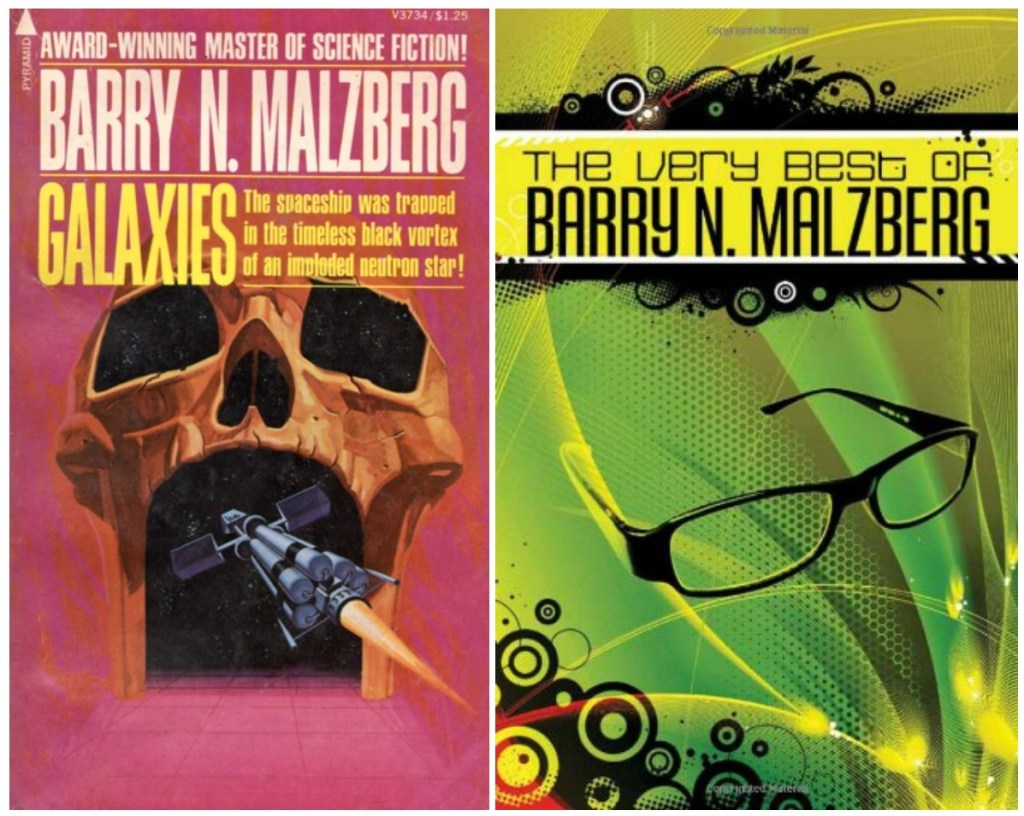
“A Galaxy Called Rome” has been reprinted often you can find it in these anthologies and collections. I read it in the anthology Inside the Funhouse: 17 SF Stories About SF edited by Mike Resnick in 1992. I highly recommend that volume if you can find it, but it was only published once by Avon. Probably the cheapest collection of Malzberg’s stories is The Very Best of Barry N. Malzberg because the Kindle edition is only $4.99. However, Malzberg expanded “A Galaxy Called Rome” into a short novel, Galaxies, and it’s available for $1.99 for the Kindle edition at Amazon.

Malzberg is known for his recursive science fiction, especially since he seems to have experienced a great deal of existential angst over being a science fiction writer. NESFA even came out with a collection of his recursive SF called The Passage of the Light: The Recursive Science Fiction of Barry N. Malzberg.

“A Galaxy Called Rome” is a novelette composed of 14 short chapters. It first appeared in the July 1975 issue of F&SF and has been anthologized a number of times. It is probably Malzberg’s most famous work of short science fiction. 

Malzberg expanded the same story into 49 chapters for a 1975 short novel version retitled Galaxies. Malzberg gained attention for a handful of science fiction novels in the first half of the 1970s. He won the John W. Campbell Award for Beyond Apollo but got a fair amount of recognition for Galaxies, The Falling Astronauts, and Herovit’s World. He went on to publish prolifically in and outside of the genre

“A Galaxy Called Rome” and Galaxies are also works of what the literary world calls metafiction – fiction about fiction. I prefer the novelette version of the story because the novelette is my favorite length for science fiction. However, the longer version of the story, Galaxies, lets Malzberg dig deeper into the nature of writing science fiction.

I want to recommend this story, but with carefully considered restrictions. If you read science fiction for escape this story isn’t for you. Well, if you want to know why you read science fiction for escape, then you might want to read it. This story is for people who like to intellectually examine everything and take things apart. This story is for readers who love academic exercises in cleverness. This story is for readers who want to know how magic tricks work.

I alternated reading Galaxies with listening to Red Rising by Pierce Brown. It was an excellent contrast. Red Rising is exactly what most science fiction readers want to read. The story immediately sucks the reader into a fantasy reality. It’s designed for your mind to forget the real world and immerse yourself in a fantasy about Mars. The reader is expected to buy into its make-believe. Galaxies on the other hand constantly remind the reader of our reality while describing how a science fiction writer goes about their business of fooling the reader.

Reading “A Galaxy Called Rome” or Galaxies could ruin your love of science fiction. Or it could make you appreciate escapist literature all the more. I know when I would switch to Red Rising after reading a dozen chapters of Galaxies I felt like that guy in The Matrix, Cypher, who wanted to take the blue pill and enjoy the juicy steak. And that might be a good analogy. Reading Malzberg is like taking the red pill and seeing an ugly reality. It might be philosophically enlightening to know the realness of reality, but it’s still grim and gritty.

This is probably why Malzberg never became a popular sci-fi writer, he was too hung up on reality. Most of the recursive science fiction I read in Inside the Funhouse was big fun. Recursive science fiction comes in many flavors but they can be roughly divided into two kinds. One kind celebrates our addiction, and the other makes you feel like you’re withdrawing from heroin. Reading “A Galaxy Called Rome” is like learning about Santa Claus as a kid, it hurts but makes you feel grown up. Reading Galaxies can feel like the agony of soul searching before deciding on becoming an atheist.

I ended up highlighting almost ten percent of Galaxies when reading the Kindle version. I won’t show all these quotes because that would probably be a copyright violation, but I do want to show enough of them to give people a chance to understand what Malzberg is doing. Malzberg is very open and straightforward with his intentions as stated in this first section.

It’s rather interesting that Malzberg tells us how the idea of the story within a story came to him. Well, the idea for the story he’s going to use to discuss writing. In the course of reading a novel about writing a novel, we will develop a whole story with characters, setting, plot, and conflict. However, we won’t experience that story like we normally do. Imagine being served a meal and instead of enjoying eating it, we put it under scientific analysis.

One thing Malzberg doesn’t do is try to imagine what we readers think while reading all of this. We readers are also part of the process. As I read Galaxies I got the idea that Malzberg both loved and hated science fiction. I got the impression he wanted to be a respected writer of hard SF, but his sense of reality conflicted with the fantasy nature of writing escapist literature.

These early sections are quite seductive, but I must warn anyone considering buying Galaxies that the going will get tough. “A Galaxy Called Rome” is the light fluffy version to read for those who aren’t ready to climb a mountain. Even though Galaxies is only 154 pages long, it’s a Ph.D. dissertation on deconstructing science fiction novel writing.

The story within this novel is about Lena Thomas who is the only living crew member of an FTL spaceship, Skipstone, that carries a cargo of 515 dead people in cryonic suspension. The year is 3902. Like in Heinlein’s novel, The Door Into Summer, rich people with diseases invest their estates and freeze their bodies in the hopes of one day being revived and cured. Those estates pay for the development of interstellar travel. Those dead people will eventually communicate with Lena like the dead in PKD’s Ubik when Lena and the Skipstone get trapped in the black galaxy. This allows Malzberg to explore metaphysical and religious themes in writing a novel. The ship also has robots programmed with human minds that help Malzberg explore other science fictional themes. His story notes get more and more extensive while getting more and more complicated. This also allows Malzberg to show how worldbuilding and plotting are developed as a writer tells their story.

Malzberg uses all this exploration in writing a science fiction novel to also speculate about the future. He imagines our civilization collapsing and being completely forgotten and a new world civilization rising in the following nineteen centuries. Malzberg imagines we’ll face limitations we can’t overcome and wild possibilities that far exceed today’s limitations.

Much of this novel is about being a writer, and specifically a writer of science fiction. You get hints along the way that Malzberg might be jealous of famous literary writers like Cheever and Updike, at other times you might feel his resentment at not being more successful at being a science fiction writer. But Malzberg is confident of his own gifts too.

In some of the actual passages of the novel, the dialog reminds me of Sheckley or Adams, or maybe even PKD, and even then Malzberg keeps making digs at science fiction.

Over time, the conflicts Malzberg provides for Lena’s story become repetitious. He knows he’s padding this novel, and even talks about how writers do pad their novels. The second half of Lena’s story becomes one long dark night of her soul struggling to escape the black galaxy. I have to wonder if such soul searching also plagues Malzberg.

Eventually, you wonder if Malzberg can find an ending to Lena’s story. Chapter after chapter he tortures the poor woman, and we can’t imagine any possible happy ending. Yet, Malzberg gives us a very strange ending that I was quite happy to read. I guess he took pity on us.

Reading Galaxies makes me doubt reading science fiction, but then I’ve doubted my addiction to our genre for decades. As a young person back in the 1960s and 1970s I thought science fiction was a wonderful tool for thinking about all the possibilities of the future, both good and bad. But after living to the year 2022, which was a very futuristic sounding year back in 1965, I know the future is everything we never imagined.

Contrasting Galaxies with Red Rising it’s quite obvious that science fiction’s purpose is escape. And the genius of writing science fiction is creating stories set in fictional worlds that are so compelling we forget this one. By Malzberg intruding into his novel and telling us everything only shows we don’t want the author intruding into our stories. Some philosophers have speculated that God invented our reality and walked away from his creation and that’s a great thing. That knowing God’s intention would ruin his/her/its art. I always felt Heinlein destroyed his career after he started poking his nose into his stories.

“A Galaxy Called Rome” and Galaxies were written as the New Wave in science fiction was fading and postmodernism fiction in the literary world was becoming old hat. It was an impressive experiment of the times, but as far as I know, readers have lost interest in such experiments. The Post Moderns of our times demand wokeness in fiction but not the metafictional kind. If anything, modern SF readers want longer voyages of fictional escape with far greater feats of worldbuilding.

It would be interesting to see someone write a version of Galaxies today that reveals what today’s SF writers go through to entertain their readers in the 2020s.

James Wallace Harris, 7/23/22

Mainstream Science Fiction

Emily St. John Mandel’s Sea of Tranquility is straight-ahead science fiction but it doesn’t feel like a genre novel. Explaining why will be hard. Science fiction has always avoided clear definition and trying to discern the difference between hardcore genre science fiction and literary science fiction might prove equally elusive. For most readers, it doesn’t even matter.

Sea of Tranquility was both entertaining and well-written. I liked it quite a lot. Many readers at Goodreads loved this short novel and gave the story five stars. However, the story was missing something for me. It lacked the intense impact I get from classic genre science fiction I love, even ones not as well told as Sea of Tranquility.

Most modern science fiction aims to be as dashing as Hans Solo but Sea of Tranquility was as mundane as a computer programmer. I considered that a positive but I have to admit the story had a certain blandness even though it dealt with many big science fictional concepts.

I do not want to tell you about those concepts because the way Mandel rolls them out makes it fun to explore the plot clue by clue. If you don’t want to read the novel but want to know a precise summary, Wikipedia has a blow-by-blow overview. However, I do want to tell you enough to want to read it. In the year 2401 Gaspery-Jacques learns about three anomalies in history. In the years 1912 a man named Edwin, in 2020 a woman named Mirella, and in 2203 a woman named Olive had the same bizarre experience that they’ve recorded in various ways in their own times. Historians in the 25th century find those records and decide they might be clues to an amazing hypothesis. Gaspery-Jacques decides he wants to be the person that solves the mystery even though he’s only an uneducated house detective for a hotel in a colony on the Moon. Lucky for Gaspery-Jacques, his sister is a brilliant scientist with connections.

BEWARE – Spoilers Ahead

To get into my discussion of mainstream science fiction versus genre science fiction will require giving away the story. The structure of Sea of Tranquility is much like another mainstream science fiction novel, Cloud Atlas by David Mitchell. Cloud Atlas was far richer and more intense than Sea of Tranquility, more like a genre novel. Both deal with epic concepts, but only Cloud Atlas felt epic in the storytelling. Mandel gives us a much quieter story and that’s often a trait of mainstream science fiction. Its tone is like two other recent mainstream science fiction novels, Klara and the Sun by Kazuo Ishiguro and Machines Like Me by Ian McEwan.

Sea of Tranquility explores the idea that our reality is a simulation. In the 25th century, scientists have a very carefully controlled type of time travel. They theorize the anomalies experienced by Edwin, Mirella, and Olive might be glitches in the simulation software. After five years of training, they send Gaspery-Jacques back to interview each of these people. We don’t know that right away, because Mandel at first tells each of their stories chronologically in time. I’m thinking of reading the book again to see if knowing that they are being interviewed by a time traveler changes how I experience the story. I guessed this might be happening because loose-lips by some reviewers said the book is a time travel novel. It would have been more fun not knowing that.

That’s another difference between mainstream science fiction and genre science fiction. Their stories often begin ordinarily and feel mundane and the science-fictional concepts creep into the tale. Genre science fiction often begins like the opening of a heavy metal concert, while mainstream science fiction begins with a quiet chamber quartet before a cerebral symphony.

Genre science fiction writers love to crank the volume to 11 and keep it there, while mainstream science fiction unfolds gently at volume 4 and politely increases to 6 or 7 at carefully chosen moments. If you compare Hyperion by Dan Simmons to Sea of Tranquility you’ll know what I mean.

Sea of Tranquility is science fiction for PBS Masterpiece. Station Eleven was Mandel’s polar opposite of Mad Max: Fury Road. Even though Sea of Tranquility explores such a deafening concept as the simulation hypothesis it does so in a whisper. A genre novelist writing the same story would have had epic rents in the fabric of reality, killing millions while its heroes save the universe at the last minute. Mandel’s hero eerily validates the hypothesis with a kind of “Ummm, that’s weird.”

Sea of Tranquility is also a pandemic novel about a writer writing a novel about a pandemic just before a pandemic hits. Olive Llewellyn is a novelist who lives on the Moon but tells of her publicity tour on Earth just before a brutal plague spreads across Earth in 2203. I assume Olive’s details and feelings about promoting a book came from Mandel’s own experience. Some of the characters in this novel were in Mandel’s previous novel, The Glass Hotel, and Edwin’s full name is Edwin St. John St. Andrew. Since he shares a middle name with Mandel I have to wonder if he was an ancestor of hers? Now I have to read The Glass Hotel. One of my favorite writers, Larry McMurty liked to recycle characters in other novels.

Finally, I wonder if fans of science fiction by Margaret Atwood, Hilary St. John Mandel, or Kazuo Ishiguro would also be fans of Dan Simmons, Iain M. Banks, and James S. A. Corey? Or vice versa? Let me know how you feel.

James Wallace Harris, 7/4/22