For Us, The Living by Robert A. Heinlein

After reading this quote in Farah Mendlesohn’s book, The Pleasant Profession of Robert A. Heinlein, I jumped back to reading Heinlein’s first work of fiction, For Us, The Living:

During 1938, Heinlein started casting around for work and, cushioned by that military pension, decided to try fiction. His first attempt, For Us, the Living, was an Edward Bellamyesque utopia, loosely plotted and heavy on the lectures, which never reached the public during his lifetime. However, for the rest of his life he would mine this unpublished manuscript for ideas, so that we can see the working and reworking of the thoughts of the young Heinlein using the skill and critical eye (and sometimes mature cynicism) of the older Heinlein. While it did the rounds of publishers Heinlein embarked on his first venture into the pulp magazines.

She was right. I could see where Heinlein pulled “The Roads Must Roll,” “Coventry,” and Beyond This Horizon from this trunk novel, as well as a good portion of his Future History timeline. Not only that, but Heinlein’s first novel sounds very much like his last novels. I always thought Heinlein’s later novels, which I dislike, were badly written because Heinlein was old and in decline. Of course, Heinlein could be like me now that I’m old when I spend a lot of time thinking about ideas I had when I was young.

At seventy I have this urge to go back and reread Heinlein to see why he made such an impact on me when I was a teen. It’s obvious from For Us, The Living, that Heinlein was preoccupied with the same ideas his whole life. But I also believe the writing techniques he used also revealed aspects of his personality. I don’t know if we males are allowed to call another male this, but Heinlein was one helluva of a mansplainer. Heinlein should have been a preacher because he loved to give sermons. I get the feeling that Heinlein was more than a little annoyed with our society and political system and was dying to redesign it.

I’ve been making fun of how often Heinlein brings up nudity and getting naked, and in For Us, The Living, nudism is a way of life. The book is like many of the utopian novels of the 19th century where a writer finds a way to put a character from their time into the future. The story becomes a travelogue through a utopia where the reader must listen to various people lecture about how the future society works.

The opening scene has Perry Nelson dying in a car crash and waking up in 2086. He’s rescued by a young woman, Diana, living alone in the mountains. When he wakes up Perry finds himself in bed, naked under the sheets, with Diana bustling around the house naked too. At first, Perry is embarrassed to get up when she asks him to join her for breakfast. Perry can’t understand why she’s not embarrassed too. Eventually, Perry assumes, when in Rome do as the Romans.

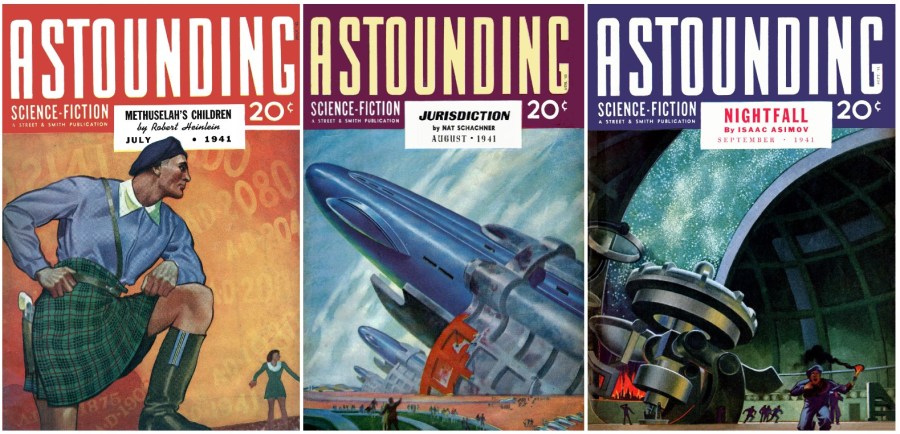
When I was a kid, and read Stranger in a Strange Land and The Puppet Masters, I was titillated at all the nudity in those stories, but I had not noticed how often Heinlein’s other characters in other stories went around in the raw. When I reread Methuselah’s Children recently I kept seeing scenes as Heinlein wrote them and I’d go “Eeeewwww” in my head. In For Us, The Living, the characters wear clothes sometimes, especially if it’s cold, but clothing is optional. Perry sometimes wears a kilt (evidently only a kilt), which was what Lazarus Long wore in Methuselah’s Children. Heinlein also had a thing about redheads – they are everywhere in his stories. In all the scenes where the characters are naked in For Us, The Living, I keep picturing how ugly that world would look. I wouldn’t mind seeing a few unclad females walking around a little more often than I do now, but a world full of visible scrotums would just be wrong. (I don’t know why all women aren’t lesbians.)

But maybe that’s Heinlein’s point. He wanted to spread the gospel of nudity, the glory of the human body. I’m afraid I’m an atheist of that religion too.

For Us, The Living is a clunky novel. There are a couple dramatic scenes, like when Perry dies, or when he goes into a jealous rage and punches Diana’s old boyfriend. But those are few and far between. The punch in the face is a setup to explain how the U.S. of 2086 is a libertarian utopia, where Perry is taken to be evaluated for mental illness. In this future society, any kind of violence is considered a mental illness, and violators are given a choice. They can get treatment or go to Coventry. Coventry is a reservation for people who do not want to follow the rules. In Heinlein’s later story, “Coventry” the main character punches someone out and selects Coventry. But he eventually learns he doesn’t like a totally free society. Perry chooses treatment.

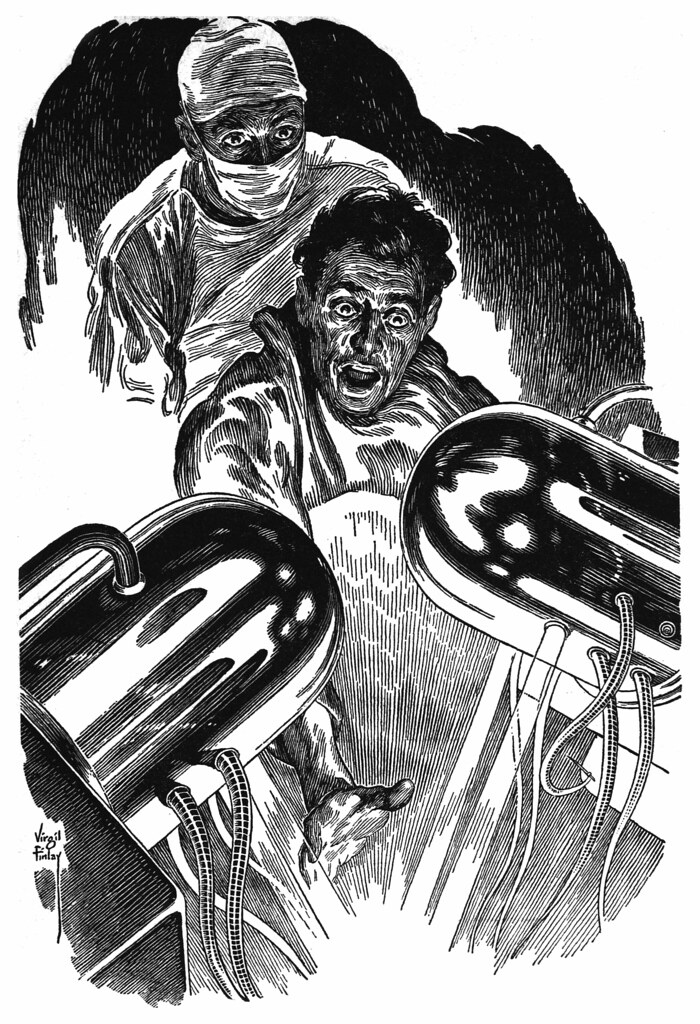
As part of his treatment, Perry must study the ways of the future society. There’s a long painful section where Perry is lectured on economics that even includes a long algebraic formula. In this fictional future, everyone has a guaranteed income. It’s enough to live comfortably, but if you want more out of life, you earn extra money. Perry can’t understand why this society supports so many layabouts. This gives Heinlein a chance to lecture on how he believes our society should work.

At one point Perry meets Master Cathcart, a “Master of History.” Cathcart quizzes Perry on what he’s learned about American history from when he died in 1938, until 2086. I get the feeling from this section that Heinlein wanted to predict the future, or at least extrapolate it and show off how smart he was regarding world events. Heinlein fails but fails in an interesting way. Most of his projections sound a whole lot like his Future History chart. Here’s a sample.

“I am to assume, I take it, that you are for all practical purposes an inhabitant of 1939 A.D., well educated in your period, transported by some witchcraft to this period. Very well. You have been studying some records today? Which ones?” Perry ran through the list. “Good enough. Now suppose you summarize briefly what you have learned today and I will explain and amplify and answer questions as best I can.” 

“Well,” replied Perry, “that’s a large order but I’ll give it a try. At the time of my accident, July 1939, President Franklin D. Roosevelt was in his second term. Congress had adjourned after wrecking most of the President’s program. The war in Spain had been won by the fascists. Japan was fighting China and was apparently about to fight Russia. Unemployment and an unbalanced budget were still the main troubles in the United States. 1940 was a presidential year. President Roosevelt was forced to run for a third term through lack of an electable successor to carry on his policies. His nomination by the Democratic convention resulted in the defection of the conservative wing of the party to Republican Party. In the meantime the National Progressives had organized on a nationwide scale and put young Bob LaFollette in the field. The Republicans nominated Senator Vandenburgh. Vandenburgh was elected but polled considerably less than half of the popular vote and failed to get a majority in either house. His administration was doomed from the start. 

Very little was done for four years except for a half-hearted attempt to balance the budget by eliminating relief, but riots and hunger marches soon scared Congress into providing more and more for the dole. In the spring of 1944 the death in a plane crash of Mr. Roosevelt demoralized the remnants of the Democratic Party and most of them joined the Republicans or the Progressives. The Democrats adjourned their convention without naming a candidate. The Progressives named LaGuardia, the fiery little Mayor of New York, while the Republicans after many ballots picked Senator Malone. President Vandenburgh was as thoroughly discredited by circumstances he did not understand and could not control as President Hoover before him. Senator Malone was a midwestern politician, a typical demagogue of my period, if I’m any judge. The recordings show him red-faced and raucous, a man of the people. Malone ran on a platform of blaming everything on Europe and the radicals. He demanded instant payment of the war debts, which were pretty silly since the second European war was already on. He called for the outlawing of the Communist Party, protection of the American home, and a return to rationalism in education which he defined as readin’, ’ritin’, and ’rithmetic and a particularly offensive jingoistic patriotism. He advocated deportation of all aliens, laws to prevent women from holding men’s jobs, and protection of the morals of the young. He promised to restore prosperity and promised everyone the ‘American’ standard of living. And he won, by a narrow vote in the electoral college. LaGuardia said afterwards that since Malone had promised them the moon, all he could offer was the moon with whipped cream, which didn’t seem practical to LaGuardia. 

“Once in office Malone ran things with a high hand. Congress was willing in the first session to pass almost any law he desired. One of the most important was the Public Safety bill which was in effect a gag for the press and other means of public information. Inasmuch as it was first used to suppress news of labor troubles which resulted from the discontinuance of the dole, the capital controlled press submitted to it without really knowing what they were in for. Then a law was passed which greatly increased the scope of the G-men or Federal enforcement agents and making them directly responsible to the chief executive. Malone staffed these expanded and greatly changed corps from his home state political machine. In the meantime, in spite of his controlled press, the people were getting restless. Even those who were still economically fairly comfortable had had swarms of the hungry, dispossessed, and unemployed turned loose on them. Malone was apparently afraid to chance another election, even a mid-term. Perhaps he never intended to. In any case he declared a state of emergency, using the mobs of unemployed as an excuse, and took over the internal civil government as an absolute dictator. He used the army and navy to quell any local difficulties. With his new secret service and control over the means of communication and propaganda this was feasible. By the way, the record states that he was able to use the army and navy to destroy the democratic form of government. I find that hard to believe, Master Cathcart. You see I was in the navy myself and I don’t believe that the American Services were fascist minded. How do you account for it?”

For Us, The Living: A Comedy of Customs (pp. 63-66). Scribner. Kindle Edition. 

Later on. he gets one interesting fact right:

“What happened to the dictators?” 

“Adolf Hitler committed suicide by shooting himself in the roof of the mouth. Mussolini got out much more gracefully. He submitted his resignation to the king he had kept around during his entire tenure and the king appointed a new prime minister, a social democrat. But to my mind the most interesting thing about the peace was the peculiar terms of the peace treaty.” 

“Some sort of a league of nations, all over again wasn’t it?” 

“Yes, and no. A very brilliant young Frenchman, a descendant of LaFayette, argued that a continental government or federation was necessary if a lasting peace was to come, and argued further that a constitutional monarchy was the most stable form under which free men could live. And so the United Europe was created. But the romantic part is the man who was chosen to head this polyglot creation. The Hapsburgs and the Hohenzollerns were out for obvious reasons of bad blood and bad records. The English king was suggested but he aroused no enthusiasm, being rather negative in character and further handicapped by his shyness and speech impediments. None of the pretenders in exile had any real following. But one prince was available, who had long before captured the world’s imagination. Edward, Duke of Windsor, who had abdicated the British throne in 1936 rather than accept the complete domination of his prime minister, became the choice.” 

“Well, I’ll be damned!” muttered Perry. “I don’t believe that was in the record.”

For Us, The Living: A Comedy of Customs (pp. 69-70). Scribner. Kindle Edition. 

But where is the Heinlein that’s going to write all the books about exploring space? That’s the Heinlein that I loved as a kid. Well, towards the end of For Us, The Living, while Perry is still in rehab, he and one of his therapists, Olga, go on a tour of a rocket testing facility. In 2086, rockets are standard for traveling around the world, much as we now use jetliners, but they don’t go into space. At the testing facility, they are working on rockets that can achieve escape velocity. Perry and Olga witness a rocket failure, and this lights up Perry’s ambition.

Eventually, Perry discovers he’s cured. He ends up with a three-way relationship with Diana and Olga and is released from his reeducation. Perry then goes off to train as a rocket pilot, and at the end of the story, three years later, is heading to the Moon. The ending, by the way, reminds me a whole lot of the ending of the 1936 film, Things to Come. But Perry Nelson’s speech is nowhere as elegant as Oswald Cabal’s speech. Thus the ending of For Us, The Living sets us up for “Requiem,” and “The Man Who Sold the Moon.” The ending of For Us, The Living also feels like the ending to Tunnel in the Sky, and other Heinlein stories, where the main character is heading for a bright future on the high frontier.

If you only read Heinlein occasionally, you might not detect his pet ideas. But reading him solid like I am now, starting from the beginning and working forward as he published new stories, For Us, The Living is a fascinating clue to how Heinlein thought.

From reading all the biographies of Heinlein, and his work, I get the feeling he was deeply dissatisfied with our society and was burning to reshape it. Many of the lectures/infodumps deal with customs and beliefs that were common in the 1940s and are still embraced today. I think Heinlein resented the thinking behind them as impediments to his freedom. By the time I started reading Heinlein in 1964, when I was twelve, I had already decided to become an atheist. Maybe I felt a kinship with Heinlein’s quest to be mentally free. But I grew up in the sixties when youthful rebellion was required. We were way beyond Heinlein regarding free thinking.

What I loved about Heinlein as a kid, was all the gung-ho-ness for exploring space. What I’m seeing in my rereading is Heinlein had several ambitions as a writer, and the space stuff was only one of them.

Heinlein always told us that “Life-Line” was his first effort at writing. He’d brag how he read about a writing contest in Thrilling Wonder Stories that offered a $50 prize, but when he finished his first effort, it was good enough to sell to John W. Campbell for $70. He never mentioned For Us, The Living. I vaguely remember reading that Heinlein and his wife burned copies of it before he died because they didn’t want it published. But evidently, he had lent it to a biographer, and that copy was rediscovered. I’m glad his estate went against his wishes. It offers so many clues about Heinlein. It also tells us that Heinlein wasn’t quite honest. That he had secrets he didn’t want us to know. I think these essays I’m writing are a way to deduce some of them.

James Wallace Harris, 9/29/22

Sixth Column by Robert A. Heinlein

Sixth Column first appeared in the January, February, and March 1941 issues of Astounding Science-Fiction. For it, Heinlein used the pseudonym of Anson MacDonald, so it’s not considered part of his Future History series. Sixth Column is generally thought of as one of Heinlein’s bottom-of-the-barrel novels. Critics sometimes try to defend Heinlein by pointing out he wrote Sixth Column based on a story given to him by John W. Campbell, Jr., thus transferring some of the blame for this stinker to his editor. Also, it’s often dismissed as a racist Yellow Peril novel that was common back in the 1930s. Even if you ignore the racism, the story itself is silly and unbelievable. The story’s sense of reality is equal to a comic book.

The basic plot is six American servicemen are the sole survivors of an overwhelming attack on the United States that completely destroys all our military. We are occupied by soldiers from an unnamed Asian country, that Heinlein refers to as Pan Asian. The six surviving soldiers were in a hidden mountain bunker doing secret scientific research, and one of them just happens to be smarter than Einstein who can churn out exotic weapons based on theoretical physics. The story is about how they conquered the invaders and freed America.

Heinlein’s Sixth Column falls into the category of invasion literature. These were an early form of science fiction that began in the last third of the 19th century and ran until WWI. In England, the common fear was Germany would take over. But every country had authors that wrote scary stories about invasions from other countries. The War of the Worlds by H. G. Well is considered inspired by the invasion literature genre.

Since Sixth Column was written in 1940, and Japan had been invading countries since 1931, I have to assume Heinlein meant Japan when he wrote Pan Asian. It’s a shame Heinlein just didn’t write Japan and Japanese instead as he typed. It would seem much less racist now, and probably a bit prophetic at the time. Were there legal issues back then?

The Pan Asians who occupied America in this story completely controlled every aspect of Americans’ lives. They only allowed one freedom – the freedom of religion. Heinlein’s six soldiers invent a religion to spread to all the major cities as a cover and then use secret super weapons to defeat the enemy.

Sixth Column is readable, but that’s about all I can say for it. I did think the idea of creating a fake religion was neat. In another serial Heinlein wrote in 1940, “If This Goes On—” he has the U.S. overthrown by a theocracy. I’m reading that one now. Heinlein sure did like to think big in his plotting. The idea of six men repelling an entire invasion was exciting stuff in 1941, at least to pulp magazine readers. Heinlein loved creating characters that were confident in their abilities and could essentially do anything. Heinlein plotted Sixth Column better than Methuselah’s Children, his second three-part serial of 1941. I think that was due to focusing on fewer characters and a smaller scale if you can envision six men fighting off millions being a smaller setting than the events in Methuselah’s Children. But I do since Heinlein’s imagination ran to even bigger whoppers to believe in that story.

But even with this faint praise, I can’t recommend reading Sixth Column, unless you’re like me and studying all of Heinlein’s work.

James W. Harris

Methuselah’s Children by Robert A. Heinlein

Methuselah’s Children first appeared 81 years ago this summer, in the July, August, and September 1941 issues of Astounding Science-Fiction. In 1948, Erle Korshak gave Heinlein a $200 advance to publish the serial at Shasta Press. The revised and slightly expanded version should have been Heinlein’s third hardback book, but it didn’t get published until 1958. In 1967 Methuselah’s Children was included in The Past Through Tomorrow, Heinlein’s giant collection of Future History stories. The Past Through Tomorrow was widely distributed by the Science Fiction Book Club, so I expect many people have read this novel. Methuselah’s Children was first reprinted in paperback in 1962, having an extensive reprint history.

This past week while convalescing after surgery, I got hooked on reading early Heinlein. I needed reading material I could consume on my iPhone, and I’ve been meaning for years to reevaluate my adolescent love of Heinlein’s fiction. This seemed like a good time, and it made me feel more productive while lying around all day. I’ve finished Methuselah’s Children and The Sixth Column and working on Revolt in 2100. These are Heinlein’s first three novels (depending on how you measure wordage).

I expect to read even more from Heinlein’s pre-war stories. I feel like an academic studying his early work. I used to think that Heinlein had four periods where the stories were distinctively different. I grouped them into the Pre-WWII stories, the 1947-1959 stories, novels from the 1960s, and the later novels. Some of his books from the 1950s I have read many times, and are my favorites. Heinlein’s books from the 1960s I’ve read at least three times each, I think. I read most of the pre-WWII stories only once, except for the more famous anthologized short stories. I’ve read those several times. For his later work, I’ve only read those books either once, or I didn’t finish them.

I’m now realizing that Heinlein changed far less from period to period than I previously thought. A lot of the perceived differences were due to the markets that published the stories. His work at Putnam showed Heinlein at his most verbose. I’m now seeing those personal pet ideas he expounded on at length in his later novels revealed in his earlier works as mere asides. Despite editorial restraint or the limits of length, Heinlein expressed himself one way or another.

Heinlein was incredibly prolific before WWII. One estimate suggested that 20% of Astounding Science Fiction in 1941 was written by Heinlein using his own name or under pseudonyms. After the war, five of those stories were published as novels, even though they were very short, or fix-ups. Most of the famous Future History stories were written during this period. Before Heinlein quit writing to join the war effort in 1942, he wrote five tales that would be published as novels. I’ve read the first and last three times each, but the middle three only once.

  • Beyond This Horizon (1948, Fantasy Press) (Astounding April, May 1942)
  • Sixth Column (1949, Gnome Press) (Astounding, January, February, March 1941)
  • Revolt in 2100 (1953, Shasta) (Astounding, February, March 1940)
  • Methuselah’s Children (1958, Gnome Press) (Astounding, July, August, September 1941)
  • Orphans of the Sky (1964, Putnam) (Astounding, May, October 1941)

When I first started reading Methuselah’s Children I thought I must have first read it when I got The Past Through Tomorrow in 1967. It was considered the last story in Heinlein’s Future History, and the one that was set second furthest in the future. The characters in “Universe” and “Common Sense” (reprinted as Orphans of the Sky) lived the furthest in the future in Heinlein’s fictional universe. When I started writing this essay I remembered borrowing and reading Methuselah’s Children from Homestead Air Force Base Library in 1965 because that library had all of Heinlein’s Gnome, Fantasy Press, and Shasta’s editions. I distinctly remember its cover (see above).

I have not read Methuselah’s Children since then, and I barely remembered it. I can’t say it’s a great story. You can tell Heinlein was just learning how to write a novel. It’s rather episodic, with three main story arcs that go along with being serialized over three issues. And Heinlein hadn’t figured out how to plot a long story yet, nor was he particularly good at developing dramatic scenes. I believe Sixth Column had better plotting, and Revolt in 2100 had some better dramatic scenes. However, Methuselah’s Children is full of exciting science fictional ideas, referencing many of his other early stories that fit within the Future History timeline.

I’m not sure I’d recommend Methuselah’s Children to modern readers, although at Goodreads there were many reviewers who raved about it. Now that I’m rereading old Heinlein I’m also pondering why as I go along.

First, let’s consider the science fictional concepts presented by Heinlein for the readers of 1941.

  • Longevity. The Howard Family (the collective name, there were many surnames) began selective breeding in the 19th century by only marrying spouses that had four living grandparents. By the 22nd century, many of them were living close to two hundred years. The oldest, Lazarus Long, was 213 at the beginning of the novel, and somewhere between 50-75 years older at the end. No one knows for sure because of the time dilation of space travel. In 1941 Americans were still interested in eugenics, but the techniques used to achieve longevity in this story were merely animal husbandry. Heinlein should have known this wouldn’t work because we’ve never bred any long-lived farm animals.
  • Political Utopia. The story is set after the Crazy Years and the Second American Revolution, under a new constitution called The Covenant. Maximum political freedom was guaranteed. However, The Covenant breaks down when the average citizen learns that the Howard Family has longevity and they want to suspend its freedom and torture the Howard Family members into revealing their secret. It’s a shame that Heinlein didn’t flesh out this semi-utopian period.
  • STL and FTL Space Travel. The Howard Family escapes Earth by stealing the sister ship to the one in “Universe” and “Common Sense”. Their ship, the New Frontiers, starts out slow, but Andrew Jackson Libby, a character from Heinlein’s second published story, “Misfit” finds a way to soup up the engines to travel near light speed. Eventually, he learns how to make it go faster than light. That means in two 1941 stories Heinlein explores several ways to achieve interstellar travel.
  • Psychic Powers. Even though the Howard Family breed for longevity they still have birth defects (assumed from all that inbreeding). Heinlein is careful to point out how well they take care of these children. Some of those handicapped offspring had psychic powers, and that figured in the plot in a couple of places. Children with birth defects and psychic powers reminded me of stories by Philip K. Dick from the 1950s and 1960s. Heinlein’s aliens also have various degrees of psychic powers. In one instance, reminding me of Arthur C. Clarke’s stories Childhood’s End and 2001: A Space Odyssey. This is interesting for 1941. SF in the 1950s was known for its ESP stories.
  • Vastly Superior Aliens. The Howard Family refugees first encounter an alien species called the Jockaira, a pleasant, vaguely humanoid people that welcomes them to their planet. Then the Howards meet the real rulers of the planet and it scares the shit out of them. This is very interesting because John W. Campbell supposedly had some kind of unwritten editorial rule that forbade stories with superior aliens. For the rest of his writing career, Heinlein always claimed humans were the meanest, toughest species in the galaxy, but in this story, we run away with our tails between our legs.
  • Lotus Eater Aliens. The next planet has extremely nice aliens. Too nice.

For 1941, this is some impressive science fiction, but is it for 2022? And was the writing all that impressive, even for 1941? Heinlein has a reputation for blazing onto the pulp scene as a far superior writer. I have my doubts in places. This is where I wonder if this story will survive the test of time. Heinlein loved writing stories where people had huge meetings in large halls to argue about their problems using Robert’s Rules of Order. These group meetings happened several times in Methuselah’s Children. To me, this was a cheating kind of infodump. And quite often it allows Heinlein to spout his philosophy using his protagonist. Lazarus Long is a popular character but could be a holier-than-thou know-it-all.

At the beginning of the novel, Mary Sperling is the leader of the Howard Family because of her age. It’s a shame Heinlein didn’t stick with this woman protagonist. Mary was the chairman of the board and the moderator at meetings where the various families send their representatives. But when Lazarus Long admits he’s older Mary gives him the gavel. From then on Lazarus conducts the meetings. Heinlein tries to make him sound like a cross between Mark Twain and Will Rogers, but in my mind, he failed. I never felt Lazarus showed the wisdom that a man of 213 years should have.

Heinlein loved his character Lazarus Long and brought him back in several stories. We’re told Lazarus wears a kilt with a gun (blaster) strapped between his legs. The jokes I could make about that. I was never sure he wore anything besides a kilt, but every chance he gets Lazarus will shuck his skirt. I’ve read that Heinlein was a nudist, and that concept shows up over and over again in his stories. I tried to imagine a hundred thousand naked people in a spaceship in zero-g and it brings out the Puritanical prude in me. The thought of being in a cabin with Lazarus long while floating in free space and being forced to stare at his two guns hurt this story.

Also, Lazarus often acted like he was ready to shoot first and ask questions later. Throughout Heinlein’s fiction, his characters ignore laws and often commit capital punishment for offenses that the law would seldom execute.

Lazarus Long has an ego the size of Texas. I’m sure Heinlein used all the incidents I saw as egotism as a way to prove that Lazarus was a competent man who could do anything. At one point, Lazarus shows how any man with moxie can bully his way through the telephone system to talk to the world leader. I wonder if Heinlein thought he could call up FDR anytime he wanted?

In another story arc, Lazarus steals an interstellar spaceship, buys a giant cargo vessel, and rescues over a hundred thousand people – all by himself. This really hurt the novel because it’s absolutely unbelievable. Methuselah’s Children would have been a much better story if the Howard Families totaled fewer than a thousand people. At one point Lazarus is moderating a meeting of all hundred thousand using televisors. That just seemed ridiculous to me. Try imagining Donald Trump interacting with a hundred thousand of his fans concurrently who wanted their say too.

And maybe Lazarus Long isn’t Heinlein, but I imagine this character is the person Heinlein wished he could be. Ditto for Jubal Harshaw, and all the other characters people think of as standing for Heinlein. The William Patterson biography of Heinlein hints that Heinlein was an unpopular cadet at the Naval academy and that he was very thinned-skinned.

Heinlein fans have often accused critics of not understanding that writers aren’t their characters. But for Heinlein, I believe he created a dominating character that he wished he could be. For some readers, this works. I’m guessing they’d like to be those characters too. And maybe I did too when I was a kid. Now, Heinlein’s supermen are unappealing, to say the least.

Still, I found Methuselah’s Children to be very readable and thought-provoking. The way the story handles the resentment over genetically enhanced humans was done better with Nancy Kress and her novel Beggars in Spain, so I’d recommend it before Methuselah’s Children.

In 1941 Heinlein was dealing with several ways of achieving interstellar travel. That was amazing at a time when most Americans pictured space travel like Buck Rogers and Flash Gordan series, where alien planets seem no further than the Moon. Heinlein worked to get his readers to imagine the immense distance between the stars and the limitations Einstein had put on space travel. Unfortunately, all that has been done countless times since. So I don’t know if young readers need to dig this far back in science fiction to find rewarding stories on those science fictional topics.

My main enjoyment in reading Methuselah’s Children is finding all the easter eggs linking to earlier Future History stories. Also, I liked that Heinlein kept imagining the United States being overthrown by various other forms of government. Even though I believe this 81-year-old story is unworthy of future pop culture recognition, it still entertained me because I’m a life-long Heinlein fan.

But I’m also seeing that I never really paid attention to Heinlein’s philosophy and politics. What mattered to me were the science fictional ideas. When I was young I wanted Heinlein to be read and loved by everyone. I wanted him to become a classic author like Charles Dickens. That just isn’t happening. If 10,000 novels are published every year, 99.999% of them will be forgotten, leaving about ten to fight for a slot in our long-term pop culture memory. If you look at Wikipedia’s list of 1941 fiction, Methuselah’s Children is there (probably because of an editor who is a Heinlein fan), but so are a bunch of books already forgotten. It’s funny, but from the list, the most memorable pieces of 1941 fiction for me were Mildred Pierce by James M. Cain and “Nightfall,” by Asimov. If we look at Wikipedia’s remembered films of 1941, I see far more that have retained some pop cultural vitality – especially Citizen Kane.

People probably wonder why I obsess over remembering the past, worrying about what will be remembered and what won’t. I’m just fascinated by what history and world culture retain from pop culture. What works of art can speak the furthest across time.

I started reading Heinlein when I was twelve, so maybe I’m now finalizing the project twelve years before I die. I’m seeking both closure and exorcism. When I retired I got heavily into reevaluating my past, but I’ve been doing that for a decade and I realize I don’t want to spend my last years looking backward. I want to get back to thinking about the future.

James Wallace Harris, 9/11/22

Red Planet by Robert A. Heinlein

Why read an old science fiction novel? Maybe a friend recommended it. Or maybe you discovered an author you like and you’re reading all of their books. Or it was on a list of great science fiction novels. Or a YouTuber reviewed it. Maybe even, it was assigned in a class. In my case, and I think it’s true of most people my age, we’re rereading old SF novels we loved in our youth.

A better question to ask: Which old science fiction novels should we read? The obvious answer is the true classics. But what makes a book classic? I once calculated there were less than one hundred famous books from the 19th century that are regularly read today. Scholars and fans of 19th-century lit are familiar with more titles but I’m talking about the average bookworm. I’m going to assume as the 21st century progresses, we’ll collectively forget about most of the science fiction published in the 20th century.

I’m reading and rereading old science fiction because of nostalgia and to fill in the gaps in my knowledge about 20th-century science fiction. But as I do this I’m thinking about which books might survive long term. Doing that requires analyzing books for their various qualities. One way to do that is to recall what made me love a book then and try to figure out why it might be loved or hated today.

If I was thirteen years old today and read Red Planet by Robert A. Heinlein which was first published in 1949, would I love it like I did when I read it at thirteen in 1964? I’m not sure I can answer that at 70 because my mind is clouded with nostalgia. Probably any 13-year-old today would laugh at Heinlein’s attitude toward women. But would kids today, especially those science-savvy kids, dismiss the book because Heinlein has Mars populated with life, even with beings more intelligent than humans? Or would they forgive him in the same way we forgive 19th-century writers like Jules Verne, and assume Heinlein was from some pre-scientific dark age and just didn’t know better?

Would the core story in this 1949 science fiction novel still be entertaining to any reader in 2022? People still find Journey to the Center of the Earth immensely entertaining even though they know Verne was full of lala regarding his science.

Red Planet was immensely appealing to me in 1964. It was about a boy, Jim Marlowe, and his friend Frank Sutton, living in a colony on Mars. Jim also had a pet Martian “rounder” that is somewhat intelligent and could speak some English. Because Mars is so cold the colonists must migrate between the south and north to avoid Martian winters. The plot involves Jim and Frank going away to boarding school and learning the corporation that owns the colony secretly wants to end the practice of migration to save money. Jim and Frank sneak away and travel across the Martian landscape to warn their parents, which eventually causes the colonists to revolt against the corporation. The plot also deals with the Martians and the conflict of intelligent species, so it’s very exciting.

In 1965 with the Mariner IV flyby probe we learned that Mars was much closer to being like the Moon than Earth and there would be no advanced life forms found there. Ever since then science fiction writers have been writing quite differently about Mars. Some readers felt NASA invalidated all the older science fiction about Mars, and some readers didn’t mind at all. I wonder what young readers growing up in the 21st century think when reading such stories. I know they are often quick to reject stories for woke reasons, and that’s understandable. I sometimes wonder if they ignore the less evolved attitudes of our ancestors, and the science we know about Mars, could older stories gain fans just because of their storytelling virtues?

I can overlook bad science and some lack of wokeness. I even wrote an essay – “I Miss Martians” because I get a kick out of stories where the solar system is full of life and intelligence. But I remember a time before NASA’s probes when many people hoped that would be true. Will readers growing up after that time feel the same way? Is The War of the Worlds still a popular book with young readers?

Books are like people, they survive death in the memories of folks who loved them. But as those people die, who will keep the memories going? History keeps the memory of significant people alive. For a book to keep being read requires a similar kind of historical significance.

Red Planet was the first Heinlein story I read. That was back in the autumn of 1964 just before I turned thirteen, and before Mariner IV. My eighth-grade English teacher required us to read three books for each six-weeks grading period. Red Planet was on her approved list, and maybe the only science fiction title. I wished I remembered her name because I’ve always been thankful to her for introducing me to Heinlein. By the end of 1965, I believe I had read all of Heinlein that had been published in paperback and hardback up to that time.

The Heinlein juveniles won library awards and were recommended for young adults. In the late 1940s when few science fiction writers got published in hardback, Heinlein sold his young adult novels to Charles Scribner’s Sons, the publisher of Ernest Hemingway, F. Scott Fitzgerald, and Thomas Wolfe. After WWII Heinlein also broke into slick magazines with several SF stories published in Saturday Evening Post, and he even had a Hollywood movie, Destination Moon, made in 1950. And I have met countless people on the web testifying how much they loved the Heinlein juveniles growing up. I think they are why those twelve books stay in print. But after they die, do those twelve books have any literary or historical significance to keep them in print?

Heinlein’s words had a certain amount of respect around the time I was born in 1951 but I’m not sure his same words would be respected today. While liberals shame-censor books with woke concerns and conservatives seek to actually have books banned from school and public libraries I’m not sure how the books I loved as a kid would be judged today.

Red Planet made a great impact on me as a kid. Conservatives today would probably completely approve of Red Planet — the only fault they might find in it is I grew up to be a liberal. I’m afraid my liberal friends would not approve of this novel because Heinlein had a completely 1940s attitude towards the role of women in society. But his attitudes didn’t rub off on me because I completely embraced feminism in the 1960s. I did wince at all of Heinlein’s patriarchal sentiments when I reread Red Planet this weekend. What’s strange is just a few years later, in the 1950s Heinlein changed his attitude completely toward what jobs women could hold. Wonder what made him change? And should we retroactively forgive him for his 1940s attitudes?

I’ve wondered if Heinlein’s third wife, Ginny, changed Heinlein’s mind about women. Or did his science fictional instincts make him ask: What if women had the freedom to be who they wanted? In the 1950s Heinlein made women rocket scientists, spaceship pilots, and combat soldiers. He put them in leadership positions. Did he think of that himself? Or were there feminists in the 1950s who changed his mind? Is a feminist change in SF significant enough historically to keep Heinlein’s 1950s books in print?

My favorite part of Red Planet is the Martians. They appear to be the same Martians Heinlein uses in his 1961 novel Strange in a Strange Land. However, they don’t seem to be the same Martians in his 1956 novel, Double Star. And there’s even a recursive SF joke in Red Planet. Willis turns out might be a princess of sorts, bringing in an Edgar Rice Burroughs allusion. In Red Planet, the Martians have a ceremony with water and call Jim their “water friend” but in Strange in a Strange Land, Mike undergoes the same water ceremony and is called a “water brother.”

In other words, I don’t care if the real Mars is lifeless, but it’s amusing to see how Heinlein gave Mars an intelligent species for his books. Alan Brown in his review of the novel said he thought Stranger was actually a prequel to Red Planet. If Stranger in a Strange Land stays in print, will it help Red Planet be remembered by science fiction scholars as a footnote?

Actually, many themes that Heinlein covered in other books are touched upon in Red Planet. Heinlein was a nudist, and the men in this novel only wear jockey shorts on the inside and describe women wearing what Earth women would wear to the beach. A lot of cheesy 1950s science fiction movies pictured such skimpy attire for the future. Will some science fiction books be remembered for their bad visions of fashion of the future? I doubt Red Planet has enough of those.

The revolution in Red Planet has a lot of similarities to the revolution in The Moon is a Harsh Mistress. Many of Heinlein’s stories involve revolutions or overthrowing some kind of tyranny. And they often have a big committee meeting where everyone argues and abuse Robert’s Rules of Order. And all these stories involve innocents being killed to ramp up the emotions and justify the revolutionaries using deadly force. Heinlein loved replaying the American revolution. I’m pretty sure MAGA people, and even preppers would find Red Planet appealing for its politics.

What’s funny is Jim Marlowe throws fits over minor school rules claiming it violates his freedom. Heinlein loved the Navy Academy and Jim would have been considered a whiner there. The way freedom is defined in Red Planet is the same kind as people who didn’t want to wear masks during the pandemic defined it. Heinlein also spends a fair amount of time promoting gun ownership in this book. He also promotes a kind of frontier justice that many conservatives today would love.

I was disappointed with this rereading of Red Planet because Heinlein failed to make his Martian colony realistic, or even spend much time on how a colony would be built. Heinlein saw Mars as a solution to Earth’s overpopulation and a place for people wanting to be free to be pioneers. Both are absolutely ridiculous assumptions.

The Martians in Red Planet have the same ability to make people disappear as Valentine Michael Smith did in Stranger in a Strange Land. I find that concept extremely unethical in the way Heinlein uses it. It gives his characters a god-like power which Heinlein assumes his characters know what’s right and wrong and can make god-like judgments. In more than one novel Heinlein has stated that bad manners should be a capital offense. Again, this will probably appeal to the MAGA crowd.

In recent decades I’ve developed a theory that Heinlein wanted to be another Ayn Rand, especially after the success of Atlas Shrugged. He switched from writing short YA novels to long preachy adult novels after Ayn Rand became famous. And Heinlein promoted a similar kind of political philosophy. Before he died, Heinlein said in many places he wanted to be remembered for three novels: Starship Troopers, Stranger in a Strange Land, and The Moon is a Harsh Mistress. I see those as his Ayn Rand novels, but the same political sentiments exist in Red Planet. I believe Heinlein knew most of his novels would be forgotten in the 21st century, and he intended to winnow out the ones he wanted and why. I never liked Heinlein’s politics, so as I’ve gotten older, I jettison his 1960s and later novels too. I love a lot of his 1940s work, but I know they have woke problems. And from 1960 on, they have had political and literary problems. That leaves me with his 1950s work. And as I reread it, I might revise my opinions on those stories too.

Heinlein also likes writing stories about advanced aliens judging humanity. Red Planet parallels Have Space Suit-Will Travel in this regard. I’m not sure this theme is strong enough in Red Planet to ensure its long-term survival.

I still enjoyed reading Red Planet this weekend. I’ve read it several times over my lifetime. It’s a nostalgic favorite, but not a top favorite. It’s too quaint for modern readers, but I don’t think it offers enough historical or literary value to last. And I can see why it would offend many readers.

When I was young I loved Heinlein’s books so much that I thought they would become classics, but I doubt that now. I wanted Heinlein to be the H. G. Wells of 20th-century science fiction. I’m starting to think he might be remembered like Edward Page Mitchell.

James Wallace Harris, 8/23/22

Wow — I Wish I Hadn’t Opened That Can of Worms

I need an equivalent saying to “My eyes are bigger than my stomach” that applies to trying to read too much. My reading desires far exceed my ability to get things read. For the past year, I’ve spent most of my reading time consuming short stories. On average, I still squeeze in a book a week, but usually, it’s anthologies or nonfiction, rarely novels. Lately, I’ve been missing novels or I thought I did. Novels get all the buzz. Novels are what readers remember. Novels are what pop culture respect. So I felt I was missing something important.

One thing about getting old is letting things and pursuits you love fall away. I regret not keeping up with new science fiction novels. I’ve identified with being a science fiction fan my whole life, so I feel a pang of loss that I haven’t kept up with the genre.

I felt I should fight that aging trend. I told myself I should catch up. Last week I decided I would look for all the best science fiction novels that have come out in 2022 and read three or four of them. I quickly discovered it was like lighting a cigarette from a Raptor 2 engine. Not only are publishers launching SF novels like SpaceX launches Starlink satellites, but many are reaching orbit with reviewers and list makers, and I’m essentially grounded.

I went to Google and searched for the best science fiction of 2022 and found these lists:

Because I subscribe to Scribd.com I was able to sample several of them right away. For the others, I used the Look Inside feature at Amazon. It didn’t take me long to remember that novels aren’t like short stories, which I can read in a sitting, but each requires a week’s commitment. None of the ones I started grabbed me enough to make me want to make that commitment. I’m willing to take on some long reads, but only if the novel is great. I used to go to the bookstore every week and pick a science fiction novel out by the cover. I was willing to climb many mountains to find an El Dorado.

I needed another plan. I needed to know more about a book before I started reading, a judgment of its value. So I started going through the SF magazines and reading their book reviews.

Twenty years ago I felt I was getting out of touch with current science fiction. Going through all these reviews was like pistol-whipping myself with the truth. I’m completely out of touch. And more depressingly, I realize I’ll never catch up. If I really want to read great 2022 science fiction novels, I’ll just have to wait the years until they are universally recognized.

I probably never did keep up, even when I was reading a paperback a day back in my school days. I just had the illusion I was because so many books and authors felt familiar.

I’ve come to accept that I can’t stay current with modern science fiction. I will accidentally stumble upon a new novel now and then, probably because it gained immense popularity. I’ve also got to accept that what I really like is reading old science fiction and reading about old science fiction. I’m now more of a science fiction scholar, specializing in a period in the genre’s history. I can’t honestly call myself a science fiction fan anymore.

I just finished John Brunner by Jad Smith, a monograph on his life and work, part of the Modern Masters of Science Fiction series from the University of Illinois Press. It inspires me to read several Brunner novels I missed from decades ago. Even that urge is unrealistic, but I’m more likely for me to read one of Brunner’s older novels than to read a new novel from an unknown writer.

For me, at seventy, it’s more rewarding to understand the science fiction novels from my past that were about my generation’s imagined future than trying to read current novels about the new futures young readers are imagining today.

Science fiction isn’t really about the future at all. It’s taken me a lifetime to learn that. Science fiction is about the present and what we think about the future at that moment. Reading the science fiction I grew up with is a kind of meditation on who I was. Reading new science fiction tells me about the current generation. And I’m afraid that opens up a can of worms I can’t face. Pop culture has gotten too fast, too complex, and too prolific, to keep up with.

I’ve got to retreat to a smaller territory, to putter about in my own small land.

One of the aspects of getting old is learning to let go of who you think you are, who you wanted to be, doing what you want to do, going places you wanted to go, and things you wanted to own. That sounds depressing, but getting older requires a kind of streamlining or downsizing so you won’t get depressed. It’s just a practicality.

For a couple of days, it became depressing trying to catch up, but now I’m happier.

James Wallace Harris, 8/18/22

Why Did I Stop Reading New Science Fiction?

Early this morning, before it got light, I woke up and wondered when did I stop reading new science fiction? And why? I assume my unconscious mind had been mulling over the feeling that I’d lost touch with science fiction in the 21st century. (See yesterday’s essay.) Before I went to sleep last night, my conscious mind assumed it was natural to stop reading science fiction as one got older. Evidently, my unconscious mind objected to that assumption and I awoke with several other possibilities to consider.

I read many new science fiction books as they came out in the 1960s and 1970s because of the Science Fiction Book Club (SFBC). I was also aware of new SF books as they were published because I subscribed to the science fiction magazines and fanzines and loved reading reviews. I bought new SF paperbacks and read them because of those reviews. I think I stop regularly reading reviews back in the 1990s. That might be the main reason I got out of touch with the genre and new writers.

I got married in 1978 and started working full-time at a job I’d stay in for the next 35 years. In 1979 I became obsessed with microcomputers and shifted most of my reading to studying computers. Sometime during the 1980s, I canceled my membership with the SFBC, and let my magazine and fanzine subscriptions lapse.

However, Susan and I loved going to the bookstore at least once a week, and I always went through the science fiction section. During the second half of the 1980s and into the 1990s I’d get nostalgic for science fiction and resubscribe to the SFBC, F&SF, and Asimov’s. Sometimes I’d even subscribe to Locus Magazine, and for a short while, I wrote for Lan’s Lantern. During those periods I’d try and catch up with what was new.

When I did return to science fiction periodically, I realized science fiction had changed and changed quite a bit. Books were now bigger, often huge. And trilogies became common, or even longer series. And by the 1990s most of the writers I grew up reading had died. Long books and trilogies turned me off – I just didn’t want to make the commitment. I grew up reading SF books that were often less than 250 pages, with many with less than 200 pages. Now new novels were two and three times that size. And the thought of having to read three of them to complete a story seemed absurd.

And the SFBC kept changing too. I just didn’t know all the new authors, and the SFBC kept offering other kinds of books, fantasies, media tie-ins, gaming — books that just didn’t appeal to me, so I’d quit. For many decades the SFBC’s two monthly selections seem to zero in on the core SF books everyone was reading – and then it didn’t.

My guess is the boom in SF and fantasy gave us too many choices so it was no longer obvious what to read. At the bookstores, the SF/F section just grew and grew. It was like a tsunami of new titles and authors. Not only was it impossible to keep up with reading the popular titles it became impossible to even keep up with a sense of the genre. SF had gotten too big. There seemed to be hundreds of new writers and I just didn’t know who they were. Even reading Locus Magazine didn’t help.

When I retired in 2013 I came back to science fiction. But instead of trying to catch up on the new works, I jumped back in time to read the classics I missed the first time around. I focused mainly on books from 1950-1980. And then I got into short stories again and started my project of reading all the best-of-the-year SF anthologies from the 20th century. It was more rewarding to fill in my knowledge of a historical period than trying to keep current.

However, after years of gorging on classic science fiction, I’m back to craving new science fiction. The genre is even larger, and I’m still not interested in trilogies and book series. I read science fiction for its ideas. Following a character through endless obstacles book after book is just tedious to me. I hunger for standout standalone stories that convey a far-out concept. So far, I’ve had my best luck with Kim Stanley Robinson.

I believe one of the main reasons I don’t read new science fiction is because the genre is no longer based on new ideas. Quite often the first book in a trilogy or series will have a new idea and unique worldbuilding, but the sequels just grind that idea and setting into the ground. And sadly, I’m not sure there are that many new ideas anymore. Writers are having to rehash old themes. Sometimes they find fresh ways to present them, and that works, but all too often new stories just feel like slight variations on old tunes.

However, I haven’t given up. Breakthrough SF novels do come out. The problem is finding them. How I go about that will be a topic for my next essay.

James Wallace Harris, 8/10/22

The Challenge of Writing a Significant Time Travel Tale

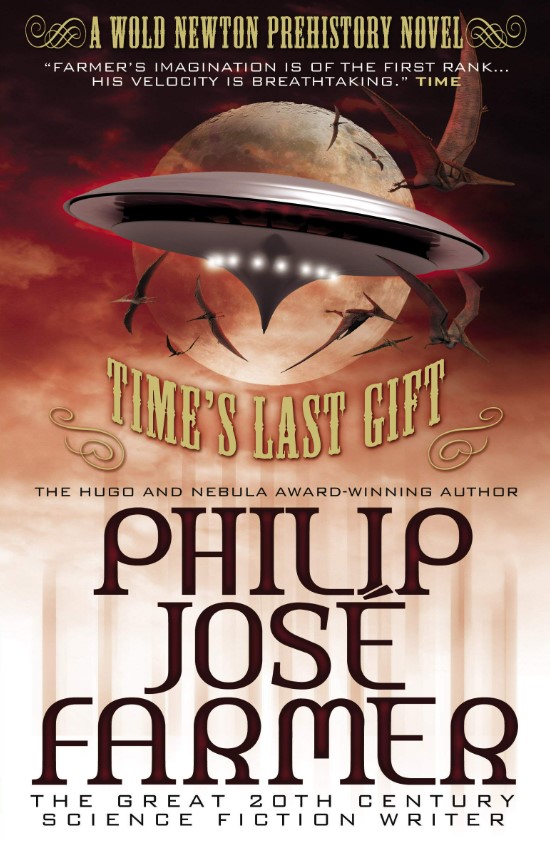
My aim is to review a time travel novel, Time’s Last Gift, by Philip José Farmer, but I need to explain my attitude towards time travel stories before I can pass judgment. I bought Time’s Last Gift because I read on the cover blurb that four scientists from the year 2070 travel back to 12,000 BC to study the Magdalenian culture. Since I’ve recently read a number of books on prehistory that plot appealed to me. I even read a large book just on locating the origin of the people who produced the proto-Indo-European language.

Within Time’s Last Gift, one character, Robert von Billmann is obsessed with finding the people who created the Proto-Indo-Hittite language. If you’re not interested in pre-history or the origins of language you might not want to bother with Time’s Last Gift – unless another factor appeals to you, but I want to wait and mention that after the spoilers warning. Let’s just say that John Gribardson, who was made leader of the expedition at the last minute has a very interesting backstory.

Does Time’s Last Gift stand on its own as a solid story and as a good addition to the time travel theme despite any details related to actual history or literary plot gimmicks? To me, a worthy time travel story has to add something different to the theme, otherwise, it’s just a romance, thriller, or historical novel that jumps around in time.

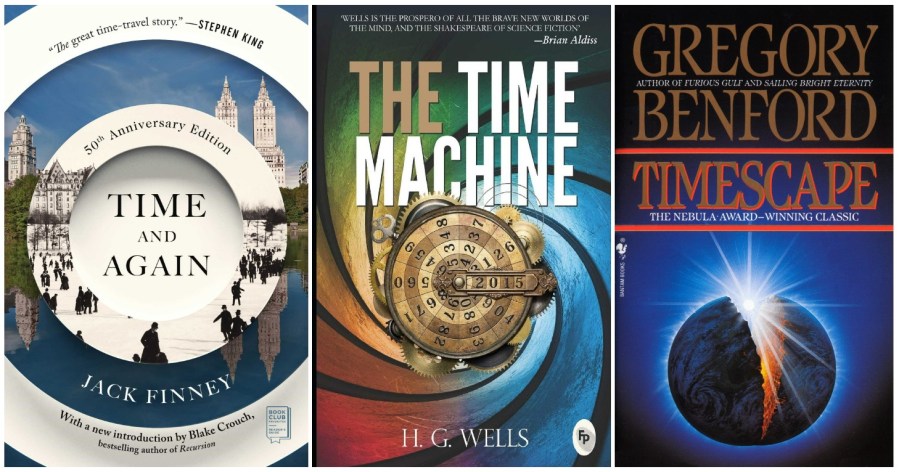
There have been countless science fiction books about time travel, but for me, I find very few of them worthy of using the theme. Most throw their characters into the past or the future and develop a story about that new setting. What I love is a time travel adventure that also explores the wonder of time and time travel. H. G. Wells set the bar very high with The Time Machine in 1895. I’m not sure any work has ever surpassed it for its sense of wonder.

There are so many time travel stories that Michael Main has created The Internet Time Travel Database. Town & Country Magazine listed their top 35 time travel books but only three of my top favorites make their list. Read This Twice found 92 favorite time travel books, and they do list many of my favorites. About Great Books lists 30-time travel books they think are great, and seven of my favorites are there, but I don’t consider many of those books really time travel stories. But that brings up another issue.

What is time travel? Replay by Ken Grimwood is one of my all-time favorite novels, but does Jeff Winston time travel? He repeats his life over and over. I call such fiction time loop stories. Stories such as The First Fifteen Lives of Harry August by Claire North, and The Midnight Library by Matt Haig are really time loop stories too, which I consider a different theme than time travel stories. I’ve written about it before.

Are such literary classics as The Time Traveler’s Wife, Kindred, Slaughterhouse-Five, A Christmas Carol, and Woman on the Edge of Time really about time travel? Don’t they just use the gimmick of time travel to reveal deep characterization or explore social issues in a clever way? These are great novels, but I don’t really want to lump them into the kind of science fiction novel I’m pointing to. Nor do I want to consider all the novels that use time travel to hook people up romantically.

Real science fiction about time travel should make us think about the nature of time travel. Time’s Last Gift does do this. Time travel has always been plagued by paradoxes, but I believe Farmer has found a neat way around them. If a time traveler goes into the past and changes the future, it’s already happened. Whatever exists now, whether affected by time travel or not, is what is. Speculations about what might be changed are no different from what was changed. If a time traveler shows up in 12,000 BCE there was never a 12,000 BCE without a time traveler. Of course, that means everything that happens is fixed. Or is it? Does this theory about time travel require predestination? It could mean everyone has free will, but whichever way history plays out it only plays out once.

Most of Time’s Last Gift is about living in 12,000 BCE. The four scientists immediately befriend a small tribe of humans and learn their language. John Gribardsun even wears their clothing and hunts with their weapons, although he often uses his rifle when necessary to help feed the tribe. The main conflict of the story deals with the two scientists who are married, Rachel and Drummond Silverstein, and their breakup. Farmer suggests that time travel has a psychological effect, like a larger case of jet lag, and it wears on three of the scientists. Gribardsun seems immune. In fact, he thrives in the past, and his vitality attracts both Rachel and the young women of the tribe. Much of the novel is about whether or not Drummond is out to kill Gribardsun because of jealousy. I didn’t care for this part of the story. It felt like a contrived conflict to move the novel along. However, the story is very readable and kept me reading.

Beyond Here Lie Spoilers

In the 1950s Philip José Farmer wrote some very innovative science fiction stories – “The Lovers,” “The Alley Man,” “Sail On! Sail On!” and others. Then he created two series that were fairly successful, the Riverworld series and The World of Tiers. Farmer won the Hugo award for best novel for the first Riverworld story, To Your Scattered Bodies Go (1971). I loved that novel when it came out because the main character was Sir Richard Francis Burton, the 19th-century explorer, and translator. And I loved the second book, The Fabulous Riverboat (1971) because it featured Mark Twain. I had read biographies of both men and that made me partial to those Farmer’s novels.

Over the decades I have come to feel that using a famous historical person as a character in a novel is a cheat, a way to sell books. But I also consider writing book series as a crutch for writers. For the rest of his life Farmer mostly churned out books for various series, and they were just so-so. He later refined the famous person gimmick by switching to writing about famous fictional characters, and this is where Time’s Last Gift comes in. John Gribardsun is Tarzan. It’s never said within the novel, but I guess it fairly quickly. If you’ve ever read a Tarzan novel, Time’s Last Gift feels like one and could have been Tarzan’s Time Machine.

There’s nothing wrong with book series, they do help writers to pay bills, but each book feels like just another episode in a TV series to me. If you love a series, that’s great. But for me, usually, only stand-alone novels can be great.

I assume Farmer didn’t use the name Tarzan in the book because of being sued by the Edgar Rice Burroughs estate, but ISFDB even lists Time’s Last Gift among the Tarzan novels. Philip José Farmer wasn’t the only writer to continue the character. More importantly, it’s part of Farmer’s Wold Newton series where he brings many famous characters from literature into the real world. If you really like this kind of publishing gimmick, then Time’s Last Gift might excite you.

I find the Wold Newton idea fascinating in conception, but lackluster in execution. It capitalizes on the readers’ love of famous books and characters and I consider that exploitation. Heinlein did the same thing in his later books bringing back his own favorite characters and tieing them into his favorite fictional worlds. The idea is neat, but again, the execution was horrible.

As a time travel novel, Time’s Last Gift is mediocre – readable and somewhat interesting. The plot moves along well enough. The John Gribardsun character is appealing but his adventures back in 12,000 BCE aren’t that significant. If you enjoy the idea that it’s an alternate origin story for Tarzan, and Farmer makes him immortal, then you might enjoy the book more.

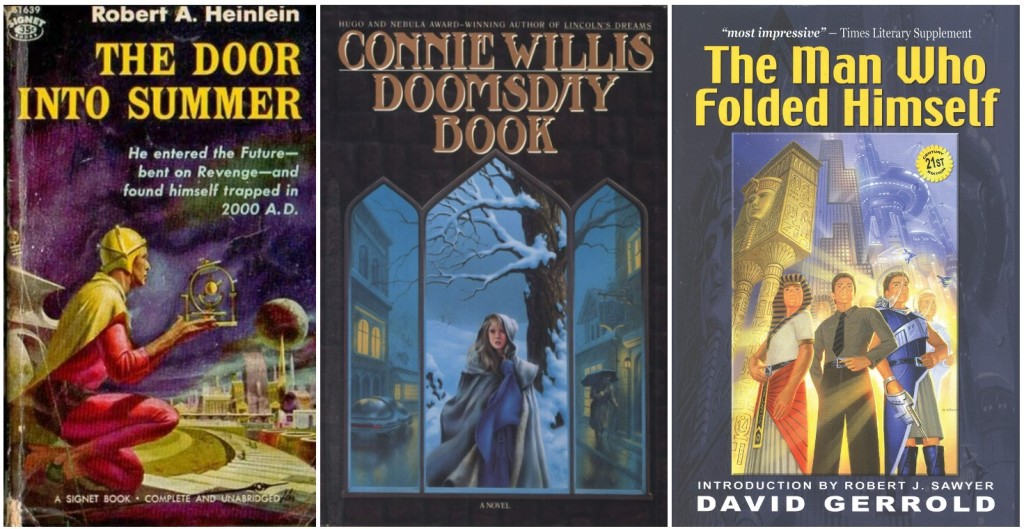
I judge time travel stories by how creative they are at dealing with time travel. For example, Heinlein’s “All You Zombies—” uses time travel and gender reassignment in a unique way. David Gerrold uses The Man Who Folded Himself to allow a time traveler to really get to know himself. Jack Finney in Time and Again used historical photographs to enhance his novel. Kurt Vonnegut combined memoir and fiction brilliantly. Connie Willis has explored both drama and comedy in her time travel novels. Of course, Wells illustrated both evolution and cosmology to his 19th-century readers. Wells inspired the Dying Earth genre and the idea that humanity will spin off different new species. Olaf Stapledon ran away with that idea with his novel Last and First Men.

With time travel stories, writers need to go big or go home. Philip José Farmer knew this. This is why he tacked on the Wold Newton afterward in a 1977 later edition. If you think Wold Newton is cool, then that might make Time’s Last Gift a good time travel story. If not, you might want to pass on it.

Here's a list of my favorite time travel stories.

1895 - THE TIME MACHINE by H. G. Wells
1934 - "Twilight" by John W. Campbell
1935 - "Night" by John W. Campbell
1941 - "Time Wants a Skeleton" by Ross Rocklynne
1941 - "By His Bootstraps" by Robert A. Heinlein
1943 - "Mimsy Were the Borogoves" by Henry Kuttner and C. L. Moore
1946 - "Vintage Season" by Henry Kuttner and C. L. Moore 
1951 - "I'm Scared" by Jack Finney
1952 - "A Sound of Thunder" by Ray Bradbury
1952 - "Hobson's Choice" by Alfred Bester
1953 - "Who's Cribbing" by Jack Lewis
1956 - "A Gun for Dinosaur" by L. Sprague de Camp
1956 - "The Man Who Came Early" by Poul Anderson
1957 - THE DOOR INTO SUMMER by Robert A. Heinlein 
1957 - "Soldier from Tomorrow" by Harlan Ellison
1958 - THE TIME TRADERS by Andre Norton
1958 - "Poor Little Warrior!" by Brian Aldiss
1958 - "The Ugly Little Boy by Isaac Asimov
1958 - "The Men Who Murdered Mohammed" by Alfred Bester
1959 - "All You Zombies---" by Robert A. Heinlein
1964 - FARNHAM'S FREEHOLD by Robert A. Heinlein
1964 - "When Time Was New" by Robert F. Young
1965 - "Traveller's Rest" by David I. Masson
1966 - "Behold the Man" by Michael Moorcock and BEHOLD THE MAN (1969)
1967 - "Hawksbill Station" by Robert Silverberg
1968 - THE LAST STARSHIP FROM EARTH by John Boyd
1969 - SLAUGHTERHOUSE-FIVE by Kurt Vonnegut, Jr.
1970 - TIME AND AGAIN by Jack Finney
1970 - THE YEAR OF THE QUIET SUN by Wilson Tucker
1971 - DINOSAUR BEACH by Keith Laumer
1973 - THE MAN WHO FOLDED HIMSELF by David Gerrold
1976 - "The Hertford Manuscript" by Richard Cowper
1967 - "Infinite Summer" by Christopher Priest
1980 - TIMESCAPE by Gregory Benford
1982 - "Firewatch" by Connie Willis
1985 - "Sailing to Byzantium" by Robert Silverberg
1988 - "Ripples in the Dirac Sea" by Geoffrey A. Landis
1992 - DOOMSDAY BOOK by Connie Willis
1995 - THE TIME SHIPS by Stephen Baxter
1995 - FROM TIME TO TIME by Jack Finney
1998 - TO SAY NOTHING OF THE DOG by Connie Willis
2003 - THE TIME TRAVELER'S WIFE by Audrey Niffenegger

Time Travel Anthologies

The Mammoth Book of Time Travel SF and The Time Travel MEGAPACK is currently 99 cents at Amazon for the Kindle edition.

James Wallace Harris, 7/30/22

“The Curse of the Mhondoro Nkabele” by Eric Norden

What if our pleasure in life is wallowing in the minutiae of our favorite subject? I follow a lot of YouTubers and most of their channels are about going deeper and deeper into a beloved special interest. When we are young we pursue pleasures of the flesh, but as we get older we follow our Alice of interest down a rabbit hole. This lets us find our true tribe, our people.

I feel like I’m among a few survivors of a tribe that is dying out. I lament that our culture and language are disappearing. My tribe is those beings who grew up reading science fiction magazines in the mid-20th century. I know that tribe was never very large and that all the various tribes of pop culture eventually fade from the collective memory of the present. But this sense of passing is why I find myself enjoying recursive science fiction so much now. Recursive science fiction is science fiction about science fiction, and quite often it remembers the genre’s past. And to enjoy such stories requires either a direct experience of the past or a good education about that past.

One of the funniest recursive science fiction stories I’ve ever read is one that seems to parody/remember more of the genre than any other recursive science fiction story I’ve read. The story is “The Curse of the Mhondoro Nkabele” by Eric Norden (Eric Pelletier 1899-1979). Unfortunately, it’s been a long time since this story has been reprinted, meaning if you want to legally read it, it will require tracking down a used copy of F&SF for September 1980, The Best from Fantasy and Science Fiction 24th Series edited by Edward L. Ferman in 1982, or Inside the Funhouse: 17 SF Stories about SF edited by Mike Resnick in 1992. If you have a free account with the Internet Archive you can check out The Best of F&SF 24th for one hour. Since this story hasn’t been reprinted in 30 years, and its author has been dead for 43 years, I hope their heirs won’t mind me offering you a pdf copy. (If you do, let me know and I’ll take it down, but I doubt if six people will read it.)

Of course, not everyone will find this story funny or meaningful. It depends on you knowing a good deal about the genre’s history. I thought I’d review the story by providing links to the pertinent bits of history that knowing will let the reader appreciate the story.

The story is an exchange of letters between Oginga Nkabele, a young man from Africa studying in America, and Edward L. Ferman, the editor of The Magazine of Fantasy and Science Fiction (F&SF). Nkabele, from the tribe of Diolas in Senegal, Africa, was educated by French and Belgian missionaries who he refers to as the Holy Ghost Fathers. One of his teachers, Father Devlin brought three steamer trunks containing over five hundred pulp science fiction magazines from 1936-1952. Nkabele has read these magazines so thoroughly that he’s even memorized some of his favorite stories. Nkabele feels he’s an expert on science fiction and decides to become a rich science fiction writer while in America.

Unfortunately, the stories he submits to Ed Ferman are modeled on the writing styles that were heavily criticized for bad writing when they were new and are now so out of fashion as to be glaringly awful. Ferman is appalled by Nkabele’s stories and rejects them immediately. Nkabele feels the rejection letter is a mistake and keeps pestering Ferman with more letters. In fact, he never accepts any rejection and keeps trying to convince Ferman his stories are brilliant and will make him famous and promises they’ll help sell more copies of F&SF.

Through the exchange of letters, two fun plots emerged. One is a horror tale for SF magazine editors which is hilarious if you’re not an editor, and the other is about how the genre has changed drastically from its past which is still wistfully nostalgic for some.

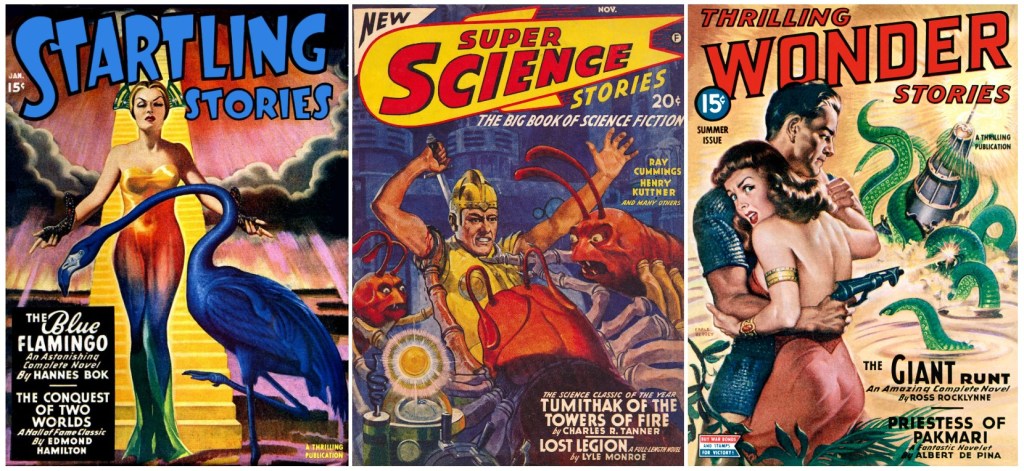
First, it’s important to know the magazines Nkabele admires. It’s notable that Father Devlin did not subscribe to Astounding Science-Fiction, the magazine revered until recent decades (another irony of this tale). Nkabele’s favorites are:

Nkabele’s favorite writers are Richard Shaver, L. Ron Hubbard, and Stanley G. Weinbaum, but is also a fan of Robert Moore Williams, E. E. “Doc” Smith, Nelson Bond, Ray Cummings, Eric Frank Russell, P. Schuyler Miller, and Raymond Z. Gallum. Although not specific to this story, if you know about The Shaver Mystery you’ll have a sense of the kind of thinking fans of these magazines pursued.

Most telling of all is that Nkabele’s favorite editor is Raymond A. Palmer. That’s quite revealing. Young science fiction writers today want to erase the memory of John W. Campbell, but when I was growing up, science fiction fans wanted to forget Ray Palmer’s impact on the genre.

To understand Nkabele’s taste in science fiction, even more, is to know the names of the three stories he keeps submitting:

  • “Astrid of the Asteroids”
  • “Slime Slaves of G’Harn”
  • “Ursula of Uranus”

The magazines Nkabele loved were the ones that appealed most to adolescents featuring exotic interplanetary adventure stories told in purple prose. The exact kind of science fiction John W. Campbell was fighting against in our Golden Age of Science Fiction. But Nkabele considers his science fiction the actual Golden Age of Science Fiction. Over the decades, different generations have defined their own Golden Age of Science Fiction. Youth always reject the past. Nkabele can’t fathom why Ferman is rejecting his Golden Age.

It helps to know a little about Edward L. Ferman since he’s a major character, but it’s very important to know about Harlan Ellison. Ferman panics and gives Nkabele Ellison’s address and phone number to get rid of him. Ferman tells Nkabele about Ellison’s legendary SF anthology Dangerous Visions. Now Harlan Ellison starts writing letters and Eric Norden parodies Ellison’s writing style in an over-the-top style that wasn’t far from Ellison’s own. They even rope in Isaac Asimov. Norden does a great job of making each letter writer sound like a distinct personality. Sometimes the epistolary caricatures aren’t so flattering and it’s a wonder Norden didn’t get sued by Ellison who was known for his litigious wrath.

It also helps to know about BEMs – Bug Eye Monsters – especially SF covers that showed BEMs running off with mostly naked Earth women. BEMs in SF anticipated the whole abductee theme of UFO fanatics. And Ray Palmer turned his SF magazines into UFO fanaticism.

Parodying science fiction has been around for a long time, and Norden mentions a classic, Venus on a Half Shell by Kilgore Trout. Kilgore Trout is a character in many of Kurt Vonnegut’s novels. But I’ll have more to say about such other fun novels and stories soon.

I’m not sure how many current SF readers will enjoy “The Curse of the Mhondoro Nkabele” by Eric Norden. Is the pop culture that it skewers too oldy moldy? I tend to think the people who will enjoy it most are the people of my tribe.

James Wallace Harris, 7/24/22

Mainstream Science Fiction

Emily St. John Mandel’s Sea of Tranquility is straight-ahead science fiction but it doesn’t feel like a genre novel. Explaining why will be hard. Science fiction has always avoided clear definition and trying to discern the difference between hardcore genre science fiction and literary science fiction might prove equally elusive. For most readers, it doesn’t even matter.

Sea of Tranquility was both entertaining and well-written. I liked it quite a lot. Many readers at Goodreads loved this short novel and gave the story five stars. However, the story was missing something for me. It lacked the intense impact I get from classic genre science fiction I love, even ones not as well told as Sea of Tranquility.

Most modern science fiction aims to be as dashing as Hans Solo but Sea of Tranquility was as mundane as a computer programmer. I considered that a positive but I have to admit the story had a certain blandness even though it dealt with many big science fictional concepts.

I do not want to tell you about those concepts because the way Mandel rolls them out makes it fun to explore the plot clue by clue. If you don’t want to read the novel but want to know a precise summary, Wikipedia has a blow-by-blow overview. However, I do want to tell you enough to want to read it. In the year 2401 Gaspery-Jacques learns about three anomalies in history. In the years 1912 a man named Edwin, in 2020 a woman named Mirella, and in 2203 a woman named Olive had the same bizarre experience that they’ve recorded in various ways in their own times. Historians in the 25th century find those records and decide they might be clues to an amazing hypothesis. Gaspery-Jacques decides he wants to be the person that solves the mystery even though he’s only an uneducated house detective for a hotel in a colony on the Moon. Lucky for Gaspery-Jacques, his sister is a brilliant scientist with connections.

BEWARE – Spoilers Ahead

To get into my discussion of mainstream science fiction versus genre science fiction will require giving away the story. The structure of Sea of Tranquility is much like another mainstream science fiction novel, Cloud Atlas by David Mitchell. Cloud Atlas was far richer and more intense than Sea of Tranquility, more like a genre novel. Both deal with epic concepts, but only Cloud Atlas felt epic in the storytelling. Mandel gives us a much quieter story and that’s often a trait of mainstream science fiction. Its tone is like two other recent mainstream science fiction novels, Klara and the Sun by Kazuo Ishiguro and Machines Like Me by Ian McEwan.

Sea of Tranquility explores the idea that our reality is a simulation. In the 25th century, scientists have a very carefully controlled type of time travel. They theorize the anomalies experienced by Edwin, Mirella, and Olive might be glitches in the simulation software. After five years of training, they send Gaspery-Jacques back to interview each of these people. We don’t know that right away, because Mandel at first tells each of their stories chronologically in time. I’m thinking of reading the book again to see if knowing that they are being interviewed by a time traveler changes how I experience the story. I guessed this might be happening because loose-lips by some reviewers said the book is a time travel novel. It would have been more fun not knowing that.

That’s another difference between mainstream science fiction and genre science fiction. Their stories often begin ordinarily and feel mundane and the science-fictional concepts creep into the tale. Genre science fiction often begins like the opening of a heavy metal concert, while mainstream science fiction begins with a quiet chamber quartet before a cerebral symphony.

Genre science fiction writers love to crank the volume to 11 and keep it there, while mainstream science fiction unfolds gently at volume 4 and politely increases to 6 or 7 at carefully chosen moments. If you compare Hyperion by Dan Simmons to Sea of Tranquility you’ll know what I mean.

Sea of Tranquility is science fiction for PBS Masterpiece. Station Eleven was Mandel’s polar opposite of Mad Max: Fury Road. Even though Sea of Tranquility explores such a deafening concept as the simulation hypothesis it does so in a whisper. A genre novelist writing the same story would have had epic rents in the fabric of reality, killing millions while its heroes save the universe at the last minute. Mandel’s hero eerily validates the hypothesis with a kind of “Ummm, that’s weird.”

Sea of Tranquility is also a pandemic novel about a writer writing a novel about a pandemic just before a pandemic hits. Olive Llewellyn is a novelist who lives on the Moon but tells of her publicity tour on Earth just before a brutal plague spreads across Earth in 2203. I assume Olive’s details and feelings about promoting a book came from Mandel’s own experience. Some of the characters in this novel were in Mandel’s previous novel, The Glass Hotel, and Edwin’s full name is Edwin St. John St. Andrew. Since he shares a middle name with Mandel I have to wonder if he was an ancestor of hers? Now I have to read The Glass Hotel. One of my favorite writers, Larry McMurty liked to recycle characters in other novels.

Finally, I wonder if fans of science fiction by Margaret Atwood, Hilary St. John Mandel, or Kazuo Ishiguro would also be fans of Dan Simmons, Iain M. Banks, and James S. A. Corey? Or vice versa? Let me know how you feel.

James Wallace Harris, 7/4/22

Science Fiction Writers in Conversation with Each Other

Imagine a world where science fiction had never been invented. Could you have written the first science fiction story? Be honest now, and think hard about yourself and what I’m asking. Before Galileo, did anyone think the Moon was a world that could be visited? Once people heard Galileo saw mountains on the Moon with his telescope they began to imagine going there. Science fiction needed certain kinds of seed ideas to begin. When the seeds come from reality I’ll call that Stage 1 science fiction. We don’t see a lot of that kind of science fiction anymore. Maybe The Martian by Andy Weir when he tried to realistically portray growing potatoes on Mars or when a writer extrapolates on current events like John Brunner did in Stand on Zanzibar back in 1968 or what Kim Stanley Robinson did in The Ministry for the Future in 2020.

Once the genre got rolling, science fiction seeded itself. One story about a trip to the Moon inspired an infinity. I call that Stage 2 science fiction. In Stage 2 writers try to stick to reality but work off the collective knowledge of the genre. Eventually, science fiction was making copies of copies, where the inspiration had no connection with reality. I’ll call that Stage 3 science fiction.

Early stories about traveling to the Moon were Stage 1 because it’s not likely the authors had read each other’s work. But when Verne and Wells wrote their novels of lunar exploration a lot of their inspiration was Stage 2. When John Varley wrote his stories about a lunar colony, most of the science-fictional concepts within those stories had been germinating for generations in the genre – Stage 3.

I believe science fiction writers have an ongoing conversation that never ends. To take part in this conversation, publish a story. It can be Stage 1, 2, or 3. To be heard and answered requires writing something in Stage 1 or 2, or a very creative Stage 3.

This is why I’ve become fascinated by the forgotten writer Walter F. Moudy. The 1950s and 1960s were a fertile time for Stage 1 and Stage 2 stories. By the second half of the 1960s and early 1970s writers who made themselves noticed were writing a baroque Stage 3 science fiction to attract attention. For example, the works of Samuel R. Delany, Roger Zelazny, and Robert Silverberg were based on old SF ideas told with new writing styles. Unfortunately, Moudy wrote Stage 3 stories in the same prose style that the classics of Stage 2 were written. His 1964-65 stories feel like they were written in 1954. One reason the New Wave writers of the 1960s were so important is they recognized that retelling Stage 2 stories in the same way, would get them ignored. The reason why Heinlein blazed onto the scene in 1939 is that he wrote Stage 1 stories with a new writing style, making his stories stand out.

I enjoy reading Walter F. Moudy in 2022 because I doubt I could write any better than he did, and he was responding to the stories I admired back then. His writing ability and knowledge of the genre were just good enough to get five works published and then become forgotten. As a would-be science fiction writer, I greatly identify with that. He wanted to join the conversation and made the effort to have his say. He just wasn’t heard, but now after decades, I’m listening.

While reading Walter F. Moudy’s meager output of science fiction I kept feeling his stories were inspired by the science fiction he and I both read. They made me wonder what he was trying to say in the ongoing conversation.

Of the five science fiction stories, I’ve read by Walter F. Moudy, “The Search for Man” is my favorite, although if I reread “The Survivor” or No Man On Earth I might change my mind. All were good fun, old-fashion science fiction, the kind my nostalgia loves. As I read “The Search for Man,” I kept wondering what science fiction Moudy had read that inspired this story. I can’t say for sure but this story about robots speculating about long-dead or gone humans reminded me of City by Clifford Simak. That “The Search for Man” set hundreds of years into the future speculated about our times and turned us into a religion reminded me of A Canticle for Leibowitz. That both the protagonists of No Man On Earth and “The Search for Man” were about a super-human and a super-robot reminded me of The Hampdenshire Wonder, Slan, Odd John, Chocky, Stranger in a Strange Land, and all the other science fiction stories about next-stage beings. Reading those two Moudy stories made me think about how I would have written a story on that theme. How much could I base it on reality, and how much would be inspired by other science fiction?

“The Search for Man,” begins with a baby being born, but it’s a strange birth, a kind of decanting that made me think of Brave New World. Then we learn the baby will only have three senses, and it will be put into a robotic baby’s body, the first of four body types it will use.

Moudy sets up a good mystery for us. Humans died out hundreds of years earlier, with all other animal life. The humans had tried to travel to the stars, but it appears their three missions had failed. The robot brains have improved their brains with genetics found in 12 human brains that had been preserved. The robots have found long-dead humans in various kinds of chambers that tried to create suspended animation. Their hope is to find a chamber with a viable human to resurrect. There are classes of robots that are archeologists and others that are priests that teach a strange religion based on their theories about humans. All of that is a very appealing setup for a story, at least for me.

I’m not sure Walter F. Moudy would have written “The Search for Man” without reading a lot of science fiction. Part of the conversation science fiction writers have is about science fictional ideas, but the other part is about how to present those ideas in a story. I felt “The Search for Man” was Moudy’s reply to both but in the language of 1950s science fiction. I wonder if he had been more of a stylist would he have made a greater impact?

“The Search for Man” was published in an original anthology In The Wake of Man that’s never been reprinted. I’ve been trying to get a copy, but it’s expensive, starting at $75 used. I had found a $10 copy for sale, but my order was canceled a couple days after I ordered it. Right now the only source for this story is a copy of In The Wake of Man at Archive.org. If you are a member, which is free, you can check it out for an hour to read online. Thanks to Joachim Boaz for finding that link.

Joachim Boaz and Rich Horton have also been writing about Walter F. Moudy. Rich is planning to review all of Moudy’s work soon.

James Wallace Harris, 6/30/22