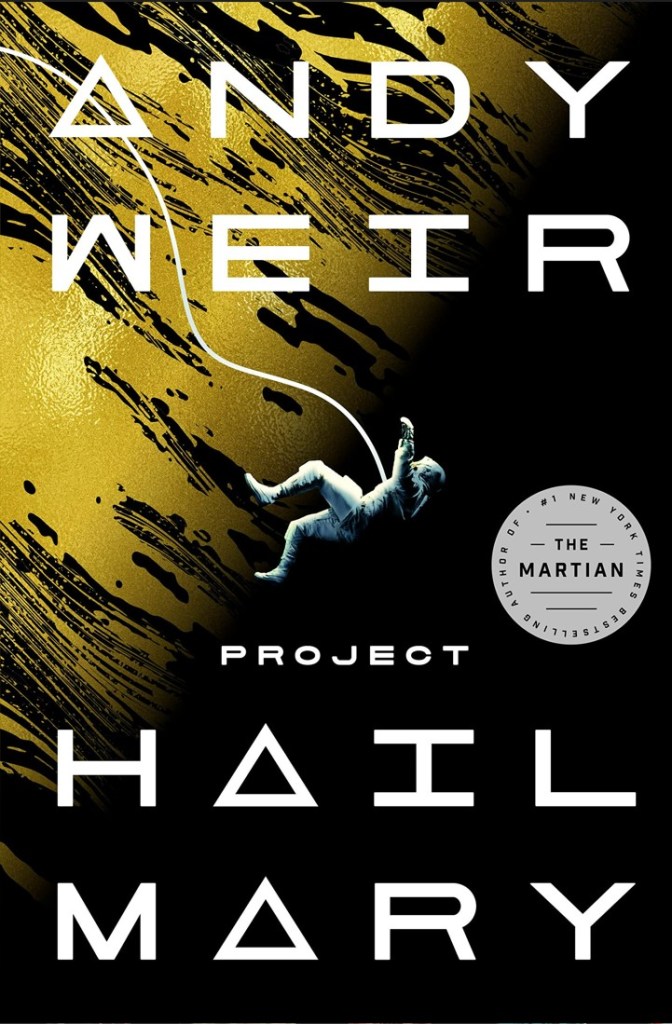
Project Hail Mary by Andy Weir

All people crave romance and sex, accomplishments and adventures, possessions and travel. Most of us settle for marriage and work while living our fantasies out vicariously in fiction. We use books, TV shows, movies, video games, or VR as substitutes for our desires. When fiction fails to satisfy we dine out, party, exercise, or travel. What we really want is to live a different life.

Knowing this should enlighten us about the fiction we choose. Are the stories we love most the ones we wished we were living?

Andy Weir’s latest book Project Hail Mary, left my eyes watery and my nose runny while listening to the last chapter on audio. I loved it. Is that the life I wished I was living? At 70, I know it’s an absurd fantasy and should answer that question with no. But when I was a teenager I would have said yes with great enthusiasm.

Nowadays, few science fiction books move me like that. And, I have to ask myself why. Did Project Hail Mary impact me in the same way the Heinlein juveniles did in the 1960s when I was twelve? Getting close to the end of life, I’m not sure I have much of a sense of wonder left, at least not the kind I had when reading science fiction in that golden age of being young.

When I discovered science fiction sixty years ago almost every story blew my mind with far-out ideas, giving me a tremendous sense of hope for the future, especially for the possibilities for my personal potential. Now, that I’m living in the future, with what little potential I have left, I see science fiction from a different vantage.

Project Hail Mary is one hell of a hopeful book and I enjoyed the hell out of it. I highly recommend reading it. If I had read it in 1964, or if I was 12 years old today, it would have made me a true believer in the science fiction faith. This week I read Weir’s novel and forgot about the world we see every evening on the NBC Nightly News, and I entered into a wonderful virtual reality created by Andy Weir’s skillful worldbuilding with words.

The entire time I listen to Project Hail Mary I marveled at Weir’s storytelling skills. He blended many of my favorite SF themes into an enchanting first-person narrative. Weir obviously imagined his novel as a movie, creating a lovable hero that will save the Earth. For some reason, science fiction blockbusters always seem to put Earth in final jeopardy. And many of them love having an average guy overcome an endless series of obstacles. Kurt Vonnegut gave some famous advice to would-be writers. He said: create a likable character and then do mean things to them. Andy Weir gives Ryland Grace a long series of impossible problems to solve.

The story begins with Ryland waking up in a strange hospital bed, not knowing who he is, where he’s from, or where he’s at. This is a neat storytelling trick. The novel breaks down into two tracks: the now and the past. Amnesia is the perfect excuse for creating flashbacks. Normally, I hate flashbacks, but Weir’s gimmick made me look forward to them.

I don’t want to tell you much about the novel and I want to beg you to get the audiobook version. The narrator acts out each character with a different voice, including accents for different nationalities. For the alien, Rocky, who speaks in musical tones which the audiobook plays, the narrator creates a charming accent for his English. The audiobook should have way more impact than just reading with your eyes.

Looking at reviews on Facebook, Goodreads, and Amazon, some readers loved this novel, while many others complain it’s too tedious. Weir tells this story in one long series of problems that Ryland Grace solves, many of which involve science. I assume the readers who love this story are problem solvers. If you’re not, this book might not be for you.

Ryland Grace is the ultimate competent man who can do everything. This character attribute is why I loved the Heinlein juveniles as a kid. It’s why I also loved the recent Bobiverse books. That’s one of my big personal fantasies, being a generalist that knows everything and can do anything. I’m not. I’m half-ass at doing a lot of things, and I vaguely know a little about a lot.

Ryland Grace is the modern manifestation of Tom Swift. That might be another clue for you if you’re thinking about reading this book.

Another fantasy Project Hail Mary tunes into is being alone in the world. I love the last man on Earth type stories, the Robinson Crusoe types. Ryland Grace is alone in space for a lot of this story. He even meets his Man Friday. (I hope I’m not giving too much away.)

Ryland Grace is the hero that saves Earth, and that’s one fantasy this book promotes that’s not mine. I don’t like attention. However, because of the way Andy Weir presents Ryland Grace’s achievements, I didn’t feel getting attention was a theme of this story. In flashbacks, we learn that Ryland Grace loved being a junior high school teacher who enjoyed promoting science with his students. That’s another theme that Heinlein and Weir are into that doesn’t resonate with me, but I imagine it will for teachers. Project Hail Mary would be a great book to teach in an English or science class.

Now to the negatives – which I just ignored because I was enjoying the story so much. Ryland Grace pulls a rabbit out of the hat every time, and his mental abilities are unrealistic. Plus, the invented science for this story is too good to be true. If people love Superman for his fantasy physical feats, Ryland Grace is a Superman of intellectual feats. In other words, the reality of this story is closer to a comic book than literary fiction.

That brings us back to my original psychobabble. Why do we choose the fiction we do? Why do we love some stories way better than others? Do the same themes appeal to us our whole life, or do they change as we age?

The Heinlein juveniles made the biggest impact on me of anything I read as a teen. That’s because I wanted to be like the characters in those books, and I wanted to grow up and live adventures similar to those in the stories. I wanted those fantasies to become real.

I can’t possibly believe that at 70. I’m a great deal more aware of reality now. I shouldn’t buy into anything in Project Hail Mary. I should be too old to enjoy it, but I did. A simple answer is I know too much about reality, and yet, I loved reading this book because it help me escape from reality that’s becoming all too harsh and hard. And that might have been the reason I loved science fiction as a kid too. The 1960s were tough times for anyone to grow up in, and I had feuding alcoholic parents who dragged me and my sister from state to state. That made things worse. Is it any wonder I wanted a science fictional fantasy to be real? Is it any different today?

Project Hail Mary is not a young adult novel, but it has that kind of appeal. As a kid, I knew science fiction was fantasy but reading science fiction made me hope that reality would become more like science fiction. It didn’t. We have science-fictional technology, but not science-fictional lives. That’s what we wanted. That’s what I wanted then, and now. And I can only find that life in books, books like Project Hail Mary.

James Wallace Harris, 8/7/22
The Challenge of Writing a Significant Time Travel Tale

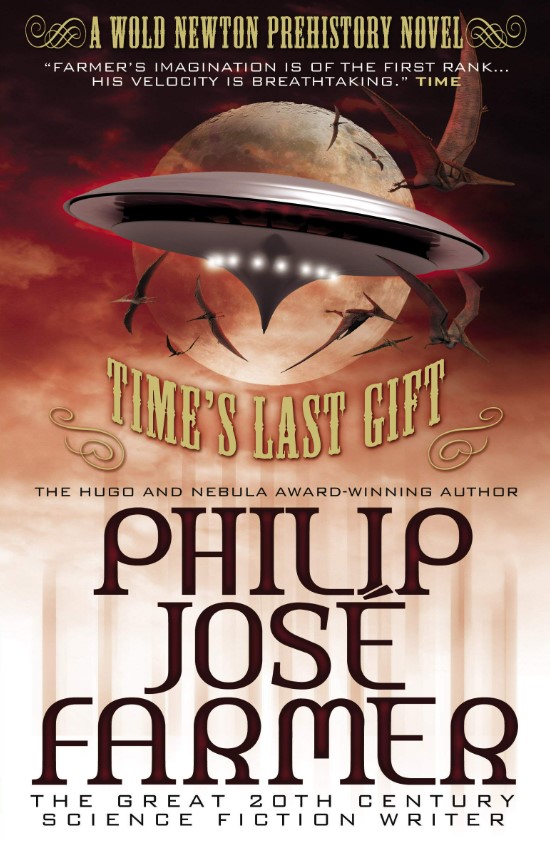
My aim is to review a time travel novel, Time’s Last Gift, by Philip José Farmer, but I need to explain my attitude towards time travel stories before I can pass judgment. I bought Time’s Last Gift because I read on the cover blurb that four scientists from the year 2070 travel back to 12,000 BC to study the Magdalenian culture. Since I’ve recently read a number of books on prehistory that plot appealed to me. I even read a large book just on locating the origin of the people who produced the proto-Indo-European language.

Within Time’s Last Gift, one character, Robert von Billmann is obsessed with finding the people who created the Proto-Indo-Hittite language. If you’re not interested in pre-history or the origins of language you might not want to bother with Time’s Last Gift – unless another factor appeals to you, but I want to wait and mention that after the spoilers warning. Let’s just say that John Gribardson, who was made leader of the expedition at the last minute has a very interesting backstory.

Does Time’s Last Gift stand on its own as a solid story and as a good addition to the time travel theme despite any details related to actual history or literary plot gimmicks? To me, a worthy time travel story has to add something different to the theme, otherwise, it’s just a romance, thriller, or historical novel that jumps around in time.

There have been countless science fiction books about time travel, but for me, I find very few of them worthy of using the theme. Most throw their characters into the past or the future and develop a story about that new setting. What I love is a time travel adventure that also explores the wonder of time and time travel. H. G. Wells set the bar very high with The Time Machine in 1895. I’m not sure any work has ever surpassed it for its sense of wonder.

There are so many time travel stories that Michael Main has created The Internet Time Travel Database. Town & Country Magazine listed their top 35 time travel books but only three of my top favorites make their list. Read This Twice found 92 favorite time travel books, and they do list many of my favorites. About Great Books lists 30-time travel books they think are great, and seven of my favorites are there, but I don’t consider many of those books really time travel stories. But that brings up another issue.

What is time travel? Replay by Ken Grimwood is one of my all-time favorite novels, but does Jeff Winston time travel? He repeats his life over and over. I call such fiction time loop stories. Stories such as The First Fifteen Lives of Harry August by Claire North, and The Midnight Library by Matt Haig are really time loop stories too, which I consider a different theme than time travel stories. I’ve written about it before.

Are such literary classics as The Time Traveler’s Wife, Kindred, Slaughterhouse-Five, A Christmas Carol, and Woman on the Edge of Time really about time travel? Don’t they just use the gimmick of time travel to reveal deep characterization or explore social issues in a clever way? These are great novels, but I don’t really want to lump them into the kind of science fiction novel I’m pointing to. Nor do I want to consider all the novels that use time travel to hook people up romantically.

Real science fiction about time travel should make us think about the nature of time travel. Time’s Last Gift does do this. Time travel has always been plagued by paradoxes, but I believe Farmer has found a neat way around them. If a time traveler goes into the past and changes the future, it’s already happened. Whatever exists now, whether affected by time travel or not, is what is. Speculations about what might be changed are no different from what was changed. If a time traveler shows up in 12,000 BCE there was never a 12,000 BCE without a time traveler. Of course, that means everything that happens is fixed. Or is it? Does this theory about time travel require predestination? It could mean everyone has free will, but whichever way history plays out it only plays out once.

Most of Time’s Last Gift is about living in 12,000 BCE. The four scientists immediately befriend a small tribe of humans and learn their language. John Gribardsun even wears their clothing and hunts with their weapons, although he often uses his rifle when necessary to help feed the tribe. The main conflict of the story deals with the two scientists who are married, Rachel and Drummond Silverstein, and their breakup. Farmer suggests that time travel has a psychological effect, like a larger case of jet lag, and it wears on three of the scientists. Gribardsun seems immune. In fact, he thrives in the past, and his vitality attracts both Rachel and the young women of the tribe. Much of the novel is about whether or not Drummond is out to kill Gribardsun because of jealousy. I didn’t care for this part of the story. It felt like a contrived conflict to move the novel along. However, the story is very readable and kept me reading.

Beyond Here Lie Spoilers

In the 1950s Philip José Farmer wrote some very innovative science fiction stories – “The Lovers,” “The Alley Man,” “Sail On! Sail On!” and others. Then he created two series that were fairly successful, the Riverworld series and The World of Tiers. Farmer won the Hugo award for best novel for the first Riverworld story, To Your Scattered Bodies Go (1971). I loved that novel when it came out because the main character was Sir Richard Francis Burton, the 19th-century explorer, and translator. And I loved the second book, The Fabulous Riverboat (1971) because it featured Mark Twain. I had read biographies of both men and that made me partial to those Farmer’s novels.

Over the decades I have come to feel that using a famous historical person as a character in a novel is a cheat, a way to sell books. But I also consider writing book series as a crutch for writers. For the rest of his life Farmer mostly churned out books for various series, and they were just so-so. He later refined the famous person gimmick by switching to writing about famous fictional characters, and this is where Time’s Last Gift comes in. John Gribardsun is Tarzan. It’s never said within the novel, but I guess it fairly quickly. If you’ve ever read a Tarzan novel, Time’s Last Gift feels like one and could have been Tarzan’s Time Machine.

There’s nothing wrong with book series, they do help writers to pay bills, but each book feels like just another episode in a TV series to me. If you love a series, that’s great. But for me, usually, only stand-alone novels can be great.

I assume Farmer didn’t use the name Tarzan in the book because of being sued by the Edgar Rice Burroughs estate, but ISFDB even lists Time’s Last Gift among the Tarzan novels. Philip José Farmer wasn’t the only writer to continue the character. More importantly, it’s part of Farmer’s Wold Newton series where he brings many famous characters from literature into the real world. If you really like this kind of publishing gimmick, then Time’s Last Gift might excite you.

I find the Wold Newton idea fascinating in conception, but lackluster in execution. It capitalizes on the readers’ love of famous books and characters and I consider that exploitation. Heinlein did the same thing in his later books bringing back his own favorite characters and tieing them into his favorite fictional worlds. The idea is neat, but again, the execution was horrible.

As a time travel novel, Time’s Last Gift is mediocre – readable and somewhat interesting. The plot moves along well enough. The John Gribardsun character is appealing but his adventures back in 12,000 BCE aren’t that significant. If you enjoy the idea that it’s an alternate origin story for Tarzan, and Farmer makes him immortal, then you might enjoy the book more.

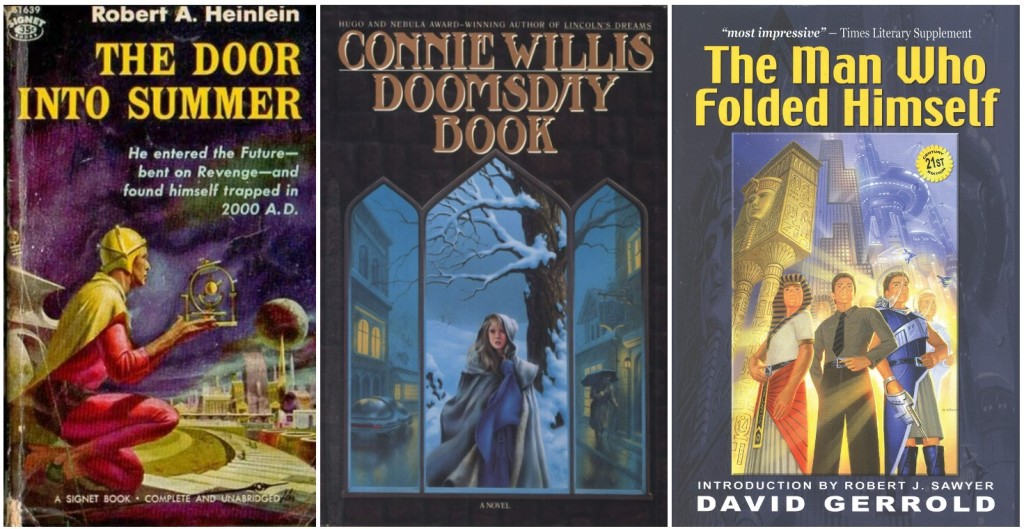
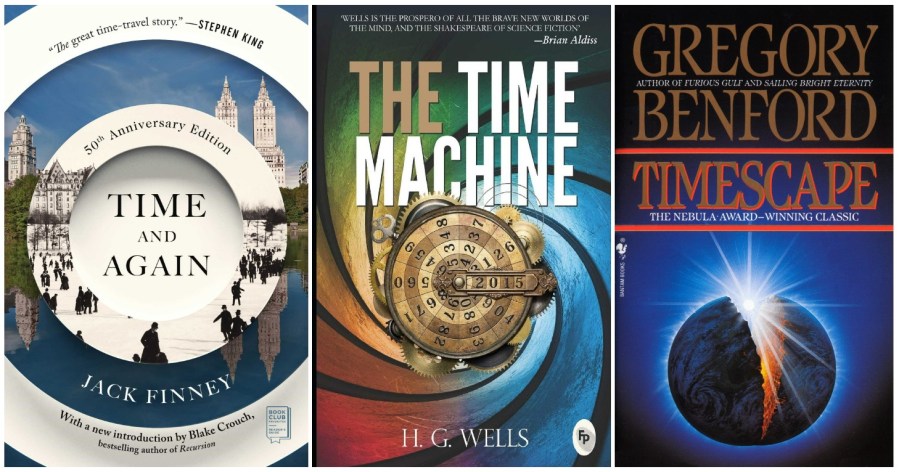
I judge time travel stories by how creative they are at dealing with time travel. For example, Heinlein’s “All You Zombies—” uses time travel and gender reassignment in a unique way. David Gerrold uses The Man Who Folded Himself to allow a time traveler to really get to know himself. Jack Finney in Time and Again used historical photographs to enhance his novel. Kurt Vonnegut combined memoir and fiction brilliantly. Connie Willis has explored both drama and comedy in her time travel novels. Of course, Wells illustrated both evolution and cosmology to his 19th-century readers. Wells inspired the Dying Earth genre and the idea that humanity will spin off different new species. Olaf Stapledon ran away with that idea with his novel Last and First Men.

With time travel stories, writers need to go big or go home. Philip José Farmer knew this. This is why he tacked on the Wold Newton afterward in a 1977 later edition. If you think Wold Newton is cool, then that might make Time’s Last Gift a good time travel story. If not, you might want to pass on it.

Here's a list of my favorite time travel stories.

1895 - THE TIME MACHINE by H. G. Wells
1934 - "Twilight" by John W. Campbell
1935 - "Night" by John W. Campbell
1941 - "Time Wants a Skeleton" by Ross Rocklynne
1941 - "By His Bootstraps" by Robert A. Heinlein
1943 - "Mimsy Were the Borogoves" by Henry Kuttner and C. L. Moore
1946 - "Vintage Season" by Henry Kuttner and C. L. Moore 
1951 - "I'm Scared" by Jack Finney
1952 - "A Sound of Thunder" by Ray Bradbury
1952 - "Hobson's Choice" by Alfred Bester
1953 - "Who's Cribbing" by Jack Lewis
1956 - "A Gun for Dinosaur" by L. Sprague de Camp
1956 - "The Man Who Came Early" by Poul Anderson
1957 - THE DOOR INTO SUMMER by Robert A. Heinlein 
1957 - "Soldier from Tomorrow" by Harlan Ellison
1958 - THE TIME TRADERS by Andre Norton
1958 - "Poor Little Warrior!" by Brian Aldiss
1958 - "The Ugly Little Boy by Isaac Asimov
1958 - "The Men Who Murdered Mohammed" by Alfred Bester
1959 - "All You Zombies---" by Robert A. Heinlein
1964 - FARNHAM'S FREEHOLD by Robert A. Heinlein
1964 - "When Time Was New" by Robert F. Young
1965 - "Traveller's Rest" by David I. Masson
1966 - "Behold the Man" by Michael Moorcock and BEHOLD THE MAN (1969)
1967 - "Hawksbill Station" by Robert Silverberg
1968 - THE LAST STARSHIP FROM EARTH by John Boyd
1969 - SLAUGHTERHOUSE-FIVE by Kurt Vonnegut, Jr.
1970 - TIME AND AGAIN by Jack Finney
1970 - THE YEAR OF THE QUIET SUN by Wilson Tucker
1971 - DINOSAUR BEACH by Keith Laumer
1973 - THE MAN WHO FOLDED HIMSELF by David Gerrold
1976 - "The Hertford Manuscript" by Richard Cowper
1967 - "Infinite Summer" by Christopher Priest
1980 - TIMESCAPE by Gregory Benford
1982 - "Firewatch" by Connie Willis
1985 - "Sailing to Byzantium" by Robert Silverberg
1988 - "Ripples in the Dirac Sea" by Geoffrey A. Landis
1992 - DOOMSDAY BOOK by Connie Willis
1995 - THE TIME SHIPS by Stephen Baxter
1995 - FROM TIME TO TIME by Jack Finney
1998 - TO SAY NOTHING OF THE DOG by Connie Willis
2003 - THE TIME TRAVELER'S WIFE by Audrey Niffenegger

Time Travel Anthologies

The Mammoth Book of Time Travel SF and The Time Travel MEGAPACK is currently 99 cents at Amazon for the Kindle edition.

James Wallace Harris, 7/30/22

“A Galaxy Called Rome” and Galaxies by Barry N. Malzberg

I’ve been reading recursive science fiction lately, and one of the most famous recursive science fiction stories is Barry N. Malzberg’s “A Galaxy Called Rome.” Recursive science fiction is science fiction about science fiction. Sometimes this is a story that mentions science fiction, sometimes it’s a story about science fiction writers, their fans, and science fiction conventions, and sometimes it’s in-jokes about the genre, other times recursive science fiction is about the writing of science fiction, and that’s the case with “A Galaxy Called Rome.”

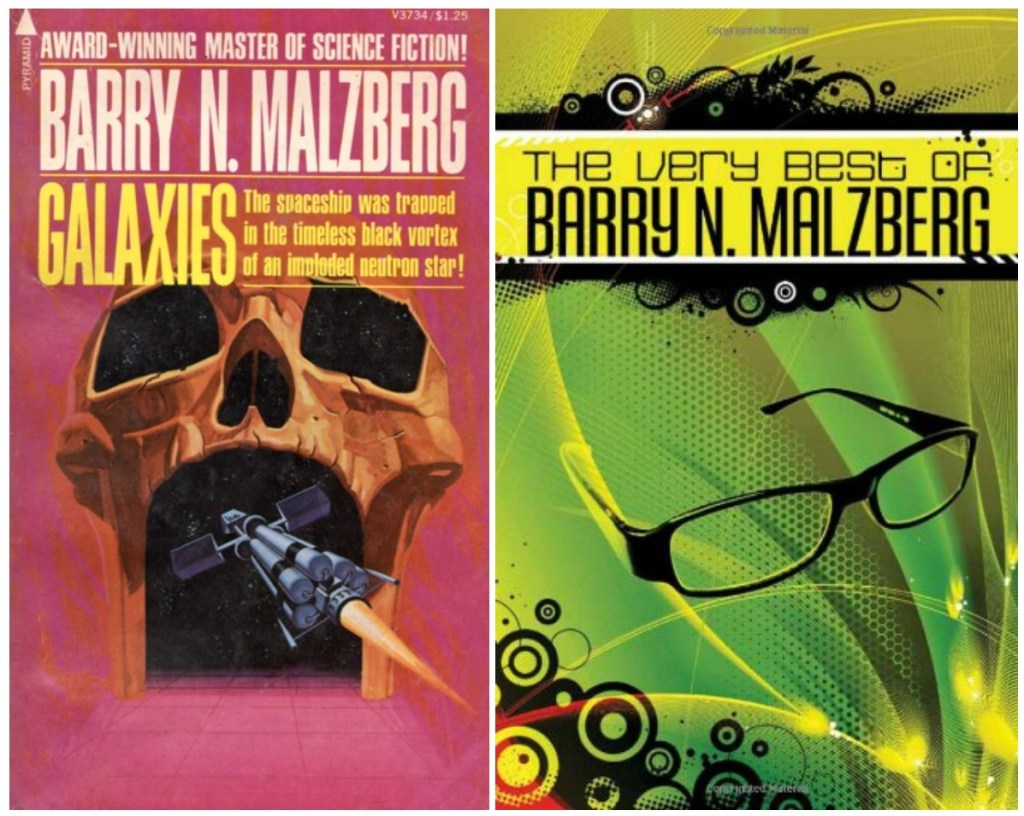
“A Galaxy Called Rome” has been reprinted often you can find it in these anthologies and collections. I read it in the anthology Inside the Funhouse: 17 SF Stories About SF edited by Mike Resnick in 1992. I highly recommend that volume if you can find it, but it was only published once by Avon. Probably the cheapest collection of Malzberg’s stories is The Very Best of Barry N. Malzberg because the Kindle edition is only $4.99. However, Malzberg expanded “A Galaxy Called Rome” into a short novel, Galaxies, and it’s available for $1.99 for the Kindle edition at Amazon.

Malzberg is known for his recursive science fiction, especially since he seems to have experienced a great deal of existential angst over being a science fiction writer. NESFA even came out with a collection of his recursive SF called The Passage of the Light: The Recursive Science Fiction of Barry N. Malzberg.

“A Galaxy Called Rome” is a novelette composed of 14 short chapters. It first appeared in the July 1975 issue of F&SF and has been anthologized a number of times. It is probably Malzberg’s most famous work of short science fiction. 

Malzberg expanded the same story into 49 chapters for a 1975 short novel version retitled Galaxies. Malzberg gained attention for a handful of science fiction novels in the first half of the 1970s. He won the John W. Campbell Award for Beyond Apollo but got a fair amount of recognition for Galaxies, The Falling Astronauts, and Herovit’s World. He went on to publish prolifically in and outside of the genre

“A Galaxy Called Rome” and Galaxies are also works of what the literary world calls metafiction – fiction about fiction. I prefer the novelette version of the story because the novelette is my favorite length for science fiction. However, the longer version of the story, Galaxies, lets Malzberg dig deeper into the nature of writing science fiction.

I want to recommend this story, but with carefully considered restrictions. If you read science fiction for escape this story isn’t for you. Well, if you want to know why you read science fiction for escape, then you might want to read it. This story is for people who like to intellectually examine everything and take things apart. This story is for readers who love academic exercises in cleverness. This story is for readers who want to know how magic tricks work.

I alternated reading Galaxies with listening to Red Rising by Pierce Brown. It was an excellent contrast. Red Rising is exactly what most science fiction readers want to read. The story immediately sucks the reader into a fantasy reality. It’s designed for your mind to forget the real world and immerse yourself in a fantasy about Mars. The reader is expected to buy into its make-believe. Galaxies on the other hand constantly remind the reader of our reality while describing how a science fiction writer goes about their business of fooling the reader.

Reading “A Galaxy Called Rome” or Galaxies could ruin your love of science fiction. Or it could make you appreciate escapist literature all the more. I know when I would switch to Red Rising after reading a dozen chapters of Galaxies I felt like that guy in The Matrix, Cypher, who wanted to take the blue pill and enjoy the juicy steak. And that might be a good analogy. Reading Malzberg is like taking the red pill and seeing an ugly reality. It might be philosophically enlightening to know the realness of reality, but it’s still grim and gritty.

This is probably why Malzberg never became a popular sci-fi writer, he was too hung up on reality. Most of the recursive science fiction I read in Inside the Funhouse was big fun. Recursive science fiction comes in many flavors but they can be roughly divided into two kinds. One kind celebrates our addiction, and the other makes you feel like you’re withdrawing from heroin. Reading “A Galaxy Called Rome” is like learning about Santa Claus as a kid, it hurts but makes you feel grown up. Reading Galaxies can feel like the agony of soul searching before deciding on becoming an atheist.

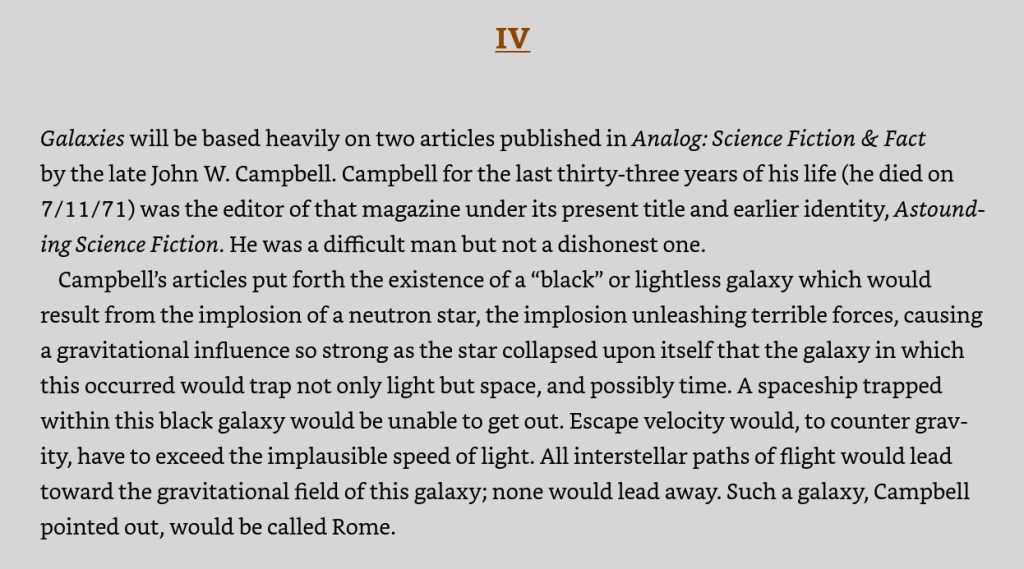
I ended up highlighting almost ten percent of Galaxies when reading the Kindle version. I won’t show all these quotes because that would probably be a copyright violation, but I do want to show enough of them to give people a chance to understand what Malzberg is doing. Malzberg is very open and straightforward with his intentions as stated in this first section.

It’s rather interesting that Malzberg tells us how the idea of the story within a story came to him. Well, the idea for the story he’s going to use to discuss writing. In the course of reading a novel about writing a novel, we will develop a whole story with characters, setting, plot, and conflict. However, we won’t experience that story like we normally do. Imagine being served a meal and instead of enjoying eating it, we put it under scientific analysis.

One thing Malzberg doesn’t do is try to imagine what we readers think while reading all of this. We readers are also part of the process. As I read Galaxies I got the idea that Malzberg both loved and hated science fiction. I got the impression he wanted to be a respected writer of hard SF, but his sense of reality conflicted with the fantasy nature of writing escapist literature.

These early sections are quite seductive, but I must warn anyone considering buying Galaxies that the going will get tough. “A Galaxy Called Rome” is the light fluffy version to read for those who aren’t ready to climb a mountain. Even though Galaxies is only 154 pages long, it’s a Ph.D. dissertation on deconstructing science fiction novel writing.

The story within this novel is about Lena Thomas who is the only living crew member of an FTL spaceship, Skipstone, that carries a cargo of 515 dead people in cryonic suspension. The year is 3902. Like in Heinlein’s novel, The Door Into Summer, rich people with diseases invest their estates and freeze their bodies in the hopes of one day being revived and cured. Those estates pay for the development of interstellar travel. Those dead people will eventually communicate with Lena like the dead in PKD’s Ubik when Lena and the Skipstone get trapped in the black galaxy. This allows Malzberg to explore metaphysical and religious themes in writing a novel. The ship also has robots programmed with human minds that help Malzberg explore other science fictional themes. His story notes get more and more extensive while getting more and more complicated. This also allows Malzberg to show how worldbuilding and plotting are developed as a writer tells their story.

Malzberg uses all this exploration in writing a science fiction novel to also speculate about the future. He imagines our civilization collapsing and being completely forgotten and a new world civilization rising in the following nineteen centuries. Malzberg imagines we’ll face limitations we can’t overcome and wild possibilities that far exceed today’s limitations.

Much of this novel is about being a writer, and specifically a writer of science fiction. You get hints along the way that Malzberg might be jealous of famous literary writers like Cheever and Updike, at other times you might feel his resentment at not being more successful at being a science fiction writer. But Malzberg is confident of his own gifts too.

In some of the actual passages of the novel, the dialog reminds me of Sheckley or Adams, or maybe even PKD, and even then Malzberg keeps making digs at science fiction.

Over time, the conflicts Malzberg provides for Lena’s story become repetitious. He knows he’s padding this novel, and even talks about how writers do pad their novels. The second half of Lena’s story becomes one long dark night of her soul struggling to escape the black galaxy. I have to wonder if such soul searching also plagues Malzberg.

Eventually, you wonder if Malzberg can find an ending to Lena’s story. Chapter after chapter he tortures the poor woman, and we can’t imagine any possible happy ending. Yet, Malzberg gives us a very strange ending that I was quite happy to read. I guess he took pity on us.

Reading Galaxies makes me doubt reading science fiction, but then I’ve doubted my addiction to our genre for decades. As a young person back in the 1960s and 1970s I thought science fiction was a wonderful tool for thinking about all the possibilities of the future, both good and bad. But after living to the year 2022, which was a very futuristic sounding year back in 1965, I know the future is everything we never imagined.

Contrasting Galaxies with Red Rising it’s quite obvious that science fiction’s purpose is escape. And the genius of writing science fiction is creating stories set in fictional worlds that are so compelling we forget this one. By Malzberg intruding into his novel and telling us everything only shows we don’t want the author intruding into our stories. Some philosophers have speculated that God invented our reality and walked away from his creation and that’s a great thing. That knowing God’s intention would ruin his/her/its art. I always felt Heinlein destroyed his career after he started poking his nose into his stories.

“A Galaxy Called Rome” and Galaxies were written as the New Wave in science fiction was fading and postmodernism fiction in the literary world was becoming old hat. It was an impressive experiment of the times, but as far as I know, readers have lost interest in such experiments. The Post Moderns of our times demand wokeness in fiction but not the metafictional kind. If anything, modern SF readers want longer voyages of fictional escape with far greater feats of worldbuilding.

It would be interesting to see someone write a version of Galaxies today that reveals what today’s SF writers go through to entertain their readers in the 2020s.

James Wallace Harris, 7/23/22

Mainstream Science Fiction

Emily St. John Mandel’s Sea of Tranquility is straight-ahead science fiction but it doesn’t feel like a genre novel. Explaining why will be hard. Science fiction has always avoided clear definition and trying to discern the difference between hardcore genre science fiction and literary science fiction might prove equally elusive. For most readers, it doesn’t even matter.

Sea of Tranquility was both entertaining and well-written. I liked it quite a lot. Many readers at Goodreads loved this short novel and gave the story five stars. However, the story was missing something for me. It lacked the intense impact I get from classic genre science fiction I love, even ones not as well told as Sea of Tranquility.

Most modern science fiction aims to be as dashing as Hans Solo but Sea of Tranquility was as mundane as a computer programmer. I considered that a positive but I have to admit the story had a certain blandness even though it dealt with many big science fictional concepts.

I do not want to tell you about those concepts because the way Mandel rolls them out makes it fun to explore the plot clue by clue. If you don’t want to read the novel but want to know a precise summary, Wikipedia has a blow-by-blow overview. However, I do want to tell you enough to want to read it. In the year 2401 Gaspery-Jacques learns about three anomalies in history. In the years 1912 a man named Edwin, in 2020 a woman named Mirella, and in 2203 a woman named Olive had the same bizarre experience that they’ve recorded in various ways in their own times. Historians in the 25th century find those records and decide they might be clues to an amazing hypothesis. Gaspery-Jacques decides he wants to be the person that solves the mystery even though he’s only an uneducated house detective for a hotel in a colony on the Moon. Lucky for Gaspery-Jacques, his sister is a brilliant scientist with connections.

BEWARE – Spoilers Ahead

To get into my discussion of mainstream science fiction versus genre science fiction will require giving away the story. The structure of Sea of Tranquility is much like another mainstream science fiction novel, Cloud Atlas by David Mitchell. Cloud Atlas was far richer and more intense than Sea of Tranquility, more like a genre novel. Both deal with epic concepts, but only Cloud Atlas felt epic in the storytelling. Mandel gives us a much quieter story and that’s often a trait of mainstream science fiction. Its tone is like two other recent mainstream science fiction novels, Klara and the Sun by Kazuo Ishiguro and Machines Like Me by Ian McEwan.

Sea of Tranquility explores the idea that our reality is a simulation. In the 25th century, scientists have a very carefully controlled type of time travel. They theorize the anomalies experienced by Edwin, Mirella, and Olive might be glitches in the simulation software. After five years of training, they send Gaspery-Jacques back to interview each of these people. We don’t know that right away, because Mandel at first tells each of their stories chronologically in time. I’m thinking of reading the book again to see if knowing that they are being interviewed by a time traveler changes how I experience the story. I guessed this might be happening because loose-lips by some reviewers said the book is a time travel novel. It would have been more fun not knowing that.

That’s another difference between mainstream science fiction and genre science fiction. Their stories often begin ordinarily and feel mundane and the science-fictional concepts creep into the tale. Genre science fiction often begins like the opening of a heavy metal concert, while mainstream science fiction begins with a quiet chamber quartet before a cerebral symphony.

Genre science fiction writers love to crank the volume to 11 and keep it there, while mainstream science fiction unfolds gently at volume 4 and politely increases to 6 or 7 at carefully chosen moments. If you compare Hyperion by Dan Simmons to Sea of Tranquility you’ll know what I mean.

Sea of Tranquility is science fiction for PBS Masterpiece. Station Eleven was Mandel’s polar opposite of Mad Max: Fury Road. Even though Sea of Tranquility explores such a deafening concept as the simulation hypothesis it does so in a whisper. A genre novelist writing the same story would have had epic rents in the fabric of reality, killing millions while its heroes save the universe at the last minute. Mandel’s hero eerily validates the hypothesis with a kind of “Ummm, that’s weird.”

Sea of Tranquility is also a pandemic novel about a writer writing a novel about a pandemic just before a pandemic hits. Olive Llewellyn is a novelist who lives on the Moon but tells of her publicity tour on Earth just before a brutal plague spreads across Earth in 2203. I assume Olive’s details and feelings about promoting a book came from Mandel’s own experience. Some of the characters in this novel were in Mandel’s previous novel, The Glass Hotel, and Edwin’s full name is Edwin St. John St. Andrew. Since he shares a middle name with Mandel I have to wonder if he was an ancestor of hers? Now I have to read The Glass Hotel. One of my favorite writers, Larry McMurty liked to recycle characters in other novels.

Finally, I wonder if fans of science fiction by Margaret Atwood, Hilary St. John Mandel, or Kazuo Ishiguro would also be fans of Dan Simmons, Iain M. Banks, and James S. A. Corey? Or vice versa? Let me know how you feel.

James Wallace Harris, 7/4/22

Blowing Your Chance to Speak to the Future

Writers cherish the myth that their work will make their names immortal. And it is true we have remembered some authors for thousands of years. However, if you want to be heard across time, you have to write something timeless.

My friend Mike and I are fascinated by forgotten writers, especially forgotten science fiction writers. We can’t help but wonder why a writer quits after their initial success of selling a few stories or maybe a novel. Mike texted me the other day about such a writer he discovered in an interview with Geraldine Brooks in The New York Times.

It was part of their By the Book series, where all writers are asked the same standard questions. My favorite question: “What’s your favorite book no one else has heard of?” Often this makes for an interesting title to chase down. Brooks said: “‘No Man on Earth,’ by Walter Moudy. The only other person I know who has read it is my son because I pressed it on him.”

So one well-regarded literary writer resurrects Walter F. Moudy 49 years after he died. That one little mention in the Times got me to read his novel. Maybe a few other people will too. And it’s a pretty good science fiction story for 1964. The question is, could it have been better? What would have made that novel stay in print? Is it worth reprinting? And do I recommend you read it?

You can read a pdf copy of No Man On Earth here.

It turns out that No Man On Earth is a forgotten science fiction novel by a forgotten science fiction writer, Walter F. Moudy (1929-1973). His ISFDB entry lists one novel and four short stories. This novel appeared in October of 1964, and then three of his four stories appeared in April and May of 1965, two in Fantastic and one in Amazing, both edited by Cele Lalli (Goldsmith). Moudy would have been in his mid-thirties. In 1966 he published another novel, The Ninth Commandment, probably not science fiction, and one I can’t track down. Finally, in 1975, after his death, Moudy had one more story, a novella, published in an original anthology, In the Wake of Man. The other two authors in that book were Gene Wolfe and R. A. Lafferty, pretty impressive company.

Besides No Man On Earth, I’ve read his three stories in Fantastic and Amazing, but it would cost me $75 to read his final story and that’s too much. For me, Walter F. Moudy’s science fiction legacy is that one novel, two short stories, and a novelette. Not much to go by, but still, I’m terribly envious since I’m a lifelong would-be science fiction writer. I’d give anything to have contributed even that much to the genre.

Why after his initial success in 1964-1966 did Moudy quit writing? And how did Roger Elwood get his last story? I guess Moudy tried one more time before he died to say something in print. But maybe Elwood had been holding it for years, and it was written in the mid-sixties. Reviewers haven’t been kind to it.

I was able to track down a few biographical details. Moudy was from Missouri, served in the Air Force from 1950 to 1953, got a degree in 1954, and then a law degree in 1957. He was Phi Beta Kappa. Moudy was married and had three children. In other words, he had a successful life and didn’t need to be a writer. Still, as I read his work over the last few days, I felt he had something to say. At least in No Man On Earth.

His three short stories were rather minor. The first, “The Dreamer,” was about a young man who wanted to get rich and famous as a space trader. The story was told like a fable. Its redeeming feature was a super-intelligent parrot. The second, “I Think They Love Me,” is about rock stars going to extreme lengths to survive hordes of screaming teenage girls. This was written a year after The Beatles hit America and was kind of cute, but not really worth remembering. The last, and the one most anthologized, is “The Survivor,” about a televised war game between America and Russia. It reminded me of The Hunger Games. This story came out in 1965 and was probably inspired by the 1964 Olympic games and the films Dr. Strangelove and Fail-Safe. “The Survivor” was gritty, detailed, and suggested each country sacrifice 100 men every four years in a fight to the death rather than risking total national annihilation.

Those three stories were somewhat entertaining, especially the last one, but they don’t leave the kind of impression that Moudy was making a statement. However, No Man On Earth does. Writers can make different kinds of statements. They can aim to write a better story than what’s written before. Or they can capture their times realistically in words. And common with science fiction writers, they can say something philosophical about reality. And there are so many other ways.

For example, I believe Robert Heinlein was influenced by the success of Atlas Shrugged by Ayn Rand in 1957, and that’s why he aimed so high with Stranger in a Strange Land. In his later years, Heinlein repeatedly tried to convince fans that Starship Troopers (1959), Stranger in a Strange Land (1961) and The Moon is a Harsh Mistress (1966) were books that he wanted to be remembered for because they expressed his philosophy on freedom and responsibility.

My guess is Moudy was inspired by Stranger in a Strange Land when he wrote No Man On Earth. Heinlein’s main character Valentine Michael Smith is a human raised by Martians who taught him psychic powers. Moudy’s main character, Thad Stone, had a human mother and alien father and was a super-genius. Both novels are told with picaresque plotting. Both books comment on sex and society. Moudy has Stone tour many planets and visits many kinds of societies and civilizations. No Man On Earth ran 176 pages in its first publication, a slim paperback original to Stranger’s 408 pages in the G. P. Putnam’s Sons first-edition hardback. Heinlein was obviously trying to hit one out of the genre after over twenty years of being a big fish in a small pond. Frank Herbert also aimed sky high with Dune in 1965. It was also over 400 pages.

There are a lot of one-hit wonders in the book world but few writers struggle with their masterpieces like Harper Lee or John Kennedy Toole. My guess is Moudy knocked this novel out quickly and was probably paid around $750 for his paperback original and when it disappeared on the twirling wire racks after a couple of months felt his time was better spent being a lawyer. If he had written a 400-page monster and got it published by a major hardback publisher No Man On Earth might have had a better chance. He just didn’t aim high enough.

It would have also helped if he had written No Man On Earth in an innovative style that made the genre take notice, like Dune and Stranger in a Strange Land. Moudy’s story and writing reminded me a bit of Leigh Brackett’s The Long Tomorrow (1955), Edgar Pangborn’s A Mirror for Observers (1955), and Walter Tevis’s The Man Who Fell to Earth (1963), all books he could have read and could have inspired No Man On Earth.

Obviously, if Geraldine Brooks fondly remembers No Man On Earth in 2022 so it can’t be a stinker. I liked it quite a lot and rushed through it in two days because it was compelling in the old-fashion kind of science fiction I love. It’s great that Tevis’s 1963 novel is still remembered, and I think it’s a shame that Moudy’s book isn’t more remembered.

James Wallace Harris, 6/21/22

Improving the Internet for Researching Science Fiction

I wrote an long review of We Can Build You by Philip K. Dick for my personal blog. Normally, I would put my science fiction reviews here, but my goal is to review every book I read in 2022 at Auxiliary Memory. Go read the review if you’re interested in PKD, but what I want to do now is talk about how I researched that review. I found quite a few impressive sites devoted to Philip K. Dick, but I didn’t think Google was very good at helping me find them. I also assumed there are way more great sites out there that I’m not finding through Google.

Google is unfortunately geared at helping people sell stuff. It’s a shame it doesn’t offer us radio buttons or a pulldown menu near the search box where we could tell Google what kind of results we want. If the box “[ ] I’m Buying” isn’t checked, then don’t show us any site trying to sell us stuff. There is scholar.google.com to search, but its results come mainly from academic sites (often with content behind paywalls), and I want results from all sites. I believe search engines aren’t the solution.

Once upon a time I wanted to become a librarian, so I’m thinking of librarian type solutions. Remember the good old card catalog? I believe one way to separate the informational wheat from the chaff is to use a curated card catalog. And I believe one already exists – Wikipedia.

Here is Wikipedia’s entry for We Can Build You and the entry for Philip K. Dick. The first link in the Reference section is to the novel’s entry in ISFDB. Between those three web pages, most readers would learn about all they wanted about We Can Build You before reading it. Searching Wikipedia first was far more efficient than starting with Google.

What Do We Want From An Internet Search Tool?

  • Immediate access to the exact information we seek
  • Links to the most authoritative information
  • We want enduring sources that can be sited
  • We want accurate information
  • We want human curated information
  • We want cumulative history of the information
  • We want information organized into useful subcategories

Using my research for We Can Build You as an example, here’s what would be the ideal results, both in general, and specifically how I see Wikipedia providing it.

  1. A comprehensive history of the writing and publication of the book.
  2. A complete but concise summary of the plot with a listing of characters.
  3. A summary of the most common interpretations of the book
  4. A summary of how the book has been reviewed and judged.
  5. Links to the best online reviews/essays/academic papers
  6. Links to databases that contain information about the book
  7. Links to where I can buy/download the book
  8. Links to books/essays/academic articles about the book
  9. Bibliography of significant books/journal citations that aren’t online.

Wikipedia has already been moving in this direction. The entry for We Can Build You is a decent start. Dr. Bloodmoney has some improvements. But the entry for The Man in the High Castle gets much closer to what I’m wanting.

Google claims there are 53,800 pages with information about [“We Can Build You” by Philip K. Dick]. Just how many extensive reviews or scholarly papers on We Can Build You exist? Some might be on the 12th page of a Google results or the 153rd, or hidden behind a firewall protecting academic publications so they aren’t easily found. How many excellent articles on the book have been written? 8, 15, 172? What if human editors decided on the best 5-10 to list on the Wikipedia, especially if their full text was available online? At what point do we have enough information about any subject?

A Wikipedia entry doesn’t need to be a dissertation on the subject but it should be the start of one. It should provide all the links to start writing a dissertation.

ISFDB lists eight reviews, but not links to the actual reviews. Some of those reviews are on the internet, some are not. One of those reviews is also listed on Wikipedia but without a link, even though the full text of the magazine is available online. Read the Theodore Sturgeon’s review in the January 1973 issue of Galaxy, and it is summarized on the Wikipedia page. However, none of these links proved that useful to me, and I have to assume much better content has been written about We Can Build You in the last fifty years.

Wikipedia could link to all the academic contend behind paywalls. That would be a tremendous step forward. Better yet link to a service that would allow users to easily buy those articles with Paypal (and give Wikipedia a cut). Or if the publication was something for sale on Amazon, link to it and allow Wikipedia an affiliate cut. Here is the opening page to a book I found that has a chapter on We Can Build You that I discovered though scholar.google.com. It was on Amazon for $9.99 for the Kindle edition. The book is The Twisted Worlds of Philip K. Dick: A Reading of Twenty Ontologically Uncertain Novels by Umberto Rossi.

I found this first page of the introduction so exciting that I bought the book – and it has a chapter on We Can Build You. Because of my knowledge of Sheckley and PDK I know Rossi will have incredible insight. This book should have a link on Wikipedia.

All the scholarly opinions about We Can Build You would be too much for Wikipedia to summarize, but it should point to the best. That would certain be a better solution than Google. Google is finding information by machine indexing. Right now, Wikipedia is presenting information by human intelligence. I believe we need more human help in internet searches than brute force AI. Of course, AI will eventually be better than humans. Someday, an AI will write the perfect nonfiction book on any subject we request of it.

Scholar.google.com returned 47,700 results for the search [We Can Build You by Philip K. Dick]. Wikipedia could link to that search results, and it could list some of those citations that have been human verified by editors to be among the best. Wikipedia is written and edited by volunteers. New volunteers looking for something to contribute could curate the most important links.

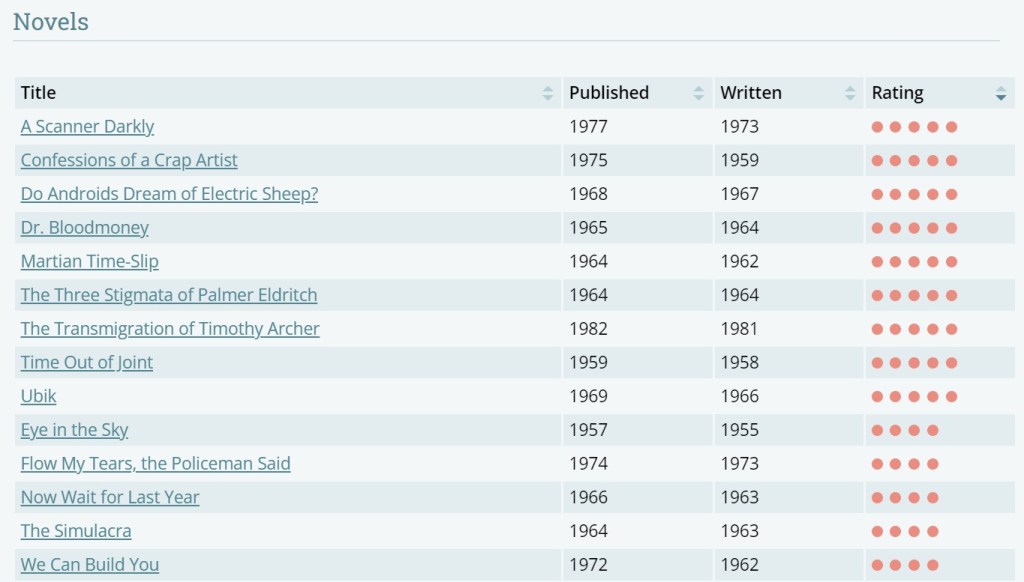
While researching We Can Build You I found all kinds of web pages that offer useful information. At the site The World Dick Made they had user sortable listing of PKD’s novels with star ratings, giving the data written and date first published. Here are the books that get 5 and 4 star ratings. We Can Build You gets 4 stars from this site. This certainly would be a nice link for Wikipedia. The link for the novel takes us to a page with more good information, including a long list of characters within the story.

Our own citation listing shows We Can Build You wasn’t very popular on recommended lists and fan polls, but that Josh Glenn put it on the list “75 Best New Wave Sci-Fi (1964-1983) Novels.” That would be another worthy link to include at Wikipedia.

Ultimately, what we want from an internet search is knowledge. Most of us use Google to gather data so we can assemble that data into our own version of knowledge. That’s what my review ended up being. However, my take was highly idiosyncratic. Most people searching on We Can Build You would want facts. Wikipedia does a decent job now, and it’s getting better all the time. However, some researchers would want to know about or even want to read the most common idiosyncratic takes on the novel. Right now, we have to use Google to track those down but it’s very inefficient. Scholar.google is better, but still returns to many results. The right links added to Wikipedia would make it a far superior search tool.

In the future, I can picture the volunteer editors at Wikipedia adding more and more information to each entry, and it will get into helping its users find those idiosyncratic views. This will be much more efficient than Google.

Right now I have several shelves of books about science fiction and its history. If I started with the main entry for Science Fiction in Wikipedia and pulled out all the content that is linked to it, I’d have the best book ever written on the subject, with the best illustrations. All the famous SF authors and their novels have entries in Wikipedia, as well as most of their famous short stories. Wikipedia also covers the editors, book publishers, and magazines. Eventually, Wikipedia could describe every SF stories ever written, and link to where they could be bought or read online, as well as links to everything we know about them. That’s why I believe Wikipedia should become the card catalog of the internet.

Of course, the next problem is making this knowledge permanent.

James Wallace Harris, 2/11/22

Getting to Know PKD

I’ve written about the biographies of Philip K. Dick before. They each give a different view of PKD. Recently I discovered there were six volumes of his selected letters from Underwood-Miller/Underwood Books. I don’t know why I didn’t know about these before or think to search them out. I just didn’t. They are all currently out of print. I saw a quote from one letter recently and went to ABEbooks to buy it. Wowza. They were expensive. My buddy Mike who shares my interest in PKD and I bought five of the six volumes, but we just didn’t want to pay $350 for the first volume. What a mistake. I’ve seen four copies come up for sale lately, all over a $1,000, with two going for $1,500.

I’m not a book collector and won’t pay those prices. I just want to read them. The Selected Letters of Philip K. Dick Volume One covers the years from 1938-1971. MIke is reading in 1972 and finding some good stuff. I started with the sixth volume, 1980-1982, the last. Reading PKD’s letters gives a whole different feel for the guy that I didn’t get from the biographies. Mike sent me one letter I found particularly intriguing.

After I read that I had to read “Who Shall Dwell” by H. C. Neal. According to ISFDB it originally appeared in the July 1962 issue of Playboy, and then was reprinted three times in anthologies from Playboy about science fiction (1966, 1968, 1971). Then it was reprinted in two other anthologies, Themes in Science Fiction (1972) edited by Leo P. Kelley (where PKD read the story), and Look Back on Tomorrow (1974) edited by John Osborne and David Paskow. ISFDB offered no biographical information on H. C. Neal. But I found this introduction in The Playboy Book of Science Fiction and Fantasy.

Searching Google didn’t come up with anything until I added “newspaper writer” to his name. I then found his obituary.

I love discovering forgotten science fiction authors. It appears H. C. Neal wrote one science fiction short story, for Playboy no less. It was liked enough to be reprinted in five anthologies, the last being in 1974. In 1972, Philip K. Dick wrote a rather gushing fan letter. Reading PKD’s letters shows you he was often very sentimental, often wanting to help people. Dick did have mental problems, and he did do some drugs, but nothing like his reputation.

Why did PKD feel so strongly about Neal’s story? What did he think it was one of the finest stories the science fiction genre produced. Well, I had to track down a copy. I found two copies of Themes in Science Fiction for sale and ordered one. However, I later was able to find it online.

I don’t know how to ask H. C. Neal’s heirs for permission to reprint this story, so I’m going to take a chance they won’t sue me. I’ll gladly take it down if someone notifies me (classicsofsciencefiction at gmail dot com). I’m hoping it is out of copyright because the story came out during the era when writers had to renew their copyright, and maybe Mr. Neal never got around to doing that. And I hope it’s not a big deal to reprint this here since I only have about a dozen readers. But I do want to reprint it because I think it’s important to understand PKD’s letter.

This isn’t the finest science fiction story ever written, but it’s pretty good. Stories about bomb shelters were common back in the 1950s and 1960s. I wonder if Neal was inspired by the September 9, 1961 episode of The Twilight Zone called “The Shelter” because the stories are very similar, except for the endings. To me, Neal seems to be speaking directly to the TZ ending, offering an alternative ending that’s positive about humanity.

I have to assume Philip K. Dick admired Neal’s story because it’s pro-humanity and PKD felt science fiction was too cynical. But like his explanation to Mr. Neal, Dick was sad because he lost touch with his wife and son, and here was a story about a man who sacrificed himself for his children and others. Maybe he admired the story because it made him feel guilty.

This one letter shows us PKD’s sentimental side. Mike said that’s common in the letters he’s reading. The letters I’m reading are more about the writing business, but they also include letters to pen pals. Dick is often generous, asking his agent to send gifts to people.

If you’re fascinated by Philip K. Dick and have read some of the biographies, I’m sure you’ll want to read his selected letters. Unfortunately, they are priced out of reach of most fans. Let’s hope they are reprinted soon and stay in print next time. If Kindle editions were available for a reasonable price I’d buy them again because my old eyes prefer ebooks.

James Wallace Harris. 12/7/21

“Let Us Save the Universe” by Stanislaw Lem

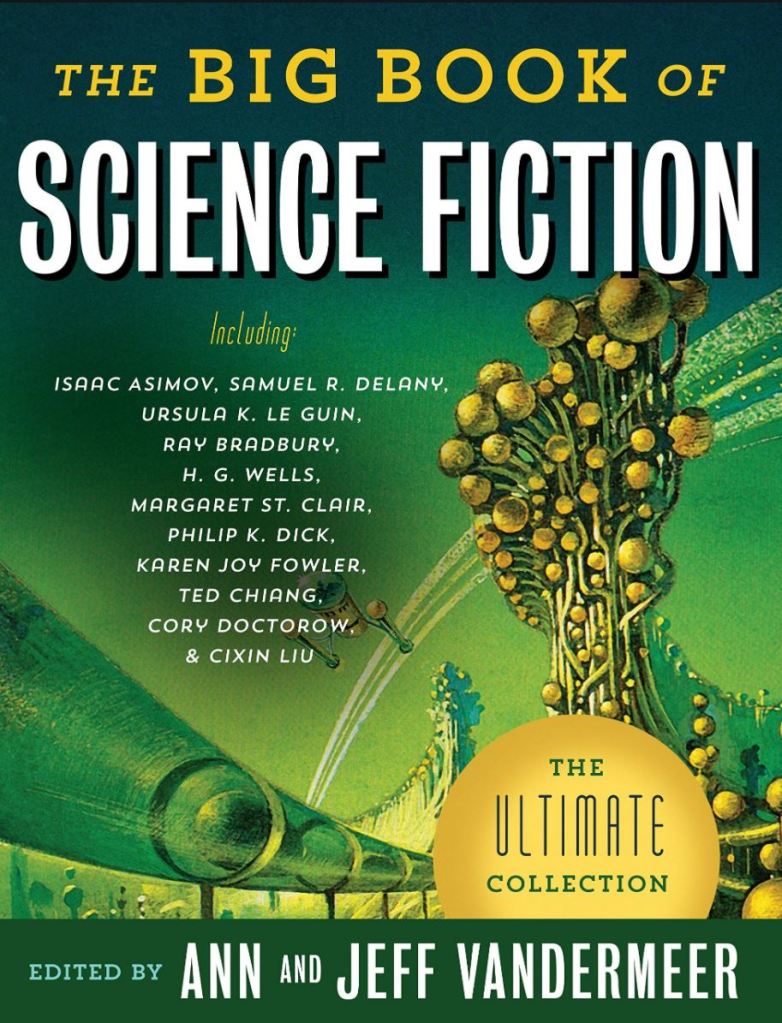
Group Read 27The Big Book of Science Fiction

Story #55 of 107: “Let Us Save the Universe” by Stanislaw Lem

“Let Us Save the Universe” by Stanislaw Lem was first published in The New Yorker. That’s rather prestigious. It’s currently in print from MIT Press in the collection Memoirs of a Space Traveler. Strangely, the paperback at Amazon is cheaper than the $13.99 Kindle edition, and that seems rather steep for a small ebook.

“Let Us Save the Universe” is a bit of humor about human tourists trashing the galaxy. It is lightly clever, and a bit amusing, but I found it only mildly entertaining. More and more, as I go through these stories in The Big Book of Science Fiction, I realize there are all kinds of science fiction and all kinds of fans for each kind of science fiction. Probably, if I had read “Let Us Save the Universe” back in 1981 when it came out, I might have enjoyed it a lot more. I might have even praised it and recommended my friends read it. But now I’m old and crotchety and don’t have much patience for fluff.

At the Facebook group where we discuss these stories reaction to them is all over the place. We’ve read many anthologies and have discussed how well we like them. The evidence shows that it’s extremely difficult to assemble an anthology with a high hit rate for a majority of readers. Hell, it seems an impossible task to assemble an anthology that any two readers will agree on which are the best stories.

At this time in my life, I’m looking for great stories. I want to find the stories I love best, and then reread them. It’s beginning to annoy me to have to wade through so-so stories. But what I’m trying to say is “Let Us Save the Universe” didn’t push my buttons but it could push yours. It’s not a story I’ll add to my ultimate list of favorite SF stories.

I wish Amazon would offer a feature like playlists in Spotify where we could assemble our own anthology of favorite stories. I’d want mine to be both a Kindle and an Audible book. And I understand I could only add stories from books, magazines, and audiobooks I own or purchased separately. Although, wouldn’t it be neat if there was a Spotify for short stories? You pay one monthly price and could read/listen to any short story. I wonder if people realize how cool short stories work for smartphones? I like rereading my favorite stories in the same way I like replaying my favorite tunes.

Piet Nel in the group mentioned he’s has a list of 150 science fiction stories he loves most. This made me think I should assemble my own list of favorites. I have a couple of tall Billy bookcases from Ikea stuffed with anthologies. That’s a lot of short stories. However, I probably only love maybe 100-200 of them at most, maybe less.

When I was young I rarely re-read fiction. I’d say 100% of my input was new. But as I’ve aged, I tend to reread old favorites more often, and that’s especially true for short stories. Being in this short story Facebook group we’re reading many whole anthologies and quite often I’m rereading stories. This has turned out to be a good thing. I’m learning that rereading is often better than new reading. That the experience of getting deeper into a story is superior to the excitement of reading a new story — unless that new story is great. It’s always wonderful to discover something great. Of course, that doesn’t happen often.

But to the point, I feel like I’m wasting my time reading so-so stories, or even merely very good stories. When I was young and it was exciting to try a lot of different kinds of stories, “Let Us Save the Universe,” would have been fun. Now it’s mildly entertaining, but mostly a waste of my time. I’m jaded. I’ve developed a tolerance for certain kinds of fiction. I need the hardcore great stories, the really good stuff to get off.

That’s why I’d like an anthology of my favorite stories — more often than not, to get the most out of my reading time, it’s a bigger thrill to reread something I know.

Main Page of Group Read

James Wallace Harris, 12/5/21

The Difference Between 5-star and 4-star Stories

At our SF short story reading group on Facebook we’ve been discussing story rating systems. Everyone has a slightly different way to review and rate stories but a 5-star system is common. However, several people expand that basic 5 levels into 10 levels with half-stars or pluses, or to 100 levels with tenths of a point refinements. Personally, I can’t distinguish that finely between stories to organize them into ten levels, much less one hundred. However, I can say subjectively I like one story better than another, and compare them relative to each other.

After reading 1,000-2,000 stories over the last four years I’m starting to get an intuition about their quality. Some stories just stand out above all the others, and the group essentially agrees that 5-stars should be reserved for those very best stories, the stories that have become recognized classics or feel will become classic in the future. And I say essentially because we never agree on anything precisely in our group. And this relative system of rating doesn’t mean one reader’s 5-star classic can’t be some other member’s 3-star it’s okay story.

We discuss one story a day, and maybe a handful of members out of a near 500 membership will read and comment on the story. Those comments are enlightening about how we each read stories, and what reading pleasures and displeasures trigger their responses. A few of us have started leaving star ratings and that’s beginning to become illuminating too.

I’m slowly getting a feel for the short story form, at least regarding science fiction stories. If you haven’t read that many SF short stories, even an average story can trigger a “far out” or “great” response. But once you’ve logged your ten thousand hours of reading time, you realize truly great stories are few and far between. My guess is less than six 5-star level stories are published each year, and probably less than two dozen 4-star level stories. Most stories are good solid stories but they must be classed as 3-stars if you consider them relative to the 5-star and 4-star stories.

In other words, a 4-star story is a story that breaks out from the crowd by a significant measure. It’s like the Magnitude scale for earthquakes, logarithmic. It just feels like a big jump from 3-stars to 4-stars, and that’s why so many in the group want to rate stories ***+ or 3.5-stars, or even 3.2 or 3.7, because they feel the story is better than average but not quite up to that 4-star level. When you’ve read a lot of stories it intuitively feels like a 4-star stories is a quantum leap above a 3-star story but few people can explain why in details. And there’s another another tremendous leap from 4-stars to 5-stars. When you think of stories like “Flowers for Algernon” or “The Ones Who Walked Away From Omelas” you know very few stories come close to their magnitude in power.

I think many people want to rate fiction (or movies, or albums) like people rate their purchases on Amazon where 5-stars means you have no complaints. Which is why for some products on Amazon you see 80% 5-star ratings. When it comes to the artistic, 5-stars has to be for artwork that is 1 in 100 to 1 in 1,000 in quality.

But how can we understand this at a gut-reaction level? An idea came to me today that I think might help, so I’m trying it out here. Take any author you’ve read many of their short stories. How many stand out as your very favorites? How many are almost as good? And if you count the rest, how large is that number in relation to the first two groups?

Take for example Ray Bradbury. I consider these his obvious 5-star stories:

  • “There Will Come Soft Rains”
  • “Mars is Heaven!”

I consider his 4-star stories to be:

  • “The Million-Year Picnic”
  • “The Veldt”
  • “A Sound of Thunder”
  • “The Pedestrian”

And the first two I’d probably rate ****+ or 4.5-stars.

There might be other stories that I haven’t read by Bradbury that I would rate with a 5-star or 4-star, but for the most part I’ve read dozens of his hundreds of stories and they go into a vague 3-star pile. If I studied his work thoroughly, I’d probably find several more stories I love, but for now, this is how I remember Ray Bradbury.

For all my favorite authors I can remember stories that stand out as classic, and some that I don’t feel are quite as good. For example, with Clifford Simak, as much as I love “The Big Front Yard,” it’s not on the the save level as “Huddling Place” or “Desertion.” As much as I love “The Year of the Jackpot” by Heinlein, it’s not on the same level as “The Menace From Earth,” or “Requiem,” or “Universe.”

Another difference between 4-star and 5-star stories is how many times I will reread them. I can enjoy a 3-star story quite a lot, but I know I’ll never want to reread them. Whereas, when I read a story for the first time and know I want to reread again someday, that tells me the story is a 4-star story. Stories that I have read many times are the ones I think of as 5-star stories. In fact, I might not know a story is a 5-star story until I’ve read it two or three times.

There is no way to objectively and quantitatively rate a work of art, but using a system based on relative impact is somewhat helpful, don’t you think?

Using this relative system to read new stories, especially by authors I don’t know, can be troublesome. I have to rate the story against all the other stories I know by other writers. So if I’m reading a new story from the latest issue of Lightspeed Magazine it has to complete with all the 5-star and 4-star stories I’ve discovered over my lifetime.

Is that fair? Would it be fair to do otherwise?

SF Short Story Rating Systems I Admire

James Wallace Harris 6/10/21

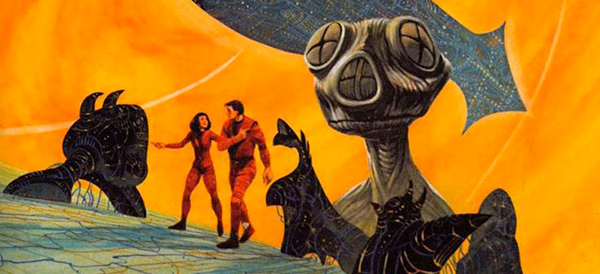
Lords of the Psychon by Daniel F. Galouye

Daniel F. Galouye (1920-1976) was never a famous science fiction writer, but back in the 1950s and 1960s his shorter work appeared regularly in many of the SF magazines with the notable exception of Astounding/Analog. Galouye published five novels, three of which made it to my list of SF novels of the 1960s (Dark Universe, Lords of the Psychon, and Simulacron-3). Over the years, I’ve seen several mentions of his work and have meant to read them, but it hasn’t been until I got Lords of the Psychon in a batch of old paperbacks from eBay that I’ve had a chance. Galouye’s books aren’t rare, but they aren’t widely known either. Dark Universe and Simulacron-3 are currently in print, and Dark Universe is even available on Audible.com. Simulacron-3 inspired both a TV miniseries (World on a Wire) and a movie (The Thirteenth Floor), and some have called it an early cyberpunk novel. Not a bad legacy for a writer who is mostly forgotten.

Lords of the Psychon was a lot of fun to read, but not as much fun as I had with Of Men and Monsters by William Tenn, the SF book I read before it. Both of these 1960s novels deal with alien invasion. Both novels are set years after the aliens have conquered Earth. Both novels deal with a small group of humans hoping to overthrow the aliens. Both novels have a unique take on showing the alienness of the invaders.

Don’t read beyond this point if you hate any kind of spoilers.

In this section I’ll give you a bit more of the details but still try to avoid all plot spoilers. The 1950s was a time when many science fiction stories, especially in Astounding Science Fiction, explored psychic powers, ESP, or sometimes called psionics. I’ve always thought Stranger in a Strange Land (1961) was the pinnacle of that trend which quickly faded from popularity. I now see that Daniel F. Galouye had something more to add in 1963 with Lords of the Psychon. Actually, I feel the novel was inspired by Heinlein, and even feels somewhat like a 1950s Heinlein novel in tone. Galouye was a test pilot during WWII, so he also has a military background like Heinlein.

The setup for Lords of the Psychon is the speculation that the fundamental subatomic building blocks of reality can be controlled by thought, and this 1963 novel predates such woo-woo physics books as The Tao of Physics (1975) by Fritjof Capra and The Dancing Wu Li Masters (1979) by Gary Zukav. Basically, Galouye tortunes quantum mechanics to come up with a fun science fictional idea. Instead of swinging East like Capra and Zukav, Galouye keeps a western view of psychic powers.

Today, we think of such psionic themes as malarky, but I believe Galouye worked hard to pull off his speculative fiction. Eventually, the story moves towards Theodore Sturgeon and gestalt minds. In other words, I give Galouye credit for producing an evolutionary science fictional work.

I won’t go into plot details because I really don’t like any such spoilers myself, but I will reprint two reviews from 1963 that do, so read them at your own risk. The first is from Analog, November 1963 by P. Schuyler Miller.

I love reading reviews of books from when they first came out to see how my reaction is different. Miller praises Lords of the Psychon but claims Galouye’s first novel, Dark Universe, is the real standout. That means I need to read it soon.

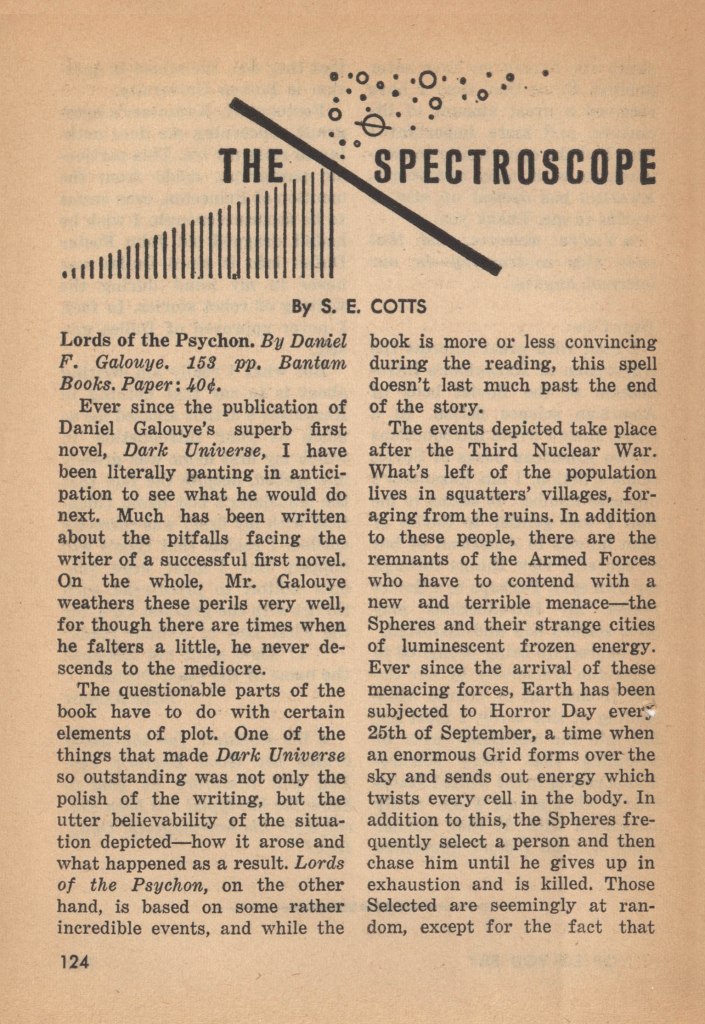
S. E. Cotts reviews the novel in the August 1963 issue of Amazing Stories. I know nothing about Cotts, but I like her review. If you know anything about S. E. Cotts, leave a comment.

Cotts also gives away way too much of the plot for my taste. I’m still figuring out how to review fiction. I like the details of a story to unfold as the author intended. Both Miller and Cotts reveal things I prefer to learn for myself. However, I suppose they believe that a certain amount of plot details need to be given to hook the reader into buying the novel.

Rosemary Benton writing for Galactic Journey gives this novel 4.5 stars. Her 2018 review pretends to have been written in 1963. She also gives away quite a few plot points. Unlike Miller and Cotts, Benton seems to prefer Psychon over Dark Universe.

I believe Lords of the Psychon is a 4-star out of 5-star novel for those readers who delight in reading science fiction novels from the 1960s. I admire Galouye’s speculation even though I don’t think it’s scientific. I feel the novel is plotted tighter than modern SF novels, and is told with far fewer words, which is one of the reasons why I prefer older science fiction. Hopefully, that’s enough information for people who don’t like spoilers, but if it’s not, just read the three reviews above.

James Wallace Harris, 5/31/21