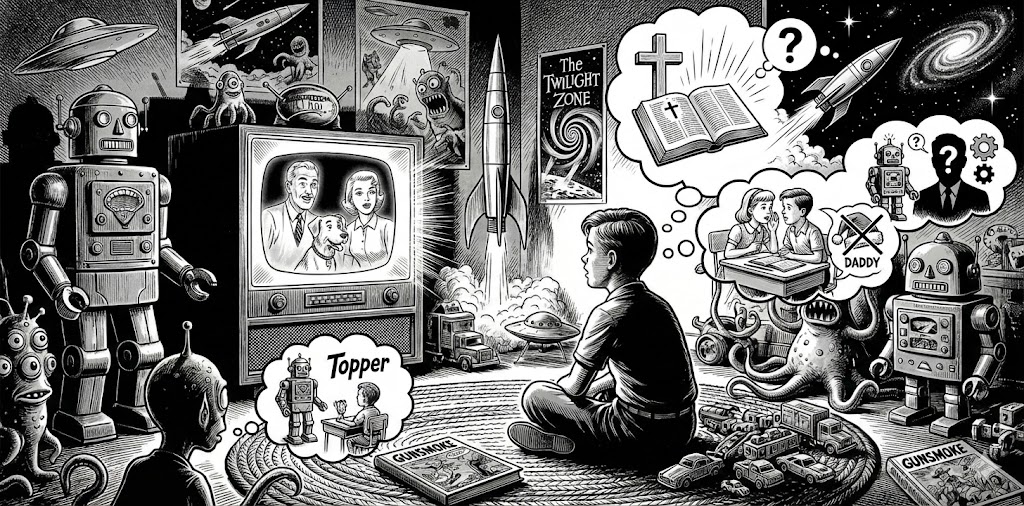
Can you remember when you first encountered concepts such as aliens, space travel, robots, time machines, and the end of the world? If you read science fiction, you might think of specific books that introduced those ideas. Think hard for a moment. Didn’t you encounter all those ideas before you could read? It’s my theory that all the iconic themes of science fiction were well integrated into society by the 1950s. Anyone under 80 probably heard about space travel, robots, and aliens in early childhood and can’t remember when these concepts first entered their minds.
I didn’t understand there was a genre called science fiction until the fall of 1964, just before I turned 13. That’s when I discovered the science fiction section at the Homestead Air Force Base Library. Before that, I just stumbled onto science fiction books in the Young Adult section of the base library or at my school library. They weren’t labeled science fiction.
From ages 0-5 (1951-56), I don’t remember television, books, or magazines. My cognitive awareness was limited to my parents, sister, and grandmother. I can only recall a few conversations, and I was struggling with some very limited ideas. My vocabulary was small, and I comprehended few abstractions. However, if I had perfect recall, I bet I heard people talk about rockets, space travel, aliens from outer space, and robots. I’m not sure about time travel.
From 1956 until the fall of 1964, I was exposed to science fiction on television. I didn’t know these shows about space travel, aliens, and robots were science fiction; I was just drawn to those ideas. However, if I study my memories of sitting in front of a television set, I don’t think I comprehended much before third grade (1959/1960).
I turned five on 11/25/56. I have only a few dozen memories of that year. My view of the world was quite minimal. Unlike some kids today, I didn’t know my alphabet, I couldn’t count, or tell time. I didn’t learn those things until first grade, which began in September 1957, the month before Sputnik. I attended Kindergarten in the 1956/57 school year, but they didn’t teach us those things back then.
The first show I remember liking was Topper. All I can remember are the names George and Marion Kirby, the dog Neal. They were ghosts. I don’t remember any scenes or plots, other than the ghosts had to hide from everyone but Topper. I had no idea this show was a fantasy. I’m quite sure I didn’t even know the word fantasy.
The earliest TV show I can remember a specific scene from is Gunsmoke in 1957. Matt Dillon killed a guy in a gunfight. I remember thinking that guy was only pretending to be dead, and I started thinking what being really dead meant. It blew my little mind. As far as I can remember now, that’s the first time my mind got philosophical.
The first movie I remember seeing at the theater was in 1958. It was called Snowfire, about a white wild stallion that a little girl loved. That same year, I remember seeing my first movie on television, High Barbaree. There was a scene about a little boy and a girl. The girl’s family was moving away, and the boy was crying. I had already experienced that several times since we moved a lot. That might be the first time I identified with a fictional character.
The next TV show I can remember was Clutch Cargo in 1959. This show may have had plot elements and may have proto-science fiction. I don’t remember any plots or stories, just the visuals.
My first real introduction to science fiction was probably The Twilight Zone during the first season, 1959/1960. I was in the third grade. There were many science fiction shows on television before The Twilight Zone, but I don’t remember ever watching them.
The only specific episode I can remember is “The Eye of the Beholder” (November 11, 1960). It was so creepy. I remember watching it with my mother and sister. I had started the fourth grade, and we were living in Marks, Mississippi. That September, I also remember going to a friend’s house to see the last showing of Howdy Doody.
That first season of The Twilight Zone introduced me to robots, aliens, rockets, and Martians. I didn’t really comprehend what all of those concepts meant. I was eight years old when the season started.
Writing this essay has helped me understand the limits of the childhood mind. It is a time when we are quite impressionable and especially gullible. If you meditate very hard on this, you’ll discover that many of your beliefs go back to these early years. There is no other way to say it, but we are brainwashed as kids by popular culture.
My earliest memories of going to church and hearing about God and Jesus were when we lived in Marks, Mississippi. My mother’s oldest sister lived in Marks, so I think we lived there because my father was stationed in Texas. He was training as a mechanic for the F-106. My mother’s family, as well as the people from Mississippi in general in 1960, were big on going to church. I didn’t like Sunday School or going to church. It wasn’t because I wasn’t religious; hell, I didn’t know what religion was when I was eight. I just thought being stuck in Sunday School class or sitting in a pew during church services was boring. But I do remember they taught us this little song, “Jesus Loves the Little Children,” which had these lyrics:
Jesus loves the little children
All the children of the world
Red and yellow, black and white
They are precious in His sight
Jesus loves the little children of the world
I didn’t know what racism was, but I felt it in Marks, in 1960. I have this distinct memory of being at the Piggly Wiggly getting a drink of water, when this giant of a man runs up, grabs me by the arm, puts his face right up next to mine, and starts screaming something at me. I was terrified. I don’t think I ever understood his words, but later my mother explained I had been drinking from the fountain for black people.
This was the beginning of my doubt about Christians. They had me sing one thing, but they lived another. I didn’t know the word hypocrite then, but I felt it. Not consciously. I bring this incident up to illustrate how my mind was being shaped.
Here’s the thing: around this time, I was being told a lot of fantastic things. God and Jesus came along the same time as Santa Claus and the Easter Bunny. And then there was science fiction, with aliens, robots, rockets, and flying saucers. In the second grade, a girl humiliated me in class when I told the class that Santa had brought me a certain toy. She sat in front of me, our row was next to the left wall. My desk was third in line. She said very snotily, “What a baby, there ain’t no Santa, it’s your daddy.” I think that was the first time I realized that people could lie to me.
So in the third grade, I was disturbed that adults were talking about believing in God and Jesus, beings I couldn’t see. If they hadn’t tricked me with Santa Claus, I might have been more receptive. I didn’t challenge them. And I didn’t completely doubt them. I just thought maybe they could see things I couldn’t.
I admit I was a weird little kid. After hearing about robots, I wondered if adults were robots. Kids were real. I could relate to them. But adults didn’t tell me what they were thinking. They just ordered me around. I didn’t know about the Peanuts comic strip at this time, but my world was like Charlie Brown’s. I hardly saw adults. I was in school, playing with my friends, or watching television. Adults only gave orders: get up, take a bath, go to school, go outside and play, clean up your room, etc.
And I wasn’t too impressed with school. My friends were real. Television was real. School was boring. It was painful to have to sit at my desk all day. I wanted to be out playing in the dirt with my cars and trucks. I loved climbing trees. I loved walking around the neighborhood looking for treasures. I loved playing Cowboys and Indians. By the way, TV back then was dominated by westerns. The Twilight Zone shook up my world.
Looking back, since I turned fifty, I realized that during this period, instead of accepting what people told me about God, I chose to believe in what science fiction was telling me. Most kids were sucking down theological beliefs. I didn’t want to go to Heaven, I wanted to go to the stars. I wasn’t interested in God; I wanted to hear about aliens. Of course, kids didn’t talk theology or science fiction.
In 1960, I had no idea about geography, much less astronomy. Outer space was just up. I could see the Moon. Mars and Venus were just words like Heaven and Hell. My absorption of concepts from science fiction came at a murky time in my mind. I wasn’t really self-aware and conscious.
There were certain Bible stories I was drawn to. Adam and Eve, and the Garden of Eden, Noah and the Flood, and the Tower of Babel. But think about it, those stories are very much like science fiction. In recent decades, I imagine they were written by guys who had minds like science fiction writers.
My theory is that we acquire fantastic beliefs in early childhood. That’s why ancient people embraced myths and religions. It’s why we embrace science fiction today. Our personalities meld with ideas we love, and we spend the rest of our lives believing in them.
But there’s a problem. A huge problem. At that age, we have little cognitive ability to evaluate those beliefs. And once ingrained, they are almost impossible to reprogram.
By the eighth grade (1964/65), I decided I was an atheist. I didn’t know it at the time, but I believe now it’s because I had accepted science fiction instead.
Why has it taken until I was in my sixties, retired, and collecting Social Security to challenge my belief in science fiction? Science fiction helped me challenge my faith in religion as a child, but why did I wait so long to challenge my faith in science fiction?
I am reminded of something Eric Hoffer said in his book The True Believer. He said to get a true believer to give up their beliefs, you have to give them something else to believe. That’s what I did with religion and science fiction. But for me to challenge my faith in science fiction, I would have to believe in something else.
In old age, I’m looking for something else. I’ve concluded that all the political turmoil since 2016 is caused by people having too much faith in their beliefs and not enough understanding of reality. I’ve decided everyone is delusional, and we need to give up faith in our beliefs. I’ve decided faith in anything is bad.
I’m reminded of a science fiction novel I discovered in my teens, Empire Star by Samuel R. Delany. In the story, a wise character tells a naive character that there are three modes of perceiving reality: simplex, complex, and multiplex. The beliefs we acquire in youth are a simplex view of reality. As we learn that our beliefs are only fantasies, perceiving the world becomes complex. It’s only when we can act on the multiple complexities of reality that our thinking becomes multiplex.
 Classics of Science Fiction
WAR OF THE WORLDS scared me so much — this was around ’64 on a B&W TV. I ran to my bedroom in our small house.
The Energy Beam Creature (Outer Limits) scared me so much too. “It Crawled Out of the Woodwork” or “The Galaxy Being”.
THE WIZARD OF OZ gave me recurring nightmares of tornadoes. I first saw it at my Aunt’s farm in central Illinois the day before Easter ~1965.
Excellent article, Harris!
LikeLike