The Facebook group, Best Science Fiction and Fantasy Short Fiction, was discussing “A Walk in the Sun” by Geoffrey A. Landis. The group had read the story before, and my previous comment was: “Good sole survivor story that reminded me of Kip’s journey across the Moon in Have Spacesuit-Will Travel. Unfortunately, it’s way too unrealistic. I did catch the magnificent desolation reference.”
This time, when I read “A Walk in the Sun,” I found it harder to get into the story. Landis asks us to believe that an astronaut stranded on the Moon, waiting 30 days for a rescue mission, could walk entirely around the Moon. It’s certainly a sense-of-wonder idea, but on this reading, I spent too much time thinking about the realistic problems Patricia Jay Mulligan faced. The story is moving because of Patricia’s will to live, and her imagined conversation with her sister, Karen. Patricia only has a spacesuit and enough extra equipment to keep it going for 30 days. Landis tries to address all our objections to realism, but this time the story was just too unbelievable.
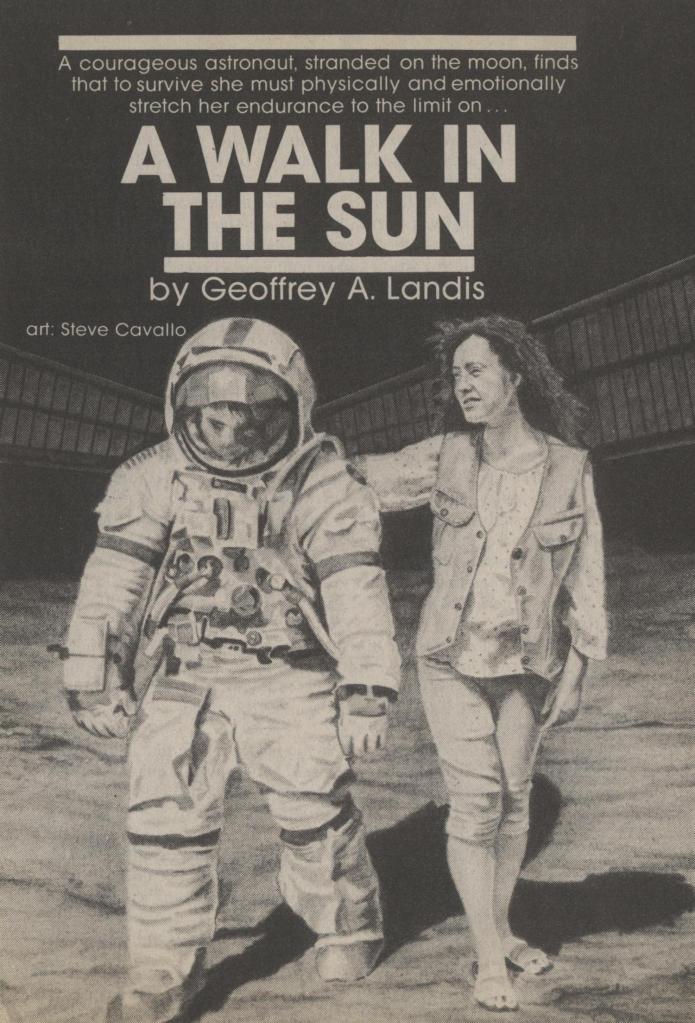
“A Walk in the Sun” is well-liked. The story first appeared in Asimov’s Science Fiction (October, 1991). It won a Hugo and came in first in a Locus annual Readers’ poll. It’s often reprinted. I don’t mean to pick on it, but it does serve as a useful example of when science fiction goes too far.
Now, going too far is relative. Science fiction explores a limited number of themes, and new writers often take an old theme and push it a bit further. While reading “A Walk in the Sun,” I thought of Have Spacesuit-Will Travel, where Kip and Peewee make a dash across the Moon’s surface only in spacesuits. It’s quite dramatic and realistic. At least, it’s always been realistic to me. Heinlein worked with a team designing pressure suits during WWII, and he wrote two books in which spacesuits were a significant part of the story. The other being Starship Troopers.
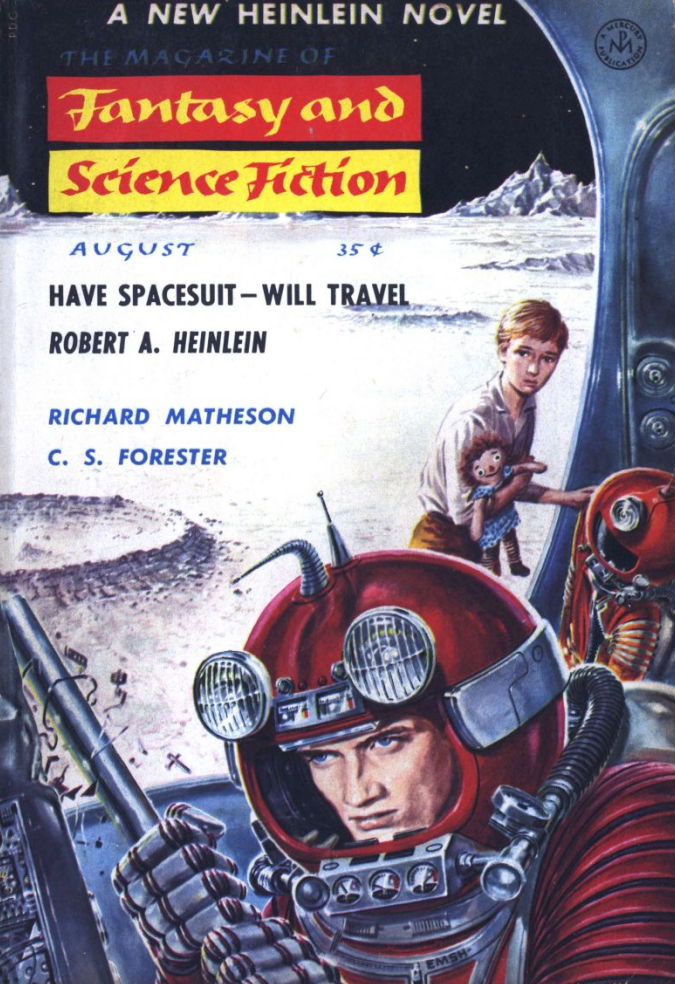
Have Spacesuit-Will Travel was first serialized in the August 1958 issue of The Magazine of Fantasy & Science Fiction. By 1958, real spacesuits were being designed and tested. I feel the science fiction from the 1950s tried much harder to stick to realistic speculation because writers knew manned rocket travel was just a few years off, and travel to the Moon wasn’t much farther.
However, Heinlein took science fiction too far in Have Spacesuit-Will Travel. By the end of the story, Kip and Peewee traveled to the Lesser Magellanic Clouds. Even though I dearly love Have Spacesuit-Will Travel and have reread it more than any other book, I do know that Heinlein was satirizing science fiction in it.
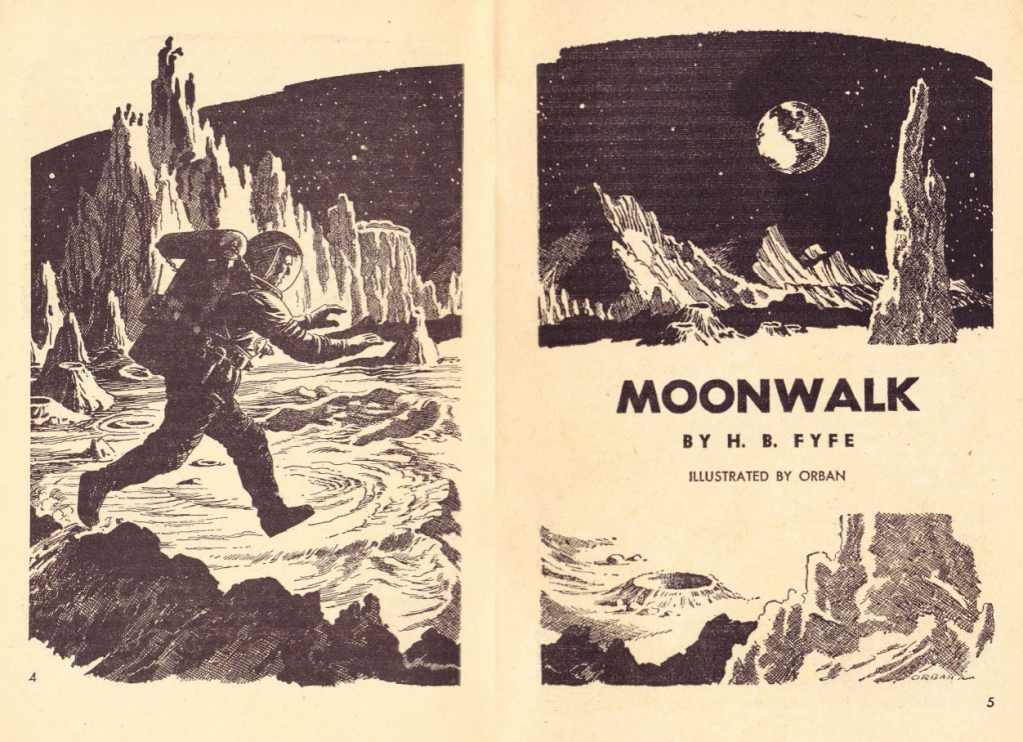
In one of the comments on this discussion of “A Walk in the Sun,” Frank Policastro mentioned H. B. Fyfe’s “Moonwalk” as a more realistic story. (Space Science Fiction, November 1952.)
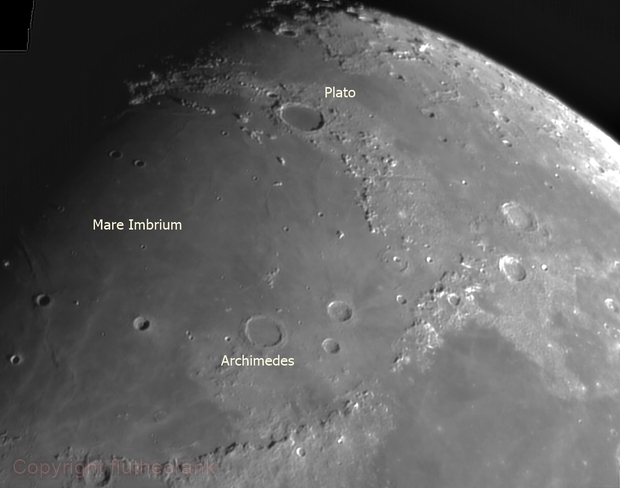
I loaded that issue on my iPad and read it. “Moonwalk” was indeed a much more realistic story about an astronaut walking across the lunar surface. I wondered if Heinlein had read it. Here was a case of science fiction not going too far. The story is about the first major scientific base on the Moon near the crater Archimedes. The base houses fifty people. It has two tractors that explore the surrounding area. They lose contact with Tractor Two, which was heading towards the crater Plato, and aren’t sure what to do. Radio is limited to line-of-sight. They figured something bad could have happened, or the tractor had gone behind the wall of a crater. They decide to wait.
However, Tractor Two has been destroyed in a landslide, but one astronaut, Hansen, has been thrown free. He has the air tanks of his suit, and one large oxygen tank from the tractor. Hansen decides to start walking back towards base, hundreds of miles away, figuring base will eventually assume something is wrong and send out Tractor One to rescue him.
It’s interesting to compare the descriptions of walking across the Moon by Fyfe, Heinlein, and Landis. Two writers were speculating, and one had the accounts of twelve American astronauts who walked on the Moon.
When I was younger, I enjoyed science fiction stories that went too far. In fact, the further out the better. Now that I’m older, I prefer science fiction that stays close to what might be real. This time around, I preferred “Moonwalk.” It was a basic adventure story, but I enjoyed how Fyfe imagined what it would be like working on the Moon. While researching “Moonwalk” on ISFDB.org, I came across an Ace Double.
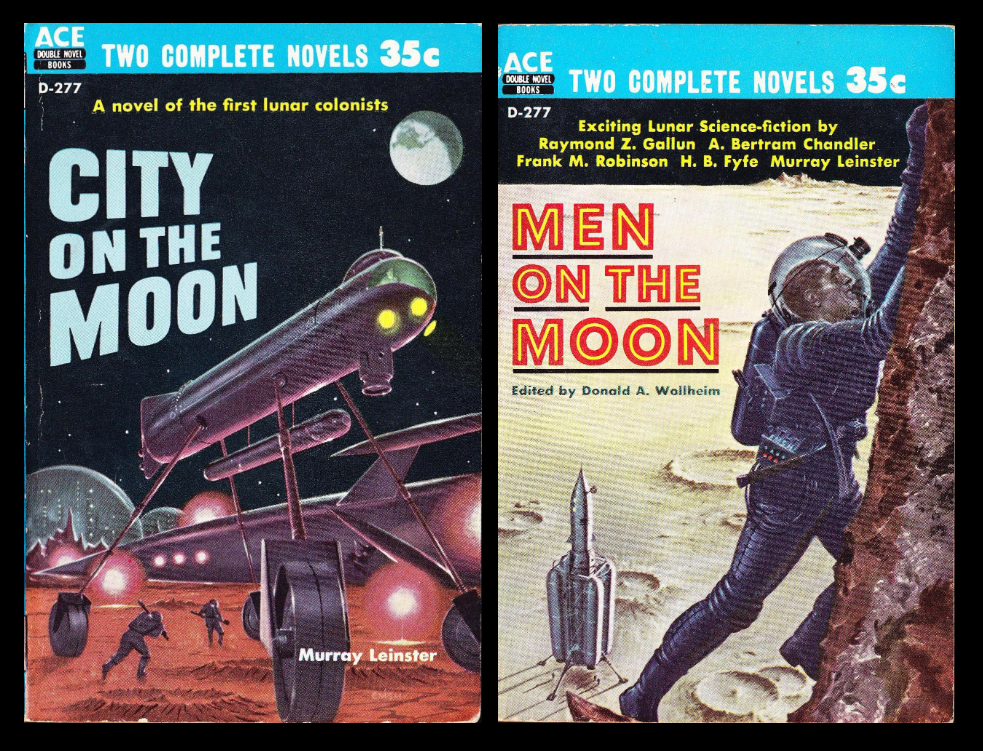
“Moonwalk” was anthologized in Men on the Moon. I’m looking forward to reading it, but I started reading City on the Moon by Murray Leinster first. I haven’t been in the mood to read science fiction for months. I just got burned out. However, I’m enjoying all these 1950s stories about early explorers of the Moon. I’m enjoying them because they don’t go too far.
Except for odd alternative-history stories, we don’t get science fiction about early exploration of the Moon. We get a fair amount of science fiction about established lunar colonies, but for the most part, I think they gone too far. I believe establishing bases on the Moon will be extremely difficult, so there’s plenty of room for speculative fiction. Establishing self-sufficient lunar colonies will be next to impossible. Science fiction has seldom explored that territory. Most science fiction today about the Moon leaps too far ahead. I want to read the nitty-gritty of building the first bases and what it would take to make permanent colonies.
I think I’ll dig into the past and see how science fiction writers handled the subject who stayed close to reality. If you know of any, please let me know.
JWH
 Classics of Science Fiction
LikeLike
I’ll check out No Man Friday. Was it the basis for the film, Robinson Crusoe on Mars?
LikeLike
LikeLiked by 1 person
I don’t think so. The movie more closely followed the classic. I don’t remember any malicious aliens or a companion in the book. I have fond memories of the movie — saw it when I was 10 on late night tv. It’s available on the Internet Archive site. Have to watch it again soon. I see Bryon Haskin directed it.
LikeLike
I saw Robinson Crusoe on Mars when I was a kid back in the 1960s. I’m fond of all Robinsonade type stories.
LikeLiked by 1 person