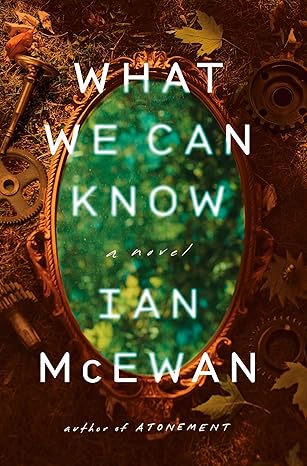
You might be wondering if the acclaimed literary writer Ian McEwan, whose most famous novel is Atonement, has become a science fiction writer. His last novel, Machines Like Me, was about a robot. His new novel, What We Can Know, is set in the year 2119. Many reviewers suggest that What We Can Know is about life after climate change. I don’t think it is, nor do I think it’s a science fiction novel. If anything, What We Can Know is a literary mystery, one that I enjoyed reading a great deal.
I think it’s perfectly fine to categorize this novel as science fiction, but many science fiction fans will be disappointed if they read it. Some reviewers call the novel dystopian. That’s bogus, too. Sure, between our times and 2119, there were nuclear wars, and worldwide flooding has left Britain an archipelago of islands. But those are inconsequential to the story.
The plot of What We Can Know is simple. Tom Metcalfe, an academic and writer living in England in 2119, is writing a nonfiction book about a lost poem that was read at a party in 2014. Metcalfe wants to write a whole history of this poem, but he can’t find a copy. He knows a fair amount about “A Corona for Vivien” because of biographical research on all the people at the party. Wikipedia defines a corona as:
A crown of sonnets or sonnet corona is a sequence of sonnets, usually addressed to one person, and/or concerned with a single theme. Each of the sonnets explores one aspect of the theme, and is linked to the preceding and succeeding sonnets by repeating the final line of the preceding sonnet as its first line. The first line of the first sonnet is repeated as the final line of the final sonnet, thereby bringing the sequence to a close.
Hell, I’d love to read such a poem too.
“A Corona for Vivien” has been missing for over one hundred years. Finding it would be a triumph for Tom’s career and make his book a bestseller.
Notice that Tom doesn’t worry about the condition of the world after drastic climate change and nuclear wars. He’s obsessed with Francis Blundy, the poet, and his wife Vivien. Like many literary scholars, he romanticises the time period of his study, the 2010s. For years, Tom has followed every clue he could find about the dinner party where the poem was read and the guests who heard the only known reading of the poem.
What We Can Know reminds me of Possession by A. S. Byatt and The French Lieutenant’s Woman by John Fowles. McEwan’s novel isn’t as complex or as delicious as those two, but it does feel like historiographic metafiction.
One of the fun aspects of this novel is that it’s about people from the future reflecting on our times. Science fiction is usually about reflecting on future people. This gives McIwan a chance to comment on us. Some of that commentary is satire, but with a deft light touch. People in Tom’s time called the changes caused by climate change the derangement. They marvel at our excesses and lack of regard for the future. But on the other hand, there are people like Tom who see us living through glory days.
What We Can Know also reminds me of the recent biography Red Comet: The Short Life and Blazing Art of Sylvia Plath by Heather Clark. I haven’t read it, but my friend Mike has been reading it for weeks and he’s been telling me about it. It’s about a literary circle of egocentric poets. Francis Blundy and his friends are also a famous literary circle of poets and writers with tremendous egos.
I loved listening to What We Can Know. Yes, it did ocassionally thrill my science fiction bent with a few asides, but it mainly entertained because it was about a literary circle. I love reading about The Beats, The Bloomsbury Group, writers of The Lost Generation, The Transcendentalists, the German Romantics, and other literary groups.
Now, if that’s your cup of tea, then get the book. But if you’re a science fiction fan who enjoys a well-imagined future, I think you will be disappointed. This novel isn’t about a post-apocalyptic world but poets and biographers.
James Wallace Harris, 10/30/25
 Classics of Science Fiction
Thank you. I brushed this book off, because I got the impression that it is dystopian science fiction. Now I will buy it.
Have you read the obscure novel “The Ballad of Beta 2” by Samuel R. Delany. It is a sort of metafiction.
LikeLiked by 1 person
When I was young and don’t remember it. Delany was a favorite SF writer of mine back in the 1960s. I’ll reread it.
LikeLiked by 1 person
Jim asked me to repeat a comment I made on his Facebook page, so here it is (we were comparing Asimov’s Foundation trilogy with this literary novel):
Jim Harris actually, the McEwan book is relatively optimistic. The characters don’t do a lot of hand-wringing about the state of the world and go about their business without much hardship.
But yes, of course I wish that Asimov had shown more skill and maturity in his depiction of a collapsing empire. Come to think of it, there’s not a great deal about how the empire is collapsing—most of it is just two guys in a room, arguing. This wouldn’t be so bad if he was, at that stage of his career, able to show some psychological insight and a deeper look into character and motivation, but to the young Asimov, facial expressions were his way of expressing character. Look how much more interesting McEwan’s depiction of people is: during the famous reading of Francis Blundy’s poem, we get the impression that the gathering was stunned, intrigued, or were listening with rapt attention. Later we learn that they were either embarrassed or daydreaming or pretending to listen.
But it’s not just that Asimov lacked literary skills early in his career. Even in terms of good old beach chair reading, his work is lacking. There’s no suspense about any of it, whereas McEwan provides pop fiction entertainment as well—buried treasure, a jaw-droppingly improbable sexual encounter, and more.
LikeLiked by 1 person
I’ve read a lot of McEwan, including “Machines Like Me”. I saw he had a new book: it was recommended by The Economist a couple of months ago. Quoting :
“What We Can Know. By Ian McEwan.
In 2014 a celebrated poet reads his latest work, dedicated to his wife, at her birthday party. Then the poem goes missing. In 2119 an academic trawls through archives in his quest to track down the lost poem. His discovery yields an account of passion, murder and guilt. Ian McEwan combines a post-apocalyptic dystopia, a love story and a thrilling mystery to great effect: this is an inventive, exquisitely written book. https://www.economist.com/culture/2025/09/15/the-best-recent-novels-to-read-this-autumn“
I see they probably make the mistake about the “dystopia” aspect. It’s good to see a “literary” writer doing “SF” sometimes and I appreciate your reference to Byatt. “Possession” is a beautiful book and one of my all time favourites.
I’ve just finished Silverberg’s “Book of Skulls”. Not really SF I’d say. Good but a tough read by the end (the theme not the writing).
Cheers, Alastair
LikeLike