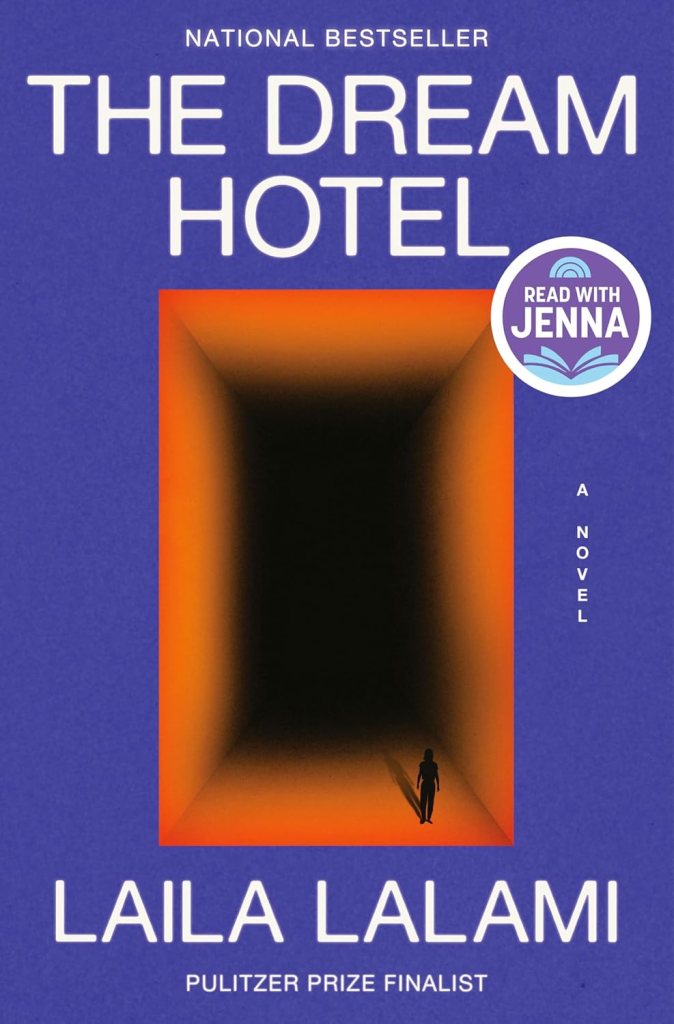
If you’ve ever wondered what the United States would be like if it had a social credit rating system like the falsely reported one in China, or the Orwellian surveillance system in Iran, then you might want to read The Dream Hotel by Laila Lalami.
I read The Dream Hotel because it was on a list of the best science fiction novels of 2025. I felt I was dwelling too much in science fiction’s past, and wanted to sample what the genre is currently producing.
The Dream Hotel is an engaging story about a near future where America detains citizens whose RAA (Risk Assessment Administration) score is above 500. Sara Hussein is caught in a surveillance net when returning from a business trip to London. Her score goes to 516 due to an incident on the plane. When she gets huffy with her detainers claiming there were mistakes in their data, they start increasing her score and send her to a detention center for women.
Eventually, we learn that America has deployed various technologies that go beyond the algorithms that monitor our buying preferences. When I say the story is set in the near future, it’s only a matter of a few years. Lalami’s setting is almost today. The only science-fictional invention is a device that monitors dreams. That seems unbelievable to me. Sara is also accused of being a threat to her husband because of her dreams. That aspect of the story reminds me of Philip K. Dick’s precog story, “The Minority Report.”
The story would have been better if it had remained believable. It’s creepy how much we’re monitored. I see news stories and ads in my various social media feeds that are triggered by texts, emails, and sometimes, I fear, even by things I say on the phone.
Sara’s frustration to prove her innocence while in detention reminds me of Kafka’s The Trial and Ken Kesey’s One Flew Over the Cuckoo’s Nest. The dream aspects slightly remind me of The Dream Master by Roger Zelazny and The Lathe of Heaven by Ursula K. Le Guin.
Sara believes she’s an honest, law-abiding, rational human being. Being detained makes her doubt herself. While detained, she reevaluates her life, looking for the behaviors she’s accused of having. With each new humiliation by her keepers, she rebels and radicalizes, which keeps raising her RAA score.
The Dream Hotel isn’t meant to be science fiction. It’s a literary-lite work that lightly extrapolates on the present. The U.S. isn’t transformed like it is in The Handmaid’s Tale. Nor does Sara live under Big Brother. I’m not sure if science fiction fans will find this novel entertaining. It doesn’t go to extremes. The Dream Hotel is just a best-seller and book club favorite because it gently borrows from our genre.
Reading The Dream Hotel made me crave a heavy-duty updating of Nineteen Eighty-Four. The future we’re racing into needs a stronger warning label. I’m not sure if the genre is up to the task. Technology is driving social change so rapidly that writers can’t keep up. Lalami doesn’t even deal with AI or the political upheavals we’re experiencing in 2025. Her protest is too gentle, her ambiguity too kind.
Unfortunately, our problems are too complex for novels. The only way to understand the near future is via nonfiction. Heinlein could have imagined Elon Musk, but not Donald Trump. Orwell could have. Orwell wasn’t a genre writer.
I’m searching for current science fiction novels that explore realistic possible futures. I don’t think members of SFWA are hoeing in that field anymore, but I’m not sure if literary writers want the job either.
Americans want reality to fulfill their desires, not what science measures. Readers choose escapism and entertainment. Novels that go too deep into our problems go unread. The Dream Hotel touches on some of our fears, but not in a way that will make readers depressed. It should have been scarier than anything Stephen King has written.
James Wallace Harris, 9/8/25
 Classics of Science Fiction
Very well written.
I agree with you — and I think the novel you wanted would become an “underground” best seller, but would have to be self published.
Today, it seems everything well written that doesn’t fit NYNY’s intellectually preferred styles is being self-published.
LikeLike
Thanks for the thoughtful review of “The Dream Hotel.” Your summary of Sara’s ordeal under an algorithm-driven surveillance system is chilling and timely. It’s fascinating that Lalami imagines a near-future America where dreams are monitored—do you think such tech feels plausible? I recently pondered similar themes here: https://theblackmyth8.wordpress.com/category/uncategorized/
LikeLike
The billionaire tech-bros and their disciples believe we can invent anything. My guess is we’ll never have a device that can record dreams or read minds. Lalami never goes into the details. At one point, the detainees keep dream journals. But at other times in the story, it Lalami implies the device can record dreams. It’s vague. The original device was designed to help people sleep. Towards the end of the story, in a subplot, the same device is used to implant subliminal commercials.
Our minds are biochemical and bioelectrical. I find it hard to imagine an interface with an inorganic electrical device.
LikeLike
Heinlein had a populist dictator similar to Trump – the religious dictator Nehemiah Scudder. I forget which work, but there’s a description somewhere about how he got elected and then there were no more elections.
I would like to find that passage now.
LikeLike
Nehemiah Scudder was part of the story “If This Goes On–” see the Wikipedia entry:
https://en.wikipedia.org/wiki/%22If_This_Goes_On%E2%80%94%22
What’s interesting, is the main character is named John Lyle, the one you are going by.
LikeLike
The description is in the essay “Concerning Stories Never Written” which was in the book “Revolt in 2100”. It has also been printed in some versions of the Future History. Here’s a quote.
“Presently they needed stormtroopers; they revived the Ku Klux Klan in everything but the name — sheets, passwords, grips, and all. It was a “good gimmick” once and still served. Blood at the polls and blood in the streets, but Scudder won the election. The next election was never held.“
LikeLike