SCIENCE FICTION: THE 100 BEST NOVELS by David Pringle

I’ve been reading science fiction for sixty-three years, and it’s getting difficult to find anything that feels new and different. However, my problem is more than just being old and jaded. I’ve discovered that I missed or ignored many kinds of science fiction books that didn’t appeal to me for one reason or another. Late in life, I’ve discovered that I need to read science fiction outside my comfort zone.

I recently took another look at David Pringle’s Science Fiction: The 100 Best Novels. Pringle, a Scottish critic and editor, selected one hundred science fiction novels published from 1949 until 1984 to recommend. I knew his list was a good one because I had already read over sixty of the books on it. I figured the ones I haven’t read should be equally good. I’ve read and reviewed two so far: The Inheritors by William Golding and The Inverted World by Christopher Priest.

Both of those novels were outstanding, but more importantly, they were different, with stories and writing techniques lying outside my usual tastes. I’ve now started No Enemy but Time by Michael Bishop. It’s proving to be equally good and different.

I’m buddy reading these books with my old friend Mike. Having someone to discuss books with is important. So is reading slowly and taking notes. I’ve decided to read or reread all the books on Pringle’s list.

This project is also a way to reevaluate a lifetime of science fiction reading. I plan to review each title when I finish that book.

The list below of Pringle’s recommended SF novels was copied from Wikipedia. However, Pringle’s book is $1.99 on Amazon (Kindle edition), and the essays recommending each novel are well worth reading.

Most of these books are still in print, but not always. Some are in very cheap eBook editions. I wish all were available as audiobooks, but they are not. I consider that a kind of criticism. Any true classic should be in print as a hardback, paperback, eBook, and audiobook.

The title and author link take you back to Wikipedia for those entries. If I give a date, it’s the last date I read the book. If I put a number in parentheses, it’s the number of times I remember reading the book. If I don’t provide a date but include a number, it’s because I read it before 1983, when I started keeping my reading log. The Buy link will direct you to the least expensive edition on Amazon. It will also allow you to view the availability of different editions. Bolded titles are unread titles I hope to read before I start rereading the others.

By reading Pringle’s essay, the Wikipedia entry, and the content and comments on the Amazon page, it’s possible to judge how these books are remembered since Pringle created his list in 1985, and to decide if they are worth buying and reading. Many of these books are still discussed by book reviewers on YouTube. But many others are forgotten.

  1. Nineteen Eighty-Four by George Orwell (1949) – 12/31/13 (2) – Buy
  2. Earth Abides by George R. Stewart (1949) – 4/12/10 (3) – Buy
  3. The Martian Chronicles by Ray Bradbury (1950) – 1/9/15 (3) – Buy
  4. The Puppet Masters by Robert A. Heinlein (1951) – 9/2/93) (3) – Buy
  5. The Day of the Triffids by John Wyndham (1951) – 6/3/12 – Buy
  6. Limbo by Bernard Wolfe (1952) – Buy
  7. The Demolished Man by Alfred Bester (1953) – 2/8/18 (2) – Buy
  8. Fahrenheit 451 by Ray Bradbury (1953) – 10/30/05 (2) – Buy
  9. Childhood’s End by Arthur C. Clarke (1953) – 12/23/08 (3) – Buy
  10. The Paradox Men by Charles L. Harness (1953) – Buy
  11. Bring the Jubilee by Ward Moore (1953) – (1) – Buy
  12. The Space Merchants by Frederik Pohl and C. M. Kornbluth (1953) – 11/26/08 (2) – Buy
  13. Ring Around the Sun by Clifford D. Simak (1953) – Buy
  14. More Than Human by Theodore Sturgeon (1953) – 3/13/09 (2) – Buy
  15. Mission of Gravity by Hal Clement (1954) – 12/24/15 (1) – Buy
  16. A Mirror for Observers by Edgar Pangborn (1954) – 11/24/24 (2) – Buy
  17. The End of Eternity by Isaac Asimov (1955) – Buy
  18. The Long Tomorrow by Leigh Brackett (1955) – 10/7/13 (1) – Buy
  19. The Inheritors by William Golding (1955) – 7/7/25 (1) – Buy
  20. The Stars My Destination by Alfred Bester (1956) – (1) – Buy
  21. The Death of Grass by John Christopher (1956) – 3/10/20 (1) – Buy
  22. The City and the Stars by Arthur C. Clarke (1956) – (1) – Buy
  23. The Door into Summer by Robert A. Heinlein (1957) – 8/1/06 (5) – Buy
  24. The Midwich Cuckoos by John Wyndham (1957) – (1) – Buy
  25. Non-Stop by Brian Aldiss (1958) – 2/21/15 (1) – Buy
  26. A Case of Conscience by James Blish (1958) – 12/15/08 (2) – Buy
  27. Have Space Suit—Will Travel by Robert A. Heinlein (1958) – 4/30/17 (7) – Buy
  28. Time Out of Joint by Philip K. Dick (1959) – 2/2/24 (2) – Buy
  29. Alas, Babylon by Pat Frank (1959) – 8/21/11 (1) – Buy
  30. A Canticle for Leibowitz by Walter M. Miller, Jr. (1959) – 9/8/11 (1) – Buy
  31. The Sirens of Titan by Kurt Vonnegut, Jr. (1959) – 5/7/9 (1) – Buy
  32. Rogue Moon by Algis Budrys (1960) – (2) – Buy
  33. Venus Plus X by Theodore Sturgeon (1960) – Buy
  34. Hothouse by Brian Aldiss (1962) – 11/9/24 (2) – Buy
  35. The Drowned World by J. G. Ballard (1962) – 12/4/16 (1) – Buy
  36. A Clockwork Orange by Anthony Burgess (1962) – (1) – Buy
  37. The Man in the High Castle by Philip K. Dick (1962) – 12/27/15 (3) – Buy
  38. Journey Beyond Tomorrow by Robert Sheckley (1962) – Buy
  39. Way Station by Clifford D. Simak (1963) – 10/7/08 (2) – Buy
  40. Cat’s Cradle by Kurt Vonnegut, Jr. (1963) – Buy
  41. Greybeard by Brian Aldiss (1964) – 10/25/24 (1) – Buy
  42. Nova Express by William S. Burroughs (1964) – Buy
  43. Martian Time-Slip by Philip K. Dick (1964) – 2/11/10 (3) – Buy
  44. The Three Stigmata of Palmer Eldritch by Philip K. Dick (1965) – 10/24/08 (2) – Buy
  45. The Wanderer by Fritz Leiber (1965) – Buy
  46. Norstrilia by Cordwainer Smith (1965) – Buy
  47. Dr. Bloodmoney by Philip K. Dick (1965) – 2/14/22 (2) – Buy
  48. Dune by Frank Herbert (1965) – 4/11/09 (2) – Buy
  49. The Crystal World by J. G. Ballard (1966) – 12/22/24 (1) – Buy
  50. Make Room! Make Room! by Harry Harrison (1966) (1) – Buy
  51. Flowers for Algernon by Daniel Keyes (1966) – (1) – Buy
  52. The Dream Master by Roger Zelazny (1966) – (1) – Buy
  53. Stand on Zanzibar by John Brunner (1968) – 1/29/16 (3) – Buy
  54. Nova by Samuel R. Delany (1968) – 11/14/14 (2) – Buy
  55. Do Androids Dream of Electric Sheep? by Philip K. Dick (1968) – 4/15/08 (4) – Buy
  56. Camp Concentration by Thomas M. Disch (1968) – 3/10/25 (2) – Buy
  57. The Final Programme by Michael Moorcock (1968) – Buy
  58. Pavane by Keith Roberts (1968) – 4/3/16 (1) – Buy
  59. Heroes and Villains by Angela Carter (1969) – Buy
  60. The Left Hand of Darkness by Ursula K. Le Guin (1969) – (1) – Buy
  61. The Palace of Eternity by Bob Shaw (1969) – Buy
  62. Bug Jack Barron by Norman Spinrad (1969) – (1) – Buy
  63. Tau Zero by Poul Anderson (1970) – (1) – Buy
  64. Downward to the Earth by Robert Silverberg (1970) – 8/26/17 (3) – Buy
  65. The Year of the Quiet Sun by Wilson Tucker (1970) – 5/13/12 (1) – OOP
  66. 334 by Thomas M. Disch (1972) – Buy
  67. The Fifth Head of Cerberus by Gene Wolfe (1972) – 6/25/18 (1) – Buy
  68. The Dancers at the End of Time by Michael Moorcock (1972) – Buy
  69. Crash by J. G. Ballard (1973) – Buy
  70. Looking Backward, from the Year 2000 by Mack Reynolds (1973) – OOP
  71. The Embedding by Ian Watson (1973) – Buy
  72. Walk to the End of the World by Suzy McKee Charnas (1974) – Buy
  73. The Centauri Device by M. John Harrison (1974) – Buy
  74. The Dispossessed by Ursula K. Le Guin (1974) – (1) – Buy
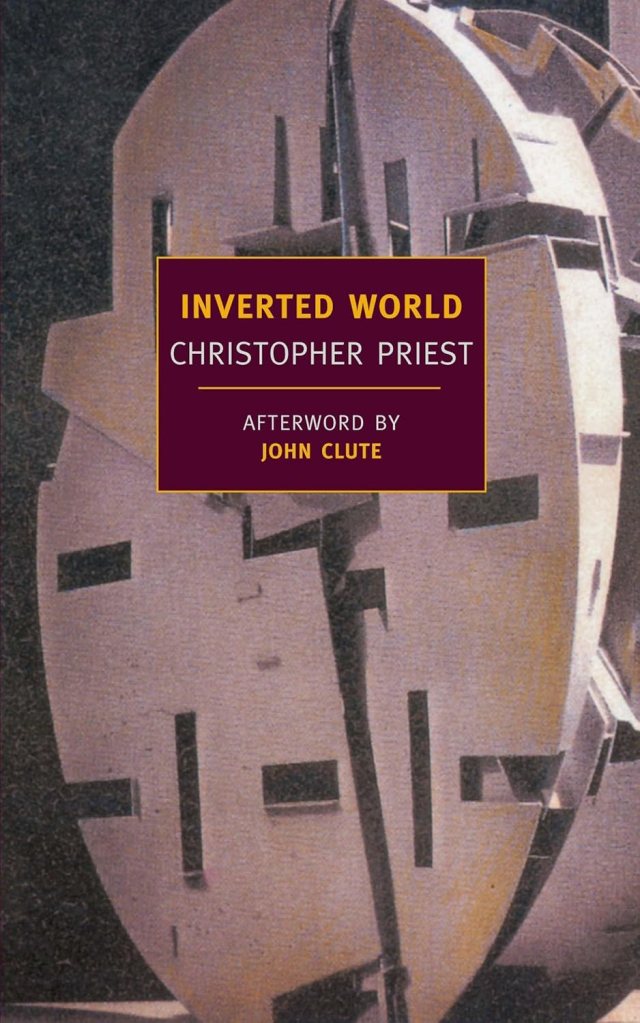
  75. Inverted World by Christopher Priest (1974) – 7/21/25 (1) – Buy
  76. High Rise by J.G. Ballard (1975) – Buy
  77. Galaxies by Barry N. Malzberg (1975) – 7/22/22 (1) – Buy
  78. The Female Man by Joanna Russ (1975) – Buy
  79. Orbitsville by Bob Shaw (1975) – Buy
  80. The Alteration by Kingsley Amis (1976) – Buy
  81. Woman on the Edge of Time by Marge Piercy (1976) – (1) – Buy
  82. Man Plus by Frederik Pohl (1976) – 8/30/96 (1) – Buy
  83. Michaelmas by Algis Budrys (1977) – Buy
  84. The Ophiuchi Hotline by John Varley (1977) – 5/18/85 (1) – Buy
  85. Miracle Visitors by Ian Watson (1978) – Buy
  86. Engine Summer by John Crowley (1979) – Buy
  87. On Wings of Song by Thomas M. Disch (1979) – Buy
  88. The Walking Shadow by Brian Stableford (1979) – Buy
  89. Juniper Time by Kate Wilhelm (1979) – OOP
  90. Timescape by Gregory Benford (1980) – 12/22/14 (3) – Buy
  91. The Dreaming Dragons by Damien Broderick (1980) – OOP
  92. Wild Seed by Octavia E. Butler (1980) – Buy
  93. Riddley Walker by Russell Hoban (1980) – Buy
  94. The Complete Roderick by John Sladek (1980) – Buy
  95. The Shadow of the Torturer by Gene Wolfe (1980) – Buy
  96. The Unreasoning Mask by Philip José Farmer (1981) – Buy
  97. Oath of Fealty by Larry Niven and Jerry Pournelle (1981) – Buy
  98. No Enemy But Time by Michael Bishop (1982) – Buy
  99. The Birth of the People’s Republic of Antarctica by John Calvin Batchelor (1983) – Buy
  100. Neuromancer by William Gibson (1984) – 5/8/85 (1) – Buy

JWH
THE INVERTED WORLD by Christopher Priest

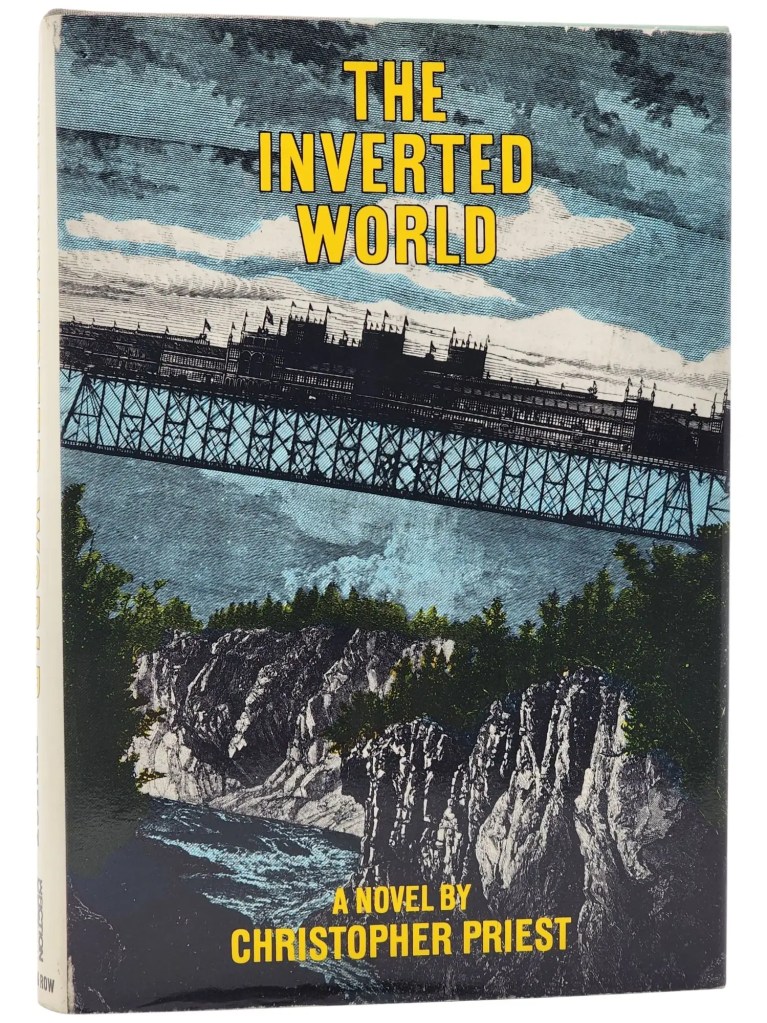
Read The Inverted World by Christopher Priest is my first recommendation. My second recommendation is not to read anything about this novel before you read it. This well-designed novel is a science fiction mystery. It unwraps like the layers of an onion. To get the maximum joy out of reading The Inverted World, you should do all the problem-solving yourself. Don’t even read the blurbs to the book.

The Inverted World is recommended in Science Fiction: The Best 100 Novels by David Pringle, which is currently $1.99 for the Kindle edition at Amazon. I’m using Pringle’s recommendations for a buddy read with my friend Mike. The novel also won the British Science Fiction Award and was nominated for the Hugo Award. It’s currently available in print from New York Review Books Classics, a highly respected publisher of forgotten literary classics. You can purchase a Kindle or a paperback edition, but unfortunately, there is no audiobook edition.

I read The Inverted World on my iPhone, using the Kindle app with the text-to-speech feature turned on. No matter how hard I try, I read too fast. And even though the computer voice is not very good, it kept me reading slowly and deliberately. And that was very important in The Inverted World.

You know this story is different when the protagonist gives his age in miles. That’s about the only thing I will tell you about this story specifically. There are many mysteries in this novel. And I found them delicious to contemplate. If you need straightforward adventure stories, you should probably skip this one.

Priest creates a very different science-fictional reality. The story is tightly plotted. Priest obviously rewrote his draft many times to get his plot to work so well and to unfold so smoothly.

The Inverted World sometimes feels metaphoric or symbolic, and it is. But it’s also a unique kind of hard science fiction. The NYRB Classic edition includes an afterward by John Clute that explains the social and political climate of England in 1974 when the book was first published. That might make you think the book is about that. But the novel fits so perfectly with 2025 that you’ll realize it’s not really. It’s more universal.

The Inverted World is a philosophical novel. To get the most out of it, you need to think about this story, and if you can, you need to talk about this story with a friend. Mike and I had quite a conversation. Our society is undergoing paradigm shifts that disappoint and depress me. I’m amazed by this novel, which came out fifty-one years ago, speaks so directly to today.

I’m surprised this novel isn’t more famous among science fiction fans. This is the reason I’m reading my way through Pringle’s book. So far, he’s gotten me to read two outstanding forgotten classics that I haven’t read before. You can see his list of recommended novels on Wikipedia. (I recommend buying Pringle’s book. It’s only $1.99.) Before I started my project to read all the books recommended in Science Fiction: The 100 Best Novels 1949-1984, I had read 62 of the 100. I already knew it was a solid list of great science fiction books. Reading The Inheritors by William Golden and The Inverted World by Christopher Priest suggested I still had 38 great SF novels to blow my mind.

James Wallace Harris, 7/21/25

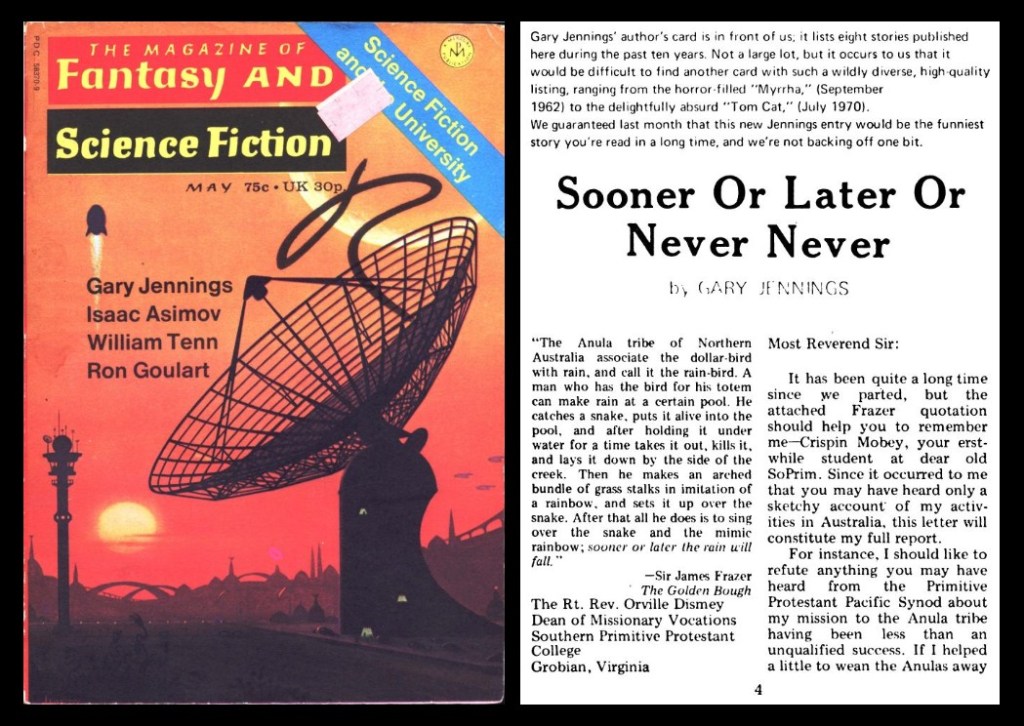
“Sooner or Later or Never Never” by Gary Jennings

What exactly is fantasy? “Sooner Or Later Or Never Never” by Gary Jennings has no magic, no fantastic creatures. Its setting is present-day Australia. The story is both comic and absurd. Yet, it’s based on a somewhat realistic premise. Yes, the characters and plot are made up, but so is most fiction. I can find no reason to call this a fantasy. I assume Edward L. Ferman published it in the May 1972 issue of The Magazine of Fantasy & Science Fiction because he admired the creative prose — and he had the power to publish it.

Gary Jennings (1928-1999) is known for writing historical fiction, but also published many stories in F&SF. You can read the story online here.

“Sooner or Later or Never Never” is told as a letter to The Rev. Orville Dismey, Dean of Missionary Vocations, at the Southern Primitive Protestant Seminary in Grobian, Virginia. Crispin Mobey narrates his effort to bring Christ to the Anula tribe in the Australian outback. Mobey was inspired by a quote from The Golden Bough by Sir James Frazer. The quote describes a ritual Frazer witnessed. Mobey wants to use that ritual to bring Christianity to a rather primitive tribe.

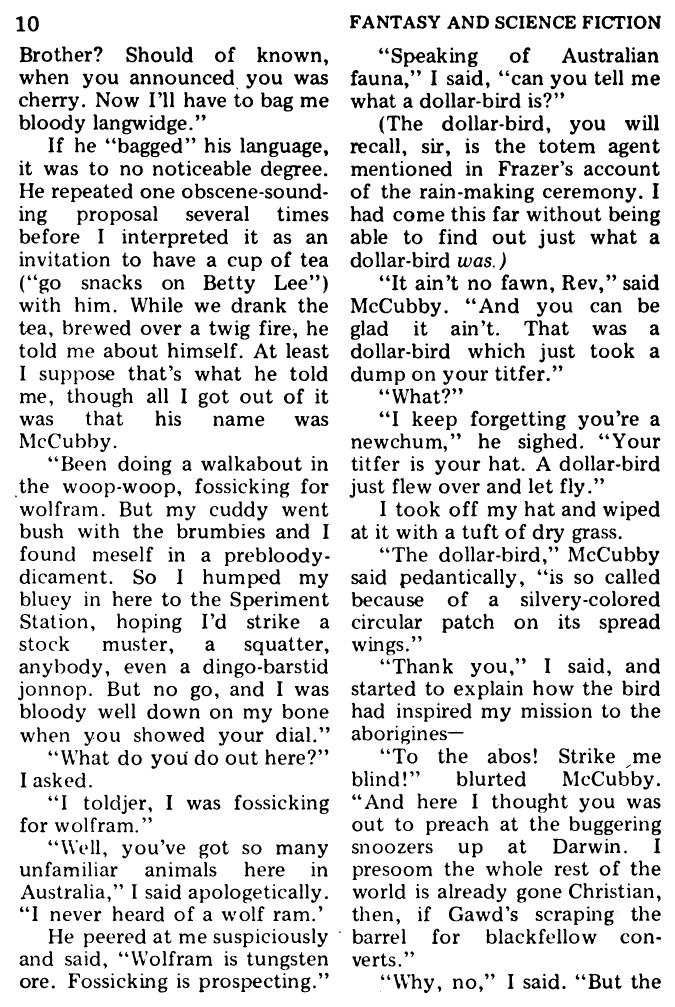
I’ve read “Sooner or Later or Never Never” before, but I’m not sure where and how. I don’t normally read this kind of fiction. However, the prose is quite entertaining. Normally, I dislike dialect, but Jennings captures outback Aussie hilariously. I wish I had an audiobook version.

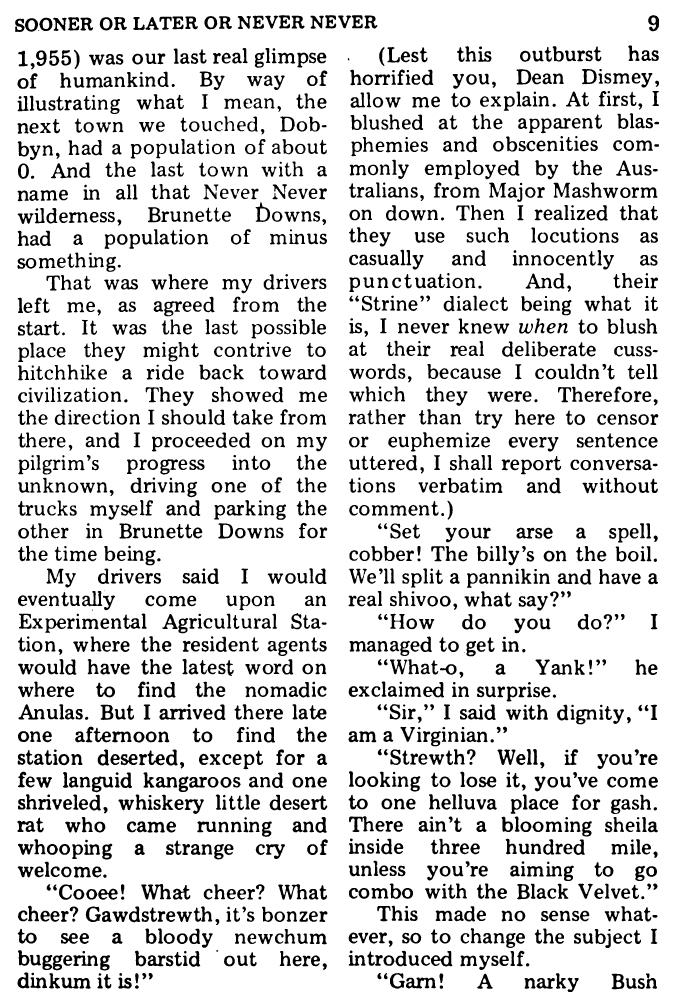
There is no way I can describe this story, so I’m just going to give you two pages to read as a sample.

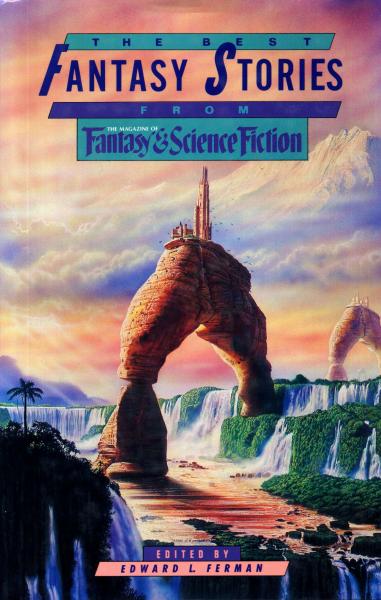
I know this is cheating, but I’m taking the easy way out. I’m posting this merely to encourage people to read this story. I read it today because my Facebook short story club is reading The Best Fantasy Stories from The Magazine of Fantasy and Science Fiction. Reading this 792-page anthology demonstrates the range of what people call fantasy.

I routinely tell people I dislike fantasy. But of the stories we’ve read in this anthology, the ones set in the present about ordinary people have been the most entertaining to read. And the ones that people consider traditional fantasy were no fun to read. I guess when I say I dislike fantasy, I dislike only a subset of the genre.

However, I also think Ferman is cheating to call “Sooner or Later or Never Never” fantasy. It could have been published in almost any kind of fiction magazine.

James Wallace Harris, 7/14/25

THE INHERITORS by William Golding

Our species, Homo sapiens, have been around for 300,000 years, but we only have recorded history for about 5,000 years. Neanderthals date back even further in time. For hundreds of thousands of years, people created societies and maybe even forgotten civilizations that existed before history. Science fiction is mostly known for imagining possible futures, but a subgenre exists that speculates about human life in prehistory.

Probably, many science fiction fans would consider stories about our cave-dwelling ancestors as historical fiction or historical fantasy. David Pringle claims the novel was inspired by science, so it should be science fiction. Of course, that opens up a whole can of worms. But I’m willing to embrace these kinds of stories into our genre.

I read The Inheritors by William Golding because I’m reading or rereading the classics of science fiction. I’m going through David Pringle’s Science Fiction: The 100 Best Novels. The Kindle edition of the Pringle book is $1.99. The Kindle edition of The Inheritors is just 99 cents. You can read a list of Pringle’s 100 recommended SF titles here.

William Golding’s first novel was The Lord of the Flies (1954). His second novel, published in 1955, was The Inheritors. Lord of the Flies is about a group of schoolboys forced to live like primitives. The Inheritors is about a small band of Neanderthals confronting Homo Sapiens. It’s obvious Golding was exploring similar themes in these two novels.

Writers have long speculated about Neanderthals in fiction. Neanderthals thrived for 400,000 years but became extinct 40,000 years ago. Modern humans may have coexisted with them for up to 100,000 years. William Golding portrays Neanderthal life based on scientific speculation in 1955. It’s quite sympathetic.

Most of the novel is in third-person Neanderthal point of view, following a male named Lok. Golding expects his readers to decode action from the limited awareness of Lok’s mind. He does not say “bow and arrow” but describes them in terms that a Neanderthal would understand. Quite often, the narrative is confusing, but that’s intentional. Golding wants the reader to struggle in the same way that Lok struggles to understand.

Golding offers several interesting speculative theories. He suggests that Neanderthals had no sense of time but understood past and possibly future events by talking about pictures in their minds. Their language consists of simple nouns and verbs. The members of the tribe spend a lot of time comparing mental imagery. Their social bonding suggests they felt an almost telepathic connection with each other. Golding suggests that gender roles were divided. Males, especially the leader, decided on actions, while females, through a primitive religion, decided on meaning.

This speculation about how Neanderthals thought reminded me of The Origins of Consciousness in the Breakdown of the Bicameral Mind by Julian Jaynes, first published in 1976. Jaynes theorized that humans didn’t always have the same kind of internal consciousness that we have now. Golding anticipates this idea in 1955.

Throughout the novel, characters are forced into an original concept. The plot begins with crossing a stream. The Neanderthals are terrified of water. They have always depended on a fallen log to cross a stream, but one day it’s no longer there. It takes a great deal of group effort to come up with a solution.

The leader of the Neanderthal band is Mal, an old man. An unnamed old woman, maybe Mal’s mate, leads the group in other ways. There are indications that tribe members mated with whomever. There are four adults, Lok and Fa are the younger ones, and they become the main characters. Ha and Nil are the other two. There is a little girl named Liku and a baby.

Liku and the baby go missing. Then Ha and Nil. We follow Lok as he tries to track them down. Lok eventually discovers a new animal that Lok hasn’t seen before. After observing them, he starts calling them the new ones. They are Homo Sapiens, or Cro-Magnon, but it’s never said.

The women carry a small figurine they call Oa and treat it as if it were alive. My guess is the Oa is a Venus figurine, but I’m not sure. The Venus figurines came much later, well after Neanderthals went extinct. I assume Golding is speculating that such a religious symbol might have existed far back into time, so that intellectual attributes we speculate began with modern humans had early antecedents in Neanderthals.

In chapter 11, the penultimate chapter, we follow Lok at first through a close third-person narrative. But near the end, the point of view changes to omniscient. This lets Golding describe the scene as if we were seeing it through the modern mind. We are told Lok holds something in his hand: “It was a root, old and rotted, worn away at both ends but preserving the exaggerated contours of a female body.” I’m sure this is Oa.

In Chapter 12, the final chapter, we get a third-person account from the perspective of the Homo sapiens. This lets us know what they thought about the Neanderthals. It also allows Golding to speculate about their state of consciousness.

The Inheritors is not a breezy read. In some ways, it reminds me of A Clockwork Orange and how I had to struggle to understand what was going on. I’m quite sure if I reread The Inheritors two or three times, I would discover many more layers of speculation and narrative devices. With just this one reading, I’m left puzzled over several scenes.

The Inheritors is not famous enough to have a current audiobook edition. I believe hearing the story would help me understand it better. I did find an old audiobook edition on YouTube. Listening to it did indeed make the action clearer. I have long known that I tend to read too fast. Audiobooks make me slow down. Listening makes certain parts of the prose easier to understand. However, I need to read with my eyes to understand other parts. I believe The Inheritors deserves to be read with both my eyes and ears. By the way, Audible is scheduled to publish a new audiobook edition next year.

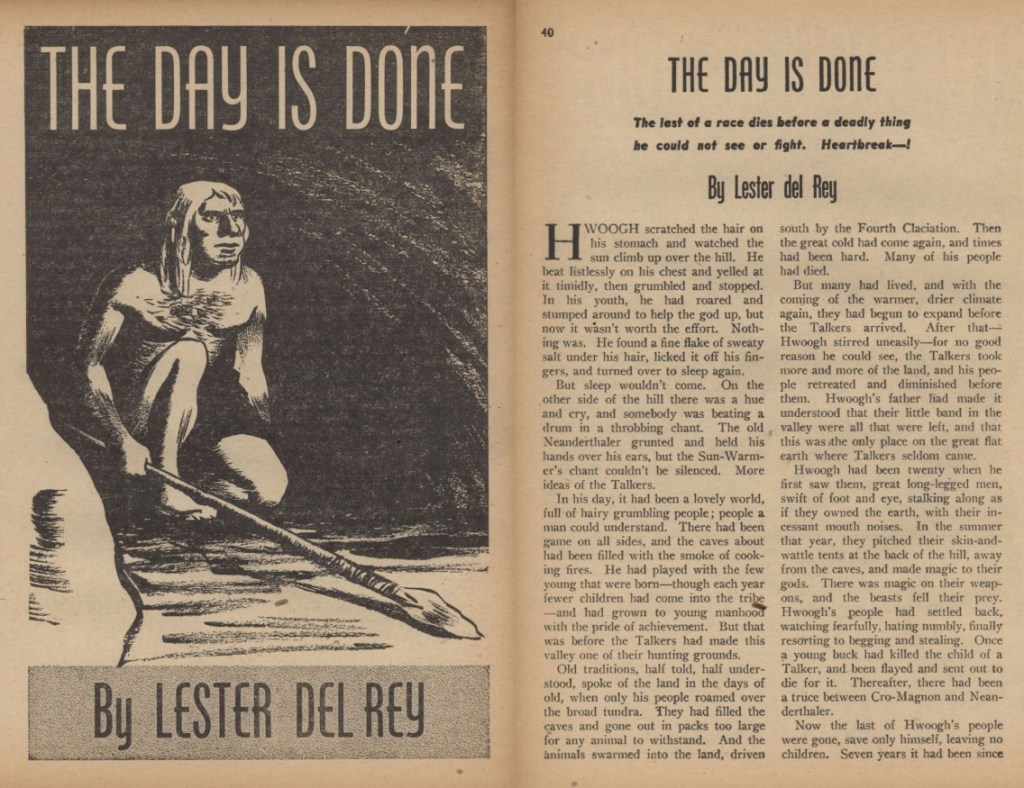
The Inheritors reminds me of the short story, “The Day is Done” by Lester del Rey, first published in the May 1939 issue of Astounding Science-Fiction. It’s another tale of a Neanderthal confronting Homo sapiens. You can read it here. I wonder if William Golding had read “The Day is Done.”

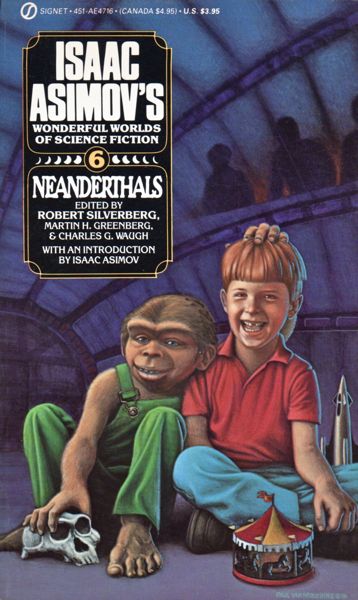
There is an anthology of science fiction stories, Neanderthals, edited by Robert Silverberg, Martin H. Greenberg, and Charles G. Waugh. View the table of contents here.

H. G. Wells wrote “The Grisly Folk” in 1921, an unflattering look at Neanderthals.

Of course, the most famous fiction featuring Neanderthals is Earth’s Children series, by Jean M. Auel.

James Wallace Harris, 7/8/25

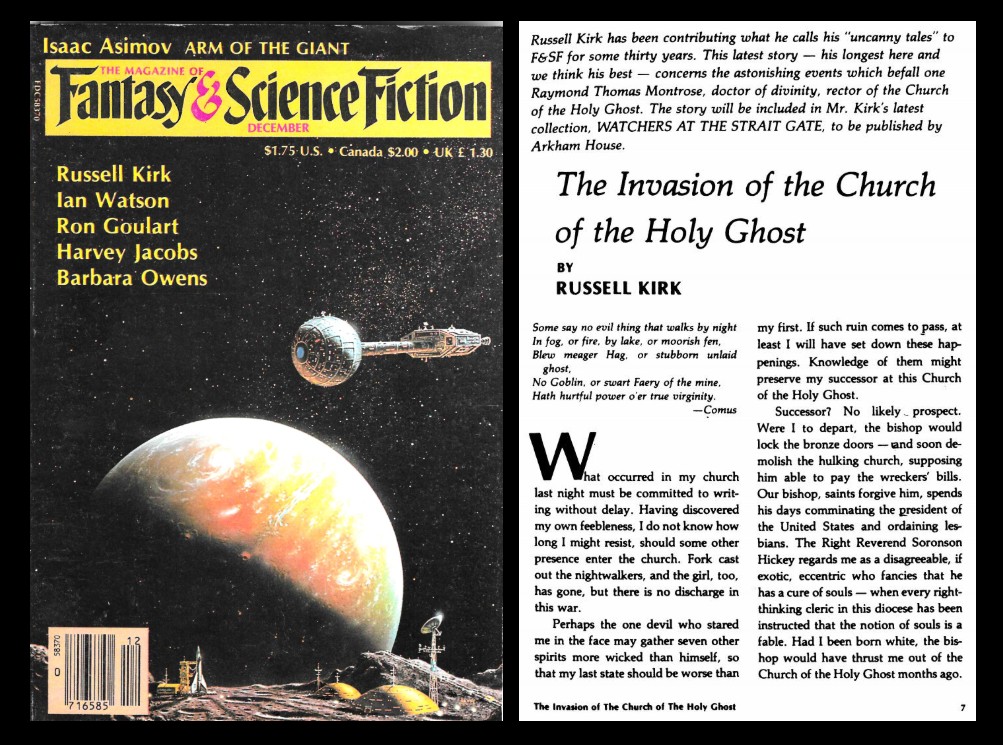
“The Invasion of the Church of the Holy Ghost” by Russell Kirk

I’m an atheist who doesn’t normally enjoy reading fantasy fiction; however, I found “The Invasion of the Church of the Holy Ghost” by Russell Kirk, a religious ghost story, to be quite entertaining and well-written. The characters of Father Raymond Thomas Montrose and Fork Causland are so well developed that it’s hard not to like this story. Plus, the story is set in a seedy, rundown section of town filled with hustlers, prostitutes, and con men, has all the feel of a Damon Runyon tale.

You can read this story online.

I had no idea who Russell Kirk was, but after reading about him on Wikipedia, the philosophy behind the story made more sense. Kirk was a major conservative intellectual and a distinguished fellow at the Heritage Foundation. Since I’m a liberal, this doesn’t endear me to him. Kirk was also a convert to Catholicism and enjoyed writing ghost stories.

Kirk’s significant spiritual, political, and philosophical background forces me to look deeper into “The Invasion of the Church of the Holy Ghost.” Kirk was a serious thinker. That makes it hard to dismiss the story as a silly, inconsequential ghost story.

Even while liking “The Invasion of the Church of the Holy Ghost” very much, it proposes ideas I find totally repugnant. Both Father Montrose and Fork Causland are possessed. Kirk suggests that when people do bad things, it’s because they are influenced by evil ghosts, and when they do good things, they are empowered by higher-order beings. He doesn’t specifically say angels, but that’s how I interpreted the story.

In old religious philosophy, good comes from God, and evil from Satan. If humans do good, it’s because of the influence of the divine, and if we do bad, it’s because of the devil working through us. At one point, the normally good Father Montrose starts thinking about raping a young woman. Kirk proposes that those thoughts come from being possessed by an evil spirit.

I don’t believe in free will, but I also refuse to believe that our thoughts and actions originate with ghosts or other metaphysical beings. I don’t know if Russel Kirk believes that either, but “The Invasions of the Church of the Holy Ghost” is based on such a religious foundation. This fantasy is a religious reality to some. On the other hand, it might just be Kirk’s way of scaring us.

However, if I ignore what this story is suggesting, it’s an exceptionally creative work. Russell Kirk does an amazing amount of world-building. When I like fantasy, it’s often because it’s set in our present-day world. For example, It’s a Wonderful Life or The Bishop’s Wife.

Yesterday, I was pondering the value of fiction and nonfiction. Writers of nonfiction strive to be as accurate as possible. We read nonfiction to understand reality. Fiction is elaborate lies, but sometimes fiction writers work to express a truth they perceive at a deep, personal level. Knowing the kind of person Russell Kirk was, I can’t help but believe that he might believe in ghosts and possession.

James Wallace Harris, 7/3/25

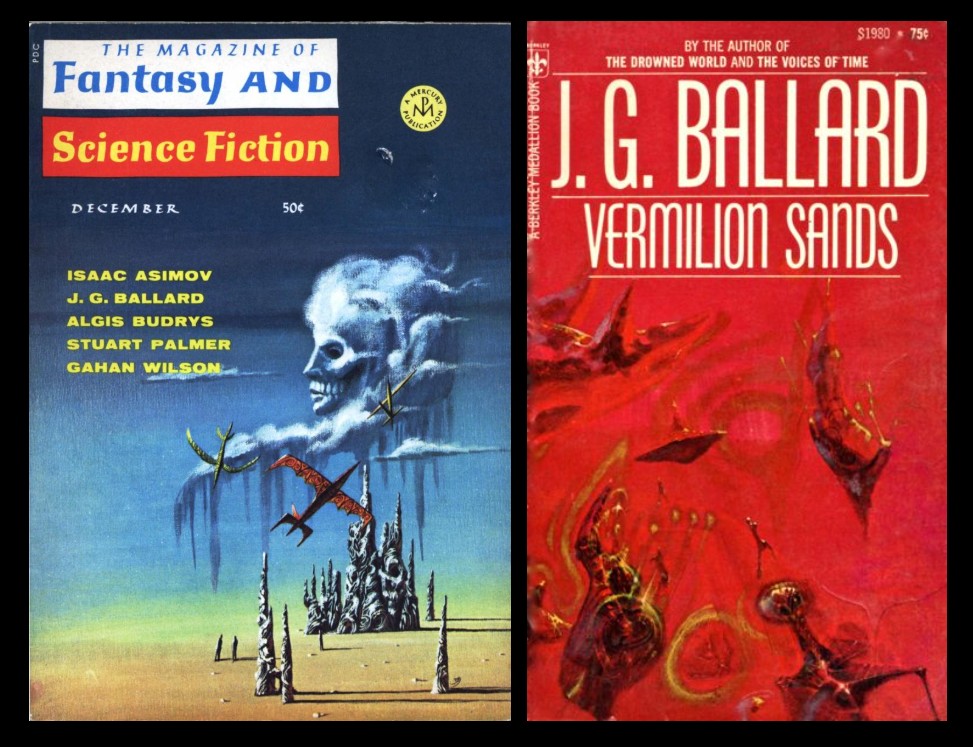
“The Cloud-Sculptors of Coral D” by J. G. Ballard — Fantasy or SF?

I reread “The Cloud Sculptors of Coral-D” by J.G. Ballard because my short story reading group is reading The Best Fantasy from The Magazine of Fantasy and Science Fiction. Inclusion in this volume suggests its fantasy. However, it was also included in The Great Science Fiction Series edited by Martin H. Greenberg, Joseph Olander, and Frederik Pohl. The story contains no magic, no dragons or elves, and it’s set in our present day, but in a fictional resort called Vermillion Sands.

Vermillion Sands feels like a decadent playground for the rich, which also features the many kinds of parasites that live off the wealthy. It’s also an artist and expat colony. We don’t know its location, but it feels like Palm Springs, California. Many worldly travelers come and go there.

“The Cloud Sculptors of Coral-D” was my first introduction to J. G. Ballard back in the 1960s. Other stories from that setting make up the series, collected into Vermillion Sands.

  • “Prima Belladonna” (Science Fantasy, December 1956)
  • “Venus Smiles” (Science Fantasy, June 1957)
  • “Studio 5, the Stars” (Science Fantasy, February 1961)
  • “The Thousand Dreams of Stellavista” (Amazing Stories, March 1962)
  • “The Singing Statues” (Fantastic Stories, July 1962) (not in original collection)
  • “The Screen Game” (Fantastic Stories, October 1963)
  • “Cry Hope, Cry Fury!” (F&SF, October 1967)
  • “The Cloud-Sculptors of Coral D” (F&SF, December 1967)
  • “Say Goodbye to the Wind” (Fantastic, August 1970)

Wikipedia provides an excellent overview of the stories, highlighting that each dealt with a different artistic medium being affected by technology.

When I first read “The Cloud Sculptors of Coral-D” as a teen, it felt very grown-up to me. The characters were the kinds of people I met growing up in Miami, not the typical heroes of science fiction stories I spent so much time reading. It never occurred to me to think of the story as fantasy, but it didn’t seem like science fiction either. At the time, I was just discovering British science fiction writers like Brian Aldiss and John Brunner and the New Wave SF. The stories were set in the present or near future and took place on Earth. No rockets or robots. Was this actual science fiction?

“The Cloud Sculptors of Coral-D” is about a band of glider pilots who shape clouds with silver iodide. At first, their audience and patrons are people who park their cars along the lagoon road to watch. Eventually, the Garbo-like Leonora Chanel hires them to perform for her party. Sculpting clouds is a neat idea, but far from realistic. Does that make the story science fiction? Ballard does throw in a creature called sand rays, which I suppose are like manta rays that live under the sand instead of the sea. Do they make the story a fantasy?

Science fiction has often been the dumping ground for any kind of weird story that can’t be classified. The Vermillion Sands stories would have been rejected by mainstream and literary magazines. They fit nicely in The Magazine of Fantasy & Science Fiction. They were also published in the British magazine Science Fantasy and the American Fantastic. Only one was published in a straight-ahead science fiction magazine, Amazing Stories. I doubt John W. Campbell would have accepted them in Astounding or Analog. Nor would he have published them in Unknown. I wonder if Rod Serling would have used “The Cloud Sculptors of Coral-D” for The Twilight Zone?

I’m not fond of traditional fantasy, and many of the stories in The Best Fantasy from The Magazine of Fantasy and Science Fiction aren’t enjoyable for me to read. But I did enjoy “The Cloud Sculptors of Coral-D.” The story has a pleasant, surreal feel. The setting is very close to this world, but just a smidge off. I love the artist colony atmosphere, the hint of decadence, the ever-so-slight sense of unreality. The story combines barnstorming, carny folks, and the ugly rich. I visualize it as a cross between early Faulkner and Fellini.

The shortest description would be to say the story has atmosphere.

James Wallace Harris, 7/1/25