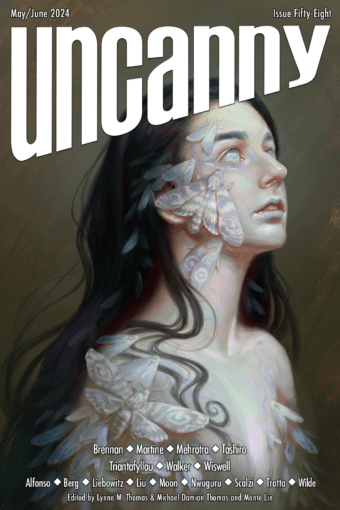
“Loneliness Universe” by Eugenia Triantafyllou appeared in Uncanny (#58, May/June 2024) and is a finalist for the 2025 Hugo Award in the Best Novelette category. You can read or listen to the story online. If you are a member of the 2025 Seattle Worldcon, you can vote for this story through July 23, 2025.
I first learned about the Hugo Awards back in the 1960s. I never attended a Worldcon but always wanted to. I did attend some regional conventions back in the 1970s. I kept up with the Hugo and Nebula awards for most of the 20th century, but slowly lost touch with science fiction and fandom in the 21st century. I discovered “Loneliness Universe” when I read Austin Beeman’s “Reviewing the 2025 Hugo Award Finalists: Best Novelettes” at his website www.shortsf.com.
I’m so impressed with “Loneliness Universe” that I will try to read all the finalists. I might even join the convention as a virtual member and vote. Members get a packet that includes many of the works up for voting. Membership is $50, and adding virtual attendance is another $35. There’s little chance I will physically attend a Worldcon, so that might be my best shot at achieving an old desire.
“Loneliness Universe” is not what I’d call science fiction. Nor would I categorize it as fantasy. One reason I let the science fiction genre pass me by is that it’s no longer what I thought it was supposed to be. That’s not a criticism. I just didn’t feel like keeping up with changing times. However, “Loneliness Universe” is an outstanding work of fiction.
The story begins with an email from Nefeli to Cara dated September 18, 2015. Throughout the story, we get to read email exchanges, but the next one is dated July 5, 2015. I don’t know if this is a spoiler, but the first email is the end of the story. I did not discover right away. In fact, I wouldn’t have discovered it at all if I hadn’t immediately reread the story by listening to it a second time.
I recommend you read this story the first time, then listen to it a second time.
I’m not going to spend much time describing this story. Read it. I will spend some time trying to explain what it’s doing.
There are infinite ways to understand fiction. One way is to think of fiction as a spectrum. At one end are stories where the author sends the readers a message. On the other end of that spectrum are stories where the author creates a story that is just a story.
Think of the first type as a message in a bottle from an individual stranded on a deserted island. And think of the second type as how some people describe God as an artist who created our existence but walked away.
In “Loneliness Universe,” Eugenia Triantafyllou has created a metaphor for our current cultural existence. In this story, Nefeli realizes she is losing physical contact with everyone she knows. She can only communicate with them through email and instant messages. They can leave evidence of their existence, but she no longer communicates with people face-to-face.
The setup for this story reminds me of an experience I had on LSD fifty-five years ago. I thought everyone was in an isolated universe by themselves, and our efforts to communicate in words were no better than writing a message, putting it in a bottle, and throwing it into the sea, hoping for a reply. That each of us was an isolated universe inside our heads. In Eugenia’s story, she imagines we’re all moving into separate universes of a multiverse, and for a while, can communicate via email and instant messages. This sounds science-fictional, but it’s probably more Kafkaesque.
The thing about metaphors is not that they are accurate, true, or valid, but that they make you think about a concept from a new perspective. In recent weeks, I’ve often woken in the middle of the night and thought about all the hundreds of people I’ve known in my lifetime and wondered about what has happened to them. And I ask myself, did we ever really communicate? This is what “Loneliness Universe” is about. Are we on the same wavelength?
Are we ever in the same room at the same time with someone else? If you truly understand this question, I will say those moments of being together are fleeting. Many people want to believe sex is a way to achieve such synchronicity, but that’s not true either. I don’t believe telepathy is possible, but sometimes, when two people have had the same life experiences, they can say just the right words, they know they have achieved a kind of psychic Venn diagram intersection for a fleeting moment.
“Loneliness Universe” is not a perfect story. It’s only as good as you can resonate with what Eugenia Triantafyllou is expressing. I don’t know how well her message in a bottle was decoded by my inner self. We will never be in the same room together. But I’d like to believe I know what she was trying to say.
I know full well that can be a delusion.
That’s also the dark bleakness of her ending.
James Wallace Harris, 5/1/25
 Classics of Science Fiction
2 thoughts on ““Loneliness Universe” by Eugenia Triantafyllou”