In Ted Chiang’s impressive overview of human superintelligence in science fiction, he mentions that John W. Campbell Jr. rejected a story by Vernor Vinge about a character with human superintelligence because no one can write such a story. (Vinge had proposed a sequel to “Bookworm, Run!“) The implication: since none of us know what being superintelligent is like subjectively, we can’t describe it. That’s silly. Campbell had been publishing a magazine describing space travel decades before NASA, or atomic bombs before 1945, or robots long before Roombas.
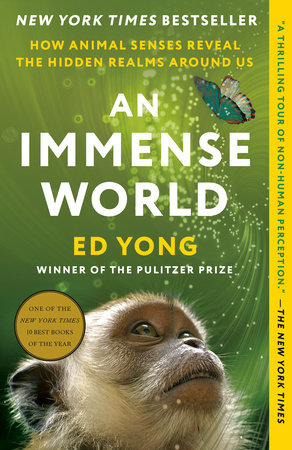
British journalist Ed Yong describes the umwelt of many species in his book An Immense World. How each organism views reality from its collection of sense organs is called umwelt. We might not be able to imagine being a dog, but we can analyze a dog’s senses and speculate what they can perceive.
Shouldn’t we assume science fiction can speculate on a human being with superintelligence by what it’s capable of perceiving and what it does with those perceptions? I’m guessing John W. Campbell assumed that a dog couldn’t imagine what it’s like to be a human. But is that really true? A dog might not comprehend humans reading a book, but I’m sure they understand much about us in their own special way. In fact, they might observe qualities about us that we’re unaware of.
Astounding Science Fiction in the 1950s was full of stories about ESP and other psychic abilities. Campbell called such abilities psionics. Throughout the history of science fiction, writers have speculated that superhumans would have god-like powers. I’ve written about science fiction and human superintelligence before and described many of the most famous of these stories. See: “Science Fiction and Human Evolution” and “The Origins of Higher Intelligence in Science Fiction.” The genre has a long history of attempting what Campbell supposedly told Vinge he couldn’t.
Strangely, hard science fiction writer Arthur C. Clarke wrote two classic novels about superhumans: Childhood’s End and 2001: A Space Odyssey. Clarke gave no scientific explanation of how people might transform into next-stage humans. Clarke’s new humans were almost impossible to imagine. They are god-like to us. This is fun but gives us little to speculate about realistically.
Greg Bear imagines a new strain of virus affecting pregnant women causing a mutation in Darwin’s Radio. Children born of these women are more intelligent, have greater disease resistance, and can communicate non-verbally. This isn’t hard to imagine. Current humans show a tremendously wide spectrum of intelligence and physical health. And some humans are far better at communicating than others, especially via body language and empathy.
Nancy Kress imagines genetic engineering creating a new species of humanity in Beggars in Spain. Their key feature was needing less sleep. This gave them more time to learn, work, and compete. It’s easy to imagine this adaptation and how these new humans would do better than ordinary humans.
The movie Gattaca imagined a future society where normal humans competed with humans with carefully selected genes. The improved humans had the same human frailties, but out-competed normal humans for the better jobs. They were better-looking, smarter, more athletic, and had greater discipline. That’s not hard to imagine.
In Flowers for Algernon by Daniel Keyes, Charlie Gordon undergoes an operation that advances his IQ. At the beginning, Clarlie works as a janitor and is cognitively challenged. The operation allows him to learn new things, and eventually become a super-genius. His new attributes are not beyond belief. Charlie learns new languages, achieves great academic success, and becomes tremendously productive. Charlie doesn’t develop ESP or godlike powers, but achieves the maximum levels of current human skills and traits. This is believable and easy to imagine.
Homo sapiens are only slightly improved over Neanderthals, but those improvements let us do so much more. For us to describe Homo superior we only need to imagine slight enhancements to our species and speculate about what impact they would have.
Some humans have tetrachromacy, which means they can detect four primary colors rather than three. Other people have eidetic memory. Stephen Wiltshire, an autistic savant, can draw detailed images of cities from memory after just a helicopter ride. All the traits that Human 2.0 might have are already showing up in us now. Conversely, all the traits that won’t emerge are those we lack precursors for now.
That’s why I think it’s silly to imagine humans evolving to have telepathy or be able to teleport at will. Those are comic book ideas. Campbell was both too hopeful and too naive about human evolution. He expected “The Man Who Evolved” by Edmond Hamilton. At best, I think we’ll get Gattaca.
One problem with evolving our current abilities is that we often see cognitive issues associated with people with extreme examples of those abilities. Can a perfect memory be imperfect? Can we be too smart? I’ve known many people far ahead of me in many skills. I can’t fathom general and special relativity. Does that mean Albert Einstein was a 2.0 human?
Until recently, I thought the human race was evolving slowly on average. But current events make me think we’re regressing. Some people already have superintelligence compared to others. It could be the evolution of our species won’t be by quantum leaps, but slow adaptation of biological trial and error. Much of science fiction is just fun bullshit speculation. We need to distinguish between fantasy and scientific possibilities.
Personally, I feel our role in evolution was to evolve machine intelligence. I don’t believe humans will ever become giant brains with tiny bodies, nonphysical beings, or something like Q from Star Trek: The Next Generation. It’s interesting that Greg Bear and Nancy Kress in their novels, had normal humans wanting to wipe out the new humans before they got established.
Lester del Rey summed us up nicely in “For I Am a Jealous People!” Our creator and descendants need to watch out.
I don’t see why Campbell rejected Vernor Vinge’s idea of writing a sequel to “Bookworm, Run!” Campbell had already published Slan by A. E. van Vogt and many other stories featuring human superintelligence.
James Wallace Harris, 3/9/25
 Classics of Science Fiction
THE DEMOLISHED MAN and THE STARS MY DESTINATION featured super humans. Alfred Bester had some brilliant ideas in his 1950-era novels.
LikeLike