“The Million Year Picnic” by Ray Bradbury

Screenshot

“The Million Year Picnic” by Ray Bradbury is about as famous to science fiction readers as O’Henry’s “The Gift of the Magi” is to English majors. “The Million Year Picnic” was first published in the Summer 1946 issue of Planet Stories. (Read it online here.)

However, most readers know “The Million Year Picnic” as “October 2026: The Million-Year Picnic” from The Martian Chronicles. Most modern readers think The Martian Chronicles is so out of date scientifically that they don’t consider it science fiction but fantasy. But it is science fiction, and “The Million Year Picnic” is a classic, touching on several iconic themes of the genre.

“The Million Year Picnic” was published just one year after Hiroshima, making it one of the earliest stories about humanity destroying the Earth with atomic weapons. But we don’t know that right away. When we begin reading the story, Bradbury voices his story with a quaint tone, almost like a parable, sounding like Mr. Rogers’ Neighborhood. A father, mother, and their three sons have just landed on Mars. They decide to go fishing. The narrative pacing seems only a few steps up from “See Dick run.”

Back in the 1940s, throughout the 1950s, and even into the 1960s, it was popularly considered that there was life on Mars or had once been, even intelligent life. This is partly due to H. G. Wells and Giovanni Schiaparelli, an Italian astronomer who convinced the world that he saw canals on Mars. Until July 1965 when Mariner 4 showed us a couple dozen grainy pictures of Mars that looked like the Moon, we had so much hope for Mars.

Science fiction writers loved to imagine Mars occupied with all kinds of beings and ancient civilizations. The common belief was Mars was a cold dying cold world and Venus was a hot young jungle world. Ray Bradbury wrote many stories based on these assumptions. In 1950 Bradbury published a collection of his stories about Mars as The Martian Chronicles, a “fix-up” novel. (In 2009, Subterranean Press published The Martian Chronicles: The Complete Edition, which claimed to collect all of Bradbury’s stories about Mars. I’d love to have a copy, but the cheapest copy I can find online is $1,300.) Because “The Million Year Picnic” was so popular it had already been reprinted three times before The Martian Chronicles. And it has been extensively reprinted ever since.

Bradbury also reprinted “The Million Year Picnic” in his collection: S is for Space. Most of Bradbury’s science fiction was found in four collections when I was growing up: The Martian Chronicles, The Illustrated Man, S is for Space, and R is for Rocket. Bradbury quit writing science fiction for the most part in the 1950s and went on to write fantasy, horror, and mainstream fiction after that. I read “The Million Year Picnic” this week because the Facebook group Best Science Fiction and Fantasy Short Fiction is reading 12 science fiction stories by Ray Bradbury that they haven’t read before. Here’s the discussion schedule.

But back to the story. After the family sets out on a boat on a Martian canal to go fishing we slowly learn that “The Million Year Picnic” is a post-apocalyptic tale. But we don’t discover it right away. The three boys are all excited. Timothy, the oldest carefully watches his father, trying to learn what’s happening. As they travel down the canal they pass by countless old cities where Martians once lived. Some cities are just mounds, while others have grand skylines. The dad promises his boys he will show them the Martians, and they get excited.

Along the way, we discover “The Million Year Picnic” follows another hoary old science fiction theme, the retelling of Adam and Eve. This idea had become so overused that by the 1960s writer’s guidelines for magazines would state “no Adam and Eve stories.”

I don’t know how many times I’ve read “The Million Year Picnic.” But back in the early 1960s when I first discovered it, I still believed in Martians on Mars. I was so into Mars, that as a kid, I thought my goal in life was to get there. So when I read the story I focused on the dead Martian civilization. That’s what made the story exciting. I too wanted to see the Martians. And that’s how I always remember this story, especially the surprise ending, which was quite clever.

However, on this rereading, I realized that I had forgotten Bradbury’s serious point. Bradbury was a nostalgic writer, even as a young man. He grew up in the 1920s and 1930s and his stories often have the feel of that era, like watching old black and white Frank Capra movies. Many of his Martian stories transplant small midwestern downs to Mars. But Bradbury wrote “The Million Year Picnic” with an undercurrent of horror and even cynicism. The quaint family on Mars has fled an Earth where humanity has destroyed itself in a nuclear war.

When the Dad realizes the radio signals from Earth have gone silent he tells his boys that one day their grandchildren might hear radio signals again. When I read that I thought about Adam and Eve and their sons and how Biblical skeptics always asked “Where did the wives of Adam and Eve’s sons come from?”

I’m always amused and fascinated by what I remember and don’t remember from stories when I reread them. The gimmick ending of “The Million Year Picnic” overshadows all my memories. I had completely forgotten this was a post-apocalyptic story. In other words, I remembered the positive and forgot the negative. I also forgot how many Biblical allusions where were in the story.

Bradbury solves the wives’ problem. In the end, we learn that another family had also secretly prepared to go to Mars when armageddon began, this one had four daughters.

Now that number is interesting. Bradbury even tells us it will be a problem. I think he’s hinting at the old Cain and Abel conflict. Humans don’t change and even if we start over we’ll have violence and wars again. We know two if not three of the sons will want that extra wife.

Every time I reread a Ray Bradbury story I tell myself I need to get into Ray Bradbury in a big way. I even bought three biographies of the man: Becoming Ray Bradbury and Ray Bradbury Unbound by Jonathan R. Eller, and The Ray Bradbury Chronicles by Sam Weller – but I haven’t read them yet. I also bought two giant collections of his stories for the Kindle: The Stories of Ray Bradbury and Bradbury Stories: 100 of His Most Celebrated Tales. And on audio, I bought The Martian Chronicles and The Illustrated Man, which I have listened to. I also bought Golden Apples of the Sun and Other Stories and A Medicine for Melancholy and Other Stories on audio which reprints much of what was in R is for Rocket and S is for Space.

The problem is I always go on to read other science fiction. Rereading “The Million Year Picnic” makes me want to delve into Bradbury once again, and read or reread all these books I’ve collected. Even though I’m retired and have all my time free, I can’t seem to find the time to pursue this project. I’m hoping the Facebook group reading of Bradbury will get me going.

If you’re a fan of listening to short stories, I recommend two giant collections of Ray Bradbury on audio that repackages four of Bradbury’s early collections. #1-32 is The Golden Apples of the Sun and Other Stories (1997), and #33-63 is A Medicine for Melancholy and Other Stories (1998). I wish Bradbury Stories: 100 of His Most Celebrated Stories (2003) were on audio, but it is not. (Table courtesy of Piet Nel.)

James Wallace Harris, 3/20/25
CAMP CONCENTRATION by Thomas M Disch

The first time I read Camp Concentration by Thomas M. Disch, I was around 20 and proud of myself for reading one of those New Wave science fiction novels I had been reading about in fanzines. It wasn’t much fun to read. It was overly intellectual – well beyond my level of comprehension. After reading thousands of other books over the last fifty-plus years, Camp Concentration made much more sense. I actually enjoyed the story. I enjoyed it a lot. But please, don’t buy a copy without carefully reading this review.

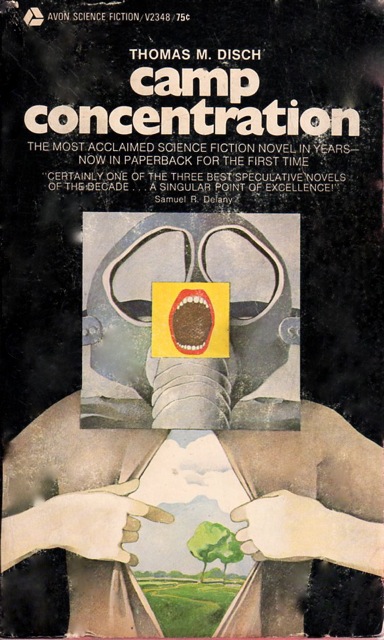
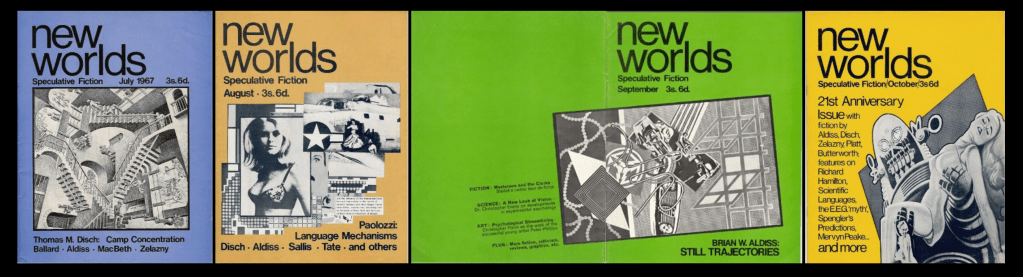
It’s important to know that Camp Concentration first appeared in the July, August, September, and October 1967 issues of New Worlds. It suggests it was written in 1966 or early 1967 and published first in England, in a magazine that promoted the New Wave. To fully appreciate this novel, you must remember when it was written and what happened in the United States in 1966 and 1967. The first hardback came out in England in 1968, and it wasn’t until 1969 when it was published in America. I didn’t read it until after the 1971 Avon paperback, cover shown above.

I’d love to hear an audiobook version of Camp Concentration. However, a highly skilled narrator would be needed to handle all the accents, poetry, foreign language quotes, and characterizations. It would also make a wonderful movie. Unfortunately, the audience for either the audiobook or film would be small.

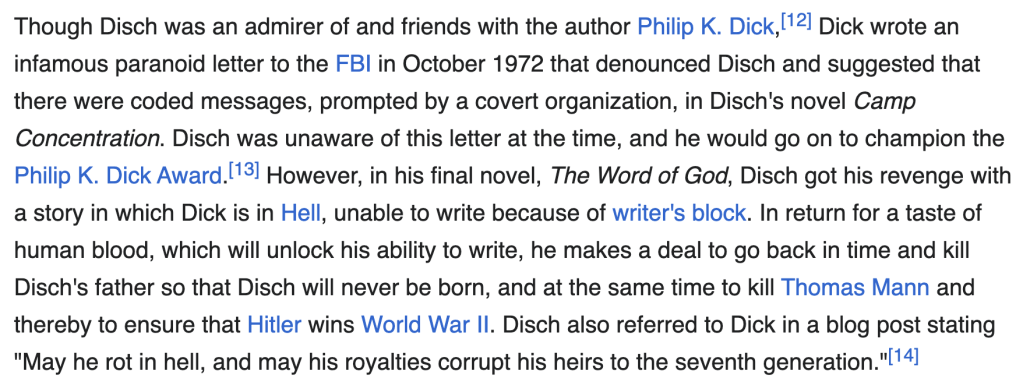
Back in the 1970s Camp Concentration was greatly admired. Philip K. Dick loved the book so much he promoted to friends and suggested it be made into a movie to a producer interested in his own work. But there’s a bizarre story here. Dick, who was paranoid, started seeing things in Camp Concentration and wrote a letter to the FBI claiming it had secret intel. You can read that letter here. Eventually, Disch found out about this and didn’t take it kindly. Wikipedia describes what happened:

I mention this early in the review because it helps set up how strange Camp Concentration is as a novel. It’s quite readable, but it has so many references to literature, music, philosophy, poetry, etc., that you might feel it has some deeper message. Even though I just finished the novel, I’m already looking forward to rereading it again. However, before I can do that, I need to study first. At minimum I should read Christopher Marlowe’s play Doctor Faustus, and Thomas Mann’s novel Dr. Faustus. In fact, I need to go through Camp Concentration, make a list of all the works Disch mentions, and at least read their Wikipedia pages about them.

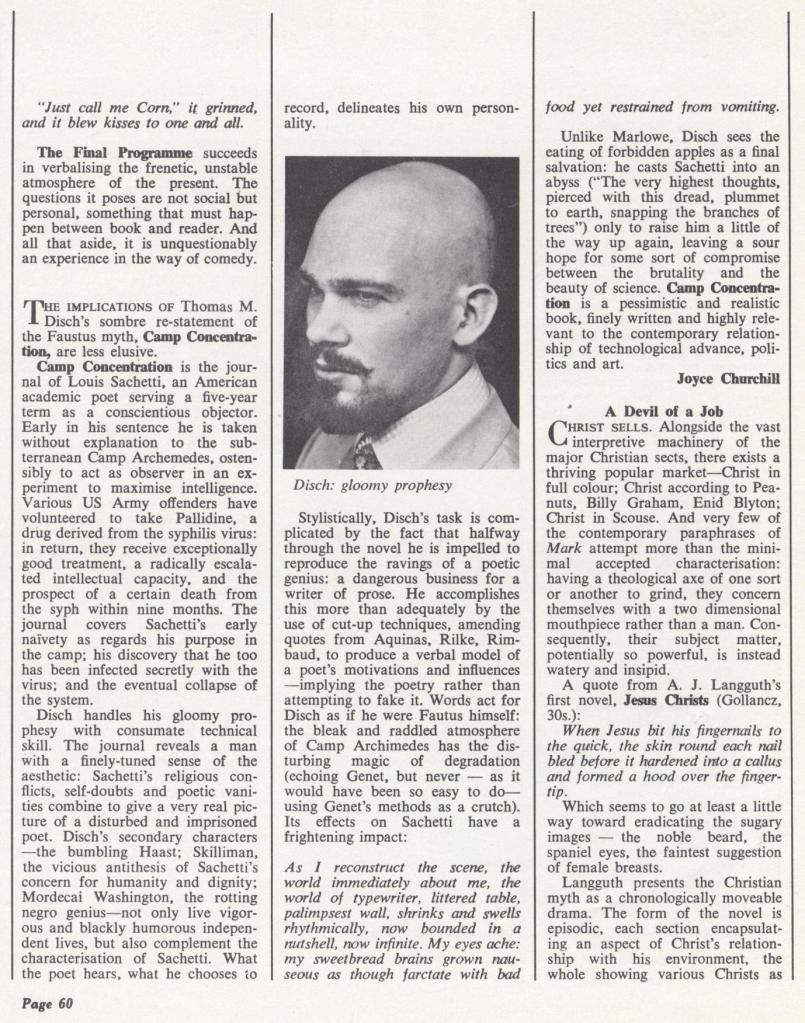
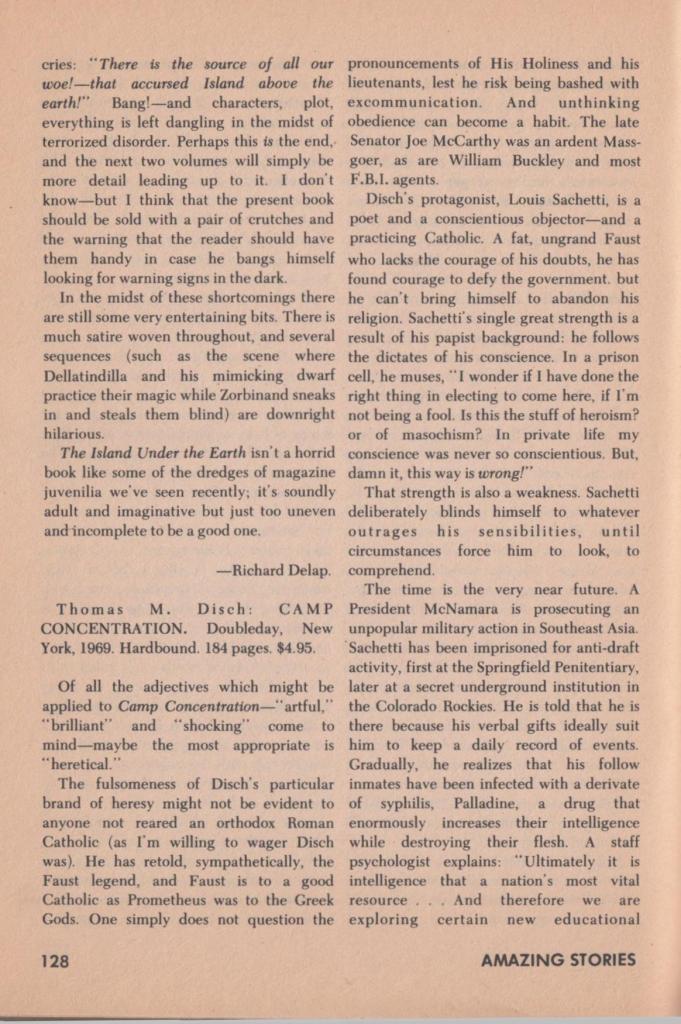
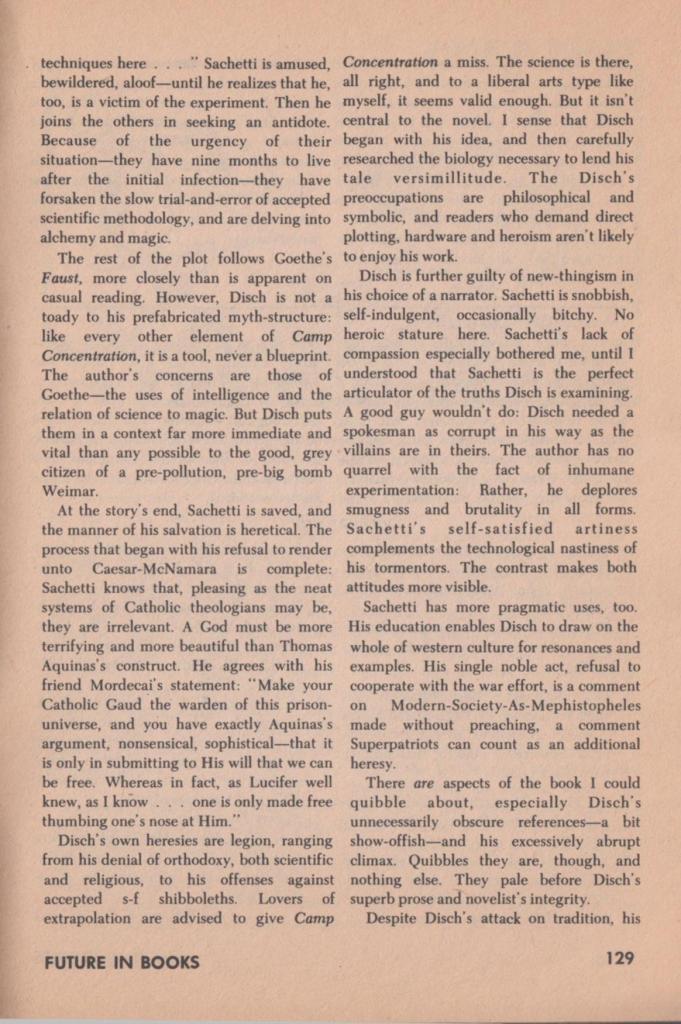
Louis Sacchetti is a conscientious objector, and Camp Concentration is the journal he writes while imprisoned in two locations. Disch wrote the novel while LBJ was president, and before Nixon. The story is set somewhat in the future, and Robert McNamara is President. McNamara was the Secretary of Defense under JFK and LBJ. McNamara played a major role in promoting the Vietnam War. To get the fullness of Camp Concentration, you need to read the Wikipedia link to McNamara. It also helps to see The Fog of War: Eleven Lessons from the Life of Robert S. McNamara, a 2003 Academy Award winning documentary.

Camp Concentration is a deeply cynical view of the United States in 1967. Louis is a war resister, at first imprisoned in an ordinary prison. He accepts that. But the novel is about when he is transferred to another prison, a military prison, where an experimental drug is used on the inmates by the U.S. Army. Most of the prisoners had committed crimes while in the Army, but Louis is a special civilian prisoner. The army believes it has synthesized a drug that will enhance intelligence. It was derived from a strain of syphilis.

The U.S. Army conducted experiments with LSD from 1955 to 1967. From 1932 to 1972, the U.S. government studied the effects of syphilis on black people after telling them they were being treated. These are just two examples of unethical experiments by our government. It’s not hard to believe the setup for Camp Concentration.

Camp Concentration reminds some readers of Flowers for Algernon because it’s about a treatment that makes people smarter. Over one hundred journal entries, we see Louis and the other prisoners change and become brilliant. I felt the characters did change, but my friend Mike, who got me to reread the novel, says he didn’t. Writers find it hard to describe humans with superintelligence. I’ve written about that recently. I thought Disch pulled it off, Mike didn’t.

Most of the novel is intellectual discussions about art, literature, poetry, theater, music, religion, philosophy, Alchemy, and other medieval beliefs. Mike thought all this discussion was boring, I was fascinated. I feel it helps to have a classical education to appreciate Camp Concentration. I don’t, but I’ve read enough to wish I had.

While reading Camp Concentration I was reminded of another book I read in the 1970s, Where the Wasteland Ends: Politics and Transcendence in Post Industrial Society by Theodore Roszak. I’m not saying the two books are about the same things, but as the characters evolve intellectually, they start sounding like Roszak.

Read Disch’s Wikipedia entry, you’ll see that Thomas M. Disch and Louis Sacchetti have much in common. Louis is a poet, and Disch wrote The Castle of Indolence: On Poetry, Poets, and Poetastes.

In the novel, the drug makes the test subject smarter, but it also kills them within months. As the characters grow more brilliant, they realize they have much more to live for and become bitter. Disch appears to equate higher IQ with depression and cynicism.

Disch does not suggest that superintelligence leads to super-powers. The test subjects only become more academic in their communication with each other. As they evolve mentally, their use of intellectual ideas to express themselves becomes more dense. This is subtle, and it may be hard to believe they are more intelligent. It seems that most of their references are to ideas covered in Classical studies or Medieval studies.

If you are prone to depression, I would not read this novel. If you are among the faithful, I would not read this novel. If you prefer tightly plotted stories, that are easy to read, and enjoy action, don’t buy this book.

On the other hand, if you’re into the history of science fiction, the New Wave, or the 1960s, Camp Concentration might be a good one to read. Science fiction changed in 1967-1968. I believe several young prodigies like Disch and Delany took the genre in new directions, and older writers like Silverberg, Brunner, and Ellison decided they were tired of where science fiction was going too.

Camp Concentration is available at Amazon.com (Kindle $5.99, Trade paper $15.00)

Reviews:

New Worlds (December 1968)

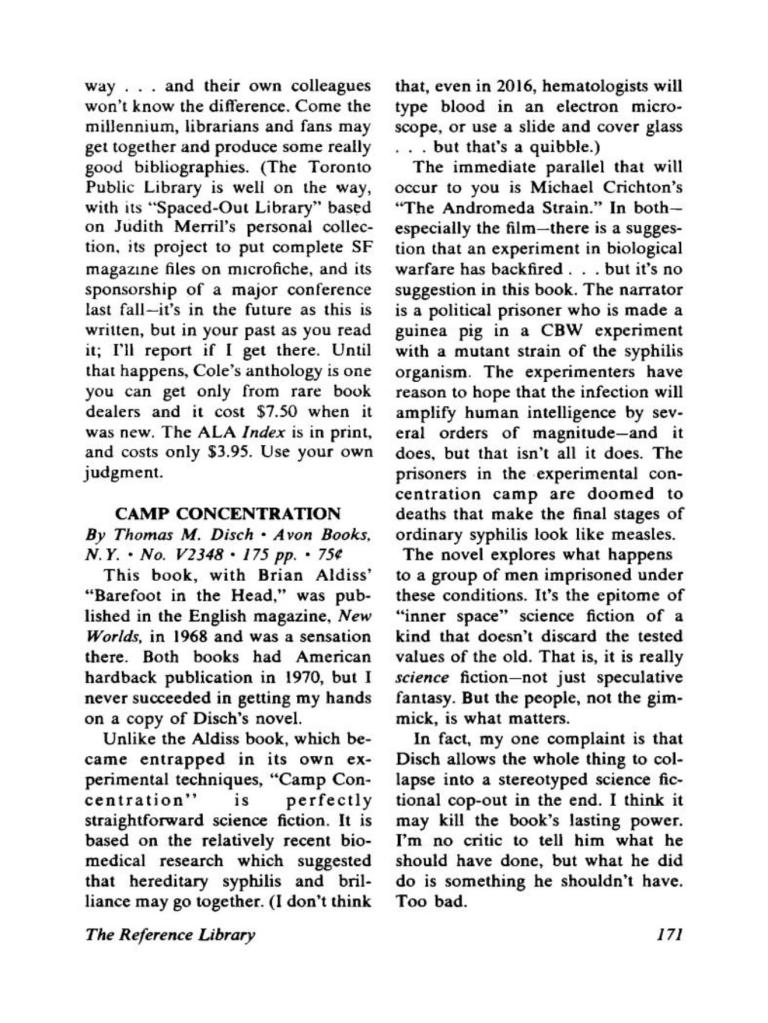
Amazing Stories (January 1970)

Analog (March 1972)

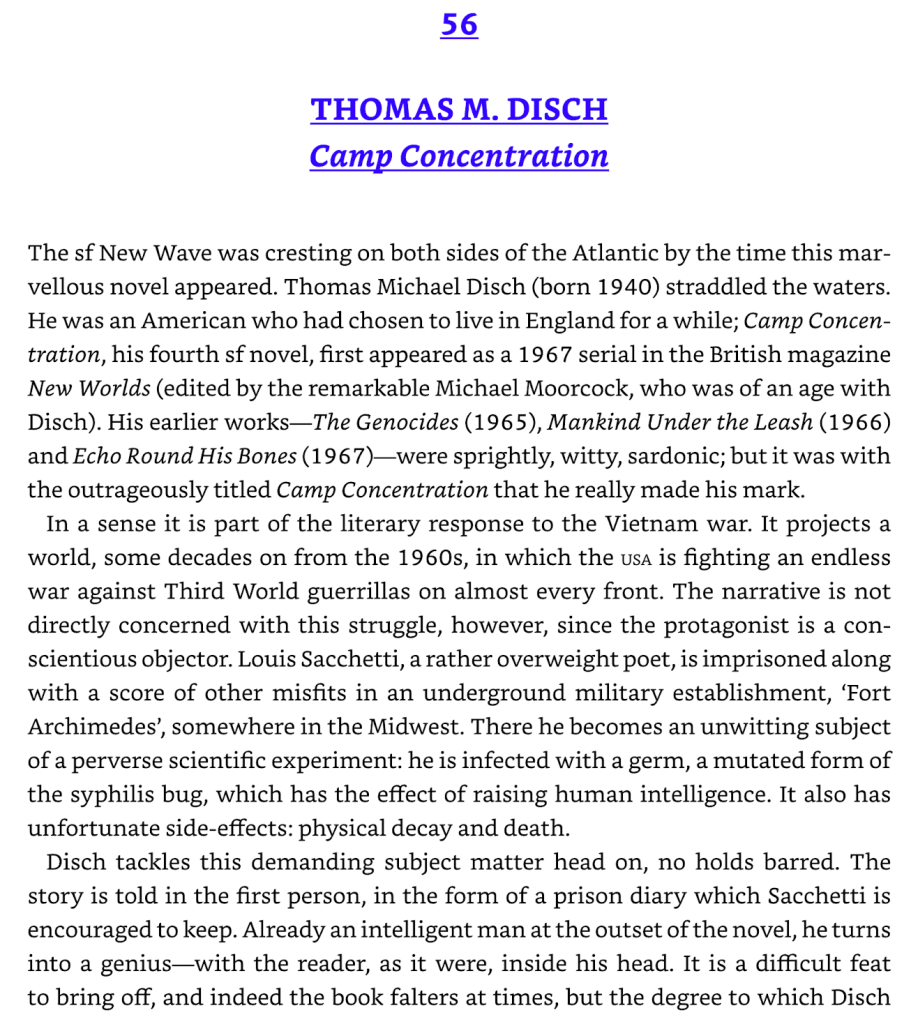
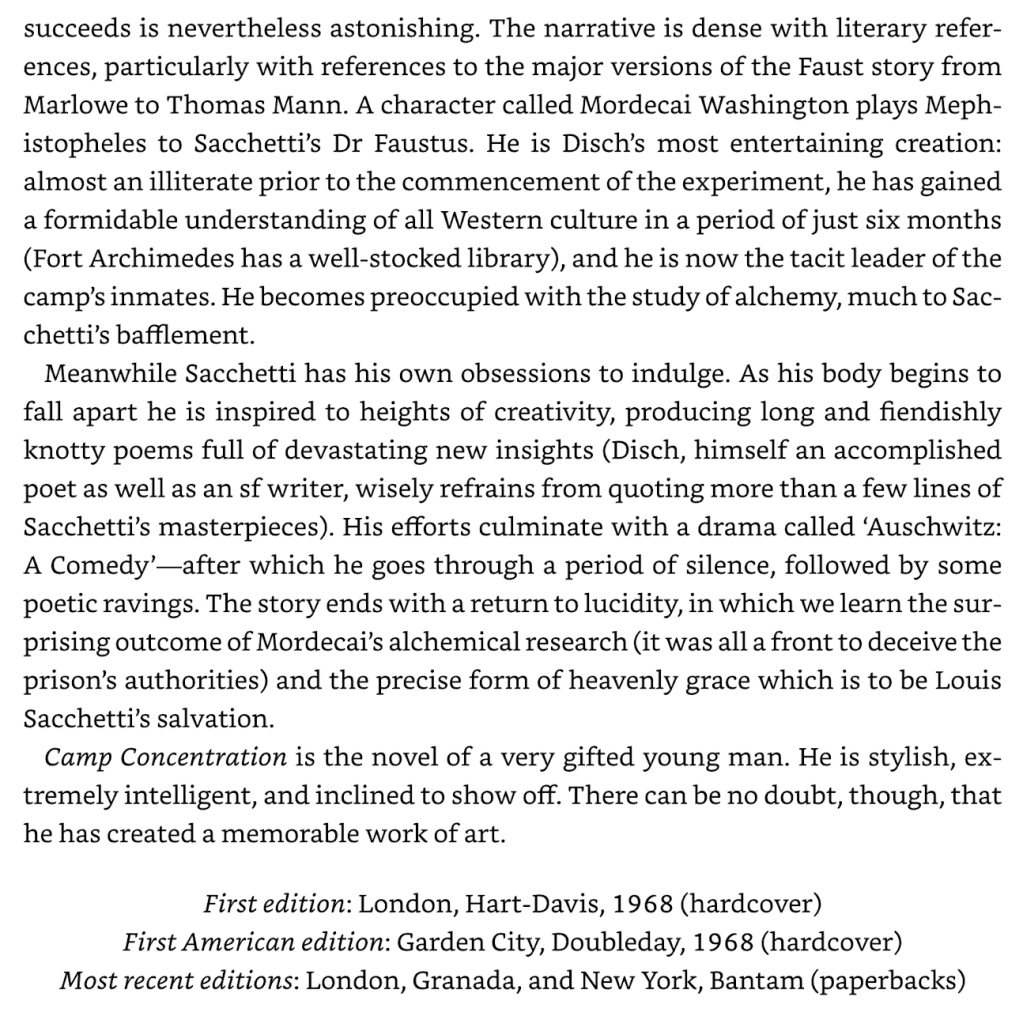
Science Fiction: The 100 Best Novels by David Pringle ($1.99 Kindle)

James Wallace Harris, 3/11/25

If We Can’t Imagine Human Superintelligence Can We Describe It in Fiction?

In Ted Chiang’s impressive overview of human superintelligence in science fiction, he mentions that John W. Campbell Jr. rejected a story by Vernor Vinge about a character with human superintelligence because no one can write such a story. (Vinge had proposed a sequel to “Bookworm, Run!“) The implication: since none of us know what being superintelligent is like subjectively, we can’t describe it. That’s silly. Campbell had been publishing a magazine describing space travel decades before NASA, or atomic bombs before 1945, or robots long before Roombas.

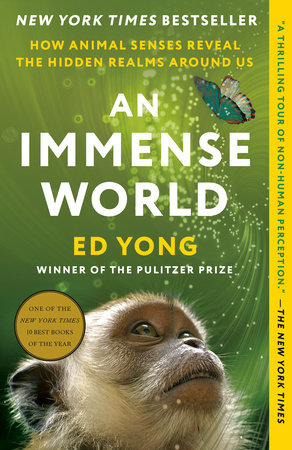
British journalist Ed Yong describes the umwelt of many species in his book An Immense World. How each organism views reality from its collection of sense organs is called umwelt. We might not be able to imagine being a dog, but we can analyze a dog’s senses and speculate what they can perceive.

Shouldn’t we assume science fiction can speculate on a human being with superintelligence by what it’s capable of perceiving and what it does with those perceptions? I’m guessing John W. Campbell assumed that a dog couldn’t imagine what it’s like to be a human. But is that really true? A dog might not comprehend humans reading a book, but I’m sure they understand much about us in their own special way. In fact, they might observe qualities about us that we’re unaware of.

Astounding Science Fiction in the 1950s was full of stories about ESP and other psychic abilities. Campbell called such abilities psionics. Throughout the history of science fiction, writers have speculated that superhumans would have god-like powers. I’ve written about science fiction and human superintelligence before and described many of the most famous of these stories. See: “Science Fiction and Human Evolution” and “The Origins of Higher Intelligence in Science Fiction.” The genre has a long history of attempting what Campbell supposedly told Vinge he couldn’t.

Strangely, hard science fiction writer Arthur C. Clarke wrote two classic novels about superhumans: Childhood’s End and 2001: A Space Odyssey. Clarke gave no scientific explanation of how people might transform into next-stage humans. Clarke’s new humans were almost impossible to imagine. They are god-like to us. This is fun but gives us little to speculate about realistically.

Greg Bear imagines a new strain of virus affecting pregnant women causing a mutation in Darwin’s Radio. Children born of these women are more intelligent, have greater disease resistance, and can communicate non-verbally. This isn’t hard to imagine. Current humans show a tremendously wide spectrum of intelligence and physical health. And some humans are far better at communicating than others, especially via body language and empathy.

Nancy Kress imagines genetic engineering creating a new species of humanity in Beggars in Spain. Their key feature was needing less sleep. This gave them more time to learn, work, and compete. It’s easy to imagine this adaptation and how these new humans would do better than ordinary humans.

The movie Gattaca imagined a future society where normal humans competed with humans with carefully selected genes. The improved humans had the same human frailties, but out-competed normal humans for the better jobs. They were better-looking, smarter, more athletic, and had greater discipline. That’s not hard to imagine.

In Flowers for Algernon by Daniel Keyes, Charlie Gordon undergoes an operation that advances his IQ. At the beginning, Clarlie works as a janitor and is cognitively challenged. The operation allows him to learn new things, and eventually become a super-genius. His new attributes are not beyond belief. Charlie learns new languages, achieves great academic success, and becomes tremendously productive. Charlie doesn’t develop ESP or godlike powers, but achieves the maximum levels of current human skills and traits. This is believable and easy to imagine.

Homo sapiens are only slightly improved over Neanderthals, but those improvements let us do so much more. For us to describe Homo superior we only need to imagine slight enhancements to our species and speculate about what impact they would have.

Some humans have tetrachromacy, which means they can detect four primary colors rather than three. Other people have eidetic memory. Stephen Wiltshire, an autistic savant, can draw detailed images of cities from memory after just a helicopter ride. All the traits that Human 2.0 might have are already showing up in us now. Conversely, all the traits that won’t emerge are those we lack precursors for now.

That’s why I think it’s silly to imagine humans evolving to have telepathy or be able to teleport at will. Those are comic book ideas. Campbell was both too hopeful and too naive about human evolution. He expected “The Man Who Evolved” by Edmond Hamilton. At best, I think we’ll get Gattaca.

One problem with evolving our current abilities is that we often see cognitive issues associated with people with extreme examples of those abilities. Can a perfect memory be imperfect? Can we be too smart? I’ve known many people far ahead of me in many skills. I can’t fathom general and special relativity. Does that mean Albert Einstein was a 2.0 human?

Until recently, I thought the human race was evolving slowly on average. But current events make me think we’re regressing. Some people already have superintelligence compared to others. It could be the evolution of our species won’t be by quantum leaps, but slow adaptation of biological trial and error. Much of science fiction is just fun bullshit speculation. We need to distinguish between fantasy and scientific possibilities.

Personally, I feel our role in evolution was to evolve machine intelligence. I don’t believe humans will ever become giant brains with tiny bodies, nonphysical beings, or something like Q from Star Trek: The Next Generation. It’s interesting that Greg Bear and Nancy Kress in their novels, had normal humans wanting to wipe out the new humans before they got established.

Lester del Rey summed us up nicely in “For I Am a Jealous People!” Our creator and descendants need to watch out.

I don’t see why Campbell rejected Vernor Vinge’s idea of writing a sequel to “Bookworm, Run!” Campbell had already published Slan by A. E. van Vogt and many other stories featuring human superintelligence.

James Wallace Harris, 3/9/25

A Unique History of Science Fiction (1945-1975)

From 1945 to 1975, P. Schuyler Miller reviewed science fiction books for Astounding Science Fiction and Analog Science Fiction. He died in October of 1974. I stumbled upon an online PDF collection of those reviews from 1945-1967. You can download that file here. (Warning – it’s 235MB.)

Unfortunately, the individual reviews aren’t dated and the run is far from complete. However, the PDF is searchable, and you can use ISFDB.org to date an individual review. Just look up the book title, then scroll down to the Reviews section, and find the one for Miller. Someday I’d like to create a file of all of Miller’s reviews from 1945-1975.

I put this PDF on my iPad and read it like a book. It’s wonderful. The reviews start before science fiction was regularly published in book form. Whoever collected these reviews evidently picked those they thought interesting to modern readers. Collectively, they have a history of science fiction published before 1968. For example, the early reviews cover books published before science fiction was a genre. Then we started seeing books from Gnome and Fantasy Press, essentially fan publishers. After that, we slowly see big name New York publishers take chances on the genre along with the rise of mass market paperback publishers.

We get to read the original reviews of books now remembered as genre classics and books that have since been forgotten. Often I read reviews of forgotten books that sound interesting enough to track down.

The first two reviews are books by Vardis Fisher: Darkness and the Deep and The Golden Rooms (April 1945). These books imagine life when Neanderthals and Cro-Magnon coexisted. Popular writers like H. G. Wells, Jack London, and Stephen Vincent Benet, also wrote on this theme. It wasn’t considered science fiction then, but our genre has claimed that theme since.

Here’s that first review:

Most book reviews in science fiction magazines are short blurbs. Miller writes comprehensive essays. As the years progress, Miller’s reviews become more elaborate, longer, often beginning with some science fiction history. The next review is of The Time Stream by John Taine (March 1947). Miller does more than describe and react to the novel, giving the background of how that story fits in the genre, and biographical information on the author. He compares Taine’s work to A. Merritt’s, and points out how Taine’s work originally appeared in hardback, while Merritt’s stories were serialized in magazines first. I’ve not read Taine or Merritt, but I’ve often read about both in histories of science fiction. This review makes me want to try The Time Stream. These reviews also give me information about collecting original editions. (Amazon has a Kindle edition of The Time Stream for $2.99.) Here’s Miller’s review.

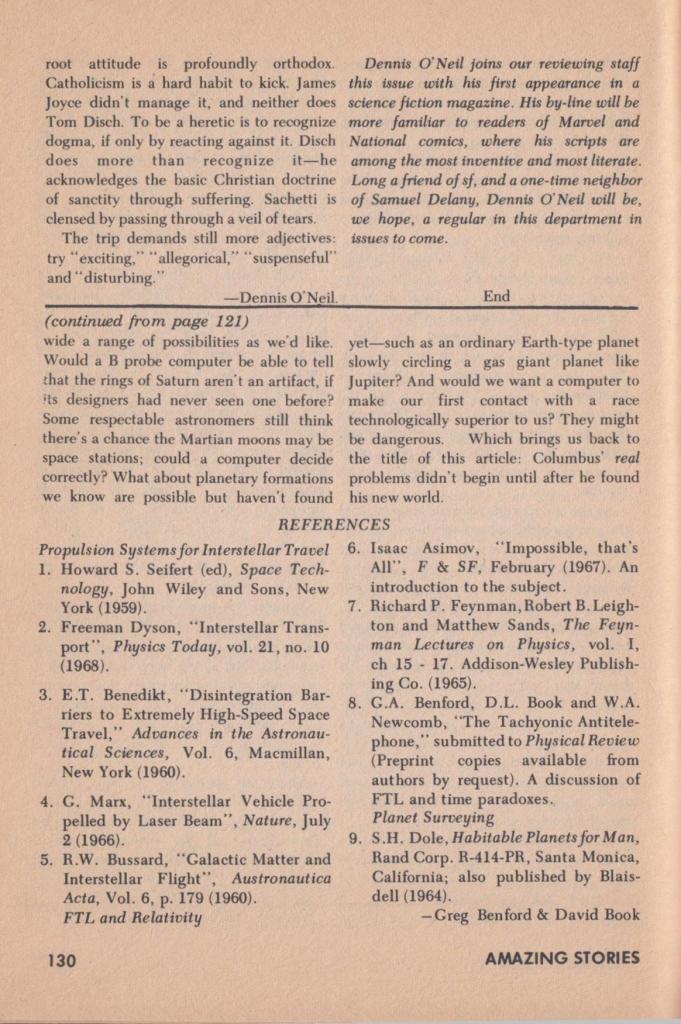
I decided to jump to June 1954 and read the review for The Lights in the Sky are Stars by Fredric Brown, the science fiction novel I’m currently reading. By now Miller’s columns are longer. He reviews more books each month, so each review is shorter. That’s because far more SF books are being published every month. Since October 1951, they come under the title “The Reference Library.” (That’s where I steal the image above for this post.) Miller often begins his columns with a digression exploring topics related to current publishing.

I thought I’d test Miller on something hard. This is his review for Stranger in a Strange Land by Robert A. Heinlein from the January 1962 issue of Analog. I’m including his essay in the introduction as a sample of how he composed his columns.

That should give you enough examples to decide on downloading the entire collection of Miller’s reviews. If you’re reading on a computer with a large monitor, I have a page I’m working on that links to Miller’s reviews in issues of Astounding and Analog at Archive.org. You can read each column one at a time on screen.

P. Schuyler Miller also wrote some science fiction. I own this first edition of The Titan with a beautiful Hannes Bok cover.

James Wallace Harris, 3/5/25

INHERIT THE STARS by James P. Hogan

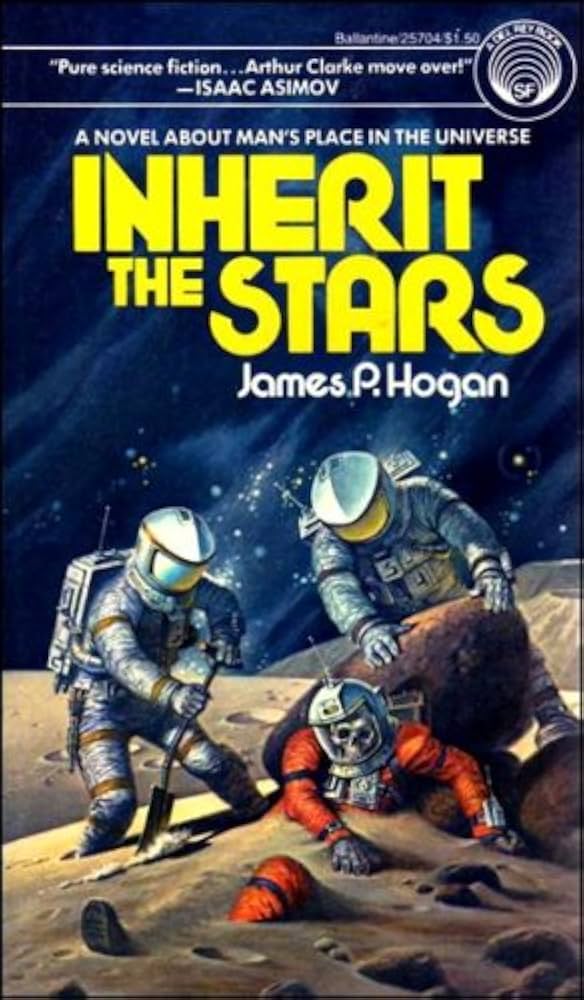
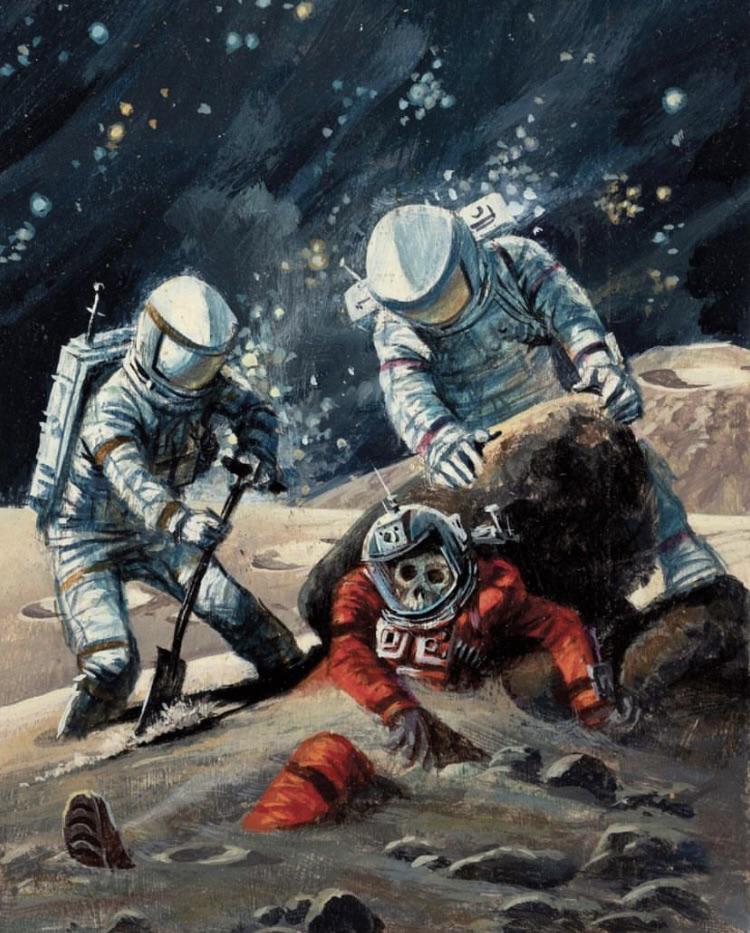
The original paperback, Inherit the Stars by British writer James P. Hogan (1941-2010), had a terrific cover – the kind that made you buy the book. The artwork appears to show astronauts on the Moon finding a dead astronaut, but that is deceptive. Hogan creates a scientific mystery because the dead astronaut has been there for 25,000 years.

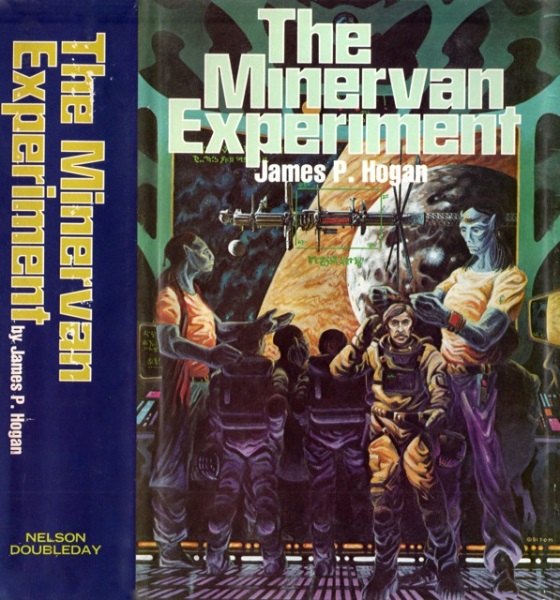
I first read Inherit the Stars in 1992 but after seeing Whitney’s review on YouTube, I wanted to reread the story. I went to Amazon but couldn’t find the book. Was it out of print? I did find it on Audible. Later, I discovered that Inherit the Stars and its sequel The Gentle Giants of Ganymede are now being sold together as The Two Moons for the Kindle. A bargain for $6.99, especially since Whitney also praised the second book. It turns out that there are five books in the series being sold as three Kindle editions. The series is called Giants. Only the first three novels are available on Audible. The Science Fiction Book Club once published the first three novels as The Mirnervan Experiment. Ballentine also published a paperback called The Giants Novels that contains all three.

Before anyone rushes out to buy Inherit the Stars, I need to describe it more, but not enough to give spoilers. Hogan’s story is the kind you want to figure out for yourself. It kept me guessing for the entire novel even though I had read it before. That worried me. Why wasn’t it more memorable? Was that an indication it was a bad book? I don’t think so. How the story is told isn’t very memorable, but the ideas are big-time fun. I did remember some of those, but not connected to the book.

Inherit the Stars is basically scientists talking about one mystery after another. There’s no real plot. A lot happens, but it’s not dramatic. With each discovery, there’s a new puzzle, which makes you think and try to guess what caused each mystery. Inherit the Stars is science fiction focused on ideas and not storytelling. I’ve told you the first mystery, but I don’t want to give away any others.

However, I will give you some fun clues. Inherit the Stars reminds me a lot of Rendezvous With Rama by Arthur C. Clarke. Hogan’s prose is similar to Clarke’s. At one point, the story reminded me of the classic short story “Omnilingual” by H. Beam Piper. The novel also triggered memories of Gateway by Frederik Pohl. At other times it reminded me of the Winston Science Fiction, a series of young adult SF that came out in the 1950s, especially the entries where the protagonists find relics of ancient alien technology. If you love alien archeology stories, you might like Inherit the Stars.

I call Inherit the Stars Pre-NASA Science Fiction, by which I usually mean science fiction written before Mariner 4 photographed Mars in July 1965. Until NASA started exploring the solar system with robotic probes, many people hoped that we would find life, even intelligent life somewhere on other planets in our solar system. For example, Heinlein’s Stranger in a Strange Land from 1961 imagines Mars being inhabited by a dying race. However, after Mariner 4, serious science fiction assumed we were alone in the solar system. (I must admit, that I still love Pre-NASA science fiction. Growing up in the 1950s and 1960s, I desperately wanted us to find Martians.)

I consider Hogan’s 1977 Inherit the Stars Pre-NASA Science Fiction because Hogan maintains the hope that we had neighbors. However, some readers might feel Hogan’s ideas might come across like those of Erich von Däniken, who wrote Chariot of the Gods? Another reviewer dismissed this book as unbelievable. Personally, I find Erich von Däniken’s theories to be insulting to humanity. But I consider Hogan’s speculation to be great science fictional fun.

James Wallace. Harris, 3/1/25