THE CRYSTAL WORLD by J. G. Ballard

At a minimum, The Crystal World by J. G. Ballard was an entertaining cozy catastrophe that I was always anxious to get back to reading. What compels me to write this review is figuring out why. The prose is vivid, propelled by a moderately interesting mystery. However, its characters are rather bland but then so are ordinary people. In the end, the story faintly alludes to something, but what?

What elevates this novel is trying to understand how it works. Its Heart of Darkness vibe feels biblical, spiritual, or at least existential. Reading The Crystal World makes me ask why we read fiction. Why are humans addicted to fiction and how does that addiction affect our brains? I do this because I’m also reading Stephen Greenblatt’s The Rise and Fall of Adam and Eve, a nonfiction work that says a great deal about fiction.

Any hardcore bookworm will recognize The Book of Genesis as a genius work of fiction. I also think it’s a brilliant work of speculative fiction. Its author felt challenged to imagine how Earth and life on Earth began. Genesis was written well before the concepts of history or science. The author obviously knew of humans living in cities, and those that farmed and herded animals, the author could even have heard that there were places where humans were hunters and gatherers. And from that knowledge speculated that there was a time when humans lived like animals. The author of Genesis even realized there might be a time when humans didn’t have a language. The author pictured Eden where humans lived in harmony with nature before we became different. The obvious question became: What made us change? The obvious answer was, whatever made everything else. Then the question becomes how. Doesn’t eating from the Tree of Knowledge of Good and Evil make a lovely allegorical explanation?

Do you see why I consider The Book of Genesis an early example of speculative fiction? And isn’t the story of Noah and the Flood, an early apocalyptic tale? Stephen Greenblatt makes a good case that the author of The Book of Genesis cribbed his ideas from much older Babylonian tales. We’ve always had storytellers and writers who tried to explain reality. However, this makes me wonder about modern writers and storytellers. What are they trying to explain?

Billions of humans have believed in the literal story of Genesis. That story says a lot about fiction and its impact on us. The early fathers of the Christian Church tortured the Book of Genesis for centuries producing endless interpretations. That’s a great example of literary criticism gone wrong.

I bring up Greenblatt’s book because we must ask certain questions about the fiction we read. The first question is: Does it have anything to say? In most modern works of fiction, the answer is no, but not always. If the answer is yes, is the fiction allegorical, satirical, literal, comical, historical, romantic, academic, philosophical, speculative, etc. Of course, the last question: Shouldn’t we abandon fiction for nonfiction if we have something to say? Even when fiction is about saying something, it’s often indecipherable.

I’m getting old, and I worry I’ve wasted too much of my life on fiction. I fear that fiction has no value other than as an entertaining way of killing time, and since time is running out, that’s bad.

Reading The Crystal World made me wonder if J. G. Ballard had something to say, or was his novel was just meant to be entertaining? To complicate the answer, The Crystal World is an early work of New Wave science fiction, published before the term was coined.

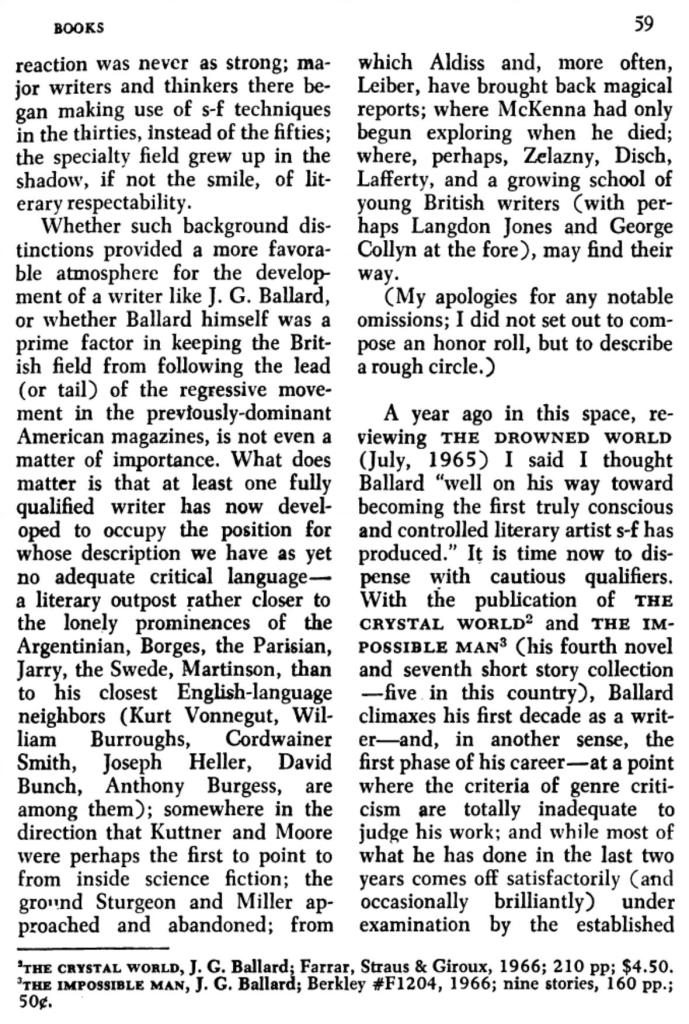
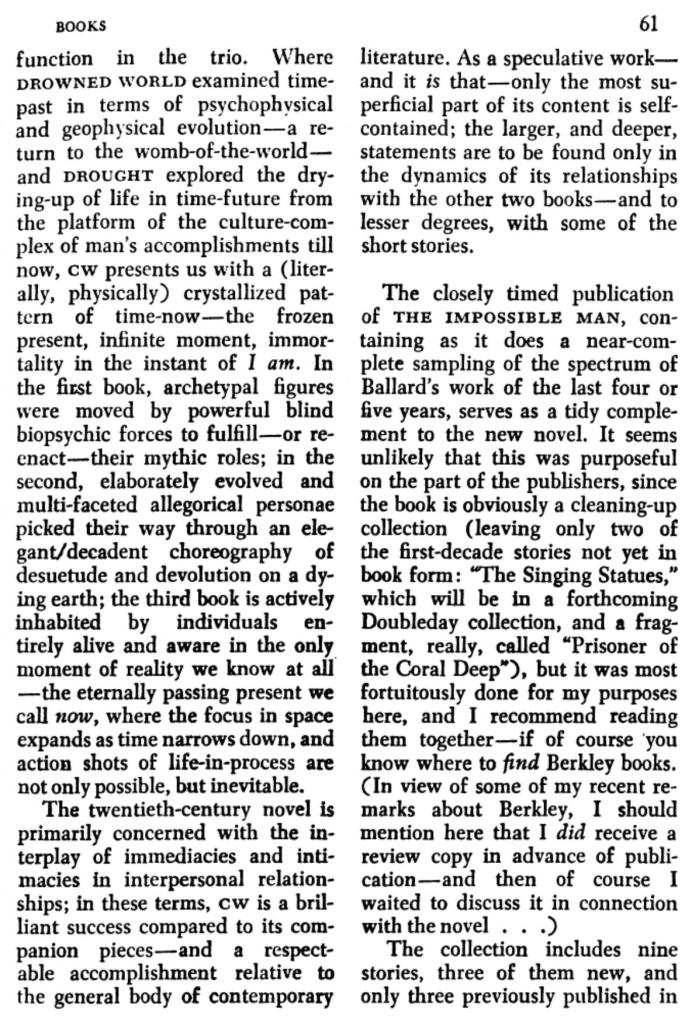
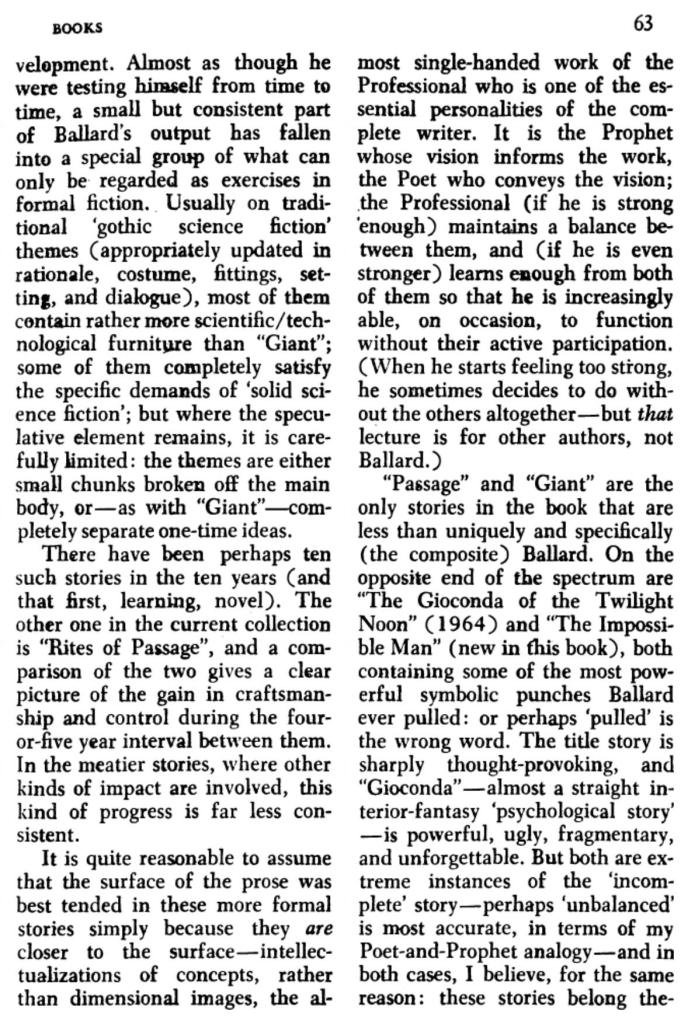
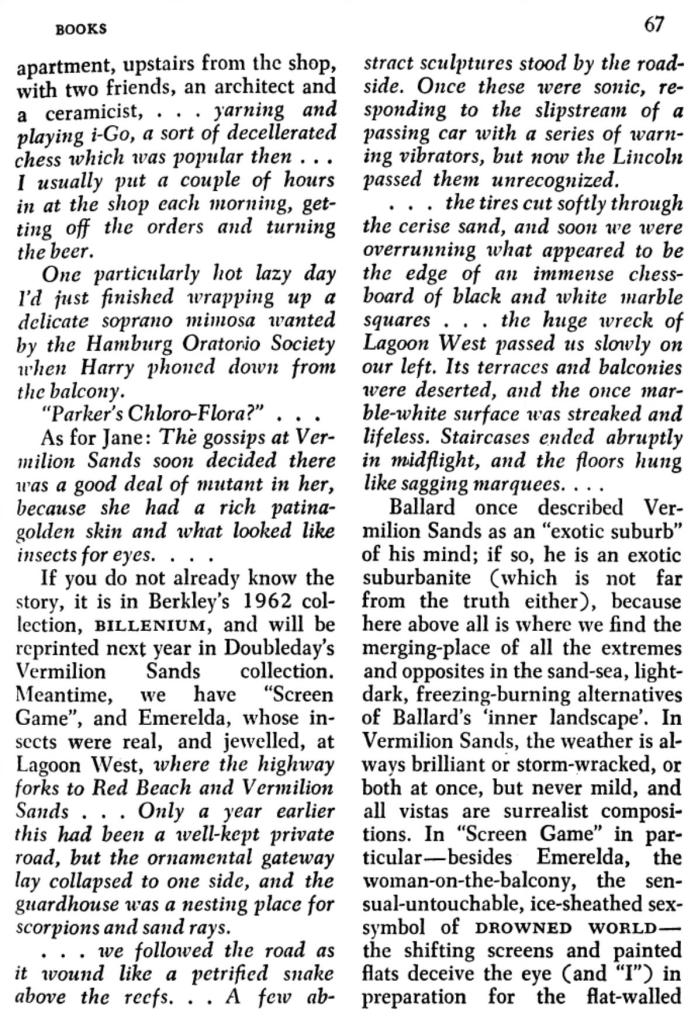
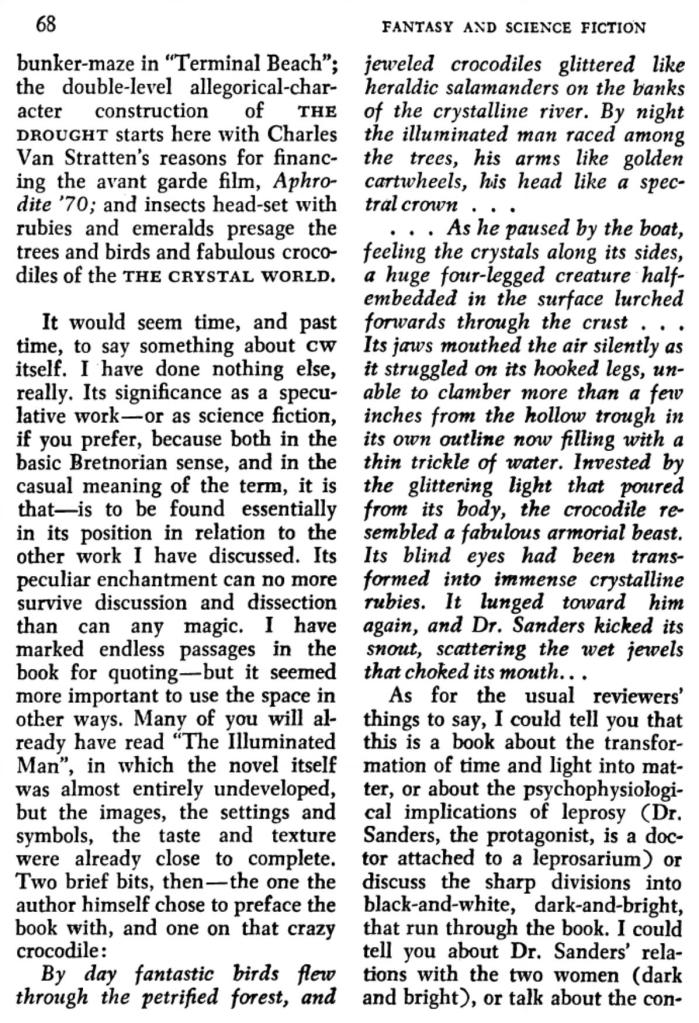
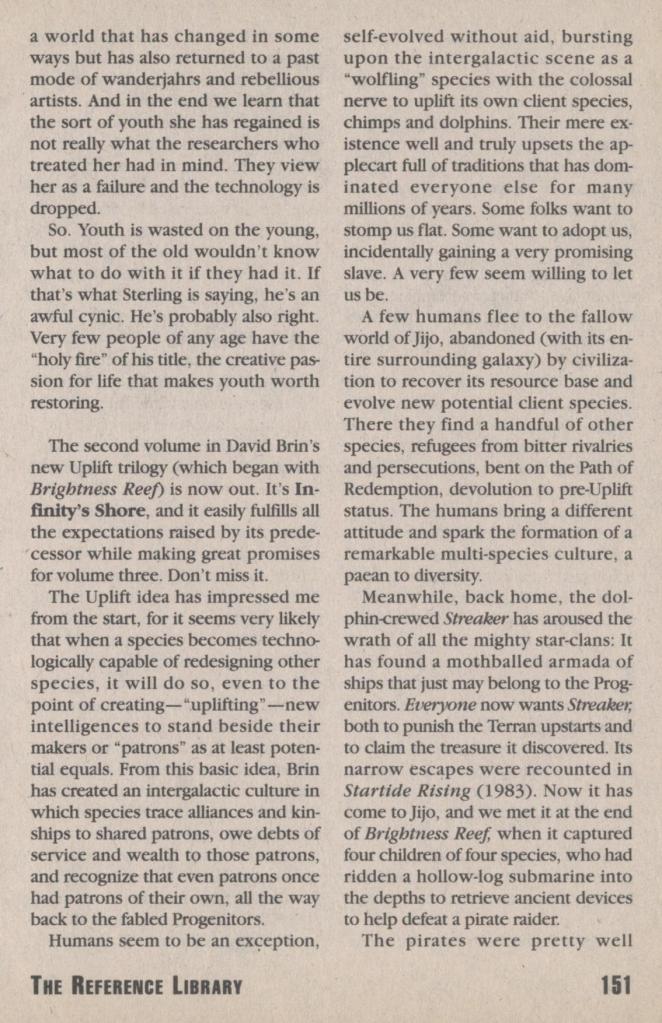
As evidence, I reprint below Judith Merril’s “Books” column from the August 1966 issue of The Magazine of Fantasy and Science Fiction. Merril recognizes that science fiction is changing in 1966, and has something to say, and that J. G. Ballard might be leading the way.

The older I get the harder it gets to find science fiction to read. I roam up and down the decades looking for worthy books I’ve missed. With each book that still succeeds on any level, I ask why? Such revelations help me squeeze every last drop of wonder I can out of the genre.

I sometimes wonder if reading fiction hasn’t been a wasted diversion. On the other hand, I wonder if processing fiction hasn’t been my life’s work.

Reading The Crystal World made me think about the power of fiction to temporarily suggest that a made-up story could be true. This isn’t true of all fiction. Some writers can use narrative techniques that convey a sense “that this really happened”
more than others. I’m not claiming that The Crystal World is a brilliant work of realism, but it does use such techniques. And I thought they were the same techniques H. G. Wells used with The War of the Worlds.

The primary technique is using an eyewitness POV. The second technique is telling the story in linear time. The third technique is avoiding fancy prose or embellishments. If the prose feels like reporting events the story will feel real.

The Crystal World is about a science-fictional infection that alters plants and animals. This infection has hit the Earth in several places, much like how the Martian canisters land around the globe in The War of the Worlds. But our narrator, Dr. Edward Sanders doesn’t know this. He learns about one site slowly, by word-of-mouth, as people did before being connected to the internet.

Dr. Sanders lands at Port Matarre on a riverboat steamer from Libreville, in the Cameroon Republic of Central Africa. Dr. Sanders wants to visit two friends, Max and Suzanne Clair, who run a leprosy clinic further upriver. Dr. Saunders works at a leper hospital in Fort Isabelle and is in love with Suzanne Clair.

The story feels like Joseph Conrad’s The Heart of Darkness. At Port Matarre, Dr. Sanders finds it difficult to go any further. The police and army have put up a blockade around the infected area but don’t explain why. At first, Dr. Sanders has no idea of what’s happening, but something mysterious is occurring in the jungle.

I’ve only read Ballard’s novel The Dround World and Vermillion Sands, a collection, and less than a dozen short stories from anthologies. Ballard is great at creating an atmosphere. The Crystal World suggests a plague infecting reality spreading across the galaxy, even the universe, which affects time and consciousness. It’s not much of an idea, as science-fictional ideas go, but it is different.

However, what if The Crystal World was the only text found from our times, thousands of years from now like The Book of Genesis is to us. Would future humans imagine it as an allegory for something that happened to us? Would some think it described a literal event? Would the author of Genesis ever imagine billions of future humans believing their speculation was absolutely literal?

Fiction is like dreams, they both feel like they’re about something. Dreams are supposed to serve some kind of biological/psychological function. Is that true of fiction too? The authors of The Bible intended it to mean something. But millions of books and sermons have been created to explain The Bible and we’ve never agreed on any of them. The Crystal World is entertaining because it triggers that mechanism in our brain that fools us into believing we’re making sense of reality, the same mechanism that processes religious works, political news, or even gossip.

If I were a Zen Master or an intelligent robot, I’d discipline myself to ignore that delusion. The ancient Church fathers decided that eating from the Tree of Knowledge of Good and Evil, was the origin of sin, and the downfall of mankind. I believe the allegory could also explain our addiction to fiction, and I include religion as a genre of fiction. Both drive us crazy. The faithful use scripture to explain reality, while we heathens use novels.

In Eden, we wouldn’t have needed novels or scriptures.

James Wallace Harris, 12/25/24

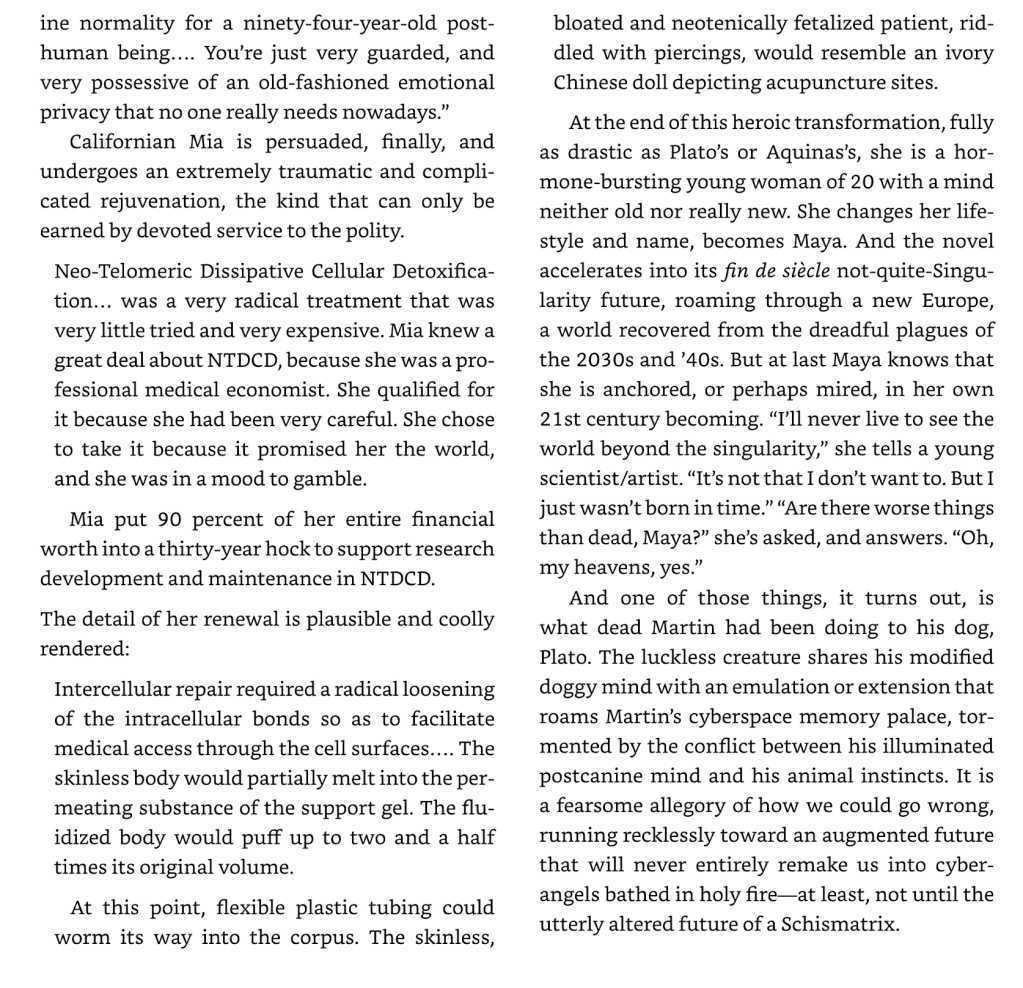
“Books” by Judith Merril (F&SF August 1966):

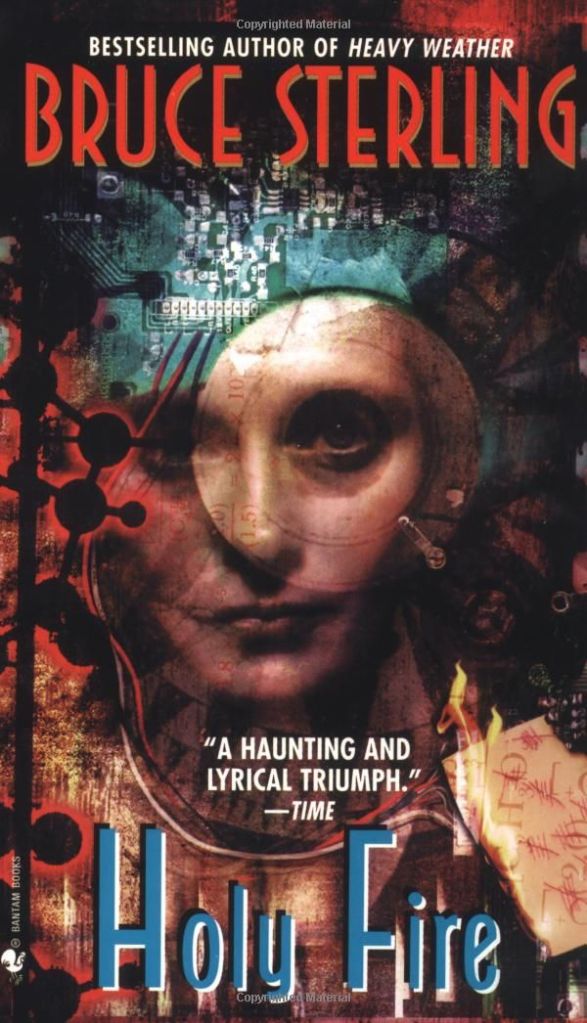
HOLY FIRE by Bruce Sterling

Science fiction writers can’t predict the future but some aim to speculate on times to come by extrapolating current trends. One of the most famous SF novels to do this was Stand on Zanzibar by John Brunner, his 1968 novel that anticipated the world of 2010. Bruce Sterling’s 1996 novel Holy Fire tries to imagine life in 2096 via speculation and extrapolation. Do I recommend it? That’s hard to say, even at the current Kindle price of $1.99.

How self-aware are you regarding the selection of the science fiction you read? Does your mind crave a tightly plotted story? If so, Holy Fire by Bruce Sterling might not be for you. Or do you love reading novels with characters you care about, even identify with, and want to vicariously live their fictional adventures? Again, Holy Fire might not be your cup of tea. If you are the kind of science fiction reader who resonates with dense science fiction speculation, reading Holy Fire should definitely be for you.

We judge such speculative fiction in two ways. Does it jive with our own efforts to imagine the future, and now that the novel is almost thirty years old, how well has it done so far? Evidently, back in 1996, Sterling saw that medical technology, changing trends in family size, and population demographics would lead to a world where there were far more old people than young people. The exact opposite of the Baby Boom generation I grew up with. All the current 2024 demographics point to such a future.

Sterling solved the overpopulation problem that many science fiction writers before him saw by having a great pandemic in the 2020s. And he imagined that networks, artificial reality, and artificial intelligence would reshape society. Instead of predicting gloom and doom like so many science fiction novels from the late 20th century, Sterling imagines a near-liberal utopia and a post-scarcity society. The problems faced by the characters in this novel divide between the old and young. The old strive to find purpose with an ever-lengthening lifespan, while the young feel crushed under the weight of a gerontocracy that advises the youth to learn from their experience and live longer.

Because humans have been trying out medical life-extension procedures for decades, a growing percentage of the population is old. These elders have the wealth and power and dominate politics with their gerontocracy. Mia Ziemann, Holy Fire’s protagonist, is 94 at the start. Because she has led such a cautious life and is in such good shape, the medical establishment offers her the latest life extension treatment, one that goes way beyond any previous effort. The procedure is so arduous, that it can be fatal. Mia comes through the process and now looks 20, although some of her memories are gone.

Mia’s doctors consider her an expensive experiment and legally bind her to them for years of research. Mia runs away to Europe and hides as an illegal alien, living among a youthful bohemian crowd of revolutionaries. She changes her name to Maya. On nearly every page of Holy Fire, Sterling speculates about the future evolution of society, technology, and politics. Strangely, climate change is never brought up. But then, Holy Fire came out a decade before An Inconvenient Truth.

Sterling doesn’t focus on space flight, but it happened. The focus of the story is finding meaning in everyday living on Earth. Dogs and other animals have been uplifted, and talk with computer-aided voices. Governments take care of the needy. People use public transportation. People engineer their minds with designer hormones and neural transmitters. And the net and virtual reality is everywhere. Holy Fire makes me think that Bruce Sterling had abundant optimism for the future in the 1990s. I used to have such liberal optimism but it was crushed in 2016.

Sterling’s future is not quite a utopia, because segments of the population are discontented, especially the young who are too brilliant for their own good. That’s the crowd Mia/Maya, embraces. They want the freedom to fail.

Sterling calls Mia/Maya and others in this book posthumans, and that’s where this story shines. His posthumans aren’t silly comic-book superheroes like in many 21st-century SF books. Virtual reality is toned down too from 21st-century SF stories of people downloading themselves into virtual realities. Sterling tries to stay reasonably realistic and scientific. Holy Fire reminds me of the dense speculation in John Brunner’s Stand on Zanzibar. Sterling doesn’t take it to narrative gonzo extremes like Brunner.

Holy Fire is a somewhat picaresque novel, with one reviewer comparing it to Candide. Of course, Candide is considered a broad satire, and I’m not sure that’s true of Holy Fire. I didn’t read it that way, but I could see how a filmmaker could present Holy Fire as a satire. The novel attempts to be transcendental, you might have guessed that from the title. The youth rebellion in Sterling’s 2090s is like the 1960s involving art, music, drugs, and mind-expansion — adding networking, AI, and AR.

The problem with picaresque novels is they are episodic. The hero is exposed to a series of people and subcultures, and that’s what happens to Mia/Maya. There are so many different characters it’s hard to keep up with them or even care about them. Most of the story is about how they impact Mia/Maya, whereas I believe a novel about a 94-year-old woman becoming 20 again should be about her inner transformations.

Mia is an uptight old lady who protects herself by hiding from life, and Maya is a free-spirit young woman giving everything a try and throwing all caution to the wind. We are told that Mia lost some of her memories, but would she lose all wisdom from living to 94?

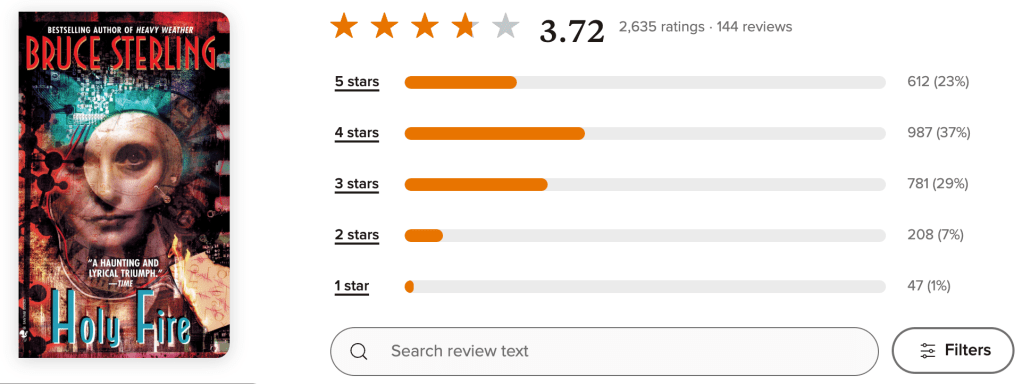
Response to Holy Fire is all over the place. Hundreds at Goodreads gave it five stars, a few more hundred gave it four stars, but plenty of folks just didn’t care for the story.

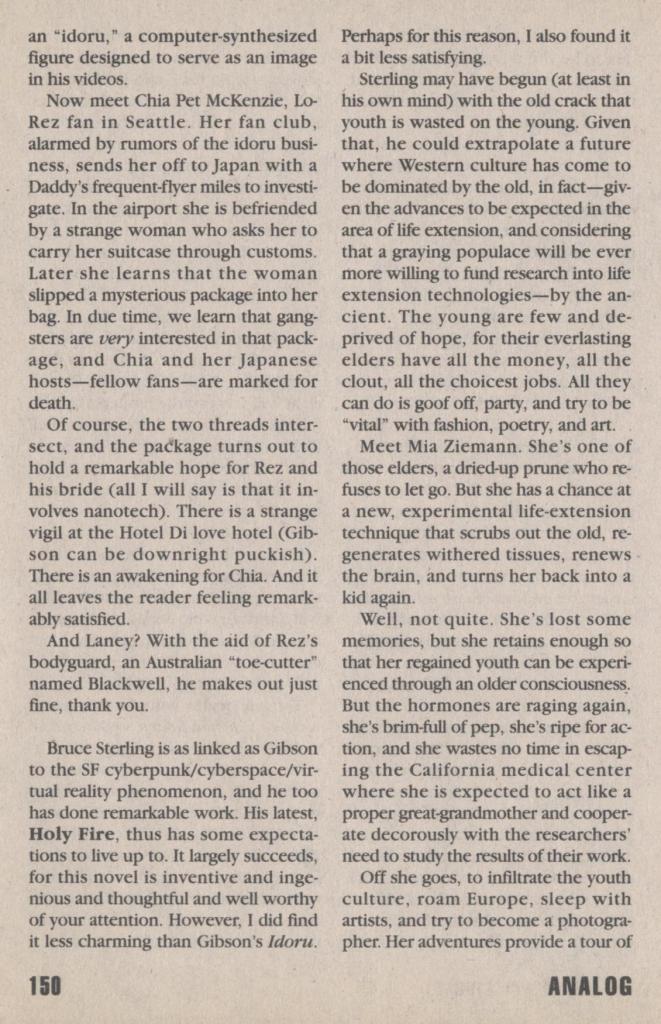
Reviews were also mixed. Tom Easton in “The Reference Library” for the March 1997 issue of Analog has this to say:

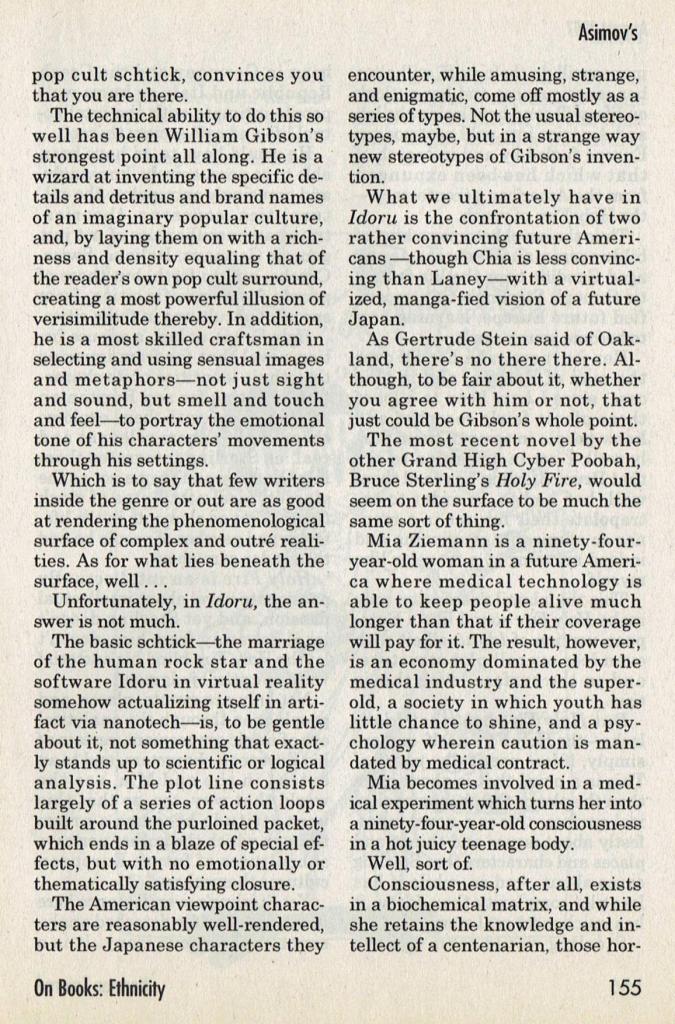
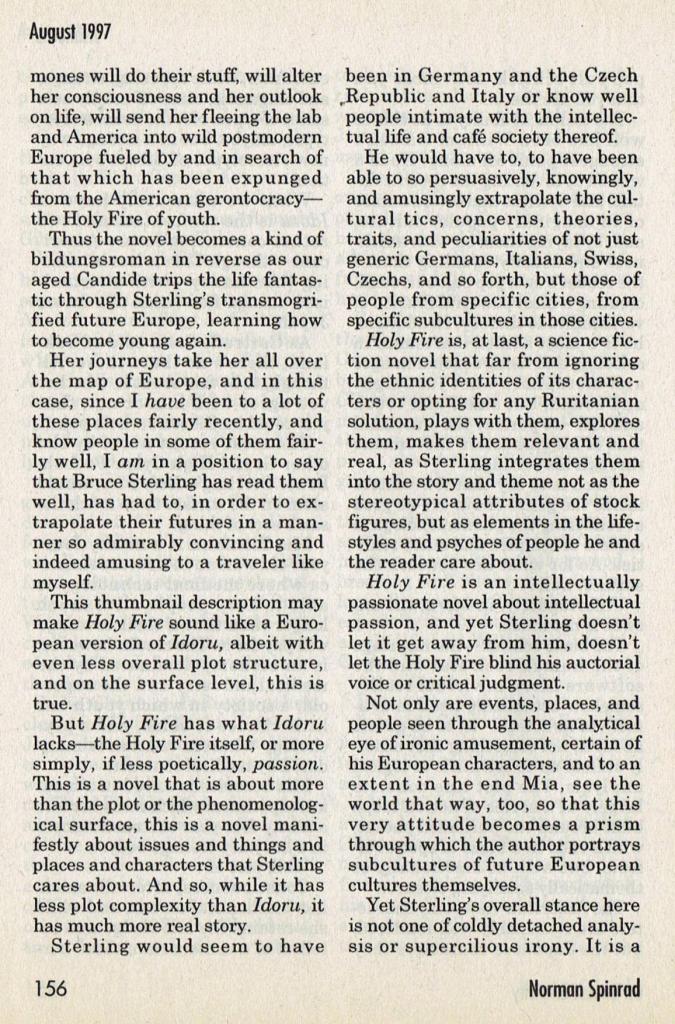
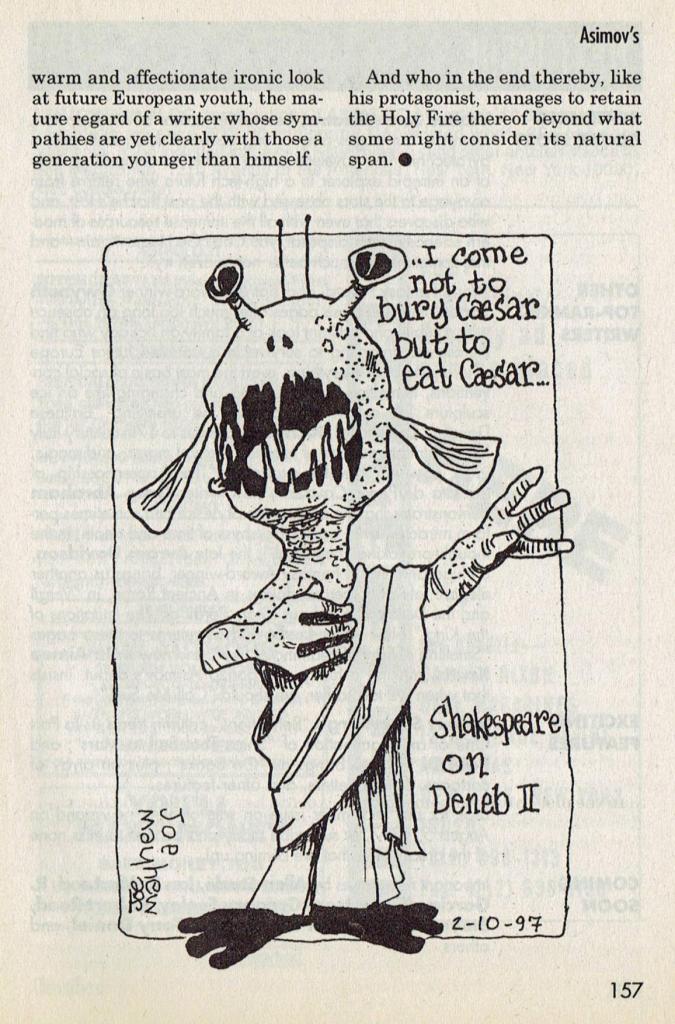
Norman Spinrad’s “On Books” from the August 1997 issue of Asimov’s Science Fiction also compares Holy Fire to William Gibson’s Idoru but comes to a different conclusion. Both novels are later cyberpunk works from the two leading founders of the cyberpunk movement, so it was logical to review them together. Spinrad is the more insightful of the two reviewers.

Damien Broderick and Paul Di Filippo in Science Fiction: The 101 Best Novels 1985-2010 had this to say about Holy Fire.

That Damien Broderick and Paul Di Filippo would recommend Holy Fire as one of the best SF novels from 1985-2010 is high praise. But why don’t I hear more about this novel after all these years? My assumption, is most science fiction readers don’t particularly care for serious speculation about the future and would prefer to read stories that compel you to turn the pages because of tight plots and characters they care about.

This is my second reading of Holy Fire. I first read it when it came out from the Science Fiction Book Club. I bought it then because its plot sounded similar to a 1926 novel I was trying to find, Phoenix by Lady Dorothy Mills. That book was also about an old woman undergoing a rejuvenation process and then running off to Europe to join a bohemian crowd. I finally found Phoenix several years ago and it’s more of a love story than science fiction. I need to reread it and compare the two.

For my second reading, I listened to it on audio. I’ve started rereading it again with my eyes. I never developed an emotional bond with Holy Fire like I have with the novels I consider my favorites. However, I admire it intellectually. It could have had the emotional impact of Flowers for Algernon because Mia/Maya goes through a similar arc of intellectual development. We just don’t see her experiences as tragic.

I think Sterling tried though. Throughout the novel, Mia/Maya experiences epiphanies that should have had a deep emotional impact. To me, they were just intellectually interesting. The ending should have been profoundly spiritual, like something from Hermann Hesse. Instead, it just seemed like a logical way to end the story. The choices Mia/Maya and her former husband, Daniel made in the end are vivid, even dramatic in concept. That just didn’t make an emotional impact on me. I assume Bruce Sterling wanted the ending to be an emotional epiphany. The ending does say a lot about how a posthuman would react to becoming posthuman.

Please leave a comment if you’ve read Holy Fire. I’m curious if you had an emotional response to the story. I found it intellectually exciting. I would recommend it on that level. However, it didn’t touch me, so I’m hesitant to say it’s good. I gave it four stars on Goodreads.

James Wallace Harris, 12/18/24

SciFiScavenger’s 2024 SF Survey

The YouTube channel SciFiScavenger recently conducted a poll of their viewers’ favorite science fiction novels. Viewers were asked to submit their Top 10 SF novels in order. SciFiScavenger received around two hundred submissions. They assigned point values, with ten points for #1, nine points for #2 down to one point for #10 to determine the final ranking of the Top 75 books. Watch the video to see the results and hear comments on each book.

I thought this was a good survey and added it as a citation list to the Classics of Science Fiction database. We like to regularly add new polls, lists, and awards to the database because our two lists are generated on the fly listing the most popular novels and short stories. Keeping up with the times reflects the changes in readers’ tastes. Each list, poll, award, scholarly recommendation, etc. is considered a citation. To get on the Classics of Science Fiction v. 5 requires receiving at least 12 citations. Currently, the book with the most citations is The Left Hand of Darkness by Ursula K. Le Guin with 53 citations. As of today, we have 138 books with 12 or more citations.

SciFiScavenger’s results overlap well with our list. Of the 75 books ranked, 56 were already on our list. One title, Parable of the Sowers was pushed onto the list because of this poll. The novel only had 11 citations before the poll, so with SciFiScavenger’s citation, it now had the minimum 12 to be on v. 5 of the list.

We do have one ongoing problem with our system. Some famous series books get on lists by the name of the series, and sometimes by the name of individual titles. For example, Foundation by Isaac Asimov was voted onto SciFiScavenger’s list. We put the vote with The Foundation Trilogy since most people think of the trilogy as one work, and its sometimes even published in one volume. We put The Shadow of the Torturer with The Book of the New Sun.

By continually adding more citation lists we reveal the most popular books over time. We don’t think of our system as recognizing the absolute best books but recognizing the most remembered books and short stories. You can read about the history of the project here. If v. 5 of the list gets too long, we’ll up the minimum citations. This way books that are being forgotten over time drop off. We like to keep the list in the 100-150 range. For v. 6 we’ll probably make the cutoff 14 citations. If you look at the v. 5 list, you’ll see books with 12 and 13 citations will get knock off unless they get additional citations. If you click on the citation number in the v. 5 list, you will see which citations put it on the list.

Here is a list of all our current book citations. If you scroll down to the bottom, you will see SciFiScavenger’s 2024 Poll. Click here to see it. You will see the 75 books on the survey. Each book in bold is on our v. 5 list. Because there is so much overlap, it suggests that SciFiScavenger’s survey correlates well with the aggragation of all the other citation lists.

You can use our List Builder feature to set your own requirements.

James Wallace Harris, 12/1/24