For thirty-five years (1984-2018) I depended on Gardner Dozois to tell me about the state of short science fiction in his annual The Year’s Best Science Fiction. After he died, there were still many best-of-the-year anthologies to consult, but none had the extensive wrap-up of the year in science fiction that Dozois produced. By 2024 some of those anthologies have died off, making me wonder if the science fiction short story is dying off too.
Print magazines have lost subscribers for decades, and influential online publishers continually complain about a lack of funding. Today I read an article in Business Insider about how the plurality of companies selling online makes it hard to know what to buy. My theory is there are too many publishers for science fiction short stories. It’s great for new writers wanting to get published, but it’s bad for us readers because we’re reading stories that would have remained in the slush pile decades ago.
Before the internet, fans of short science fiction bought The Magazine of Fantasy & Science Fiction, Analog, Asimov’s, and an occasional original anthology like Orbit. There were semi-pro magazines, but few read them. Because there were fewer slots where a story could appear the competition to get into one was greater.
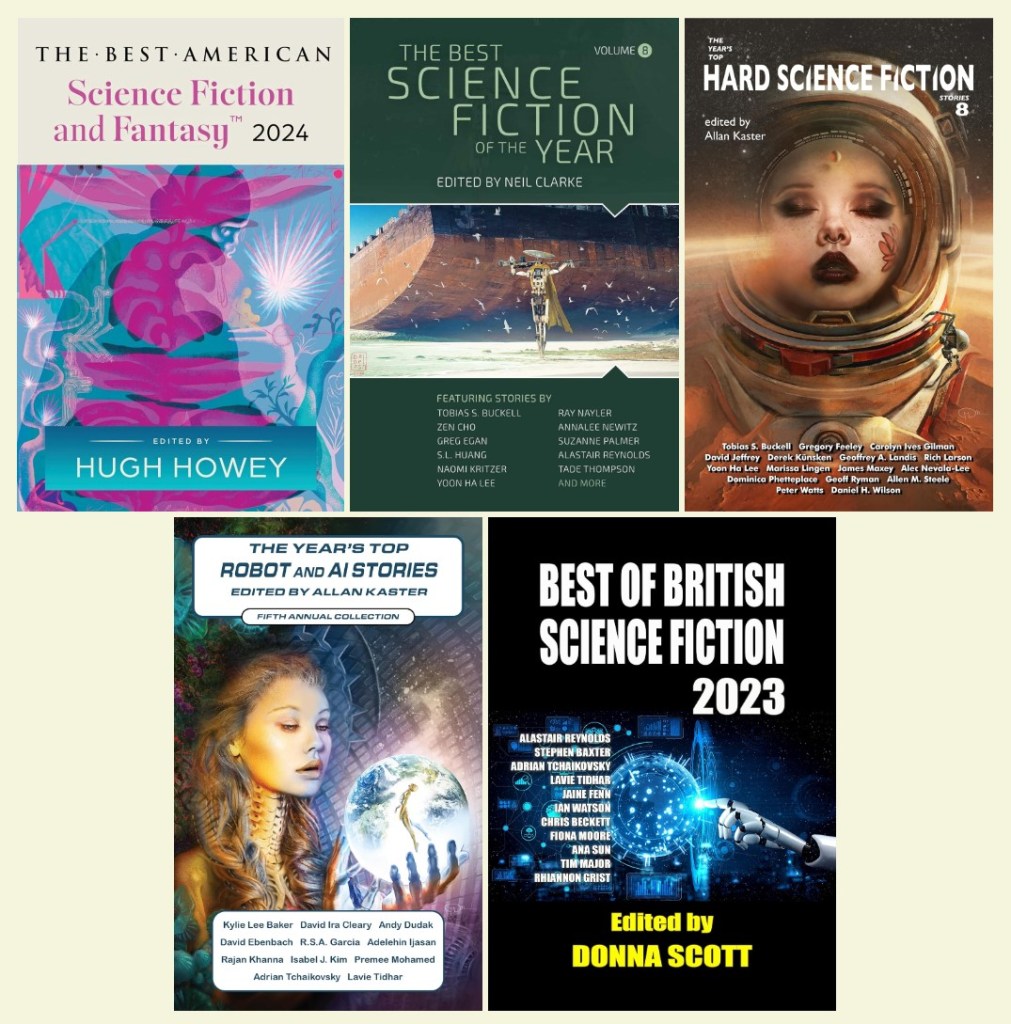
John Joseph Adams in The Best American Science Fiction and Fantasy 2024 gives a fair overview of science fiction short story publishers. His anthology publishes twenty stories each year. Ten science fiction and ten fantasy. As the series editor, he picks 80 stories to give to the guest editor, who picks the 20 that are published. Here are the publications he used, with the number of stories included in the 80 in parentheses.
- Lightspeed (7)
- Clarkesworld (5)
- Uncanny (5)
- Beneath Ceaseless Skies (4)
- The Magazine of Fantasy & Science Fiction (4)
- Reactor (formally Tor.com) (4)
- Asimov’s Science Fiction (3)
- The Sunday Morning Transport (3)
- Fantasy Magazine (2)
- McSweeney’s (2)
- Bourbon Penn (1)
- Cast of Wonders (1)
- Escape Pod (1)
- FIYAH (1)
- Nightmare (1)
- PseudoPod (1)
- The Dark (1)
Since this is only 46 stories, the other 34 must have come from author collections and original anthologies. Adams said he also read these periodicals:
- Analog
- Apex Magazine
- Apparition Lit
- Baffling Magazine
- The Kenyon Review
- khōréō
- Vastarien
- Weird Horror
This doesn’t cover all the publishers of short science fiction. By the way, some of these periodicals are for fantasy and horror. I only care about science fiction, so I’m disappointed with every other story in The Best American Science Fiction and Fantasy 2024. You can read Adams’s introduction by reading the sample at Amazon. It’s mostly about his selection process but it gives a good insight into what’s being published.
Because so many science fiction short stories are being published I’ve given up trying to follow the genre during the year by reading the periodicals. I just wait for the annual best-of-the-year anthologies. I occasionally buy F&SF, Analog, or Asimov’s, but F&SF has too little SF, Analog has too many minor stories, and Asimov’s has become rather hit-and-miss. I can’t but wonder if they’d get better stories if the online markets didn’t exist.
Neil Clarke’s The Best Science Fiction of the Year: Volume 8 is more to my taste, but it’s over a year behind. Volume 8 covering 2022 stories, came out in September 2024.
Clarke reports finding a huge number of print magazines:
- Analog
- Asimov’s
- Bourbon Penn
- Clarkesworld
- Cossmass
- Infinities
- Dark Matter
- The Dread Machine
- Dreamforge
- Fusion
- Fragment
- Galaxy’s Edge
- Infinite Worlds
- Lady Churchhill’s Rosebud Wristlet
- Luna Station Quarterly
- The Magazine of Fantasy and Science Fiction (F&SF)
- Interzone
- Metaphorosis
- On Spec
- Planet Scumm
- Pulphouse
- Pulp Literature
- Reckoning
- Shoreline of Infinity
- Space and Time
- Underland Arcana
- Weird Tales
- Wyldblood
That blows my mind. I never see most of those titles. Clarke’s State of the Union of SF short stories is comprehensive. I guess he’s the new Gardner Dozois. Even if you don’t buy Clarke’s anthology, you can read his introduction in the sample at Amazon. I won’t summarize what he says, it covers what my title above claims but only hints at. Go read his overview.
Allan Kaster publishes two best-of-the-year anthologies. They showcase SF stories about hard science fiction and AI/robots. Kaster comes closest to what I want to read. I think Kaster succeeds because he defines his science fiction narrowly and only publishes twelve to fifteen stories. Before Gardner Dozois blew up the size of annual best-of-the-year SF anthologies, editors like Donald Wollheim, David Hartwell, and Terry Carr just picked ten to fifteen stories each year too. Check out his two series: The Year’s Top Hard Science Fiction Stories and The Year’s Top AI and Robot Stories.
There is an overwhelming number of science fiction short stories to read coming out. In that regard, the industry is doing great. Remember the lament in Business Insider, there are too many sellers. It makes selecting difficult and lowers overall quality. Back in 1953, there was an SF magazine boom, with over forty titles published. That boom crashed because the genre couldn’t support that many titles. I wonder if that will be true today? Or does the Internet allow for countless tiny markets supported by a handful of faithful fans? If that’s true, it might be better to ignore the larger genre, and just find a comfortable niche.
James Wallace Harris, 11/10/24
 Classics of Science Fiction
Let’s be honest. Horror and fantasy are easier to write than hard sci fi — All three genres, great writing is equally difficult. But very good writing that is story good and basic science factor accurate (or accurately inaccurate, such as warp drives) takes a deeper knowledge level than consistent world creation in which real world accuracy is optional. Thirty years ago, many high school and college students appreciated hard sci fi and fantasy, plus the few who skillfully blended the genres. Today, national test scores indicate the vocabulary and math averages have gone down. That means there are fewer students who can appreciate hard sci fi. I remember reading a story in which tidal differences between the hero’s head and feet nearly killed him because he had approached a sharply curved gravity well, had the whole class the next day arguing about the story’s accuracy and our physics teacher wisely changed the day’s planned lecture to one on tides. That short story forever enlarged my understanding.
It was an ordinary freshman college physics class in a state university — not a select group of extra smart kids (well, physics students, but not at MIT). I learned high school and jr high classes were similarly inspired. From what I’ve read, the sheer number of young people who could enjoy reading the story for the fun of it, and then debate its science is much less now.
In other words, the target audience hasn’t really changed its taste that much (need updated science input, but style similar), but the dumbing down of American education has reduced that audience size. Very sad.
Fran Tabor
LikeLiked by 1 person
I would think there would be plenty of young people still interested in science. But I don’t know that. Have you seen any studies that say there is a drop in test scores, or data that shows fewer kids are interested in science? It is true that forty years ago Analog and Asimov’s had about a hundred thousand subscribers, and now I think it’s less than ten thousand for both of them.
LikeLiked by 1 person
There are still many interested in science, and many high performance schools, but national averages, a test score that in the 1960’s would have you in the 80th to 90th per centile ranking, today will put a student in the high 90’s. Among the Western/1st world countries, we spend the most per capita on education and seem to be the only ones with deteriorating results.
Dr. Thomas Sowell has written heavily on this topic. He has a strong personal interest in this as it was because of quality inner city schools he, a ghetto born black, became one of the world’s most famous economists. In some ways, his story mirrors Dr. Ben Carson’s, who also credits quality inner city schools for his ability to become a professional.
How can you enjoy playing with concepts if the author is forced to spend too much time explaining the concept? Today’s sci fi author must explain more terms and make fewer assumptions, or alternatively just accept a very small potential readership and just pray that their stories and books can find their way to those who will appreciate a not dumbed down story. The dilemma: Explain much and pretend you’re a good enough writer to get away with lots of exposition or know you’re not that good, don’t slow the action with repeated explanations, but know even fewer people will enjoy your story.
Today’s sci fi publications face those problems big time — and then have to compete with the many podcasts that satisfy the same itch that drove us to Analog.
A good sign: The many excellent math and science podcasts that are developing an enthusiastic audience. Hopefully those podcasts will help those test score averages to re-achieve and exceed past highs.
EZines seem to help with the costs of a magazine — but well-worn, passed around copies were one of the best advertisements in the 60’s.
LikeLiked by 1 person
I’m glad I’m not the only one concerned by the sudden lack of year’s best collections. What I’ve been using to supplement the year’s best collections over the last decade is Rocket Stack Rank. They aggregate reviews, awards, and year’s best TOC to give each story a score so you can easily see which are the most highly rated stories of the year. It’s helped me find a ton of great stories I might have overlooked without it.
http://www.rocketstackrank.com/search/label/Ratings
LikeLike
I used to read RSR and then they stopped reviewing stories. Are they back? I’ll go check. Thanks.
LikeLike
They aren’t reviewing still but the aggregate score is still useful for finding quality stories to read.
LikeLiked by 1 person