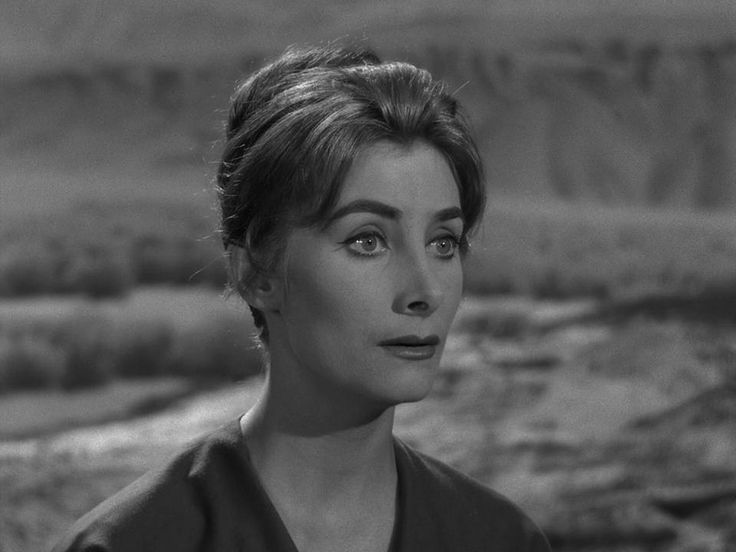
My friend Mike told me that he and his wife Betsy were watching The Twilight Zone, one episode each evening. I told him I would do the same. We’ve been texting every morning about the previous night’s episode. Day before yesterday we watched “The Lonely,” from season one, episode seven. I think I’ve seen this episode three times over the last sixty-plus years, but this time I thought more about the story. I think texting with Mike is pushing me to analyze the story in ways that casual watching never did.
The Twilight Zone tended to set its audience up for a surprise ending, often ignoring logic, or even other possibilities for how the story might go. Rod Serling wanted us to get involve and then surprise or shock us – but do it quickly. He treated his stories like a magic trick, and I don’t think he expected us to ask too many questions.
In “The Lonely,” Corry (Jack Warden), convicted of murder, has been sentence to solitary confinement on a deserted asteroid. He is visited four times a year by a supply rocket. The captain of the supply ship, Allenby (John Dehner), has taken pity on Corry and tries to bring him something each time to occupy his mind because he knows Corry is going crazy with loneliness. This time he brings him a large box. Allenby tells Corry not to open until he leaves. It turns out its a robot that looks, acts, and talks just like a beautiful woman. (It’s Jean Marsh who will star in Upstairs, Downstairs in the 1971.)
The robot is named Alicia. At first Corry is offended by thinking his loneliness could be eliminated by the companionship of a machine. But, Alicia is hurt by his rejection, and Corry takes pity on her. They become close.
Then Captain Allenby shows up again and tells Corry he’s been giving a pardon and has twenty minutes to get ready to leave. Corry assumes he can bring Alicia, but Allenby says there’s a weight limit because of limited fuel and he only has room for Corry. Corry can’t believe Allenby could be so cruel as to leave Allicia. To quickly convince Corry he is serious, Allenby shoots Alicia in the face, revealing all her mechanical parts.
This makes “The Lonely” a cold equations story. “The Cold Equations” by Tom Godwin was a controversial story from 1954. It set up a problem where the only solution was killing a teenage girl. A lot of readers hated “The Cold Equations” and over the decades they have protested that the author should have found a way to save her. They completely missed the point of the story. Godwin set up the story so the girl had to die. And that’s what Serling did in “The Lonely.”
Not only that, but they solved the plot quickly by having Captain Alleby shoot Alicia. I accept all that. That’s the point of the story. But here is where in 2024 I took a different path thinking about the story.
Why didn’t people talk about Corry falling in love with Alicia? In 1959, I wonder if the audience assumed Alicia was just a machine, and that Corry’s loneliness overcame the fact, that his love was a delusion. That when we see the mechanical parts of Alicia that we undertand why Alleby shoots her.
Over the decades, we’ve had a lot of stories that might be called robot liberation stories where many readers believe that a machine that looks and acts like a human is just as human as a biological person. I wonder if the ending shocks modern readers who have come to love robots. If someone shot C-3PO in the face and killed him, wouldn’t we be shocked and mourn his death?
If I remember right, there were a couple of Asimov robot stories where Susan Calvin kills a robot. I was always shocked by that.
In 2024 we don’t want robots murdered. Accepting the logic of the story that Alleby can only take one person back, how could we change it to work with modern audiences?
Rod Serling wrote this episode. He didn’t give the audience or Corry a chance to think about the options. His stories are setup to only work one way. When I was watching the episode I had forgotten the ending, and I wondered how Serling was going to solve the problem. Having Allenby shoot Alicia was a tidy way to end the story. After he shoots Alicia Alleby tells Corry that the only thing he’s leaving behind is his loneliness. Corry says, “I must remember that,” and “I must remember to keep that in mind.”
There’s a problem. We don’t get to decide and neither does Corry. I wish Serling had ended the story differently. I wish Allenby had handed Corry the gun and said, “I can take one person back, the ship leaves in fifteen minutes no matter what,” and then walks off.
The story could end there. We don’t really need to know the ending, because the story has shifted to thinking about all the possibilities. We should accept that the rocket only has fuel for one person. We should also assume there will be no future supply runs so if Corry stays, he will eventually die. We might also assume Alicia runs on radioactive pellets and will live a long time.
But let’s say the TV show had to reveal an ending. The camera in the very last scene could be aimed at the rocket’s hatch from the inside waiting to see who shows up. We could see Corry’s face climb into view, Alicia’s face climb into view, or Allenby say, “Time to go, shut the door.”
Each possible ending would imply so much still.
- Corry shows up and we think he shot Alicia
- Corry shows up and we think he didn’t shoot Alicia but left her to be lonely
- Alicia shows up and we think Corry shot himself
- Alicia shows up and we think Corry volunteered to die alone
- Neither show up and we think Corry decided to stay with Alicia
- Neither show up and we think Corry decided to stay with Alicia but kills her before he dies so she won’t be alone
- Neither show up and we think Corry decided to stay with Alicia but gives her the gun to make her own decision when he dies
It’s unfair to change an author’s story after the fact. But in this case, I’m suggesting my idea because it illuminates how people might have thought about the story in 1959 would be different from how we like to think about stories in 2024.
James Wallace Harris, 10/27/24
 Classics of Science Fiction
Or worse ending:
The convicted killer, driven insane by loneliness, so insane all positive human emotions have become focused on a machine, has figured out if robotics has become so advance an animatronic can pass for human, than perhaps something less sophisticated no longer needs a real human to pilot it. He checks out the rocket, learns his assumption is true, and kills the pilot to he and his love can escape into the wide world.
LikeLike
Of Fran, you are the romantic.
Didn’t think of that. Lots of possibilities.
LikeLike
Not really. If the robot had been a real person, a slave dropped off to make his exile palatable, it would have been a true “Cold Equations” story. It would show that it’s easier to be nice & fair during a time of plenty than when scarcity forces hard choices.
Only in times of scarcity are people forced to really think about what it means to be noble or righteous. Aristotle claimed only the examined life is worth living. The examined life gains an extra richness, but is it worth the price to force everyone to live an examined life, to ask which values they hold most dear?
Science fiction forces us to consider value questions more deeply than “realistic” fiction ever can because no fictional (or even non fictional) story can be told without using terms and names that do not evoke intellectual knee-jerk reactions. Knee-jerk reactions are deep thought killers.
If the self-appointed literati of the academic world were more honest, they would admit some sci fi is possibly the most valuable literature that exists.
LikeLike
But don’t you believe that Alecia was equal to a person? I assume back in the 1950s people didn’t think that was possible. But don’t people today think robots will eventually be sentient? And won’t that make them equal to humans?
LikeLike
Allenby knew it was a robot. So he shot it to demonstrate that it was not a human being.
LikeLike
What about the fact that the supply ship is never returning so no more food for Corry.?
LikeLike
in college I did a paper on the Cold Equations and, yes, I tried to save the girl. What no one knew, even the prof (unless he didn’t tell us) was that Godwin did try to save the girl, but Campbell didn’t want a happy ending. He kept sending it back saying “I don’t want a happy ending.” My professor copied my paper (without first asking me) and asked if the whole class could read it. What could I say?
LikeLike
or Alicia destroys herself so Corry would ho
LikeLike
WARNING!! SPOILER ALERTS FOR OTHER EPISODES!!!
Serling seems fascinated by the idea that people often have to choose either to escape into an (unreal?) world of love, beauty, and imagination OR to choose to suck it up with the unfeeling and often cruel people in their unsatisfying and mundane world. He explored this tension over and over, seemingly coming to different conclusions: can Martin Sloane really go back to his childhood? Is Willoughby a town literally to die for? Should Burgess Meredith be happy that the world’s been dismantled via nuclear destruction: on the one hand, he can finally read as much as he wants. On the other hand, there’s nobody alive who can fix his damn glasses!!!!
i think The Lonely is the ultimate example of this, and it illustrated why the issue of whether or not the robot can indeed feel and love is an important one. Is he losing the best thing in his life in order to resume his old life of human connections, or, as Serling’s narration ambiguously asks, is he just leaving behind another one of his machines, now rendered obsolete? The poor man lost one wife due to a reckless man’s actions and now a second one?!? Truly one of the series’ most heart-rending episodes in my opinion.
as far as the issue of Elena goes, get ready for the ethical questions to increase exponentially. Can an AI program really “love” us and how should we treat it if it does? Somebody already wrote and asked Miss Manners if they should bother being polite to their interactive AI program from work. (She said yes, by the way.) Oh boy.
Yes, Susan Calvin “murdered” at least one robot; she was furious that it deceived her by making her think a scientist she loved returned his feelings. Meanwhile it was just trying to execute the three robotic laws in the best way it interpreted it could!
LikeLike
I’ve been watching Twilight Zone since I was a kid. I’ve enjoyed most of them. One pisode I remember seeing “Death’s Head Revisted” It’s the story of a Nazi commander who returns to the Concentration Camp he commanded. The ghost of the people who he had dealt with put him on trial for crimes against humanity. He’s found guilty a sentenced to be insane and feel the pain of the people who came there. It seems most people don’t want to address this. It wasn’t till I was 17 years old, I heard of The Holocaust, the 12 years in school nothing was said about it. Rod Serlingwas the only one to address this darkest time I our history. “It true If you don’t know your past, you doomed to repeat it”
LikeLike