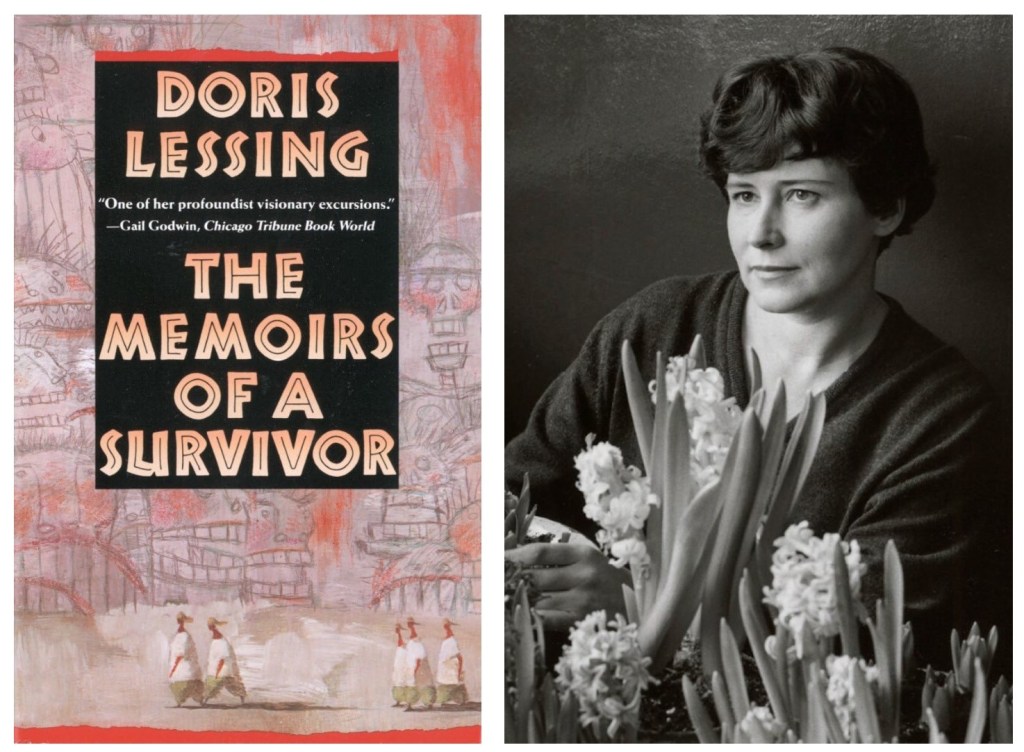
What would it be like to experience living through an emerging apocalyptic crisis? Forget about sinister aliens conquering the Earth, or silly zombie invasions, or even biker gangs running around in their skimpy S&M outfits. No, what would it be like if civilization collapsed, and you had to live in an emerging dark age? Reading The Memoirs of a Survivor by Doris Lessing will make you think about it.
It’s what the English call a cozy catastrophe. An unspecified crisis happens, and England slowly unravels. An unnamed narrator, of unspecified gender writes in their memoir about living through such an event. They eventually take in a twelve-year-old girl named Emily, and her pet named Hugo. Hugo is sometimes described as looking like a cat or dog, and it sometimes purrs and other times whimpers. Lessing likes to explore both gender and species identity.
The memoirs narrate two story threads. The more interesting of the two involves the narrator watching society fall apart while Emily grows up. The second thread is episodes in the narrator’s fantasy life, which might be called exploring inner space. This is a science fiction novel that was published in 1974, when Ursula K. Le Guin was becoming famous as a women science fiction writer. Lessing’s style is much different from other women writing science fiction in the 1970s. Imagine Virginia Woolf writing a post-apocalyptic novel.
Doris Lessing (1919-2013) was a British novelist who won the Nobel Prize for Literature in 2007. She also wrote several science-fiction novels, including the five-volume Canopus in Argos (1979-1983) series as well as The Memoirs of a Survivor. She was most famous for her novel The Golden Notebook (1962), which is considered a story of inner space written at the dawn of exploring outer space. Lessing was born in what’s now called Iran and grew up in what was called Rhodesia. She moved to England as a young woman, becoming a writer, and radical.
Lessing’s birth was one year before Isaac Asimov’s, so if she had been considered a science fiction writer, she would have been among the Heinlein-Clarke-Asimov generation. However, her science fiction reminds me of the Ballard-Brunner-Aldiss generation. The Memoirs of a Survivor came out in the era of the best-selling nonfiction books about threats to civilization: The Limits of Growth, The Population Bomb, Future Shock. Those same books inspired John Brunner’s novels Stand on Zanzibar, The Jagged Orbit, The Sheep Look Up, and The Shockwave Rider. The 1970s felt like a pre-apocalyptic time, like our 2020s.
The Memoirs of a Survivor is a very British post-apocalyptic novel, far cozier than American novels covering the same theme. American male writers like to imagine life after the apocalypse as a new wild west. American female writers picture things a good less violent but acknowledge our violent heritage. British writers of both genders often write about characters getting along after the collapse. Their novels do have violence, but it’s not all kill-or-be-kill. The Memoir of a Survivor has a small amount of violence, even some guns, but it’s very minimal.
The setting is a city where the lights and water still work, but the economy is coming undone, and refugees from other parts of the country that have totally collapsed, are streaming through on their way north. The unnamed narrator, presumably an older woman because of how she characterizes people and things, watches the slow unfolding of the collapse from her window. The story become more interesting when a man abandons Emily and Hugo to her care.
Lessing is rather ambiguous in The Memoirs of a Survivor. The gender of the narrator isn’t clear, but the narrator’s personality feels like an old woman. Emily is quite well-defined by the narrator, who spends most of her time observing her and Hugo. Lessing had taken in a young adolescent girl, Jenny Diski, for a while in her life, and I assume much of the novel comes from that experience. Although, Lessing had three children of her own, so she had plenty of experience observing children growing up.
There are two parallel stories within the novel. The one I liked best was about Emily, her growth, and her fascination with the hordes of young people streaming through the city. In the other thread, the narrator stares at a wall, and fantasizes about exploring other apartments in the city, where she cleans, repairs, and paints. Lessing has said this is an autobiography of dreams. I felt it was a metaphor for repairing society because the narrator is always trying to renovate the rooms. However, these fantasies are important for the ending.
What’s beautiful about The Memoirs of a Survivor is it describes the early days of an apocalypse. Young people are on the move, anxious to build a new society, while older people huddle in their houses and apartments, trying to maintain and remember the old society. Since I feel we’re in the early years of a slow decline, The Memoirs of a Survivor is an interesting read for our times. Sadly, this book isn’t well known. There’s no ebook or audiobook edition, although it’s still available in trade paper. I looked everywhere for an audiobook edition because the writing is lovely and serene. I wanted to hear this story, rather than read it because I prefer listening to literary writing.
The growth and transformation of Emily is described in psychological detail that is realistic for most young girls of any time. When Emily first saw the refugees, she desperately wanted to join them but felt rebuffed. She decided to make her own clothes, which the narrator and I felt was a way of creating her own identity. At first, her outfits sounded like something Stevie Nicks would have designed for the bedroom, witchy lingerie, but Emily never even wore them outside. Next, her designs seemed like Madonna’s outfits from the early 1980s. Finally, Emily designed something close to punk and grunge. Remember, this novel was written in the early seventies.
The story is noticeably quiet, and the details of Emily’s relationship with her pet, Hugo, are heart wrenching. Emily wants to run away with the young people but can’t go because she knows they will eat Hugo. Obviously, Hugo is her emotional anchor after losing her parents, but she’s moving into the boy-crazy years. Emily, and many of the city girls fall in love with the various young men who are the leaders of the various roving bands, and these young men take advantage of their attractive powers to create harems of little adoring girls. I wonder if that’s how things were in our cave dwelling days — all the young women wanting the alpha male.
Like I said, The Memoirs of a Survivor is not a Mad Max post-apocalypse. Lessing tells us some people have guns, but guns aren’t part of the story. When you read this story it’s not hard to think about people living in Haiti or Sudan, or the many other countries in the world with failing economies, decaying infrastructures, gangs, which send out hordes of refugees into countries with more civilization.
This novel will make you think about what you would do if things fell apart. What if the electricity stopped working and water stopped flowing from your taps? What would you do? Would you join a group marching north to better economies? Or would you hunker down, learning to live with less, giving up money to barter, accepting violence and mob rule? Would you learn how to grow food and make things?
The Memoirs of a Survivor is like Earth Abides by George R. Stewart in that it assumes the young will quickly invent new ways out of the old, while the youngest children, who were never educated, will become feral. Gerald, a young leader whom Emily loves, does everything he can to save these feral children. What would you do with them? Ish, in Earth Abides, had a tremendous insight into their future survival, but I think Lessing’s take was more cynical, and maybe realistic.
I doubt current generations of science fiction readers will find this novel very appealing. I think it’s becoming a forgotten novel. And I tend to feel Lessing is becoming a forgotten writer, even though her name continues to show up now and then, such as this recent piece “10 of the best Booker Prize-nominated books with a political slant” that includes Lessing’s novel, The Good Terrorist.
I would have rated The Memoirs of a Survivor 5-stars if it had only been about Emily and the collapse. The inner space sequences dragged the story down. However, if I reread this book in the future I might like those part better. For now, 4-stars.
James Wallace Harris, 7/8/24
 Classics of Science Fiction