Have You Read Any of These Ten Science Fiction Books from 2023?

I was surprised that I hadn’t heard of any of these ten novels and authors from The Shades of Orange YouTube review “The Top Science Fiction Books Published in 2023.” Is this an indication of how out of touch I am with new science fiction, or do my tastes just run much different from the reviewer? When and why did I stop reading new science fiction?

Here are Shades of Orange’s Top 10 SF novels for 2023. The numbers in parenthesis are from Goodreads. They are (average rating / # of raters / # who left reviews). Those numbers are from Goodreads users who have marked the title read. It would also be interesting to see the number of people who have the book in their library marked “Want to read.” Titles with an asterisk have audiobook editions.

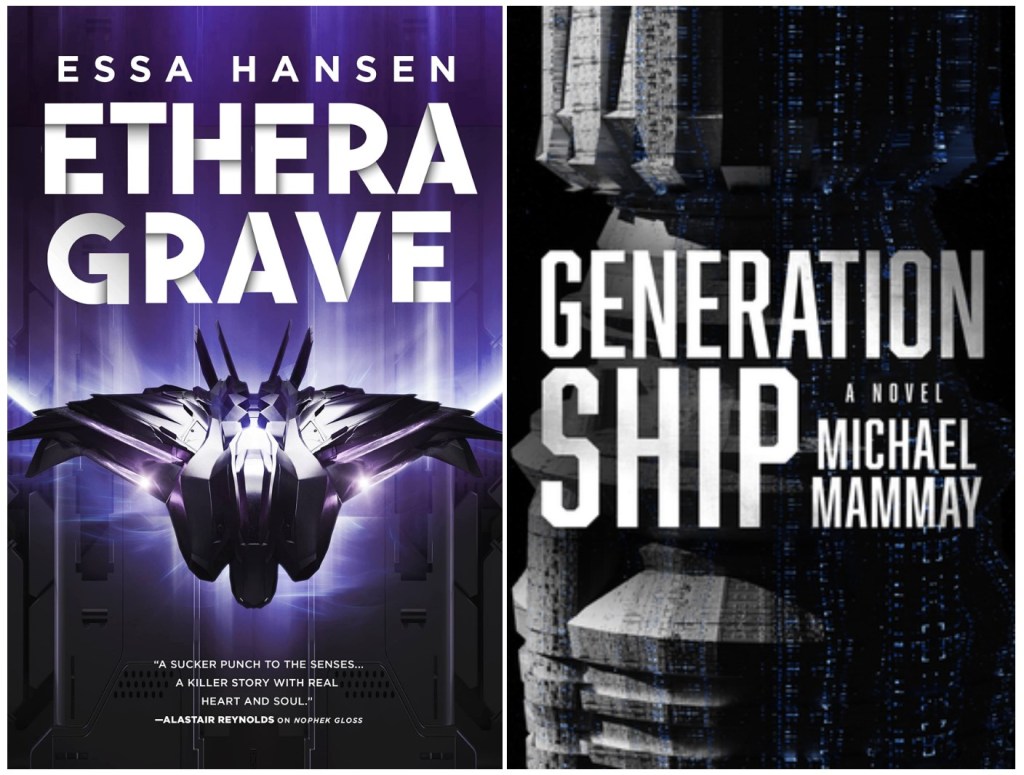
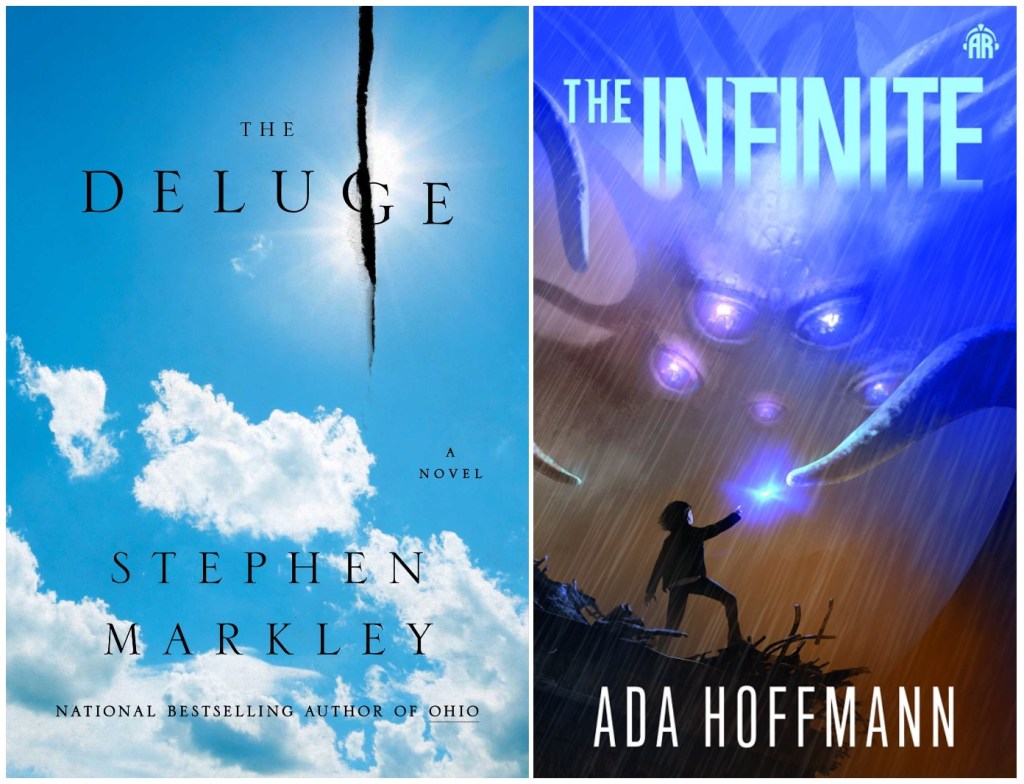
  1. The Deluge by Stephen Markley (4.22 / 3,107 / 738) *
  2. The Infinite by Ada Hoffmann (4.27 / 241 / 55) *
  3. Ethera Grave by Essa Hansen (4.09 / 141 / 29)
  4. Generation Ship by Michael Mammay (3.83 / 805 / 187) *
  5. The Scourge Between Stars by Ness Brown (3.6 / 3,006 / 808) *
  6. The Archive Undying by Emma Mieko Candon (3.3 / 1,091 / 391) *
  7. Saint Elspeth by Wick Welker (4.11 / 44 / 28) *
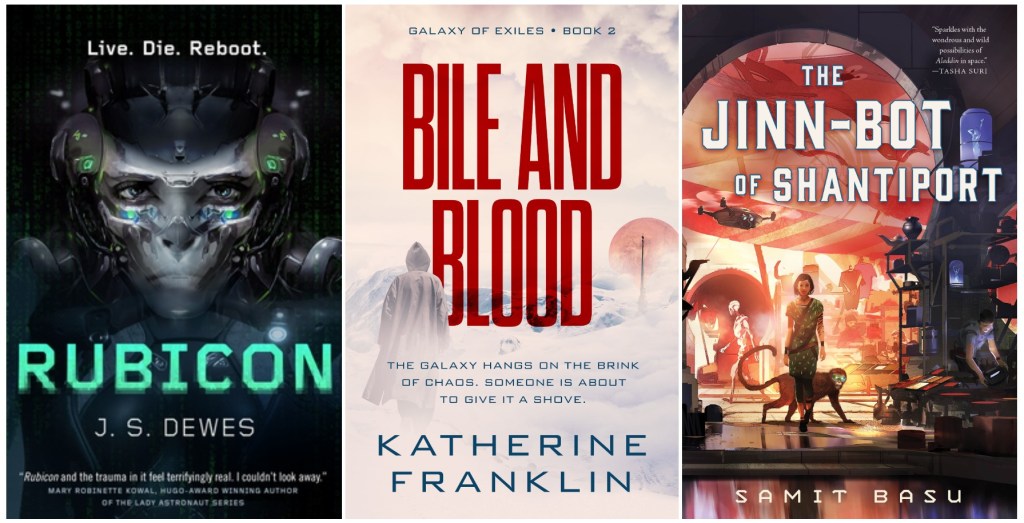
  8. The Jinn-Bot of Shantiport Samit Basu (3.67 / 684 / 255)
  9. Bile and Blood by Katherine Franklin (4.50 / 2 / 2)
  10. Rubicon by J. S. Dewes (3.95 / 1,632 / 324) *

I wonder if science fiction fans growing up in the 1930s felt the way I do now when they read best-SF-of-the-year lists in the 1990s? Nearly all my favorite science fiction writers I got to know growing up are dead, and the living ones that became popular during my lifetime evidently aren’t favorites with young readers in 2024 anymore.

If I read these new books, would I find the same kind of excitement I did sixty years ago? Even more interesting to contemplate: Do young readers today find the same kind of excitement that I did in the 1960s and older generations did in the 1930s? Both Doc Smith and Samuel Delany wrote space operas, but were their intent and appeal the same?

If I could somehow get every generation of science fiction readers to write an essay “What I Discovered in Science Fiction” would the revelations be similar?

I am intrigued by the tiles: The Deluge, The Archive Undying, and Generation Ship. Since all three are available as part of my Spotify subscription, I’m going to try them. I keep forgetting that Spotify includes 15 hours of audiobook listening with my music subscription. I think I’ll use that feature to test out new science fiction books since it won’t cost me anything extra.

I’m also impressed with many of the YouTube book reviewers. I assume YouTube is making an enormous impact on what books readers buy today. However, many of my favorite YouTube reviewers only review older science fiction. This is still great because I’ve missed a lot of great science fiction, but it seems to indicate new science fiction gets less attention.

My absolute favorite YouTube reviewer is Bookpilled. He has 36.6 thousand subscribers. I’m absolutely fascinated by which books and authors from the past he still finds significant. Bookpilled doesn’t review new SF.

After Amazon and Audible, I stopped going to new bookstores every week. I think that’s where and why I used to keep up with new releases. Another reason I quit discovering new science fiction at new bookstores is because the science fiction sections grew too large. There was just too much choice, so I gave up.

Shades of Orange has done me a favor by limiting my choices to ten.

by James Wallace Harris, 2/17/24

In Which Postapocalyptic Novel Would You Prefer to Live?

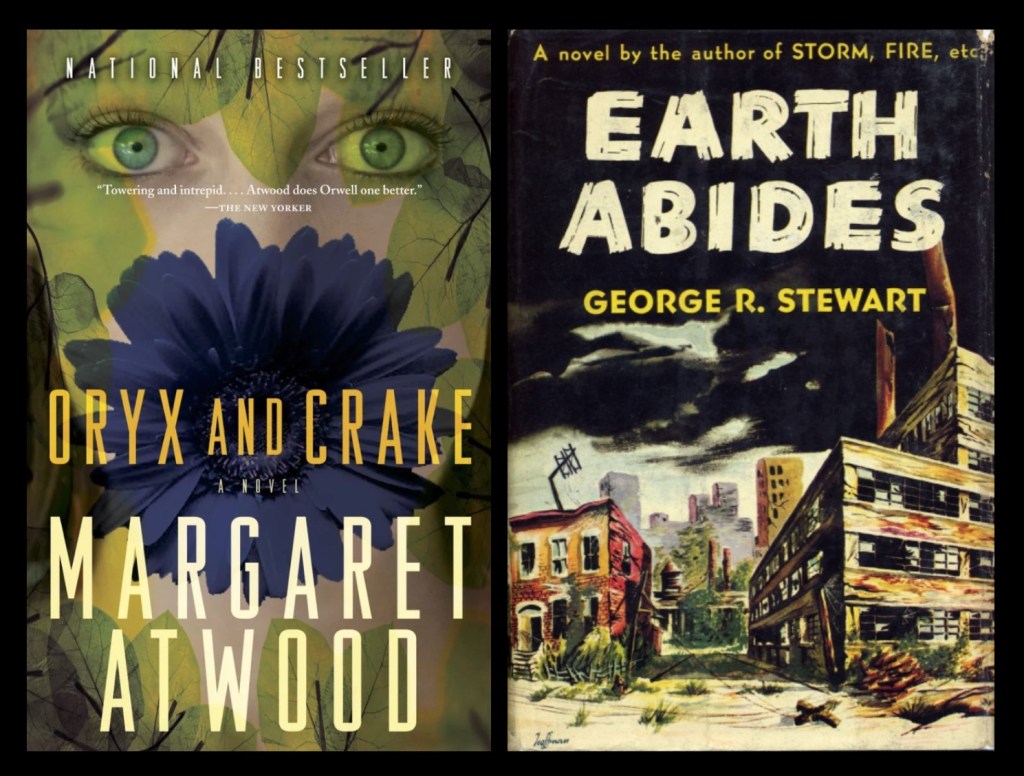
Oryx and Crake by Margaret Atwood is a postapocalyptic novel about humanity being assassinated by a mad genetic engineer. Although well-written and thought-provoking it wasn’t a pleasant read. I doubt any science fiction fan would vicariously put themselves into Atwood’s imagined future. Its narrator, a human survivor nicknamed Snowman, is a rather repulsive individual. This novel might be intellectually stimulating, especially for its thoughts on the evilness of humanity, but it’s not a novel that promises hope for rebuilding the future.

As a young reader of science fiction back in the 1960s, I used to fantasize about what I’d do if I lived in the books I read. Even 1950s post-apocalyptic novels about WWIII left room for me to see positive paths to take. Oryx and Crake was as bleak to me as Cormac McCarthy’s The Road. I admired that novel, but I would never daydream myself into it.

The blurb on the cover above praises Atwood for outdoing Orwell, but not by me. Nineteen Eighty-Four was bleak and depressing, but it was infinitely instructional about avoiding possible futures. Oryx and Crake feels like an oracle of doom. But then I haven’t read Nineteen Eighty-Four in a couple of decades, and at 72 I might find it just as nihilistic as Oryx and Crake.

I’m a connoisseur of after the collapse settings in science fiction. My all-time favorite is Earth Abides by George R. Stewart. In that story, almost everyone dies from an illness and the world reverts to a time when humans are few, becoming hunters and gatherers again.

I’m not saying I’d like to live a tribal existence. No, the postapocalyptic world I’d like to live in, is just after the collapse, where the infrastructure of humanity is still intact. I’d want enough leftover supplies to keep me going for the rest of my life, which might not be more than a decade. When I was younger, the idea of rebuilding civilization appealed to me, but I’m too old for that anymore. But if I were in my twenties, would I fantasize about surviving Atwood’s future?

No, old me would want to live in a nicer post-apocalypse to contemplate the end of our species. In Atwood’s book, she has Snowman contemplating his own fucked up life, while he caretakes a genetically engineered new form of humanity. Atwood imagines our replacements as genetically engineered non-violent humanoid beings called Crakers. These post-humans have a reproductive cycle that removes gender conflict and are peaceful herbivores. I can’t imagine these wimpy creatures surviving the highly aggressive genetically modified animals created in the years before humanity was snuffed out.

In Oryx and Crake Homo sapiens are defined by our worse traits. We deserve our fate in Atwood’s story. And I wouldn’t argue with Atwood. But Atwood’s philosophy makes for a bleak depressing read. The novel has two sequels: The Year of the Flood (2009) and MaddAdam (2013). Even though I was bummed out reading Oryx and Crake, I’m tempted to read the rest of the trilogy just to see if Atwood ever offers her readers hope. I have read that the second volume is about religious people, and that was a frequent theme in 1950s postapocalyptic novels. That tempts me.

Oryx and Crake has got me thinking about the appeal of reading postapocalyptic novels. Why are postapocalyptic settings with zombies so popular with readers today? I’ve never been one to enjoy horror themes. And zombies are so damn yucky. Why would anyone find pleasure putting themselves into such a setting? I must wonder if fans of these stories secretly want to live in a world where they could kill, kill, kill to their heart’s content.

I’m more of a Henry Bemis type myself. I want a nice cozy catastrophe postapocalyptic setting. A peaceful place to meditate on the passing of human existence. When I was younger, I fantasized about playing Tarzan and Jane after the fall of civilization, but now that I’m older, having a faithful dog and robot would be the only companions I’d want. I’d desire a Clifford Simak flavored setting if I were the last man on Earth.

I’m trying not to say end of the world. I dislike that phrase. Humans are so arrogant. They believe when our time is up it’s the end of the world. I think Earth will bop along simply fine without us. Animals and plants would flourish again. The Earth would again teem with life. I can only assume self-aware intelligence was an experiment that failed. Let the robots have the next turn. They might be more compassionate to the animals.

I often write about the difference between old science fiction and new science fiction. In old science fiction we do ourselves in because we’re the stupid violent bastards we are, but there’s not a lot of self-recrimination. In the new science fiction, writers dwell on our evilness. In Atwood’s book, we see two boys, Jimmy (Snowman) and Glenn (Crake), grow up and snuff out humanity. Their formative years were spent watching porn, snuff films, child pornography, playing sick violent video games — just being a couple of gifted brainiacs. They are super intelligent, yet soulless and unlikeable. Jimmy and Glenn use their genius to create and sell ugly products to a world all too anxious to consume them. Sure, that reflects our real world, but does experiencing such in fiction do us any good? Will readers in the future cite Oryx and Crake warnings about genetic engineering? It lacks the symbolism or political resonance of The Handmaid’s Tale.

Atwood’s The Handmaid’s Tale is about another ugly future, but its ugliness offers us inspiration on how to avoid that future? I assume she intended Oryx and Crake to be positive in the same way, but it isn’t. The Handmaid’s Tale inspires us to fix society. Oryx and Crake only make me want to pull the plug on our species.

In most old science fiction novels about after-the-collapse of civilization, we’re shown ideas for starting over. Sure, some of those novels tell us we’re only going to make the same mistakes again, but there is a will to try again. Some of those stories even suggested it might be possible to take different paths. Reading Oryx and Crake left me feeling it’s time to just let go. Let some other species become the crown of creation.

Maybe Atwood put hope in the sequels, so we’d buy them.

Is my pessimism due to my age? Do younger readers find hope in this novel?

James Wallace Harris, 2/16/24

Gather Yourselves Together by Philip K. Dick

Only the most ardent fans of Philip K. Dick will want to read Gather Yourselves Together, the ones who want to read everything he wrote. I say that not because the novel is bad, but because I can’t imagine it offering much to any reader who isn’t an ardent fan of Philip K. Dick. I rather enjoyed the story, but then I’m the kind of Philip K. Dick fan who wants to read everything he wrote. Gather Yourselves Together is about sex, but not in a graphic way. It’s about a young man’s first sexual encounter with a woman who was bitter and traumatized by her own first sexual experience.

The character Carl Fitter is obviously a stand-in for the author because Carl shares many personality traits with Dick. Scholars disagree over when Gather Yourselves Together was written. Wikipedia says 1948-1950, but some of his biographers extend the date to 1952. Dick could have been revising it for years, while he was submitting it for publication, because the novel seems more polished than a first effort. Gather Yourselves Together is probably Dick’s first completed novel. I’m guessing most of the first draft was written just before, during, or just after Dick’s first marriage because of the novel’s subject matter.

Dick got married to Jeanette Marlin in 1948 when he was nineteen years old. The marriage only lasted from May 14th to November 30th. Dick appears to have gotten lucky with Marlin even before they were married. Dick married Kleo Apostolides in 1950, and it lasted nine years. Gather Yourselves Together feels like the author wrote it before he got married, or at least conceived the novel before the experience of marriage. Dick’s next novel, Voices from the Street is about being married.

After high school, Dick moved into a warehouse converted into apartments, and most of the other tenants living there were gay. Dick’s mother accused him of being gay, and he also worried about being homosexual. Many of his friends were gay, but they didn’t think Dick was. Dick worked at a record store, Art Music, and one of his fellow clerks got him laid with Marlin, presumably to help Dick with his sexual identity crisis. I recommend reading To the High Castle Philip K. Dick: A Life 1928-1962 by Gregg Rickman. Part Three, chapters 16-22 cover 1945-1950 in much detail, far more than I’ve seen in other biographies. Unfortunately, this book is out of print and the cheapest copy I can find is $75. It’s generally over a hundred, with a few copies going for several hundred. It should be reprinted.

In Gather Yourselves Together, Carl Fitter, about the same age as Dick, with some similar physical and emotional characteristics, meets Barbara Mahler, a slightly older woman of twenty-five, which was true of Marlin. Carl Fitter is afraid of having sex and Barbara Mahler has been psychological damaged by her first experience and is also afraid of getting involved with Carl. Why was Carl so afraid of being seduced by Barbara? He told her because he was afraid of embarrassing himself by not knowing how, but could it be Carl also worried about being homosexual? I don’t think Dick could have put that in a novel in the late 1940s.

The setting and setup for Gather Yourselves Together is both neat and naive. Three people in 1949 are left as caretakers of an American mining operation in China, tasked with handing over the plant to communists after the revolution. Two of those people are Carl and Barbara, the third is Verne Tildon, a guy on the downside of thirty, who had seduced Barbara as a virgin five years earlier by getting her drunk.

It’s obvious that Dick knew little about China, and nothing in the novel suggests a setting of China. A more mature writer would have at least spiced up the story with details specific to China, its culture and geography. It’s a shame that Dick didn’t use his own locale of 1940s Berkley and San Francisco and had the three characters work at a music store like Art Music. Dick knew about the gay, art, music, and bohemian scenes during that time. If he had used his real life for the novel, I bet he would have sold Gather Yourselves Together.

I believe Dick chose the China location for two reasons. Dick’s reading experience was mostly from science fiction, and China was as exotic as outer space. And Dick’s description of China was no more realistic than any of his outer space settings in his science fiction novels. Plus, Rickman mentions that back in the late 1940s, Dick toyed with the idea of moving to Australia. He wanted to get far away from his life after a suicide attempt.

During the novel Barbara wants to convince Verne how much he damaged her, but Verne only wants to seduce her again. Carl, who is a happy puppy dog of a big blond guy, only wants to read his philosophical writings to Barbara.

Gather Yourselves Together reminds me of Catcher in the Rye by J. D. Salinger because of its late forties’ vibes, where everyone is psychologically disturbed, and sex is a major theme without being explicit because of censorship. It also reminds me of early Kerouac, mainly because of its 1940s intellectual topics. Dick was Carl’s age when he wrote this book, just before his first marriage, and maybe just after his co-worker got him laid. I must assume, much of the fiction in Gather Yourselves Together was inspired by Dick’s personal life. It even touches on the Dark-Haired Girls theme that haunted Dick his whole life, and his obsession with classical music, opera, and philosophy. Carl’s Thesis reminds me of Dick’s Exegesis. Carl also talks about his teenage interests and hobbies, as well as his hatred for his mother. Since Dick hated his mother, I assume the hobbies discussed might have been Dick’s too.

Here is the publication history for Gather Yourselves Together at philipdick.com, and its entry at Wikipedia. There’s not much written about this novel. I thought the audiobook was well narrated.

I’m looking forward to rereading Voices from the Street soon. The first time I read it, I knew less of Dick’s biography. But rereading it after reading Rickman’s biography should make it much more interesting.

James Wallace Harris, 2/14/24

“The Ones Who Walk Away from Omelas” by Ursula K. Le Guin

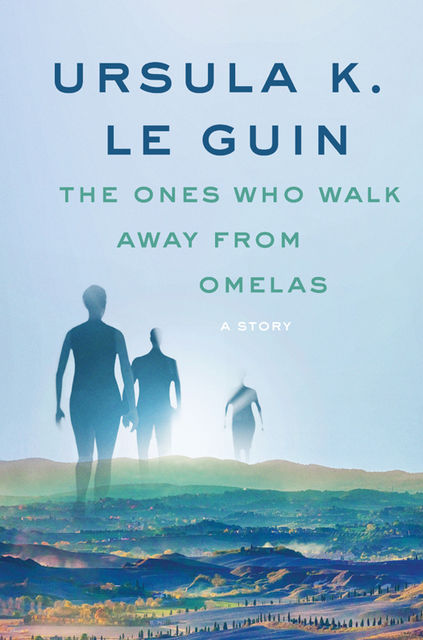
Today our group, Best Science Fiction and Fantasy Short Fiction, is discussing “The Ones Who Walked Away from Omelas” by Ursula K. Le Guin. It’s part of “Group Read 69 – Previously Unread Hugo Winners.” I can’t believe out of all our previous sixty-eight group reads we haven’t read this 5-star story before. I have written about “The Ones Who Walk Away from Omelas” before in the essay “A Philosophical Conversation Between Two Short Stories.”

“The Ones Who Walk Away from Omelas” is perfect for generating classroom discussions about philosophy. It’s short, only seventeen minutes on audio, and is told as an allegory. Le Guin presents a tiny utopian country where everything is wonderful except for one detail. Happiness in this land depends on the suffering of one child. Nearly everyone in Omelas accepts they must allow one ten-year-old child to suffer horribly, because that suffering allows everyone else living in Omelas to be happy. Of course, as you can guess from the title, some citizens can’t accept this and walk away.

Is Le Guin’s story questioning Christianity and asking why did Jesus suffer for all of us? I don’t think so. Is Le Guin pointing a finger at Capitalism, where the happiness of many depends on the suffering of the economic losers? Maybe. Do you worry about the losers in your society when you’re one of the winners? Is the story also asking how can we have a perfect society if even one person must pay a price? Isn’t it true that in every society some must suffer? Where can those who walk away from Omelas go?

Most people who read “The Ones Who Walk Away from Omelas” focus on the ending, the problem of the suffering child. But in the story’s buildup Le Guin describes what she thinks is a utopian society. Le Guin is challenging her readers to imagine a perfect society too. Le Guin says she doesn’t want clergy or the military, but figures she’ll have to accept orgies and drugs. What would you reject and accept?

I think Le Guin started writing this story wanting to speculate about creating a perfect society, but then realized it couldn’t go anywhere, and then came up with the idea for the suffering child, which led to the idea about those who walk away.

I sense the brilliance of this story wasn’t planned. It’s like my recent discussion of Slaughterhouse-Five. Sometimes a writer accidentally produces a story that works perfectly as a mirror. In my essay, I talked about reading Vonnegut’s classic when I was 18, 55, and 72. With each reading I saw something different about myself. I believe this is also true with “The Ones Who Walk Away from Omelas.” Le Guin has created a mirror for her readers.

However, I do believe there is a universal psychological theme that deals with the suffering of a few that allows for the benefit of the many. I thought that theme was explored twice in 1956 by Damon Knight with “Stranger Station” and “The Country of the Kind.” I even wondered if Le Guin was inspired to write “The Ones Who Walked Away from Omelas” after reading “The Country of the Kind.”

On my other blog, I produced a theory about ChatGPT, and similar AI programs. I’m wondering if our unconscious minds work in the same way AIs based on large language models. Those AI models are trained on millions of pages of text and images using neural networks. We can query those AI models with a prompt. Imagine all the books Ursula K. Le Guin read in her lifetime before writing “The Ones Who Walked Away from Omelas.” Now imagine Le Guin asking herself, “How would a functional utopia work?” Isn’t that the same as prompting an AI model? Her unconscious mind then generated “The Ones Who Walked Away from Omelas.”

Readers add the story to their own mental model and then prompt themselves with a question: “What does this story mean?” Their answers will depend on what they’ve read during their lifetime and how their unconscious mind processed that content.

Instead of asking, “What did Le Guin mean by “The Ones Who Walked Away from Omelas,” we should ask instead: “Why did I interpret the “The Ones Who Walked Away from Omelas” the way I did?”

I’m guessing great writers don’t intend to mean anything specific but aim to excite our unconscious minds into a kind of creativity. In other words. “The Ones Who Walked Away from Omelas” is a bit of prompt engineering, aimed at readers, knowing they each have a mental model that will generate a unique personalized output.

James Wallace Harris, 2/13/24

Has Science Fiction Changed?

I often encounter the opinion that science fiction has changed. Is it true? Over my lifetime novels have gotten longer, trilogies and series have become more common, there are more female authors, and the genre has been heavily influenced by fantasy. Before Star Trek in 1966, the world of science fiction seemed tiny, and that TV show brought in millions of new SF fans. Then Star Wars in 1977 brought in tens of millions of new SF fans. (But I’m not sure how much the population of science fiction readers grew.)

But these are all externals. I’m wondering if the essence of science fiction itself has changed. Yes, the writing has gotten better, and the literary world has become more accepting, but do modern readers get something different out of reading science fiction than what I found in the 1960s? Why do I prefer older science fiction? Is it more than just because I imprinted on it when I was young? I’m not the only one who feels this way. Many aging Baby Boomers say they prefer older science fiction too, but so do some young book reviewers.

Over the last forty days I’ve read five novels by Philip K. Dick written between 1959-1963, plus Ammonite by Nicola Griffith and The Player of Games by Iain M. Banks. These aren’t new novels, but newer than what I’m talking about, and they feel different. Over the last year I’ve read such new SFF books as Sea of Rust by C. Robert Cargill, Babel by R. F. Kuang, and The Mountain in the Sea by Ray Nayler. I know this is a small sample, but I’ve also read hundreds of science fiction short stories, both old and new, over the last couple of years.

All I can say is science fiction from the first half of my life (1951-1987) feels much different than the second half (1988-2024). The change started around the time of Star Wars in 1977. George Lucas and Steven Spielberg might be the main factors changing the genre. I confess that I’ve long thought that science fiction ran out of original ideas at some point, and the genre has been living on recycling ever since. But women writers, literary standards, and fantasy radically changed the flavor of science fiction since the 1970s too.

But what if the change in science fiction is due to other factors? Yesterday I watched a video by Bookborn, “Do SFF authors think we are stupid now” that offered two innovative ideas. Bookborn suggests that current science fiction lacks subtlety. She also suggests that newer science fiction requires less critical thinking because newer authors tell their readers what to think rather than letting the readers draw their own conclusions. Bookborn also felt authors wrote about topical problems too obviously. Even with books she likes, presenting viewpoints she agrees with, she felt they were too explicit, lacking subtly. She admits this problem is not measurable and highly subjective.

Bookborn then cites an essay, “The Death of the Author” by Roland Barthes. The essay in long, so I suggest reading Wikipedia’s summary instead, but to give you a quick idea, here’s a quote from the first paragraph at Wikipedia:

"The Death of the Author" (French: La mort de l'auteur) is a 1967 essay by the French literary critic and theorist Roland Barthes (1915–1980). Barthes's essay argues against traditional literary criticism's practice of relying on the intentions and biography of an author to definitively explain the "ultimate meaning" of a text. Instead, the essay emphasizes the primacy of each individual reader's interpretation of the work over any "definitive" meaning intended by the author, a process in which subtle or unnoticed characteristics may be drawn out for new insight.

Bookborn is quite articulate at explaining her position, and her position is more complex than what I’m conveying here, so I recommend clicking on the link above to watch her video. Bookborn goes on to say that current authors hide from their readers because of social media. They fear attacks on what they say so they are overly careful about what they put forth. I had an additional insight. Because modern science fiction is often about elaborate world building, modern authors struggle to be precise so readers will see clearly what they have worked so hard to invent.

In Ammonite by Nicola Griffith and The Player of Games by Iain M. Banks, I was disappointed by the blandness of the author’s voice. And I never felt the presence of Griffith or Banks in their stories. Yes, in both cases their world building is beautifully detailed, but both authors left no mysteries about their stories or their personal views for me to ponder. I have theories to explain this too.

Modern writers prefer a close personal third point of view, or first person, to the older omniscient point of view which is better suited for conveying the author’s voice. I also find that the novels I admire most are ones written by authors I love reading about. Maybe what I love about older science fiction is my connection to the author.

Any science fictional world that’s set far from Earth becomes a fantasy world, and thus far less complex than our reality. Such fictional worlds are far from the infinite complexity of contemporary controversies. Writers can avoid personal philosophy by using allegory. Reading such fantasies means passively consuming what the book describes. Such stories don’t lend themselves to ambiguity and complexity, which makes the reader think. Our reality is infinitely full of shades of gray. Made up fictional worlds tend to be consistently designed because authors want them to be understandable to readers unless you’re Gene Wolfe writing The Book of the New Sun.

The five Philip K. Dick novels were far more compelling and thought provoking than the books by Griffith and Banks. I often try newer science fiction, but they usually come across as merely fun stories. Overall, newer science fiction stories are like going to Disneyland. They dazzle but when the ride is over, are quickly forgotten. I’m still thinking about those Philip K. Dick novels. When nothing else thrills, switching to a Philip K. Dick story will get my mind excited. Why is that? I believe it’s because his Dick’s books are closer to real life, and that makes them ambiguous and mysterious. They offer endless room for speculation. I’m reading another biography of Philip K. Dick, my sixth, I think, because Dick’s novels make me crave understanding.

Dick’s novels were compelling, Ammonite and The Player of Games were not. They aren’t bad, in fact, they’re exceptionally good stories, just not compelling. Dick was obsessed with deciphering reality. He doubted that what we perceive is real. He was horrified by other people, often thinking they were machines, disguised supernatural beings, or illusions of the mind. Paranoia fueled his narratives. Our reality was too complex for Philip K. Dick, and it drove him into insane states of mind trying to figure it out. Every Philip K. Dick novel is another exciting speculative assumption about reality.

Interestingly, Dick doesn’t fit the theory about the author being dead. Yes, his stories are wonderful without knowing anything about Philip K. Dick, but their complexity increases the more you do know about him. I want stories where the authors aren’t dead by Barthes criteria.

By coincidence, both The Player of Games and Time Out of Joint are about game playing. However, the first novel feels contrived. It’s hard to believe. But the second, which is far more fantastic, yet feels very real and believable. Why is that?

I believe the reason I love older science fiction is because it speculates about reality. Whereas newer science fiction is focused on telling a delightful story. Lucas and Spielberg overly inspired newer writers to focus on entertaining the masses.

I loved the Heinlein novels of the 1950s because they speculated about future space travel. That was before NASA showed us what real space travel would be like in the 1960s. Heinlein’s stories honestly tried to speculate about traveling to the Moon or Mars. Space travel in Star Trek, Star Wars, or the Culture novels of Iain M. Banks are really fantasies. Space travel in Red Mars by Kim Stanley Robinson is somewhat speculative.
Most science fiction isn’t very speculative, even the old stuff. However, novels like Flowers for Algernon or Earth Abides feel far closer to reality. And I’m sure many people will point out that stories by Philip K. Dick are extremely fantastic, yet their characters feel like ordinary real people, and that grounds them.

For all his insanity, Philip K. Dick struggled to understand reality. And I think the reason I admire many older science fiction writers is because they were commenting on reality. I do love entertaining stories, but pure storytelling seldom offers much to think about.

I’m not sure I understand “The Death of the Author” in the same way as Bookborn. It seems to me that classics were written by authors whose personality dominated their fiction. Think about Jane Austen, Charles Dickens, F. Scott Fitzgerald, Eudora Welty, Ernest Hemingway, Flannery O’Conner, Jack Kerouac, or the science Fiction writers like H. G. Wells, Robert Heinlein, Philip K. Dick, Theodore Sturgeon, Ursula K. Le Guin, Harlan Ellison, Zenna Henderson, Samuel R. Delany, John Brunner, etc. If you want to write a great science fiction novel, I think it must connect with reality. Just think how silly and fantastic Slaughterhouse-Five is, yet Vonnegut points to reality, and that makes it a great novel.

James Wallace Harris, 2/4/24
“The Sharing of Flesh” by Poul Anderson

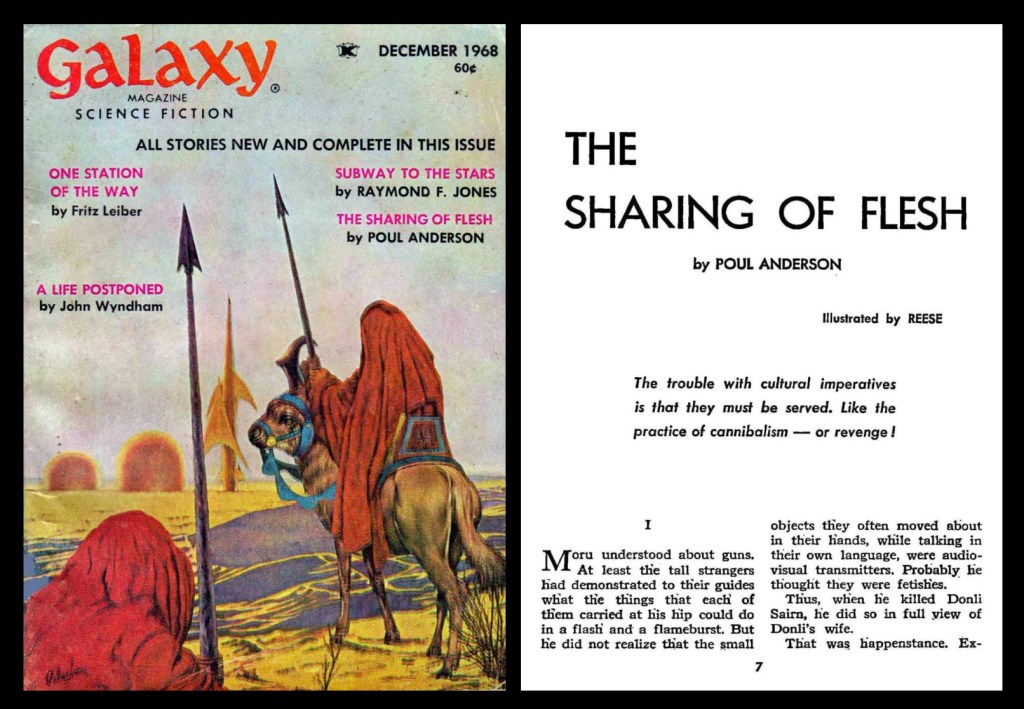
“The Sharing of Flesh” by Poul Anderson first appeared in the December 1968 issue of Galaxy Magazine. It won a Hugo award for best novelette in 1969 and was also nominated for a Nebula award. As soon as I started reading it in The Hugo Winners Volumes I and II edited by Isaac Asimov I knew I had read it before. The trouble is I can’t remember when and how I read it before, and that annoys me. I do remember getting that issue of Galaxy back in 1968, but if I only read it then, it wouldn’t have been so fresh in my memory. With this reading, it felt like I must have read it just weeks ago. Everything portion of the story as I read it came back to me.

“The Sharing of Flesh” is about humans discovering a planet that was previously colonized by humans but forgotten. This is the third story in the past couple of weeks I read using this theme. The other was Anderson’s own “The Longest Voyage” and Nicola Griffith’s Ammonite. “The Sharing of Flesh” is a murder mystery with a sociological/biological twist. It’s the kind of story I don’t want to spoil by summarizing it. I would link to Archive.org so you could read it online, but that issue of Galaxy has the story removed, meaning the Anderson estate requested the cut. It is available in Call Me Joe: Volume One of the Short Fiction of Poul Anderson from NESFA Press. (I did find it online later.)

I checked ISFDB.org to see where “The Sharing of Flesh” has been reprinted, and I don’t own any of those anthologies or collections except The Hugo Winners Volume I and II. I suppose I could have read “The Sharing of Flesh” there, but I don’t think so.

I know you’re probably thinking I’m overly obsessed with memory, but recalling when, where, and how I read a story is important for two reasons. First, I’m getting old, and I’m slowly losing my ability to recall. Working to remember is good exercise for my mind. But second, and more importantly, the memorability of a story is a measure of its quality. If words etch into your mind and they stay there for years, there’s a good reason.

Despite all the millions of short stories published, and the thousands that I have read, the memorable ones only number in the low hundreds, and the ones worth cherishing over a lifetime, add up to just a handful of tens.

“The Sharing of Flesh” is memorable because it’s about something grotesque and horrifying, yet its resolution is about forgiveness. The story is about transcending upbringing and culture. It’s incredibly positive. Yet, I don’t know if I’d put “The Sharing of Flesh” into the all-time classic category. I might need to read it a couple more times before I decide. Still, it makes me think I need to read more Poul Anderson.

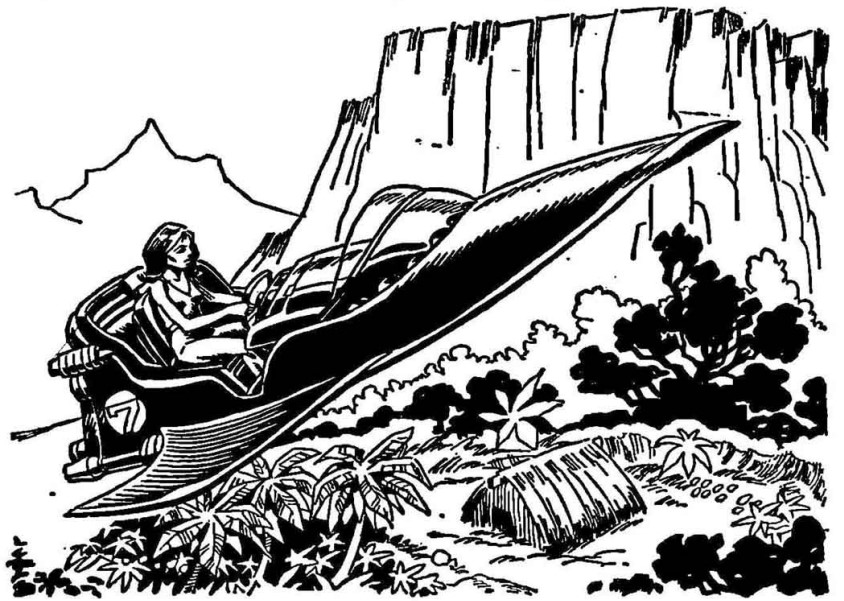
Even the illustrations from Galaxy are so familiar to me. I must wonder if I read it back in 1968. If I did, I don’t think I’m remembering that time. I wish I had kept a journal from the time I first started reading. I probably read “The Sharing of Flesh” recently because some blogger mentioned it, and I went and read it. If you remember, let me know.

That’s another thing I’d like to remember. I’d like to remember other people by the stories they love. I wish I had started worrying about memories when I was a child. Who knew they’d be so important to me now?

I’m beginning to realize that stories I love are like my genes, they define who I am.

James Wallace Harris, 2/1/24