I’ve recently reviewed two short stories by Alfred Bester lately where I wondered if Bester didn’t reveal an undercurrent of disdain for the science fiction genre within his brilliant science fiction. Those two stories were “The Men Who Murdered Mohammed” and “5,271,009.” But I also discovered an essay I wrote a few years ago that I’ve completely forgotten, “Blows Against The Empire: Alfred Bester’s 1953 Critique of Science Fiction.” This essay might duplicate what I said before, but I’m using new evidence.
Whenever I read a science fiction story by Alfred Bester I sense a sneer behind his dazzling storytelling. Almost like God chuckling at us behind his creation. Is that just me?
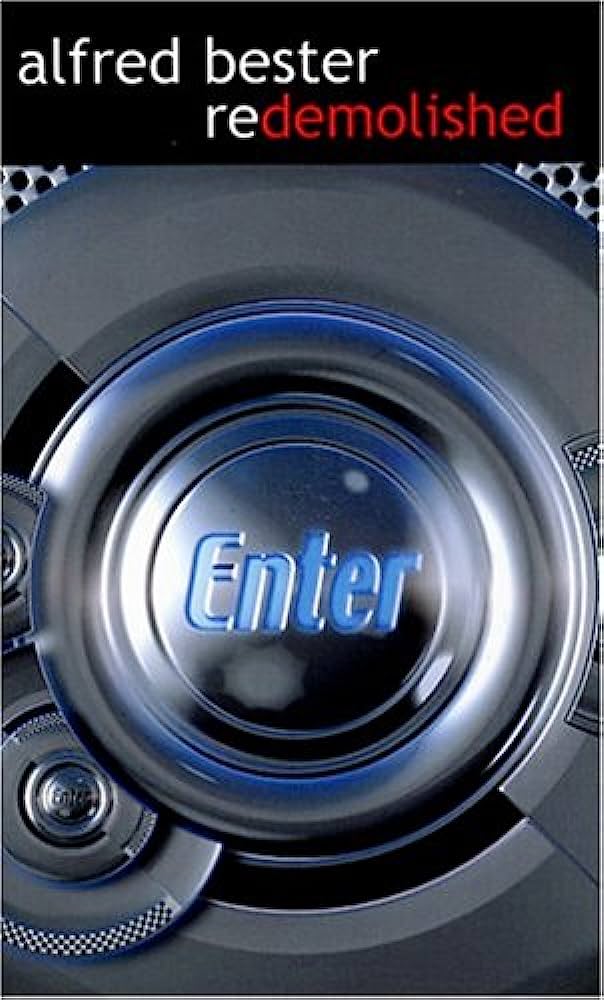
I went off to find out more about Bester and discovered what I needed in a forgotten volume on my shelf, Redemolished. It’s a collection of unreprinted short stories and essays. One essay that stood out for me was, “A Diatribe Against Science Fiction,” which reprints most of Bester’s February 1961 “Books” column from The Magazine of Fantasy and Science Fiction. (Redemolished says May 1961, but it’s wrong.) (The link above is to the collection on Amazon, and the Kindle edition is fairly cheap. I recommend it to fans of Bester.)
I’m going to post scans of pages from F&SF (and hope I won’t get into any copyright trouble) because I believe Bester’s real feelings about science fiction comes through in them. It’s less than four pages.
Ignore the first paragraph about Merril’s book, although it does point to some classic science fiction short stories that Bester admires, ones I admire too.
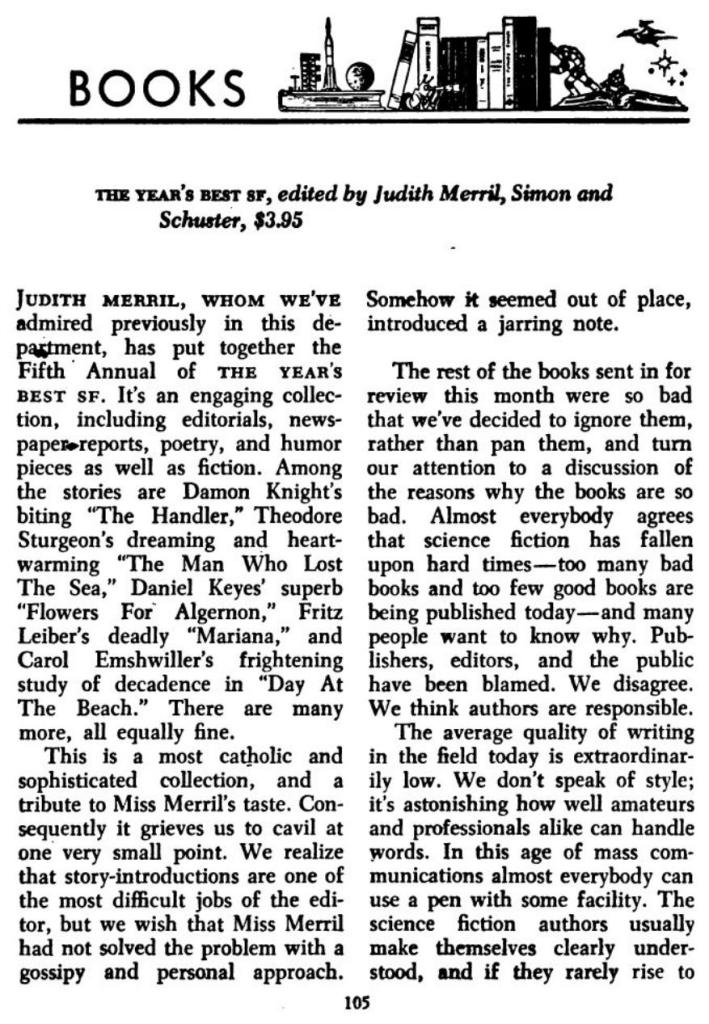
Notice that Bester puts the blame on science fiction writers. He does say that most writers, amateur or professional, can write, but that’s not the problem. And for my point, I’m not really concerned about Bester attacking writers. I’m suggesting you pay attention to his tone. It’s the same tone that comes through in his fiction — I think.
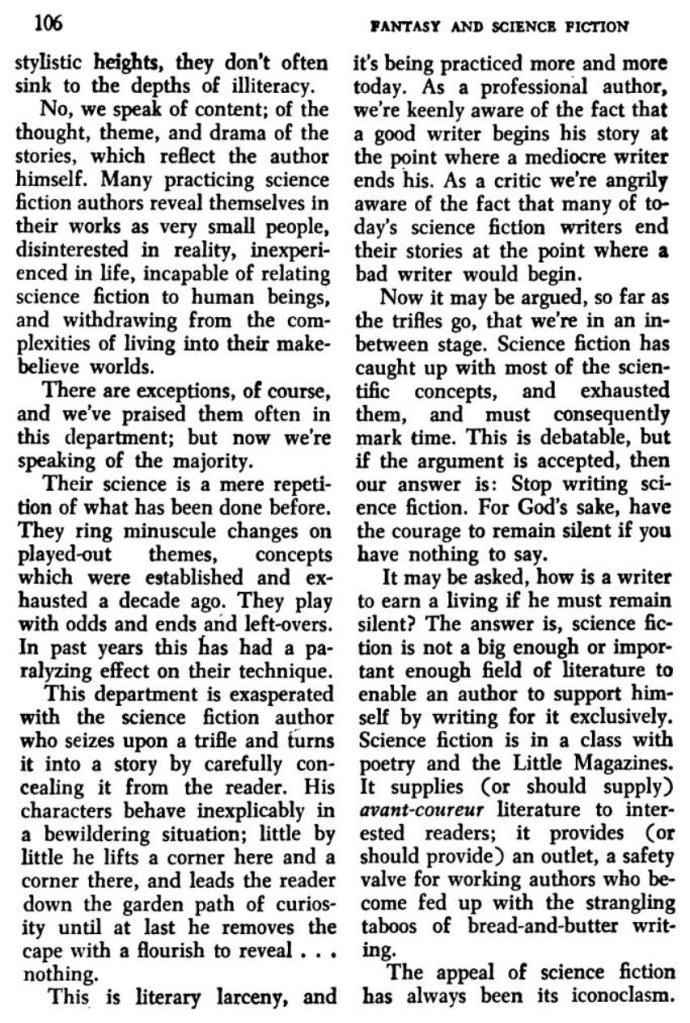
Note the line, “Many practicing science fiction authors reveal themselves in their works as very small people, disinterested in reality, inexperienced in life, incapable of relating science fiction to human beings, and withdrawing from the complexities of living into their make-believe worlds.” Ouch. Reminds me of that Saturday Night Live skit where William Shatner tells the Trekkies to get a life.
Now Bester does make criticisms of writing that I agree with but again, that’s not my point here. I’m trying to gather evidence for how Bester felt when writing his stories. Bester’s stories are extremely clever, so I can’t help but feel that Bester felt he was a giant among the pygmies.
Note the dig where Bester says good writers begin their stories where mediocre writers end their stories, but science fiction writers end their stories where bad writers begin. This could be valid criticism but it’s also pretty dang harsh. Few writers come close to ever writing something as good as “Fondly Fahrenheit.” Who knows, maybe Bester is trying to give new writers some tough love — that he wants to help them out. But his next two paragraphs are equally harsh, even telling potential writers to stop writing science fiction.
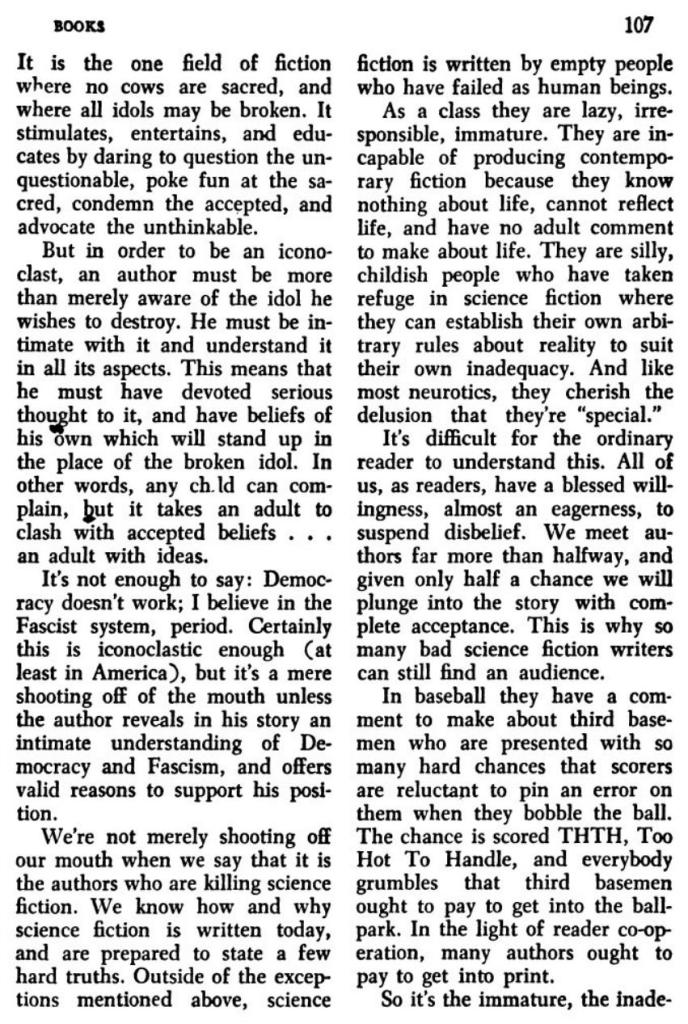
Bester then goes into describing science fiction as a genre for writers to be iconoclasts – “It is one field of fiction where no cows are sacred, and where all idols can be broken. It stimulates, entertains, and educates by daring to question the unquestionable, poke fun at the sacred, condemn the accepted, and advocate the unthinkable.”
Wow, is that what Bester thinks he’s doing? His stories are bitter satires. And here’s where I often detect an attack on the genre. Satire has to have an object to attack, and sometimes I think Bester is attacking science fiction. Evidently, even our genre can’t be a sacred cow.
Is he just attacking science fiction writers? Or is it also the readers?
Bester says, “We’re not merely shooting off our mouth when we say that it is the authors who are killing science fiction. We know how and why science fiction is written today, and are prepared to state a few hard truths. Outside of the exceptions mentioned above, science fiction is written by empty people who have failed as human beings.” Damn, now that’s one helluva of a zinger.
But then we get to this attack on science fiction writers – and readers.

Finally, we finish up with an ending that reminds me that Bester left the genre not long after this, and wrote and edited Holiday from 1963 to 1971 when it folded. He then returned to write science fiction. However, the novels written after this, never gain the fame of The Demolished Man and The Stars My Destination.

There are several more essays in Redemolished where Bester attacks science fiction. One, “The Perfect Composite Science Fiction Author” claims to praise seven science fiction writers, but damn, if that’s praise, I’m not sure any of those writers would want it. It’s in the March 1961 issue of F&SF, in case you have a copy.
I plan to read all of Redemolished, and Bester’s two collections I own, Starlight, an old SFBC omnibus that reprints two early paperback collections, and Virtual Unrealities, which is currently in print. However, that will take some time.
James Wallace Harris, 6/11/23
 Classics of Science Fiction
Bester is actually one of my favorites for his cutting remarks. I believe some of the criticism was leveled pragmatically, but at times it seems like it was a passive aggressive note to someone he didn’t like about everything that was wrong with them. And that, I think, is great, because when it is read across time we don’t know about that, but we do see his criticism for those in his craft.
He had the chops. I imagine he would *not* like perusing the science fiction section at a modern book store. Or maybe he would, until he read a few of them and found the formulae.
LikeLiked by 1 person
Bester is considered one of the precursors to the New Wave, so maybe he would like modern science fiction. But maybe not. He actually wrote more after 1971, but it’s seldom remembered. I should try some of his later novels.
My hunch was he was a smart guy, maybe he’d even been precocious as a child and just didn’t have much patience with the average.
LikeLiked by 2 people
If memory serves, earlier and milder versions of Bester’s sentiments appear in “Science Fiction and the Renaissance Man,” which I believe is in REDEMOLISHED.
LikeLiked by 1 person
It is, along with a long essay, “My Affair With Science Fiction.” Redemolished is turning into a gold mine of information about Bester. I wonder if anyone living remembers him? Reading his stories makes me wonder what he was like as a person.
LikeLiked by 2 people
[1.] JamesWHarris: ‘I should try some of his later novels.’
I really wouldn’t. A couple of the short stories from when Bester came back are arguably okay: ‘The Four Hour Fugue’ and, *maybe,* ‘Someone Up There Likes Me.” But the novels display a sad loss of chops and, perhaps more sadly, a loss of the Besterian cleverness. Which may in part translate to a loss of the capability to take pains.
Apropos of which ….
[2.] I don’t think Bester’s thinking about SF writing was much different that anyone else who’s honest and smart, and considers the matter. Here’s Gardner Dozois, for instance, in 1984 ….
“YOU HAVE TO BE a little crazy to try to do good work in science fiction, a field where indifferent, run-of-the- mill, lowest-common-denominator work is often not only tolerated but actively rewarded, and where good work is often not only ignored, but, in many cases, greeted with outright hostility. About the only thing that has saved sf, kept it evolving, is the constant influx of new writers, writers young and enthusiastic enough to actually work harder than they need to for the same kind of money they’d have gotten for producing a formula space opera. Eventually, many of them burn out, wear themselves smooth, get tired and cynical, and opt for the easier way.”
https://www.washingtonpost.com/archive/entertainment/books/1984/12/30/science-fiction-in-the-eighties/526c3a06-f123-4668-9127-33e33f57e313/
Basically, Bester’s loss of chops when he came back in the 1970s may be due in no small part to loss of the capability to “work harder” for the same money he’d have got for producing space opera or similar formula product. Writing SF to the highest level *is* hard work; in their later careers, writers as various as Zelazny, Wolfe, and Silverberg all arguably gave up the game as not being worth the candle. In Bester’s case, furthermore, he’d enjoyed the easy money of being an editor on a gloss magazine of the time, HOLIDAY. I know of nothing as likely to cause a writer to lose their writing muscles than having an easy gig like that
LikeLiked by 1 person
Thanks for that link to the Washington Post and Gardner Dozois review. I posted it to SF short story Facebook group.
There’s another factor. Bester was born in 1913, so when he was laid off from HOLIDAY closing, he was pretty old. Creative pursuits is a young person’s game. A few authors improve with age, but I don’t think it’s common.
LikeLike
I have Redemolished but haven’t read it. However, criticisms of immaturity, shallowness, laziness, and the inability to confront life show up in many a Bester story.
Gully Foyle in The Stars My Destination is transformed from such a person, and the public, at novel’s end, is given charge of an apocalyptic weapon. (In an interview in Dream Makers, Bester said he was less optimism about human nature in his later years.)
You can find these criticisms in “5,271,009”, “Time Is the Traitor”, and “Hobson’s Choice”.
Bester’s own powers left him towards the end of his career. Almost no one reviewed his last novel, The Deceivers, with one commenter saying that Bester seemed to have forgotten how the trick was done.
Bester may have soured on sf towards the end of his life. Why else name your bartender as your literary executor?
LikeLiked by 1 person
I think he sourced on SF in the 1950s. But he might have been one of those people who were just sour on life their entire life.
Didn’t know about the bartender. Now I want to know who they were and what kind of job they did.
LikeLiked by 1 person
That comes from some conversations I remember on the Coode Street Podcast. Evidently, tracking down the rights to Bester’s literary estate prevented reprints of his work for a while.
I
LikeLike
I waited years for his two classic novels to come to audio.
LikeLike
Wow – had no idea Bester was about this in the early ’60s. Of course I read them 20+ years ago his two most famous novels and LOVED THEM a ton. His criticism here is super harsh and I am sure he was PISSED at the crap that was sent to him to review. Wonder if they are totally forgotten titles?
LikeLike
Bester reviewed books for F&SF from October 1960 to July 1962. I’ve been meaning to read those reviews straight through.
Wikipedia lists quite a lot of nonfiction by Bester, including a section of reviews, which I assume were covered in F&SF. See https://www.isfdb.org/cgi-bin/ea.cgi?6
It’s a mixture of unknowns and knowns. I definitely want to go see what he said about Rogue Moon.
LikeLiked by 1 person
You may be interested to read Bester’s contribution to the late Earl Kemp’s “Who Killed Science Fiction?”, first published as a fanzine in 1960, for which he won the 1961 Hugo, and currently available as a print book. I published this electronic version for Earl on my efanzines.com website in December 2006:
https://efanzines.com/EK/eI29
(scroll down for Bester)
LikeLike
Thanks, I’ll go read it.
LikeLike
I’ve always meant to read “Who Killed Science Fiction?” I didn’t know or had forgotten Bester contributed to it.
It’s kind of weird to see how wrong Bester was. SF was going through a slump in 1960, but they have gone through several ups and downs since then. Also, he couldn’t have imagined the demise of the mass market paperback in favor of the ebook, or the explosion of self-publishing.
To me, science fiction blows up pop culture and in many ways dominates it. I remember a time when I didn’t know anyone personally who read science fiction. That I was geeky for reading it. That I had to travel to conventions and subscribe to fanzines to meet other fans.
Bester regrets the loss of science fiction he knew thinking science fiction had died, well I wish the genre was back in those days because science fiction go too successful.
LikeLike