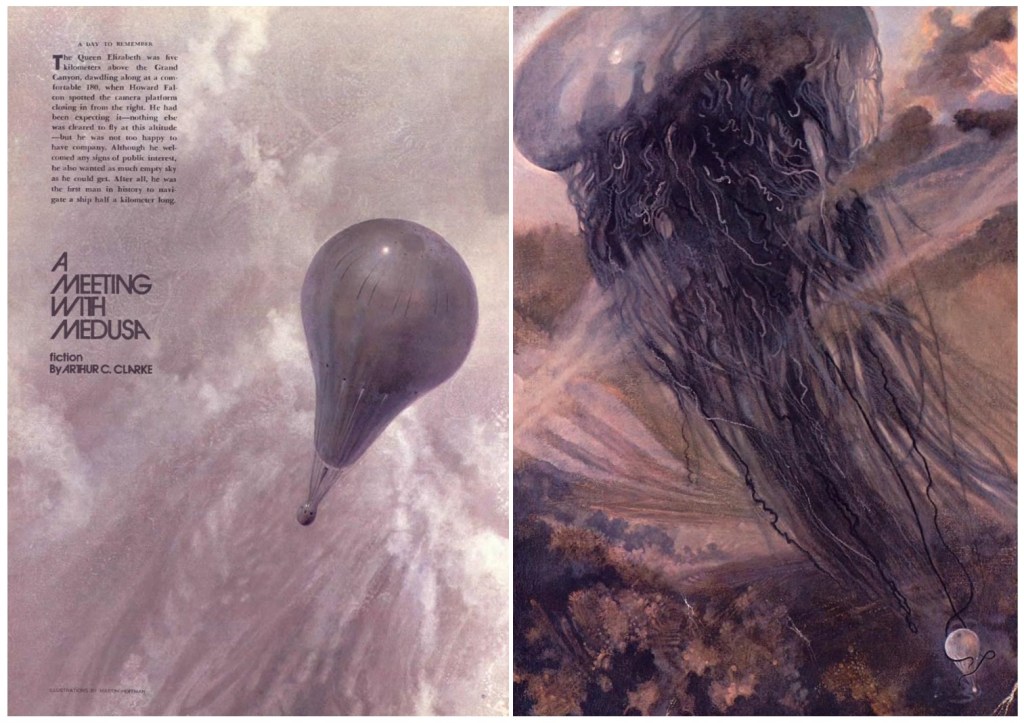
“A Meeting With Medusa” by Arthur C. Clarke is story #10 of 52 from the anthology The World Treasury of Science Fiction edited by David G. Hartwell (1989) that my short story club is group reading. Stories are discussed on Tuesdays, Thursdays, and Saturdays. “A Meeting With Medusa” first appeared in Playboy, in December 1971.
“A Meeting With Medusa” is among Arthur C. Clarke’s best works of science fiction, including Childhood’s End, Rendezvous with Rama, 2001: A Space Odyssey, and The City and The Stars. And I like it better than any of his more famous shorter works including, “The Nine Billion Names of God,” “The Star,” “The Sentinel,” and “Rescue Party.” I believe it’s his best work of hard science fiction, and probably one of the best works of hard science fiction by anybody.
The story is set up with Howard Falcon surviving a dramatic crash of a giant dirigible on Earth. Years later, he is descending into the atmosphere of Jupiter where he mans a monstrous hot-hydrogen balloon. Clarke was never known for writing literary fiction and wasn’t particularly good with characterization and drama, but this story has both.
“A Meeting With Medusa” reminds me of two other classic science fiction stories, “The Martian Odyssey” by Stanley G. Weinbaum and “Call Me Joe” by Poul Anderson. I don’t want to explain why because I don’t want to spoil the reading of “A Meeting With Medusa.” If you know those two stories, you’ll have a couple of hints.
“A Meeting With Medusa” has been reprinted often, and it won the Nebula Award for Best Novella in 1973. It has also been translated into many languages. This is not a story to miss if you love science fiction. I believe this is the third time our SF short story group has read “A Meeting for Medusa,” and it is well admired.
“A Meeting With Medusa” resonates with our deepest desires for science fiction. We want to explore the universe, and we want to find amazing wonders of nature and lifeforms, and I think most of all, we don’t want to be alone. Most of us will never leave Earth, so science fiction empowers our imaginations to go where we can’t.
I’ve always thought of science fiction as a tool for speculating about the future. History is a tool that lets us know the past, but we can’t know the future like history teaches us about the past. Science fiction can only extrapolate upon endless possibilities. I’d love to know the history of the future, to what will come after I die, but that’s impossible. Science fiction gives me hints, enough to soothe that desire to know the future just a tiny bit.
To me, the best hard science fiction leaves me with the feeling that whatever it imagines might possibly come to be after I die.
James Wallace Harris, 5/27/23
 Classics of Science Fiction
One thought on ““A Meeting With Medusa” by Arthur C. Clarke”