Group Read 27: The Big Book of Science Fiction
Story #74 of 107: “Passing as a Flower in the City of the Dead” by S. N. Dyer
“Passing as a Flower in the City of the Dead” by S. N. Dyer first appeared in Terry Carr’s Universe 14. Dyer’s real name is Sharon N. Farber and she has written a number of science fiction stories, but little else is known about her.
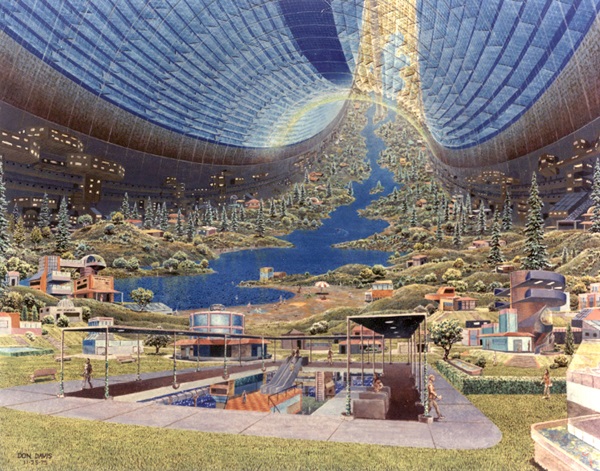
“Passing as a Flower in the City of the Dead” is a story about using an O’Neill space colony for patients with immune-compromised diseases and conditions. To complicate the plot, Dyer has her society resent people who voluntarily undergo the rigorous preparation to live in the colony just to be with an ailing loved one. They call these faithful partners Fidos. They hate them because they could return to Earth when all the truly afflicted know they can’t ever leave the colony. Madeline is a Fido, hiding her marriage to Henri, by pretending to have Lupus with complications just so she can stay with her husband.
I’d rate this story 3-stars and give it a plus (***+) because it’s a solid piece of science fiction I enjoyed. I liked how Dyer worked up a story setting and then developed a plot to fit it. However, even though it’s a good story, it doesn’t transcend. It was a good idea story, but I never felt emotion for Madeline or Henri.
For me, there’s a definite barrier between 3-star and 4-star stories. Of course, it’s subjective, and it’s relative. Each reader resonates with stories differently, but I think we all have buttons when pushed, will kick the story up to the next level. For me, it’s the immediate awareness that I’ll want to reread the story someday. Yet, that’s a rather vague way of explaining what I mean. What makes me want to reread a story?
A totally useless way to say it is to say stories that spark magic. Boy does that sound dumbass. It sounds like I’m Marie Kondo holding up a possession, to decide to keep or throw out. Yet, it’s about as definitive as I can get. Some stories just spark joy.
This story didn’t. It’s sparked, “That’s pretty cool.” And that’s often good enough. Most stories will never be ones we put in our “To Keep” piles. The mathematics behind that is realistic. I’ve read thousands of short stories, but it’s only practical to keep so many in my memory and heart. I often wonder about that number. Right now, it’s between 100 and 200, but I feel as I get older, it will fall below 100, and then 50, then 25, and finally, and if I’m lucky, I might remember a handful of favorites during my last days.
James Wallace Harris, 1/15/22
 Classics of Science Fiction
Not an author I’ve heard of. Eager to explore her early fiction!
LikeLike
I’ll be curious what you discover. She never even had a collection. And there’s no entry for her in Wikipedia.
LikeLike
I recognize the name and have probably read more than one Dyer and Farber, but the only one that stuck in my mind was Farber’s “Return of the Dust Vampires”, a horror story.
LikeLike
I’m sorry for you to be unable to perceive its magic. It’s extremely ordinary for me that not everyone could appreciate a breakup story especially the subtle feeling of the blue melancholy. (It also seem like you don’t enjoy the romantic story, do you?)
Nevertheless, the emotions here can be easily captured by me for Madeline attempted to suicide after being betrayed in double senses by a man who she was willing to sacrifice her sculptor career to follow and support his own artistic career.
It was a good story in my eye because I highly appreciated the marvelous metaphor in its title
and Dyer’s brilliant demonstration of her knowledge on medicine within this work, particularly the elaboration of blood.
It also prompted me to doubt whether most of the unflagging love portrayed in the romantic dramas is not literally often the case in the reality, where couples just parted as long as they were incompatible. Nevertheless I can not determine which kind of love is happier, healthier or better because people in the complicated world just value things differently.
You can check more information about my take here:
https://animae-magnae-prodigus.github.io/blog/2025/03/01/S-N-Dyer-Passing-as-a-Flower-in-the-City-of-the-Dead.html
LikeLike
I went and reread “Passing as a Flower in the City of the Dead.” I wanted to give myself a second chance to discover what you admired. However, my reaction was the same. I thought the story well constructed, and I could see how Dyer intended us to emotionally react to it, but I just didn’t.
First off, I never felt Madeline loved Henri. Obviously, she’s made great sacrifices for him, but none of the interactions in the story felt liked they loved each other. But Dyer never made me, the reader love Henri, so I have trouble believing Madeline did. I think for a story to convey love the writer needs to make me feel it too.
You asked if I enjoy a romantic story and that made me think. I’m fond of Jane Austen novels. Romance is a big part of Tolstoy and Edith Wharton. And I have tried genre romance novels. But yes, romance isn’t a big selling point for me. Love and romance is usually portrayed as obsession. Passion is a driving force in a story, but it’s seldom conveyed. Yes, we’re shown all the reasons why Madeline loves Henri, but it never came through as an emotion to me as a reader.
By the way, how do you perceive romance and love in a story? Amp, I don’t know you’re male or female, young or old. But your support for Madeline makes me wonder if you are young and female.
By the way, I’ve read the story twice and completely missed Madeline’s suicide attempt. Where was it?
LikeLike
> I thought the story well constructed, and I could see how Dyer intended us to emotionally react to it, but I just didn’t. First off, I never felt Madeline loved Henri. Obviously, she’s made great sacrifices for him, but none of the interactions in the story felt liked they loved each other. But Dyer never made me, the reader love Henri, so I have trouble believing Madeline did. I think for a story to convey love the writer needs to make me feel it too.
Indeed Dyer lacked the direct description of their love, but the sacrifice of Madeline accompanying his husband was enough to tell it all, since usually a woman would not be willing to do so. Dyer wrote clear and concise scenes here without resorting to redundant words, so no doubt lots of emotions needed to be sensed particularly. But I can enlist several points to persuade readers how Madeleine unquestionably loved his husband:
+ She accompanied the operation of her husband and eventually agreed to inhabit the limited space along with him.
> “Never. I—I’m afraid. Don’t ever leave me.” And he began to cry.
> She’d never seen him cry before. “I’ll stay with you,” she promised, and woke.
+ She sacrificed her beloved career to support his husband for his own career.
> She’d given up her own art studies—one of them had to bring home a salary
> “Me. I gave up my career to support—my husband. But I still sculpted, even showed.”
+ She encouraged Giselle to help her husband continue his career.
> Madeline was thoughtful. “Do you think you could get someone else to see this beauty? Henri?”“I can try.”
+ She sulked at the fact that she was unable to celebrate their anniversary but eventually compromised with his husband’s proposal.
+ She once told doctors that she would never retrieve her marrow and came back to Earth.
> “Then it will wait forever.”
+ She attempted to suicide after the breakup.
> “Forever,” Madeline repeated now. She could push off from the tower, glide slowly to her doom. And when she landed—there would be no telltale red spot on the pavement.
> The body cannot tolerate an invader. One or the other must die.
> You asked if I enjoy a romantic story and that made me think. I’m fond of Jane Austen novels. Romance is a big part of Tolstoy and Edith Wharton. And I have tried genre romance novels. But yes, romance isn’t a big selling point for me. Love and romance is usually portrayed as obsession. Passion is a driving force in a story, but it’s seldom conveyed. Yes, we’re shown all the reasons why Madeline loves Henri, but it never came through as an emotion to me as a reader.
Indeed, passion was hard to pass through text just like music, which accounted for your lack of resonance.
> By the way, how do you perceive romance and love in a story? Amp, I don’t know you’re male or female, young or old. But your support for Madeline makes me wonder if you are young and female.
Right. I thought our distinct reading experience could be boiled down to sex discrepancies, for as we all know, the majority of readers of romance fiction are women. While I’m reading, I deeply resonated with the heroine rather than Henri who was not lovable and I thought Madeline loved Henri more than Henri loved Madeline.
Meanwhile, I often appreciate reading melancholic romance ending in a breakup, but I guess you extremely disliked this genre, since the works you mentioned mostly have a good end.
By the way, do you still insist that Madeline didn’t love her husband? Then let’s agree to disagree. Though we harbored lots of differences between our tastes, gladly at least we can both enjoy certain science fiction together.
LikeLike