
Group Read 27: The Big Book of Science Fiction
Story #69 of 107: “Swarm” by Bruce Sterling
Well, I can’t complain about not getting good old fashion science fiction with “Swarm” by Bruce Sterling? It has a proper pedigree, being first published in the April 1982 issue of F&SF, my favorite SF magazine, and then reprinted by my two favorite best-of-the-year anthologists at the time (Carr and Wollheim). And it’s part of a well-imagined science fiction series, the Shaper/Mechanist universe.
What makes “Swarm” good old fashion science fiction? First, it thinks big. Really big. It imagines humanity dividing into two species, the Shapers, who use genetics to become posthuman, and the Mechanists, who use cybernetics as their path to evolving. Making “Swarm” even more exciting is meeting aliens who have chosen a third way, of symbiosis with multiple organisms.
“Swarm” takes place in an alien hive world fashioned out of an asteroid. Two humans, Simon Afriel and Galina Mirny survive there naked, coexisting in the hive ecology of many symbiotic species. Their clothes were consumed right off their bodies by various unintelligent alien critters who serve the hive organism. They eat what the symbiotes regurgitate.
Visually, this reminds me of The Forgotten Planet, by Murray Leinster, Hothouse by Brian Aldiss, and “Surface Tension” by James Blish. It also makes me think of the film Fantastic Voyage but imagining Raquel Welch and Stephen Boyd without suits floating in the inner space of the human body. Simon and Galina float in weightlessness instead of fluids.

“Swarm” would make a fascinating film because of its tremendously alien setting, however, it needs a plot and an ending that doesn’t spring out of a hidey-hole at the last minute. How the story wraps up is rather impressive, but there was no buildup to it at all. We’re told Galina and Simon each have their assignments from the Shapers, but those tasks don’t drive the story. “Swarm” is full of dazzling ideas, but they all feel tacked on like Christmas tree decorations.
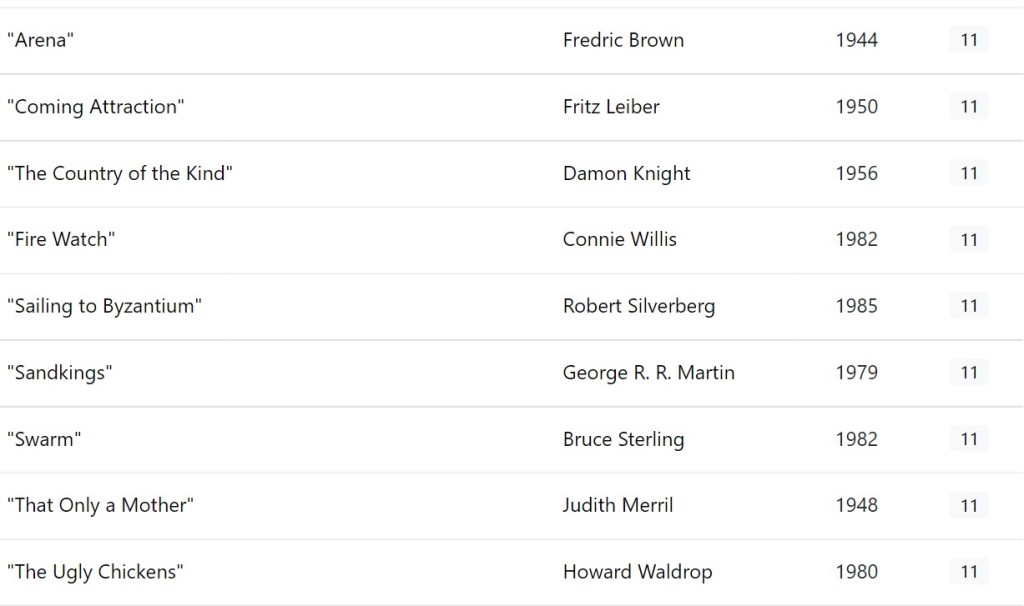
“Swarm” got 11 citations, making it on our Classics of Science Fiction Short Story list. That’s impressive, revealing a lot of people loved this story when it came out, and it’s well remembered by two fan polls.

I’m afraid it’s only an average good story for me because I never felt anything for Simon or Galina. “Swarm” tied for 7th place with nine stories. “Fire Watch” beat “Swarm” for both the Hugo and Nebula awards that year. I liked all of the other stories below much more but felt if “Swarm” had been more emotional I would have liked it much more than the others. If we had felt a sense of posthuman difference in Simon and Galina, if the ending had been built up to so we felt the tragedies of both characters, then this story would have been at the top of the group with me. It thought big but moved little.
James Wallace Harris, 1/5/22
 Classics of Science Fiction
Welcome to the 1980s! https://reiszwolf.wordpress.com/2021/10/07/swarm-1982-transhuman-sf-novelette-by-bruce-sterling/
LikeLike
The 80s are to me what the 60s were for you James. But the end of the decade cyberpunk was definitely my bag, and Bruce Sterling’s work in particular—tho John Shirley and K.W. Jeter were by far my favourite of all the cyberpunks. I have dim fond memories of the Shaper/Mechanist stories, for instance the novel « Schismatrix » and the collected shorts in « Crystal Express » (1989).
LikeLike
This story inspired an episode (“Swarm”) of the Netflix series “Love Death + Robots”.
LikeLike
Having just reread many years later I see the prescience and symbolic references throughout.
It’s looking at who and what we are now – by framing it in a different perspective.
It’s characteristic of SF as a means to articulate insight and intuition via narratives.
I could be critical of the portrayal of its characters as ‘heads’ (human identity faction) and the swarm as an Other depicted as a lab specimen. Yet symbiosis is is what a conflicted dissociation from life cannot see – except as a threat or a tool for its own
‘separate and warring survival.
The feeling dimension of communioned being transcends time & place as a qualitative root or source potential of which self-awareness rises within thought as exchange, sharing, and creative expression.
What we call intelligence is more of a bot net – or machined response than we assume from the impulse to ‘wield or control’ thought as IF a free agent.
I thought the ending was both horrifying yet recognisably ‘just’ as what we would do unto even the least was in fact what we invoked on our selves.
The spin in the tail is the agreement to faction between the swarm’s vehicle of intelligence and the would be Promethean genetic thief.
Looking for character development would have to explore the themes through the lens of feeling rather than thinking. But as a sketch or framework the idea could eaily be clothed as transformative journey or shifting perspective though the experience of hubris brought not just to a humiliation, but to a reintegration – for the Prodigal son story does apply to regaining an integrality of being from a factioned state of dissociated self for-getting.
LikeLike
Ditto.
The plot was so simple that I somewhat anticipated the appearance of the Mechanist to spice things up during my reading of the work.
The heroine here was a guide and researcher whose personal settings would be more interesting, had it not been for the intentional abbreviation of their experiment and experience within the swarm.
And the world building of a prosperous swarm requires a more detailed plot with emotions to emphasize the sense of wonder.
It’s said to be Sterling’s first published work which indeed manifested the indispensable capability of a fabulous world building for a science-fiction writer and his great improving potential in the aspect of plots. Despite not fully convinced that intelligence would be the critical impediment to the immortality of the species, I’m exactly impressed with the great biologic diversity of this swarm.
https://animae-magnae-prodigus.github.io/blog/2025/02/14/Bruce-Sterling-Swarm.html
LikeLike