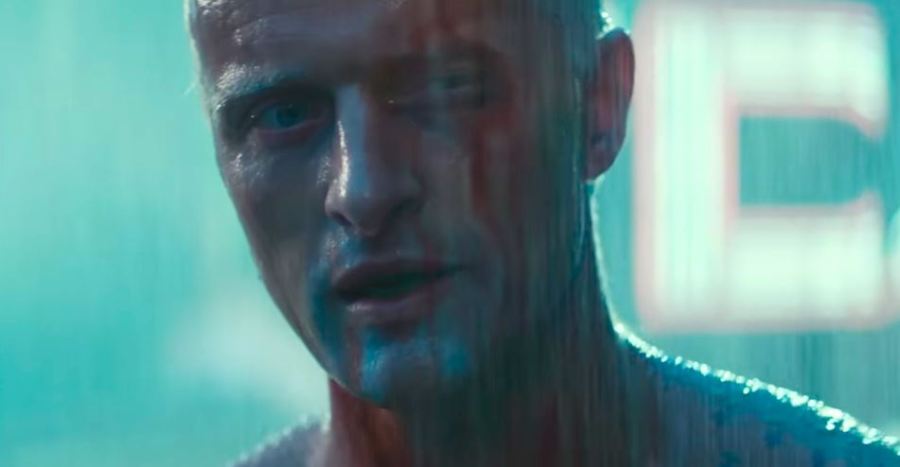
Everyone remembers Roy Batty’s monologue from the end of Blade Runner, sometimes called “Tears in the Rain.” Wikipedia even has an entry for it. It’s very short but when you hear Rutger Hauer speak it in the film, it feels timeless.
I've seen things you people wouldn't believe. Attack ships on fire off the shoulder of Orion. I watched C-beams glitter in the dark near the Tannhäuser Gate. All those moments will be lost in time, like tears in rain. Time to die.
Well, today I was listening to The Dying Earth by Jack Vance, and in particular, to the short story “Ulan Dhor Ends a Dream,” and it reminded me of Roy’s monologue. It evoked the same emotion. Aren’t these monologues so much more impressive when performed/spoken?
I have known the Ampridatvir of old; I have seen the towers glowing with marvellous light, thrusting beams through the night to challenge the sun itself. Then Ampridatvir was beautiful — ah! My heart pains when I think of the olden city. Semir vines cascaded from a thousand hanging gardens, water ran blue as vaul-stone in the three canals. Metal cars rolled the streets, metal hulls swarmed the air as thick as bees around a hive — for marvel of marvels, we had devised wefts of spitting fire to spurn the weighty power of Earth … But even in my life I saw the leaching of spirit. A surfeit of honey cloys the tongue; a surfeit of wine addles the brain; so a surfeit of ease guts a man of strength. Light, warmth, food, water, were free to all men, and gained by a minimum of effort. So the people of Ampridatvir, released from toil, gave increasing attention to faddishness, perversity, and the occult.
This made me wonder how many stories have a monologue of remembrance in them? It’s a very powerful trick of fiction, don’t you think? Charles Dickens used it very effectively as the opening to A Tale of Two Cities.
It was the best of times, it was the worst of times, it was the age of wisdom, it was the age of foolishness, it was the epoch of belief, it was the epoch of incredulity, it was the season of Light, it was the season of Darkness, it was the spring of hope, it was the winter of despair, we had everything before us, we had nothing before us, we were all going direct to Heaven, we were all going direct the other way—in short, the period was so far like the present period, that some of its noisiest authorities insisted on its being received, for good or for evil, in the superlative degree of comparison only.
I believe Heinlein must have been inspired by Dickens when he wrote the opening to Glory Road.
I know a place where there is no smog and no parking problem and no population explosion...no Cold War and no H-bombs and no television commercials...no Summit Conferences, no Foreign Aid, no hidden taxes—no income tax. The climate is the sort that Florida and California claim (and neither has), the land is lovely, the people are friendly and hospitable to strangers, the women are beautiful and amazingly anxious to please—

I could go back. I could—
I can’t recall any others at the moment. Can you? If you can, post them in the comments.
The most read essay on my personal blog is “Do You Dream About Dinosaur Attacks?” Evidently, I’m not the only person who runs from dinosaurs in their dreams, because 25-50 people daily find my essay on Google. I recently realized that I sometimes run from both human giants as well as giant space aliens in my dreams too. This obviously reveals my personal philosophy about the big dangers of life – keep a low profile. In my dreams the solution to avoiding being killed is to be quiet and hide from all the big monsters.
Warning: Don’t read this review. Just go read the book below to have the maximum fun. Don’t even read the blurbs on the cover. However, if you need more convincing, keep reading, I’ve kept the spoilers to the bare minimum.
Keeping a low profile is exactly what Eric the Only doesn’t do in Of Men and Monsters, a classic science fiction novel by William Tenn. It’s an expansion of Tenn’s October 1963 story for Galaxy Science Fiction magazine, “The Men in the Walls.” I vaguely remember reading the novel back in the early 1970s, but decided to reread it yesterday because of reviews by Joachim Boaz and MarzAat. Luckily, I didn’t read their entire reviews ahead of time because they both have spoilers. I just got caught up with MarzAat’s enthusiasm responding to Joachim’s review, and grabbed my copy of book and started reading. In fact, it’s the first novel in decades that I’ve read in less than a day. Just fun, good old fashion science fiction. Joachim gives it four stars out of five, and that’s what my initial assessment was too, however…
Of Men and Monsters has a simple backstory. Giant aliens from space have conquered Earth and humans are thrown into a kind of dark age, living in the walls of alien buildings. The story is well told, and surprisingly engaging for such a simple premise. Eric the Only, is a member of one of many tribes trying to survive by stealing food from the aliens they call monsters. Each tribe has a competing philosophy about existence, and Eric the Only is a bright young man trying to figure out reality from many contradictory beliefs.
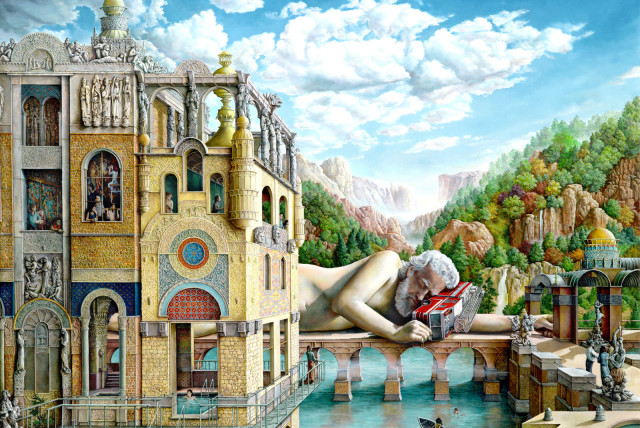
Think about giants in the Bible, or “Jack and the Beanstalk,” or the big and little episodes in Gulliver’s Travels, or “Giant Killer” by A. Bertram Chandler, or J. G. Ballard’s “The Drowned Giant” (now animated for season 2 of Love, Death & Robots). And if you remember, the 1968 TV show Land of the Giants. I wonder if Willian Tenn was given any credit or money for his idea? He probably wasn’t as pugnacious and litigatious as Harlan Ellison. Well, the Land of the Giants is somewhat different, with castaway humans on the planet of giant aliens. Anyway, giants make up a tiny sub-sub-sub-genre that I believe triggers a certain psychological appeal. For some reason, pop culture returns to it fairly often.
Of Men and Monsters also reeks of another minor motif I’ve seen in science fiction, and that’s about life in the corridors. I remember reading the “Tumithak of the Corridors” stories in Before the Golden Age edited by Isaac Asimov, an anthology of his favorite science fiction stories he loved reading growing up in the 1930s. But life in the corridors was also the setting in Heinlein’s Orphans in the Sky (1963), a fixup novel based on “Universe” and “Common Sense” first published in Astounding Science-Fiction in 1941, and in Brian Aldiss’ 1958 novel Non-Stop (called Starship in the U.S.). This motif often connects to the theme of forgotten civilization which we find in many science fiction and fantasy stories about the far future. Not only do we love stories about running from big beings like dinosaurs, King Kong, 50-foot high women, and giant space aliens, but we also love stories about forgetting who we were as a society.
The corridor motif also runs parallel with the back to the primitive theme in post apocalyptic stories of the 1950s. Science fiction writers have suggested in both books and movies that after a nuclear war civilization could be reduced to living like hunters and gathers again. Writers imagine our descendents forgetting the past, and picture these future humans like cavemen or 19th century native Americans. I vaguely remember some Andre Norton novels like this. Eric the Only wears just a leather jock strap, and the women of his tribe only wear their hair, but very long. His tribe use spears for weapons and live by rigid customs created by superstitions. Some readers might consider this aspect of the story satire on humanity, but I didn’t. It just felt logical to the plot.
I’ve tried very hard not to give the details here to Of Men and Monsters because I thoroughly enjoyed how the story unfolded. I wouldn’t have told you about the monsters being aliens but that tends to be in all reviews and on the cover blurbs. I will give one tiny spoiler that I found fascinating. The tunnels the humans live in are the air spaces of the insulation used by aliens in their buildings. That should give you an idea of relative size. All the cover art on the many book editions gets this wrong drawing the aliens only three or four times the size of humans. The aliens are immensely larger.
Probably reading Of Men and Monsters was so entertaining for me because I need some escapism. I had a CT scan Friday and I’m waiting the results. In other words I’m hiding from a big monster. But I also loved this book because it is so 1950s science fictional. It’s a retreat into my childhood and contained so many themes, ideas, motifs, and speculations that I loved when first discovering science fiction. Because of that I’ll give it 5-stars when I rate it for Goodreads. I’m sure a reader less prejudiced by nostalgia wouldn’t be so generous.
One last thing. Towards the end of the story William Tenn intrudes in the novel by allowing one of the characters to philosophize about humanity. That character says we’re kin to rats and roaches and we’ve not been kind to each other or to the other species we share the planet. I agree with what Tenn is preaching, but I felt this bit of philosophy dumping marred the story. The story itself had already inspired me to think of these things without being told. If this novel has a flaw it’s how modern knowledge that should have been forgotten was worked into the story. Either that, or Tenn should have developed the backstory of the Aaron tribe to explain how they could have retained that knowledge.
I divide fiction into two types: stories about reality, and stories that are make believe. Words are not cameras, but some writers use words to paint what they see. Most writers use words to trigger artificial realities in our mind’s eye. Their stories might feel reality based, but they are not. Some writers use such fantasies as analogies to comment on real world, which can be confusing. We never can distinguish the unreal from any slight implications about reality.
What do you do when you encounter an absurd story that feels like it has something to say about life but is impossible to decipher? Do you stick with it, hoping understanding will come? Do you study critical works hoping for insight? Do you take notes and ponder the possibilities? Or do you get disgusted and throw the book against the wall? One Goodreads reviewer claimed that’s what he did with Past Master by R. A. Lafferty. I thought about it.
The title, Past Master, can be interpreted in a number of ways. One approach is to accept how it’s used in the story. Thomas More is retrieved from the past to become the president of a colony planet in the future, a decaying utopia. The characters in the story call More the past master and hope he will save their society. Throughout the novel, we get many allusions to literary past masters because their words encrust Lafferty’s prose like barnacles. Third, and maybe finally, or maybe not, we sense that Lafferty himself is the past master. His soul is swollen with past experiences he recasts onto clean typewritten pages like Jackson Pollard throwing paint at a canvas.
As a reader I ache to make sense of Lafferty’s first novel. I hope it has a point, because swimming across a lake of his Baroque prose I can’t tell if Past Master is a shallow tall-tale, or The Divine Comedy. I find Lafferty’s voice not much fun to read, but I do perceive his work as creative and unique. I keep reading because I’ve been pushing myself to read more science fiction by admired writers I ignored because I didn’t like them.
Past Master was selected by the Library of America as one of the significant science fiction novels of the 1960s. It was a finalist for the Hugo and Nebula awards. And over the years Lafferty has had many champions promoting his work, including: Neil Gaiman, Harlan Ellison, Robert Silverberg, Michael Dirda, Nancy Kress, Samuel R. Delany, Ursula K. Le Guin, etc.
It would be helpful if I knew more about R. A. Lafferty. He’s sometimes referred to as an engineer, but he never finished college. After serving in the South Pacific in WWII, he worked as a salesperson in an engineering supply house until 1980 when his writing could support him instead. He never married, supposedly lived with his sister, and was a Catholic who went to daily communion. Lafferty was very prolific, publishing many novels, hundreds of short stories, and leaving a tall stack of unpublished novels and stories at his death. He probably leaned towards the conservative politically, but not completely.
Because of Lafferty’s prose, especially his word choices, I assume he was widely read, probably from old books. The narrative voice in many of his stories often feels like some translations of Homer or even writers from Elizabethan England. His characters lack an inner landscape like those in classical literature, and are often presented as archetypes. Yet, Lafferty writes science fiction, even though it sometimes feels as it was written by Virgil, Apuleius, or Petronius.
Past Master is a story about a utopia, but one set five hundred years from now on the planet Astrobe. Lafferty claims civilization is recreated every five hundred years, and Astrobe is the third great attempt at creating a utopia after the failures in the Old World in Europe, and the New World in the Americas. Near the beginning of Past Master we learn:
The three men gathered in the building were large physically, they were important and powerful, they were intelligent and interesting. There was a peculiar linkage between them: each believed that he controlled the other two, that he was the puppeteer and they were the puppets. And each was partly right in this belief. It made them an interlocking nexus, taut and resilient, the most intricate on Astrobe.

Cosmos Kingmaker, who was too rich. The Heraldic Lion.

Peter Proctor, who was too lucky. The Sleek Fox.

Fabian Foreman, who was too smart. The Worried Hawk.

“This is Mankind’s third chance,” said Kingmaker. “Ah, they’re breaking the doors down again. How can we talk with it all going on?”

He took the speaking tube. “Colonel,” he called out. “You have sufficient human guards. It is imperative that you disperse the riot. It is absolutely forbidden that they murder this man at this time and place. He is with us and is one of us as he has always been.”

“The colonel is dead,” a voice came back. “I am Captain John Chezem the Third, next in command.”

“You be Colonel Chezem now,” Kingmaker said. “Call out what reinforcements you need and prevent this thing.”

“Foreman,” said Peter Proctor softly within the room. “Whatever you are thinking this day, do not think it so strongly. I’ve never seen the things so avid for your life.”

“It is Mankind’s third chance we have been throwing away here,” Kingmaker intoned to the other two in the room, speaking with great serenity considering the siege they were under. Even when he spoke quietly, Kingmaker was imposing. He had the head that should be on gold coins or on Great Seals. They called him the lion, but there were no lions on Astrobe except as statuary. He was a carven lion, cut out of the Golden Travertine, the fine yellow marble of Astrobe. He had a voice of such depth that it set up echoes even when he whispered. It was part of the aura of power that he set up about himself.

Lafferty, R. A.. Past Master (pp. 14-15). Library of America. Kindle Edition.
These three decide to send someone back in time to fetch Thomas More. They want to run him for president of Astrobe as the only solution to save themselves and their utopian society. To get a bit more of the flavor of this story, let me quote the beginning of chapter two.
THE PILOT chosen by Fabian Foreman to bring Thomas More from Earth to Astrobe was named Paul. Paul was two meters of walking irony, a long, strong, swift man, and short of speech. His voice was much softer than would be expected from his appearance, and had only a slight rough edge to it. What seemed to be a perpetual crooked grin was partly the scar of an old fight. He was a compassionate man with a cruel and crooked face. From his height, his rough red hair and ruddy face, and his glittering eyes he was sometimes called The Beacon.

For a record of irregular doings, classified as criminal, Paul had had his surname and his citizenship taken away from him. Such a person loses all protection and sanction. He is at the mercy of the Programmed Persons and their Killers, and mercy was never programmed into them.

The Programmed Killers are inhibited from killing a human citizen of Astrobe, though often they do so by contrived accident. But an offender who has had his citizenship withdrawn is prey to them. He has to be very smart to survive, and Paul had survived for a year. For that long he had evaded the remorseless stiff-gaited Killers who follow their game relentlessly with their peculiar stride. Paul had lived as a poor man in the Barrio, and in the ten thousand kilometers of alleys in Cathead. He had been running and hiding for a year, and quite a bit of money had been bet on him. There is always interest in seeing how long these condemned can find a way to live under their peculiar sentence, and Paul had lived with it longer than any of them could remember. And he was ahead of those stiff killers. He had killed a dozen of them in their brushes, and not one of them had ever killed him.

An ansel named Rimrock, an acquaintance of both of them, had got in touch with Paul for Fabian Foreman. And Paul arrived now, remarkably uncowed by his term as fugitive. He arrived quite early in the morning, and he already had an idea from the ansel of what the mission was.

“You sent for me, Hawk-Face?” he asked Foreman. “I’m an irregular man. Why should you send me on a mission? Send a qualified citizen pilot, and keep yourself clean.”

“We want a man capable of irregular doings, Paul,” Foreman said. “You’ve been hunted, and you’ve become smart. There will be danger. There shouldn’t be, since this was decided on by the Inner Circle of the Masters, but there will be.”

“What’s in it for me?”

“Nothing. Nothing at all. You’ve been living in the meanest circumstances on the planet. You are intelligent. You must have seen what is wrong with Astrobe.”

“No, I don’t know what is wrong with our world, Inner Circle Foreman, nor how to set it right. I know that things are very wrong; and that those who use words to mean their opposites are delighted about the whole thing. You yourself are a great deal in the company of the subverters. I don’t trust you a lot. But you are hunted by the killers. You slipped them yesterday by a fox trick that nobody understands, so you enter the legendary of the high hunted. There must be something right about a man they hate so much.”

“We are trying to find a new sort of leader who can slow, even reverse, the break-up, Paul. We’ve selected a man from the Earth Past, Thomas More. We will present him to the people only as the Thomas, or perhaps, to be more fanciful, as the Past Master. You know of him?”

“Yes, I know him as to time and place and reputation.”

Lafferty, R. A.. Past Master (pp. 23-24). Library of America. Kindle Edition.
The program killers are robots, maybe androids. In Lafferty everything is mythical, so people can be a product of human and machine, or animal and human, etc. You get the feeling that Lafferty dreads the coming technological changes, and the social transformations he’s experiencing in the mid-1960s. Lafferty’s science fiction might even be anti-SF.
Astrobe is only partly utopian, where its citizens can have anything. Yet, many people are leaving the utopian cities, choosing to live instead in outlaw territories, even when forced to work as slaves or worst. In the chapters where Thomas More is studying Astrobe, we encounter many strange places and people. These picaresque parts of the novel feels like something out of Lewis Carroll or L. Frank Baum. In the later chapters, where More is running for president and then ruling, the story becomes more metaphysical and surreal. It’s about fate and who really rules reality. In the last chapters, Lafferty becomes philosophical, but in a religious/spiritual way.
What is Lafferty saying about reality? We know Lafferty was devoutly Catholic, and the story strongly mirrors Christ and the crucifixion. At one point Thomas More asks to attend Mass on Astrobe, but he’s shown a horrible mechanical freak show. Another time he gets to meet the Pope, who is barely alive. Lafferty began Past Master around 1964 or earlier, during the changes of the Vatican II Council. Lafferty hated the new direction the church was taking. I’m guessing that Lafferty didn’t like the way the world at large was going either, and Past Master is his commentary on those upheavals. The novel essentially predicts a reboot of society, something some crazy people desire today.
On one level, Past Master feels like the humor of Robert Sheckley or Avram Davidson. Lafferty is just writing weird shit to amuse science fiction readers who are mostly adolescents. On the other hand, Lafferty is a mature man writing what will become his first novel published when he’s in his early fifties. I’m not sure, but he may be an old white guy with something to say.
Just how sophisticated is Lafferty’s novel? Is he no better than a Qanon reposter or something closer to Gore Vidal? If we’re to believe the Library of America, Neil Gaiman, or Andrew Ferguson, Lafferty is a literary wonder. Go to Amazon and read Gaiman’s introduction to The Best of R. A. Lafferty or Ferguson’s introduction to Past Master in the “Look inside” feature. On the other hand, just reexamine the quotes above.
I can’t decide. Since the 1960s I’ve read three of Lafferty’s novels, and maybe a couple dozen short stories. Sometimes I’m amused, sometimes I’m annoyed. If Past Master is commentary on the mid-20th century by a grumpy old Catholic guy from Tulsa, then I’m kind of impressed. But if it’s just an absurd play for the theater of our minds, I’m mostly unimpressed.
There’s another way to judge this story. We learn next to nothing about Thomas More or his Utopia, or utopias in general. Nor do we learn anything significant about Catholicism or Christianity. Past Master is satire, but not very sophisticated, closer to SNL. Sometimes it’s amusing like “More Cowbell” but other times it’s moronic like the Bassomatic. All too often science fiction takes a half-ass approach to its philosophizing. The level of humor in Past Master is closer to Sheckley’s Dimension of Miracles or The Hitchhiker’s Guide to the Galaxy by Douglas Adams, two comic SF novels I enjoyed. However, Lafferty uses an archaic voice for his humor which I didn’t enjoy. Because Lafferty is riffing on many serious subjects, we get the whiff of serious literature. But is it? To tell the truth, I don’t know. I think not, but Lafferty’s out of print books are now rare, expensive, and hard to find because of his faithful fans.
I do believe R. A. Lafferty was protesting reality by writing Past Master back in the 1960s, but his fiction is ineffable, giving us only hints at what he really thought. And you know what’s funny? Reading Past Master makes me want to read a memoir by Lafferty, or a good biography. Lafferty fiction can be entertaining, but I actually wish I knew what he actually thought and experienced, and that’s easier to come by in nonfiction. Satire sometimes feels like its from a superior intellect, but just as often, I get the feeling it hides a lack of knowledge, or is just anger and snideness.


 Classics of Science Fiction