When Does a Bad Movie Become Great? Well, Maybe Pretty-Good. Okay, Weirdly Compelling

I’ve seen a lot of science fiction movies since I began watching them back in the 1950s, so I seldom catch an old movie that I haven’t seen or at least read about. Well, last night I caught The Creation of the Humanoids on Amazon Prime. The film supposedly came out in 1962, but maybe 1961, and maybe made in 1960. The poster for it on Amazon made it look dreadful. I can’t believe I even tried watching it. However, The Humanoids by Jack Williamson is one of my favorite old SF novels, meaning that one keyword got me to give the flick a view. And since then, the more I think about it, the more I think about it.

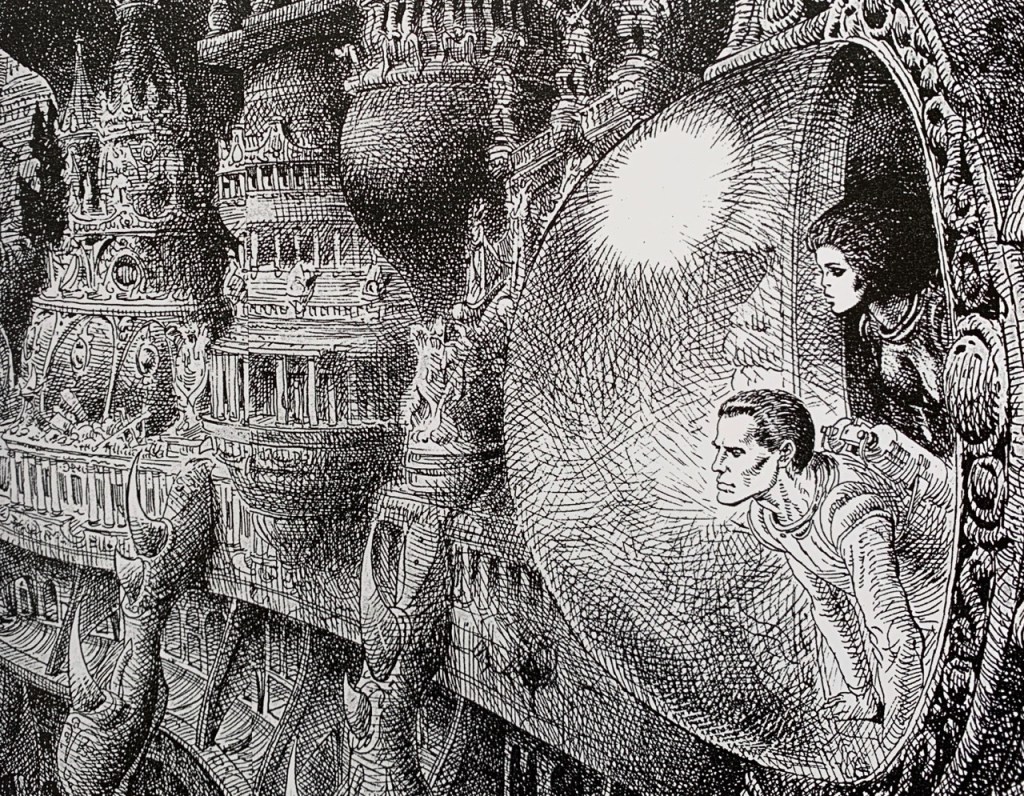
My initial reaction made me think the screenplay cribbed ideas from Isaac Asimov, Jack Williamson, and Philip K. Dick. The story and acting are very talky, but then a lot of classic science fiction from the 1940s and 1950s is overburdened with infodumps and preach dialog, so this movie has both the feel and philosophy of old pulp science fiction. And the cinematography reminded me of old science fiction magazine covers. The sets look like three different backdrops from an avant-garde theater play, but this cheapass movie was filmed in Technicolor. And the costumes and makeup are really good for the time. So there are levels of quality weaved into its low-budget production. I think they did the maximum they could with their budget.

Now don’t get me wrong, if you try watching this film, you’ll probably think, WTF??!! at the beginning. The acting is very wooden. If you stick with it, it might start growing on you until you’re thinking: “Okay, this is weirdly interesting” And if you stay until the end, you might even wonder “Is this some forgotten gem.” Or maybe not.

If you don’t have Amazon Prime, a 360p print is available on YouTube, watchable, but far from sharp.

What makes you forgive the weaknesses of The Creation of the Humanoids is the ideas it presents. I recently read and reviewed Klara and the Sun by Kazuo Ishiguro, a recent 2021 novel that covers some of the same themes dealing with androids. Android related speculations have been popular in movies and television shows for several years now, so it’s impressive that this 1960 B-movie is so ahead of its time.

The setup for this story is about a future after a nuclear war. The human population is dwindling, while the robot population is increasing. Robots are slowly taking over all human jobs and some humans resent that. Even the anti-robot crowd accepts robots at a certain intelligence level because society needs them, but doesn’t want robots produced with anything like human-level intelligence. The main character in this story is Capt. Kenneth Cragis is a leader in the racist organization called The Order of Flesh and Blood. He and his buddies wear Confederate uniforms and call robots “clickers,” so it’s pretty obvious that this early 1960s movie is not just about robots. At one point in the plot, Cragis learns his sister has married a robot and is furious.

But don’t think this film is just a thinly disguised story about civil rights. It covers all the ideas of modern science fiction on artificial intelligence and more. Don’t want to say too much that will reveal plot twists in the second half of the movie, which is far better than the first half. But those extra themes are frequently used in SF today.

Wikipedia has a positive write-up about The Creation of the Humanoids. They even let us know this was Andy Warhol’s favorite film. The Projection Booth has a ninety-minute podcast where three film buffs admit they’ve been converted to fans too. And over at Galactic Journey, a site that pretends to exist 55-years ago reviews the film with quite a bit of love and detail.

Don’t get me wrong. Probably, 99 people out of 100 who stream this movie are going to click the back button rather quickly. My initial reaction was “Yuck!” but I’m glad I stuck with it.

Finally, I think I got into The Creation of the Humanoids because the movie felt like reading a story out of Astounding or Galaxy. That says a lot about my nostalgia, but it also says something about the writing quality in the 1940s and 1950s science fiction magazines. I hate to think of it, but if I gave some of my old SF magazines to my friends to read, they’d probably react to my favorite stories just the way most audiences react today to The Creation of the Humanoids.

James Wallace Harris

Checklists for Reading Science Fiction Short Stories

We often see lists of best novels to read on the internet, but how many lists are there for reading short stories? Regarding science fiction, here are some of the major lists.

However, if you use our List Builder feature and click on Show Citations you can see which stories are on multiple lists. We haven’t added the sfadb list yet, but will. By using the year ranges, checking short story, and finding the right number of citations, you can easily see how these lists overlap. Unfortunately, you’ll also see the citations from other sources. Maybe we’ll program a way to limit by citation source type in the future. On the other hand, you’ll see how some stories are remembered by different kinds of citations: polls, awards, anthologies, scholars, etc.

Here is the List Builder set to 1939-2021 with 5 citations. That generates 863 stories. You can up the citation count to make the list shorter. Our v. 2 list uses 8 citations which reveals just 98 stories.

Reviewers of Short Science Fiction:

James Wallace Harris 3/21/21

“The Star” by H. G. Wells

When I was young, reading science fiction thrilled me by giving me new ideas to ponder, ones I wasn’t getting from school. For example, when I was twelve, I read the When Worlds Collide/After Worlds Collide double decker by Edwin Balmer and Philip Wylie. It provided three new wonders to inflame my mind. First, planets from outside the solar system could fly through our interplanetary space and even collide with the Earth. Imagining the end of the world provides no end of chilling speculation. People have been entertaining that vision since the Great Flood. Second, I was introduced to the idea that people could escape the end of the world. Wow, what a concept! And third, what if we found a dead city that was once occupied by aliens? What would it be like to walk among their ruins and imagine their lives from the clues they left?

What’s remarkable about “The Star” by H. G. Wells, published in 1897, is its science fictional setup would work just as well today in 2021. The story describes people’s reactions from from around the world at that time, but the astronomical events and effects upon the Earth would be the same today. And I’m not sure people now would react much differently than they did then. What has changed is how the news is spread.

Nowadays I am fascinated by how science fiction short stories gain popularity and then fade from pop culture memory. They are usually remembered by anthologies. An editor of a good retrospective anthology knows the genre and tries to keep older stories alive. Every few years a new large retrospective anthology of short science fiction appears. Over time, the weakest older stories are left out of the latest anthology, and the best newer stories are added, revealing a kind of evolution.

Readers who buy genre retrospective anthologies are shown a kind of photograph of the history of short science fiction, with each new anthology trying capture the genre in a pose by how the editors want their readers to see its history. I’ve been dipping into The Big Book of Science Fiction edited by Jeff and Ann VanderMeer since it came out in 2016. Its oldest story is “The Star.” The Big Book of Science Fiction has nearly a hundred stories and I’ve read maybe a quarter of them. The VanderMeers worked to diversify the history of the genre by including more stories by women writers and translated stories by non-English speaking writers.

Their family portrait of science fiction looks somewhat different than Leigh Ronald Grossman’s group photo, Sense of Wonder, taken in 2011. Grossman’s oldest pick was “Mellonta Tauta” by Edgar Allan Poe from 1849. Grossman’s anthology is even larger than the VanderMeers’, but it includes a novel, novel extracts, and introductory essays. It’s meant to be a textbook for teaching the history of science fiction, but Grossman’s photo of the genre revealed a more traditional pose for the genre.

Right now, I’m less concerned the overall image of the genre’s legacy than I am with understanding the evolution of science fictional ideas. I’d love to create a taxonomy of science fictional ideas and themes. When Groff Conklin assembled his first retrospective anthology back in 1946, The Best of Science Fiction, he divided the stories into six theme sections. Over the decades many anthologists have created theme anthologies. But it’s impossible to grasp all the far-out ideas of science fiction in just one anthology, or even a shelf of them. So, I’m going to work my way through several large retrospective anthologies, take notes, and plot my findings. Maybe I can come up with some way of showing an evolutionary tree of science fictional ideas.

I’ve decided “The Star” was inspired by astronomy, so the first theme I’m going to work on is Astronomical Science Fiction. However, did H. G. Wells think up his idea? Had Wells read Omega: The Last Days of the World by French astronomer Camille Flammarion which came out in 1894? When did the English edition first appear? Wells could also have read Olga Romanoff or, The Syren of the Skies by George Griffith serialized in Pearson’s Weekly (12/30/1893 – 8/4/1894). Both these stories are impact event stories. And then we must ask where did Flammarion get his idea? Jules Verne wrote Off on a Comet in 1877 about a comet that gives the Earth a glancing blow. Wells was savvy enough to know his planet didn’t need to impact the Earth, but it’s gravitation influence coming near us could wreak havoc on our planet.

I want to develop a classification scheme, a taxonomy, or even a mind map of how science fiction ideas evolve. Earlier writers imagined a comet hitting the Earth. Wells imagined a planet from outside the solar system, which is a much newer idea if you think about it. People were aware of comets, but how many Earthlings imagined a planet visiting the solar system? Then in the 1930s Balmer and Wylie imagined two visiting planets. By the way, Wells interstellar visitor is called a star in the title, but referred to as a planet in the story. People see it as a star in the sky.

Once you start considering the theme, thinking about astronomy can inspire all kinds of science fictional ideas. Wells used astronomy again at the end of The Time Machine when he used the Sun expanding into a red giant, and the Earth slowing its rotation.

I wish I had a better memory than I do so I could recall all the science fiction stories that used astronomy as the inspiration of its science fiction. Fred Hoyle used it for The Black Cloud a story about a dust cloud blocking the sun. But sometimes its fanciful astronomy. Poul Anderson imagined the solar system orbiting the Milky Way in Brain Wave and wondered what if the solar system passes through different kinds of radiation fields. Now this is unbelievable but fun, but what if the solar system had been in a radiation field that retarded intelligence and it moved out of that field? In Brain Wave humans and all living things become a bit smarter. Even more fanciful is Robert Charles Wilson’s Spin, where he imagines the Earth encased in a spin membrane that slows time down. Of course, this moves outside the realm of Astronomical Science Fiction because the membrane was artificially created.

Getting back to real astronomy, consider the short story “Inconstant Moon” by Larry Niven from 1971. People notice the Moon is glowing strangely one night. Our narrator theorizes the Sun has gone nova and the world is about to be destroyed, but then figures a massive solar flare has occurred, which might be survivable. Notice how these Astronomical Science Fiction stories usually involve the destruction of the Earth.

Larry Niven and Jerry Pournelle returned to the comet impact in 1977 with Lucifer’s Hammer. Comet and asteroid strikes seem to be the most common inspiration on Astronomical Science Fiction. But here is a list created by Andrew Fraknoi in 2019 that lists more recent science fiction based on astronomy and physics. Wells or “The Star” wasn’t mentioned. That’s the problem with creating a SF theme taxonomy, it’s like the biological world there are millions of examples to be classified.

One interesting aspect of “The Star” (and When Worlds Collide) is it depends on astronomers to let the people of Earth know that something is about to happen. How often are astronomers the heroes of science fiction stories?

It was on the first day of the New Year that the announcement was made, almost simultaneously from three observatories, that the motion of the planet Neptune, the outermost of all the planets that wheel about the sun, had become very erratic. Ogilvy had already called attention to a suspected retardation in its velocity in December. Such a piece of news was scarcely calculated to interest a world the greater portion of whose inhabitants were unaware of the existence of the planet Neptune, nor outside the astronomical profession did the subsequent discovery of a faint remote speck of light in the region of the perturbed planet cause any very great excitement. Scientific people, however, found the intelligence remarkable enough, even before it became known that the new body was rapidly growing larger and brighter, that its motion was quite different from the orderly progress of the planets, and that the deflection of Neptune and its satellite was becoming now of an unprecedented kind.

Few people without a training in science can realise the huge isolation of the solar system. The sun with its specks of planets, its dust of planetoids, and its impalpable comets, swims in a vacant immensity that almost defeats the imagination. Beyond the orbit of Neptune there is space, vacant so far as human observation has penetrated, without warmth or light or sound, blank emptiness, for twenty million times a million miles. That is the smallest estimate of the distance to be traversed before the very nearest of the stars is attained. And, saving a few comets more unsubstantial than the thinnest flame, no matter had ever to human knowledge crossed this gulf of space, until early in the twentieth century this strange wanderer appeared. A vast mass of matter it was, bulky, heavy, rushing without warning out of the black mystery of the sky into the radiance of the sun. By the second day it was clearly visible to any decent instrument, as a speck with a barely sensible diameter, in the constellation Leo near Regulus. In a little while an opera glass could attain it.

At the end of the 19th century the common person did not have access to television or the internet. This news would have been spread by telegraph and newspapers. Also, I doubt many citizens of the world understood much about astronomy back then. Since we know so much about astronomy now, and science fictional concepts, so I would think a science fiction writer would have a hard time coming up with a good new concept to set off people’s sense of wonder.

H. G. Wells worked imagine in his story the discovery of the event on different minds around the world. I think that’s why new writers get to retell old stories. Many science fictional concepts are quite old, so it’s the current culture that changes in new stories, not the science fiction.

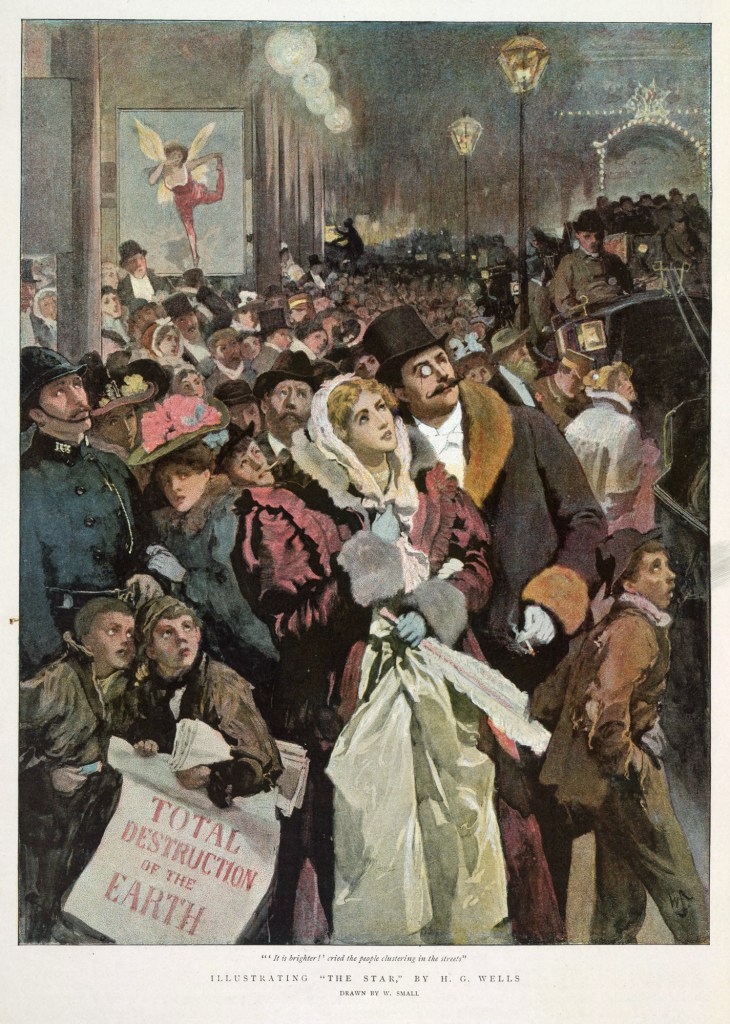
And when next it rose over Europe everywhere were crowds of watchers on hilly slopes, on house-roofs, in open spaces, staring eastward for the rising of the great new star. It rose with a white glow in front of it, like the glare of a white fire, and those who had seen it come into existence the night before cried out at the sight of it. "It is larger," they cried. "It is brighter!" And, indeed the moon a quarter full and sinking in the west was in its apparent size beyond comparison, but scarcely in all its breadth had it as much brightness now as the little circle of the strange new star.

"It is brighter!" cried the people clustering in the streets. But in the dim observatories the watchers held their breath and peered at one another it is nearer," they said. "Nearer!"

And voice after voice repeated, "It is nearer," and the clicking telegraph took that up, and it trembled along telephone wires, and in a thousand cities grimy compositors fingered the type. "It is nearer." Men writing in offices, struck with a strange realisation, flung down their pens, men talking in a thousand places suddenly came upon a grotesque possibility in those words, "It is nearer." It hurried along wakening streets, it was shouted down the frost-stilled ways of quiet villages; men who had read these things from the throbbing tape stood in yellow-lit doorways shouting the news to the passersby. "It is nearer." Pretty women, flushed and glittering, heard the news told jestingly between the dances, and feigned an intelligent interest they did not feel. "Nearer! Indeed. How curious! How very, very clever people must be to find out things like that!"

Lonely tramps faring through the wintry night murmured those words to comfort themselves--looking skyward. "It has need to be nearer, for the night's as cold as charity. Don't seem much warmth from it if it is nearer, all the same."

"What is a new star to me?" cried the weeping woman kneeling beside her dead.

The schoolboy, rising early for his examination work, puzzled it out for himself--with the great white star shining broad and bright through the frost-flowers of his window. "Centrifugal, centripetal," he said, with his chin on his fist. "Stop a planet in its flight, rob it of its centrifugal force, what then? Centripetal has it, and down it falls into the sun! And this--!

"Do we come in the way? I wonder--"

The light of that day went the way of its brethren, and with the later watches of the frosty darkness rose the strange star again. And it was now so bright that the waxing moon seemed but a pale yellow ghost of itself, hanging huge in the sunset. In a South African City a great man had married, and the streets were alight to welcome his return with his bride. "Even the skies have illuminated," said the flatterer. Under Capricorn, two negro lovers, daring the wild beasts and evil spirits, for love of one another, crouched together in a cane brake where the fire-flies hovered. "That is our star," they whispered, and felt strangely comforted by the sweet brilliance of its light.

The master mathematician sat in his private room and pushed the papers from him. His calculations were already finished. In a small white phial there still remained a little of the drug that had kept him awake and active for four long nights. Each day, serene, explicit, patient as ever, he had given his lecture to his students, and then had come back at once to this momentous calculation. His face was grave, a little drawn and hectic from his drugged activity. For some time he seemed lost in thought. Then he went to the window, and the blind went up with a click. Half way up the sky, over the clustering roofs, chimneys and steeples of the city, hung the star.

I would think in my taxonomy of science fiction for this theme I’d have to also classify the state of the world that received the story. Yet, isn’t the possibility of a roving body visiting out system still possible? Isn’t that why new SF writers in every generation can retell the story? Just research all the speculation the first known real interstellar visitor named Oumuamua caused? It reminded me of Clarke’s Rendezvous with Rama.

James Wallace Harris, 3/19/21
“The Man Who Lost the Sea” by Theodore Sturgeon

My job is to get you to read stories if you haven't. I'll try to make it easy for you by linking to a copy on the web if the story is available. I'll also tell you about anthologies where you can find the story. Then I'll start talking about the story. At first I'll be vague so as not to spoil the story, but hopefully intriguing enough to get to you to go read the story before continuing. As I progress I'll give more and more away.

“The Man Who Lost the Sea” is a magnificent work of second person prose that is as confusing as a pile of jigsaw puzzle pieces without the box. As you read the story the picture is revealed with the placement of the last piece. “The Man Who Lost the Sea” was first published in October 1959 issue of The Magazine of Fantasy and Science Fiction. It was reprinted in Best American Short Stories 1960, The Best from Fantasy and Science Fiction (Ninth Series, 1960), and Judith Merril’s annual anthology,The Fifth Annual of the Year’s Best SF (1960) where I just read it. It was up for a Hugo in 1960 but lost to “Flowers for Algernon” by Daniel Keyes, but wouldn’t any story lose to that story? “The Man Who Lost the Sea” is currently available to read online at Strange Horizons. Or jump over to Escape Pod to listen to the story.

I’ll illustrate how admired this story is by showing you some of the retrospective anthologies it’s been reprinted in over the years:

  • 1968 – Towards Infinity edited by Damon Knight
  • 1969 – First Step Outward edited by Robert Hoskins
  • 1977 – Alpha 8 edited by Robert Silverberg
  • 1983 – The Arbor House Treasury of Science Fiction Masterpieces edited by Robert Silverberg and Martin H. Greenberg
  • 1989 – The World Treasury of Science Fiction edited by David G. Hartwell
  • 1990 – The Great SF Stories 21 (1959) edited by Isaac Asimov and Martin H. Greenberg
  • 1997 – A Century of Science Fiction (1950-1959) edited by Robert Silverberg
  • 2005 – My Favorite Science Fiction Story edited by Martin H. Greenberg
  • 2016 – The Big Book of Science Fiction edited by Ann and Jeff VanderMeer

I’m feeling guilty about not having read “The Men Who Lost the Sea” before now. How could I have missed it? To be honest, I’m not sure my younger self could have appreciated the story. The second person prose involving nonlinear events would have been difficult for my speed-reading younger self to comprehend. Just read the first paragraph:

Say you're a kid, and one dark night you're running along the cold sand with this helicopter in your hand, saying very fast witchy-witchy-witchy. You pass the sick man and he wants you to shove off with that thing. Maybe he thinks you're too old to play with toys. So you squat next to him in the sand and tell him it isn't a toy, it's a model. You tell him look here, here's something most people don't know about helicopters. You take a blade of the rotor in your fingers and show him how it can move in the hub, up and down a little, back and forth a little, and twist a little, to change pitch. You start to tell him how this flexibility does away with the gyroscopic effect, but he won't listen. He doesn't want to think about flying, about helicopters, or about you, and he most especially does not want explanations about anything by anybody. Not now. Now, he wants to think about the sea. So you go away.

What the hell is going on? Where are we? Who is the narrator? Sturgeon gives us the first clues in the second paragraph:

The sick man is buried in the cold sand with only his head and his left arm showing. He is dressed in a pressure suit and looks like a man from Mars. Built into his left sleeve is a combination time-piece and pressure gauge, the gauge with a luminous blue indicator which makes no sense, the clock hands luminous red. He can hear the pounding of surf and the soft swift pulse of his pumps. One time long ago when he was swimming he went too deep and stayed down too long and came up too fast, and when he came to it was like this: they said, "Don't move, boy. You've got the bends. Don't even try to move." He had tried anyway. It hurt. So now, this time, he lies in the sand without moving, without trying.

What can you say about this story so far? Later on when Sturgeon tries to give us more concrete clues can we really put them together yet?

Out and out the sick man forces his view, etching all he sees with a meticulous intensity, as if it might be his charge, one day, to duplicate all this. To his left is only starlit sea, windless. In front of him across the valley, rounded hills with dim white epaulettes of light. To his right, the jutting corner of the black wall against which his helmet rests. (He thinks the distant moundings of nausea becalmed, but he will not look yet.) So he scans the sky, black and bright, calling Sirius, calling Pleiades, Polaris, Ursa Minor, calling that . . . that . . . Why, it moves. Watch it: yes, it moves! It is a fleck of light, seeming to be wrinkled, fissured, rather like a chip of boiled cauliflower in the sky. (Of course, he knows better than to trust his own eyes just now.) But that movement . . .

Maybe it helps when Sturgeon lets us know the man is thinking about the past:

As a child he had stood on cold sand in a frosty Cape Cod evening, watching Sputnik's steady spark rise out of the haze (madly, dawning a little north of west); and after that he had sleeplessly wound special coils for his receiver, risked his life restringing high antennas, all for the brief capture of an unreadable tweetle-eep-tweetle in his earphones from Vanguard, Explorer, Lunik, Discoverer, Mercury. He knew them all (well, some people collect match-covers, stamps) and he knew especially that unmistakable steady sliding in the sky.

By now you should realize this story takes place in the guy’s head, but you still aren’t sure where the guy is or the identity of the annoying boy.

Have I gotten you interested? Have you gone back to the top of the page and followed the link to read the story? If not, let me give you a few more tantalizing clue. Have you read “An Occurrence at Owl Creek Bridge” by Ambrose Bierce – another often reprinted short story? “The Man Who Lost the Sea” belongs to very special tiny subgenre of fiction, one that has deeply personal significance to me, see my essay “Did The First Movie You Ever See Haunt You For The Rest Of Your Life?” about the novel High Barbaree by Charles Nordhoff and James Norman Hall. You probably don’t know these guys but they wrote The Mutiny on the Bounty. Or, have you ever seen the ending to the 1966 movie Seconds with Rock Hudson?

Jeez, if I haven’t hooked you by now I give up. I’ve always been fascinated about the nature of memory and consciousness. I love this Theodore Sturgeon because he explores those concepts in one impactful story.

James Wallace Harris, 3/16/21

Surviving Childhood By Reading Science Fiction

I love when I discover a short story that pushes all my buttons. I regret that I didn’t discover such wonderful tales when they were first published, but I do have the consolation as an old jaded reader of finding a story that still thrills me. “The Island of Doctor Death and Other Stories” by Gene Wolfe is one such story that I just read. It’s about a boy, Tackman Babcock, who survives a troubled “family life” by reading science fiction. Since I survived my bumpy upbringing by reading science fiction, I immediately bonded with Tackie.

I know, it has a confusing title. I’ve seen it collected in anthologies for years, and it always sounds like a collection of short stories by the author. When Gene Wolfe created his first short story collection the title became The Island of Doctor Death and Other Stories and Other Stories, as you can see above in the first edition, a 1980 paperback from Pocket Books. The 1997 edition is still available from Amazon. The original story, “The Island of Doctor Death and Other Stories” was first published in Orbit 7 (1970) edited by Damon Knight has been reprinted many times, so you might already own a copy. However, if you just want to quickly enjoy the story right now, it’s available online for free as an audio podcast from PodCastle, episode 171. Just click and take forty-five minutes to hear the story, it has wonderful narration.

Maybe now you’ll understand the confusing title, but you’re probably wondering what book Tackie was reading? If you’d like to read speculation about possible books read the entry for this story at a wiki devoted to Gene Wolfe. I tend to think Wolfe was trying to capture the feel of many novels, stories, and famous characters so readers would imagine the ones they have read. I definitely thought of The Island of Doctor Moreau by H. G. Wells, but I also thought of famous pulp stories, horror films, and cliff-hanging serials.

Wait, you didn’t go listen to the story? Or read it? Or remember reading it, and now you’re confused?

Tackie Babcock lives with his drug addicted mother in an old resort hotel. He isn’t supervised or well cared for, but his mother’s predatory boyfriend Jason, and a couple of aunts (May and Julie) keep an indifferent eye on him. We learn about Tackie’s inner life when Jason steals a paperback book that Tackie asked him to buy. The book has a lurid cover of a muscle bound man in rags battling a horrible half ape-half human creature. For the rest of the story, reality is interrupted by flashes from this novel. Captain Phillip Ransom adrift at sea for nine days arrives at a mysterious island and his captured by the mad Dr. Death, and his experimental creations. Eventually, we learn about other characters from Tackie’s real and imaginary world, including a beautiful native girl, Talar of the Long Eyes that Cpt. Ransom rescues from a fate worse than death. As the story progresses fiction and reality mix, so do who is good and who is bad.

If that doesn’t get you hooked, I don’t know what will. My parents were alcoholics, and we moved around a lot. From the time I started reading science fiction in the 5th grade until graduating, I attended nine different schools in three states. I forgot how many houses I lived in during that period, and I forgot how many times my parents split up. I’ve also forgotten how many drunken parental brawls I had to watch and hear, or how many times I was chauffeured around by drunk drivers. I survived all of that, and remember them as good times because I read science fiction. Without science fiction I’m not sure I would have had a happy childhood. I felt like Robert A. Heinlein was my father figure, Samuel R. Delany was my big brother, and Robert Sheckley was my crazy uncle.

I completely identified with Tackie Babcock. I wish I had read his story in 1970, but I’m thankful I finally found it in 2021.

James Wallace Harris, 3/5/21

p.s. Many of Gene Wolfe’s books including this one are available through Scribd.com, a subscription library. I mention it because I hope Scribd gets enough subscribers to survive. Think of it as Netflix for ebooks and audiobooks.