Do Your Top 10 Favorite Science Fiction Books Change Often?

Bookpilled recently posted on YouTube “Ranking All the Books from Every Top 15 Sci-Fi List” where he reevaluated several years of his All-Time Top 15 SF Books videos. Interestingly, books that had been near the top on earlier lists were thrown off by books from later lists. He also reread some of his favorites, which didn’t hold up. In other words, he discovered better books and found that his first impressions didn’t always hold up. This has been my experience too.

People list their favorite books they discovered early in life. Few people reread books. Quite often, the books you read early in life, make a greater impact, than the books you read later in life.

There is no absolute way to measure the quality of a book. Our Classics of Science Fiction list, we use popularity over many lists to rank books. But the top books on the Classics lists aren’t my all-time favorite SF books.

SciFiScavenger, another YouTuber, is currently collecting votes for favorite SF novels. He asks everyone to list their top ten and will create a list and video of the most popular. You can post your top ten to his poll here. Here’s my Top 10.

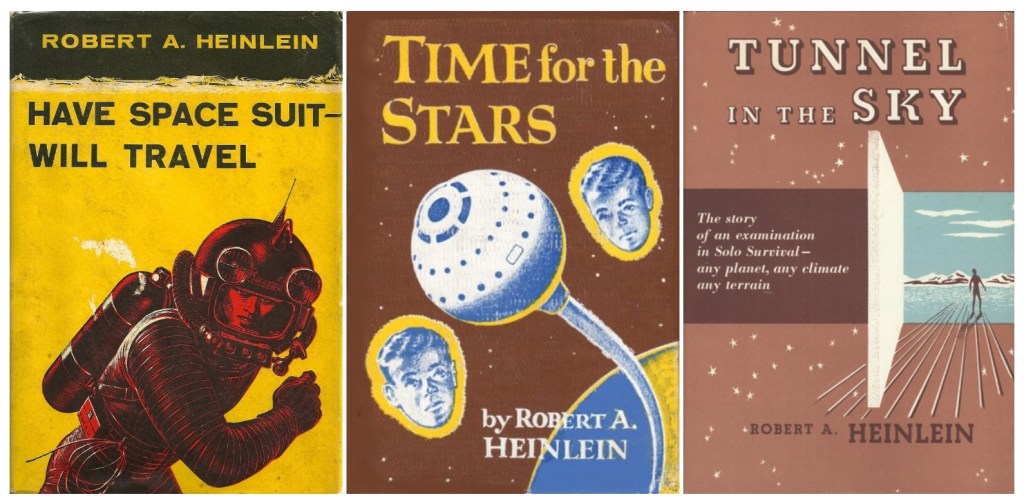
  1. Have Space Suit-Will Travel by Robert A. Heinlein
  2. Time for the Stars by Robert A. Heinlein
  3. Tunnel in the Sky by Robert A. Heinlein
  4. Flowers for Algernon by Daniel Keyes
  5. Earth Abides by George R. Stewart
  6. The Time Machine by H. G. Wells
  7. The War of the Worlds by H. G. Wells
  8. A Mirror for Observers by Edgar Pangborn
  9. The Man Who Fell to Earth by Walter Tevis
  10. Replay by Ken Grimwood

I’ve read eight of these books at least twice, most three times, and the top three I’ve read more than six times each. I’ve only read the Pangborn and Tevis once each, but they’ve left an impression. If I had spent more time on the list I might have substituted different books for those two. Hyperion comes to mind. I read it three times, and it had a tremendous first impact. However, the older me felt A Mirror for Observers and The Man Who Fell to Earth were deeper books for me at this time in my life.

I also felt The Time Machine and The War of the Worlds are the two most original science fiction books ever written, and should be on a Top Ten list. I really do like them too. I’ve read each several times. I wanted to include a Philip K. Dick novel because he’s my second favorite science fiction author after Heinlein, but I just couldn’t settle on one book – PKD has written too many good SF books to pick a favorite.

I could have made the entire list of ten by Heinlein. And could have made the whole list of ten by Dick. Heinlein made a life-long impact on me during my formative years from 13-18 (1964-1969). I developed problems with Heinlein as I got older, but I still regularly reread his books published before 1960. They are sentimental favorites, my go-to feel-good books. PKD is who I read when I’m feeling weird or I don’t feel like reading anything else. His books are endlessly fascinating, but I’m uncertain if they’re important to me on a psychological level.

I love Replay. I consider time loop stories to be science fiction. I chose it over a PKD because its philosophical explorations resonate with me more than Dick’s philosophical explorations.

I read #1-7 before 1970, when I was an adolescent. All except A Mirror for Observers is on audio, a format that has more impact on me. I wish Audible would publish more Pangborn. They only have his obscure mystery novel, The Trial of Callista Blake. I wished they would publish A Mirror for Observers, Davy, and a collection of his shorter work.

Notice, no books by Asimov and Clarke on my list, even though I’ve read many of their books and enjoyed them. Notice, Dune is not on the list even though I’ve read it twice and plan to read it for a third time soon. Dune is a better work of art than most of the books on my list. Its science-fictional content just doesn’t resonate well with me. I see it as more of an epic fantasy.

What are your favorite SF books? How have they changed over your lifetime? Have newer books supplanted your older favorites? I’ve read a lot of 21st-century science fiction, much of which I admired, but those books just haven’t stuck in my mind as all-time favorites. Is it because new SF is different from old SF, or is it because the books we read when young just stick with us?

I saw another YouTube video that I want to reference here. Rick Beato talks about how most artistic people do their best work before they turn 30. He uses The Beatles as an example. The Fab Four made all their records together while in their twenties. And all their solo efforts after their twenties.

I wonder if the art we admire most is that we encounter before turning 30, or even 20. Is there a relationship between being creative and admiring creativity? A lot of people give up actively listening to music as they get older, and many of the people who still listen to music as they get older, only listen to music they discovered before they were 30. Is that true with books too?

James Wallace Harris, 11/3/24

FUTURES PAST: A Visual History of Science Fiction, Volume 4, 1929: The Gateway to Modern Science Fiction by Jim Emerson

If you love reading about the history of science fiction, you should love reading Jim Emerson’s series Futures Past. I’ve previously reviewed the volumes for 1926 & 1927, and 1928. In the early 1990s Emerson started this project as a fanzine focusing on the history of science fiction, and published four issues: 1926, 1927, 1928, and 1929 before he had to stop. Then a few years ago when he retired Emerson started over with 1926 and expanded each fanzine issue to a softbound book. The latest volume, 1929, is 222 pages. The largest volume yet. Jim says 1929 should be ready to ship in mid-October. You can order pdf, softbound, and hardbound editions here.

Jim writes all the content, and I’m jealous of his knowledge of science fiction’s history. Each volume contains a Year in Review section that covers science fiction books, magazines, plays, and movies of the year, while documenting the people and events related to that year. But more than, that, Emerson includes in each volume a handful of long articles about the history of specific science fictional subjects that lead up to that year.

For example, the 1929 volume has a ninety page overview of women science fiction writers from 1666-1925. I’ve read a lot of SF history and I didn’t know about most of these books or their writers. Our collective culture forgets so much – why did they forget all these women writers?

Other significant articles include the “Evolution of the SF Name” which unearthed far more old examples of the term than I’ve previously known about. In the “Gernsback Bankruptcy” Emerson explains how Hugo Gernsback lost control of Amazing Stories and immediated create Science Wonder Stories. Hugo was a wheeler-dealer, and somewhat shady. Besides his magazines he had a radio station, and was an early broadcaster of TV. It blew my mind that Gernsback was paying himself $50,000 a year. That was a tremendous salary in the 1920s when the average worker was proud to make $25 a week.

I’ve always been fascinated by the history of science fiction. We tend to live in an awareness bubble that extends from decade or two before we start reading science fiction to when we lose contact with the genre as we age out. I grew up in the 1950s, starting to read science fiction in 1962, but I was reading stories that were mostly published in the 1950s, and some from the 1940s. I’m in my seventies now, but I’ve mainly lost contact with what’s going on in the genre in the early 2000s. Futures Past portrays the genre in the 1920s, and very early 1930s, and it’s very different. Have you ever thought about what being a science fiction fan in the Roaring Twenties?

One reason I like reading about the history of science fiction is discovering what science fiction fans and writers were like before my bubble of awareness began. The genre has changed several time over the course of my reading lifetime. And reading Futures Past shows how science fiction changed several times before it became the science fiction I knew as science fiction in the 1960s. Reading through the descriptions of the SF books of 1929, or the descriptions of the SF books written by women from 1666 to 1925 reveals that people have always had a fascinating with the fantastic and they’ve always speculated about the possibilities. But how they speculated depended on the common knowledge of the day. In 1929, people still thought there were things and places on Earth still to be discovered, including other intelligent beings.

Well, 1929 was also when the first science fiction clubs and fanzines were formed. Fandom arose concurrently with the early days of rocketry clubs, which were sprouting up around the world, and Emerson has articles covering the histories of both. All of that is fascinating to me. The 1920s and 1930s were when my parents grew up. I wonder if they even knew about science fiction.

For most science fiction fans this history will be too far in the past. So far in the past that it’s an alien landscape. They might be shocked by the weird ideas writers used to create their science fiction, such as lost races, hidden species, about prehistory civilizations like Atlantis and Mu, rejuvenation, utopias, eugenics, future wars, spiritualism, the occult, strange mutations, and so on. They just didn’t have the science we do now. And they believed that all the planets of the solar systems and their moons could harbor intelligent life.

With the aid of the internet, The Internet Archive, and YouTube, you can read the futures past science fiction in old books, magazines, fanzines, and watch the old movies. Emerson summarizes every issue from six SF magazines from 1929: Amazing Stories, Amazing Stories Quarterly, Science Wonder Stories, Air Wonder Stories, Science Wonder Quarterly, and Weird Tales, and quickly covers several general pulp magazines that featured science fiction. He also reviews the science fiction books that came out that year too. 1929 will go into public domain in January, but most of the magazines are already available online at the Internet Archive. Just search on the magazine’s name plus 1929. Search for book titles on Google and the Internet Archive. Search for the films on YouTube.

By the way, the YouTube channel, Mars Wants Movies, is running a history of science fiction films, and is currently up to the year 1948. It covered the 1920s in six episodes, and devoted a whole episode to 1929. This makes a great supplement to Futures Past with links to those old movies you can watch on YouTube.

Also, you can read the early fanzines at Fanac.org, including The Comet v. 1 n. 1. mentioned in Emerson’s article on the first science fiction clubs.

Here’s Volume 4’s Table of Contents:

I subscribed to Futures Past when it was a fanzine back in the early 1990s. I was disappointed when it stopped publication at 1929. Jim tells me he’s hard at work on 1930 already, and plans to cover many more years in his retirement. I’m really looking forward to the 1930s. I used to think of the 1930s as the early days of science fiction, but Futures Past shows that the origins of science fiction go way back. Emerson’s etomological search for the origins of the phrase science fiction reveals it began way before Amazing Stories.

James Wallace Harris, 10/11/24