
This review is a product of synergy and serendipity from what I’ve been reading from diverse sources over the last 40 hours. I’m going to try and reassemble all my influences before talking about my reading of “Fair” by John Brunner.
Yesterday, I got a tweet from Joachim Boaz about John Brunner (Modern Masters of Science Fiction) by Jad Smith and it intrigued me enough that I bought the Kindle edition and started reading it. I’ve read Stand on Zanzibar twice, once just after it came out, and again when it was published as an audiobook. And I’ve read a handful of Brunner’s short stories. Normally, that wouldn’t be enough to get me to read a monograph on an author, but I have a fond memory of spending an afternoon once with John Brunner. My college roommate was on the programs committee which brought in Brunner, Fred Pohl, and James Gunn for a morning panel at our school about science fiction. Greg was also their chauffeur, and I got to tag along. I mention this not out of name-dropping but because the authors took us to lunch and Greg and I sat and listened to them talk, Then afterward, we took Pohl and Gunn to the airport and Brunner asked if we’d take him down to see the Lorraine Motel. This was Memphis in the early 1970s before it was renovated into the National Civil Rights Museum. The key piece of information here is Brunner told us about being involved with the Martin Lurther King, Jr. Society in London. After, we went downtown Brunner took Greg and me out to eat at a Mexican restaurant. The impression he made on me came back when I started reading the Jad Smith monograph.
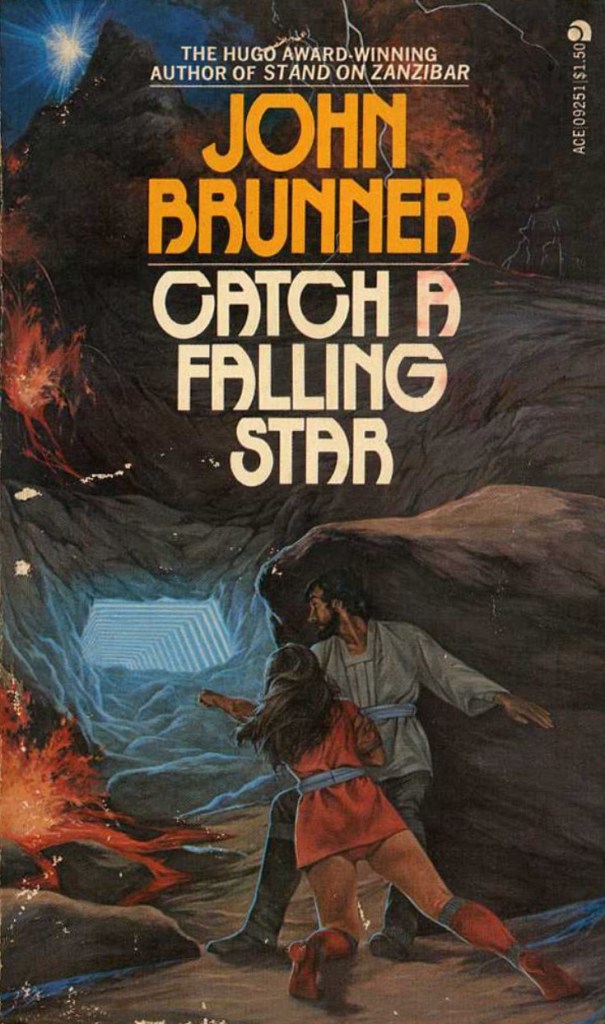
Joachim had also blogged “Future Media Short Story Review: John Brunner’s ‘Fair’ (1956)” but I wasn’t ready to read the story just yet. I was into the monograph, and the monograph inspired me to read Earth Is But a Star (1958) reprinted as an Ace Double The 100th Millenium (1959) and later expanded into Catch A Falling Star (1968). Jad Smith compared it to The Dying Earth (1950) by Jack Vance which I’ve recently read, but what really grabbed me is the inside cover blurb that quotes a passage at the beginning of the novel:

I know you’re wondering why I am digressing so much but stay with me. The sentiment of this quote is exactly what I’m worried about at the moment. But in the Jad Smith book on John Brunner, it’s what he worried about across his entire career, and in so many stories. It can be summed up by this question: What do we owe the future? My faint memories of meeting John Brunner retained an impression that he was both far more sophisticated than I was, and he was concerned about the future and mankind. He wanted us to solve our problems. It’s why he was involved with Martin Luther King, Jr. Society in London. I learned in the Jad Smith book Brunner founded that society.
Yesterday I also read “How To Do More Good” in Time Magazine. And twice yesterday I ran into reviews of What We Owe the Future by William MacAskill. Are you now getting the serendipity and the synergy of my reading? This topic was often at the core of what Brunner wrote. Like the fate of the humans in To Catch a Falling Star, we know our future too regarding climate change. Brunner could never understand why we don’t do something about all the problems we faced. In his later books he got quite cynical, and so am I. This is what draws me to him now.
All of this is important too for when I finally read his early story “Fair” an hour ago. I’ve now read 44% of the Jad Smith book on Brunner, and quite often Brunner’s plots are about saving the future. In his early stories, Smith said he would start out with a very bleak outlook but then end them with endless optimism. That applies to “Fair.”
Smith also summarized a common trait of Brunner’s where he would create an anti-hero, and that’s also what he’s done in “Fair.” Smith described how Brunner, a British author, had to write for the American markets to earn a living. Brunner grew up reading American pulps and understood how American science fiction was different from British science fiction. He tried to develop a style that merged the two. And he slowly worked toward developing a strong realistic attitude towards his subject matter even while using wild pulp conventions.
However, by the time he got to his most successful period of Stand on Zanzibar, The Sheep Look Up, and Shockwave Rider, many reviewers felt he was too realistic, too mainstream. I think we can see a hint of this in “Fair.”
“Fair” is about a nasty future. “Fair” is about Alec Jevons, a man who has lost his job, been left by his wife, and is rejected by society because his mother wasn’t of the right nationality. It was written during the Cold War, but it’s set in the future that Jevons felt he help create. Actually, it is the future we are creating. (And isn’t Brunner always speaking to us?) The fair of the story is a sprawling science-fictional fair of the future where people go to escape their miserable lives. Jevons is older than the mostly young people at the fair and he impresses them with his physical abilities on one gigantic ride designed to throw riders off. But where he has his revelation is in a booth that provides mental experiences that feel real.
I won’t tell you anymore. By luck, my best reading copy of the story was in SF: Authors’ Choice 4 edited by Harry Harrison. I say luck because it has an introduction by John Brunner that tells us quite a bit about why and how he wrote this story. I’m going to reprint it here hoping I’m not violating copyrights too much, but these introductions are seldom reprinted, and often are very enlightening.
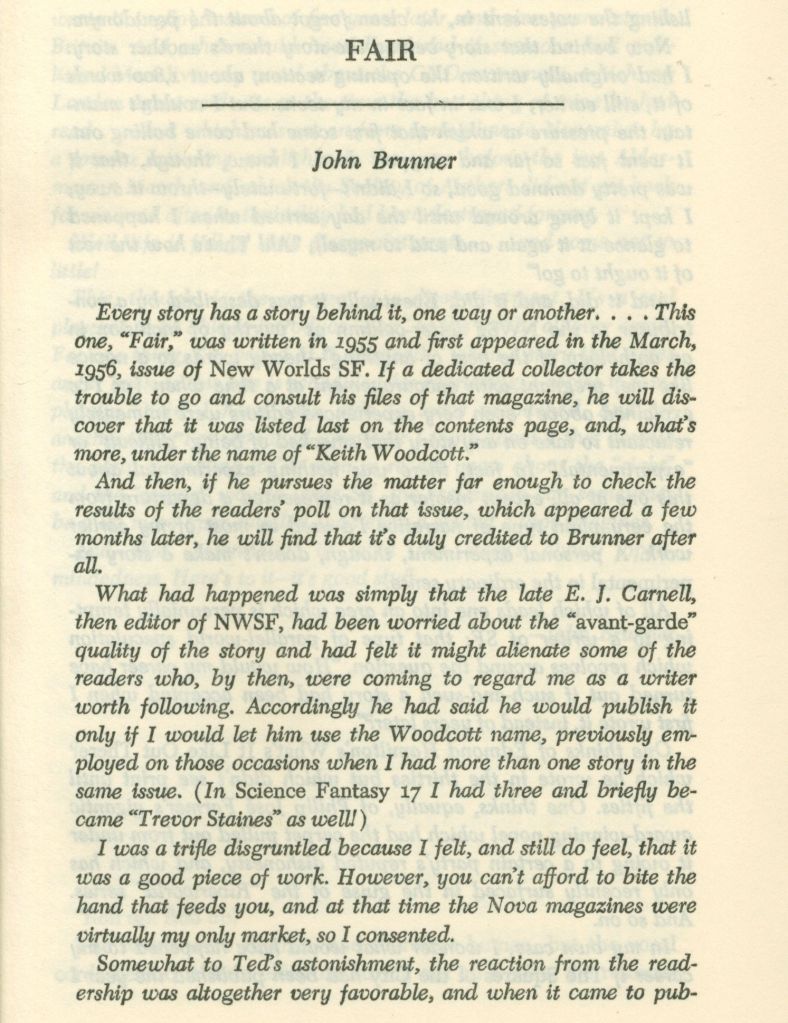


Read the ISFDB page for where “Fair” has been reprinted. I always enjoy it when I discover a story I’m searching for is already in one of the anthologies I’ve collected over the years. But you can also read “Fair” online in New Worlds (March 1956) where it was first published under the byline of Keith Woodcott.
I love that I’m rereading these older SF stories. I feel guilty about not reading new science fiction, and not knowing about the latest popular science fiction novels. But I’m retreading over territory I explored growing up. The first time around I read stories that appealed to the teenage me. I mainly focused on Heinlein, Clarke, Asimov, Dick, and Delany, but I read fairly widely. What I’m discovering in old age is I missed so much the first time around. There were so many writers I didn’t get to. Reading the Jad Smith monograph on Brunner tempts me to read a lot of Brunner that I just didn’t know was there.
The monograph also adds a sense of philosophy and intellectualism that I also missed in reading science fiction when I was young. John Brunner had quite a lot to say in “Fair,” and Smith is helping me see how Brunner developed as a writer.
James Wallace Harris, 8/16/22












 Classics of Science Fiction