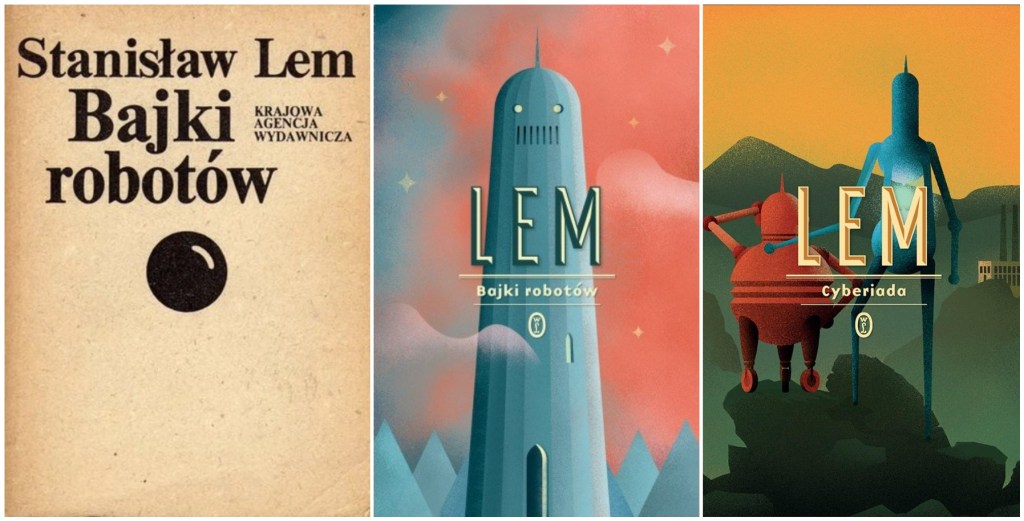
“Tale of the Computer That Fought a Dragon” by Stanislaw Lem is story #18 of 52 from The World Treasury of Science Fiction edited by David G. Hartwell (1989), an anthology my short story club is group reading. Stories are discussed on Tuesdays, Thursdays, and Saturdays. “Tale of the Computer That Fought a Dragon” has a long complicated publication history that I’ll let y’all read at ISFDB.org. It’s part of a series called Robot Fables. But from what I can tell was first published as “Bajka o maszynie cyfrowej, co ze smokiem walczyła” in Zycie literackie (August 1963). It was first translated into English for Other Worlds, Other Seas: Science-Fiction Stories from Socialist Countries edited by Darko Suvin (1970).
“Tale of the Computer That Fought a Dragon” is a very short story that comes across like a fable, and feels like it’s supposed by told by an oral storyteller. I’m afraid I dislike stories that sound like fables. Not because Lem’s tale is bad or uninteresting, but because such stories feel like a quick summary of a novel to me. I feel cheated. Such stories tell what happens instead of dramatizing the plot and developing the characters. A real short story is not a condensed novel. For some reason, many of these translated SF stories are told in this fable-like style. I wonder if that style isn’t normal in other countries because they never had pulp fiction? And thus, never developed the style of short story writing I like?
Basically, “Tale of the Computer That Fought a Dragon” is about a king who computerizes everything and then is threatened by an all-powerful computer. The solution to the king’s problem is silly and childish, much like some of the solutions Captain Kirk used against cybernetic foes in Star Trek. (It also reminds me of a solution Heinlein used against one foe in Glory Road, a fantasy novel.)
Stanislaw Lem has a great reputation, and his stories are widely reprinted. But I’ve yet to read one of his stories which makes me want to read more of them. I believe I read Solaris decades ago, and think I admired it. Need to give it another read.
This brings up an interesting problem. What if storytelling techniques are different from country to country? Are they reflected in the translation? Or, is the fable-feeling structure something that comes out of translation?
I guess it might reveal one of my biases or limitations. Other members of the short story club like these types of stories. They do sound clever, but cleverness can often draw attention away from the story. If you read “Tale of the Computer That Fought a Dragon” how do you visualize it? I visualize it as a Wizard of Id drawing.
Lem wrote a lot of these short satires. I assume, he liked cranking out ideas, but not novels. There’s enough plot content in “Tale of the Computer That Fought a Dragon” to structure a whole novel.
“Tale of the Computer That Fought a Dragon” is obviously a satire, attacking both computerizing everything, but also attacking leaders who feel the need to exert power to inflate their egos. That might have been politically subversive in 1963 in the USSR. It might also explain the childlike fable quality — a politically safer to write.
I wonder what Russians might dare to write about Putin today? Read “Tale of the Computer That Fought a Dragon” and substitute Putin every time you see the word king. It kind of works.
James Wallace Harris, 6/14/23











 Classics of Science Fiction