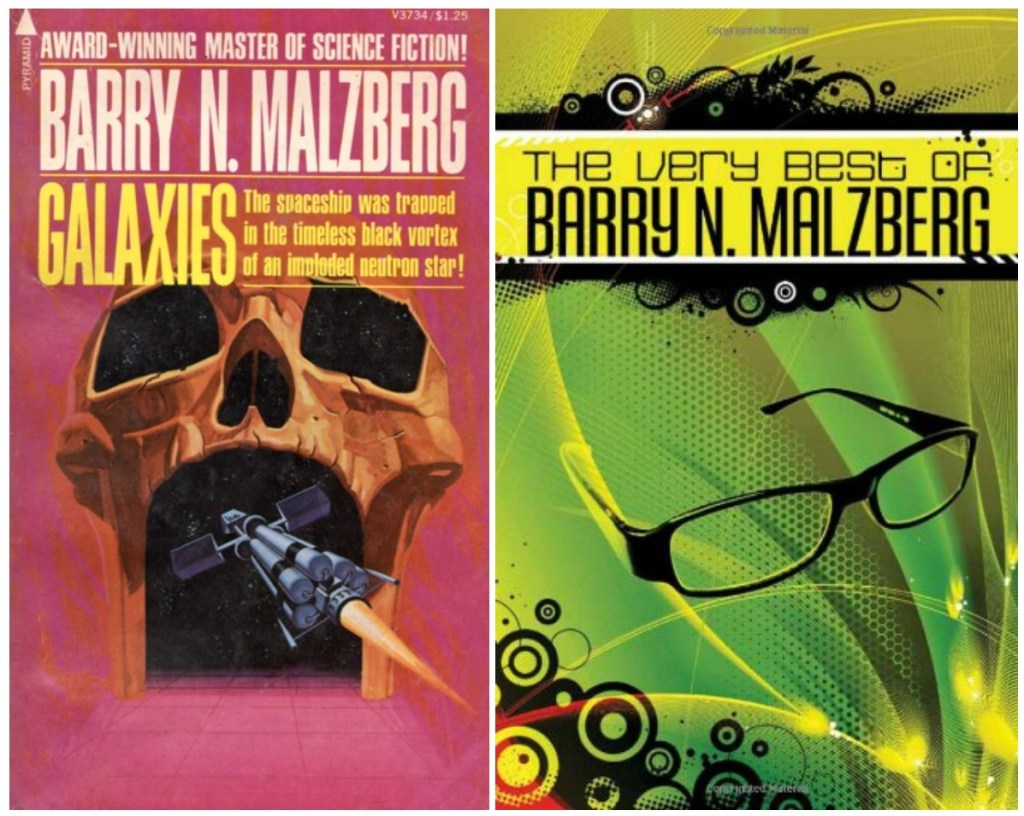
“A Galaxy Called Rome” and Galaxies by Barry N. Malzberg

I’ve been reading recursive science fiction lately, and one of the most famous recursive science fiction stories is Barry N. Malzberg’s “A Galaxy Called Rome.” Recursive science fiction is science fiction about science fiction. Sometimes this is a story that mentions science fiction, sometimes it’s a story about science fiction writers, their fans, and science fiction conventions, and sometimes it’s in-jokes about the genre, other times recursive science fiction is about the writing of science fiction, and that’s the case with “A Galaxy Called Rome.”

“A Galaxy Called Rome” has been reprinted often you can find it in these anthologies and collections. I read it in the anthology Inside the Funhouse: 17 SF Stories About SF edited by Mike Resnick in 1992. I highly recommend that volume if you can find it, but it was only published once by Avon. Probably the cheapest collection of Malzberg’s stories is The Very Best of Barry N. Malzberg because the Kindle edition is only $4.99. However, Malzberg expanded “A Galaxy Called Rome” into a short novel, Galaxies, and it’s available for $1.99 for the Kindle edition at Amazon.

Malzberg is known for his recursive science fiction, especially since he seems to have experienced a great deal of existential angst over being a science fiction writer. NESFA even came out with a collection of his recursive SF called The Passage of the Light: The Recursive Science Fiction of Barry N. Malzberg.

“A Galaxy Called Rome” is a novelette composed of 14 short chapters. It first appeared in the July 1975 issue of F&SF and has been anthologized a number of times. It is probably Malzberg’s most famous work of short science fiction. 

Malzberg expanded the same story into 49 chapters for a 1975 short novel version retitled Galaxies. Malzberg gained attention for a handful of science fiction novels in the first half of the 1970s. He won the John W. Campbell Award for Beyond Apollo but got a fair amount of recognition for Galaxies, The Falling Astronauts, and Herovit’s World. He went on to publish prolifically in and outside of the genre

“A Galaxy Called Rome” and Galaxies are also works of what the literary world calls metafiction – fiction about fiction. I prefer the novelette version of the story because the novelette is my favorite length for science fiction. However, the longer version of the story, Galaxies, lets Malzberg dig deeper into the nature of writing science fiction.

I want to recommend this story, but with carefully considered restrictions. If you read science fiction for escape this story isn’t for you. Well, if you want to know why you read science fiction for escape, then you might want to read it. This story is for people who like to intellectually examine everything and take things apart. This story is for readers who love academic exercises in cleverness. This story is for readers who want to know how magic tricks work.

I alternated reading Galaxies with listening to Red Rising by Pierce Brown. It was an excellent contrast. Red Rising is exactly what most science fiction readers want to read. The story immediately sucks the reader into a fantasy reality. It’s designed for your mind to forget the real world and immerse yourself in a fantasy about Mars. The reader is expected to buy into its make-believe. Galaxies on the other hand constantly remind the reader of our reality while describing how a science fiction writer goes about their business of fooling the reader.

Reading “A Galaxy Called Rome” or Galaxies could ruin your love of science fiction. Or it could make you appreciate escapist literature all the more. I know when I would switch to Red Rising after reading a dozen chapters of Galaxies I felt like that guy in The Matrix, Cypher, who wanted to take the blue pill and enjoy the juicy steak. And that might be a good analogy. Reading Malzberg is like taking the red pill and seeing an ugly reality. It might be philosophically enlightening to know the realness of reality, but it’s still grim and gritty.

This is probably why Malzberg never became a popular sci-fi writer, he was too hung up on reality. Most of the recursive science fiction I read in Inside the Funhouse was big fun. Recursive science fiction comes in many flavors but they can be roughly divided into two kinds. One kind celebrates our addiction, and the other makes you feel like you’re withdrawing from heroin. Reading “A Galaxy Called Rome” is like learning about Santa Claus as a kid, it hurts but makes you feel grown up. Reading Galaxies can feel like the agony of soul searching before deciding on becoming an atheist.

I ended up highlighting almost ten percent of Galaxies when reading the Kindle version. I won’t show all these quotes because that would probably be a copyright violation, but I do want to show enough of them to give people a chance to understand what Malzberg is doing. Malzberg is very open and straightforward with his intentions as stated in this first section.

It’s rather interesting that Malzberg tells us how the idea of the story within a story came to him. Well, the idea for the story he’s going to use to discuss writing. In the course of reading a novel about writing a novel, we will develop a whole story with characters, setting, plot, and conflict. However, we won’t experience that story like we normally do. Imagine being served a meal and instead of enjoying eating it, we put it under scientific analysis.

One thing Malzberg doesn’t do is try to imagine what we readers think while reading all of this. We readers are also part of the process. As I read Galaxies I got the idea that Malzberg both loved and hated science fiction. I got the impression he wanted to be a respected writer of hard SF, but his sense of reality conflicted with the fantasy nature of writing escapist literature.
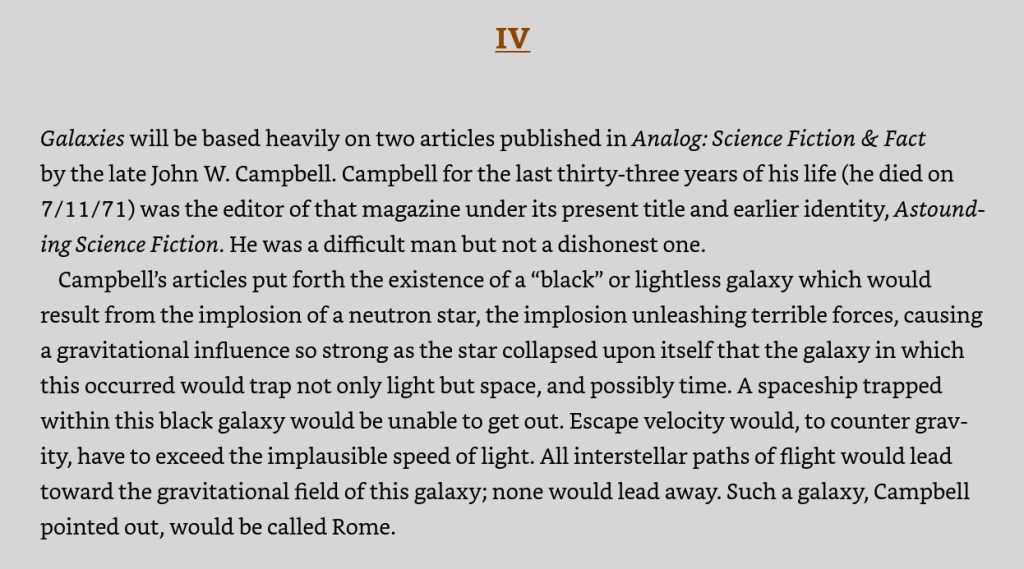
These early sections are quite seductive, but I must warn anyone considering buying Galaxies that the going will get tough. “A Galaxy Called Rome” is the light fluffy version to read for those who aren’t ready to climb a mountain. Even though Galaxies is only 154 pages long, it’s a Ph.D. dissertation on deconstructing science fiction novel writing.

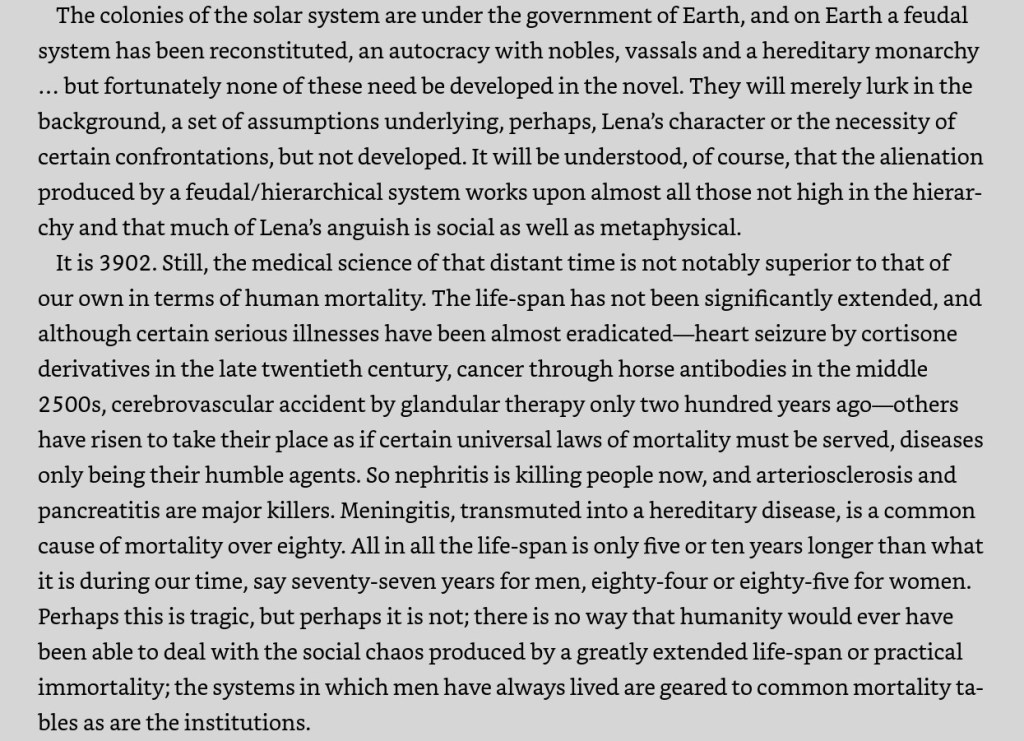
The story within this novel is about Lena Thomas who is the only living crew member of an FTL spaceship, Skipstone, that carries a cargo of 515 dead people in cryonic suspension. The year is 3902. Like in Heinlein’s novel, The Door Into Summer, rich people with diseases invest their estates and freeze their bodies in the hopes of one day being revived and cured. Those estates pay for the development of interstellar travel. Those dead people will eventually communicate with Lena like the dead in PKD’s Ubik when Lena and the Skipstone get trapped in the black galaxy. This allows Malzberg to explore metaphysical and religious themes in writing a novel. The ship also has robots programmed with human minds that help Malzberg explore other science fictional themes. His story notes get more and more extensive while getting more and more complicated. This also allows Malzberg to show how worldbuilding and plotting are developed as a writer tells their story.

Malzberg uses all this exploration in writing a science fiction novel to also speculate about the future. He imagines our civilization collapsing and being completely forgotten and a new world civilization rising in the following nineteen centuries. Malzberg imagines we’ll face limitations we can’t overcome and wild possibilities that far exceed today’s limitations.
Much of this novel is about being a writer, and specifically a writer of science fiction. You get hints along the way that Malzberg might be jealous of famous literary writers like Cheever and Updike, at other times you might feel his resentment at not being more successful at being a science fiction writer. But Malzberg is confident of his own gifts too.

In some of the actual passages of the novel, the dialog reminds me of Sheckley or Adams, or maybe even PKD, and even then Malzberg keeps making digs at science fiction.
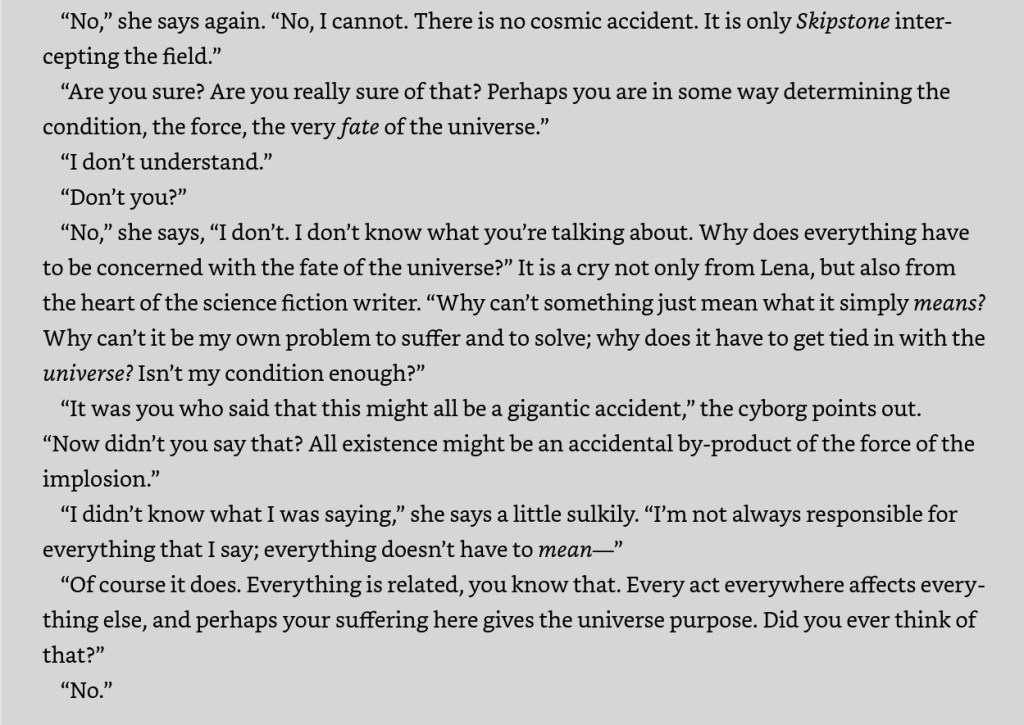
Over time, the conflicts Malzberg provides for Lena’s story become repetitious. He knows he’s padding this novel, and even talks about how writers do pad their novels. The second half of Lena’s story becomes one long dark night of her soul struggling to escape the black galaxy. I have to wonder if such soul searching also plagues Malzberg.

Eventually, you wonder if Malzberg can find an ending to Lena’s story. Chapter after chapter he tortures the poor woman, and we can’t imagine any possible happy ending. Yet, Malzberg gives us a very strange ending that I was quite happy to read. I guess he took pity on us.

Reading Galaxies makes me doubt reading science fiction, but then I’ve doubted my addiction to our genre for decades. As a young person back in the 1960s and 1970s I thought science fiction was a wonderful tool for thinking about all the possibilities of the future, both good and bad. But after living to the year 2022, which was a very futuristic sounding year back in 1965, I know the future is everything we never imagined.

Contrasting Galaxies with Red Rising it’s quite obvious that science fiction’s purpose is escape. And the genius of writing science fiction is creating stories set in fictional worlds that are so compelling we forget this one. By Malzberg intruding into his novel and telling us everything only shows we don’t want the author intruding into our stories. Some philosophers have speculated that God invented our reality and walked away from his creation and that’s a great thing. That knowing God’s intention would ruin his/her/its art. I always felt Heinlein destroyed his career after he started poking his nose into his stories.

“A Galaxy Called Rome” and Galaxies were written as the New Wave in science fiction was fading and postmodernism fiction in the literary world was becoming old hat. It was an impressive experiment of the times, but as far as I know, readers have lost interest in such experiments. The Post Moderns of our times demand wokeness in fiction but not the metafictional kind. If anything, modern SF readers want longer voyages of fictional escape with far greater feats of worldbuilding.

It would be interesting to see someone write a version of Galaxies today that reveals what today’s SF writers go through to entertain their readers in the 2020s.

James Wallace Harris, 7/23/22

Science Fiction Writers in Conversation with Each Other

Imagine a world where science fiction had never been invented. Could you have written the first science fiction story? Be honest now, and think hard about yourself and what I’m asking. Before Galileo, did anyone think the Moon was a world that could be visited? Once people heard Galileo saw mountains on the Moon with his telescope they began to imagine going there. Science fiction needed certain kinds of seed ideas to begin. When the seeds come from reality I’ll call that Stage 1 science fiction. We don’t see a lot of that kind of science fiction anymore. Maybe The Martian by Andy Weir when he tried to realistically portray growing potatoes on Mars or when a writer extrapolates on current events like John Brunner did in Stand on Zanzibar back in 1968 or what Kim Stanley Robinson did in The Ministry for the Future in 2020.

Once the genre got rolling, science fiction seeded itself. One story about a trip to the Moon inspired an infinity. I call that Stage 2 science fiction. In Stage 2 writers try to stick to reality but work off the collective knowledge of the genre. Eventually, science fiction was making copies of copies, where the inspiration had no connection with reality. I’ll call that Stage 3 science fiction.

Early stories about traveling to the Moon were Stage 1 because it’s not likely the authors had read each other’s work. But when Verne and Wells wrote their novels of lunar exploration a lot of their inspiration was Stage 2. When John Varley wrote his stories about a lunar colony, most of the science-fictional concepts within those stories had been germinating for generations in the genre – Stage 3.

I believe science fiction writers have an ongoing conversation that never ends. To take part in this conversation, publish a story. It can be Stage 1, 2, or 3. To be heard and answered requires writing something in Stage 1 or 2, or a very creative Stage 3.

This is why I’ve become fascinated by the forgotten writer Walter F. Moudy. The 1950s and 1960s were a fertile time for Stage 1 and Stage 2 stories. By the second half of the 1960s and early 1970s writers who made themselves noticed were writing a baroque Stage 3 science fiction to attract attention. For example, the works of Samuel R. Delany, Roger Zelazny, and Robert Silverberg were based on old SF ideas told with new writing styles. Unfortunately, Moudy wrote Stage 3 stories in the same prose style that the classics of Stage 2 were written. His 1964-65 stories feel like they were written in 1954. One reason the New Wave writers of the 1960s were so important is they recognized that retelling Stage 2 stories in the same way, would get them ignored. The reason why Heinlein blazed onto the scene in 1939 is that he wrote Stage 1 stories with a new writing style, making his stories stand out.

I enjoy reading Walter F. Moudy in 2022 because I doubt I could write any better than he did, and he was responding to the stories I admired back then. His writing ability and knowledge of the genre were just good enough to get five works published and then become forgotten. As a would-be science fiction writer, I greatly identify with that. He wanted to join the conversation and made the effort to have his say. He just wasn’t heard, but now after decades, I’m listening.

While reading Walter F. Moudy’s meager output of science fiction I kept feeling his stories were inspired by the science fiction he and I both read. They made me wonder what he was trying to say in the ongoing conversation.

Of the five science fiction stories, I’ve read by Walter F. Moudy, “The Search for Man” is my favorite, although if I reread “The Survivor” or No Man On Earth I might change my mind. All were good fun, old-fashion science fiction, the kind my nostalgia loves. As I read “The Search for Man,” I kept wondering what science fiction Moudy had read that inspired this story. I can’t say for sure but this story about robots speculating about long-dead or gone humans reminded me of City by Clifford Simak. That “The Search for Man” set hundreds of years into the future speculated about our times and turned us into a religion reminded me of A Canticle for Leibowitz. That both the protagonists of No Man On Earth and “The Search for Man” were about a super-human and a super-robot reminded me of The Hampdenshire Wonder, Slan, Odd John, Chocky, Stranger in a Strange Land, and all the other science fiction stories about next-stage beings. Reading those two Moudy stories made me think about how I would have written a story on that theme. How much could I base it on reality, and how much would be inspired by other science fiction?

“The Search for Man,” begins with a baby being born, but it’s a strange birth, a kind of decanting that made me think of Brave New World. Then we learn the baby will only have three senses, and it will be put into a robotic baby’s body, the first of four body types it will use.

Moudy sets up a good mystery for us. Humans died out hundreds of years earlier, with all other animal life. The humans had tried to travel to the stars, but it appears their three missions had failed. The robot brains have improved their brains with genetics found in 12 human brains that had been preserved. The robots have found long-dead humans in various kinds of chambers that tried to create suspended animation. Their hope is to find a chamber with a viable human to resurrect. There are classes of robots that are archeologists and others that are priests that teach a strange religion based on their theories about humans. All of that is a very appealing setup for a story, at least for me.

I’m not sure Walter F. Moudy would have written “The Search for Man” without reading a lot of science fiction. Part of the conversation science fiction writers have is about science fictional ideas, but the other part is about how to present those ideas in a story. I felt “The Search for Man” was Moudy’s reply to both but in the language of 1950s science fiction. I wonder if he had been more of a stylist would he have made a greater impact?

“The Search for Man” was published in an original anthology In The Wake of Man that’s never been reprinted. I’ve been trying to get a copy, but it’s expensive, starting at $75 used. I had found a $10 copy for sale, but my order was canceled a couple days after I ordered it. Right now the only source for this story is a copy of In The Wake of Man at Archive.org. If you are a member, which is free, you can check it out for an hour to read online. Thanks to Joachim Boaz for finding that link.

Joachim Boaz and Rich Horton have also been writing about Walter F. Moudy. Rich is planning to review all of Moudy’s work soon.

James Wallace Harris, 6/30/22

Blowing Your Chance to Speak to the Future

Writers cherish the myth that their work will make their names immortal. And it is true we have remembered some authors for thousands of years. However, if you want to be heard across time, you have to write something timeless.

My friend Mike and I are fascinated by forgotten writers, especially forgotten science fiction writers. We can’t help but wonder why a writer quits after their initial success of selling a few stories or maybe a novel. Mike texted me the other day about such a writer he discovered in an interview with Geraldine Brooks in The New York Times.

It was part of their By the Book series, where all writers are asked the same standard questions. My favorite question: “What’s your favorite book no one else has heard of?” Often this makes for an interesting title to chase down. Brooks said: “‘No Man on Earth,’ by Walter Moudy. The only other person I know who has read it is my son because I pressed it on him.”

So one well-regarded literary writer resurrects Walter F. Moudy 49 years after he died. That one little mention in the Times got me to read his novel. Maybe a few other people will too. And it’s a pretty good science fiction story for 1964. The question is, could it have been better? What would have made that novel stay in print? Is it worth reprinting? And do I recommend you read it?

You can read a pdf copy of No Man On Earth here.

It turns out that No Man On Earth is a forgotten science fiction novel by a forgotten science fiction writer, Walter F. Moudy (1929-1973). His ISFDB entry lists one novel and four short stories. This novel appeared in October of 1964, and then three of his four stories appeared in April and May of 1965, two in Fantastic and one in Amazing, both edited by Cele Lalli (Goldsmith). Moudy would have been in his mid-thirties. In 1966 he published another novel, The Ninth Commandment, probably not science fiction, and one I can’t track down. Finally, in 1975, after his death, Moudy had one more story, a novella, published in an original anthology, In the Wake of Man. The other two authors in that book were Gene Wolfe and R. A. Lafferty, pretty impressive company.

Besides No Man On Earth, I’ve read his three stories in Fantastic and Amazing, but it would cost me $75 to read his final story and that’s too much. For me, Walter F. Moudy’s science fiction legacy is that one novel, two short stories, and a novelette. Not much to go by, but still, I’m terribly envious since I’m a lifelong would-be science fiction writer. I’d give anything to have contributed even that much to the genre.

Why after his initial success in 1964-1966 did Moudy quit writing? And how did Roger Elwood get his last story? I guess Moudy tried one more time before he died to say something in print. But maybe Elwood had been holding it for years, and it was written in the mid-sixties. Reviewers haven’t been kind to it.

I was able to track down a few biographical details. Moudy was from Missouri, served in the Air Force from 1950 to 1953, got a degree in 1954, and then a law degree in 1957. He was Phi Beta Kappa. Moudy was married and had three children. In other words, he had a successful life and didn’t need to be a writer. Still, as I read his work over the last few days, I felt he had something to say. At least in No Man On Earth.

His three short stories were rather minor. The first, “The Dreamer,” was about a young man who wanted to get rich and famous as a space trader. The story was told like a fable. Its redeeming feature was a super-intelligent parrot. The second, “I Think They Love Me,” is about rock stars going to extreme lengths to survive hordes of screaming teenage girls. This was written a year after The Beatles hit America and was kind of cute, but not really worth remembering. The last, and the one most anthologized, is “The Survivor,” about a televised war game between America and Russia. It reminded me of The Hunger Games. This story came out in 1965 and was probably inspired by the 1964 Olympic games and the films Dr. Strangelove and Fail-Safe. “The Survivor” was gritty, detailed, and suggested each country sacrifice 100 men every four years in a fight to the death rather than risking total national annihilation.

Those three stories were somewhat entertaining, especially the last one, but they don’t leave the kind of impression that Moudy was making a statement. However, No Man On Earth does. Writers can make different kinds of statements. They can aim to write a better story than what’s written before. Or they can capture their times realistically in words. And common with science fiction writers, they can say something philosophical about reality. And there are so many other ways.

For example, I believe Robert Heinlein was influenced by the success of Atlas Shrugged by Ayn Rand in 1957, and that’s why he aimed so high with Stranger in a Strange Land. In his later years, Heinlein repeatedly tried to convince fans that Starship Troopers (1959), Stranger in a Strange Land (1961) and The Moon is a Harsh Mistress (1966) were books that he wanted to be remembered for because they expressed his philosophy on freedom and responsibility.

My guess is Moudy was inspired by Stranger in a Strange Land when he wrote No Man On Earth. Heinlein’s main character Valentine Michael Smith is a human raised by Martians who taught him psychic powers. Moudy’s main character, Thad Stone, had a human mother and alien father and was a super-genius. Both novels are told with picaresque plotting. Both books comment on sex and society. Moudy has Stone tour many planets and visits many kinds of societies and civilizations. No Man On Earth ran 176 pages in its first publication, a slim paperback original to Stranger’s 408 pages in the G. P. Putnam’s Sons first-edition hardback. Heinlein was obviously trying to hit one out of the genre after over twenty years of being a big fish in a small pond. Frank Herbert also aimed sky high with Dune in 1965. It was also over 400 pages.

There are a lot of one-hit wonders in the book world but few writers struggle with their masterpieces like Harper Lee or John Kennedy Toole. My guess is Moudy knocked this novel out quickly and was probably paid around $750 for his paperback original and when it disappeared on the twirling wire racks after a couple of months felt his time was better spent being a lawyer. If he had written a 400-page monster and got it published by a major hardback publisher No Man On Earth might have had a better chance. He just didn’t aim high enough.

It would have also helped if he had written No Man On Earth in an innovative style that made the genre take notice, like Dune and Stranger in a Strange Land. Moudy’s story and writing reminded me a bit of Leigh Brackett’s The Long Tomorrow (1955), Edgar Pangborn’s A Mirror for Observers (1955), and Walter Tevis’s The Man Who Fell to Earth (1963), all books he could have read and could have inspired No Man On Earth.

Obviously, if Geraldine Brooks fondly remembers No Man On Earth in 2022 so it can’t be a stinker. I liked it quite a lot and rushed through it in two days because it was compelling in the old-fashion kind of science fiction I love. It’s great that Tevis’s 1963 novel is still remembered, and I think it’s a shame that Moudy’s book isn’t more remembered.

James Wallace Harris, 6/21/22

The Problems with Classic Science Fiction

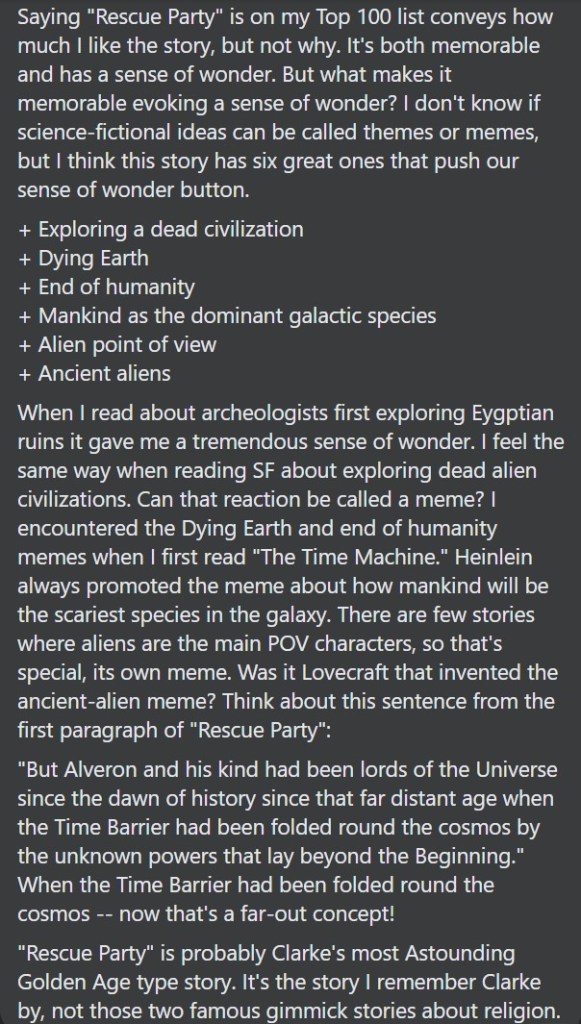
The first problem I face with assembling my Top 100 Science Fiction Short Stories list is that I’m partial to crusty old SF stories that younger readers will feel are badly dated. Our discussion group read “Rescue Party” by Arthur C. Clarke for today. Here’s my comment:

Some members of the group, and not always the younger ones, have pointed out how dated parts of this story are today, and that the characterization is rather poor. Clarke was never a particularly good writer when it came to characterization, but this story was on par for 1946. Most of our group are older fans, and we’re used to older stories, so even with them, this story might not be a great story. Generally, people liked it, rating it 3-4 stars, with one person giving it 2.

You can read “Rescue Party” for yourself if you want. Here is the story in the original publication, and here it is again at Escape Pod with both audio and text. The group read the story from The Arbor House Treasury of Modern Science Fiction that came out in 1980. Evidently, Robert Silverberg and Martin H. Greenberg considered “Rescue Party” a modern classic 42 years ago even though most anthologies back then were remembering Arthur C. Clarke with “Nine Billion Names of God” and “The Star.” One of our members said Clarke might be remembered for “A Meeting with Medusa” which came out in the 1970s and is a much more polished story by contemporary standards.

“Rescue Party” was anthologized in The World Turned Upside Down edited by David Drake, Eric Flint, and Jim Baen in 2004, but that anthology was promoted as collecting stories that we old SF fans loved when we were growing up. That’s certainly true for me because it has many old science fiction stories I love that I use for my Top 100 list of SF short stories.

In other words, I can make a list of the short science fiction stories I love, but if younger readers read those stories would they be disappointed? First, do I care? It’s my list. Actually, I do. I don’t want to waste readers’ reading time. Nor am I interested in trying to be a teacher pushing young people to read the SF classics.

I realize there are two solutions for me to pursue. One is to find the stories that are great science fiction and are well written that aren’t dated. There’s certainly plenty to choose from. And I might do that. But I had a different idea when I started work on this list. I wanted to show the evolution of science fictional ideas and my evolution as a science fiction reader. It’s not about recognizing the best stories. I no longer believe in the best of anything. This world is too complex and multiplex to order in ranks and ratings. I’ve already bogged down trying to rank my favorites numerically.

I want to start in the 19th century and progress to the 21st by reviewing the science fiction stories that evolved the genre. Contemporary readability or social correctness won’t matter. Figuring this out has given me a direction.

James Wallace Harris, 5/1/22

Old and New Science Fiction

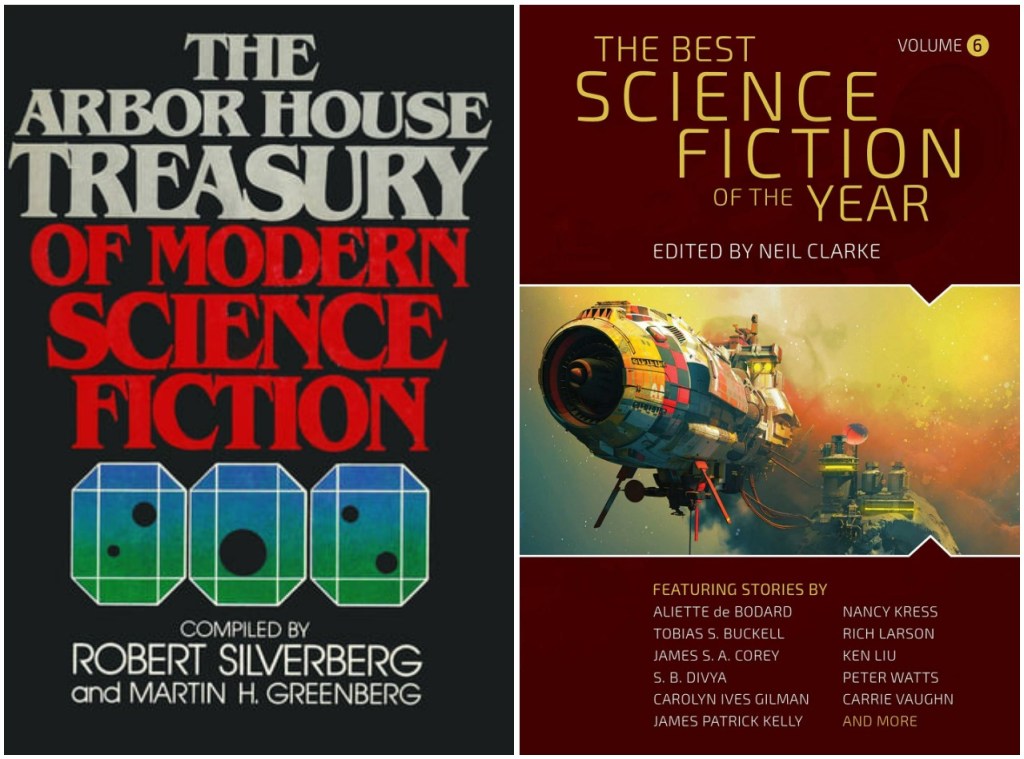
The Facebook group Best Science Fiction and Fantasy Short Fiction will begin discussing The Best Science Fiction of the Year v. 6 edited by Neil Clarke on April 24th for Group Read 38, and The Arbor House Treasury of Modern Science Fiction edited by Robert Silverberg and Martin H. Greenberg for Group Reading 39 on April 29th. That means during May, June and some of July will be alternating between old and new science fiction short stories each day.

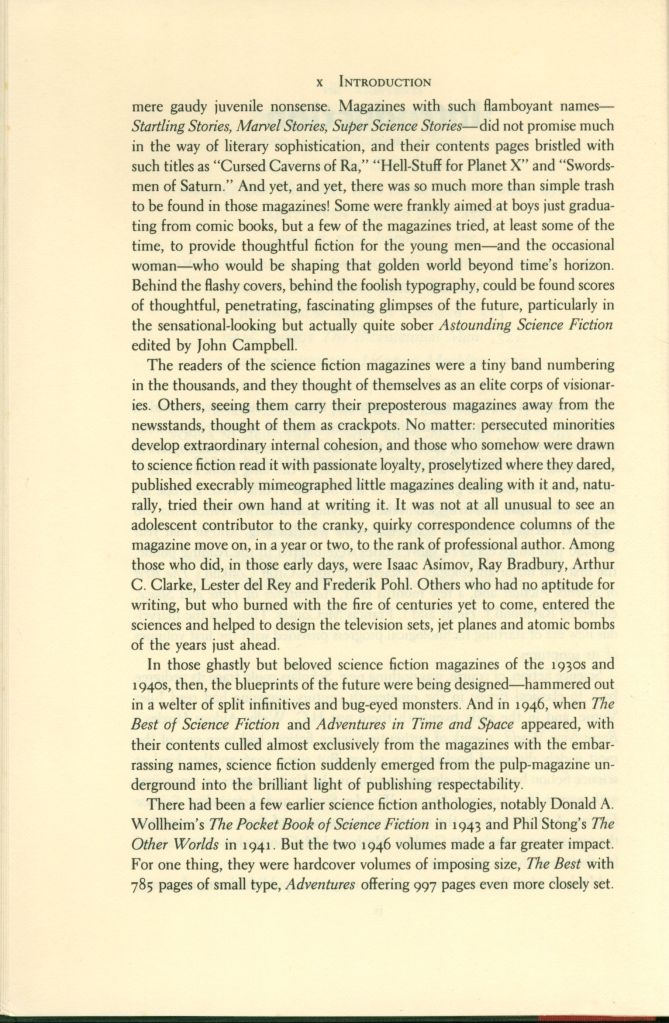
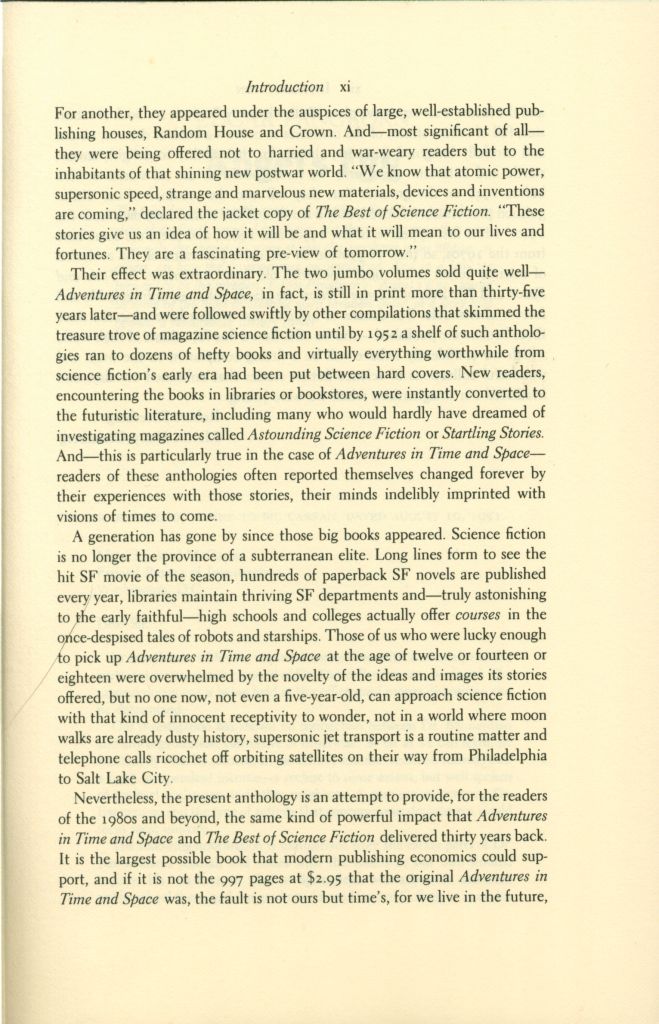
Silverberg and Greenberg compared their anthology to the two classic SF anthologies from 1946: The Best of Science Fiction edited by Groff Conklin, and Adventures in Time and Space edited by Raymond J. Healy and J. Francis McComas. For decades, readers found those two anthologies in their libraries and were standards for introducing readers to short science fiction. They hoped The Arbor House Treasury of Modern Science Fiction would cover 1946-1979 like those two classic anthologies did for science fiction before 1946.

The Neil Clarke volume is his pick of the best short science fiction of 2020. Group Read 38 schedule. Group Read 39 schedule.

Now that I’m regularly reading old and new science fiction short stories I’m learning how both science fiction and writing science fiction are evolving. Part of my daily routine is reading the next day’s story, and then thinking about it when I’m going to sleep at night so that in the morning I can type up a short review for the group when I start my day. Belonging to this Facebook group has been a real education, kind of a graduate course in science fiction literature. More than that, it’s been a meditation on my lifelong relationship with science fiction. I’ll try to write longer reviews for this blog for those stories that really inspire me.

I hope Silverberg and Greenberg won’t mind me reprinting their short introduction because it says so much about remembering science fiction short stories. 75 years later, the CSFSS list only recalls one story from the Conklin anthology and four from the Healy/McComas book. 42 years later, the list remembers 10 from the stories Silverberg and Greenberg picked out. But how many of those 10 will remain in another 33 years?

James Wallace Harris, 4/23/22 – updated 4/27/22

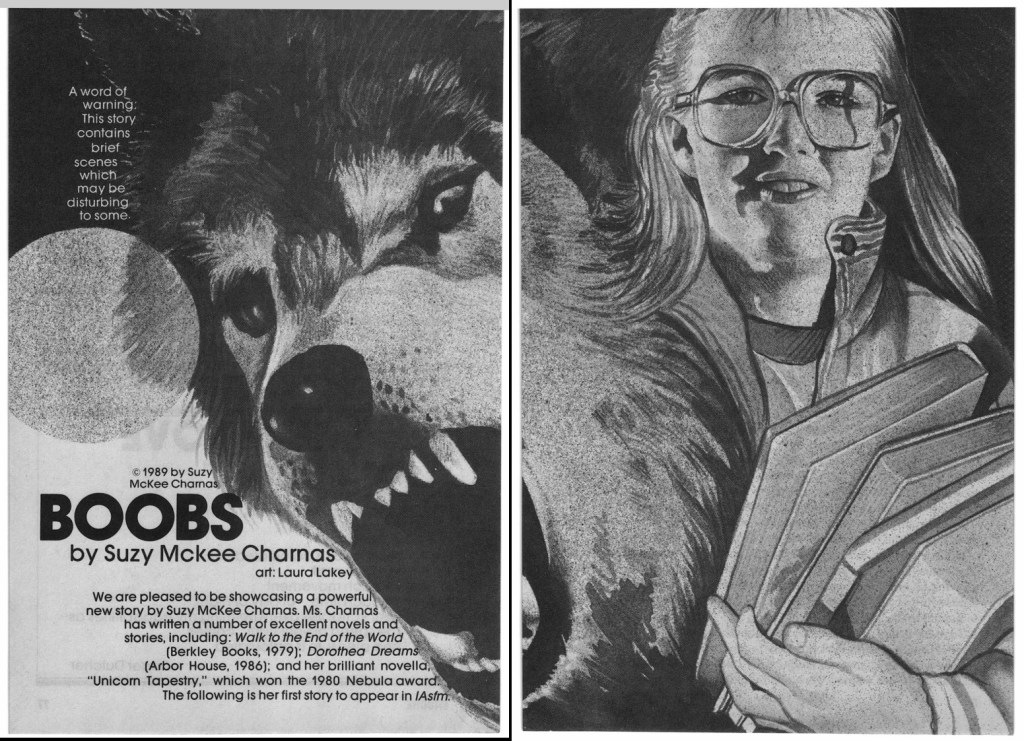
“Boobs” by Suzy McKee Charnas

Today’s story at the Best Science Fiction and Fantasy Short Fiction group on Facebook is “Boobs” by Suzy McKee Charnas. You can read it here. In the first comment, Jeppe said he was surprised it won the Hugo, which was my reaction too. It is a slight story about a girl hitting puberty and becoming a werewolf, but it’s been reprinted quite a bit, indicating its popularity. The group is reading Hugo and Nebula Award Winners from Asimov’s Science Fiction edited by Sheila Williams.

So, I asked myself, “Why would this story win an award?” I came up with two theories, neither of which involves the quality of writing.

First, “Boobs” is about being different and being bullied. Kelsey is a young girl who is developing faster than her peers and when she starts wearing a bra gets the nickname Boobs from the school bully, Billy. This reminded me of a recent phone call with my old friend. Connell had been extra tall in high school and it had been an unpleasant time for him. He told me the reason why I hadn’t been bullied in school was that I had been average-looking. I didn’t stick out. And that was true. I was of average height, average looks, average clothes, and average intelligence.

“Boobs” is about sticking out and being ridiculed and bullied, and I have a feeling that might have been true for a lot of science fiction fans. A story that resonates deeply with an old hurt might get the vote on an award ballot.

The second reason probably deals with the same psychology. “Boobs” is revenge porn. Kelsey eventually kills and eats Billy when she’s in her werewolf state. That was a quite satisfying way to plot the story, but isn’t giving the class asshole the death penalty a little harsh? If you pay attention to stories and movies, revenge against bullies is a popular plot. Revenge might be the number one plot for westerns. Westerns are often about grown-up bullies, and the common solution is to kill them. The recent western, Power of the Dog, has been described as being about toxic masculinity. It’s about a bullied kid who gets his revenge. The deep-down desire to see violent people come to a violent end is probably another reason why “Boobs” got its votes for the Hugo.

And who knows, maybe if young girls did turn into werewolves and fed on bullies and stray dogs society would be much nicer. I bet guys like Putin or Trump would never have survived adolescence.

I thought the best thing about “Boobs” is how Charnas describes being a wolf, especially perceiving the world through smells. It was also interesting that “Boobs” was a science fiction story about a young girl getting her first period. “Even the Queen” by Connie Willis was also a Hugo award-winning short story about menstruation. Are there other SF stories on this topic? Enough to create an anthology? Have any of them won awards?

Although I thought “Boobs” was a slight story, I did think it was a good story. And it reinforces my belief that straightforward science fiction/fantasy stories set closer to the present, and ones readers can relate to emotionally, will be more successful than dazzling complicated stories set in the future.

All too often we expect award-winning stories to be profound, brilliant, dazzling, impressive, complex, etc. Maybe just pushing the right emotional button is all you need to get readers to like your story.

James Wallace Harris, 4/13/22

Does Too Much Suspension of Disbelief Ruin a Story?

The willing suspension of disbelief is required to enjoy many forms of fiction, especially science fiction. On the other hand, at what point does ignoring reality ruin a story?

Some readers and moviegoers are willing to accept anything the story asks of them. If the story moves along quickly and is exciting, most readers aren’t going to stop and ask questions. Other readers will slow, pause, or even stop reading when they hit a logical speedbump.

Yesterday I read “Glitch” by Alex Irvine. I hope the author won’t mind me using his story as a lecture about the overuse of the suspension of disbelief. It’s up for the Asimov’s Science Fiction 36th Annual Readers Award. You can read it here. It’s a fun story based on a neat idea. Several people in our short story group rated it highly, with one member giving it five stars out of five.

I liked “Glitch,” but I hit several speedbumps where I couldn’t suspend my disbelief.

The story begins with Kyle Brooks waking up in a hospital room wondering how he got there. We quickly learn that Kyle was killed in a terrorist attack by a white supremacist. His mind had been backed up and he had a new body without scars, tattoos, or piercings. That implied to me it was a clone.

Speedbump #1

Where did Kyle’s new body come from? Since the doctor examines Shari’s wounds and gives her a prescription it’s implied that it’s right after the bombing. Did they grow a clone body in hours? Did they have one in storage? No one else in our group asked about this.

Obviously, Irvine wants to ignore this, so I will too. Mind uploading is a very popular topic in science fiction right now, although it’s been around for decades. I fondly remember Mindswap by Robert Sheckley from 1966 and less fondly I Will Fear No Evil by Robert A. Heinlein from 1970. I don’t believe mind swapping will ever be possible but I’m willing to suspend my disbelief for stories about this theme. It is a fun concept.

Speedbump #2

We quickly learn that Kyle isn’t alone in his new body. For some reason, Brian, the terrorist bomber is sharing Kyle’s mind. This is much harder to believe. Kyle is at a special hospital for restoring minds. Evidently, it’s quite a regulated business. How in the world could two people be in one mind? Irvine does some hand waving that is completely unsatisfactory to me.

Great Idea #1

However, this is a very cool plot twist so once again I’m willing to suspend my disbelief. The possibility of a liberal who is about to marry a person of color coexisting with a white supremacist is a great fictional situation. Again, I let my suspension of disbelief go. I love the possibility of a bad guy walking a mile in the shoes of a good guy.

Speedbump #3

The police show up at Kyle’s house the next day. They have evidence that suggests the terrorist bomber is inside Kyle’s mind, but Kyle tells them no, even though he knows Brian is there. The cops even tell Kyle that if he’s lying, he can be prosecuted as a conspirer for Brian’s crime. This is the hardest part of the story for me to buy. Kyle should have immediately told the cops that Brian was in his mind. Kyle obviously doesn’t want him there, and he has no resources to remove him, why wouldn’t he ask for help from people who did have the resources?

I know why Irvine made this plot choice. He wanted Kyle to become the action hero of the story. Personally, I always find stories where an ordinary person becomes an action hero to be completely unbelievable. I really don’t want to suspend my disbelief on this point, but I’ve got to buy into it because I want to know how Kyle rids himself of Brian.

This is why I’ve stopped watching thrillers and action movies because movies have made everything with this kind of comic book logic. Comic book logic is the most extreme version of suspension of disbelief. Anything is possible. All a writer must do is say it’s so. They expect the reader to accept that whatever is suggested is real. No critical thinking is assumed as standard.

Alex Irvine does write for comics and I’m afraid “Glitch” descends into full comic book logic from here on out. As the plot speeds up, so does the frequency in which Irvine asks us to suspend our disbelief. Irvine isn’t alone in doing this. It’s become a common practice in science fiction stories that involve action.

Science fiction books used to be more realistic. Movies and television shows have always leaned towards comic book logic. Buck Rogers and Flash Gordon started out as comic strips in the newspapers. In modern times, as comic book movies have dominated box office sales, comic book logic has infected all genres of movies based on action. I think this has inspired science fiction writers to use it more and more in their books and short stories.

The result of this is that readers don’t just suspend their disbelief at basic conceptual science fiction ideas, they have turned it off for any kind of characterization or plotting. We’re asked to accept the absurd, the impossible, the unbelievable, the illogical, the inane, actions people would never do, to move the plot forward, usually at a breakneck speed.

When I point this out most people tell me, “It’s just a story – chill out.” And I suppose that would be okay if we were all five years old and still believed in Santa Claus. But if you look at our society, comic book logic has corrupted all ages in all levels of society. The world is filling up with gullible people who expect reality to be like comic books and movies. They expect anything is possible, they want anything they believe to be true. Is this because of the fiction we consume? Has the suspension of disbelief needed for fiction transferred to how we live our lives?

One of the early critics of science fiction suggested that good science fiction should only have one suspension of disbelief per story. That after the fantastic concept everything else should be realistic. This is true for two other stories I’ve read recently, “Fire Watch” by Connie Willis and “Speech Sounds” by Octavia Butler. The first gives the ability to time travel to historians, and the second has a plague that destroys speech. After those starting points, we’re not asked to suspend our disbelief again. Both short stories are classics of science fiction.

I believe the science fiction norm has changed over time so that writers seek to cram in as many speculative ideas as possible because it keeps their readers constantly thrilled. The side-effect of this paradigm shift is that we’re asked to suspend our disbelief over and over.

If “Glitch” had only expected me to believe that mind swapping will be happening after the mid-21st century, and two minds could occupy one body, I would have been happy to let the story unfold. In fact, I was looking forward to several possibilities playing out. I’ll call these Expectations.

Expectation #1

I wanted Irvine to work out how two minds in one body would function. The old saying about walking a mile in my shoes has come true, so I wanted to see what would happen. How much of our personality is determined by our body and how much is determined by our experiences? Would Brian, the white supremacist, change because he was in a new environment?

Irvine didn’t go in that direction. Irvine spent the rest of the story having Kyle do everything possible to rid himself of Brian. Now that’s logical, but since we’re in a story about two people in one body, I wanted to imagine how that would work. Basically, it works just enough to maintain an action-oriented plot where Kyle would become a hero. I can accept that, but I also expected Kyle’s actions to save himself would be realistic from now on in the story. I also expected Kyle to grow from this experience, gain insights, or have an epiphany. Nobody grows in this story.

Speedbump #4

To save himself and prove to the police he’s not guilty of cooperation under the habeas mentis law, Kyle figures he needs to find the bad guys, stop the next bomb, and prove himself the hero. This has become such a cliché plot point that I groaned at having to read it. In science fiction, there is a suspension of disbelief over fantastic ideas, but in storytelling in general, there’s also a suspension of disbelief in basic plotting. This plot motivation is so tired that I usually stop reading or watching. Still, I wanted to find out how Kyle rids himself of Brian.

Speedbump #5

Kyle decides he needs help and remembers a programmer from work named Abdi. The magical hacker is the new fairy godmother in fiction. Abdi can quickly solve all of Kyle’s problems with his band of fellow hackers and cog swappers.

Speedbump #6

Irvine introduces us to cog swapping. Kyle needed a hospital to put a copy of his mind back into his body, but Abdi and his merry band can swap minds and stream real-time brain backups with tiny nifty gadgets. Think magic wands. This is when the story got downright stupid. I no longer could suspend disbelief at all. It was now moving a comic book panel speed.

Great Idea #2

When Kyle reaches the hideout of the bomb makers he is attacked by Brian in his body. It turns out the Brian in Kyle’s head is a copy, and the Brian with a body has no need of him. Kyle’s Brian is furious at being betrayed. This is a fantastic plotting idea. If Great Idea #1 is having the bad guy in the good guy’s head, walking a mile in his shoes, then Great Idea #2 is having the bad guy see himself. This reminds me of Bob Dylan’s song “Positively 4th Street.”

I wish that for just one time

You could stand inside my shoes

And just for that one moment

I could be you


Yes, I wish that for just one time

You could stand inside my shoes

You’d know what a drag it is

To see you

Expectation #2

If we could travel back in time one week and spend that week with ourselves, would we like each other? When the real Brian showed up in “Glitch” I was thrilled. This was a new plot twist. This was something different. And it inspired my hopes that the story would turn around.

“The enemy of my enemy is my friend” is an old saying that should have applied here. My first expectation was internal Brian to change because of walking a mile in Kyle’s shoes. My second expectation was that the internal Brian would side with Kyle to fight external Brian. I saw this as a great symbolic solution to the story. Internal Brian would change, help Kyle catch external Brian, and then fade away inside of Kyle as Brian’s evil personality was overwritten by Kyle’s goodness. That’s what the doctors told Kyle would happen at the beginning of the story.

This would be deeply positive symbolism. By the story’s logic, we should blow up all white supremacists. That’s its solution to racism. But that’s not a practical solution in the real world. We need to overwrite racism with positive personality traits. We need racists to see that they are wrong. Simple fiction has simple bad guys with simple solutions – kill the bad guys. That’s Old Testament thinking. New Testament thinking involves conversions and salvation.

Simple fiction needs bad guys to kill without remorse. Terrorists are the safe one-dimensional bad guy to use in fiction. I wanted “Glitch” to go deeper.

But this story didn’t follow my expectation.

Speedbump #7 and #8

Kyle kills external Brian by setting off the bomb. This was clearly foreshadowed early in the story. Kyle awakes in the same hospital that he did at the beginning of the story. He is free of internal Brian. How? Abdi’s magic of course. If it was that easy, why didn’t the hospital erase Brian at the beginning of the story? And Kyle has another new body. Where the hell does all these clones of Kyle keep coming from?

Conclusion

“Glitch” was fun to read. I tripped over one speedbump after another. I’m old, so I’m probably too judgmental and cranky. I thought Irvine has a great idea for a novel. The story unfolds much too fast. It should have been longer with subplots and proper pacing. It needs depth and subtlety. Even with the existing plot, it would probably make a lot of readers happy. I wouldn’t want to read it though, not as is. However, if it was fixed without all the speedbumps I might.

It would be entirely unfair for me to expect Irvine to write a story other than the one he wrote. I have to wonder if other readers aren’t like me and as they read react to stories with ups and downs, or with hopes that the tale will go in different directions and explore the territory the story inspires in our minds?

James Wallace Harris, 4/1/22

When is a Forgotten SF Story Worth Ressurecting?

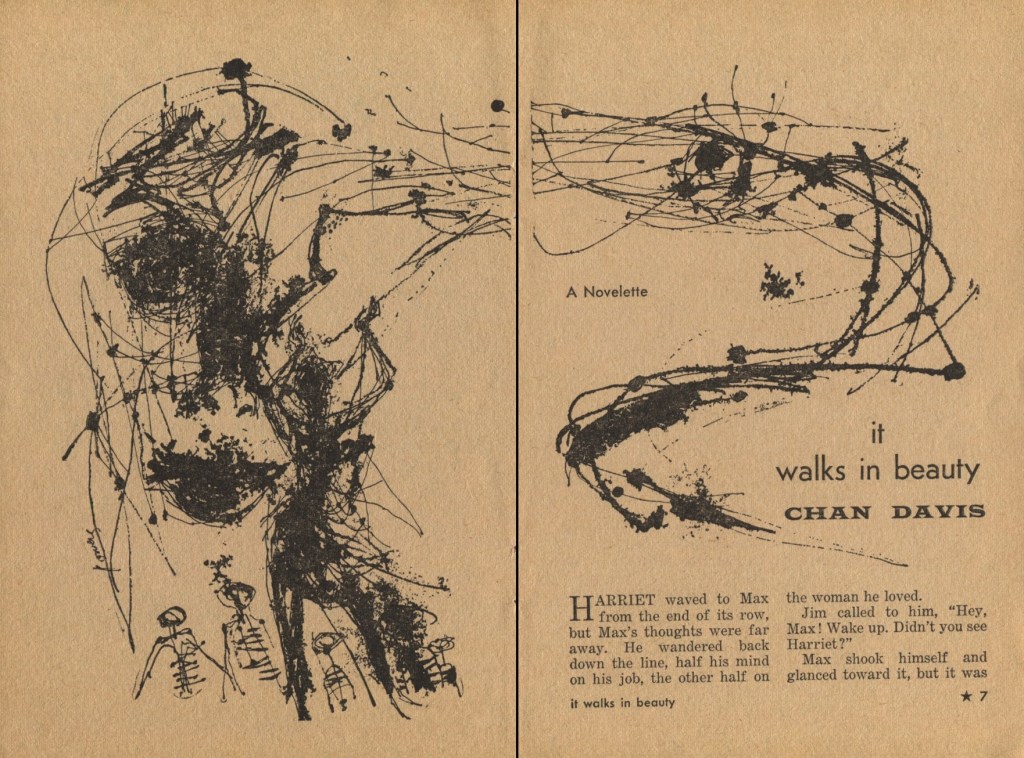
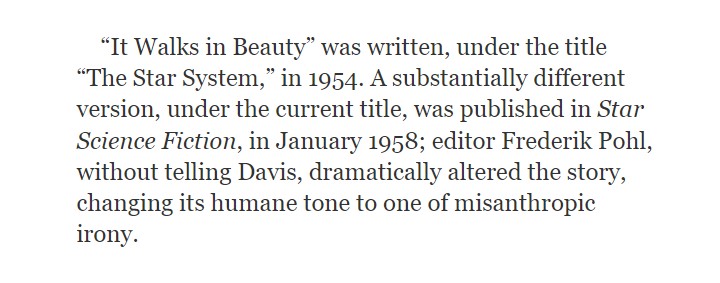
Today I read “it walks in beauty” by Chan Davis, first published in Star Science Fiction (January 1958) edited by Frederik Pohl. You can read the magazine version here. It was reprinted 9/3/3 in SciFiction at SciFi.com by Ellen Datlow who rediscovered the author’s original version. That version is in print in It Walks in Beauty, a collection of stories and essays by Chandler Davis edited by Josh Lukin. That collection was reviewed at The New York Review of Science Fiction by Mark Rich, who also provides biographical background on the mysterious Chan Davis that I won’t repeat here. However, I learned from Rich’s essay that the version I read today was altered by Frederick Pohl, which Lukin explains in an introduction:

Only looking at the two versions quickly I felt Pohl improved the story. Especially, with the opening line:

“Harriet waved to Max from the end of its row, but Max’s thoughts were far away.”

I kept rereading it wondering why Harriet was being referred to as its. Was Harriet a robot I wondered? In the Davis version, the opening line is:

“I love Luana,” said Max dreamily, leaning against the ladder that ran up the towering vat of Number 73.”

That line did nothing for me.

“it walks in beauty” is not a great story except that it plays with pronouns. Sexually attractive females are shes, but women who work are its or careers. Because we’ve become a pronoun conscious society, this makes this science fiction story from 1958 very interesting in 2022.

Max is in love with Luana, an exotic dancer. Women who want sex and babies become star performers that men chase, which is why Davis originally called the story “The Star System.” These women do everything they can to appear sexually attractive to men. They are also the women men marry. The women who want careers wear their hair short like men, wear pants, don’t get married, and don’t have children. In this story, they are ignored by men, treated like coworkers, and referred to with the pronoun it, or collectively as careers rather than girls or shes.

Chan Davis characterized men as single-minded. They equate love with sex, accept career women as equals or even professional superiors, but they don’t think of them as women. Paula is a career that is friendly and encouraging to Max, helping him to advance at his job. Max asks Paula if she wants to come with him to Luana’s dance club. He expects her to be one of the guys who’d want to watch a stripper. Eventually, Paula reveals to Max that she has a sexual side but Max can’t accept that, even when she tricks him into seeing her with a wig and make-up. He’s horrified at her pretending to be a woman, and can’t accept it when Paula tells him that Luana wears and wig and dresses up too for the part. And it really blows Max’s mind when Paula tries to convince him that playing the sexy girl role is offensive to women.

There’s a lot to admire in this 1958 science fiction story. Why then, hasn’t it been reprinted in major science fiction anthologies? Maybe in the 1950s they never imagined society playing around with pronouns? Maybe they didn’t like the idea of women having careers or the suggestion that being a sex object was an act. In 2022 people might appreciate this story more.

It’s like the famous story, “The Machine Stops” by E. M. Forster. It’s a great story for 1909, but it became a fantastic story after the internet became real.

I’m partial to 1950s science fiction, so the story might impress me in ways that modern readers will miss. I’m impressed that it stands out in hindsight. In 1958 I was seven, but if I had been ten years older, I still don’t think I would have picked up on the pronoun thing so quickly. The difference between the Pohl edit and Davis’ original is Pohl throws the reader into the pronoun thing and Davis waits to explain it. Pohl, as a skilled writer and editor, knew it was savvier to let the reader learn in context. He wanted to give the story teeth.

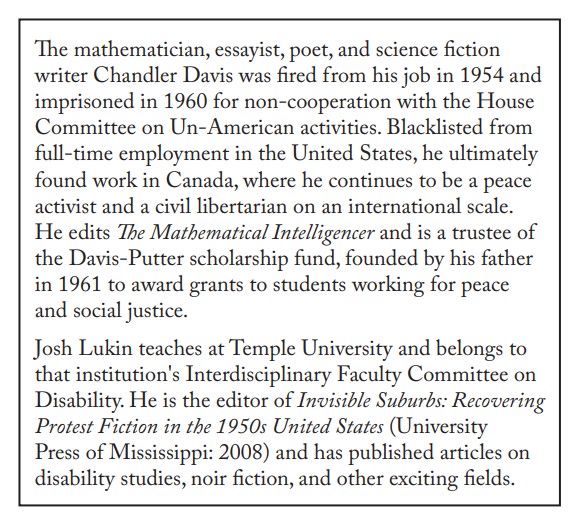
Chan Davis didn’t stick around the science fiction field for long. He was a social activist back in the 1950s so he had more important things to deal with. There’s an interview with Davis by Lukin in The Cascadia Subduction Zone v. 1 n. 1 (January 2011). This sidebar might tempt you to read it:

James Wallace Harris, 3/17/22

p.s. In case you’re wondering, I now use screenshots of quotes because my WordPress theme doesn’t word wrap in some browsers the preformatted mode I used for quotes.

Finishing The Big Book of Science Fiction

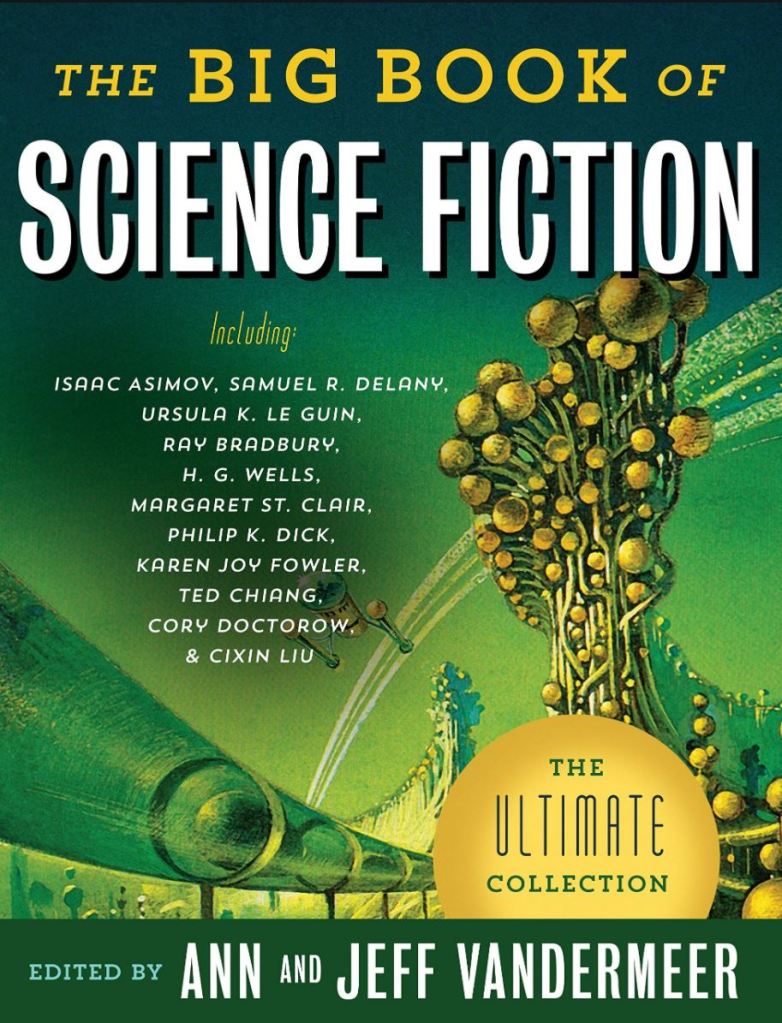
After finishing “Craphound,” I decided to go ahead and read “The Slynx” by Tatyana Tolstaya and “Baby Doll” by Johanna Sinisalo and finish The Big Book of Science Fiction. That gave me a real sense of accomplishment because The Big Book of Science Fiction is probably the largest book I’ve ever read, and I’ve read War and Peace. I’m guessing TBBofSF is even longer than The Bible.

I don’t have any final assessment on this anthology. It’s just too damn big to judge as a whole. I did complain about many of the stories, but on the other hand, it has a massive amount of great science fiction too. The other day it was on sale for $2.99 for the Kindle edition at Amazon, and I thought what a wonderful bargain. I wished I hadn’t owned it already so I could get in on such a deal.

“The Slynx” was a good science fiction story, about Moscow in the far future after an atomic war where people only remember “The Blast.” The story is about civilization being thrown back into the Dark Ages. People live by myths and superstitions. Mutations are common. This kind of story was very popular in the 1950s, and Wikipedia refers to them as nuclear holocaust fiction. Among my favorites are A Canticle for Leibowitz by Walter M. Miller, Jr., and The Long Tomorrow by Leigh Brackett. What struck me most was how Tolstaya portrayed people’s thinking in this future much like how I imagined people thinking in prehistory.

I’ve read “Baby Doll” before, but I’m not sure where. I might have read it years ago when I first bought The Big Book of Science Fiction and tried a few stories from it. At the time, I never imagined I would read it from cover to cover. “Baby Doll” is a disturbing story about the near future where the main character is an eight-year-old girl who tries to be as sexualized as possible from the clues she gets from society and her peers. It came out in 2002 and imagined a near future where grade school children would emulate the dress styles, language, and behaviors they got from watching porn and adult reality shows. I can’t help but wonder how much of that is true today? Imagine if the MTV Awards show could be sent back in time to the people in the 1950s. What would they think?

My sister recently told me she tried to get her very young granddaughter to wear something less provocative to school and the kid got upset claiming her granny was slut shaming her. I doubt “Baby Doll” could be taught in a 7th grade English class, but I sure would love to hear what the students would say about it.

On the same day finishing The Big Book of Science Fiction, I also finished Star Science Fiction Stories, the first in a series edited by Frederik Pohl from 1953. That means Group Read 27 and 35 are finishing for our Facebook group Best Science Fiction and Fantasy Short Fiction. It also means Group Read 36, Asimov’s SF Magazine Poll Finalists for 2021 starts 21st March, and Group Read 37, Hugo and Nebula Award Winners from Asimov’s Science Fiction edited by Sheila Williams will start a few days after that. It’s a coincidence that our 36th group read will be the 36th annual readers’ awards for Asimov’s Science Fiction.

So for the next several weeks, the Facebook group will be reading and discussing SF stories from the 1980s and 1990s, and 2021. If you’re interested and use Facebook drop by. I won’t be reviewing every one of these stories here, but I’ll probably write about the ones that impress me most.

James Wallace Harris, 3/15/22

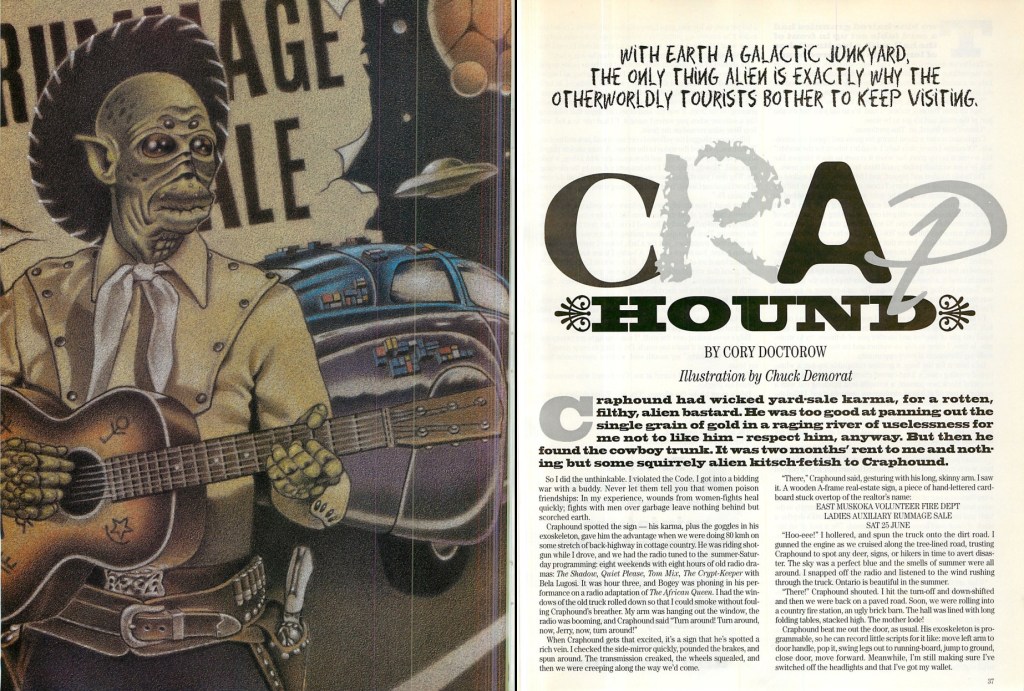
“Craphound” by Cory Doctorow

Group Read 27The Big Book of Science Fiction

Story #105 of 107: “Craphound” by Cory Doctorow

Craphound” by Cory Doctorow belongs to that wonderful sub-sub-sub-genre, nostalgia stories by science fiction writers. Other classics of that theme are “Jeffty is Five” by Harlan Ellison, “Travels With My Cats” by Mike Resnick, and “A Scent of Sarsaparilla” by Ray Bradbury. I belong to several online groups where old science fiction fans dwell on old science fiction, and many of them collect all kinds of crap from when they grew up. The novel Ready Player One by Ernest Cline resonates so well with certain readers because of its nostalgia for the 1980s.

Over my lifetime I’ve known many collectors of science fiction and their collections usually included memorabilia crap from the past. Forrest J. Ackerman, Ray Bradbury, and Harlan Ellison were known for their huge nostalgic collections (much of it toys). Just pay attention to Harlan Ellison’s house in the documentary Dreams With Sharp Teeth. A few glimpses can be had in this preview from YouTube.

All during my school and college years, I thought science fiction was about the future, but ever since then, science fiction has been about the nostalgic past. There’s an article at The Economist, “If you think sci-fi is about the future, think again” that I’d love to read but it’s behind a paywall. It’s subtitled “An exhibition in London shows how much of science fiction is fuelled by nostalgia.” If anyone is a subscriber and is willing, send me a copy.

Cory Doctorow has tuned into these nostalgic readers with a story about Jerry and his best friend known as Craphound, an alien from outer space. Both are professional hunters of old crap that they resell for big dollars to the addicts of nostalgia. Sadly, their friendship is shattered one day when they get into a bidding war over an old suitcase of cowboy clothes and toys at the East Muskoka Volunteer Fire Department Ladies’ Auxiliary sale.

Why would aliens want our old crap? Well, without Craphound (which Doctorow uses for his domain name) the story wouldn’t be science fiction, and Doctorow couldn’t have sold it to a science fiction market. Without Craphound the story would just be about a loser with arrested development making a living by going to garage sales and Goodwill stores. Without Craphound, the story would be about people like us. Just imagine if you’re yard sale copilot was an ET.

Nostalgic SF is closely related to Recursive SF. If I could remember better, I could cite a long list of stories where science fiction stories longingly look back to the past.

In recent years I’ve been collecting old science fiction anthologies and a fair amount of old science fiction magazines and fanzines. I was just looking at my wall of bookshelves and thinking about all the people that once held those books and magazines. There must have been thousands of folks like me. Mike Resnick was one since I bought some fanzines on eBay with mailing labels addressed to him. When I die my wife will liquidate my collection and it will go to new collectors. Some of my things would make garage sale craphounds very happy. Who knows, maybe one of them will be an alien.

Main Page of Group Read

James Wallace Harris, 3/15/22