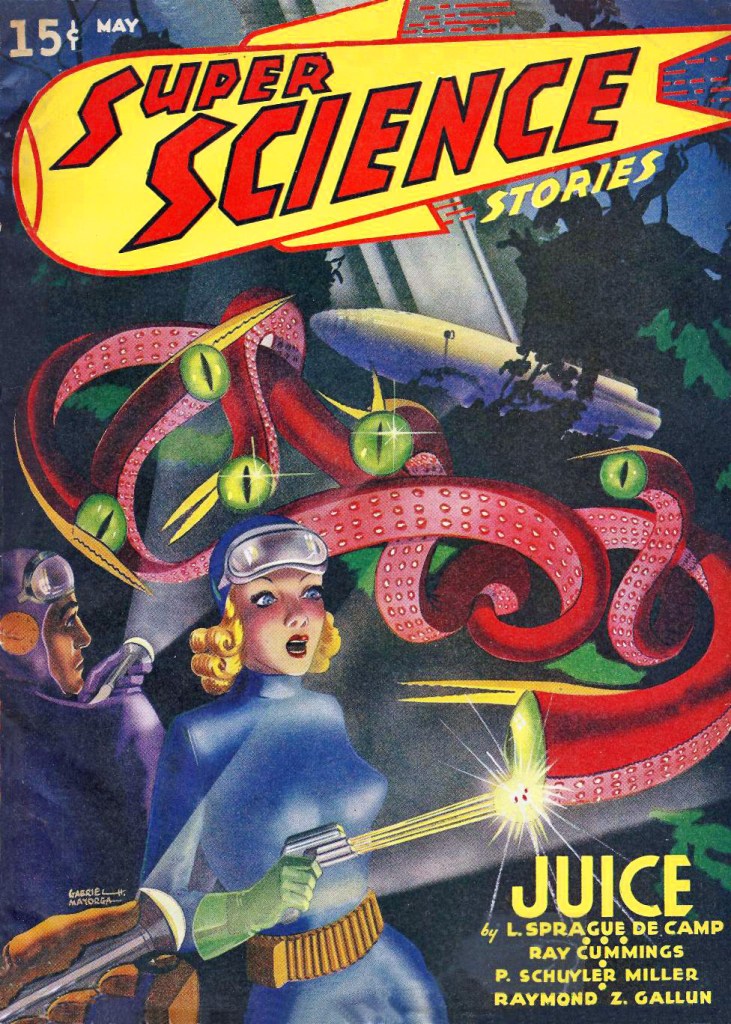
In 1939 Heinlein wrote several stories that were rejected by John W. Campbell. Heinlein wanted to save his name for stories appearing in Astounding and invented pen names for “lesser” publications. I think that was a bad idea. He sold “Let There Be Light” to Frederik Pohl for Super Science Stories and it was run under the Lyle Monroe byline. But if you look at the table of contents below, you’ll see that L. Sprague de Camp and P. Schuyler Miller weren’t protecting their Astounding reputations.
Heinlein should have used his own name for all of his stories. It would have helped out the smaller markets. Frederik Pohl practically begged Heinlein to let him publish it under his real name. Heinlein evidently felt anything Campbell rejected wasn’t first-class and he didn’t want his name associated with such stories. Heinlein obviously wanted to shape his public persona. Doesn’t that reveal a kind of egotism that disassociates flaws from their self-identity? Heinlein is perfect. Who knows who those other guys are?
Even when Campbell published two stories by Heinlein in a single issue he should have put Heinlein’s own name on them. Heinlein would have been an even greater phenomenon than he was, even with his flawed stories. Using all those names split up his reputation and momentum. And Heinlein shouldn’t have assumed Campbell was the arbiter of quality in science fiction.
“Let There Be Light” opens with Dr. Archibald Douglas getting a telegram from Dr. M. L. Martin. Martin informs Douglas “ARRIVING CITY LATE TODAY STOP DESIRE CONFERENCE COLD LIGHT YOUR LABORATORY TEN PM.” Douglas is affronted at the presumption that an unknown character could barge into his lab. Douglas consults Who’s Who in Science, and discovers Martin has a string of degrees and many prestige appointments and papers but is a biologist. Douglas figured a biologist cannot possibly connect to his work in physics.
When Douglas finally meets Martin, M. L. turns out to be Mary Lou, and she’s a beautiful young blonde. This is rather amusing since Heinlein makes all beautiful women redheads after he marries his third wife Virginia. In the 1940 magazine version, Mary Lou is compared to Sally Rand, who Heinlein and his wife Leslyn knew. In the 1950 book version, she’s compared to Marilyn Monroe. I’m surprised he didn’t switch it to a famous redhead. And Mary Lou can’t believe Archie is Dr. Douglas because he looks like a gangster. In the 1940 version, he’s compared to George Raft, but in the book version, no person is mentioned.
Heinlein did some other minor tweaking to the story when it was reprinted in book form. Strangely, the magazine version used the word hell frequently, and I think a damn was in there too, and Heinlein removed them. He also took out some of the gooiest of the sweet talk.
“Let There Be Light” turns into an invention story, but instead of featuring a mad scientist, Heinlein gives us two movie star lookalikes whose dialog sounds like it was written for a 1930s Warner Brothers picture. There’s a fair amount of scientific infodumping which lets the couple invent lighting that sounds like the LED overhead panel in my kitchen, and then solar panels. Of course, this isn’t much of a plot, so Heinlein throws in the conflict of evil corporations keeping innovative inventions off the market to protect the economics of older technology. That’s still not much of a plot.
Heinlein had spent years involved with California politics and was still griping about corruption. Even in the 1960s, I used to hear stories, often from my uncles, about how inventions were kept off the market, such as car engines that could get 200 miles to the gallon. There have always been conspiracy stories. Heinlein expresses other leftist ideas in the story too.
According to William Patterson, “Let There Be Light” was originally titled “Prometheus ‘Carries the Torch'” and it was also rejected by Thrilling Wonder Stories.
“Let There Be Light” isn’t a particularly good story. Its pluses, at least for us today, is it features a positive role for a female character. And it predicts solar power. So why did Campbell reject it? Patterson quotes Campbell’s rejection letter to Heinlein:
So Campbell is afraid of brainy women? That could explain a lot about Astounding/Analog. Heinlein loved brainy women, Leslyn and Virginia proved it. It’s just a shame he couldn’t write better dialogue when it came to men and women. It often seemed like poor dialogue cribbed from B-movie screwball comedies, and in his later novels, flirty dialogue sounded like a twelve-year-old girl trying to write a grownup romance after studying porn films.
Still, I enjoyed the story. It has no lasting value. We can stick a star on it for having a smart woman character, and another for predicting the solar energy industry. But that’s hardly enough to make it a good story for modern readers. Heinlein should have published it with his own name. He should have owned up to it. No one expects a writer to hit one out of the park every time they’re up to bat. And isn’t it odd that he wouldn’t put his name on it in 1940 for a magazine that few people would read, but would admit paternity when it came to a hardback publication in 1950?
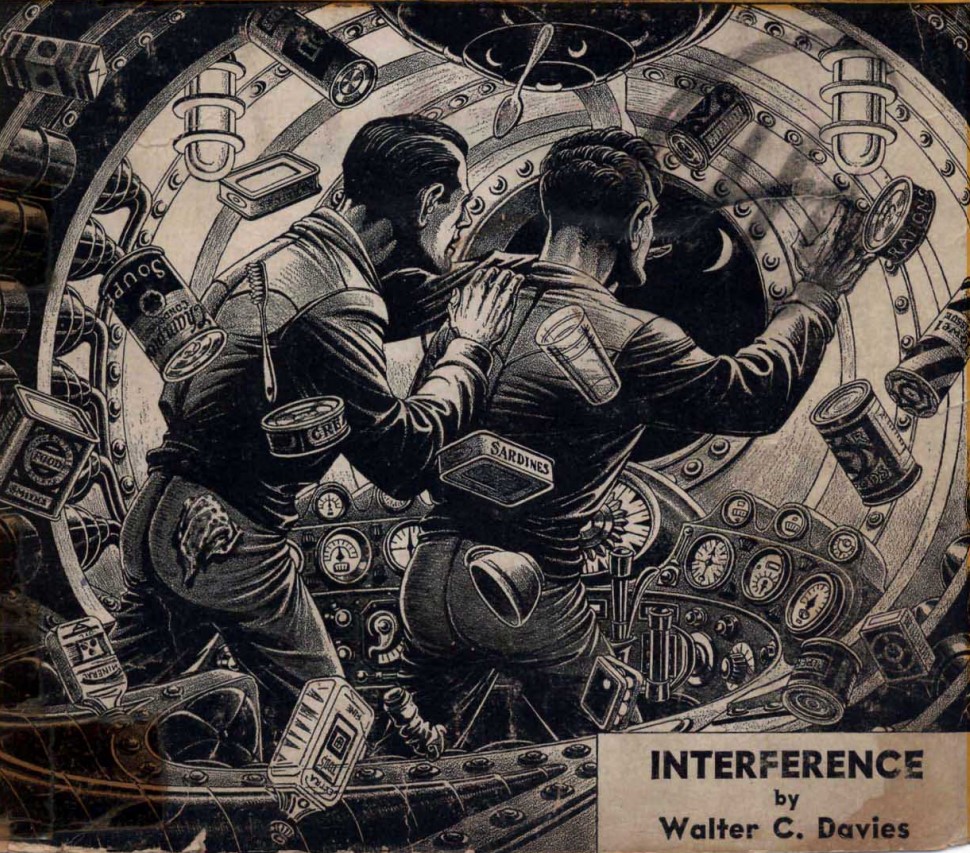
Heinlein wasn’t the only contributor showing powerful women, the cover artist paints a fully-clothed woman shooting a BEM.
Robert Heinlein wrote several stories in 1939 that he couldn’t sell to John W. Campbell. This is when he started submitting to the lesser markets, but some stories still didn’t sell. When Ray Bradbury asked Heinlein for a contribution to his fanzine, Heinlein gave Bradbury the short short “Heil!” It was later reprinted in 1970 by Sam Moskowitz in his anthology, Futures to Infinity. Then in 1980 Heinlein included in his grabbag collection, Expanded Universe: The New Worlds of Robert A. Heinlein. Heinlein renamed the story “Successful Operation.”
In the introduction to the story in Expanded Universe Heinlein said he wrote “Heil!” right after “Life-Line.” Heinlein then goes on to complain about people asking writers to contribute free work to various projects. He points out that people don’t ask for free rides from taxi drivers or free food from their grocery stores. The intro has Heinlein talking about the importance of saying no to such requests, and he takes a snipe at science fiction fans, “The chutzpah is endemic in science fiction fans, acute in organized SF fans, and at its virulent worst in organized fans-who-publish-fan-magazines.”
Heinlein really should have said no to Ray Bradbury. “Heil!” is not badly written, but it’s extremely slight, and pulls off a gimmick that only an amateur would think was a good idea. You can read the story in Bradbury’s fanzine, futuria fantasia, v. 1 n. 4 (Spring, 1940). Heinlein doctored the story when he retitled it.
It is common in literary history to read accounts of writers burning unpublished work before their death. Or heirs destroying it right after an author’s death. This horrifies fans and scholars. But reading stories like “Heil!” suggests it might be a worthwhile practice. Not everything a great writer writes will be great.
On the other hand, writers write to make a living, and at the beginning of his career Heinlein was churning out his product. And eventually “Successful Solution” made him some money. Heinlein had 5 Rules for Writing:
You must write.
You must finish what you start.
You must refrain from rewriting except to editorial order.
You must put it on the market.
You must keep it on the market until sold.
Heinlein blazed onto the science fiction world following these rules, proving quality isn’t always required. Several of Heinlein’s clunkers were published early in his career, but he hid them with pseudonyms. “Heil!” was originally published by Lyle Monroe.
“Successful Operation” is currently in print in paperback, ebook, and audiobook in Expanded Universe: Volume One. For many years Expanded Universe was sold as a single volume, but in recent years it’s split in two. Probably most buyers consider that a ripoff but was probably required for a small publisher like Phoenix Pick. However, the volume will appeal only to hardcore fans of Heinlein and probably shouldn’t be read by casual fans and readers just checking out Heinlein. Much of the content was dredged from stories and essays not previously published, obscurely published, or seldom reprinted.
Anyone visiting an average new bookstore today will probably find few Heinlein titles. This is not the time to promote the dregs of his career.
Yet, that brings up an important question: What works by Heinlein should be on shelves for readers new to Heinlein to discover? Heinlein’s estate and a good editor should really come out with The Best Short Stories of Robert A. Heinlein. That was tried a couple times in England in the 1970s, but their selection was not the best. Most of Heinlein’s classic original collections are still in print, but they are a mixture of great, good, and not-so-good stories.
Of the four short stories I’ve read and reviewed so far, including “Successful Operation,” I might include “Life-Line” and “Requiem” in a best-of volume. But that depends on the page size of the volume. Definites that I’ve reread recently would be “The Menace From Earth” and “All You Zombies …” but I need to keep rereading.
Heinlein’s third published story, “Requiem” (Astounding Jan. 1940) is a salute to science fiction fans, or at least that’s how I read it. John W. Campbell, Jr. thought it overly sentimental but decided to run it anyway to see what his readers thought. They didn’t seem to like it either. “Requiem” came in next to last in March’s Analytical Laboratory. “Requiem” even lost to “Robbie” by Isaac Asimov in 2016’s Retro Hugo Awards for 1941, and that’s another overly sentimental tale.
In both cases, my evidence isn’t reliable since the Analytical Laboratory is based on mentions in letters to the editor, which generally favor comments on the serials, and Retro Hugo award voters seldom read all the finalists. They tend to vote for their favorite authors. But it’s the evidence I got, and it’s evidence Heinlein used to measure his success at the time.
I love “Requiem”. It’s a solid, well-constructed story, with vivid characters and a satisfying ending, one with an emotional punch. The story is quite simple. D. D. Harriman is a rich old man who made his pile commercializing space travel. He contacts a couple down-and-out space jockeys, McIntyre the pilot, and Charlie the mechanic, about taking him to the Moon. Harriman has a weak heart and is legally forbidden to travel to space. Harriman promises to finance the whole deal and they get to keep the rocketship which would put them back into space too. The law was correct, Harriman couldn’t handle space travel, and he died right after they land on Luna. But he dies happy and satisfied.
I figured Harriman was a stand-in for Heinlein. Going to the Moon was Heinlein’s lifelong dream, even back in 1940. Heinlein uses Harriman again in 1950 for “The Man Who Sold the Moon.” I bet Heinlein cast himself as Harriman in his own Walter Mitty fantasies, at least until he created Jubal Harshaw. This quote from the story is Heinlein projecting his own personal feelings into the future:
“Captain, it’s the one thing I’ve really wanted to do all my life—ever since I was a young boy. I don’t know whether I can explain it to you, or not. You young fellows have grown up to rocket travel the way I grew up to aviation. I’m a great deal older than you are, at least fifty years older. When I was a kid practically nobody believed that men would ever reach the Moon. You’ve seen rockets all your lives, and the first to reach the Moon got there before you were a young boy. When I was a boy they laughed at the idea.

“But I believed—I believed. I read Verne, and Wells, and Smith, and I believed that we could do it—that we would do it. I set my heart on being one of the men to walk on the surface of the Moon, to see her other side, and to look back on the face of the Earth, hanging in the sky.

“I used to go without my lunches to pay my dues in the American Rocket Society, because I wanted to believe that I was helping to bring the day nearer when we would reach the Moon. I was already an old man when that day arrived. I’ve lived longer than I should, but I would not let myself die . . . I will not!—until I have set foot on the Moon.”

Heinlein, Robert. The Man Who Sold the Moon and Orphans of the Sky (pp. 292-293). Baen Books. Kindle Edition.
William Patterson, Jr. documents two cases that showed Heinlein was an early supporter of space travel outside of science fiction.
Late in January Heinlein joined the new American Interplanetary Society that had been formed in December 1930 in New York, with fourteen charter members. Heinlein had membership number 22. He told people about it in the Navy—Buddy Scoles, especially—and found that he was considered something of a “goof” because rockets were “crazy Buck Rogers stuff”—toys, at best.12 The first bulletin he received from the society contained a report of a visit by French Academician Robert Esnault-Pelterie13 on January 27, 1931, saying he thought it might be possible to travel to the Moon and return as soon as fifteen years from now—1946.

Patterson, William H. . Robert A. Heinlein: In Dialogue with His Century, Volume 1 (p. 148). Tom Doherty Associates. Kindle Edition.
In 1934 after the American Interplanetary Society changed its name to the American Rocket Society. We need to remember, in the 1930s, there was very little rocket development, and Robert H. Goddard’s rockets barely got into the sky, much less leave the Earth. Heinlein had zeroed in on this industry at almost the beginning.
One day at the Denver Athletic Club when he was judging a fencing match, he met Robert Cornog, a young engineer working on Boulder Dam and about to apply for graduate study at the University of California at Berkeley; they found they had the same birthday, five years apart (Cornog was born in 1912)—and both had joined the American Rocket Society. They became friendly thereafter.

Patterson, William H. . Robert A. Heinlein: In Dialogue with His Century, Volume 1 (pp. 166-167). Tom Doherty Associates. Kindle Edition.
And the story, “Requiem” attacks one of Heinlein’s most hated foes, the Nanny State. Luckily, for us, Heinlein didn’t lecture about this but showed it. That’s why writing teachers always bitch about show don’t tell. And it’s the second reason why I admire this story because I did love the sentimentality for my first reason. I admire Heinlein most when he constructs a proper short story, and “Requiem” is one for sure.
Heinlein was an enigma. Throughout his life and work, he rebelled against excess control in the government, yet he worshiped the military way of life, which is extremely regulated. Heinlein’s characters love to follow the rules and find ways to skirt them. The illegal moon rocket site in “Requiem” was later reused in Rocketship Galileo.
But there is a third aspect to “Requiem” that I detect from reading about Heinlein. Heinlein tried his hand at politics in the mid-1930s. And one of the things I’m sure he learned was how to flatter the voters. I believe “Requiem” was a statement of Heinlein’s beliefs and a bit of flattery for science fiction fans. Heinlein was campaigning to be the leader of science fiction. To do that he had to impress the fans with his stories, and himself. This is my first bit of evidence:
They smoked in silence for a while, each thinking about the coming trip and what it meant to him. Old Harriman tried to repress the excitement that possessed him at the prospect of immediate realization of his life-long dream.

“Mr. Harriman—”

“Eh? What is it, Charlie?”

“How does a guy go about getting rich, like you did?”

“Getting rich? I can’t say; I never tried to get rich. I never wanted to be rich, or well known, or anything like that.”

“Huh?”

“No, I just wanted to live a long time and see it all happen. I wasn’t unusual; there were lots of boys like me—radio hams, they were, and telescope builders, and airplane amateurs. We had science clubs, and basement laboratories, and science-fiction leagues—the kind of boys who thought there was more romance in one issue of the Electrical Experimenter than in all the books Dumas ever wrote. We didn’t want to be one of Horatio Alger’s Get-Rich heroes either, we wanted to build spaceships. Well, some of us did.”

“Jeez, Pop, you make it sound exciting.”

“It was exciting, Charlie. This has been a wonderful, romantic century, for all of its bad points. And it’s grown more wonderful and more exciting every year. No, I didn’t want to be rich; I just wanted to live long enough to see men rise up to the stars, and, if God was good to me, to go as far as the Moon myself.” He carefully deposited an inch of white ash in a saucer. “It has been a good life. I haven’t any complaints.”

Heinlein, Robert. The Man Who Sold the Moon and Orphans of the Sky (pp. 300-301). Baen Books. Kindle Edition.
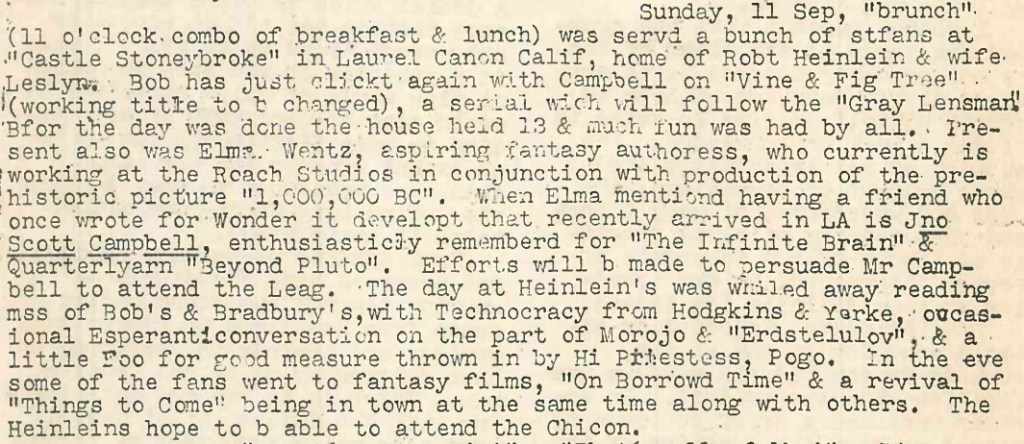
Just before Heinlein wrote “Life-Line” he made contact with Los Angeles science fiction fans. This could have encouraged him to get into writing for science fiction magazines, or Heinlein might have been on a recon mission to get to know the fans. This is from the column “Far West Facts” in the Ad Astra #4, a Chicago fanzine published in November of 1939 by Farwest Jack Erman.
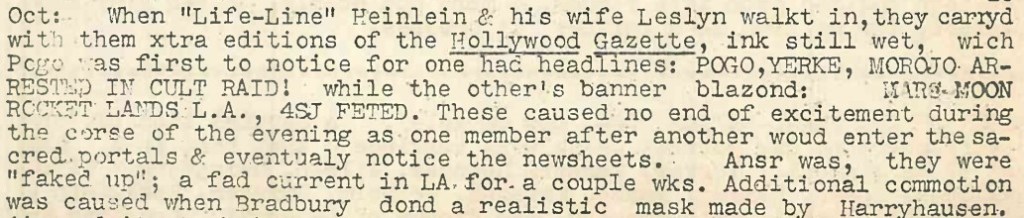
Then from the same column, in issue #5 dated January 1940, we get this tidbit.
I believe Heinlein was older than many of the LASFS fans, and he and Leslyn made an impression by writing up some fake news stories and having them printed as from the local paper. They also impressed the younger fans by hosting a meeting and being gracious and sophisticated hosts. These two instances were before “Misfit” would appear, and a couple of months before “Requiem” would hit the stands.
Heinlein had instant success with “Life-Line” but Campbell returned the first version of “Misfit.” And Campbell had been bouncing other stories Heinlein had been cranking out and so Heinlein was looking at other markets to sell them to, including Fred Pohl’s Astonishing Stories, a bottom-of-the-barrel market. My guess is he felt elated with “Life-Line” but then had a string of rejections, which blew his confidence, and Heinlein started studying the markets and fans. My guess is Heinlein wrote “Requiem” to endear himself to his audience. To show them he was one of them, and he believed in their cause.
Early fans were true believers in the potential of space travel. It’s almost impossible for people today to understand how the average American felt about science fiction. It was that “crazy Buck Rogers stuff.” And if you’ve ever seen a Buck Rogers serial, you’ll know what I mean. And rocket research in the U.S. was barely beginning. It wasn’t until the end of WWII when the world was shocked by atomic bombs and V-2 rockets that science fiction had any public validity. Science fiction fans felt they could see the future.
“Requiem” was Heinlein’s way of telling science fiction fans that they were special. When Heinlein wrote a letter thanking Campbell for buying “If This Goes On—” he submitted “Requiem” and said, “Enclosed is a short [“Requiem”]. I hope you like it. In a way, it’s my pet.”
Campbell bought it right away in August 1939, but said he didn’t like it, but would use it as an experiment to see if the readers would. But evidently, it didn’t go over like he expected. First, Campbell spoiled the story by adding four lines at the end that Heinlein thought completely spoiled the tone of the ending. They were:
Charlie looked toward the relaxed figure propped up on the bed of Lunar pumice, face fixed toward the Earth. "Well,' he grunted, "he hit the Moon—"
I only found one letter that mentions “Requiem.”
That was in the March issue. “If This Goes On—” started serializing in February, and that’s when Heinlein started getting some real notice in the letter column. But again, it was a serial, and they usually got the most attention. It also got him his first cover.
“Requiem” is one of my favorite Heinlein short stories, maybe second to my favorite, “The Menace From Earth.” However, that order might change as I haven’t read many of them for years, and might discover forgotten gems as I reread all of Heinlein’s short stories for this project. I believe Farah Mendlesohn also admired “Requiem” a great deal because she spent many pages in The Pleasant Profession of Robert A. Heinlein discussing the story in her Rhetoric chapter. I would reprint it except its length would probably trigger a copyright violation, but I will copy the first two pages. Campbell wanted to reject “Requiem” because it was too sentimental, but Mendlesohn recognized sentiment as one of Heinlein’s major virtues as a science fiction writer:
As I reread Heinlein, I’m trying very hard to forget the older Heinlein that dominates my memories. We need to remember the young Heinlein. Actually, we need to picture Heinlein as he was when he wrote each story. Most readers expect a story to be self-contained and work as a stand-alone work of art. That’s fine for superficial enjoyment. But I see Heinlein as wanting to influence or even shape the future, and he used science fiction as his tool.
J. G. Ballard made his science fiction debut in two magazines, New Worlds Science Fiction and Science Fantasy, both dated December 1956. These are the first two stories in The Complete Stories of J. G. Ballard which I just began listening to on audio. You can borrow a copy of the scanned hardback from the Internet Archive for one hour here. Amazon has a Kindle edition for just under $15. Or you can read “Prima Belladonna” online here, and listen to “Escapement” here. Links to radio and film versions are here.
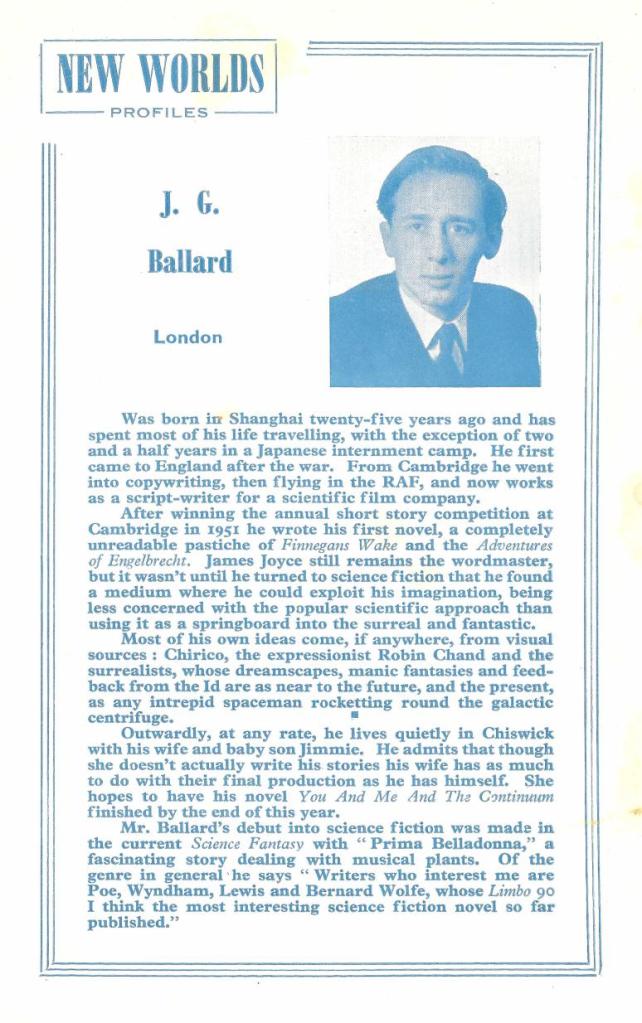
New Worlds also profiled Ballard on the inside front cover.
Ballard’s story for New Worlds, “Escapement” was a very early time loop tale. “Prima Belladonna” in Science Fantasy was Ballard’s first Vermillion Sands story. Both stories were well-written and entertaining and both struck me as pure storytelling. No message, no theme, no psychological insights. As far as I could tell, neither had a point other than being an interesting story.
I was completely satisfied with both short stories, but I wondered if I should dismiss them for having no depth? Right after reading those stories, I read “The Cinderella Machine” by Michael G. Coney, first published in F&SF (Aug. 1976). It reminded me of a Vermillion Sands story. I checked and Coney is a British writer from Ballard’s generation. It too was a pure story. I wondered if Coney had been inspired by Ballard, or if writers from that generation just tended to write those kind of stories.
I suppose in each of these stories I could dig around and find something insightful or meaningful about them, but they seemed complete and self-contained, so why bother? I feel little need to describing these stories because the very act of reading them are what they are about. “Prima Belladonna” and “The Cinderella Machine” are set in artist colonies, featuring a striking women character who is not necessarily nice, and both include an exotic science fictional creature. “Escapement” is about a man who can’t understand why his wife doesn’t notice technical difficulties in the television show they are watching.
I could say Ballard and Coney are expressing some science fictional ideas. These ideas aren’t meaningful, or significant, or even insightful. They are just some weird creative shit that both authors thought up.
All the best stories are stories that feature solid storytelling. But it seems to me, all great stories go one step further. A perfect example is Bob Shaw’s “The Light of Other Days.” It’s a solid story. It has a science fiction invention. But it’s deeply moving. You can listen to it here.
Ballard’s and Coney’s stories lack the moving part. Does that mean they can never be 5-star stories? I consider “Escapement” a three-star plus story. I consider “Belladonna” and “The Cinderella Machine” to be just squeaking by four-star stories. By the way, I give stories I believe are well-written and professional three stars. If I like them a lot, I add a plus. Four-star stories are ones I look forward to reading again. Five-star stories are classics that will stand the test of time, and are often ones I’ve read several times over my lifetime.
I really admire pure story stories. I just don’t know if I should recommend them to other people.
I do know one thing though. I’d rather read a good pure story without depth than a poorly told story that tries to be deep.
Robert Heinlein began publishing science fiction in 1939 but by July of 1941, he was the guest of honor at the 3rd Worldcon. How did he get so famous within fandom so fast? I always imagined he blazed upon the genre right from his first publication, but looking over the 1939 and early 1940 letter columns in Astounding gave no indication that was true.
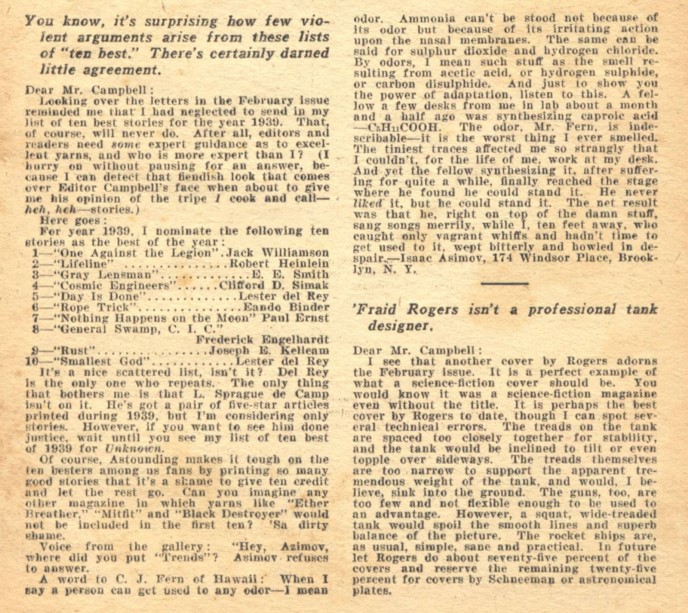
Heinlein published just two stories in 1939 (Aug. and Nov.), “Life-Line” and “Misfit.” “Life-Line” came in second in the Analytical Laboratory columns and “Misfit” last. The letter writers barely mentioned Heinlein. Not quite a stunning debut. However, in the April 1940 issue of Astounding, there’s a letter from Isaac Asimov rating all the stories for 1939, and “Life-Line” came in second — even ahead of the serial Gray Lensman. (Asimov also jokes about his own debut short story, “Trends.”)
Years later, in 1979, Isaac Asimov and Martin H. Greenberg published The Great SF Stories 1 (1939), the first in a series that collected the best science fiction short stories for every year from 1939-1963. Three of the ten stories he picked in 1940 are included, and he adds “Misfit.” Here’s the complete table of contents:
• The Strange Flight of Richard Clayton • short story by Robert Bloch
• Trouble with Water • short story by H. L. Gold
• Cloak of Aesir  • novella by John W. Campbell, Jr.
• The Day Is Done  • short story by Lester del Rey
• The Ultimate Catalyst  • novelette by John Taine
• The Gnarly Man  • novelette by L. Sprague de Camp
• Black Destroyer  • novelette by A. E. van Vogt
• Greater Than Gods  • novelette by C. L. Moore
• Trends  • short story by Isaac Asimov
• The Blue Giraffe  • novelette by L. Sprague de Camp
• The Misguided Halo  • short story by Henry Kuttner
• Heavy Planet  • short story by Milton A. Rothman
• Life-Line  • short story by Robert A. Heinlein
• Ether Breather  • short story by Theodore Sturgeon
• Pilgrimage  • novelette by Nelson S. Bond [as by Nelson Bond]
• Rust  • short story by Joseph E. Kelleam
• The Four-Sided Triangle  • novelette by William F. Temple
• Star Bright  • novelette by Jack Williamson
• Misfit  • novelette by Robert A. Heinlein
These are the stories that have survived the test of time — at least with two people very familiar with the genre in 1979. How many young science fiction readers today know of them, or even heard of the writers who wrote them? Asimov and Heinlein are still big names, well to some, but you’d have to be an aficionado of the genre to know the others.
Our CSF database contains 34 short stories from 1939, but only 8 got 3 or more citations, and only one (“Black Destroyer”) made our final list. By our criteria, “Life-Line” and “Misfit” aren’t well remembered. (But there’s another issue here, the trailing edge of pop culture memory. My guess is the 1930s and 1940s are generally being forgotten. But that’s another essay for another time.)
What stories did the fans love back in 1939-1940? Fanac.org has a treasure trove of fannish history with its archive of old fanzines but I can’t tell how they are indexed. Fanac.org has a link to Google, but I’m not sure how useful it is. I’ve looked around for a fanzine with short story reviews, but so far haven’t found one. If anyone knows of one, or how to use the archive better, let me know. However, often the content of fanzines is not about science fiction.
As far as I can tell, there has been no Retro Hugo Award for 1940 (1939).
My next source for information about the best science fiction stories of 1939 comes from A Requiem for Astounding by Alva Rogers. Of course, it only covers Astounding. Rogers discusses Heinlein, but this is long after the fact. Follow the link to read his review of 1939.
This brings me to my final source of information for the popularity of science fiction short stories that came out in 1939: The Time Machines: The Story of the Science-Fiction Pulp Magazines from the beginning to 1950 by Mike Ashley. This is a fantastic history of science fiction magazines, but I didn’t find what I was looking for. It may have more of what I want covering later years.
Years later, 1939 would be remembered as the beginning of Science Fiction’s Golden Age. John W. Campbell, Jr. will be remembered for discovering three new writers that year: A. E. van Vogt, Heinlein (August), and Theodore Sturgeon (September). Van Vogt had two stories that year and got the cover for both. Heinlein and Sturgeon would have to wait to get such recognition. Asimov is considered a protégé of Campbell’s, but he was first published by Ray Palmer (“Marooned Off Vesta”, Amazing Stories, March 1939.) “Trends” was his first story for Campbell.
However, Campbell published new writers all the time. It’s only in hindsight that he gets credit for discovering Asimov, Heinlein, Sturgeon, and van Vogt.
I’m already reading the 1940 issues of Astounding and I believe this year will be when Heinlein is discovered. However, the first Worldcon was in July of 1939, although fandom had existed for years before that. Was fandom small enough that everyone knew everyone else? Did every writer who made it onto the table of contents of a science fiction magazine encounter fandom?
Still, there are quite a few questions I’d like answered.
Why did Heinlein start writing science fiction?
Why science fiction and not the other genres?
Did he read science fiction magazines?
Did he know about fandom?
Was he a member of a science fiction club?
Did he know any science fiction writers or fans?
I just remembered I should reread Robert A. Heinlein: In Dialogue With His Century, the two-volume biography of Heinlein by William H. Patterson, Jr. Maybe Patterson has done all this work for me.
“Misfit” (Astounding, Nov. 1939) was Heinlein’s second published story and his first about space travel. It’s also his first work of juvenile fiction, or what we call YA today. Heinlein renamed FDR’s New Deal Civilian Conservation Corps (CCC) the Cosmic Construction Corps for this future space adventure. I thought that was a really neat idea. And Heinlein created one of his favorite characters, Andrew Jackson Libby, who would reappear in Methuselah’s Children in 1941, and yet again in four of Heinlein’s 1970s and 1980s novels. Eventually, Libby would become a woman, Elizabeth Andrew Jackson Libby, but we won’t get into that for a very long time. Some fans even consider Max Jones of Starman Jones a repackaging of the Libby character, but I don’t.
I never liked the way Heinlein reused his characters because he eventually turned characters I loved into characters I hated. But that’s another subject to deal with in future essays.
The plot of “Misfit” isn’t very complicated. Libby is a young man who we follow into space. Like many of the boys on the ship, Libby experiences space sickness at first but eventually adapts to living in free fall. His crew arrives at a small asteroid called HS-5388, or just Eighty-Eight. Their job is to build habitats and rocket engines into the rock. Their goal is to reposition the asteroid into an orbit between Earth and Mars to make it into an emergency shelter for space travelers.
There’s little conflict or drama in the story. The only surprise in the story is we learn that Libby has a savant’s ability for mathematics, and saves the day when their “computer” conks out. Heinlein calls Libby a lightning calculator and gives him the nickname “Slipstick” – a slang term for a slide rule. In this1939 story, the word computer was not used. They called their computer an “integral calculator.” Boy, wouldn’t Heinlein have wowed us today if he had imagined a handheld calculator instead of a slide rule? (I loved using my slide rule in my math classes back in the 1960s and 1970s. I wish I had kept it.)
This is why I said in my review of “Life-Line” that I thought “Life-Line” was a much better story than “Misfit.” In “Life-Line” Heinlein gets us hooked right away on whether or not Hugo Pinero’s invention is real, and the whole story focuses on that plotline. “Misfit” is a story where this happens, then this happens, and then another thing happens until we reach an end. It’s still a good story, but it doesn’t have a tight plot. Even the dramatic scene of Libby saving the day when putting the asteroid into its new orbit isn’t done with much drama. Still, the “Misfit” is readable and likable, but its deadpan style makes me think of the old TV show Dragnet.
Heinlein had a side to him that just enjoyed explaining how things worked. My favorite part of the story was Heinlein showing us what weightlessness would be like. I thought he got it very right for 1939. And I checked to see if he hadn’t updated the story later, but he hadn’t. I don’t know if any writer back then worked out what living in microgravity would be like. I was very impressed. They call Libby Pinky, I guessed because of his red hair and complexion.
The ship’s loudspeaker blatted out, “All hands! Free flight in ten minutes. Stand by to lose weight.” The Master-at-Arms supervised the rigging of grab-lines. All loose gear was made fast, and little cellulose bags were issued to each man. Hardly was this done when Libby felt himself get light on his feet—a sensation exactly like that experienced when an express elevator makes a quick stop on an upward trip, except that the sensation continued and became more intense. At first it was a pleasant novelty, then it rapidly became distressing. The blood pounded in his ears, and his feet were clammy and cold. His saliva secreted at an abnormal rate. He tried to swallow, choked, and coughed. Then his stomach shuddered and contracted with a violent, painful, convulsive reflex and he was suddenly, disastrously nauseated. After the first excruciating spasm, he heard McCoy’s voice shouting.

“Hey! Use your sick-kits like I told you. Don’t let that stuff get in the blowers.” Dimly Libby realized that the admonishment included him. He fumbled for his cellulose bag just as a second temblor shook him, but he managed to fit the bag over his mouth before the eruption occurred. When it subsided, he became aware that he was floating near the overhead and facing the door. The chief Master-at-Arms slithered in the door and spoke to McCoy.

“How are you making out?”

“Well enough. Some of the boys missed their kits.”

“Okay. Mop it up. You can use the starboard lock.” He swam out.

McCoy touched Libby’s arm. “Here, Pinkie, start catching them butterflies.” He handed him a handful of cotton waste, then took another handful himself and neatly dabbed up a globule of the slimy filth that floated about the compartment. “Be sure your sick-kit is on tight. When you get sick, just stop and wait until it’s over.” Libby imitated him as best as he could. In a few minutes the room was free of the worst of the sickening debris. McCoy looked it over, and spoke:

“Now peel off them dirty duds, and change your kits. Three or four of you bring everything along to the starboard lock.”

At the starboard spacelock, the kits were put in first, the inner door closed, and the outer opened. When the inner door was opened again the kits were gone—blown out into space by the escaping air. Pinkie addressed McCoy, “Do we have to throw away our dirty clothes too?”

“Huh uh, we’ll just give them a dose of vacuum. Take ’em into the lock and stop ’em to those hooks on the bulkheads. Tie ’em tight.”

This time the lock was left closed for about five minutes. When the lock was opened the garments were bone dry—all the moisture boiled out by the vacuum of space. All that remained of the unpleasant rejecta was a sterile powdery residue. McCoy viewed them with approval. “They’ll do. Take them back to the compartment. Then brush them—hard—in front of the exhaust blowers.”

The next few days were an eternity of misery. Homesickness was forgotten in the all-engrossing wretchedness of spacesickness. The Captain granted fifteen minutes of mild acceleration for each of the nine meal periods, but the respite accentuated the agony. Libby would go to a meal, weak and ravenously hungry. The meal would stay down until free flight was resumed, then the sickness would hit him all over again.

On the fourth day he was seated against a bulkhead, enjoying the luxury of a few remaining minutes of weight while the last shift ate, when McCoy walked in and sat down beside him. The gunner’s mate fitted a smoke filter over his face and lit a cigarette. He inhaled deeply and started to chat.

“How’s it going, bud?”

“All right, I guess. This spacesickness—Say, McCoy, how do you ever get used to it?”

“You get over it in time. Your body acquires new reflexes, so they tell me. Once you learn to swallow without choking, you’ll be all right. You even get so you like it. It’s restful and relaxing. Four hours sleep is as good as ten.”

Libby shook his head dolefully. “I don’t think I’ll ever get used to it.”

“Yes, you will. You’d better anyway. This here asteroid won’t have any surface gravity to speak of; the Chief Quartermaster says it won’t run over two per cent Earth normal. That ain’t enough to cure spacesickness. And there won’t be any way to accelerate for meals either.”

Libby shivered and held his head between his hands.

Heinlein, Robert A.. Revolt in 2100 (pp. 191-193). Spectrum Literary Agency, Inc.. Kindle Edition.
You can compare the current Kindle edition to the 1939 magazine edition:
This is pretty amazing when you think that most Americans at the time only knew science fiction from Buck Rogers and Flash Gorden newspaper comic strips, radio shows, and serials. But even in the hardcore science fiction of Astounding Science-Fiction, I just don’t remember reading anything from that era that dealt with this kind of realism. Over the years I’ve paid attention to illustrations of free fall in old science fiction magazines, and one of my favorites is the July 1941 cover of Cosmic Stories.
A fun essay to write for the future would be chronicling the history of how writers imagined weightlessness in space. I think even 19th-century writers knew about it, but I just don’t think any writer dealt with space sickness before. If you know otherwise, leave a comment.
Another example of Heinlein just explaining things is when he tells us how they found the asteroid:
Locating one asteroid among a couple of thousand is not as easy as finding Trafalgar Square in London—especially against the star-crowded backdrop of the galaxy. You take off from Terra with its orbital speed of about nineteen miles per second. You attempt to settle into a composite conoid curve that will not only intersect the orbit of the tiny fast-moving body, but also accomplish an exact rendezvous. Asteroid HS-5388, ‘Eighty-eight,’ lay about two and two-tenths astronomical units out from the sun, a little more than two hundred million miles; when the transport took off it lay beyond the sun better than three hundred million miles. Captain Doyle instructed the navigator to plot the basic ellipsoid to tack in free flight around the sun through an elapsed distance of some three hundred and forty million miles. The principle involved is the same as used by a hunter to wing a duck in flight by ‘leading’ the bird in flight. But suppose that you face directly into the sun as you shoot; suppose the bird can not be seen from where you stand, and you have nothing to aim by but some old reports as to how it was flying when last seen?

Heinlein, Robert A.. Revolt in 2100 (p. 193). Spectrum Literary Agency, Inc.. Kindle Edition.
Where did Heinlein learn this? Were there popular science books that speculated on space travel back then? Or did he just imagine it? Later on in the story, when they are trying to position the asteroid in its new orbit, we get a lesson on celestial mechanics. I believe Heinlein was a ballistics officer when he was in the Navy, so that makes sense. And I believe he was an amateur astronomer. Heinlein loved to have his characters use mathematics, and I remember Heinlein in interviews telling how he and his wife would get out butcher paper and calculate orbits for his stories.
As a kid, Heinlein made me want to study math and science. I wished I could have been like Kip Russell in Have Space Suit–Will Travel who applied himself vigorously with disciplined self-study. I can say Heinlein made me wish that about myself, but I never did. I took a bunch of math classes, but I only applied myself in a half-ass fashion. I also bought a telescope and read popular science books, but I just never worked hard at learning what Heinlein expected of his characters. As I got older, I even wished I could live my life over so I could be more like the characters in Heinlein’s juveniles. When I retired, I even planned to study math again, and go back to college and get a master’s in computer science. I didn’t. I bought a bunch of math books and realized I had forgotten nearly everything I had once known about mathematics. I got onto the Khan Academy website and started over with third-grade math. By the time I got to six-grade math, I realized it just wasn’t going to happen. But that desire came from reading the Heinlein juveniles back in the 1960s.
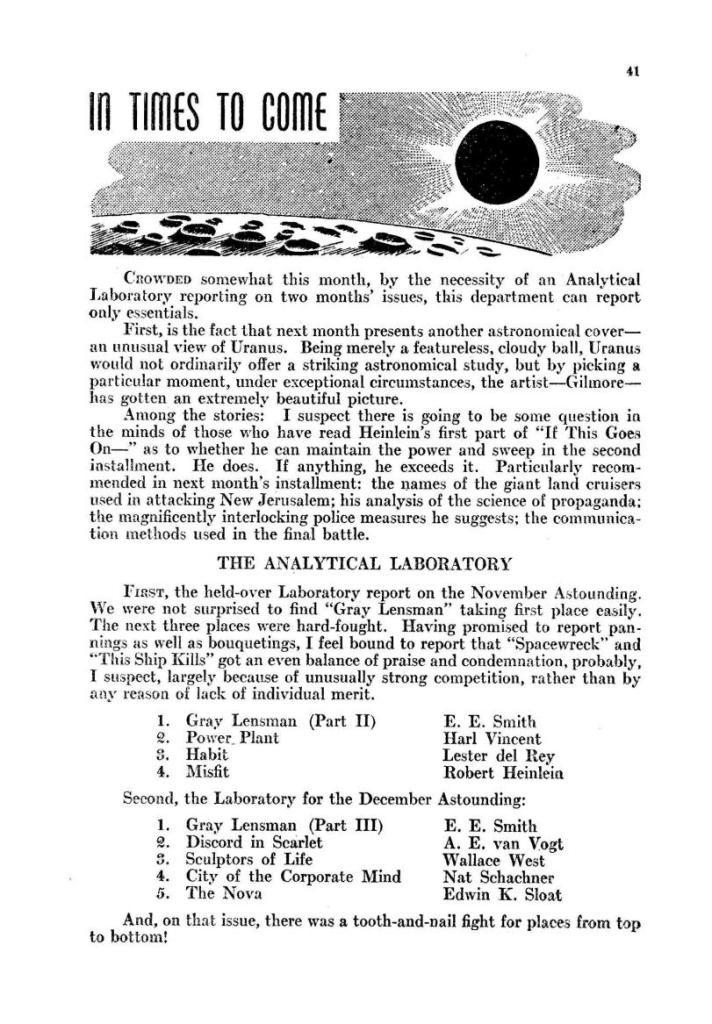
“Misfit” came in dead last in the AnLab (Feb. 1940). But “Misfit” was in an issue with the Gray Lensmen serial. Evidently, the readers back then weren’t impressed with Heinlein’s speculations about space sickness like I am now. Maybe they never imagined space sickness and didn’t want to believe it. One reader in the letter column wrote to tell Campbell there were people who could math in their heads like Libby. But I didn’t find anyone else that got excited about the story.
Campbell does push Heinlein In Times To Come for his current serial If This Goes On—. That story might be considered Heinlein’s first novel, depending on its length in the magazine. When it was revised and slightly expanded for Revolt in 2100, it was considered a novel-length by ISFDB.
The contrast is striking to read “Life-Line” right after reading and reviewingFor Us, The Living. Did Heinlein hitchhike over to the Iowa Writers’ Workshop for the 1939 Spring semester? “Life-Line” is a well-structured short story told dramatically, attributes sorely lacking in his trunk novel. How did he make such a quantum leap in writing?
“Life-Line” has a simple plot. Dr. Hugo Pinero invents a device that can give the date of a person’s birth and death. It’s based on the idea that every being exists in time as one long 4th-dimensional organism. Scientists think Pinero is a crackpot. When his machine works and causes havoc with the insurance industry they take him to court to get an injunction from using it. Pinero proposes to the court a scientific test which the judge accepts. One insurance CEO ordered a contract killing on Pinero. But before he dies we see one tear-jerking scene where Pinero tests a young married couple. The wife is pregnant. He refuses to tell the couple their results claiming his machine has become misaligned. He tried to keep them from leaving, but they eventually do and are killed outside his office by a speeding car. The scientists finally admit that Pinero’s technique was real when they find he accurately predicted his own death, and they destroy all the test predictions based on their own lives.
Farah Mendlesohn in her book, The Pleasant Profession of Robert A. Heinlein suggests Heinlein modeled his writing on the movies. I can believe that. The dialog in “Life-Line” feels like MGM films from the mid-1930s. It’s easy to picture Hugo Pinero played by Edward G. Robinson. Robinson sometimes played ethnic characters with accents, and Dr. Pinero has the same bellicose pugnacity that Robinson did in his movies. The gangster Mr. Bidwell of Amalgamated Insurance hired to kill Pinero comes across just like Humphrey Bogart in Kid Gallahad, even though Heinlein gives the gangster character just a couple of lines and a few words of description.
“Life-Line” also has several scenes that also remind me of 1930s movies, and they might be a clue to where Heinlein got his Public Argument writing technique I keep seeing in his stories. The story begins with Pinero arguing with a committee from the Science Academy. Next, he banters around with a group of news reporters. This reminds me of more than one Frank Capra film. Next, we see Pinero argue his case with a judge and lawyer for the insurance companies in court. I can see why he uses the Public Argument technique, it provides drama because it’s often used in movies, especially old movies from the 1930s, ones Heinlein should have seen — and studied.
I know when I first read “Life-Line” because in 1966 I bought a little Ace paperback for 40 cents, The Worlds of Robert A. Heinlein. I got the story again in The Past Through Tomorrow in 1967. It was first collected in Heinlein’s The Man Who Sold the Moon in 1950, but that was the year before I was born. By the way, my Baen Kindle edition of The Man Who Sold the Moon / Orphans of the Sky copy has an important missing section, the one where Bidwell hires the gangster. This time I listened to the Brilliance Audio edition of The Man Who Sold the Moon narrated by Buck Schirner — he did a fantastic job with 1930s-style voicing and accents.
To check the August 1939 Astounding edition to the current edition, I listened to the audio version while eye-reading a digital scan of the magazine. For the most part, the story was the same. Heinlein tweaked a few paragraphs to read better, and he changed one date from 1939 to 1951. I’ll try to use this comparison technique whenever I can. I wished I had used it on the few stories I’ve already reviewed.
The first time I read “Life-Line” I didn’t like the story. In fact, I remember being disappointed. I was used to Heinlein juveniles from Scribners and Starship Troopers and Stranger in a Strange Land from Putnam. And I just didn’t like the idea of a machine that predicts when people would die — it didn’t seem scientific. However, over the years, whenever I’ve reread “Life-Line” the story has gotten better and better. And when I listened to the audio version, with the dramatic reading, I’ve been very impressed with how well-written the story is, and how dramatic Heinlein made the scenes. I also thought the dialog was impressive too because it reminded me of MGM movie dialog. “Life-Line” isn’t James Joyce or even Ernest Hemingway, but it’s pretty damn good 1939 pulp fiction.
I just discovered there’s a student film version of “Life-Line.” It’s just now being released. This suggests the story still has impact and validity. That’s great.
“Life-Line” shows Heinlein could write. And write better than the average writer for science fiction magazines at the time. I have to wonder how much editing John W. Campbell did on the story. It seems whenever Heinlein isn’t reigned in, he pontificates. “Life-Line” does have a few short infodumps, but they are legit, fitting within the story’s logic.
I can’t tell what kind of impact Heinlein made with Astounding readers with his first story. He came in second in the AnLab poll, to a Lester del Rey story. Campbell did not single Heinlein out for any special praise in the editorial content, although in the AnLab (Oct. 1939) he did say there were three first-published writers in the August issue. I found two readers in the letter columns that mention the story. One wished for more stories like “Life-Line,” and the other said the story was well-written and dramatic and wished it had been novel length.
Isaac Asimov and Martin H. Greenberg picked “Life-Line” to include in their The Great SF Stories 1 (1939), but that was decades later. Alexei Panshin was rather hard on the story in Heinlein in Dimension. Of Heinlein’s first two stories, he thought “Misfit” the better of the two, and “Life-Line” wasn’t particularly good. I just read “Misfit,” and disagree. It’s a good story, but I think “Life-Line” is much better. It’s more unified. “Misfit” is a bit episodic.
“Life-Line” is not a favorite in the retrospective anthologies, most editors and readers prefer other Heinlein stories. I’m curious if it holds up with young readers today. It has an average of 3.91 stars out of 5 on Goodreads, with 906 readers rating it. 268 gave it 5 stars, and 338 gave it 4 stars. Not bad.
I have a guest columnist for y’all, Szymon Szott. Szymon worked out a computer program to find the minimum number of anthologies to buy that had the most stories from the Classics of Science Fiction Short Story list. The results were presented in these three columns:
Szymon was the first reader to tell me they’ve read all the novels on the novel list, and now he’s read all the short stories on the short story list. I still haven’t finished either list. Here’s his report on the short story reading experience.
Hi, Szymon here again. Last time I wrote that “you won’t love every work of classic science fiction” and that was after reading all the books from the list of classic SF books. Now I’m back with some thoughts after reading all the works from the classics of SF short stories. Currently, the list consists of 110 novellas, novelettes, and short stories. I read these works over a period of about four years although 80% in the last twelve months.
It was great fun to read these outstanding works, I enjoyed most of them, and those that weren’t as good at least ended quickly. The brevity of these works makes them more accessible: a short story doesn’t require the same commitment as a novel. Also, if you’re an obsessive checklist completist like I am, then you’ll be making faster progress through short stories than through the list of classic SF novels.
I rated each story on a 1-5 scale (5 being ‘excellent’) and the average of all my ratings was 3.5 which confirms my overall positive experience. I gave 19 stories a score of 5, but if I were to recommend my top 10 favorite stories (at this moment) they would be the following.
Title
Author
Year
Review
Nightfall
Isaac Asimov
1941
Grand tale, memorable idea (but I don’t want to spoil it).
Arena
Fredric Brown
1944
Like a Star Trek episode, a timeless classic!
Second Variety
Philip K. Dick
1953
A movie (Screamers) was based on this tale. Similar themes to Blade Runner, vintage PKD.
The Last Question
Isaac Asimov
1956
At least my third read. A great look into the possible future of any sentient life in the universe.
Flowers for Algernon
Daniel Keyes
1959
I knew the novel, which I prefer, but the story is still outstanding!
Inconstant Moon
Larry Niven
1971
Last day on Earth. Apocalypse/catastrophe story. Great fun, I love this kind of tale!
Vaster Than Empires and More Slow
Ursula K. Le Guin
1971
Colonists on a forest world find that it is conscious (as a whole planet/biosphere). Perfectly done!
Jeffty Is Five
Harlan Ellison
1977
Very nostalgic and a bit on the horror side (well, it is Ellison). Memorable!
The Mountains of Mourning
Lois McMaster Bujold
1989
I first thought it was great, but then the denouement hitched it up a notch. Worthy of the Hugo and Nebula that it won!
Story of Your Life
Ted Chiang
1998
Hard SF. The perfect marriage of story, plot, and physics (Fermat’s principle).
Surprisingly, only one story from the 90s made it to the above list even though the 90s were on average my highest-rated decade (with a score of 4.0). I was in my teens then, which is in line with the theory that “the golden age of science fiction is thirteen.” Meanwhile, the true Golden Age of SF (the 40s and 50s) are my next favorite decades, both with an average rating of about 3.8.
One of the coolest aspects of completing this list was finding sources (books, podcasts, etc.) from which to read the stories. For each story, I looked to see if it was available online for free, in any of the books I already own, in any of the book services I subscribe to, and, finally, in my local library. The Internet Speculative Fiction Database was an indispensable resource in this regard. Ultimately, I didn’t follow my own advice but rather worked with what I had available. I used a total of 48 unique sources to find the stories, but two of them stand out in terms of the number of stories: Sense of Wonder and The Science Fiction Hall of Fame. They’re both great anthologies and I’ll be reading the other stories they include as well.
Looking at the per-source average rating, these were my favorite, which I’ve arranged by type:
Anthologies: Future On Fire (80s stories, edited by Orson Scott Card)
Finally, I’d like to share two stories that aren’t on the list. The first one is a classic: “The Colony” by Philip K. Dick. It doesn’t have enough citations to make the list. The second one is too new to have been included: “The Ocean Between the Leaves” by Ray Nayler (which Jim has blogged about). Both have what I love most about SF stories: a sense of wonder and high “readability”.
Overall, I think the Classics of Science Fiction Short Stories v2 list is just as great a resource as the novel list. And it’s even better if you want to read all the stories from beginning to end: it’s not that long a project and you can find the best that SF has to offer in compact form. Highly recommended!
This review is a product of synergy and serendipity from what I’ve been reading from diverse sources over the last 40 hours. I’m going to try and reassemble all my influences before talking about my reading of “Fair” by John Brunner.
Yesterday, I got a tweet from Joachim Boaz about John Brunner (Modern Masters of Science Fiction) by Jad Smith and it intrigued me enough that I bought the Kindle edition and started reading it. I’ve read Stand on Zanzibar twice, once just after it came out, and again when it was published as an audiobook. And I’ve read a handful of Brunner’s short stories. Normally, that wouldn’t be enough to get me to read a monograph on an author, but I have a fond memory of spending an afternoon once with John Brunner. My college roommate was on the programs committee which brought in Brunner, Fred Pohl, and James Gunn for a morning panel at our school about science fiction. Greg was also their chauffeur, and I got to tag along. I mention this not out of name-dropping but because the authors took us to lunch and Greg and I sat and listened to them talk, Then afterward, we took Pohl and Gunn to the airport and Brunner asked if we’d take him down to see the Lorraine Motel. This was Memphis in the early 1970s before it was renovated into the National Civil Rights Museum. The key piece of information here is Brunner told us about being involved with the Martin Lurther King, Jr. Society in London. After, we went downtown Brunner took Greg and me out to eat at a Mexican restaurant. The impression he made on me came back when I started reading the Jad Smith monograph.
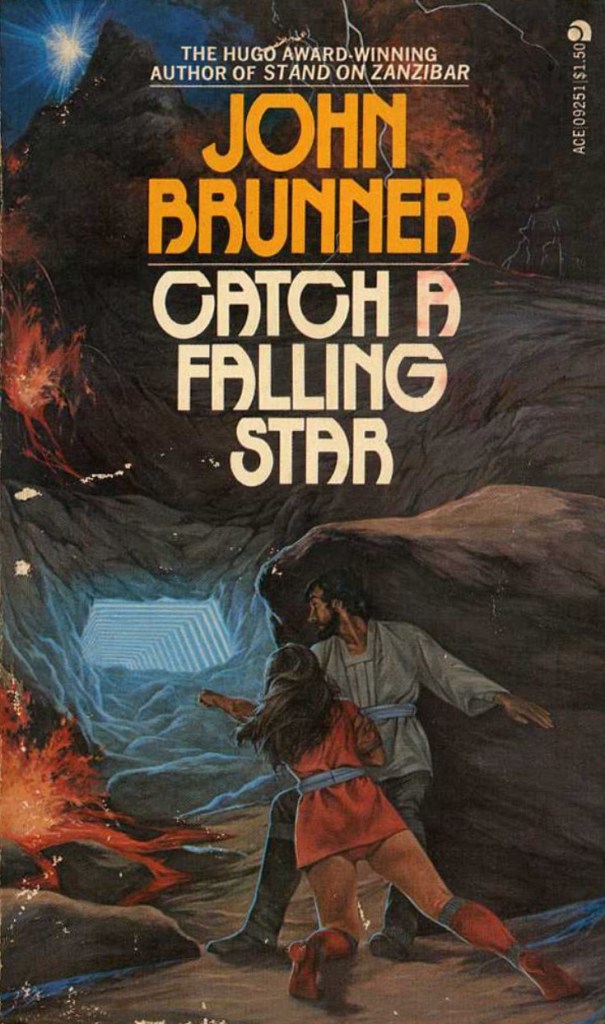
Joachim had also blogged “Future Media Short Story Review: John Brunner’s ‘Fair’ (1956)” but I wasn’t ready to read the story just yet. I was into the monograph, and the monograph inspired me to read Earth Is But a Star (1958) reprinted as an Ace Double The 100th Millenium (1959) and later expanded into Catch A Falling Star (1968). Jad Smith compared it to The Dying Earth (1950) by Jack Vance which I’ve recently read, but what really grabbed me is the inside cover blurb that quotes a passage at the beginning of the novel:
I know you’re wondering why I am digressing so much but stay with me. The sentiment of this quote is exactly what I’m worried about at the moment. But in the Jad Smith book on John Brunner, it’s what he worried about across his entire career, and in so many stories. It can be summed up by this question: What do we owe the future? My faint memories of meeting John Brunner retained an impression that he was both far more sophisticated than I was, and he was concerned about the future and mankind. He wanted us to solve our problems. It’s why he was involved with Martin Luther King, Jr. Society in London. I learned in the Jad Smith book Brunner founded that society.
Yesterday I also read “How To Do More Good” in Time Magazine. And twice yesterday I ran into reviews of What We Owe the Future by William MacAskill. Are you now getting the serendipity and the synergy of my reading? This topic was often at the core of what Brunner wrote. Like the fate of the humans in To Catch a Falling Star, we know our future too regarding climate change. Brunner could never understand why we don’t do something about all the problems we faced. In his later books he got quite cynical, and so am I. This is what draws me to him now.
All of this is important too for when I finally read his early story “Fair” an hour ago. I’ve now read 44% of the Jad Smith book on Brunner, and quite often Brunner’s plots are about saving the future. In his early stories, Smith said he would start out with a very bleak outlook but then end them with endless optimism. That applies to “Fair.”
Smith also summarized a common trait of Brunner’s where he would create an anti-hero, and that’s also what he’s done in “Fair.” Smith described how Brunner, a British author, had to write for the American markets to earn a living. Brunner grew up reading American pulps and understood how American science fiction was different from British science fiction. He tried to develop a style that merged the two. And he slowly worked toward developing a strong realistic attitude towards his subject matter even while using wild pulp conventions.
However, by the time he got to his most successful period of Stand on Zanzibar, The Sheep Look Up, and Shockwave Rider, many reviewers felt he was too realistic, too mainstream. I think we can see a hint of this in “Fair.”
“Fair” is about a nasty future. “Fair” is about Alec Jevons, a man who has lost his job, been left by his wife, and is rejected by society because his mother wasn’t of the right nationality. It was written during the Cold War, but it’s set in the future that Jevons felt he help create. Actually, it is the future we are creating. (And isn’t Brunner always speaking to us?) The fair of the story is a sprawling science-fictional fair of the future where people go to escape their miserable lives. Jevons is older than the mostly young people at the fair and he impresses them with his physical abilities on one gigantic ride designed to throw riders off. But where he has his revelation is in a booth that provides mental experiences that feel real.
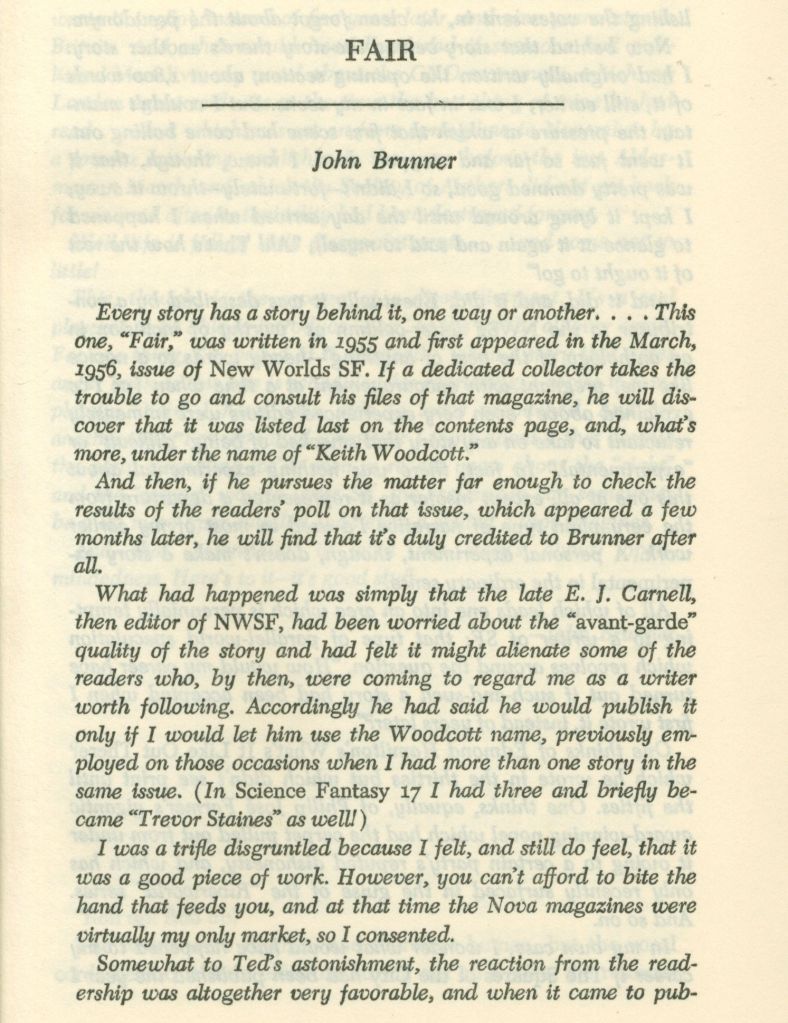
I won’t tell you anymore. By luck, my best reading copy of the story was in SF: Authors’ Choice 4 edited by Harry Harrison. I say luck because it has an introduction by John Brunner that tells us quite a bit about why and how he wrote this story. I’m going to reprint it here hoping I’m not violating copyrights too much, but these introductions are seldom reprinted, and often are very enlightening.
Read the ISFDB page for where “Fair” has been reprinted. I always enjoy it when I discover a story I’m searching for is already in one of the anthologies I’ve collected over the years. But you can also read “Fair” online in New Worlds (March 1956) where it was first published under the byline of Keith Woodcott.
I love that I’m rereading these older SF stories. I feel guilty about not reading new science fiction, and not knowing about the latest popular science fiction novels. But I’m retreading over territory I explored growing up. The first time around I read stories that appealed to the teenage me. I mainly focused on Heinlein, Clarke, Asimov, Dick, and Delany, but I read fairly widely. What I’m discovering in old age is I missed so much the first time around. There were so many writers I didn’t get to. Reading the Jad Smith monograph on Brunner tempts me to read a lot of Brunner that I just didn’t know was there.
The monograph also adds a sense of philosophy and intellectualism that I also missed in reading science fiction when I was young. John Brunner had quite a lot to say in “Fair,” and Smith is helping me see how Brunner developed as a writer.
I was an English major in college and had read A Farewell to Arms (1929) and The Sun Also Rises (1926) and a handful of Hemingway’s short stories. Other than classroom discussion I knew little about Hemingway. I’ve read several biographies since then, and more of his fiction, but at the time I didn’t know about the central inspiration of “The Hemingway Hoax,” that Hadley, Hemingway’s first wife, had lost all his early manuscripts. At the time I thought that fascinating and probably encouraged me to go read about Hemingway.
“The Hemingway Hoax” focuses on John Baird, a Boston University professor specializing in Hemingway. Baird is a vet, wounded in Vietnam, who identifies with Hemingway’s war wounds, and eventually makes a list of all the things they share. He’s married to a much younger woman, Lena. They are vacationing in the Florida Keys, but are worried about their future. Baird’s trust fund is about to run out and they are used to living a rich lifestyle. Baird is afraid of how Lena will react to living within an academic’s salary. Then Baird meets Castle, a con man who suggests a scheme for Baird to forge a lost manuscript of Ernest Hemingway. Baird is not really interested, but think’s it is an amusing idea. Lena who married Baird for his money connives with Castle to force Baird into the caper. Along the way, Castle cons a woman named Pansy into the scheme too.
The magazine version of “The Hemingway Hoax” is a long novella, which Haldeman later expanded into a short 155-page novel. (Or did he cut it down for magazine publication?) The novella won both the Hugo and Nebula awards. See Mark R. Kelly’s blog for a comparison of the novella and novel. This long story follows three main plot threads:
The Hemingway Hoax – how to forge a Hemingway unpublished manuscript. I thought this was an A+ idea for a plot both at forty and seventy. Unfortunately, Haldeman doesn’t stick with this plot. A few years ago PBS had an episode of Secrets of the Dead that told of an effort to forge a book by Galileo. It was tremendously fascinating. Baird does do a bit of work on this plot, finding typewriters and paper Hemingway would have used and starting a couple of drafts that were interesting. The old me was quite disappointed when Haldeman didn’t finish this plot, but the younger me was more than happy when Haldeman introduced the science fiction.
The Baird Con – as a counterplot, when Lena and Castle plan to con Baird into doing something illegal it could have taken the story into noir territory. The older me loves film noir and was excited by that direction. This also could have been an A+ idea too, but it was mainly used for sex and violent scenes. When I was younger I liked sex and violent scenes, but the old me hates excessive violence, and graphic sex scenes only seem suitable for hot romance novels and porn. I could understand taking the noir route with the cheating wife, skipping the science fiction, and selling it to Alfred Hitchcock’s Mystery Magazine or Ellery Queen’s Mystery Magazine. Better yet, I would have been even more impressed if Haldeman had skipped both the noir and the SF and gone the straight literary route like Possession by A. S. Byatt, another story about a literary mystery.
The Hemingway Demon – the story has one other character, a supernatural character that physically looks like Hemingway from different times in his life. I call it a demon because like Maxwell’s Demon, it guards the flow actualities between universes in a multiverse Haldeman calls the Omniverse. When I was young this was exciting stuff, but the old crotchety me considers multiverse plots much like time travel plots, easy to abuse. When anything can happen it spoils the story for me. I like my fictional universes to have limitations that reign in the plots. Haldeman goes wild with the universe hopping. That was fun at forty but tedious at seventy. It would have been mindblowing to me at thirteen if the story had been available for me to read in 1964.
You can’t expect a writer to write what you want. That’s completely unfair. But as a reader, every story creates anticipation. Stories are great when they fulfill that initial anticipation. In this reading, Haldeman got me excited about forging Hemingway and then didn’t complete the mission. I have to wonder if he felt compelled to add the science fiction thread because he’s a science fiction writer, and knows where to sell science fiction. I wonder if he would have even liked writing the story as mainstream fiction. When I was young I wanted everything to be science fiction, but as I’ve gotten older, my interests have widened. Not only do I not need everything to be science fiction, but when it is science fiction it needs to be reasonably realistic and down to Earth.
Getting old has done something to my reading tastes. My time in this life is dwindling, and my physical health also limits how much I can read. I now hate when stories are padded with extra scenes. I generally prefer science fiction at the short story or novelette length. Most novellas stretch out ideas too much. The older, impatient me, felt Haldeman was too ambitious with this story. What I really love is a story that has lots of realistic details, good characterization, a tight plot, and a compelling narrative style. But I want it focused. I don’t want any wasted words or scenes.
I’m afraid when reading “The Hemingway Hoax” Haldeman hooked me on the writing of a forged Hemingway manuscript and then distracted me with all the omniverse mumbo-jumbo. It allowed him to come up with a clever idea of what happened to the lost manuscripts, and it gave Haldeman a chance to write from Hemingway’s point of view as he lived his life backward. All that was interesting, but wasn’t part of the story that hooked me this time.
When I was young I found stories and novels that used real people as fictional characters to be neat and fun. But over a lifetime of reading biographies, I now see such a practice as exploitation – an easy way to get readers’ attention. Reading such books as The Paris Wife by Paula McLain produced a false idea of what Hadley and Hemingway were like. I wrote about this in my essay, “Why Did Ernest Hemingway Leave Hadley Out of The Sun Also Rises?“
In recent years, we’ve seen more and more best sellers and movie blockbusters that fictionalize historical people, and I’ve realized that I don’t like this trend. That has tainted my rereading of “The Hemingway Hoax.” I thought John Baird was a great idea for a character, a wounded vet who identified with Hemingway in so many ways, including his war wounds. And I thought a fictional character who is a Hemingway scholar trying to forge a lost Hemingway manuscript was a legitimate use of Hemingway’s name in fiction. Creating a supernatural demon that monitors the influence of Hemingway across the multiverse is a fun science fictional idea, but not really significant or meaningful to me at 70.
When we’re young any far-out idea is fun. But now that I’m old, I like my speculation within the realm of realism. “The Hemingway Hoax” is a case where the story was five stars when I was young, but only three stars when I’m old.













 Classics of Science Fiction