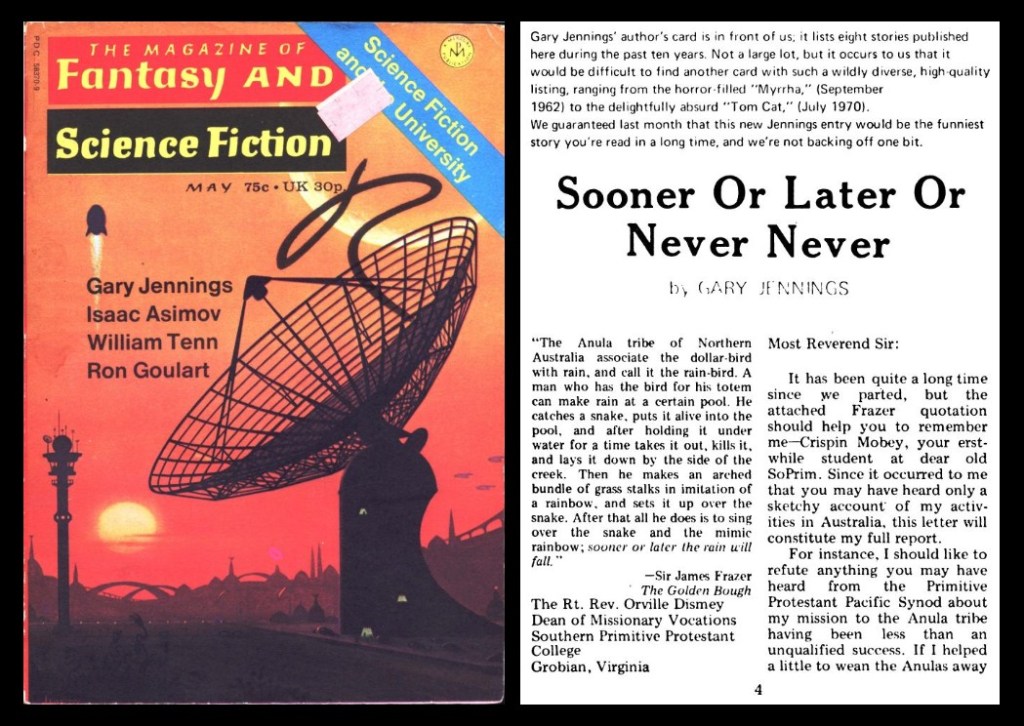
What exactly is fantasy? “Sooner Or Later Or Never Never” by Gary Jennings has no magic, no fantastic creatures. Its setting is present-day Australia. The story is both comic and absurd. Yet, it’s based on a somewhat realistic premise. Yes, the characters and plot are made up, but so is most fiction. I can find no reason to call this a fantasy. I assume Edward L. Ferman published it in the May 1972 issue of The Magazine of Fantasy & Science Fiction because he admired the creative prose — and he had the power to publish it.
“Sooner or Later or Never Never” is told as a letter to The Rev. Orville Dismey, Dean of Missionary Vocations, at the Southern Primitive Protestant Seminary in Grobian, Virginia. Crispin Mobey narrates his effort to bring Christ to the Anula tribe in the Australian outback. Mobey was inspired by a quote from The Golden Bough by Sir James Frazer. The quote describes a ritual Frazer witnessed. Mobey wants to use that ritual to bring Christianity to a rather primitive tribe.
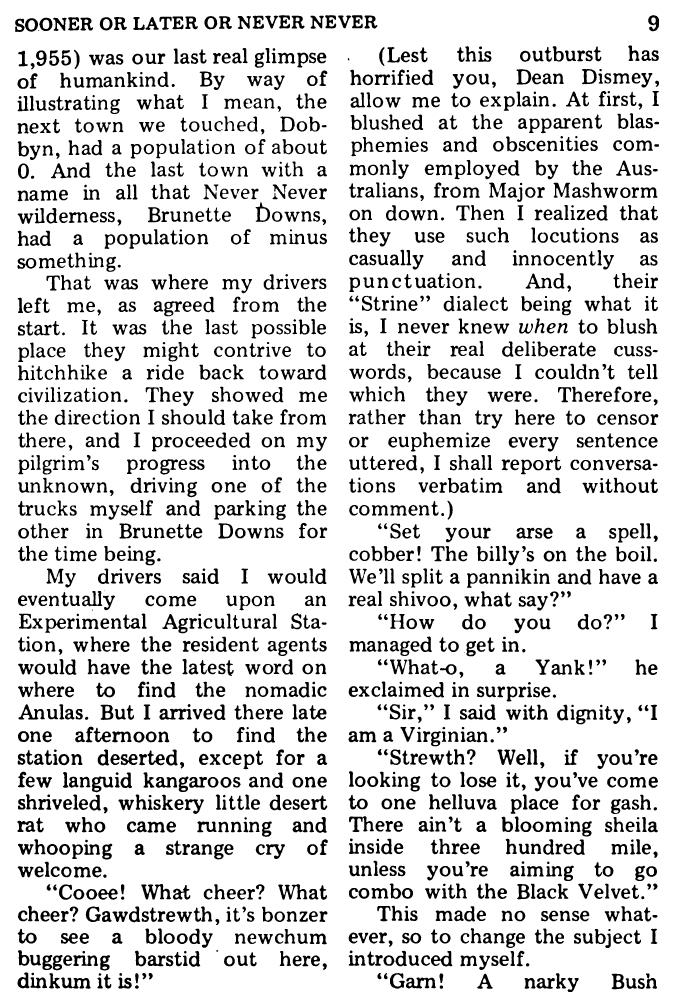
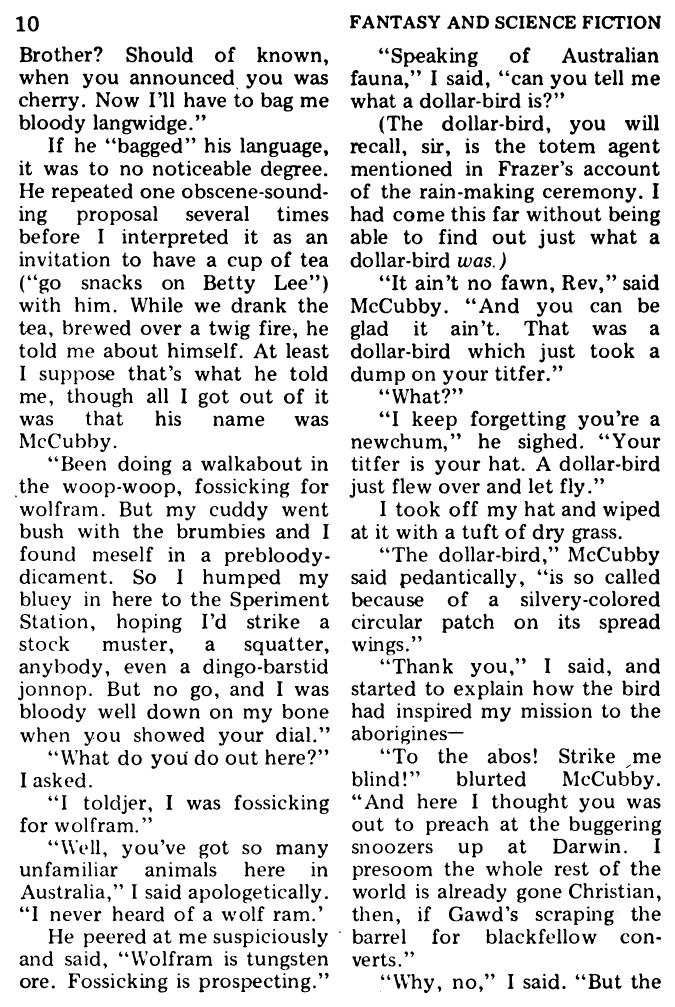
I’ve read “Sooner or Later or Never Never” before, but I’m not sure where and how. I don’t normally read this kind of fiction. However, the prose is quite entertaining. Normally, I dislike dialect, but Jennings captures outback Aussie hilariously. I wish I had an audiobook version.
There is no way I can describe this story, so I’m just going to give you two pages to read as a sample.
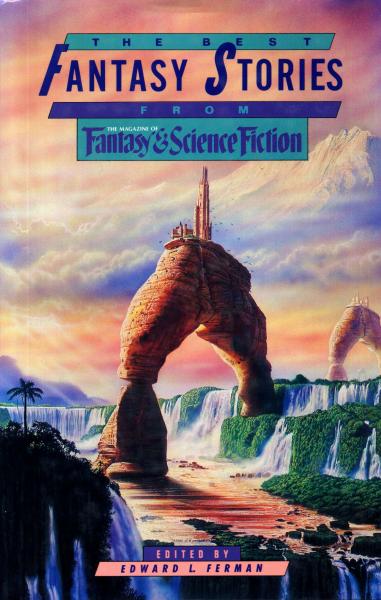
I know this is cheating, but I’m taking the easy way out. I’m posting this merely to encourage people to read this story. I read it today because my Facebook short story club is reading The Best Fantasy Stories from The Magazine of Fantasy and Science Fiction. Reading this 792-page anthology demonstrates the range of what people call fantasy.
I routinely tell people I dislike fantasy. But of the stories we’ve read in this anthology, the ones set in the present about ordinary people have been the most entertaining to read. And the ones that people consider traditional fantasy were no fun to read. I guess when I say I dislike fantasy, I dislike only a subset of the genre.
However, I also think Ferman is cheating to call “Sooner or Later or Never Never” fantasy. It could have been published in almost any kind of fiction magazine.
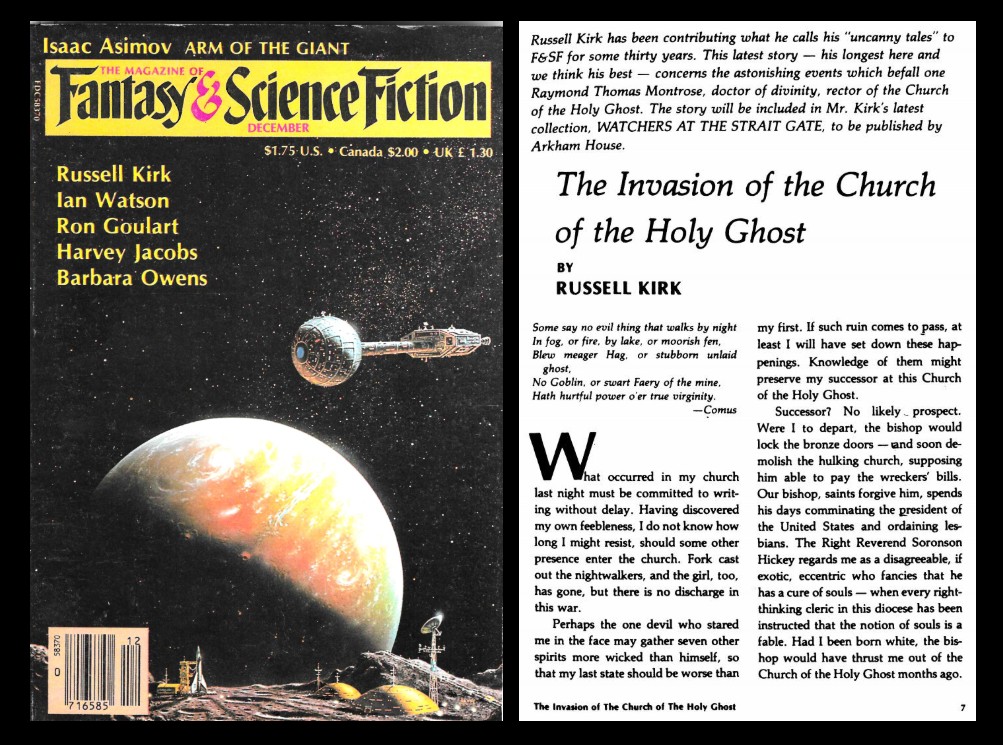
I’m an atheist who doesn’t normally enjoy reading fantasy fiction; however, I found “The Invasion of the Church of the Holy Ghost” by Russell Kirk, a religious ghost story, to be quite entertaining and well-written. The characters of Father Raymond Thomas Montrose and Fork Causland are so well developed that it’s hard not to like this story. Plus, the story is set in a seedy, rundown section of town filled with hustlers, prostitutes, and con men, has all the feel of a Damon Runyon tale.
I had no idea who Russell Kirk was, but after reading about him on Wikipedia, the philosophy behind the story made more sense. Kirk was a major conservative intellectual and a distinguished fellow at the Heritage Foundation. Since I’m a liberal, this doesn’t endear me to him. Kirk was also a convert to Catholicism and enjoyed writing ghost stories.
Kirk’s significant spiritual, political, and philosophical background forces me to look deeper into “The Invasion of the Church of the Holy Ghost.” Kirk was a serious thinker. That makes it hard to dismiss the story as a silly, inconsequential ghost story.
Even while liking “The Invasion of the Church of the Holy Ghost” very much, it proposes ideas I find totally repugnant. Both Father Montrose and Fork Causland are possessed. Kirk suggests that when people do bad things, it’s because they are influenced by evil ghosts, and when they do good things, they are empowered by higher-order beings. He doesn’t specifically say angels, but that’s how I interpreted the story.
In old religious philosophy, good comes from God, and evil from Satan. If humans do good, it’s because of the influence of the divine, and if we do bad, it’s because of the devil working through us. At one point, the normally good Father Montrose starts thinking about raping a young woman. Kirk proposes that those thoughts come from being possessed by an evil spirit.
I don’t believe in free will, but I also refuse to believe that our thoughts and actions originate with ghosts or other metaphysical beings. I don’t know if Russel Kirk believes that either, but “The Invasions of the Church of the Holy Ghost” is based on such a religious foundation. This fantasy is a religious reality to some. On the other hand, it might just be Kirk’s way of scaring us.
However, if I ignore what this story is suggesting, it’s an exceptionally creative work. Russell Kirk does an amazing amount of world-building. When I like fantasy, it’s often because it’s set in our present-day world. For example, It’s a Wonderful Life or The Bishop’s Wife.
Yesterday, I was pondering the value of fiction and nonfiction. Writers of nonfiction strive to be as accurate as possible. We read nonfiction to understand reality. Fiction is elaborate lies, but sometimes fiction writers work to express a truth they perceive at a deep, personal level. Knowing the kind of person Russell Kirk was, I can’t help but believe that he might believe in ghosts and possession.
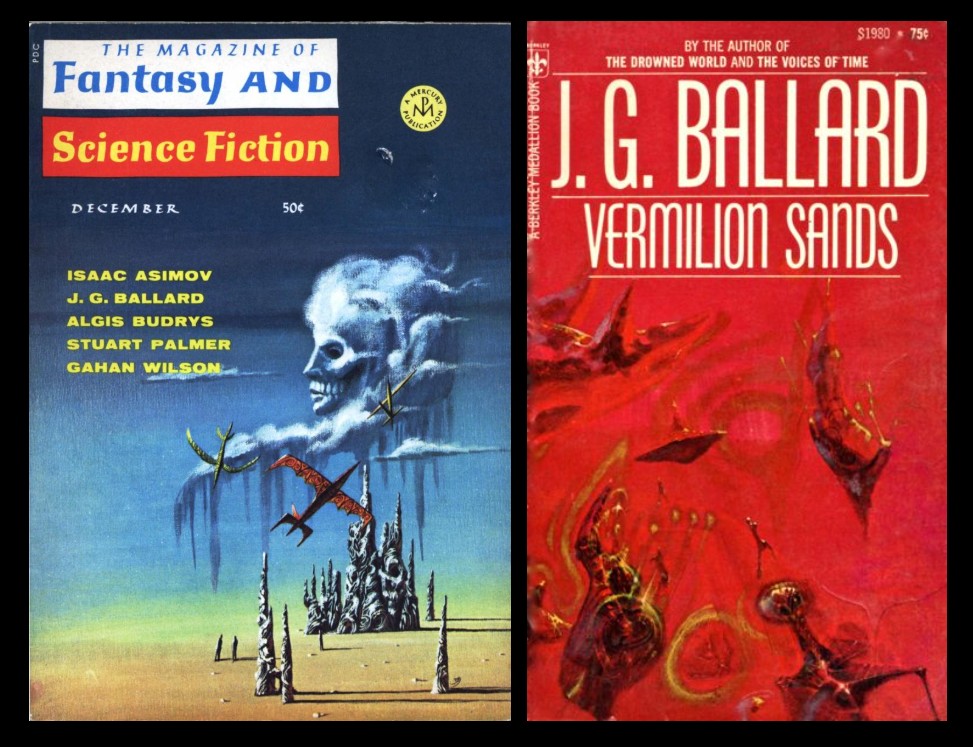
I reread “The Cloud Sculptors of Coral-D” by J.G. Ballard because my short story reading group is reading The Best Fantasy from The Magazine of Fantasy and Science Fiction. Inclusion in this volume suggests its fantasy. However, it was also included in The Great Science Fiction Series edited by Martin H. Greenberg, Joseph Olander, and Frederik Pohl. The story contains no magic, no dragons or elves, and it’s set in our present day, but in a fictional resort called Vermillion Sands.
Vermillion Sands feels like a decadent playground for the rich, which also features the many kinds of parasites that live off the wealthy. It’s also an artist and expat colony. We don’t know its location, but it feels like Palm Springs, California. Many worldly travelers come and go there.
“The Cloud Sculptors of Coral-D” was my first introduction to J. G. Ballard back in the 1960s. Other stories from that setting make up the series, collected into Vermillion Sands.
“Prima Belladonna” (Science Fantasy, December 1956)
“Venus Smiles” (Science Fantasy, June 1957)
“Studio 5, the Stars” (Science Fantasy, February 1961)
“The Thousand Dreams of Stellavista” (Amazing Stories, March 1962)
“The Singing Statues” (Fantastic Stories, July 1962) (not in original collection)
“The Screen Game” (Fantastic Stories, October 1963)
“Cry Hope, Cry Fury!” (F&SF, October 1967)
“The Cloud-Sculptors of Coral D” (F&SF, December 1967)
“Say Goodbye to the Wind” (Fantastic, August 1970)
Wikipedia provides an excellent overview of the stories, highlighting that each dealt with a different artistic medium being affected by technology.
When I first read “The Cloud Sculptors of Coral-D” as a teen, it felt very grown-up to me. The characters were the kinds of people I met growing up in Miami, not the typical heroes of science fiction stories I spent so much time reading. It never occurred to me to think of the story as fantasy, but it didn’t seem like science fiction either. At the time, I was just discovering British science fiction writers like Brian Aldiss and John Brunner and the New Wave SF. The stories were set in the present or near future and took place on Earth. No rockets or robots. Was this actual science fiction?
“The Cloud Sculptors of Coral-D” is about a band of glider pilots who shape clouds with silver iodide. At first, their audience and patrons are people who park their cars along the lagoon road to watch. Eventually, the Garbo-like Leonora Chanel hires them to perform for her party. Sculpting clouds is a neat idea, but far from realistic. Does that make the story science fiction? Ballard does throw in a creature called sand rays, which I suppose are like manta rays that live under the sand instead of the sea. Do they make the story a fantasy?
Science fiction has often been the dumping ground for any kind of weird story that can’t be classified. The Vermillion Sands stories would have been rejected by mainstream and literary magazines. They fit nicely in The Magazine of Fantasy & Science Fiction. They were also published in the British magazine Science Fantasy and the American Fantastic. Only one was published in a straight-ahead science fiction magazine, Amazing Stories. I doubt John W. Campbell would have accepted them in Astounding or Analog. Nor would he have published them in Unknown. I wonder if Rod Serling would have used “The Cloud Sculptors of Coral-D” for The Twilight Zone?
I’m not fond of traditional fantasy, and many of the stories in The Best Fantasy from The Magazine of Fantasy and Science Fiction aren’t enjoyable for me to read. But I did enjoy “The Cloud Sculptors of Coral-D.” The story has a pleasant, surreal feel. The setting is very close to this world, but just a smidge off. I love the artist colony atmosphere, the hint of decadence, the ever-so-slight sense of unreality. The story combines barnstorming, carny folks, and the ugly rich. I visualize it as a cross between early Faulkner and Fellini.
The shortest description would be to say the story has atmosphere.
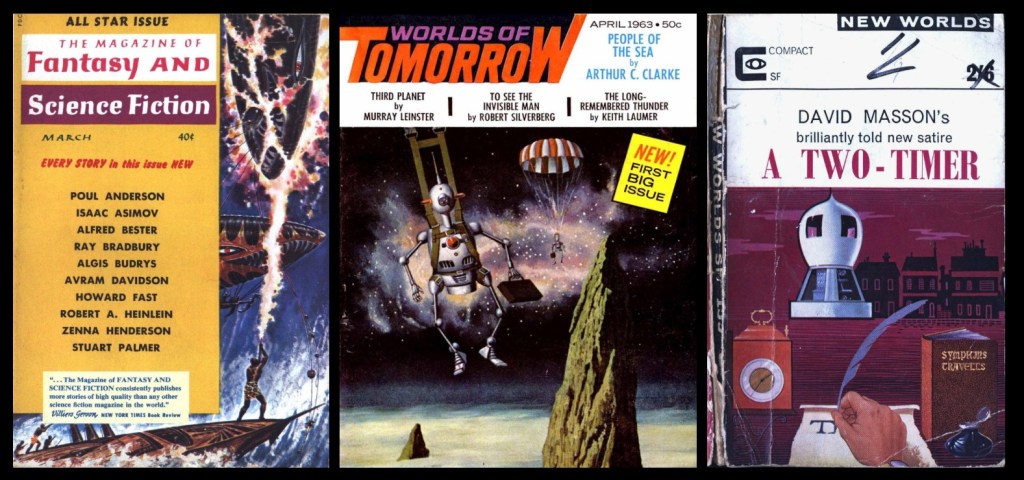
“A Two-Timer” by David I. Masson (New Worlds 159, February 1966) (Amazon)
Back in the sixties, in high school, my friends and I would argue endlessly over science fiction short stories. We didn’t remember them by their title or author, but by whatever neat idea they imagined. I still remember my friend George telling Connell and me about a humorous short story, where a human crewed military spaceship tries to get cooperation from a human colony world where the social norms and economy were wacky. The colonists kept telling the crew “myob” to everything asked. I didn’t learn until years later that this was a famous story by Eric Frank Russell called “… And Then There Were None.” Another story George told us was about an Earthman who fell in love with a girl, and she wanted him to tell him he loved her. But the guy didn’t want to use such a trite phrase, so he left Earth and went all over the galaxy to learn about the preciseness of language. Eventually, he returns to the girl and says, “My dear, I’m rather fond of you.” Of course, the girl was hugely disappointed and rejected the guy. When the guy told his language guru what happened, the guru said, “Lucky devil, vaguely enjoyable was the best I could ever find.” I didn’t discover until decades later that it was “The Language of Love” by Robert Sheckley.”
The point of all this was that we judged science fiction solely on the ideas in the stories, not the plot, characterization, or writing. George read the most and was the best at retelling a story. I think he mainly read anthologies. I read anthologies and magazines. I was more into neat inventions. For example, I told them about the ecologariums in “The Star Pit” by Samuel R. Delany. Connell and I loved Mindswap by Sheckley, and we told everyone about the Theory of Searches. We worked at the Kwik Chek in Coconut Grove, Florida. At the time, its park was a gathering place for would-be hippies. The odds of meeting someone you knew from all over Dade County were increased if you came to the park on Saturdays. That fit Sheckley’s idea that there were optimal places to go if you were searching for someone.
The last three stories we read for the Best Science Fiction and Fantasy Short Fiction Facebook group were all idea stories, the kind my buddies and I would have discussed at Connell’s house on Vista Ct.
“The Certificate” by Avram Davidson is a tight little story about alien invaders who take complete control over humanity, making us their slaves. The aliens create a vast bureaucracy that’s impossible to fight. The aliens also punish us severely if we don’t cooperate. To make matters worse, they have altered us so we heal immediately, so they can torture us over and over again.
The story’s protagonist is Dr. Roger Freeman, who desperately wants a new winter coat. To apply for one involves going through an obstacle course that takes years. But Freeman is finessing the system.
Back in high school, this story would have caused us to argue about how we’d overthrow those aliens. Being young guys, we’d probably claim to know how to start a rebellion, even though Davidson sets up the story to suggest no rebellion is possible. When I read this story this week, the idea didn’t appeal to me much. The story is well-written, with an O. Henry surprise ending. However, it doesn’t offer anything to me as an older reader.
“To See the Invisible Man” by Robert Silverberg seems like a reply to Damon Knight’s classic short story, “Country of the Kind.” Like the Knight story, Silverberg sets up a society with a unique liberal form of punishment. The unnamed first-person narrator is sentenced to a year of invisibility for being cold and detached. He’s not actually made invisible. He’s just branded on the forehead, so anyone who sees him should act like he doesn’t exist. The story is about the psychological changes this character undergoes during the year. The narrator learns that he can steal whatever he wants or visit women’s locker rooms and be completely ignored. But he gets lonely, even desperate for someone to talk to. Silverberg takes us to a different place in his story. His character rebels in a different way by being compassionate.
My buddies and I would have had a lot to say about this story, with each of us coming up with how to handle the punishment. We’d probably argued over whether or not we’d go into the women’s locker room. I would have said that my solution would have been to read science fiction for a year. We did know of “Country of the Kind,” so we would have compared the two, but only about what the two criminals did, not about the writing, plotting, or characterization. Science fiction was about setting up a situation that you could argue over.
“To See the Invisible Man” is a good story. It’s tightly told, immediate, and works. However, it is not nearly as dramatic as “Country of the Kind,” and thus won’t be as memorable.
There’s little likelihood we would have read “A Two-Timer” by David I. Masson in the 1960s because it came out in a British SF magazine. Also, the idea behind this story is probably too subtle for three teenage boys in the 1960s. Joe, the narrator, is a guy from 1683 who steals a time machine and visits 1964. Of course, he doesn’t know it’s a time machine when he discovers it, or comprehends the idea of time travel. He just sees a guy walk away from a weird enclosed chair. He gets in and sees all kinds of dials and buttons labeled with words he doesn’t understand. He pushes a button and goes to 1964. Eventually, Joe figures out how the machine travels in time and space, like the DeLorean in Back to the Future.
The real point of this story is Joe, with his Middle English mind, describing 1964 to the reader. That might have entertained us back in the sixties, but I’m not sure. Old man me, found it very creative. There’s little action in the story. The piece is Masson’s playground for showing off his knowledge about language and history. Present-day me was disappointed that Joe wasn’t inspired to explore time based on his 17th-century knowledge.
I’m getting old and jaded. I find it hard to discover science fiction that thrills me in the remaining years of my life. I’ve loved reading science fiction magazines my whole life, but most of the stories were aimed at readers like my younger self. Masson’s exploration of language is more ambitious and mature than the other two stories, but Masson built his story on a lame plot.
Even though I’ve been reading science fiction for over sixty years, I still want to find stories that thrill me to the same degree as I was at 13. I’m not sure that’s even possible. Breakthrough science fiction novels like Hyperion are rare. But it’s interesting to note that Hyperion would have been a novel that thrilled me and my high school science fiction buddies.
Obviously, many of the stories that wowed me as I grew older would have also thrilled the younger me. For example, “Think Like a Dinosaur” by James Patrick Kelly or “Beggars in Spain” by Nancy Kress.
On the other hand, would “Story of Your Life” by Ted Chiang have inspired our younger selves? We would have avidly talked about translating an alien language, but would we have appreciated the advanced plotting and exceptional writing?
And could we have appreciated “Loneliness Universe” by Eugenia Triantafyllou without having lived through the social media era? Or could my younger self appreciate “Two Truths and a Lie” by Sarah Pinsker, which moved my older self? Wasn’t I mainly moved by the writing? I’m not sure high school Jim could have.
What if we could have read “Press ENTER ■” by John Varley in 1966? Would it blow us kids away like it did me in 1984? Did we need to understand computers and know about the technological singularity first?
I have to assume certain stories in the 1960s were relevant because of my age and current events. That’s why Dangerous Visions was exciting in 1969 but painful to read last year.
I keep looking for old science fiction I missed back then that will thrill me as much now as it would have thrilled me back when — if I had discovered it when I was young. One such book was The Man Who Fell to Earth by Walter Tevis. The trouble is, I think George, Connell, and I would have all thought that story was dull. Isn’t that novel better for the old and jaded?
I need to find cutting-edge science fiction for today that would have thrilled me as a 13-year-old but also a 73-year-old.
By the way, my 1964 self expected a much different 2025 than the one I live in now. There are many nonfiction books about current affairs that, if I could send to my 1964 self, would read more like science fiction than science fiction.
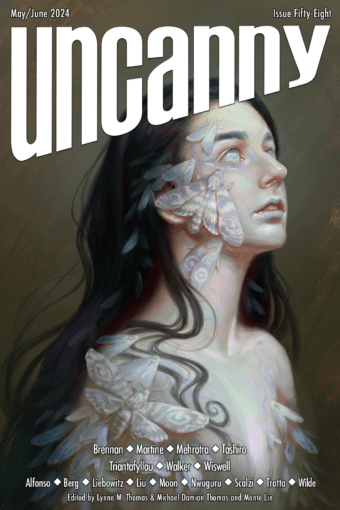
“Loneliness Universe” by Eugenia Triantafyllou appeared in Uncanny (#58, May/June 2024) and is a finalist for the 2025 Hugo Award in the Best Novelette category. You can read or listen to the story online. If you are a member of the 2025 Seattle Worldcon, you can vote for this story through July 23, 2025.
I first learned about the Hugo Awards back in the 1960s. I never attended a Worldcon but always wanted to. I did attend some regional conventions back in the 1970s. I kept up with the Hugo and Nebula awards for most of the 20th century, but slowly lost touch with science fiction and fandom in the 21st century. I discovered “Loneliness Universe” when I read Austin Beeman’s “Reviewing the 2025 Hugo Award Finalists: Best Novelettes” at his website www.shortsf.com.
I’m so impressed with “Loneliness Universe” that I will try to read all the finalists. I might even join the convention as a virtual member and vote. Members get a packet that includes many of the works up for voting. Membership is $50, and adding virtual attendance is another $35. There’s little chance I will physically attend a Worldcon, so that might be my best shot at achieving an old desire.
“Loneliness Universe” is not what I’d call science fiction. Nor would I categorize it as fantasy. One reason I let the science fiction genre pass me by is that it’s no longer what I thought it was supposed to be. That’s not a criticism. I just didn’t feel like keeping up with changing times. However, “Loneliness Universe” is an outstanding work of fiction.
The story begins with an email from Nefeli to Cara dated September 18, 2015. Throughout the story, we get to read email exchanges, but the next one is dated July 5, 2015. I don’t know if this is a spoiler, but the first email is the end of the story. I did not discover right away. In fact, I wouldn’t have discovered it at all if I hadn’t immediately reread the story by listening to it a second time.
I recommend you read this story the first time, then listen to it a second time.
I’m not going to spend much time describing this story. Read it. I will spend some time trying to explain what it’s doing.
There are infinite ways to understand fiction. One way is to think of fiction as a spectrum. At one end are stories where the author sends the readers a message. On the other end of that spectrum are stories where the author creates a story that is just a story.
Think of the first type as a message in a bottle from an individual stranded on a deserted island. And think of the second type as how some people describe God as an artist who created our existence but walked away.
In “Loneliness Universe,” Eugenia Triantafyllou has created a metaphor for our current cultural existence. In this story, Nefeli realizes she is losing physical contact with everyone she knows. She can only communicate with them through email and instant messages. They can leave evidence of their existence, but she no longer communicates with people face-to-face.
The setup for this story reminds me of an experience I had on LSD fifty-five years ago. I thought everyone was in an isolated universe by themselves, and our efforts to communicate in words were no better than writing a message, putting it in a bottle, and throwing it into the sea, hoping for a reply. That each of us was an isolated universe inside our heads. In Eugenia’s story, she imagines we’re all moving into separate universes of a multiverse, and for a while, can communicate via email and instant messages. This sounds science-fictional, but it’s probably more Kafkaesque.
The thing about metaphors is not that they are accurate, true, or valid, but that they make you think about a concept from a new perspective. In recent weeks, I’ve often woken in the middle of the night and thought about all the hundreds of people I’ve known in my lifetime and wondered about what has happened to them. And I ask myself, did we ever really communicate? This is what “Loneliness Universe” is about. Are we on the same wavelength?
Are we ever in the same room at the same time with someone else? If you truly understand this question, I will say those moments of being together are fleeting. Many people want to believe sex is a way to achieve such synchronicity, but that’s not true either. I don’t believe telepathy is possible, but sometimes, when two people have had the same life experiences, they can say just the right words, they know they have achieved a kind of psychic Venn diagram intersection for a fleeting moment.
“Loneliness Universe” is not a perfect story. It’s only as good as you can resonate with what Eugenia Triantafyllou is expressing. I don’t know how well her message in a bottle was decoded by my inner self. We will never be in the same room together. But I’d like to believe I know what she was trying to say.
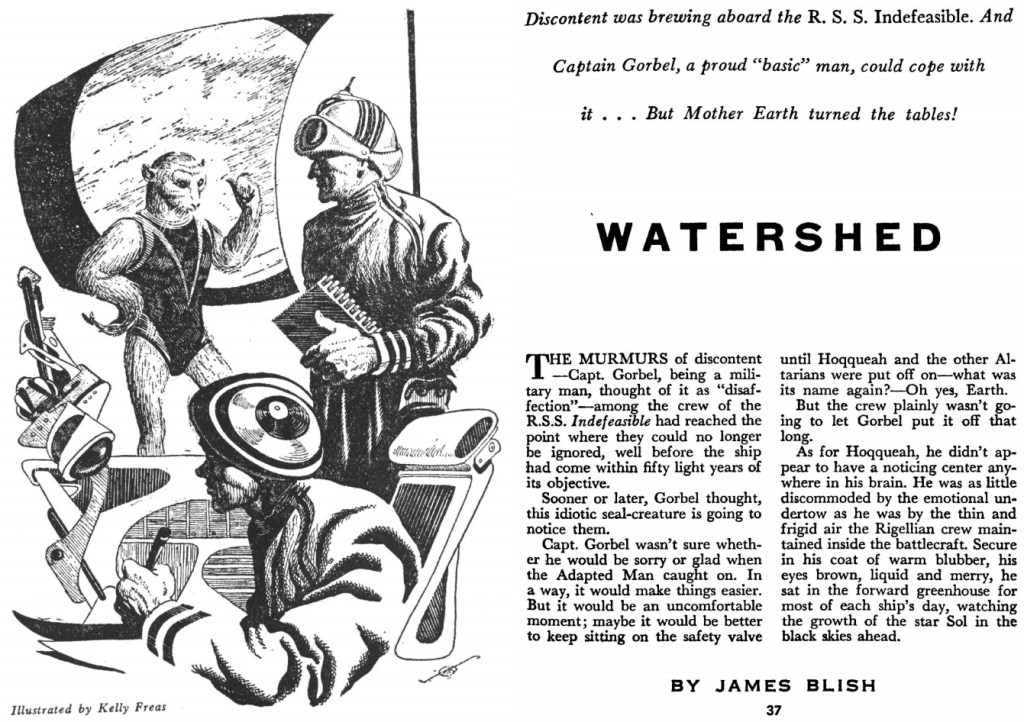
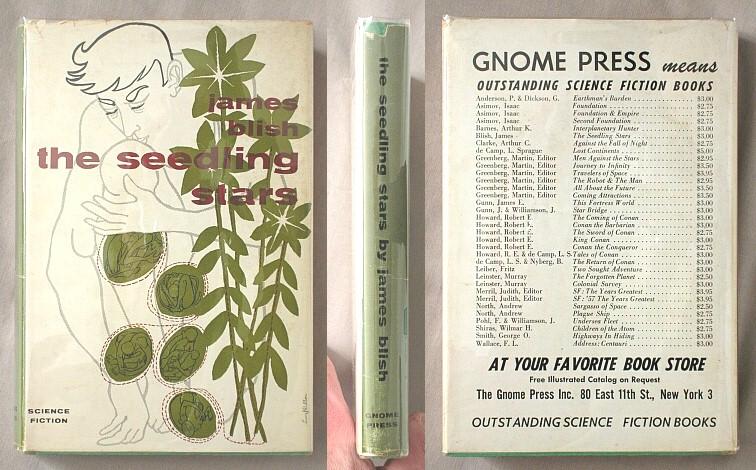
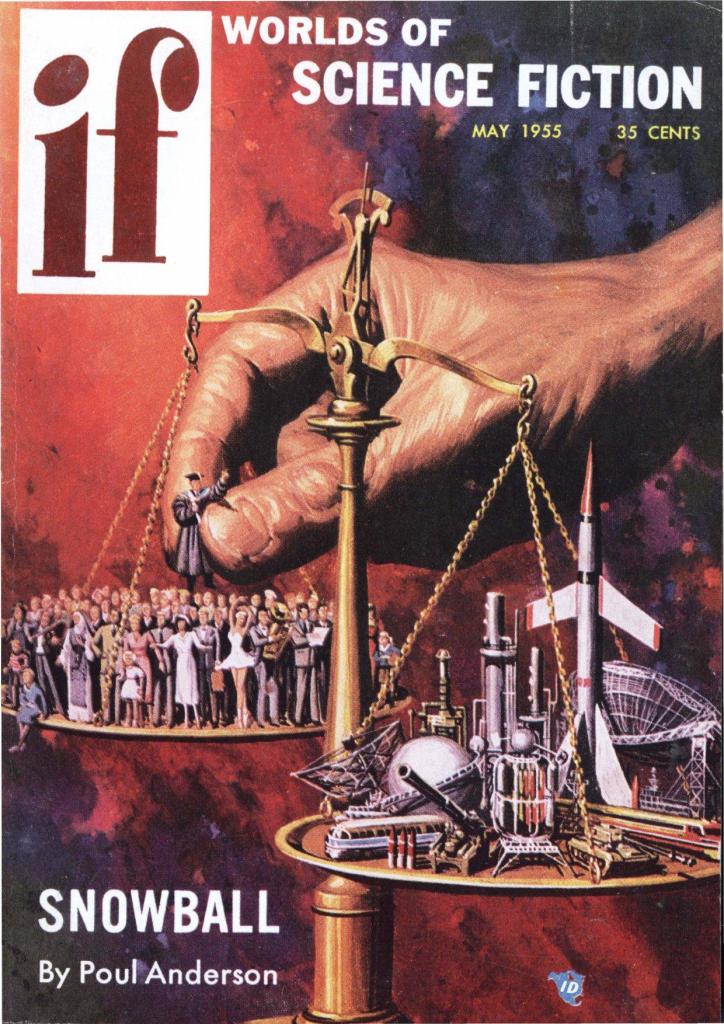
“Watershed” by James Blish was first published in IF Worlds of Science Fiction (May 1955). You can read it online here. “Watershed” became part of James Blish’s The Seedling Stars, a collection of short stories about adapting humans to new environments. The most famous story of the collection is the classic “Surface Tension.” Unfortunately, “Watershed” is not in print except for Supermen: Tales of a Posthuman Future, a 2002 anthology edited by Gardner Dozois.
“Watershed” is a rather preachy tale, not a thrillingly dramatic story like “Surface Tension.” Capt. Gorbel of the spaceship R.S.S. Indefeasible is traveling to Earth to deliver new colonists, but it’s not what you think. Humans have long colonized the galaxy, and the environment of Earth can no longer sustain “standard form” humans. Gorbel is going to Earth to deliver colonists that look like seals, but are considered just as human as we are, well, that’s by the standards of political correctness of their day.
The adapted human is Hoqqueah. He likes to sit in the forward greenhouse and stare into space as the ship approaches Earth. However, the standard form crew considers itself superior to the adapted humans. Averdor doesn’t like that Hoqqueah spends so much time in the greenhouse, and is annoyed by his constant talking. Averdor tries to convince Gorbel to forbid the adapted humans from using the greenhouse.
Hoqqueah knows of this prejudice, and he tells the Captain a story about Earth. He explains that Earth was the original home of all humans. He also tells how humans have found many planets that couldn’t support the standard human body, so they adapted humans to new forms. The concept is called pantropy. (That link gives several classic examples in SF.)
However, this is 1955, and we must ask ourselves if this story is about space exploration. The famous civil rights case, Brown v. Board of Education, happened in 1954. To be fair to James Blish, he had been exploring pantropy since 1942. But then Blish has Hoqqueah tell Captain Gorbel about prejudice against dark skin humans on old Earth.
The kicker to this story is that the standard form is now the minority.
“Watershed” has nice sentiments, but not much of a story. It’s told, not shown. It would have been far better if it had been dramatized. We don’t get to know Hoqqueah or what it’s like to be a seal person. And why, if standard form humans can’t handle Earth, how can the adapted men of his kind handle the spaceship with Gorbel and Averdor?
I recommend reading “Surface Tension” to understand what I mean by telling the story with drama. You can read it in the August 1952 issue of Galaxy Magazine.
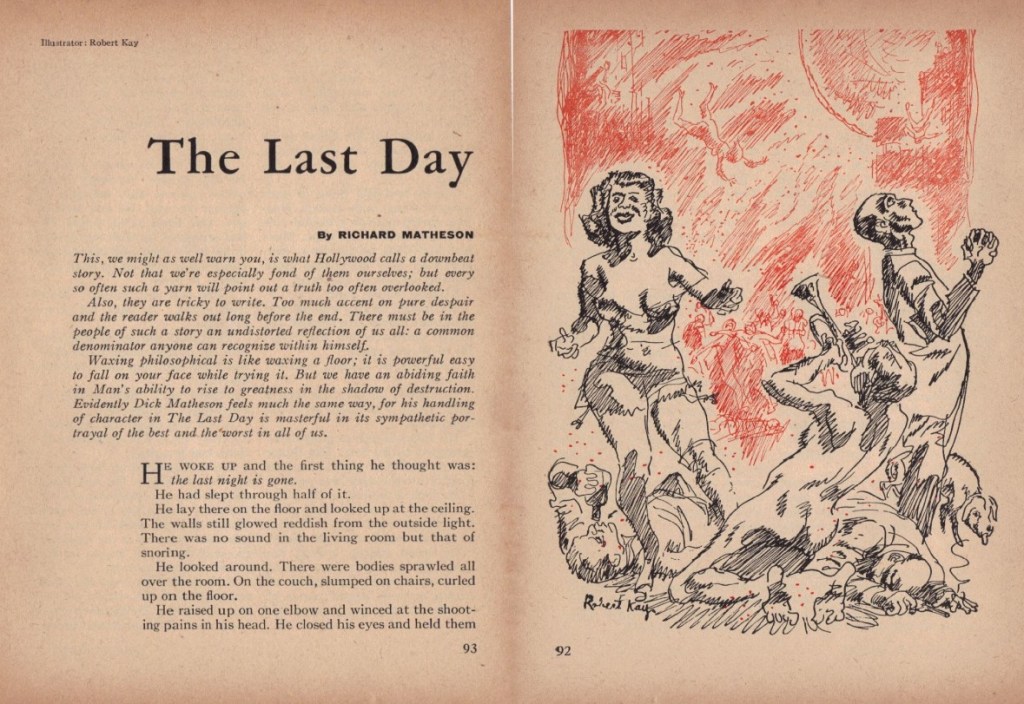
“The Last Day” by Richard Matheson was first published in the April-May 1953 issue of Amazing Stories. You can read it online here. Or you can buy The Best of Richard Matheson in various media editions here. Or look at its reprint history to see if you already own it in an anthology.
Our reading group is reading 25 short stories recommended by five group members. They are stories we haven’t read as a group, but ones the five people thought we shouldn’t miss. I didn’t submit this time, but “The Last Day” would have been one of the stories I would have submitted. Three of my favorite SF short stories from 1953 are “The Last Day,” “Lot” by Ward Moore, and “Deadly City” by Paul W. Fairman. I admire these stories because they were so gritty, even brutal.
Science fiction has often dealt with post-apocalyptic stories but “The Last Day” is about the end of the world. Some astronomical object is about to crash into the Earth. It’s not specified. The story begins in the morning of the last day and ends in the evening just before the end of everything on Earth.
I have often read and thought about surviving an apocalypse. I have often contemplated my own death. And I’ve always been fascinated by stories about people with a terminal illness and what they did with their remaining days.
But I haven’t thought about what I would do if everyone had just one day to live. It’s a neat concept to ponder. After reading “The Last Day” I’m not sure I’d need to read another story on the same idea. “The Last Day” gets the job done so nicely that I can’t imagine anyone topping it.
For this reading, I read the story with my eyes and then listened to it with my ears. I was impressed by its drama. Richard Matheson is famous for writing over a dozen episodes of The Twilight Zone. Many of Matheson’s stories and novels were adapted for television and the movies, and he wrote many screenplays. Matheson knows how to create drama.
“The Last Day” begins with Richard waking up in a room full of passed-out people. Several are naked, and it’s obvious that a drunken orgy had taken place the night before. When Richard goes into the bathroom to clean up a bit, he finds a dead man in the tub. Richard enters the kitchen where a friend, Spencer, is frying eggs. By now, we’ve realized that life on Earth is about to end.
Richard wishes he were with Mary, a woman he loved but didn’t commit to. His friend Norman comes into the kitchen and tells Richard he wants to go see his mother. Norman asks Richard if he wants to see his mother. Richard dreads the idea because he knows his mother will preach religion at him, and he doesn’t want to hear it.
After Spencer leaves to have more sex with a woman who wants everyone to watch, Norman begs Richard to drive him to his mother’s house. We learn that riots are going on all over the city. Many people have committed suicide, but others run wild, murdering each other.
All of this is amazingly adult for a science fiction story in 1953, especially published in a magazine mostly read by young adults. That issue seemed atypical for Amazing Stories. It also had stories by Robert A. Heinlein, Theodore Sturgeon, and Murray Leinster. It was edited by Howard Browne. I feel I need to reevaluate that era of the magazine. 1953 was a boom year for science fiction magazines. I’ve written about it before. I believe the Cold War had a significant impact on the genre that year. Just look at some of the other notable stories from 1953.
Richard eventually finds his mother at his sister’s house. There’s a poignant scene of his sister and her husband getting their daughter to take sleeping pills, and Richard watching all three commit suicide. And finally, Richard has a moving moment with his mother while they wait to die.
The story is cleanly told. Direct. It covers many bases without getting wordy. 5-stars.
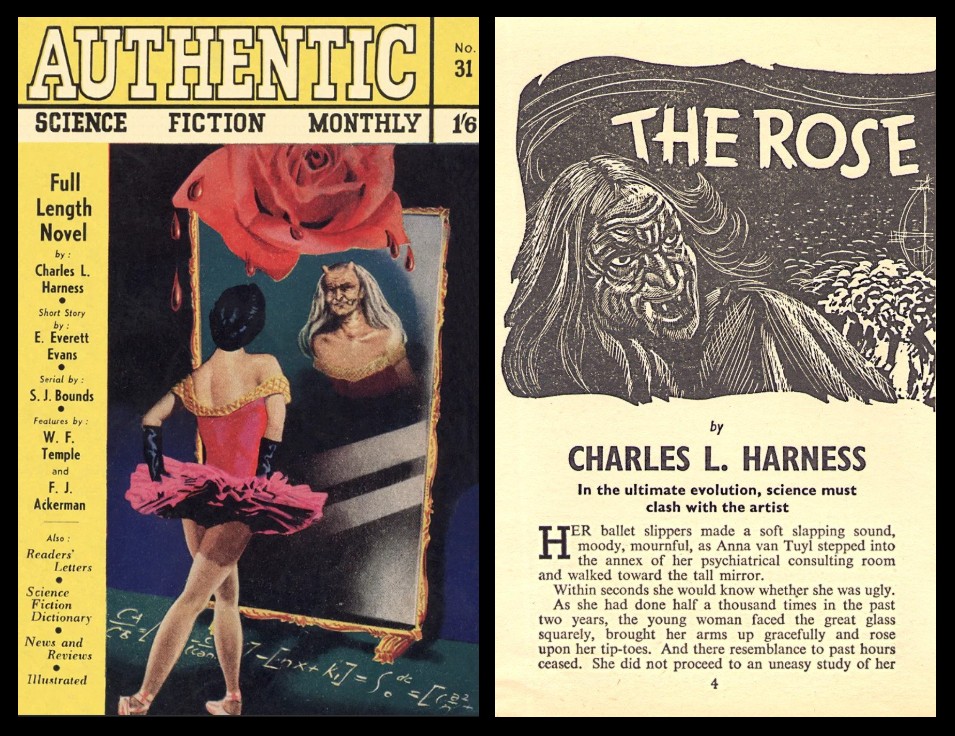
“The Rose” by Charles L. Harness was first published in Authentic Science Fiction Monthly (No. 31, March 1953). You can read it online here. Our Facebook group is discussing 25 stories suggested by five members that we haven’t discussed before. Paul Fraser has recommended “The Rose” in comments, but it’s never been up for a group discussion. I’ve tried to read “The Rose” twice before but got bogged down. The story is long, a novella, and it’s dense.
“The Rose” is one of the most ambitious science fiction novellas I’ve ever read. I’m glad that I finally finished it. This is exactly what I was hoping for from our member-recommended group read, a standout science fiction work I haven’t read. One good enough to merit rereading.
The story reminds me of what other writers explored in the years after 1953, works by Theodore Sturgeon, J. G. Ballard, Robert Silverberg, Jack Vance, and Roger Zelazny. “The Rose” has seldom been reprinted, but the most significant anthology to remember it is The Science Fiction Century, edited by David G. Hartwell.
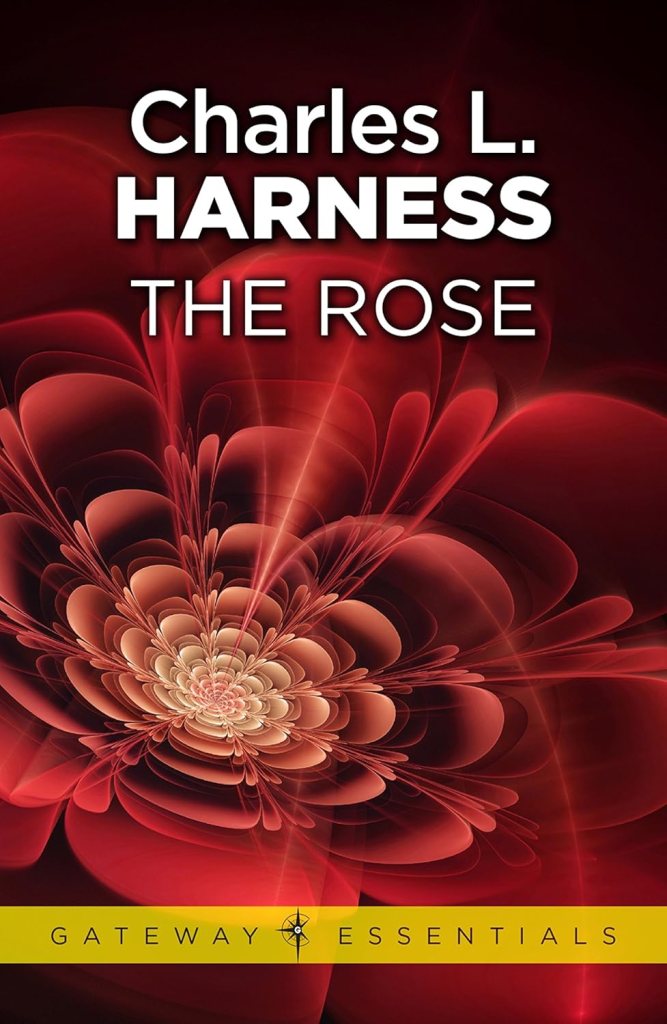
“The Rose” is available as The Rose, a standalone Kindle novel for 99 cents. They say it’s 192 pages, but I can’t tell if it’s expanded from the novella. The UK edition says it’s just 88 pages, so it’s probably the same as the novella.
But for $1 more, you can get the Kindle edition of The Ornament of His Profession for $1.99, which includes “The Rose” and several other stories by Harness. I just discovered I already own that edition in my Kindle Library. Probably, I bought it when Paul recommended “The Rose” the first time.
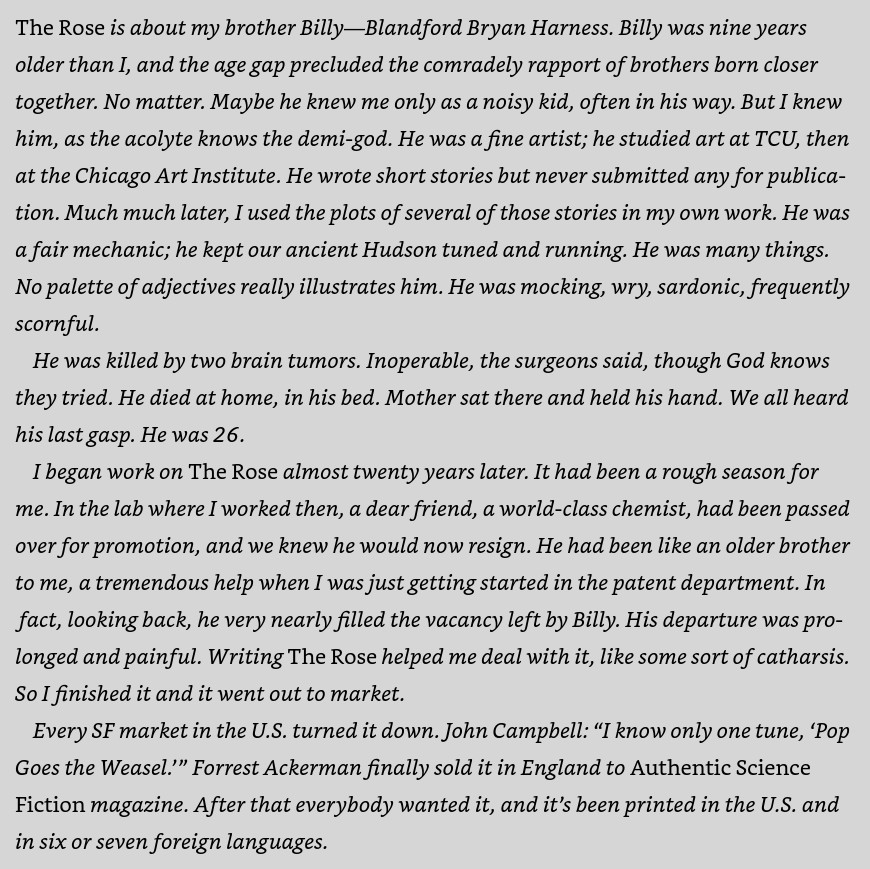
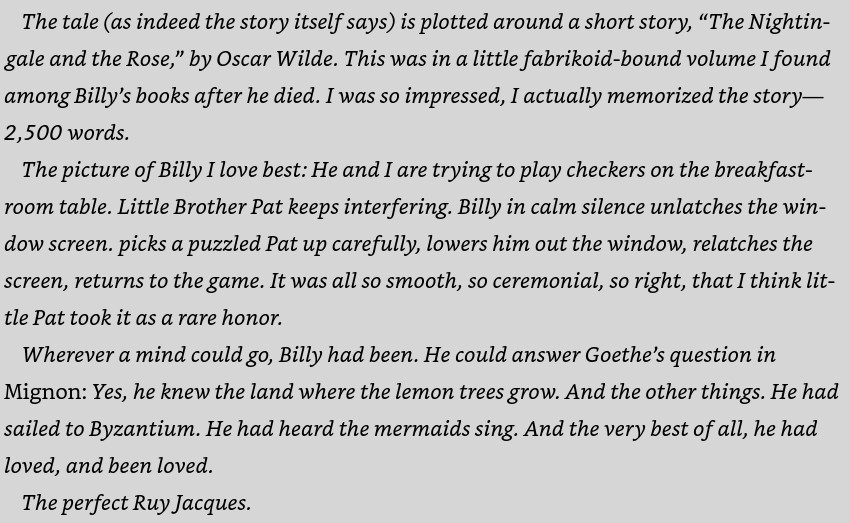
Both have the same introduction to “The Rose:”
Because “The Rose” appeared in Authentic Science Fiction Monthly, I thought Harness was British, but his Wikipedia page says he was American. I recommend taking the time to read his entry because it made me want to read more of what Charles L. Harness wrote. His science fiction sounds fascinating, but I’ve only read a couple of his shorter works. I may, or may not have read Flight Into Yesterday/Paradox Men. I also recommend reading “The Novels of Charles Harness” by Rich Horton.
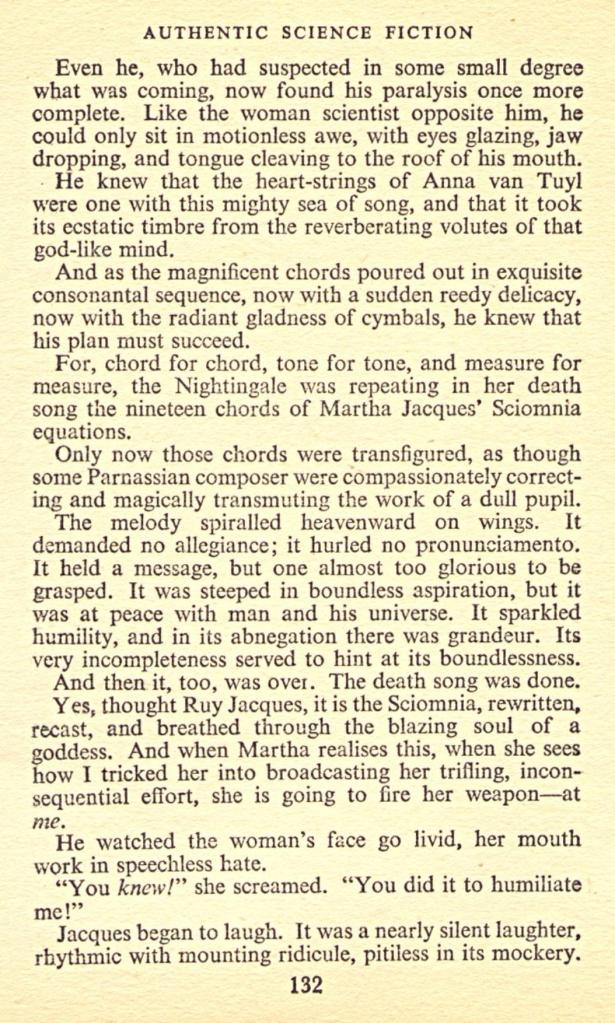
Describing “The Rose” is going to be difficult. Anna van Tuyl is a psychiatrist. She’s also a ballet dancer, composer, and choreographer. Anna was once beautiful, but now she is hunched back and has two horn-like structures growing from her forehead. The story is about Anna’s efforts to finish the score for a ballet called Nightingale and the Rose. As the introduction tells us, it’s plotted around a short story, “The Nightingale and the Rose” by Oscar Wilde. Anna is mentally blocked from composing the score’s climax.
Anna’s friend, Max Bell, a psychogeneticist, recommends Anna to Martha Jacques, wife of Ruy Jacques. Martha is a brilliant scientist working on an advanced weapon, and Ruy is an artist. Ruy has also become disfigured by a hump and horns, and recently lost the ability to read and write. Max Bell tricks Anna into meeting Ruy Jacques, where she falls in love with him. Ruy is an over-the-top, outrageous character — narcissistic, insane, and brilliant to the nth degree.
It turns out that Martha is obsessively jealous of Ruy and is hesitant to hire Anna. Throughout the story, Martha and Ruy have one never-ending argument about art versus science. This is one of the many reasons “The Rose” is so dense to read. Harness throws out all kinds of ideas and theories about art and science. Ruy believes artists have long known everything scientists eventually discover.
To complicate the story further, Ruy and Anna are emerging supermen, or examples of Homo superior. They are developing psychic powers, but these are strange powers. Harness has taken on the task of showing how advanced humans will think. Much of his speculation is psychobabble and pseudo-science, but there’s a kind of elegance to his thinking. Harness uses 1953 art theory, combined with a fair knowledge of classical music, ballet, and other arts, to contrast with scientific and mathematical ideas of the time. Reading Charles L. Harness suggests he was a cultured man, better educated than the average science fiction writer. But then, science fiction writers are often great autodidatics and bullshitters. Harness had degrees in chemistry and the law and worked as a patent attorney.
Harness also complicates his story by paralleling the plot of the novella with the plot of the fictional ballet. And Ruy and Anna work to live out their own artistic creation.
It took me a while to embrace Harness’s prose. You have to read it slowly because he intends so much with each sentence. Here’s one sample.
“The Rose” is definitely a story I look forward to rereading someday. I’d love to hear a professional narrator read it in an audiobook. “The Rose” doesn’t emotionally enchant me like “The Star Pit” by Samuel R. Delany or “A Rose for Ecclesiastes” by Roger Zelazny does. It’s about as intellectually impressive as “The Darfsteller” by Walter M. Miller, Jr., another long science fiction story about artists and performers I admire but don’t quite love.
My opinion might change with another reading of “The Rose.” Right now, it doesn’t quite make the five-star rating. I think the density of the prose keeps me from embracing the characters. I never liked Anna or Ruy, only admired them as interesting characters. This might be due to the story being too tightly plotted. Harness wanted his characters to act out a ballet they were creating, and you get the feeling that Anna and Ruy are acting for Harness, not themselves.
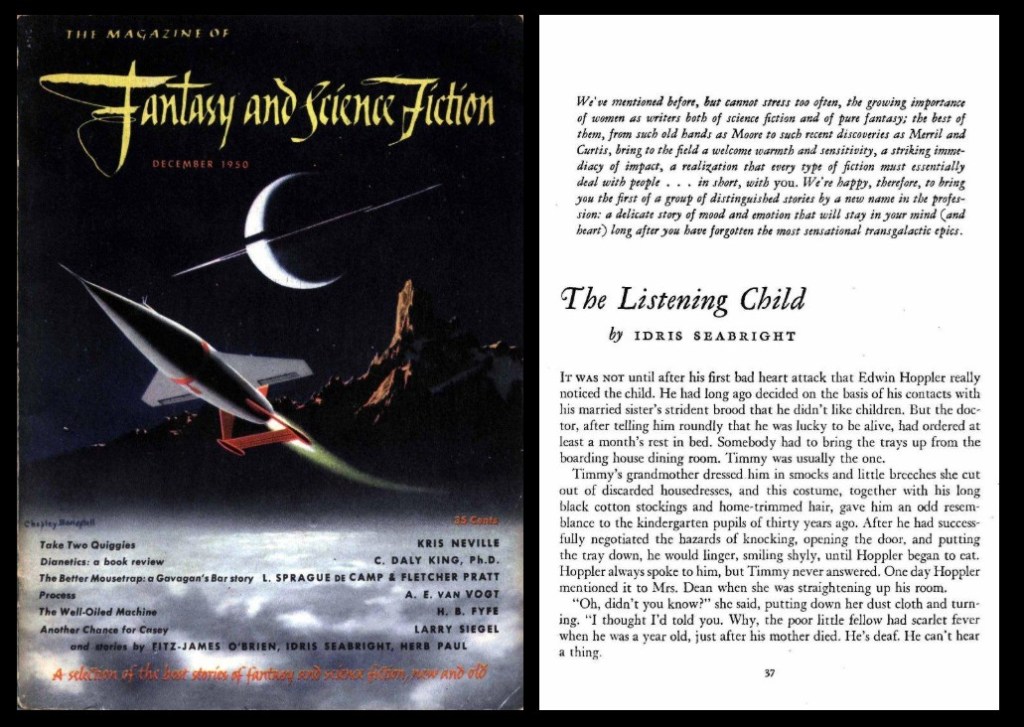
“The Listening Child” was first published in The Magazine of Fantasy and Science Fiction (December 1950) by Margaret St. Clair using the pseudonym Idris Seabright. You can read it online here. It is short story #1 of 25 that our Facebook group will be discussing as Group Read 92. (See the reading schedule at the end of this review.) Group Read 92 consists of 25 stories picked by five group members that we haven’t read before. That was a challenge since we’ve been discussing a short story daily for years. The group is public.
In the 1950s, extrasensory perception (ESP) was a popular theme in science fiction and fantasy magazines. It was often speculated that people with physical or mental abnormalities might have additional senses to compensate for the loss of one of their primary senses. I assume the assumption came from blind people who had keener hearing.
After Hiroshima, science fiction and comic book writers often used radiation as a cause of ESP. However, in the 1930s and 1940s, John W. Campbell was impressed by the Rhine experiments, and science fiction writers often supposed that advanced aliens had psychic powers. Arthur C. Clarke, who was normally a hard SF writer, proposed that the evolution of human development led to ESP in two of his most famous novels, Childhood’s End and 2001: A Space Odyssey. Soft science and fantasy writers leaned towards psi-powers in physically and mentally damaged humans, like Theodore Sturgeon’s More Than Human.
Margaret St. Clair imagines a deaf mute having a rather unique ESP talent. Timmy can “hear” when death is near. Many famous stories personify death, so this isn’t too out there, but it’s not as believable as other ESP talents, even though it is well proven that ESP does not exist. Still, hearing death makes for a nice story idea.
St. Clair’s setup for her story is rather quaint. Edwin Hoppler is 63 and suffers from a weak heart. He lives in a boarding house. Boarding houses have disappeared, but were common in old movies and science fiction short stories before the 1960s. Quite a few episodes of The Twilight Zone were set in boarding houses. It’s a shame they don’t still exist. Living with several other individuals who ate communal meals fixed by a nice old lady sounds pleasant.
Timmy is the landlady’s grandson, and Edwin feels sorry for him. Edwin befriends Timmy when he realizes that the other kids don’t play with Timmy. Edwin notices that Timmy “listens” intently at times, and eventually notices that these listening moments precede a person or animal dying. Edwin decides to use Timmy as the canary in a coal mine to detect his own impending heart episodes.
“The Listening Child” is a pleasant little story, but rather slight. Timmy and Edwin are only developed enough as characters to present the idea for the story. There’s little conflict or tension. The story also lacks color or voice. The idea is slight, but writers can flesh out simple ideas into complex characterization and plots. For example, compare it to “Jeffty is Five” by Harlan Ellison. Jeffty is a boy who is perpetually five, and always lives in the year he was five, with the popular culture never changing. Or read “Baby is Three” by Theodore Sturgeon; it’s tremendously dramatic for a boy with psychic powers talking to a psychiatrist.
I don’t want to tell you the ending, but I expected St. Clair thought her readers would find it emotional and poignant. It was presented too casually for me to be moved, but I’m curious if other members from our short story reading group will be moved. I wanted the ending to be like in Platoon when we see Elias still alive, and the emotional impact we felt watching him die.
I’m working on a project to find my all-time favorite science fiction stories I’ve read over the past sixty years. Identifying such stories means learning what makes a story work. Most published stories succeed at a basic three-star level, which is how I’d rate “The Listening Child.”
For this story to reach the four-star level, Timmy and Edwin would need to become vivid characters. To make it to a five-star story would require elevating the story gimmick of hearing death into something metaphorical and philosophical that I would want to contemplate over several readings.
James Wallace Harris, 4/21/25
Group Read 92 Schedule
01 (04/22/25) – The Listening Child, by Margaret St. Clair (ss) F&SF, December 1950 (DH)
02 (04/24/25) – Brightness Falls from the Air, by Margaret St. Clair (ss) F&SF, April 1951 (FP)
03 (04/26/25) – The Rose, by Charles L. Harness (na), Authentic Science Fiction, 15 March 1953 (PF)
04 (04/29/25) – The Last Day, by Richard Matheson (ss), Amazing, April/May 1953 (FP)
05 (05/01/25) – Watershed, by James Blish (ss), If, May 1955 (RH)
06 (05/03/25) – The Certificate, by Avram Davidson (ss), F&SF, March 1959 (FP)
07 (05/06/25) – To See the Invisible Man, by Robert Silverberg (ss), Worlds of Tomorrow, April 1963 (FP)
08 (05/08/25) – A Two-Timer, by David I. Masson (nv), New Worlds 159, February 1966 (PF)
09 (05/10/25) – The Adventuress, by Joanna Russ (nv), Orbit 2, ed. Damon Knight (Putnam, 1967) (RH)
10 (05/13/25) – No War, or Battle’s Sound, by Harry Harrison (nv), If, October 1968 (FP)
11 (05/15/25) – The Milk of Paradise, by James Tiptree, Jr. (ss), Again, Dangerous Visions, ed. Harlan Ellison (Doubleday, 1972) (RH)
12 (05/17/25) – Pale Roses, by Michael Moorcock (nv), New Worlds 7, ed. Hilary Bailey & Charles Platt (Sphere, 1974) (PF)
13 (05/20/25) – Concepts, by Thomas M. Disch (nv), F&SF, December 1978 (PF)
14 (05/22/25) – Gate of Faces, by Ray Aldridge (nv), F&SF, April 1991 (PF)
15 (05/24/25) – On Sequoia Time, by Daniel Keys Moran (ss), Asimov’s, September 1996 (PN)
16 (05/27/25) – Journey into the Kingdom, by M. Rickert (nv), F&SF, May 2006 (PN)
17 (05/29/25) – Roxie, by Robert Reed (ss), Asimov’s, July 2007 (PN)
18 (05/31/25) – 26 Monkeys, Also the Abyss, by Kij Johnson (ss), Asimov’s, July 2008 (DH)
19 (06/03/25) – Passage of Earth, by Michael Swanwick (ss), Clarkesworld 91, April 2014 (PN)
20 (06/05/25) – Cimmeria, by Theodora Goss (ss), Lightspeed 50, July 2014 (RH)
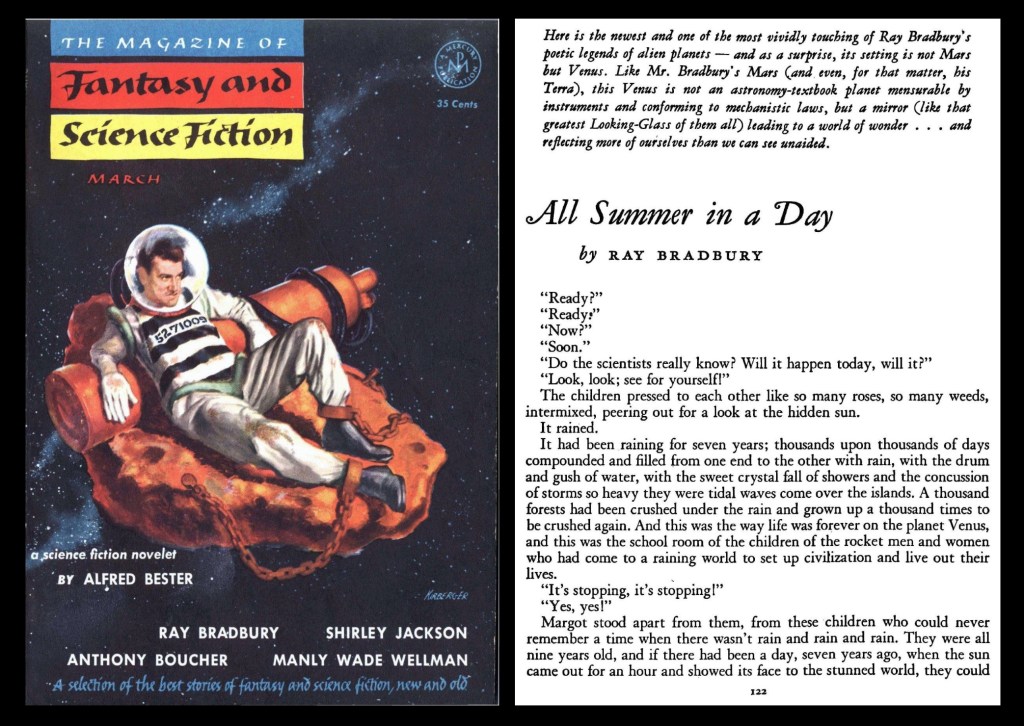
I’ve been rereading Ray Bradbury short stories, and I’m amazed at how well they hold up even when the science is beyond dated. Ray Bradbury is quite cruel to us readers in “All Summer in a Day.” In fact, I had to stop reading when I knew where the story was going, I just didn’t want to go there. I waited a couple of days to finish this fifteen-minute story on audio.
At first the kids in “All Summer in a Day” reminded me of Charles Schultz’s Peanuts characters, but then it was obvious they associated with bad kids from stories by Charles Beaumont or Shirley Jackson.
Remember when Lou Grant told Mary Richards she had spunk? And then Lou said, “I hate spunk.” Well, “All Summer in a Day” has a punch in the gut, and I should say “I hate a punch in the gut,” but when it comes to short stories, a punch in the gut is a good thing. Isn’t that weird. Why do we admire a great punch in the gut from a short story? Why is it so satisfying?
“All Summer in a Day” is set on Venus where it rains continuously except for a two-hour window of clear weather and sunshine every seven years. In a classroom the kids are talking about the impending summer. One girl, Margot, was born on Earth and didn’t come to Venus until she was four. She could remember sunshine and tried to describe it to her classmates who didn’t remember the sun because they were born on Venus. They were just two the previous summer day. They didn’t believe Margot. They resented that she knew something special. So, just before the sun was to come out, they locked Margot in a closet. All the other kids got to see the sun, and it was everything and more that Margot had tried to describe to them.
The children completely forgot about Margot while they cavorted through their brief summer day. When the rain and clouds returned, they remembered Margot and let her out.
This is a simple story about how children are cruel to each other. It’s about being the nail that sticks up. It’s about knowing the undescribable. Does the setting on Venus really matter? It makes the story science fiction so Ray Bradbury can sell it to a science fiction magazine, but does it really matter to the story? Charles Schultz could have done such a story about how the Peanuts gang mistreated Charlie Brown, and may have many times, I just can’t cite a specific panel.
I’m in the process of rereading my favorite science fiction stories and trying to understand why they are my favorites. Writing ability accounts for some of the reasons, but triggered emotions count for many too. I wish I could say I understood every cog in this story, but I don’t. What I do recognize is Ray Bradbury has a set of skills to tell a story in a way that makes it stand out. Not only that, but his stories also endure.
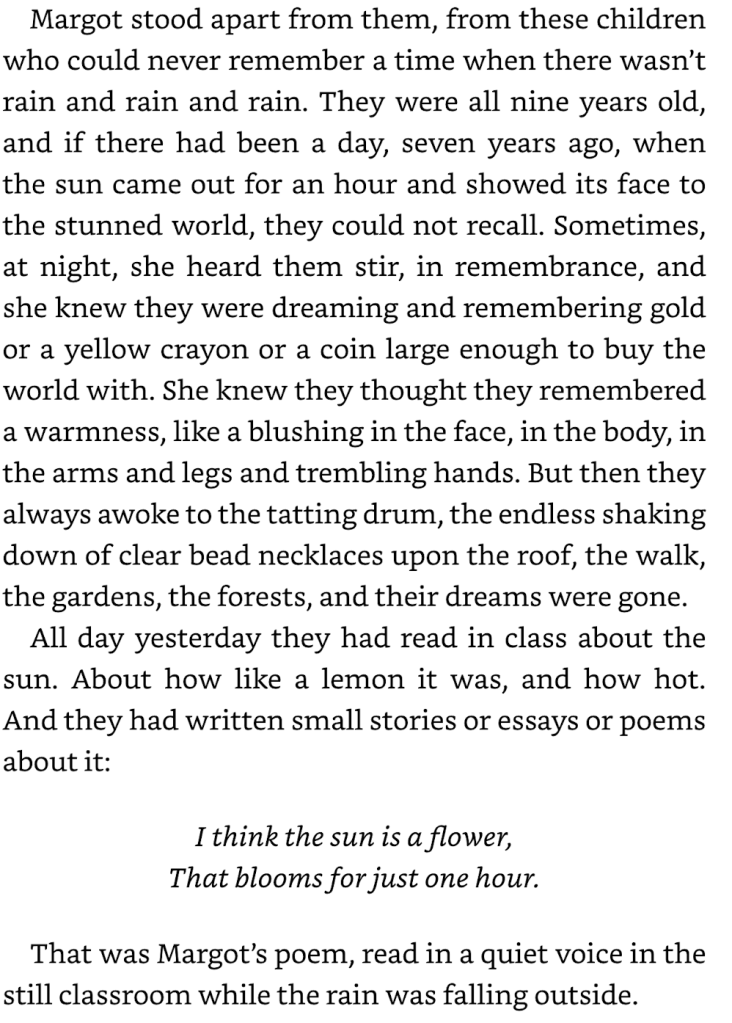
As I reread this story I didn’t remember the details, but either I guessed or remembered what was going to happen to Margot. That’s why I stopped listening to it. But when I returned to the story, I kept thinking to myself: “How is Margot going to react?” I was surprised that Bradbury didn’t give us Margot’s reaction. He left that up to us. That’s another tool in his writing toolbox. Writers don’t have to tell us everything. Bradbury does tell us this about Margot:
Because I just finished reading a biography of Ray Bradbury I know he was an odd child that stood out to his classmates. He also like to write poetry. Bradbury doesn’t have to tell us that this story is for us loners and oddballs, the ones other kids considered weird. When I was growing up, I didn’t know anyone else who read science fiction. Science fiction was like the sun appearing on Venus to me. I tried to explain its appeal to other kids, but they just thought I was a zero. I didn’t make a science fiction reading friend until the tenth grade when I met James Joseph Andrew Connell, III. The experience of meeting another science fiction fan is why Among Others by Jo Walton won the Hugo, Nebula, and British Fantasy Award. Zenna Henderson made a whole writing career out of telling stories about oddballs.
Even in the 1940s Ray Bradbury knew that being labeled a science fiction writer would hurt his career. Bradbury authored stories for all kinds of markets and genres, but when he wrote science fiction, he knew he had to be different. Back in the 1950s he might have been the best-known science fiction writer in America, but many science fiction readers didn’t consider his work science fiction. Bradbury wanted to be a writer like Sherwood Anderson, Ernest Hemingway, or Thomas Wolfe, someone who was just called a writer.
The reason “All Summer in a Day” is good is because of the parts that aren’t science fiction. The reasons why some science fiction fans dismissed him was for the science fiction parts. The obvious lesson here for would-be science fiction writers, is don’t worry about the science fictional aspects but focus on the universal human appeal.

 Classics of Science Fiction