“Weihnachtabend” by Keith Roberts

If not read carefully, “Weihnachtabend” by Keith Roberts will come across as just another alternate history about Hitler winning WWII. “Weihnachtabend” is more subtle, it’s an alternate history where England and German never fought, but made an alliance, and eventually ruled over Europe together. They called their alliance the Two Empires, graphically symbolizing it with the Lion, and the Eagle.

I have read many books and watched many movies and television shows set in England in the mid-20th century. And one historical event that has come up often is when Neville Chamberlain signed the Munich Agreement in 1938. Roberts imagines what if peace between Germany and England had played out, and, if the English fascists had come to power. In the alternate history timeline of this story the Munich Agreement is The Cologne settlement.

Roberts writes beautifully, painting with impressionistic details rather than flatly telling us what happened.

“Weihnachtabend” by Keith Roberts is story #44 of 52 from The World Treasury of Science Fiction edited by David G. Hartwell (1989), an anthology my short story club is group reading. Stories are discussed on Tuesdays, Thursdays, and Saturdays. “Weihnachtabend” was first published in New Worlds Quarterly 4 (1972) edited by Michael Moorcock. You can read it here. “Weihnachtabend” is also in The Grain Kings, which collects seven of Keith Roberts stories. It’s currently available for $1.99 at Amazon for the Kindle edition.

I highly recommend reading “Weihnachtabend” before reading my essay for two reasons. First, this story is a masterpiece of alternate history and is well-worth reading. Second, it’s a test of reading ability. The story is not hard to read, but instead of just telling what’s happening, Keith Roberts gives us pieces to put a mental jigsaw puzzle together. The story is dense with clues and implications about history and people.

“Weihnachtabend” tested my reading ability, and I didn’t do very well on my first reading. The title means Christmas Eve — I had to look that up. I read the story slowly, trying my best to understand it, but it wasn’t until afterwards that all the subtle aspects were revealed when I read Paul Kincaid’s review. I was further enlightened by Joachim Boaz’s review.

Clarity came with my second reading, and even then, I’m not sure I saw everything Roberts intended. I’m learning in old age that fiction needs two readings before you begin to understand it. It’s a shame that knowledge has come so late in life. No matter how hard I try to become a better reader, and I’ve been trying my whole life, the only thing I keep learning is how bad my reading ability still is and how much more I need to learn.

Keith Roberts’ fiction is a great test for understanding what you read. I’ve read his fix-up novel Pavane and a couple other stories. His prose is dense with layers and depth. Roberts also has a great imagination and creates beautifully visual scenes. If only someone would film his stories.

“Weihnachtabend” opens as Richard Mainwaring and Diane Hunter approach Wilton Great House while riding in a chauffeured Mercedes. Right from the beginning Roberts presents the constant presence of paranoia. Richard notices that the communication channel between the back of the car and the chauffeur is always open, and the chauffeur is listening. Before they get to the country house — I picture it as a manor house of the aristocracy, they come to a wall with watchtowers and pillboxes, and guards with machine guns. The guards speak German.

Richard gives his identity card which says: “Die rechte Hand des Gesandten.” We learn that Richard is the right-hand man of the messenger, and we’re eventually told his title is “Personal Assistant to the British Minister of Liaison.” The identity card also tells the guard Miss Hunter is from his department. (I’ve completely forgotten my high school German, so I had to depend on Google to translate. Knowledge of most of the German phrases in the story aren’t needed to understand the story, but not all.)

Diane is extremely nervous, but then so is Richard. Why is he nervous if he’s a top dog in the ruling political party? Diane is a beautiful blonde who Richard had known long ago. She belongs to someone he knew, a man named James, but for this trip, she is with him.

As the story progresses, we learn we’re in England, but it’s years after the period we know as WWII. England and Germany rule Europe. They fear America. But for some reason, the alliance is dominated by Germany, and the English leadership speak German. There is unrest in England and elsewhere, but the leadership maintains order much like the authoritarian rule in Nineteen Eighty-Four. At the top is King Edward VIII and a Fuehrer named Ziegler (I think. It’s confusing about what happened to Hitler, or who is the Fuehrer. Hess is deputy Fuehrer.) We know it’s decades later because they have large screen televisions, and rollneck shirts. I assume this means a turtleneck which was trendy in the 1960s, and around the time Roberts wrote the story.

Roberts doesn’t have a specific message in this story. He just paints a tableau. Richard, in the end, has something to say to the reader, but what he says, we’ve known all along from our history.

What makes the story compelling to read is figuring out what is happening to Richard. At first, it’s just a Christmas Eve party for extraordinarily rich people. Richard is given a Lamborghini by his boss. There is a description of a brutal hunt, and a bizarre Christmas tradition for children. Richard and Diane have sex, and we feel they are old lovers who are finally going to get together. Then Diane disappears and Richard becomes unhinged, eventually confronting his boss with a Lüger.

As I’ve said, the story has many layers. Like in Philip K. Dick’s novel, The Man in the High Castle, there’s a meaningful-to-the-story book like The Grasshopper Lies Heavy. However, instead of being from another timeline, Toward Humanity is from Richard’s own timeline. The writer’s name is Geissler, and his book is banned. Richard finds this dangerous volume planted in his room. It’s published by the Freedom Front. Richard doesn’t know if his party is testing him or if the opposition is trying to recruit him.

And Richard wonders why he’s so lucky to suddenly acquire a beautiful blonde. Is she who she says she is, or is she a plant from his party to test him, or an agent of the Freedom Front? Blondes are a reward to good party men, easily bought and traded. When Richard’s blonde goes missing everyone wants to pretend, she never existed.

Along the way, we are given clues about this world with quotes from Toward Humanity. Here are three quotes:

The Cologne settlement, though seeming to offer hope of security to Jews already domiciled in Britain, in fact paved the way for campaigns of intimidation and extortion similar to those already undertaken in history, notably by King John. The comparison is not unapt; for the English bourgeoisie, anxious to construct a rationale, discovered many unassailable precedents. A true Sign of the Times, almost certainly, was the resurgence of interest in the novels of Sir Walter Scott. By 1942 the lesson had been learned on both sides; and the Star of David was a common sight on the streets of most British cities.

---

In 1940, her Expeditionary Force shattered, her allies quiescent or defeated, the island truly stood alone. Her proletariat, bedeviled by bad leadership, weakened by a gigantic depression, was effectively without a voice. Her aristocracy, like their Junker counterparts, embraced coldly what could no longer be ignored; while after the Whitehall Putsch the Cabinet was reduced to the status of an Executive Council …

 
---

Against immeasurable force, we must pit cunning; against immeasurable evil, faith and a high resolve. In the war we wage, the stakes are high; the dignity of man, the freedom of the spirit, the survival of humanity. Already in that war, many of us have died; many more, undoubtedly, will lay down their lives. But always, beyond them, there will be others; and still more. We shall go on, as we must go on, till this thing is wiped from the earth. Meanwhile, we must take fresh heart. Every blow, now, is a blow for freedom. In France, Belgium, Finland, Poland, Russia, the forces of the Two Empires confront each other uneasily. Greed, jealousy, mutual distrust; these are the enemies, and they work from within. This, the Empires know full well. And, knowing, for the first time in their existence, fear …

We doubt Richard is persuaded by this political rhetoric. The ending of the story is quite dramatic. The final scene also reminds me of the final message of Nineteen Eighty-Four. I must wonder if Keith Roberts was commenting on the current political climate in England of 1972 when and where he wrote “Weihnachtabend.”

I know in 2023 there is much distrust of government everywhere. Was Robert’s paranoia any different than an average citizen? Who really controls us?

James Wallace Harris, 8/16/23
How Should We Judge Heinlein’s Stranger in a Strange Land in 2023?

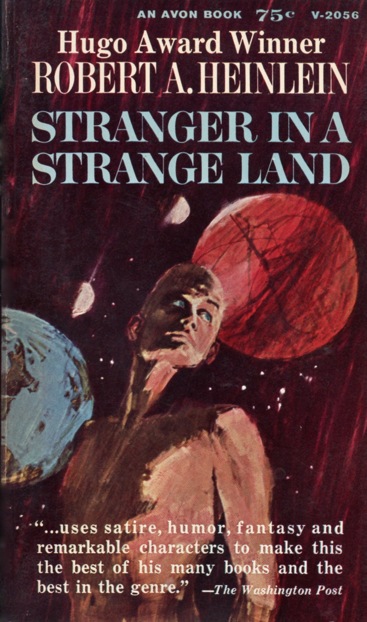
I recently watched a devastating “review” of Stranger in a Strange Land on YouTube. (Watch it below.) The short film summarized the plot of the novel, but in a way that made the story ridiculous. When I first watched it, I didn’t think the sarcasm and satire was unfair. I first read Stranger in 1965 when I was thirteen, and I loved it. I’ve reread it many times over the decades, but with each rereading I became more disappointed with the story. So, the criticisms made by Overly Sarcastic Productions resonated with the memories I have of listening to the audiobook version in 2004, and my last reading in 1991. Even though Robert A. Heinlein is still my favorite science fiction writer; I haven’t liked his books published after 1959 for a long time. However, I’m wondering if I shouldn’t reevaluate that dislike.

Today, I started reading A Martian Named Smith by William H. Patterson, Jr., the man who wrote a two-volume biography of Heinlein and who edited The Heinlein Journal. I wouldn’t call Robert A. Heinlein: In Dialogue with His Century an official biography, but it was written with the support of Virginia Heinlein. Patterson makes a great case that Heinlein was trying something quite different with Stranger, and it shouldn’t be judged like traditional science fiction. Patterson considers Stranger to be a classic satire, and that the satire has a different structural form than the novel.

In the 1960s and 1970s, Stranger in a Strange Land might have been the most famous science fiction novel. It was a cult classic on college campuses and embraced by many in the counterculture. I’m not sure Heinlein liked that. It was also embraced by the growing libertarian political movement. The more Heinlein was embraced by the Right, the more readers on the Left moved away from his works. That put me in a bind. I’m liberal. What eventually happened is I focused on his books published before 1960.

But I thought of something today. Stranger in a Strange Land could be considered an early work of New Wave Science Fiction, at least by some of its goals. The New Wave movement wanted science fiction to move away from pulp writing, escape from the old tropes in science fiction, embrace the latest literary standards, experiment in new forms of writing styles, deal with emerging social issues, and be more relevant. Heinlein was obviously doing all that with Stranger in a Strange Land. The New Wave was mostly out of England, and on the left politically. Heinlein made public proclamations that divided the science fiction community between conservative and liberal, so no one considered him New Wave at the time.

Patterson, in A Man Named Smith makes a very intellectually grounded case that Stranger in a Strange Land works on multiple levels, some of which are deep and seldom observed. What if Patterson is right? What if my liberal leanings are prejudicing me from giving the novel a fair chance? To find out I’ll need to reread the book, even both versions, and read Patterson’s book, along with other critical works and studies on the novel. That will be a huge project. That means this blog post will have another ongoing series — and I have too many of those unfinished right now. I’ve been meaning to get back to my Rereading Heinlein project. I expected to reread Stranger in a Strange Land after I read everything Heinlein wrote before it. I’m still stuck in 1940, where I planned to read “The Devil Makes the Law” (renamed “Magic, Inc.”) next.

I also got inspired to reread Stranger in a Strange Land this week when I watched the above video review. Then I read an essay on Book Riot where the writer was proposing to replace eight classic literary novels, four of which are among my favorites. I wrote about this on Auxiliary Memory, where I criticized younger writers for wanting to replace older books they hated, with newer books they loved. I said, if you want to replace a classic, it should be from the same years as the original work and cover the same thematic territory — that classics are how we view the past.

Then I read Joachim Boaz’s review of Davy by Edgar Pangborn. He called it a masterpiece. That led me to finding my copy of Davy and begin reading. It’s quite an impressive novel, but what’s interesting is its overlap with Stranger in a Strange Land. Both are about young males and their education before they become revolutionaries and try to create new social systems. Both these books precede the counterculture of the 1960s by just a few years. At first, I wondered if modern woke readers would accept Davy as a substitute science fiction classic for Stranger in a Strange Land. But if you read my essay linked above, you’ll see that I don’t believe in removing classics from the canon, but adding works that will supplement that.

I believe Stranger in a Strange Land, Davy, and The Man Who Fell to Earth by Walter Tevis make an interesting trilogy of works that reflect the early 1960s in science fiction. To write that will be another huge writing job that will take a lot of researching, reading, and writing. And I unfortunately have dwindling physical and psychic energy.

When I was growing up in the 1950s and 1960s Heinlein was considered the top science fiction author by most readers, even if they didn’t like his books. He was just that successful. He was made the first Grand Master by the SFWA in 1974.

Ever since Stranger in a Strange Land was first published, it was considered controversial, and even polarizing. Since the 1960s, Heinlein’s reputation has been in decline, but that might be relative. So many new writers have had so much success that Heinlein just had much more competition. However, in the 21st century there does seem to be a growing dislike of Heinlein among younger readers.

I love studying how books become popular and how they are slowly forgotten. Is Heinlein and Stranger on their way out? Or is there something to that novel that will keep people reading it for another century? I want to think about that.

Right now, people focus on Heinlein’s flaws. But what about Heinlein’s virtues?

I also want to think about the differences between what makes a literary novel a classic and what makes a science fiction novel a classic. There is an overlap in reasons, but each form has its unique qualities that determine whether they will become a classic novel. I believe literary novels must give significant insight into their story’s physical setting, and both the time in which the story is set, and when it was written.

We judge science fiction stories over their plots and ideas. But what if what makes a classic science fiction novel the same as what makes a classic literary novel? What does Stranger in a Strange Land say about America in 1961, and the decade before when Heinlein was writing it? My guess is it is something like what Pangborn and Tevis were saying. It’s going to take a lot of deep reading for me to find out.

James Wallace Harris, 8/12/23

Adult Science Fiction

John Brunner was the James Burke (Connections) of science fiction about the near future. Brunner was a polymath who used his diverse sources of knowledge to write four novels (Stand on Zanzibar (1968), The Jagged Orbit (1969), The Sheep Look Up (1972), and The Shockwave Rider (1975)) that extrapolated on everything he knew to envision the early 21st century. No one can predict the future, and Brunner gets all the details wrong in these novels, yet they eerily foretell the problems we face today. They are sometimes called Brunner’s Club of Rome Quartet, inspired by the famous Club of Rome from the 1960s, a think tank devoted to global problems of that day. Its most famous report, The Limits of Growth has been vilified over the decades, but time has proven it wasn’t wrong.

Brunner obviously wanted us to confront those problems before they happened. Of course, we haven’t. Even though some of Brunner’s novels won critical praise when they came out and Stand on Zanzibar won a Hugo, they were never popular. Brunner aimed as high as George Orwell, but his books never reached Nineteen Eighty-Four‘s impact. The Jagged Orbit was nominated for the Nebula and won the BSFA award, The Sheep Look Up was nominated for the Nebula, and The Shockwave Rider came in 2nd for the Locus Award for SF Novel. These four novels were mostly respected by critics, but they never became popular with science fiction readers. And as many brilliant science fiction writers know, science fiction gets no respect outside the genre.

I’ve always considered those Brunner novels to be adult science fiction and most science fiction fans don’t want adult literature. Most science fiction fans read science fiction for fun, for escape, and aren’t looking for serious speculation about present-day life or the near future.

When I use the term adult science fiction, I don’t mean Sci-Fi with X-rated content. Young adult fiction has become very popular and successful, even with adult readers. Young adult fiction usually means protagonists are in their teens. But I think the label should apply to any theme or subject that mostly appeals to young adults. Most science fiction is aimed at adolescent readers, or older readers who prefer not to grow up. And in our society, adolescence has extended into the twenties, and even later for many people. There are some awfully big kids still playing with their Star Wars toys.

To me, adult literature deals with the problems of being an adult in our current reality. That apparently doesn’t leave much territory for adult science fiction since it’s usually not set in our current reality. But let me give you an example of how a novel set in the future can be adult science fiction.

The Shockwave Rider came out in 1975, and its setting is the United States in the early 21st century. In other words, our current reality. Now I don’t mean adult science fiction is only stories set in our current day, the setting can be anytime or place in the universe so long as the reader finds something useful in the story that gives insight into being an adult. The Shockwave Rider was adult science fiction in 1975 and will probably continue to be for years to come. Unfortunately, after decades of knowing about the problems presented in the novel, we ignore them. We don’t want to grow up.

Brunner’s novel is extrapolation. He was inspired by the 1970 nonfiction book, Future Shock by Alvin Toffler. Brunner asked: how can humans survive in a world that is growing ever more complex and stressful, living with ever more information, coexisting with computers and automation, dealing with environmental decline, epic natural catastrophes, growing insanity, political corruption, constant surveillance, and ever-changing job requirements. Exactly, what we’re experiencing now. Brunner asks how society and citizens cope?

The plot of The Shockwave Rider deals with Nick Haflinger, who is a computer hacker on the run. He was a prodigy raised by the government to be an elite leader in the future, but he rejects that upbringing, and escapes. The plot is complicated by flashbacks. Part of the narrative deals with Nick being psychoanalyzed after being recaptured. While he is on the run he meets Kate Grierson, a brilliant young woman who gets Nick faster than he gets himself. While they are on the run they live in two different utopian communes that offer alternative lifestyles to what the cyber-controlled government wants.

Throughout the course of the novel, Brunner throws out concepts and gadgets he thinks will be developed by the early 21st century. He was right in imagining we’d have a gadget-oriented future, but for the most part, he pictured us with different kinds of gadgets. However, Brunner almost imagines the smartphone. He pictures a palm size with a flip-up screen. Nick does much of his hacking on such a device. People do have desktop-type computers too in The Shockwave Rider, but Brunner pictures them as smart network terminals. That’s because in the 1960s and early 1970s time sharing computers were all the rage. He doesn’t foresee the laptop.

Even though The Shockwave Rider was hard to read, confusing at times plotwise, and with less than fully developed characters, it is chock full of brilliant speculation. Reading it made me realize just how hard Brunner thought about the future, and how hard we should have been thinking about it too. The tragedy of our times is we knew all this bad stuff was coming and we didn’t do shit about it.

Cli-Fi is becoming more common now, but it’s not always handled in a serious way. Often it’s just a setting for young adult adventure. The best current example, which I would consider an adult science fiction novel is The Ministry for the Future by Kim Stanley Robinson.

The Shockwave Rider is not the kind of science fiction most science fiction fans want to read. They want adventure, rebellion, thrill rides, etc. Young people love blows against the empire stories. If you’re reading a story about zooming around the galaxy, then you’re reading young adult fiction. If you’re reading about surviving in dystopia, that’s not ours, then you’re reading young adult fiction. If you’re reading about being an old person whose mind is downloaded into a clone body, then you’re reading young adult fiction. Most far-out science fictional ideas are ones that appeal to the young adult in us. And I’m not being critical. I still love that stuff too, and I’m 71.

The Shockwave Rider is hard to read. Not just because it explores surviving in this reality, but because its storytelling structure is convoluted and hard to understand. Today, this novel is mostly unknown, but what little fame it does have, is because it’s credited as a work of proto-cyberpunk fiction. And Brunner gets credit for the term “computer worm.” But it’s much more than that.

Brunner was one of those writers who was way smarter than his readers. He was smarter than most people. Unfortunately, being smart doesn’t bring happiness. From 1968-1975, Brunner wrote a series of novels in which he seriously worried about life in the 21st century. There’s a monograph on Brunner in the Modern Masters of Science Fiction series called John Brunner by Jad Smith that I found rewarding. In some ways, Brunner comes across as a tragic figure in this study.

Brunner’s books are full of ideas, and reading about them made me want to read them. Unfortunately, they often fail to entertain. And I think that’s why most adult science fiction fails. It’s hard to pull off a serious book about serious problems and still be entertaining. It can be done. Nineteen Eighty-Four is an excellent example. So is Earth Abides by George R. Stewart.

True adult literature tends to come across as biographical because becoming an adult involves becoming mature. In adult novels, we learn so much about the main character and their growth that we feel we know them. Brunner never could bring this off. His characters are adults, and they struggle with adult problems, but we never feel them growing or even being real. They are puppets Brunner uses to act out situations he wants to intellectually explore.

Science fiction writers have the problem that they are seldom taken seriously by the literary world. They often complain that this lack of recognition keeps them from becoming financially successful. This was true of Brunner too. Despite winning awards and gaining a certain amount of respect and fame within the genre, his writing never provided the kind of money and respect he thought he deserved. I’ve wondered if it’s time to reevaluate Brunner’s work.

I found it very difficult to get into The Shockwave Writer. I had to try several times. I had to push myself to keep reading, but as I went along it became more rewarding. The Shockwave Writer is not a page-turner. But neither are Edith Wharton and Henry James. I don’t think his work will ever appeal to science fiction fans who crave young adult science fiction. And I don’t think there are many fans of adult science fiction. Kim Stanley Robinson writes adult science fiction and gets a certain amount of recognition. But his books just aren’t fun to read like the science fiction books that are popularly discussed on YouTube.

Ultimately, I’m not sure science fiction is the venue for adult literature. Brunner should have written speculative nonfiction. Science fiction works best at delighting our youthful sense of wonder. Aging makes us cynical and realistic.

For now, my favorite example of adult science fiction is Earth Abides. Its main character, Isherwood Williams, grows throughout the novel, and the ending is especially adult. But I’m open for you to leave comments about SF novels you think are adult in the comments.

James Wallace Harris, 7/18/23

A Time Before Science Fiction

I believe young people can’t imagine what life was like before the Internet, smartphones, or personal computers. I can’t imagine what my parents’ lives were like living before television, or my grandmother’s life before airplanes, cars, radios, movies, and all the inventions that my parents grew up with. My mother’s mother was born in 1881.

Lately, I’ve been trying to imagine what life was like before science fiction. There have always been stories that had science-fictional elements. Isn’t Noah’s Ark really a post-apocalyptic tale? I’m talking about science fiction as a defined category, a genre.

Life Magazine had to explain science fiction to its readers in its May 21, 1951 issue. It covered books, magazines, movies, and even fandom. Science fiction as a term had been used for the genre for about twenty years before that, but mainly in pulp magazines, and with a very small group of Americans. It’s like how the internet and network computers were used by a small subset of the population for a couple decades before the public was introduced to the World Wide Web with Mosaic in 1993. (See my essay: “When Mainstream America Discovered Science Fiction.”)

I’m theorizing it was the paperback book that got America to discover science fiction. The technology of the mass-market paperback was like when the technology of the Netscape browser got America to discover the World Wide Web.

I consider the science fiction pulp magazines of 1926-1950 to be like the internet before the World Wide Web when few people used it and all the tools were text-based. In the late 1940s and early 1950s science fiction fans created small-press publishing houses to reprint pulp magazine science fiction stories in hardback. Print runs were typically 1,500-3000, and the books were sold mainly to fans, and some libraries. I consider this era to be like the short-lived Gopher technology on the internet. (See my essay: “Remember Fantasy Press, Arkham House, Primes Press, Gnome Press, Shasta Publishers, and Others.”)

My guess is the American public noticed science fiction when science fiction movies came out in the early 1950s and when Ballantine Books, Ace Books, Pocket Books, and others brought out lines of paperback books devoted to science fiction in 1953. Movies were everywhere, and twirling paperback racks were everywhere. By the way, there was a time before mass-market paperbacks. Paperbacks as we know them began appearing in the late 1930s, were widely distributed to soldiers during WWII, and exploded on the scene in the early 1950s. Read Two-Bit Culture: The Paperbacking of America by Kenneth Davis for an excellent history of the paperback.

My guess is if you asked the average American what science fiction was before 1950 most would not know, and some might say when you mentioned space travel, “You mean that Buck Rogers stuff?” My parents grew up before science fiction. I was born in 1951, and I didn’t understand the term until 1963 when I was eleven. I had encountered plenty of science fiction on television, but I didn’t think of it as a specialized subject, genre, or art form. I didn’t go to a new bookstore until 1967 when I was 16. My first bookstores were all used bookstores, and I didn’t discover them until 1965.

Even though I was born in 1951, after the time I said was the beginning of the time when the American public started to think of science fiction as a thing, I didn’t learn it myself until 1963, and even then I had to figure it out on my own. It wasn’t until 1964 that I discovered science fiction sections in libraries. Because I had trouble comprehending science fiction as a genre in 1963 at age 11, I imagine many people in the 1950s and 1960s still didn’t comprehend it fully either.

I don’t think it was until the 1970s, when shopping malls became common, and chain bookstores were popping up everywhere, that the public began to see science fiction book sections. The used and new bookstores I shopped at in the 1960s had science fiction sections, but the bookstores were tiny, and the science fiction sections were really just two or three shelves of books. Before March 1967 I had no friends who read science fiction. That’s when I met my lifelong friend Jim Connell. Before that, the only science fiction fan I met was on a Greyhound Bus, when I struck up a conversation with a soldier.

I have to wonder what the average American thought when they saw Destination Moon in 1950 or The Day the Earth Stood Still in 1951? Was it mind-blowing? Or just silly kid stuff? I remember talking to my grandmother in 1968 about the space program and the planned Moon landing. She said it wouldn’t happen, that God would stop it.

It’s hard for me to imagine life before I was born in 1951. I think it’s harder for anyone growing up in the 21st century. We get our conception of life before 1950 in old movies, mainly ones in black and white. And think about it — have you ever seen any character in any of those old movies ever mention science fiction, or even talk about a science-fictional subject?

It was a different world back then. A much different world. A world most of us can’t comprehend. But try to imagine people of different ages visiting a drugstore back in 1953 and finding these books on a twirling rack. Especially, people who lived in small towns and suburbs. Imagine young kids, working-class men, and young housewives. What would they think if they picked up one of these books? And what would it do if they bought one, took it home, and read it?

When I read Red Planet by Robert A. Heinlein in 1964 when I was twelve, that was when I knew science fiction was my genre. I was a convert. Even by 1964, the percentage of science fiction converts in the American population was very small. And the conceptual umwelt I experienced from reading that 1949 book in 1964 must have been far different from the mind-expanding experiences of twelve-year-olds reading it in 1949, or even what Heinlein felt writing it. When did you discover science fiction as a genre, and what was the book that converted you?

I picked 1953 as the year America discovered science fiction because that’s when Ballantine Books and Ace Books began publishing science fiction, and near the beginning of the general paperback boom. Science fiction paperbacks existed before 1953, but they were much fewer. 1953 was also a boom year for science fiction magazines. (See my essay: The 1953 SF&F Magazine Boom.)

I wrote this essay because I’m learning that the umwelt of every person is different. Not only for how we perceive reality but how our biological sensory inputs lead to comprehending different abstract concepts. We have a tendency to assume everyone sees and knows what we know, and that’s so wrong. What’s amusing me to contemplate is thinking about how we perceive things at different ages and in different generations. Science fiction is just one example. What’s weird to grasp is authors work to code their umwelt into a story but the umwelt the reader decodes isn’t the same. I wish I could have gotten my parents and grandparents to read one of my favorite science fiction books when I was a kid and then ask each of them how they interpreted it.

James Wallace Harris, 7/15/23

“All the World’s Tears” by Brian W. Aldiss

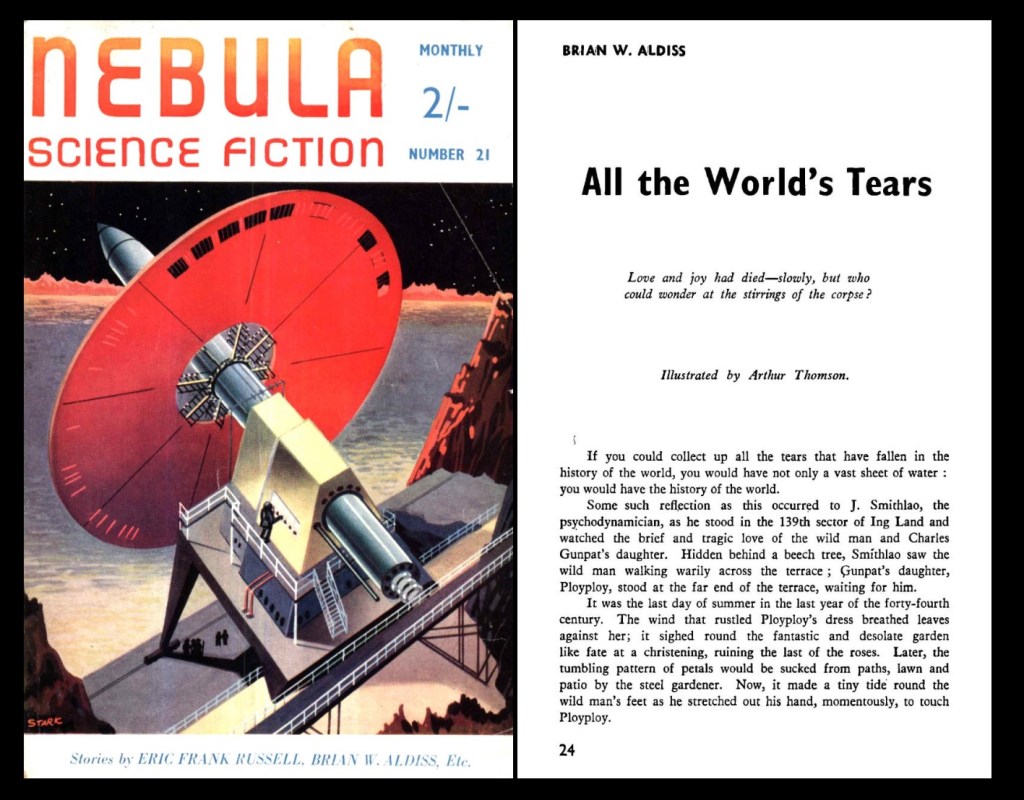
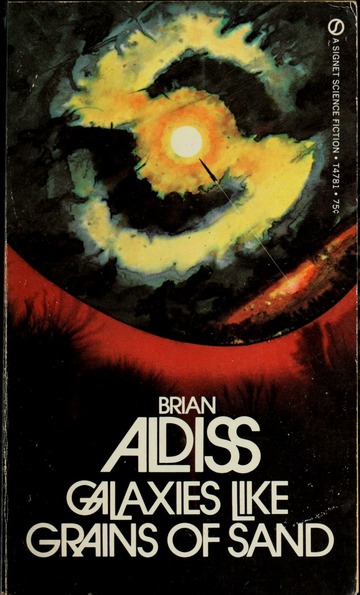
All the World’s Tears” by Brian W. Aldiss was first published in Nebula Science Fiction 21 in 1957. It has been rarely anthologized, but frequently reprinted in collections of stories by Aldiss. Older American science fiction fans might remember reading it in Galaxies Like Grains of Sand (1960). However, that collection has been republished many times with varying numbers of stories. I don’t recommend the current Kindle edition because it leaves off the story titles, uses the theme titles instead, and runs the intros into the beginnings of the stories. It’s readable but annoying.

You can read “All the World’s Tears” in Nebula Science Fiction 21. You can read a review of Galaxies Like Grains of Sand at Science Fiction and Other Suspect Ruminations.

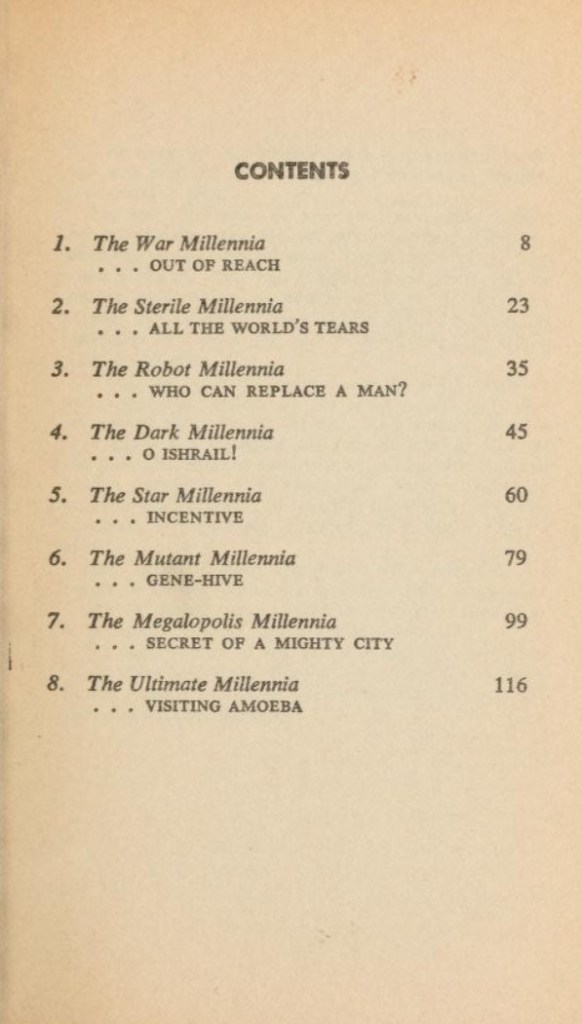
Galaxies Like Grains of Sand is a fixup novel with a mosaic story composed of eight or nine unrelated short stories glued together by imaginative introductions. Sort of like Simak’s City. It feels like a cross between Last and First Men and The Dying Earth.

“All the World’s Tears,” is the second story, under the theme “The Sterile Millennia.” For being such a short short story is dense with ideas, atmosphere, and imagery. The opening sequence, tells us the ending but we won’t know that until we get to the last page and read it. Aldiss has painted a future Earth of stark contrasts. The setting is the far future, the last day of summer of the 44th century. Earth no longer supports billions of humans, just hundreds remain, living in a high-tech society under the control of robots. No one is poor, but civilization is in decay.

Robots control every intent of peapods, bees, birds, and ants. The agricultural land is impoverished, yet wild mother nature is encroaching everywhere. I have to wonder if this is the mid-way point between the mid-20th century and the future of the Hothouse stories Aldiss would soon write.

Strangely, the robots do everything, yet are rather dumb. They monitor all activity, yet talk between each other in clumsy English and can be easily fooled. At one point, a man evades security robots by holding tree branches and telling the robots he’s a rose bush.

Aldiss’ prose suggests vivid scenes for paintings and films. Aldiss is quite imaginative. Both Hothouse and Galaxies Like Grains of Sand could be the basis for wonderful animated films for adults.

“All the World’s Tears” feature four human characters and several robots. The main character of focus of Ployploy. She is a young woman who is considered mentally deficient for being kind and barred from having children. However, Ployplay is well-loved by her father Charles Gunpat. She is judged a hereditary throwback because she is white and can’t express herself with hate and aggression. I can’t but wonder if Aldiss isn’t being racist here by suggesting non-white people are the genetic aggressors. Although he could also be suggesting that whiteness disappeared as the world’s population homogenized, and aggression was another trait that emerged after thousands of years of endless wars.

Observing Ployploy is a visitor, J. Smithloa, who is hired to visit Gunpat’s estate. He is a professional insulter, hired to fire up people’s aggression so they will mate and work to keep civilization going. The fourth character is a wild man sneaking onto Gunpat’s estate. He lives outside the control of the cyber-controlled state and wants Ployploy to run off with him.

Aldiss envisions the future as being extremely regulated, and high-tech, yet, falling into decay, near the end of mankind’s reign on Earth. Wild nature will soon overrun what is left of our civilization. Not only is Aldiss’ picture of our future bleak, but the couple we want to escape this horrible society die tragically.

Why did Aldiss write this story? Why is he so pessimistic? Over the past couple of years, I’ve become a fan of Brian W. Aldiss. Sometimes his works seem more adult, more mature than American science fiction. I assume in the 1950s, Aldiss extrapolated human aggression constantly evolving through natural selection into what he projects in “All the World’s Tears.” I have not read all the stories in Galaxies Like Grains of Sand, but the ones I have contain the same Darwinian cynicism about the future. In these stories, it’s a red tooth and claw existence.

I read this story years ago, and then yesterday, and again today. Each time I found more little nuggets of speculation. The story is both slight and deep. Aldiss included in his collection Man in His Times: The Best Science Fiction of Brian W. Aldiss, a collection I’m group reading on Facebook.

James Wallace Harris, 7/9/23

“The Lens” by Annemarie van Ewyck

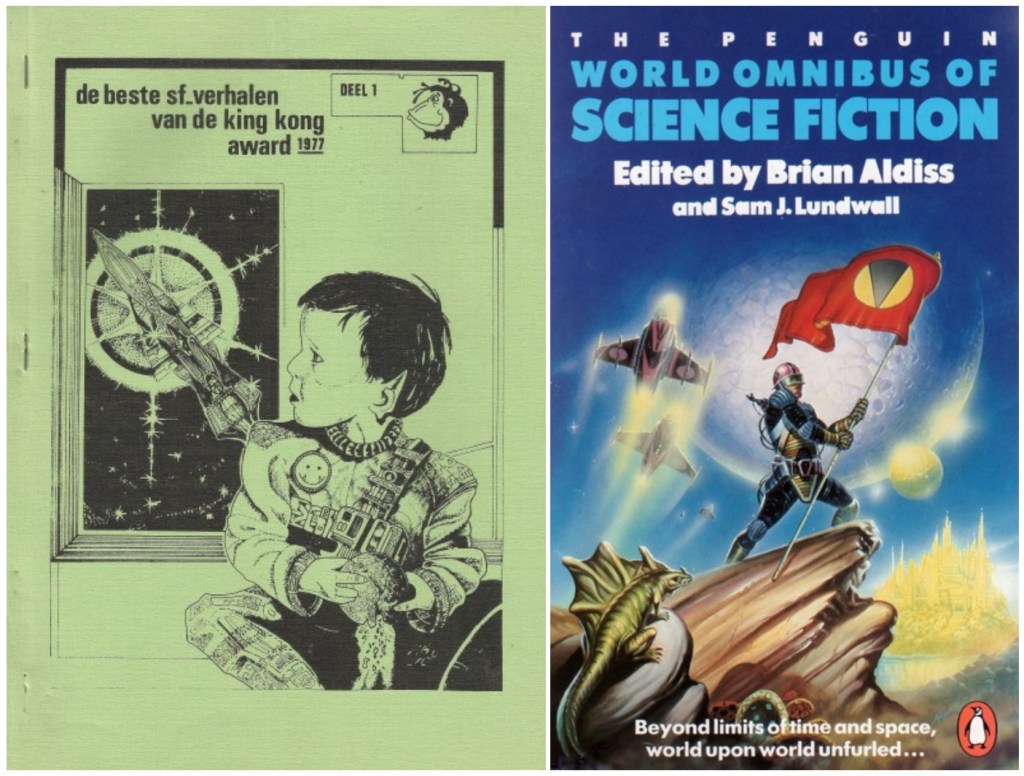
The Lens” by Annemarie van Ewyck is story #28 of 52 from The World Treasury of Science Fiction edited by David G. Hartwell (1989), an anthology my short story club is group reading. Stories are discussed on Tuesdays, Thursdays, and Saturdays. “The Lens” first appeared in Dutch in De beste sf-verhalen van de King Kong award 1977, deel 1 (Dec. 1977/Jan. 1978). In 1986 it was reprinted in English in The Penguin World Omnibus of Science Fiction edited by Brian W. Aldiss and Sam J. Lundwall.

Annemarie van Ewyck was Annemarie Pauline van Ewijck (1943-2017). She only has three short stories listed in ISFDB and was mainly an editor and columnist. The periodical above where the story first appeared looks like a fanzine to me.

Once again, I find it interesting that my take on a story is different from Hartwell’s. More and more, I’m realizing that The World Treasury of Science Fiction (1989) seems like a precursor to The Big Book of Science Fiction (2016) and that I’m out of touch with both editors. I might just be out of touch with the genre in general. However, with “The Lens” I believe it’s a perfect story for this anthology, and it’s my kind of science fiction.

Here’s Hartwell’s intro:

I thought “The Lens” was quite a nice story, especially effective for being so short, but I didn’t think “The Lens” reflected the mood, tone, or concerns of 1950s science fiction. I don’t know if that era can be generalized, and I wonder if there really is a general style to post-Anglo-American post-New Wave works. “The Lens” doesn’t feel like Bradbury, Zelazny, or Sturgeon to me at all but it does remind me of James Tiptree, Jr., but also Ursula K. Le Guin.

In other words, “The Lens” reminds me of 1970s science fiction written by women, which it is, but can we generalize on that? Is there a common denominator? I don’t think so, other than a female character in an alien society feeling the shock of otherness after undergoing an alien rite. But isn’t that theme also explored by Jack Vance in “The Moon Moth” or Downward To the Earth by Robert Silverberg?

As the years go by, I’m less inclined to believe there was much of a New Wave in science fiction, despite the efforts of Michael Moorcock, Judith Merril, and J. G. Ballard. Yes, there were some experimental efforts, like the kind we saw in New Worlds, England Swings, and Dangerous Visions, but that kind of experimentation had been going on in the literary world for a long time. I believe by the 1960s and 1970s the genre was just getting more diverse writers, and better writers in general, writers who were willing to try different ways to tell a story. By then writing programs were flourishing everywhere.

I also know people get tired of me bellyaching about some stories in these anthologies not being science fiction. That’s not because of how they were written, or by who. I believe science fiction represents a state of mind, and “The Lens” is definitely science fiction, and fits within that state of mind.

The first-person narrator, Dame Ditja, a diplomat, is returning from Earth to Mertcha after visiting their dying mother. We know things are very different when we learn her mother died at age 286. I liked how Dame Ditja described her relationship with their mother and their interaction with the other passengers on the ship. She is returning to the city of Tiel where she is the Head of Cultural Liason.

On Mertcha, the aliens have three arms and three legs, and their architecture and philosophy reflect that difference. Dame Ditja has decided to request a permanent assignment to Mertcha, which she now thinks of as home. She expected to be met at the spaceport by Mik, a local who is her driver and friend, however, a substitute driver meets her instead. That driver thinks she is an ordinary tourist and takes her to a holy place that is a main tourist attraction for people from Earth.

At the Holy Place of Tiel, Dame Ditja has a transcendental experience, one of ecstasy, one that is usually experienced by certain believers in this alien culture. While having this experience, Dame Ditja realizes that radical monks of this faith have trapped some tourists from Earth to hold hostage, and Dame Ditja comes out of her trance and carefully, but forcefully, frees them in a diplomatic coup.

This achievement gets her offered more prestige assignments, and Dame Ditja changes her mind and plans to leave, even though all through the story she wanted to stay.

The ending is strange. Because of the incident at the Holy Place of Thiel, Dame Ditja no longer feels like Mertcha is her home, and thus feels compelled to leave. It appears Dame Ditja wants to die, and she feels she can only die in a place she considers home. I’m not sure why she wants to die or is ready to die, but I wonder if it’s because people live too long in this fictional future?

After reading this story twice I feel it’s closest in style and tone to some stories I’ve read by Brian W. Aldiss. On the first reading, I would have rated this story ***+ but on my second reading, I feel it’s a **** story.

James Wallace Harris, 6/8/23

“Inconstant Moon” by Larry Niven

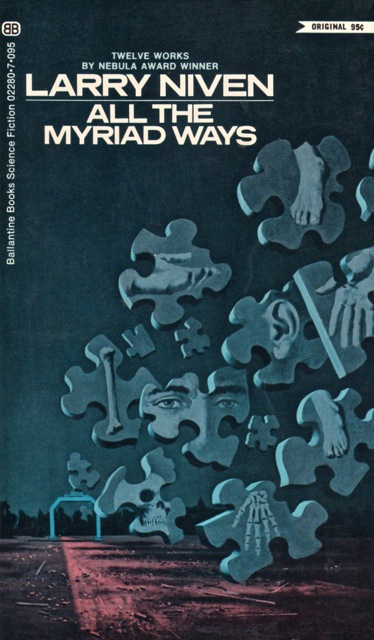
Inconstant Moon” by Larry Niven is story #23 of 52 from The World Treasury of Science Fiction edited by David G. Hartwell (1989), an anthology my short story club is group reading. Stories are discussed on Tuesdays, Thursdays, and Saturdays. “Inconstant Moon” first appeared in Niven’s 1971 collection, All the Myriad Ways. Currently, the story is available in N-Space, a retrospective collection of Niven’s work from 1990. If you want an ebook version of the story, it’s included in Masterpieces: The Best Science Fiction of the Century edited by Orson Scott Card.

Outer Limits dramatized the story – watch it on YouTube.

“Inconstant Moon” is one of those science fiction stories where the main idea sticks with you even if you don’t remember the plot or characters. “Inconstant Moon” won the Hugo for Best Short Story in 1972, and is the kind of classic SF tale I expected to see in an anthology that remembers the best science fiction of the 20th century.

Stan and his girlfriend Leslie realize something epic is happening when the Moon becomes much brighter than normal. “Inconstant Moon” is an astronomical science fiction story like “Nightfall.” I don’t know if I should tell you anymore, I wouldn’t want to spoil the fun.

“Inconstant Moon” is the kind of short story that inspires readers to ask themselves what they would do in a similar situation.

<<<Beyond Here Lie Spoilers>>>

Most science fiction is geared toward young people with romantic minds who want to fantasize about being action heroes, while “Inconstant Moon” is aimed at adults who take more wistful prosaic paths. The protagonists aren’t young or heroic, and their actions are quite ordinary and mundane. The setting is only slightly in the future from 1971, after the Apollo 19 landing. Niven didn’t know that sadly, Apollo landings would end with 17 in 1972. He even has Stan talking about getting to handle a moon rock, which I don’t know if NASA ever allowed either.

Stan goes out on his balcony one night and the Moon is several times brighter than normal. He starts wondering why and eventually concludes the Sun has gone nova. This is my third time reading this story, but I remember when I read it the first time being quite surprised that people would still be alive after such an event. Until I read “Inconstant Moon” the first time, I imagined if the Sun went nova it would instantly vaporize the Earth.

Niven gives us a more thought-out scenario. Earth is 8.5 light-minutes away from the Sun, and Jupiter is 44.2 minutes. Niven imagines the Earth itself being a barrier that protects people on the side away from the Sun, and that a shockwave travel at the speed of sound would circle the Earth. Stan rushes over to see his girlfriend, hoping to have a few good hours before the end of the world. He doesn’t tell Leslie his theory, but eventually, Stan realizes she came up with it on her own too.

I would love to see an episode of PBS’s NOVA analyze the same situation.

Stan and Leslie assume the shock wave is hours away, and it will kill them before California faces the sun. They go out for ice cream and drinks after having sex. I felt “Inconstant Moon” had an adult vibe not because of the sex, but because of the mental processes Stan and Leslie go through. My guess is young characters and readers, would think and act differently. This age-difference reaction can be seen in “The Last Day” by Richard Matheson (Amazing Stories, Apr-May 1953). Read it here.

Ultimately, Stan figures out the Sun didn’t go nova, and that it must have been a very large solar flare. It means they might live, and that changes the course of the evening.

It’s a shame we don’t get more science fiction that makes us think like this story. Some stories inspire arguments like, “The Cold Equations” by Tom Godwin, but Niven’s story makes readers think about physics and astronomy. Isaac Asimov used to write about how science fiction fans of his generation would tell their parents they were learning science from science fiction. That seldom happens, if ever. But with this story, Niven sets up a scientific situation that makes us think about science rather than science fiction.

Does anyone know what would likely happen to the Earth if the Sun went nova or there was an extremely large flare?

James Wallace Harris, 6/27/23

“The Phantom of Kansas” by John Varley

The Phantom of Kansas” by John Varley is story #21 of 52 from The World Treasury of Science Fiction edited by David G. Hartwell (1989), an anthology my short story club is group reading. Stories are discussed on Tuesdays, Thursdays, and Saturdays. “The Phantom of Kansas” first appeared in Galaxy Science Fiction (February 1976). It is currently available in The John Varley Reader: Thirty Years of Short Fiction. That collection is available on paper, as an ebook, and as an audiobook (18 stories — 26 hours and 36 minutes).

A science fiction writer is like an artist with a blank canvas, they can paint anything they can see or imagine. When you look at composing science fiction that way, you have to wonder why some authors put more on their canvas and others less, and where the images come from. With, “The Phantom of Kansas” John Varley decided to lay out his canvas with a series of related science-fictional scenes.

The setting is the Moon — after aliens have taken over the Earth and pushed humans out across the solar system — part of Varley’s Eight Worlds series. Now this image is enough to fill a whole canvas but is merely a small object in the background in this painting. Varley wisely chose not to do an elaborate alien invasion mural, those were old and tired even back in 1976. We are told it’s November 342, so I assume humanity restarted the clock when our home world was snatched away from us. This aspect of the painting does intrigue me, and I wish I could see that section of the canvas expanded.

The plot is a murder mystery. The protagonist, a woman named Fox, has just been revived in a clone body and learns she’s been murdered three times before. So she’s actually Fox 4. Because some murderers in this future like to permanently kill people, they must kill the person and destroy the memory cube that backs up their personality. This murderer has failed three times, why? Fox is told she should expect to be murdered again unless the police can find the murderer first. She doesn’t want to become Fox 5. This is a solid subject for a painting and I would have been satisfied if it was the subject of the whole canvas. However, I wouldn’t have been that impressed, not like I am with the additional imagery Varley squeezes in.

For Varley, this unique murder mystery wasn’t enough to dominate his canvas. We see Fox is an artist who engineers weather dramas. This requires quite a bit of world-building on Varley’s part. Humans who live on the Moon mainly live underground, but they crave being out in nature like humans did on Earth. So giant artificial environments are created that replicate various natural settings from old Earth. Varley calls disneylands. Fox is working on a giant storm symphony that spawns several tornadoes for a disneyland that’s a replica of the Kansas prairie.

The Kansas disneyland is a hollowed-out cylinder twenty kilometers beneath Clavius. It’s two-hundred and fifty kilometers in diameter, and five kilometers high. That’s a huge feat of super-science engineering.

Now this is interesting. Those pesky aliens got rid of humans and all our artifacts on Earth so they could enjoy nature. The human refugees in space long for the wonders of Mother Nature. What should we feel about that revealed in the painting? Back in 1976 when I was young I was dying to go into space, but now in 2023 and I’m old, you couldn’t pay me to go there. Mother nature is the place to be.

But Varley isn’t finished with adding subjects with his brush. He paints another character onto his canvas that vividly stands out, the Central Computer. Varley portrays the computer as it, which I like. Gender is a biological trait. And like Mike in The Moon is a Harsh Mistress, this computer is a quite charming and appealing image.

And there is one other aspect that reminds me of Heinlein. People can change gender. Fox has been a he in the past. And, at first, I thought this was just another added detail in Varley’s scene, but it turns out to be an essential plot element.

I’ve seen “The Phantom of Kansas” before, decades ago, and it impressed me then, except that it depends on one of my least favorite scenarios in science fiction, brain downloading and uploading. And I like that theme even less this time. However, it’s needed for the plot, so I begrudgingly accepted it.

In my judgment of art, science fiction scenes are somewhat realistic paintings, inspired by what we see in reality, whereas fantasy scenes are modern art, paintings inspired by inner visions. I liked this painting better this time because I viewed the painting as a fantasy. It’s a clever image of a murder mystery derived from an interesting series of what-if mental conjectures.

Ultimately, the painting, “The Phantom of Kansas” is elegantly symmetrical. Like any good mystery, all the clues were there, even if they were highly contrived.

James Wallace Harris, 6/22/23

“Ghost V” by Robert Sheckley

Ghost V” by Robert Sheckley is story #20 of 52 from The World Treasury of Science Fiction edited by David G. Hartwell (1989), an anthology my short story club is group reading. Stories are discussed on Tuesdays, Thursdays, and Saturdays. “Ghost V” first appeared in Galaxy Science Fiction (October 1954).

Back around 1968, when I was in high school, I had two friends that also read science fiction – Jim Connell and George Kirschner. We’d often sit around and talk about the science fiction we read over our short lifetimes. Mostly, we couldn’t remember titles or authors but always remembered a unique idea within the story. I remember George excitedly telling Connell and me about “Ghost V” back then. I’ve read it since, but probably in the 1970s. I never remembered the story title or details. Just the trick ending.

So when I started reading “Ghost V” again today I remembered nothing about it. As soon as I started reading it I thought, “Hey, this could be that story George had told us about over half a century ago!” And my hunch was right. I remembered the idea that Sheckley used as the punch line of his story. It has always been memorable, and I’ve even told other people about it a few times because it’s a charming little idea with a neat kind of connection to reality.

Now, the question I have is: should I tell the ending here? I never know how much I should say about a story when writing about them. I really want to discuss stories, not review them. To do the same thing that Connell, George, and I did way back when — talk about the most exciting and memorable ideas. I want to just bullshit about the idea or ideas that make a particular story great for me.

“Ghost V” isn’t very long. You could go read it here. It’s part of a series of nine stories Robert Sheckley wrote about the AAA Ace Planet Decontamination Service. “Ghost V” is essentially a joke. It’s about two guys, Richard Gregor, and Frank Arnold who exterminate problem creatures on newly discovered planets. Think Ghostbusters. Gregor and Arnold don’t believe in ghosts or other supernatural beings, but they are hired to get rid of supernatural threats on Ghost V.

Sheckley sets up the story when Mr. Ferngraum comes to visit their office to hire Gregor and Arnold. Ferngraum is a planet flipper, buying planets cheap, and selling them for a profit. He tells Gregor and Arnold how he invested more than his usual amount in a quality planet that he hoped to make a killing with, unfortunately, the first two expeditions to the planet were mysteriously wiped out, killing colonists in the most hideous ways. If they can’t help him he’ll go bankrupt.

By the way, you have to understand the mood of the story. Think of The Hitchhiker’s Guide to the Galaxy. For me, I recalled Sheckley’s novel, Dimension of Miracles which features a minor character we know of as God, who did a cut-rate contracting job creating Earth. The level of humor is not very sophisticated in “Ghost V,” young people might put it on the level of the current TV show Ghosts.

“Ghost V” is silly and completely unscientific, but unlike some of the stories in The World Treasury of Science Fiction, it’s told in a way that I believe the setup while reading it. That’s the difference between “Ghost V” and the stories in the anthology like “The Chaste Planet” and “Tale of a Computer Who Fought a Dragon,” which I’ve criticized for not using the kind of storytelling techniques I prefer. If those stories had been told the way Sheckley told “Ghost V,” I probably would have liked them.

Sheckley tells his tall tale realistically, with a straight face. His storytelling technique is no different from the way Hemingway writes about real-life bullfighting or deep-sea fishing.

Gregor goes off to Ghost V knowing that colonists in two previous expeditions were slaughtered by some kind of horrible scientifically undetectable monsters. Sheckley aims to scare us too. Arnold stays home to be Gregor’s research consultant.

Gregor lands with no problem and sets up living in the quarters of an earlier expedition, the ones who had been sun worshippers. (I assume we’re to read nudists.) That night, after he turns off the light and goes to bed, he sees his clothes come to life in the shadowy dark and menacingly approach him. He blasts them to pieces. Gregor then turns on the light and radios his partner. Arnold claims to have a theory, but Gregor remains frightened.

The second monster Gregor meets is a Purple Striped Grabber. The Grabber wants to eat Gregory with chocolate sauce. The Grabber also informs Gregor that he can only eat him on the first of the month, which is the following day, and asks Gregor for a favor. The monster wants Gregor to eat apples before he comes back because that will make him taste sweeter. The monster leaves and Gregor calls Arnold again. Arnold says this new report confirms his theory. Ghost V monsters are our childhood fears made real. That there must be something in the environment that messes with our brains.

The next day, when the Grabber returns Gregory remembers a monster like it from his childhood, recalling it could be stopped with a magic word. After frantically dredging up several magic words while the Grabber is trying to eat him, Gregor hits on the right one and is saved. (Hey, Gregor was the name of the character in Kafka’s “The Metamorphosis.”)

The next monster is the Shadow. Eventually, Gregor kills it with a water pistol.

Arnold arrives and they discuss the situation clarifying the solution, but the next monster that shows up, the Grumbler, seems to be invincible. Gregor and Arnold quickly take off for Earth thinking they’re escaping the Grumbler but once in space realize the Ghost V atmosphere at gotten into their ship. It must contain a hallucinogenic drug, one that will make them kill themselves. Their only hope is to hide from the Grumbler until the ship’s atmosphere is recycled.

When all hope is lost, they remember one solution that could destroy all childhood fears, and it saves them.

That solution is what I remembered from all these decades. I remembered nothing else about the story, so when I retold it, my summary of the story was always made up, except for the solution.

Should I tell you?

Or do you want to guess?

James Wallace Harris, 6/20/23

“Pairpuppets” by Manuel van Loggem

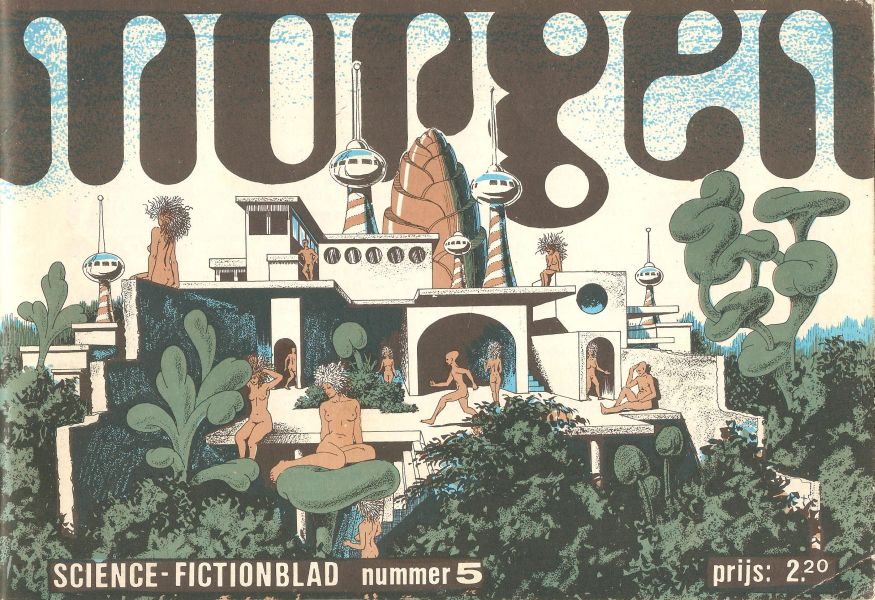
Pairpuppets” by Manuel van Loggem is story #16 of 52 from The World Treasury of Science Fiction edited by David G. Hartwell (1989), an anthology my short story club is group reading. Stories are discussed on Tuesdays, Thursdays, and Saturdays. “Pairpuppets” was first published in Dutch in Morgen #5 (December 1972) and first translated into English for The Best from the Rest of the World: European Science Fiction (1976), edited by Donald A. Wollheim.

“Pairpuppets” is about a young man, Eric, who is getting bored sexually with his current girlfriend, Tina. Eric lives in a future utopia/dystopia where every citizen’s sexual partner is selected by computers with the goal of fulfilling their sexual needs. The plot of this story follows Eric in his search for a new sexually satisfying partner.

Even though the goal of this society is utopian, aiming to make all its citizens happy, humans easily become dissatisfied. So we can also view this society as a dystopia. Basically, one person’s utopia is another person’s dystopia.

I thought “Pairpuppets” was okay as a story, but the storytelling came across as a dry parable. The ending was predictable but realistic. However, I did like the level of detail Loggen used to explain Eric’s plight. Obviously, the author wanted to say a lot about sexual desire and brings up a good many related issues. The story gives us much to think about and would make a great discussion story for a high school literature class (if they allowed discussions of sex (but aren’t we becoming dystopian in that area?)).

I’ve also been thinking about why stories like “Pairpuppets” disappoint me. The biggest problem is I’ve read too much science fiction and I compare every new story I read against the memory of all my favorite science fiction short stories. It’s extremely hard for any new story to compete with my Lifetime Top 100 Science Fiction Short Stories.

Then there is the much smaller problem of pet peeves. “Pairpuppets” is about sexbots, one of my least favorite science fiction themes. Of course, if I had read “Pairpuppets” in 1972 when it first came out (and could read Dutch) it might have been a more entertaining idea. That brings up a third problem with reading SF anthologies — they contain old stories, and thus old ideas.

Now, David Hartwell, had a lifetime of science fiction reading behind him when he selected “Pairpuppets” for this anthology in 1989, so both of my issues weren’t a problem for him. That means, like this story, The World Treasury of Science Fiction is a utopia for Hartwell, but sometimes dystopian for me. The word treasury in the title implies the anthology is where a treasure of science fiction is stored. And like the old saying, “One man’s treasure is another man’s trash.”

“Pairpuppets” is far from trash to me, but it just doesn’t light up my reading soul. Good but no cigar.

Another problem with these translated stories, is they are often on the short side. Shorter short stories often feel condensed, and that hurts their impact, except maybe for intellectuals who love cleverness over other virtues. Cleverness works well at short lengths — just think of Saturday Night Live. (By the way, SNL bores me since I left my twenties.)

I prefer short stories that dramatically reveal the emotional development of a character in a specific situation, ending with an epiphany. If Loggen had written this story with more drama, spending twice as many words, showing us Eric’s development rather than telling us, I might have liked “Pairpuppets” quite a lot more.

I believe “Pairpuppets” would be fine in anthologies that didn’t aim so high, like a theme anthology about sex in science fiction, or an anthology of foreign science fiction that didn’t claim it was the best. I have to assume editors working in English are limited to what foreign stories they can acquire that have been translated into English. And I don’t assume translators always pick the best of the best. My guess is they might pick stories their translation skills can handle. Finally, we don’t know if “Pairpuppets” wasn’t a much better story in its original Dutch.

I haven’t read that many translated stories, and the ones I have, like War and Peace, and Anna Karenina are considered to be among the world’s greatest novels. And when I read those two novels I did study their histories of being translated and tried to find the best translation to read. Also, anyone who reads The Bible knows there are way too many translations to compare, and the problems involved.

Every time I read an anthology or collection of translated science fiction short stories I’ve been disappointed. I don’t know if I’m just hitting a language barrier, or if the stories just aren’t as good as I hope they would be, or maybe they weren’t the best to begin with.

Also, think about this. “Pairpuppets” is how I think of Dutch science fiction now, even though it’s just one story from 1972. Let’s assume it’s a fantastic story in Dutch. But what will people from Holland think of American science fiction if the only story they’ve ever read is “Bears Discover Fire” — even if it has a perfect translation?

James Wallace Harris, 6/10/23