Science Fiction Writers in Conversation with Each Other

Imagine a world where science fiction had never been invented. Could you have written the first science fiction story? Be honest now, and think hard about yourself and what I’m asking. Before Galileo, did anyone think the Moon was a world that could be visited? Once people heard Galileo saw mountains on the Moon with his telescope they began to imagine going there. Science fiction needed certain kinds of seed ideas to begin. When the seeds come from reality I’ll call that Stage 1 science fiction. We don’t see a lot of that kind of science fiction anymore. Maybe The Martian by Andy Weir when he tried to realistically portray growing potatoes on Mars or when a writer extrapolates on current events like John Brunner did in Stand on Zanzibar back in 1968 or what Kim Stanley Robinson did in The Ministry for the Future in 2020.

Once the genre got rolling, science fiction seeded itself. One story about a trip to the Moon inspired an infinity. I call that Stage 2 science fiction. In Stage 2 writers try to stick to reality but work off the collective knowledge of the genre. Eventually, science fiction was making copies of copies, where the inspiration had no connection with reality. I’ll call that Stage 3 science fiction.

Early stories about traveling to the Moon were Stage 1 because it’s not likely the authors had read each other’s work. But when Verne and Wells wrote their novels of lunar exploration a lot of their inspiration was Stage 2. When John Varley wrote his stories about a lunar colony, most of the science-fictional concepts within those stories had been germinating for generations in the genre – Stage 3.

I believe science fiction writers have an ongoing conversation that never ends. To take part in this conversation, publish a story. It can be Stage 1, 2, or 3. To be heard and answered requires writing something in Stage 1 or 2, or a very creative Stage 3.

This is why I’ve become fascinated by the forgotten writer Walter F. Moudy. The 1950s and 1960s were a fertile time for Stage 1 and Stage 2 stories. By the second half of the 1960s and early 1970s writers who made themselves noticed were writing a baroque Stage 3 science fiction to attract attention. For example, the works of Samuel R. Delany, Roger Zelazny, and Robert Silverberg were based on old SF ideas told with new writing styles. Unfortunately, Moudy wrote Stage 3 stories in the same prose style that the classics of Stage 2 were written. His 1964-65 stories feel like they were written in 1954. One reason the New Wave writers of the 1960s were so important is they recognized that retelling Stage 2 stories in the same way, would get them ignored. The reason why Heinlein blazed onto the scene in 1939 is that he wrote Stage 1 stories with a new writing style, making his stories stand out.

I enjoy reading Walter F. Moudy in 2022 because I doubt I could write any better than he did, and he was responding to the stories I admired back then. His writing ability and knowledge of the genre were just good enough to get five works published and then become forgotten. As a would-be science fiction writer, I greatly identify with that. He wanted to join the conversation and made the effort to have his say. He just wasn’t heard, but now after decades, I’m listening.

While reading Walter F. Moudy’s meager output of science fiction I kept feeling his stories were inspired by the science fiction he and I both read. They made me wonder what he was trying to say in the ongoing conversation.

Of the five science fiction stories, I’ve read by Walter F. Moudy, “The Search for Man” is my favorite, although if I reread “The Survivor” or No Man On Earth I might change my mind. All were good fun, old-fashion science fiction, the kind my nostalgia loves. As I read “The Search for Man,” I kept wondering what science fiction Moudy had read that inspired this story. I can’t say for sure but this story about robots speculating about long-dead or gone humans reminded me of City by Clifford Simak. That “The Search for Man” set hundreds of years into the future speculated about our times and turned us into a religion reminded me of A Canticle for Leibowitz. That both the protagonists of No Man On Earth and “The Search for Man” were about a super-human and a super-robot reminded me of The Hampdenshire Wonder, Slan, Odd John, Chocky, Stranger in a Strange Land, and all the other science fiction stories about next-stage beings. Reading those two Moudy stories made me think about how I would have written a story on that theme. How much could I base it on reality, and how much would be inspired by other science fiction?

“The Search for Man,” begins with a baby being born, but it’s a strange birth, a kind of decanting that made me think of Brave New World. Then we learn the baby will only have three senses, and it will be put into a robotic baby’s body, the first of four body types it will use.

Moudy sets up a good mystery for us. Humans died out hundreds of years earlier, with all other animal life. The humans had tried to travel to the stars, but it appears their three missions had failed. The robot brains have improved their brains with genetics found in 12 human brains that had been preserved. The robots have found long-dead humans in various kinds of chambers that tried to create suspended animation. Their hope is to find a chamber with a viable human to resurrect. There are classes of robots that are archeologists and others that are priests that teach a strange religion based on their theories about humans. All of that is a very appealing setup for a story, at least for me.

I’m not sure Walter F. Moudy would have written “The Search for Man” without reading a lot of science fiction. Part of the conversation science fiction writers have is about science fictional ideas, but the other part is about how to present those ideas in a story. I felt “The Search for Man” was Moudy’s reply to both but in the language of 1950s science fiction. I wonder if he had been more of a stylist would he have made a greater impact?

“The Search for Man” was published in an original anthology In The Wake of Man that’s never been reprinted. I’ve been trying to get a copy, but it’s expensive, starting at $75 used. I had found a $10 copy for sale, but my order was canceled a couple days after I ordered it. Right now the only source for this story is a copy of In The Wake of Man at Archive.org. If you are a member, which is free, you can check it out for an hour to read online. Thanks to Joachim Boaz for finding that link.

Joachim Boaz and Rich Horton have also been writing about Walter F. Moudy. Rich is planning to review all of Moudy’s work soon.

James Wallace Harris, 6/30/22

Blowing Your Chance to Speak to the Future

Writers cherish the myth that their work will make their names immortal. And it is true we have remembered some authors for thousands of years. However, if you want to be heard across time, you have to write something timeless.

My friend Mike and I are fascinated by forgotten writers, especially forgotten science fiction writers. We can’t help but wonder why a writer quits after their initial success of selling a few stories or maybe a novel. Mike texted me the other day about such a writer he discovered in an interview with Geraldine Brooks in The New York Times.

It was part of their By the Book series, where all writers are asked the same standard questions. My favorite question: “What’s your favorite book no one else has heard of?” Often this makes for an interesting title to chase down. Brooks said: “‘No Man on Earth,’ by Walter Moudy. The only other person I know who has read it is my son because I pressed it on him.”

So one well-regarded literary writer resurrects Walter F. Moudy 49 years after he died. That one little mention in the Times got me to read his novel. Maybe a few other people will too. And it’s a pretty good science fiction story for 1964. The question is, could it have been better? What would have made that novel stay in print? Is it worth reprinting? And do I recommend you read it?

You can read a pdf copy of No Man On Earth here.

It turns out that No Man On Earth is a forgotten science fiction novel by a forgotten science fiction writer, Walter F. Moudy (1929-1973). His ISFDB entry lists one novel and four short stories. This novel appeared in October of 1964, and then three of his four stories appeared in April and May of 1965, two in Fantastic and one in Amazing, both edited by Cele Lalli (Goldsmith). Moudy would have been in his mid-thirties. In 1966 he published another novel, The Ninth Commandment, probably not science fiction, and one I can’t track down. Finally, in 1975, after his death, Moudy had one more story, a novella, published in an original anthology, In the Wake of Man. The other two authors in that book were Gene Wolfe and R. A. Lafferty, pretty impressive company.

Besides No Man On Earth, I’ve read his three stories in Fantastic and Amazing, but it would cost me $75 to read his final story and that’s too much. For me, Walter F. Moudy’s science fiction legacy is that one novel, two short stories, and a novelette. Not much to go by, but still, I’m terribly envious since I’m a lifelong would-be science fiction writer. I’d give anything to have contributed even that much to the genre.

Why after his initial success in 1964-1966 did Moudy quit writing? And how did Roger Elwood get his last story? I guess Moudy tried one more time before he died to say something in print. But maybe Elwood had been holding it for years, and it was written in the mid-sixties. Reviewers haven’t been kind to it.

I was able to track down a few biographical details. Moudy was from Missouri, served in the Air Force from 1950 to 1953, got a degree in 1954, and then a law degree in 1957. He was Phi Beta Kappa. Moudy was married and had three children. In other words, he had a successful life and didn’t need to be a writer. Still, as I read his work over the last few days, I felt he had something to say. At least in No Man On Earth.

His three short stories were rather minor. The first, “The Dreamer,” was about a young man who wanted to get rich and famous as a space trader. The story was told like a fable. Its redeeming feature was a super-intelligent parrot. The second, “I Think They Love Me,” is about rock stars going to extreme lengths to survive hordes of screaming teenage girls. This was written a year after The Beatles hit America and was kind of cute, but not really worth remembering. The last, and the one most anthologized, is “The Survivor,” about a televised war game between America and Russia. It reminded me of The Hunger Games. This story came out in 1965 and was probably inspired by the 1964 Olympic games and the films Dr. Strangelove and Fail-Safe. “The Survivor” was gritty, detailed, and suggested each country sacrifice 100 men every four years in a fight to the death rather than risking total national annihilation.

Those three stories were somewhat entertaining, especially the last one, but they don’t leave the kind of impression that Moudy was making a statement. However, No Man On Earth does. Writers can make different kinds of statements. They can aim to write a better story than what’s written before. Or they can capture their times realistically in words. And common with science fiction writers, they can say something philosophical about reality. And there are so many other ways.

For example, I believe Robert Heinlein was influenced by the success of Atlas Shrugged by Ayn Rand in 1957, and that’s why he aimed so high with Stranger in a Strange Land. In his later years, Heinlein repeatedly tried to convince fans that Starship Troopers (1959), Stranger in a Strange Land (1961) and The Moon is a Harsh Mistress (1966) were books that he wanted to be remembered for because they expressed his philosophy on freedom and responsibility.

My guess is Moudy was inspired by Stranger in a Strange Land when he wrote No Man On Earth. Heinlein’s main character Valentine Michael Smith is a human raised by Martians who taught him psychic powers. Moudy’s main character, Thad Stone, had a human mother and alien father and was a super-genius. Both novels are told with picaresque plotting. Both books comment on sex and society. Moudy has Stone tour many planets and visits many kinds of societies and civilizations. No Man On Earth ran 176 pages in its first publication, a slim paperback original to Stranger’s 408 pages in the G. P. Putnam’s Sons first-edition hardback. Heinlein was obviously trying to hit one out of the genre after over twenty years of being a big fish in a small pond. Frank Herbert also aimed sky high with Dune in 1965. It was also over 400 pages.

There are a lot of one-hit wonders in the book world but few writers struggle with their masterpieces like Harper Lee or John Kennedy Toole. My guess is Moudy knocked this novel out quickly and was probably paid around $750 for his paperback original and when it disappeared on the twirling wire racks after a couple of months felt his time was better spent being a lawyer. If he had written a 400-page monster and got it published by a major hardback publisher No Man On Earth might have had a better chance. He just didn’t aim high enough.

It would have also helped if he had written No Man On Earth in an innovative style that made the genre take notice, like Dune and Stranger in a Strange Land. Moudy’s story and writing reminded me a bit of Leigh Brackett’s The Long Tomorrow (1955), Edgar Pangborn’s A Mirror for Observers (1955), and Walter Tevis’s The Man Who Fell to Earth (1963), all books he could have read and could have inspired No Man On Earth.

Obviously, if Geraldine Brooks fondly remembers No Man On Earth in 2022 so it can’t be a stinker. I liked it quite a lot and rushed through it in two days because it was compelling in the old-fashion kind of science fiction I love. It’s great that Tevis’s 1963 novel is still remembered, and I think it’s a shame that Moudy’s book isn’t more remembered.

James Wallace Harris, 6/21/22

Is There Any New Territory for Science Fiction to Explore?

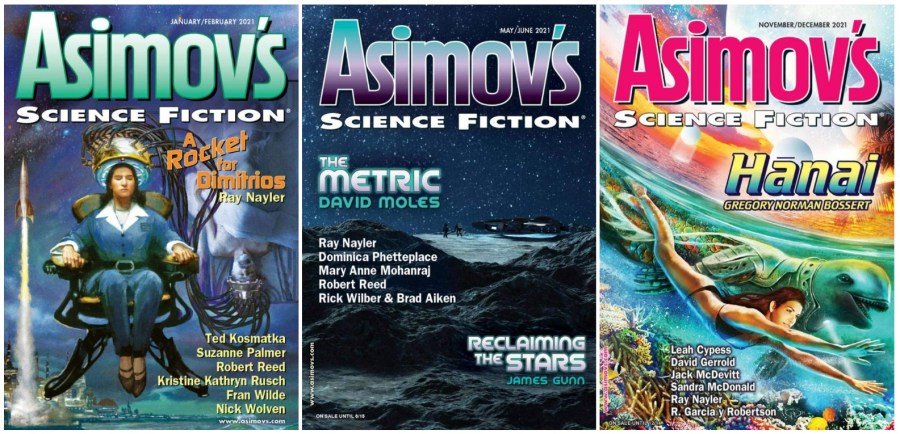
Ray Nayler had a successful year writing science fiction short stories in 2021. Three of his stories made the Asimov’s Readers’ Award Finalists poll: “A Rocket for Dimitrios” (novella), “Año Nuevo” (novelette), and “Muallim” (short story). That doesn’t include four other stories he had published in other magazines in 2021. The Facebook group Best Science Fiction and Fantasy Short Fiction has been reading and discussing all the finalist stories and Nayler’s stories have been popular with our group. We tend to be an older crowd that’s been reading science fiction for a long time, and Nayler’s stories fulfill our need for new science fiction that feels like older science fiction.

Before I say what I want to say, just let me assure you I’m not picking on Ray Nayler, but questioning science fiction in general. I enjoy Nayler’s stories and consider them among the best science fiction coming out today. I’m looking forward to his first novel, The Mountain in the Sea coming out in October.

While reading all the finalists for the Asimov’s Readers’ Award, and especially Nayler’s stories, I couldn’t help but wonder if science fiction has any new territory left to explore? All the stories seem to be variations on old themes. I always wanted to be a science fiction writer, but reading these stories made me think just how hard it must be to write new science fiction, especially original science fiction. Our Facebook group has read hundreds of SF stories, and it’s obvious that few stories succeed with a majority of our readers. Writing a major science fiction short story is very rare.

Nayler’s stories stood out for me of the sixteen finalists. They were the most enjoyable to read, and I felt the most successfully told. However, they all seemed like old friends wearing snazzy new threads. I can’t help but wonder if new science fiction writers ever come up with new science-fictional ideas? Or has our genre explored all the territory to be explored?

Of course, this is my problem since I’m 70 years old and I’ve been reading science fiction for 60 of those years. Younger readers might not see any problem at all. If you live long enough, you begin to feel like Solomon writing Ecclesiastes 1:9 and saying “There is nothing new under the sun.” That feels like an oxymoronic adage when talking about science fiction. (Yet, I felt “A Rose for Ecclesiastes,” by Roger Zelazny was something new under the sun in 1963.)

My favorite of Nayler’s stories was “A Rocket for Dimitrios.” (Story links are to pdf files to read.) However, its plot was inspired by A Mask for Dimitrios by Eric Ambler, called A Coffin for Dimitrios in the U.S., which better connects to Nayler’s title. I haven’t read that novel, but I’ve seen the Sidney Greenstreet/Peter Lorre movie from 1944, so that’s how I pictured it when reading Nayler’s novella. Both stories about Dimitrios overlap in interesting ways with exotic flavors.

“A Rocket for Dimitrios” is an alternate history story, so it’s a double retread, It’s rewriting history, and writing a classic mystery novel. That’s quite clever, and I think that points to Nayler solving the problem I’m discussing. If you can’t produce a new science fiction idea for a story, repackage old ones in clever ways. And is that what all the new science fiction writers must do today? Or, am I seeing something different? Are new writers reinventing science fiction with each new generation because they haven’t read the old science fiction? Is it a variation on the famous quote, “Those who cannot remember the past are condemned to repeat it” by George Santayana?

“A Rocket for Dimitrios” is a sophisticated alternate political history that reflects a great deal of our current political reality. After America finds a crashed flying saucer in 1938 it becomes the sole superpower using advanced technology discovered in the UFO. The story creates an alternative geopolitical view from around 1960 I guess. (FDR is in his 7th term.) Because Nayler is in the foreign service and has been stationed in the Caucasus, he obviously knows the history of Turkey after the fall of the Ottomans. This local coloration gives the story its strongest appeal, but then that was true of the movie, and probably the novel.

Fictional characters Sylvia Aldstatt, Alvin Greenly, and Chief Inspector Rafik Bayar are mixed with alternate history characterizations of Franklin Roosevelt, Eleanor Roosevelt, and Hedy Lamarr. Greenly is in the OSS and Aldstatt is a medium that uses alien technology to speak to the dead Dimitrios Makropoulos. This story is far more complex than the other nominated stories for the Asimov’s Reader Awards which suggests a growing writing maturity by Nayler. This was my second reading of this story and I rate it a strong four stars out of five.

Even though this is a fun story I can’t help but believe it’s Nayler’s philosophical statement about current world affairs. In that sense, it’s quite interesting to compare “A Rocket for Dimitrios” to David Brooks’ latest editorial in The New York Times. Both Nayler and Brooks want to be positive, but they see the growing trend toward nationalistic thinking since the 2016 election, and it’s not positive. The obvious connection to both story and essay is humans are an intelligent species, just not quite intelligent enough to survive. Both Nayler and Brooks are hopeful, I’m not.

Muallim” is a wonderful story about a teaching robot and a student-teacher in Khynalry, Azerbaijan. The plot is rather simple, about how the village tricks the student teacher who wants to change their old ways, but the story is far richer. I think we should ask why? “Muallim” is an exceptional science fiction story, but what makes it so?

The obvious answer is the setting. Nayler’s foreign service experience, and knowledge of languages, along with being a keen observer of local details, infuses wonderful details into this story. Would this story have been as good if it was set in Los Angeles? Maybe, but I think not. An exotic setting can really make an old science fiction theme stand out.

Writers have reached the saturation point of writing about robots and AI. It’s extremely hard to do anything different. The foreign color of this story is what made it impressive. The story itself is just a retelling that sentient robots are just as good as humans.

I also think “Muallim” shines because it’s built on layers. The outsider, the student-teacher, rejects what Irada, the female blacksmith, and the other villagers want for their children. But then, there are other people outside of the village, who reject the robot. We know these people have been there for hundreds of years and they don’t like change, but some of them do accept the robot. Azerbaijan is in a part of the world where some of the oldest civilizations began. There’s quite a contrast between old and new. Finally, I think the story stands out for characterization. I rate it a strong four stars out of five.

Año Nuevo” caressed all my science fiction zones but didn’t give me a sense-of-wonder orgasm. That might be due to me being old. I liked Nayler’s story mostly because he’s writing good old-fashioned science fiction in an era when good old-fashioned science fiction is being left behind.

“Año Nuevo” uses twin storylines to effectively evoke two classic science fiction themes: the alien that’s unlike us, and the Jesus alien. Science fiction writers have always been challenged to describe a real alien first encounter. Of course, Nayler pulls a twist on this one and a good twist at that. Where my uncertainty comes from regarding this story is with the Jesus alien.

I’m calling aliens who bring us salvation, uplift, transcendence, or special powers, the Jesus alien. Religion has always worked in that psychological territory, so it’s interesting when science fiction offers alien saviors. I remember Arthur C. Clarke covering this topic several times. It always aroused suspicion in me, but then I’m an atheist.

We’re actually given two reasons for Bo’s transformation from a surly teenager to a loving son – he’s infected by the alien, and he has sex with Aliyah, neither of which should have brought about such a dramatic personality transformation. I also thought it too melodramatically cliche that Bo was brutally beaten by Aliyah’s brothers. That plot choice hurt the story for me. It would have passed if the story had been set in Azerbaijan but not in modern America.

Nayler is a skilled writer, but I can also see the machinations in his storytelling. This is the third finalist story in the Asimov’s Reader Awards by Nayler that our Facebook group has read. Such prolific output requires a certain amount of hackwork. “Muallim” and “A Rocket for Dimitrios” felt more original than “Año Nuevo,” but all three reveal Nayler’s approach to writing science fiction. Ray Nayler knows what readers love, hopes to give them more, and is succeeding. I give this story a strong three stars.

Nayler isn’t breaking any new ground but he’s entertaining and very readable. Is there any new territory to be found in our genre anymore? That’s the trouble with being an old science fiction reader, we’ve read it all before.

JWH

Does Too Much Suspension of Disbelief Ruin a Story?

The willing suspension of disbelief is required to enjoy many forms of fiction, especially science fiction. On the other hand, at what point does ignoring reality ruin a story?

Some readers and moviegoers are willing to accept anything the story asks of them. If the story moves along quickly and is exciting, most readers aren’t going to stop and ask questions. Other readers will slow, pause, or even stop reading when they hit a logical speedbump.

Yesterday I read “Glitch” by Alex Irvine. I hope the author won’t mind me using his story as a lecture about the overuse of the suspension of disbelief. It’s up for the Asimov’s Science Fiction 36th Annual Readers Award. You can read it here. It’s a fun story based on a neat idea. Several people in our short story group rated it highly, with one member giving it five stars out of five.

I liked “Glitch,” but I hit several speedbumps where I couldn’t suspend my disbelief.

The story begins with Kyle Brooks waking up in a hospital room wondering how he got there. We quickly learn that Kyle was killed in a terrorist attack by a white supremacist. His mind had been backed up and he had a new body without scars, tattoos, or piercings. That implied to me it was a clone.

Speedbump #1

Where did Kyle’s new body come from? Since the doctor examines Shari’s wounds and gives her a prescription it’s implied that it’s right after the bombing. Did they grow a clone body in hours? Did they have one in storage? No one else in our group asked about this.

Obviously, Irvine wants to ignore this, so I will too. Mind uploading is a very popular topic in science fiction right now, although it’s been around for decades. I fondly remember Mindswap by Robert Sheckley from 1966 and less fondly I Will Fear No Evil by Robert A. Heinlein from 1970. I don’t believe mind swapping will ever be possible but I’m willing to suspend my disbelief for stories about this theme. It is a fun concept.

Speedbump #2

We quickly learn that Kyle isn’t alone in his new body. For some reason, Brian, the terrorist bomber is sharing Kyle’s mind. This is much harder to believe. Kyle is at a special hospital for restoring minds. Evidently, it’s quite a regulated business. How in the world could two people be in one mind? Irvine does some hand waving that is completely unsatisfactory to me.

Great Idea #1

However, this is a very cool plot twist so once again I’m willing to suspend my disbelief. The possibility of a liberal who is about to marry a person of color coexisting with a white supremacist is a great fictional situation. Again, I let my suspension of disbelief go. I love the possibility of a bad guy walking a mile in the shoes of a good guy.

Speedbump #3

The police show up at Kyle’s house the next day. They have evidence that suggests the terrorist bomber is inside Kyle’s mind, but Kyle tells them no, even though he knows Brian is there. The cops even tell Kyle that if he’s lying, he can be prosecuted as a conspirer for Brian’s crime. This is the hardest part of the story for me to buy. Kyle should have immediately told the cops that Brian was in his mind. Kyle obviously doesn’t want him there, and he has no resources to remove him, why wouldn’t he ask for help from people who did have the resources?

I know why Irvine made this plot choice. He wanted Kyle to become the action hero of the story. Personally, I always find stories where an ordinary person becomes an action hero to be completely unbelievable. I really don’t want to suspend my disbelief on this point, but I’ve got to buy into it because I want to know how Kyle rids himself of Brian.

This is why I’ve stopped watching thrillers and action movies because movies have made everything with this kind of comic book logic. Comic book logic is the most extreme version of suspension of disbelief. Anything is possible. All a writer must do is say it’s so. They expect the reader to accept that whatever is suggested is real. No critical thinking is assumed as standard.

Alex Irvine does write for comics and I’m afraid “Glitch” descends into full comic book logic from here on out. As the plot speeds up, so does the frequency in which Irvine asks us to suspend our disbelief. Irvine isn’t alone in doing this. It’s become a common practice in science fiction stories that involve action.

Science fiction books used to be more realistic. Movies and television shows have always leaned towards comic book logic. Buck Rogers and Flash Gordon started out as comic strips in the newspapers. In modern times, as comic book movies have dominated box office sales, comic book logic has infected all genres of movies based on action. I think this has inspired science fiction writers to use it more and more in their books and short stories.

The result of this is that readers don’t just suspend their disbelief at basic conceptual science fiction ideas, they have turned it off for any kind of characterization or plotting. We’re asked to accept the absurd, the impossible, the unbelievable, the illogical, the inane, actions people would never do, to move the plot forward, usually at a breakneck speed.

When I point this out most people tell me, “It’s just a story – chill out.” And I suppose that would be okay if we were all five years old and still believed in Santa Claus. But if you look at our society, comic book logic has corrupted all ages in all levels of society. The world is filling up with gullible people who expect reality to be like comic books and movies. They expect anything is possible, they want anything they believe to be true. Is this because of the fiction we consume? Has the suspension of disbelief needed for fiction transferred to how we live our lives?

One of the early critics of science fiction suggested that good science fiction should only have one suspension of disbelief per story. That after the fantastic concept everything else should be realistic. This is true for two other stories I’ve read recently, “Fire Watch” by Connie Willis and “Speech Sounds” by Octavia Butler. The first gives the ability to time travel to historians, and the second has a plague that destroys speech. After those starting points, we’re not asked to suspend our disbelief again. Both short stories are classics of science fiction.

I believe the science fiction norm has changed over time so that writers seek to cram in as many speculative ideas as possible because it keeps their readers constantly thrilled. The side-effect of this paradigm shift is that we’re asked to suspend our disbelief over and over.

If “Glitch” had only expected me to believe that mind swapping will be happening after the mid-21st century, and two minds could occupy one body, I would have been happy to let the story unfold. In fact, I was looking forward to several possibilities playing out. I’ll call these Expectations.

Expectation #1

I wanted Irvine to work out how two minds in one body would function. The old saying about walking a mile in my shoes has come true, so I wanted to see what would happen. How much of our personality is determined by our body and how much is determined by our experiences? Would Brian, the white supremacist, change because he was in a new environment?

Irvine didn’t go in that direction. Irvine spent the rest of the story having Kyle do everything possible to rid himself of Brian. Now that’s logical, but since we’re in a story about two people in one body, I wanted to imagine how that would work. Basically, it works just enough to maintain an action-oriented plot where Kyle would become a hero. I can accept that, but I also expected Kyle’s actions to save himself would be realistic from now on in the story. I also expected Kyle to grow from this experience, gain insights, or have an epiphany. Nobody grows in this story.

Speedbump #4

To save himself and prove to the police he’s not guilty of cooperation under the habeas mentis law, Kyle figures he needs to find the bad guys, stop the next bomb, and prove himself the hero. This has become such a cliché plot point that I groaned at having to read it. In science fiction, there is a suspension of disbelief over fantastic ideas, but in storytelling in general, there’s also a suspension of disbelief in basic plotting. This plot motivation is so tired that I usually stop reading or watching. Still, I wanted to find out how Kyle rids himself of Brian.

Speedbump #5

Kyle decides he needs help and remembers a programmer from work named Abdi. The magical hacker is the new fairy godmother in fiction. Abdi can quickly solve all of Kyle’s problems with his band of fellow hackers and cog swappers.

Speedbump #6

Irvine introduces us to cog swapping. Kyle needed a hospital to put a copy of his mind back into his body, but Abdi and his merry band can swap minds and stream real-time brain backups with tiny nifty gadgets. Think magic wands. This is when the story got downright stupid. I no longer could suspend disbelief at all. It was now moving a comic book panel speed.

Great Idea #2

When Kyle reaches the hideout of the bomb makers he is attacked by Brian in his body. It turns out the Brian in Kyle’s head is a copy, and the Brian with a body has no need of him. Kyle’s Brian is furious at being betrayed. This is a fantastic plotting idea. If Great Idea #1 is having the bad guy in the good guy’s head, walking a mile in his shoes, then Great Idea #2 is having the bad guy see himself. This reminds me of Bob Dylan’s song “Positively 4th Street.”

I wish that for just one time

You could stand inside my shoes

And just for that one moment

I could be you


Yes, I wish that for just one time

You could stand inside my shoes

You’d know what a drag it is

To see you

Expectation #2

If we could travel back in time one week and spend that week with ourselves, would we like each other? When the real Brian showed up in “Glitch” I was thrilled. This was a new plot twist. This was something different. And it inspired my hopes that the story would turn around.

“The enemy of my enemy is my friend” is an old saying that should have applied here. My first expectation was internal Brian to change because of walking a mile in Kyle’s shoes. My second expectation was that the internal Brian would side with Kyle to fight external Brian. I saw this as a great symbolic solution to the story. Internal Brian would change, help Kyle catch external Brian, and then fade away inside of Kyle as Brian’s evil personality was overwritten by Kyle’s goodness. That’s what the doctors told Kyle would happen at the beginning of the story.

This would be deeply positive symbolism. By the story’s logic, we should blow up all white supremacists. That’s its solution to racism. But that’s not a practical solution in the real world. We need to overwrite racism with positive personality traits. We need racists to see that they are wrong. Simple fiction has simple bad guys with simple solutions – kill the bad guys. That’s Old Testament thinking. New Testament thinking involves conversions and salvation.

Simple fiction needs bad guys to kill without remorse. Terrorists are the safe one-dimensional bad guy to use in fiction. I wanted “Glitch” to go deeper.

But this story didn’t follow my expectation.

Speedbump #7 and #8

Kyle kills external Brian by setting off the bomb. This was clearly foreshadowed early in the story. Kyle awakes in the same hospital that he did at the beginning of the story. He is free of internal Brian. How? Abdi’s magic of course. If it was that easy, why didn’t the hospital erase Brian at the beginning of the story? And Kyle has another new body. Where the hell does all these clones of Kyle keep coming from?

Conclusion

“Glitch” was fun to read. I tripped over one speedbump after another. I’m old, so I’m probably too judgmental and cranky. I thought Irvine has a great idea for a novel. The story unfolds much too fast. It should have been longer with subplots and proper pacing. It needs depth and subtlety. Even with the existing plot, it would probably make a lot of readers happy. I wouldn’t want to read it though, not as is. However, if it was fixed without all the speedbumps I might.

It would be entirely unfair for me to expect Irvine to write a story other than the one he wrote. I have to wonder if other readers aren’t like me and as they read react to stories with ups and downs, or with hopes that the tale will go in different directions and explore the territory the story inspires in our minds?

James Wallace Harris, 4/1/22

What is Your Preferred Space-Time Setting for Science Fiction?

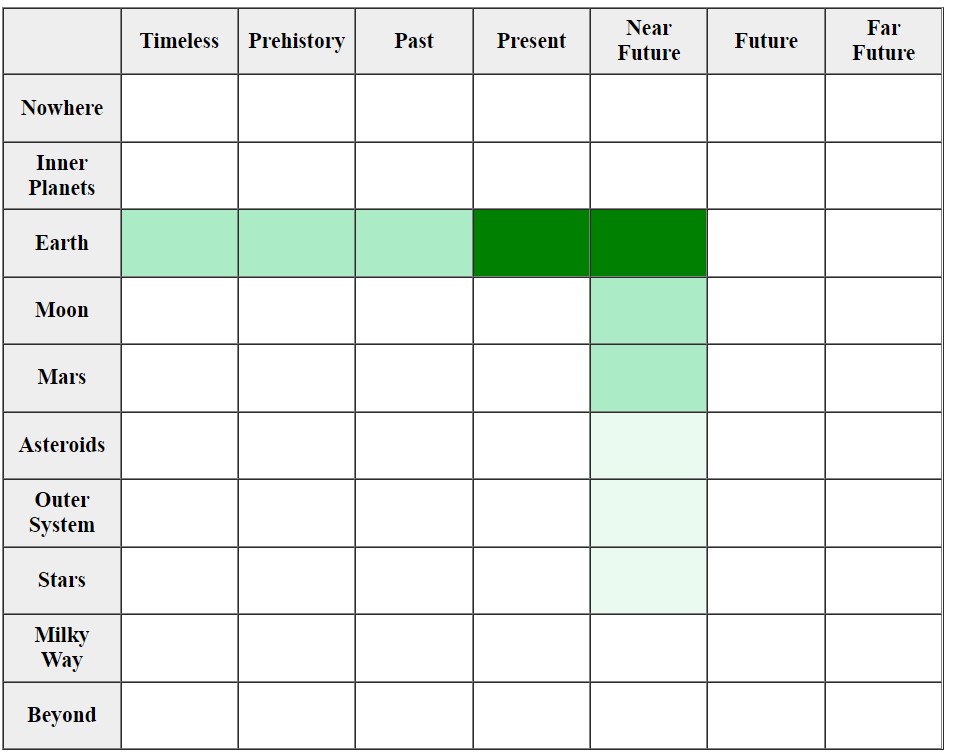
At one time I loved reading science fiction stories set anywhere in space and time, which would be all the squares on the chart below. At 70, my focus has narrowed to what I show in shades of green. The darker, the more interested I am in reading fiction or science fiction set in that space-time. I don’t hate stories set further afield, but I’m just not that into them anymore either.

One assumption deals with age. When I was young I was dazzled by any possibility. Galactic empires set in the far future had such a tremendous sense of wonder that I thought colonizing the galaxy was humanity’s reason for existing. I was also blown away by Olaf Stapledon’s stories of post-humans, and figured that was our destiny too.

Of course, I began my science fiction habit with a gateway drug of Heinlein’s juveniles, first with adventures about boys going to the Moon and Mars, then with stories that ranged over the solar system, and finally with tales that ventured into interstellar travel. I also embraced stories robots, time travel, alternate history, the multiverse, and other dimensions. I really wanted to believe we could go anywhere.

One of my all-time favorite SF stories, “The Star Pit” is set on the galaxy’s rim and is about the few special people who can travel to Andromeda and the impact their freedom had on the characters who couldn’t. As a kid, that story mirrored the frustration I felt not being able to leave Earth.

I still love “The Star Pit” but for nostalgic reasons. I still reread all my favorite SF stories set in any of the space-time locations above, but when it comes to reading new SF stories I prefer stories set in the near future set, especially on the Earth, but no further than the Moon, or Mars. To a lesser degree, I enjoy science fiction about machines exploring the asteroids and the outer system, or about SETI contact with nearby stars.

Why has aging narrowed my fictional horizons? When I was young I believed anything was possible. Now that I’m 70 I doubt humans will ever travel beyond the Moon and Mars. I believe intelligent machines will live out our big science fictional dreams. The more I’ve learned about the hostility of space on our biology, the more I’ve doubted people will live beyond Earth. As I’ve grown more practical and become less of a dreamer, I find it terribly hard to picture people actually wanting to live anywhere but Earth. I believe Elon Musk will get us to Mars, but we’ll discover we won’t like living there. Thus it’s become harder to enjoy stories set in far-ranging places of space and time.

But that’s me. What about you?

Where do you like your science fiction stories set? Has growing older affected the science fiction you love to read?

James Wallace Harris, 3/22/22

“New Rose Hotel” by William Gibson

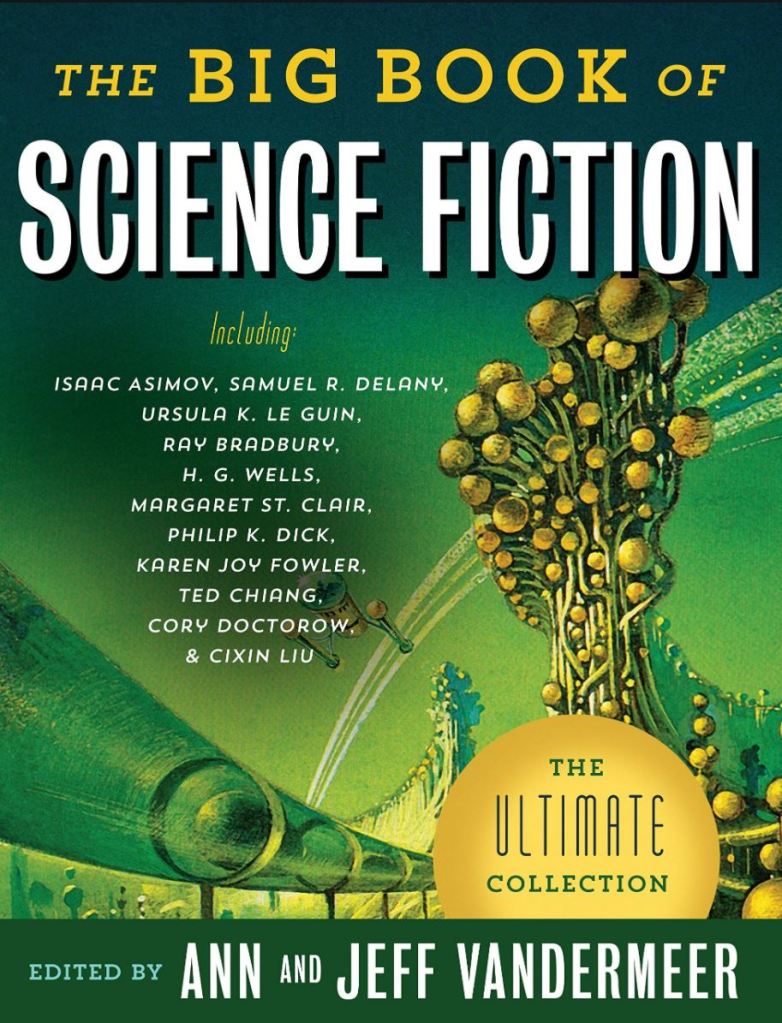
Group Read 27The Big Book of Science Fiction

Story #75 of 107: “New Rose Hotel” by William Gibson

“New Rose Hotel” by William Gibson first appeared in the July 1984 issue of Omni Magazine but was overshadowed by Gibson’s novel Neuromancer, which won the Hugo, Nebula, and the PKD awards for that year. Still, the “New Rose Hotel,” is a dazzling piece of writing.

Gibson’s story brings up the importance of writing style in the success of a story. “New Rose Hotel” is all style. Science fiction meets Raymond Chandler high on William Burroughs pretending to be Hunter S. Thompson. The story is not about the plot, but how the story is told.

The plot is your typical noir gangster drama of two tough guys double-crossed by an alluring woman. But instead of stealing money, they steal a brilliant bioengineer in the near future where cutting-edge science is the hottest of commodities. The story is set in Japan, which at the time was a rising economic powerhouse, but also because Gibson loved various Japanese subcultures.

The trouble with style is it can be like cotton candy, tasty but empty. I enjoyed reading “New Rose Hotel” but when I was finished the exquisitely crafted atmosphere left me immediately. I never cared about the narrator, Fox, or Sandii. And, I’m not fond of thrillers. I do like the 1940s and 1950s film noir movies, and I’m a fan of Raymond Chandler’s novels, but that’s because I love the historical details from those times. Gibson’s cyberpunk Japan used to be interesting to me, but over the decades that interest has faded.

This makes me wonder about science fiction settings. Why do some of them endure, and others fade? People love galactic empires. That setting is so well-loved that recent TV series and movies for Foundation, Dune, Star Wars, all have a similar feel. The same is true for interplanetary space operas like The Expanse. For a while, cyberpunk stories had a standard feel and settings, but the popularity of that cyberpunk atmosphere has dissipated. (Or is that just me? Does cyberpunk still have a fanbase?)

I have to admit that I’m partial to certain styles/settings that developed in 1950s science fiction, and they still work for me. Back in the 1980s cyberpunk stood out. It was extremely popular and many writers jumped on its bandwagon. And I assume there are readers who grew up with cyberpunk that still love it, but it’s lost its luster for me. On the other hand, a lot of the technical speculation that came out in the cyberpunk novels are now considered standard background ideas in modern science fiction. We’ve kept the cyber, but not the punk.

Main Page of Group Read

James Wallace Harris, 1/17/22

“Broad Dutty Water” by Nalo Hopkinson

“Broad Dutty Water” is set in the future after climate change has raised the ocean levels many feet leaving Caribbean islands mostly submerged. Jacquee lives on a floating artificial community but as the story begins is flying away from an atoll where she had snuck away to have a brain implant. Accompanying her on this adventure is an uplifted pig called Lickchop, who already had a brain implant. Jacquee is young and headstrong, ignoring her mentor’s advice, her doctor’s advice, and her friends’ advice getting herself and Lickchop nearly killed but having quite an adventure. “Broad Dutty Water” is the cover story in the latest issue of F&SF.

I read “Broad Dutty Water” because I wanted to read some recent science fiction since I’ve been gorging on old science fiction for months. This abrupt switch has given me an interesting perspective contrasting old SF with new SF. This also comes after I’ve been watching several videos on YouTube that list the best science fiction coming out on film and TV. There has been an overwhelming number of post-apocalyptic movies produced in the last few years. And quite a few movies and shows that people call dystopian. Watching all those previews made me feel folks don’t have much hope for the future.

Should we call “Broad Dutty Water” a post-apocalyptic story because it’s about surviving in a world much different from now? Has civilization collapsed or merely adapted? Jacquee lives on a floating community that looks for new ways to survive and thrive. It’s a positive portrayal. Its citizens are tech-savvy, printing parts for machines like an ultralight plane, and science-minded enough to exploit biological mutations in the climate changed ocean.

I’m currently addicted to watching YouTube and I’m seeing a lot of videos predicting the collapse of civilization. The future is very dark for many young people. Personally, I don’t believe we’ll stop adding CO2 to the atmosphere or correct the flaws of capitalism, so I expect the collapse of our current global civilization in the coming decades. But does that mean doom and gloom?

Isn’t Nalo Hopkinson giving us a positive view of the future in “Broad Dutty Water?” Sure, the story ignores all the suffering involved in a major paradigm shift, but isn’t that good? Don’t we need science fiction that imagines a post doom world with a positive perspective?

Back in the 1950s and 1960s, a great percentage of SF stories were about apocalypses. People thought the human race was about to blow itself up or wreck the environment. But there was also a lot of science fiction about bright shiny futures. Ever since An Inconvenient Truth I’ve worried that young people didn’t have much of a future. That the science fiction I read only seemed positive about the far future.

I think we need more science fiction like “Broad Dutty Water” that imagines thriving in a post-doom world. Yes, we’ve fucked the planet over big time, but that doesn’t mean we’re all heading into a Mad Max future. Stockpiling AR-15 ammo isn’t the best way to prep for the future.

One other comment on “Broad Dutty Water.” Hopkinson uses dialect in her story. Dialect is hard to read, and most writing teachers tell budding writers not to use it. However, I thought it was effective here. The story is set in the Caribbean and in the future, so people will sound different. Maybe writing teachers are wrong.

James Wallace Harris, 12/6/21

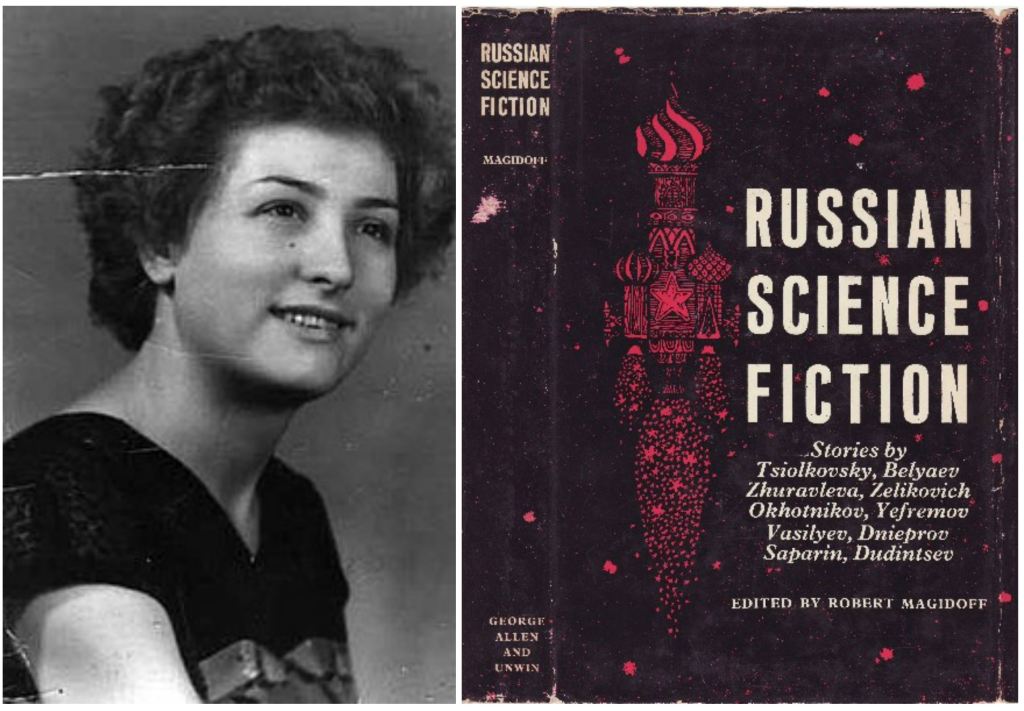
“The Astronaut” by Valentina Zhuravlyova

Group Read 27The Big Book of Science Fiction

Story #38 of 107: “The Astronaut” by Valentina Zhuravlyova

The thing about getting old is running down. I have good days and bad days. Actually, I have good hours and bad hours. This morning started off nice. I woke up early this morning to the sound Messenger makes to notify me of a new message. It was still dark outside, just a bit after six. Piet Nel has sent me a link to John O’Neill’s review of Modern Classic Novels of Short Fiction edited by Gardner Dozois. That’s an anthology I’ve wished the group would pick to read, especially because it has my all-time favorite science fiction novella in it, “The Star Pit” by Samuel R. Delaney. Reading O’Neill’s review and comments put me in the mood to read science fiction.

Ozzy the cat was sleeping soundly on my legs, so I decided not to bother him. Instead of getting up to start my day, I tapped on the Kindle app to read “The Astronaut” by Valentina Zhuravlyova. The VanderMeers introduction got me interested in the story right away when they gave away the part about the astronauts having to reduce the weight of the spaceship to make the return voyage back to Earth. That same idea is used in Destination Moon (1950). I’ve always used that idea about jettison mass to minimize the weight to take off as a metaphor for succeeding at efforts in life. Often I’m weighted down by too many desires, so to get something done I have to toss out everything but the one thing I want to accomplish.

As soon as I started reading the story I liked it. The narrative was simple and engaging. I often write about why we like or dislike a story. In our group discussions, I’m amused by how some of us praise a story while others dismiss it. It’s so easy to get annoyed by a story, to fail at enjoying it. This morning while still snug under my covers and cat, and having just finished an upbeat essay about the joys of great science fiction, and still fresh from a night’s sleep, I got into this story in a big way.

“The Astronaut” is the kind of story I wanted to find when we voted to read The Big Book of Science Fiction. I hoped to find stories I loved as much as the stories I loved in the classic anthology The Science Fiction Hall of Fame. I wanted to read stories I had never read and were unknown to all the famous SF anthologists. I have no memory of Valentina Zhuravlyova, and I’m quite certain I will soon forget her name. And I’ll probably even forget the name of this story, but I will remember three things about this tale.

I will remember a story about astronauts needing to throw out equipment so they could take off because I often remember Destination Moon. I now will remember two stories that used that idea.

I will remember I’ve read a story where the space administration decided it was important for astronauts to have hobbies for their long space voyages. I’m surprised I haven’t seen this idea before.

And I will remember I read a story about a lone stranded astronaut who put his soul into two paintings. Valentina Zhuravlyova has put a bit of her soul into “The Astronaut.” She is dead now, but she coded part of herself into this story.

I have another metaphor I often use to explain the limitations of communication. I compare all our efforts to speak across the void between conscious minds as throwing a message in a bottle upon the ocean hoping someone will find it. The astronaut Zarubin threw two paintings upon the void hoping to express himself, and “The Astronaut” is Valentina’s message in a bottle to us.

This is the second time I tried to write this essay. After I read “The Astronaut” I drained away the rest of my night’s store of energy by doing the exercises that keep my aches and pains away. I tried to write this later this morning, but I was too weary. I had to even nap to feel like eating lunch. And then I had to nap again. But that gave me time to think about this story and what to write. Getting old means running out of energy. I have to jettison many things I want to do just to accomplish one thing during my day. This was it. For the rest of the day, I will store up energy by napping or listening to books.

I’m alternating between two novels right now, To Say Nothing of the Dog by Connie Willis and Crossroads by Jonathan Franzen. Both provide psychic food that gives me the energy to think. Exercise and proper eating give me physical energy. The thing about being old is my batteries drain so damn quickly. Napping and reading are my ways of recharging. But I need a quality reading diet to generate psychic energy. “The Astronaut” gave me that.

Main Page of Group Read

James Wallace Harris, 11/2/21

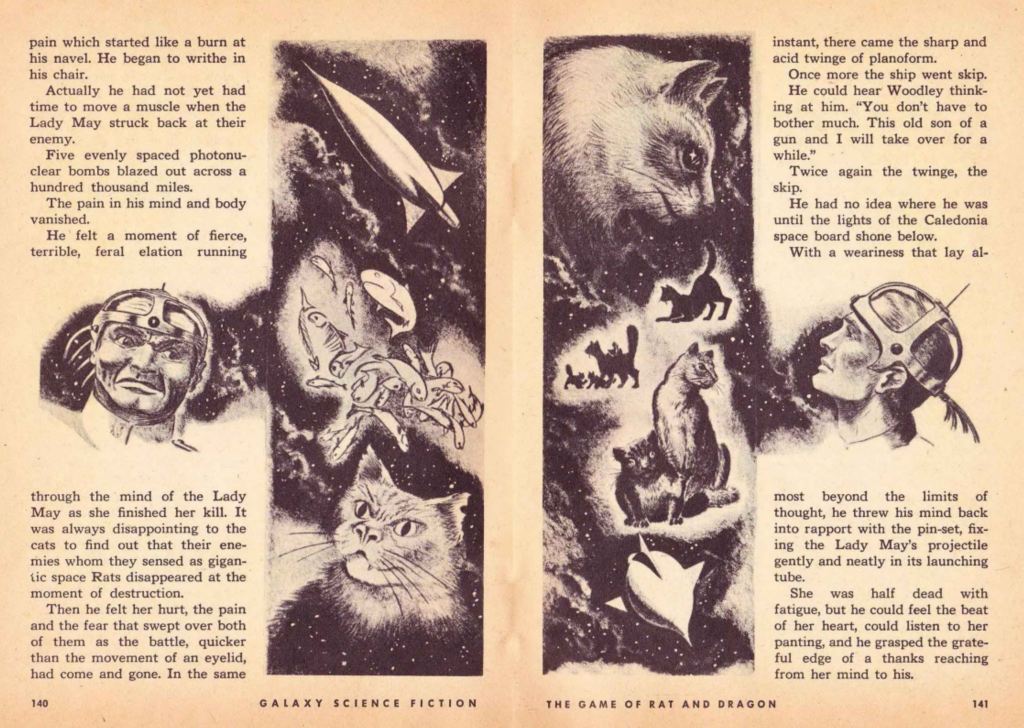
“The Game of Rat and Dragon” by Cordwainer Smith

Group Read 27The Big Book of Science Fiction

Story #27 of 107: “The Game of Rat and Dragon” by Cordwainer Smith

At first, I was disappointed to see “The Game of Rat and Dragon” was the next story in The Big Book of Science Fiction. I was hoping for a story new to me, instead of another reread. “The Game of Rat and Dragon” seemed too fresh in my mind and I’ve lost count of how many times I’ve read it. But I have this thing about rereading stories. I’ve disciplined myself to always reread a work when encountering it again in another anthology. Experience has taught me it’s well worth the time and effort, and that was the case this time too.

Each time I forget why I love this story, but whenever I start rereading all the details I admired comes back to me. Cordwainer Smith has created a delicious tale for people who love cats and space travel, and I’m his perfect target audience.

I have to wonder why Smith wrote this story? It came out in the October 1955 issue of Galaxy Science Fiction, just before the dawn of the Space Age. The story speculates we’ll eventually discover dangers in interstellar space that we can’t fathom consciously. Unknown threats that will drive us mad. Eventually in Smith’s fictional universe, we’ll discover that people with telepathic powers partnered with cats with telepathic powers can overcome those dangers. Humans perceive those unknowable attackers as dragons, and cats see them as rats.

In the 1950s there were countless stories about telepathy, ESP, psionics, and other psychic superpowers. There were a fair number of stories about humans having psychic bonds with cats, with other Earthly animals, as well as all kinds of alien space creatures. Did people in the 1950s really believe the space was going to be full of psychological barriers, that humans were going to develop psi-powers in the future, and we’d communicate with animals and aliens with our minds? Or were those the futures we wanted?

As a kid I thought science fiction was speculation about possibilities just around the corner, maybe within my lifetime, but now as an old person, I wonder if I ever really believed that? I think I did. Or at least, I think I hoped. Was I just a gullible kid who wanted to believe in science fictional theories. Had I put my own hopes for the future into the hands of writers who were only making shit up to tell a neat story? Or is there an inbetween position, where writers were making stuff up, but they also kind of believed their own bullshit?

Paul Linebarger, the real person behind the byline “Cordwainer Smith” was quite a serious and well-educated dude, even writing a textbook Psychological Warfare. Since “The Game of Rat and Dragon” was written in the middle of Cold War, when psychological warfare and brainwashing were topical topics, it’s easy to see the inspiration of the story. But why blend that heavy subject with sentimental fluff about cats? Imagine The Manchurian Candidate with several cute cat scenes.

Do stories need to make sense? Do stories about serious topics need to be serious and logical? “The Game of Rat and Dragon” has been reprinted extensively, including four of the giant doorstop SF retrospective anthologies of this century. Why is that?

Why do science fiction readers keep reading this story? Is it just our love of cats? Do we still hope people will become psychic? Or fear space might have psychological barriers? Or is it merely a story, well told, that entertains us for a few minutes?

The obvious answer is yes, it’s just a little story. But time and time again, I have to wonder why science fiction resonates with us. Science fiction has become immensely popular. As a society we have a vast appetite for fiction and an unquenchable thirst for novelty. Are we bored with reality and need all the books, movies, television shows, and video games we can consume which features interesting fictional realities? Why am I spending so much of my remaining life reading science fiction?

And what about the ending? Isn’t it questioning another normalcy? Doesn’t Underhill love the cat, Lady May, just a little too much? A nurse shows interest in him, and then feels rebuffed because Underhill can only ask about a cat. Should we wonder about Underhill rejecting human company for feline? Or does that line up with our own preference for pet companions? Or is it symbolic for our preference for fiction over life?

Main Page of Group Read

James Wallace Harris, 10/10/21

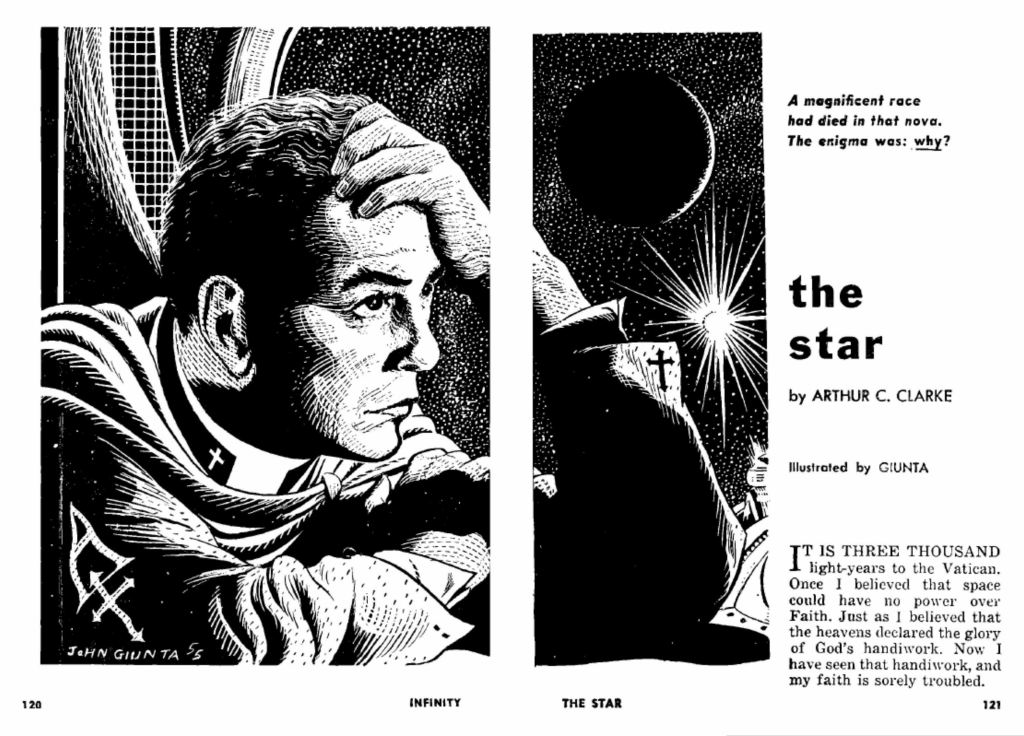
“The Star” by Arthur C. Clarke

Group Read 27The Big Book of Science Fiction

Story #25 of 107: “The Star” by Arthur C. Clarke

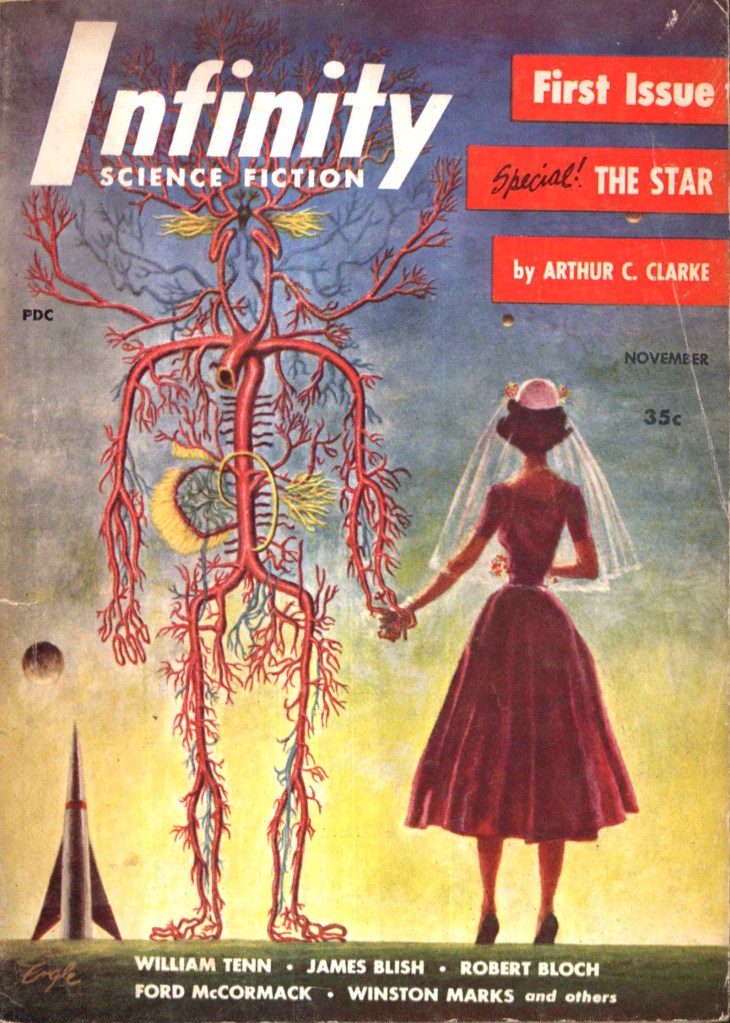
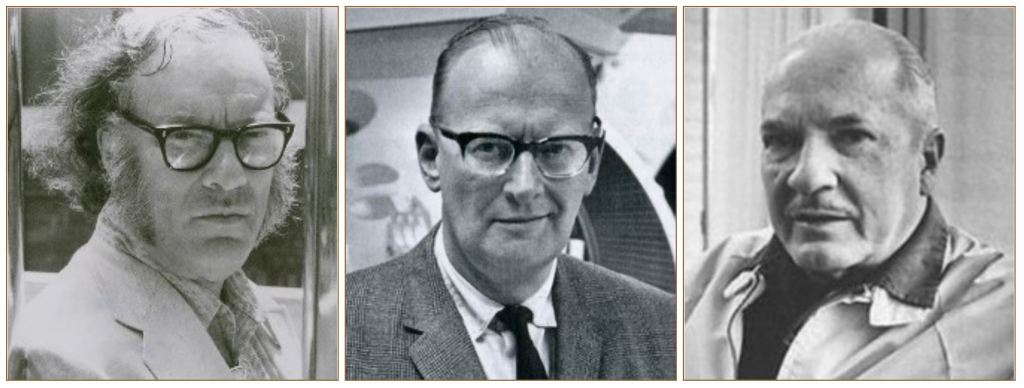
“The Star” by Arthur C. Clarke appeared in the very first issue of Infinity Science Fiction in November 1955 and got top billing on the cover. Was Clarke famous in 1955? “The Star” won a Hugo for him in 1956, so did that make him famous? Clarke was quite prolific at writing short stories and getting them published in a wide variety of science fiction magazines since 1946. So when did Arthur C. Clarke become famous as a top science fiction writer? By 1955 he was known for “Nine Billion Names of God,” Against the Fall of Night, Childhood’s End, and for the nonfiction book, The Exploration of Space, which Wikipedia claims Wernher von Braun gave to John F. Kennedy to promote the idea of space exploration. I ponder all this because I recently read a query on Facebook asking when Clarke became famous enough to be considered integral to the Big Three of science fiction writers. (Although, a more interesting question might be: Who are the top three writers of science fiction in 2021? I could not even begin to answer that.)

I discovered Clarke in 1963 when I read Dolphin Island, first published that year. I then discovered Islands in the Sky (1953) around 1965. In March of 1967 I argued with my best friend over who was the greatest science fiction writer, me claiming Heinlein, but Connell claiming Clarke. So by the mid-1960s I knew who he was, but only vaguely. I believe I had also read The Exploration of Space by then. Still, I was only slightly familiar with Clarke, but Heinlein-Clarke-Asimov were already the Big Three of science fiction. I accepted that because it seemed so.

But when did Clarke become famous? When 2001: A Space Odyssey came out that seem to make him well known. In July 1969 he was interviewed on live television during the Apollo 11 moon launch and landing as if everyone knew him, not just SF fans. But when did he become a legendary science fiction writer to science fiction fans? Clarke was the Guest of Honor at the Worldcon in 1956, the year after Asimov. Heinlein was Guest of Honor in 1941, just two years after he began publishing, and again in 1961, 1976.

I bring all this up because I wonder if the success of stories is related to the success of their authors? How long does it take for a great story to be recognized as a classic? Members of the Worldcon voted “The Star” the best short story the year after it came out, but T. E. Dikty didn’t select it for his best of the year annual. Dikty did pick “The Game of Rat and Dragon” that competed with “The Star” for the Hugo.

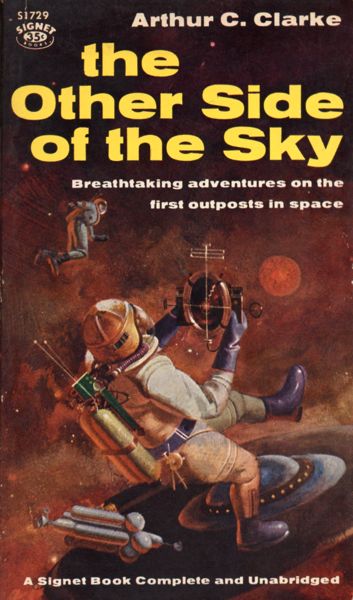
Looking at the story’s ISFDB entry, we can see it’s been reprinted quite often. However, that ball didn’t start rolling until 1962 when “The Star” was included in The Hugo Winners edited by Isaac Asimov and A Century of Science Fiction edited by Damon Knight. Those two anthologies were often reprinted, and were selections for the SFBC. That spread the word far and wide. Plus “The Star” was included in Clarke’s third collection, The Other Side of the Sky that went through many editions. The list of reprints at ISFDB is quite long, and so is the list of languages its been translated into.

I’m surprised that the VanderMeers included “The Star” in The Big Book of Science Fiction, since they often seem to avoid the widely reprinted classics. I would have expected them to find a less famous Clarke to promote. They didn’t include a story by Heinlein because they couldn’t get the rights — and that omission really sticks out. The Asimov they picked was Asimov’s favorite I believe, but not mine. Both “The Star” and “The Last Question” are excellent stories, but not evidence that Clarke and Asimov were once part of a Big Three. Are there three stories that would stand as evidence?

When I go to bookstores I often check to see how many books are available by Heinlein, Clarke, and Asimov. Where once each of their titles would fill a shelf or two, they now take up inches with a few titles. Heinlein, Clarke, and Asimov are hardly the big three today. Will “The Star” survive if Clarke’s reputation doesn’t?

The story is rather slight, and can be read in 5-15 minutes, and I believe most people remember it because of its trick ending. Just to remind folks, I’m not reviewing stories, but discussing them, so I will spoil that surprise ending.

It’s rather interesting that Clarke’s two most famous short stories confirm the existence of God, and his two most famous novels, suggest that mankind will be resurrected into a higher state of being. That’s rather interesting since I believe Clarke was an atheist. Was he just going for a surprise ending, or was he making a philosophical statement. Maybe we should look closer at those two short stories.

In “Nine Billion Names of God,” the almighty dissolves the universe after Buddhist monks compile a list of all his possible names. In “The Star” God destroys a planet of advanced beings just to signal to our planet that his son had arrived. Was Clarke wanting his readers to consider that God is not nice? Or the ways of God are not fathomable by us? James Blish in A Case of Conscience and Mary Doria Russell in The Sparrow also use science fiction to question the nature of God.

In my opinion, Clarke was going for the cheap gasp. In both stories, he setup the story nicely. In “The Star” he does some astronomical infodumping, and covers a couple classic science fiction themes, one of which is a favorite of mine. I love stories about exploring the remains of extinct alien civilizations. Clarke even throws in a nice Jesuit character that I was getting to like. Then WHAM – the surprise.

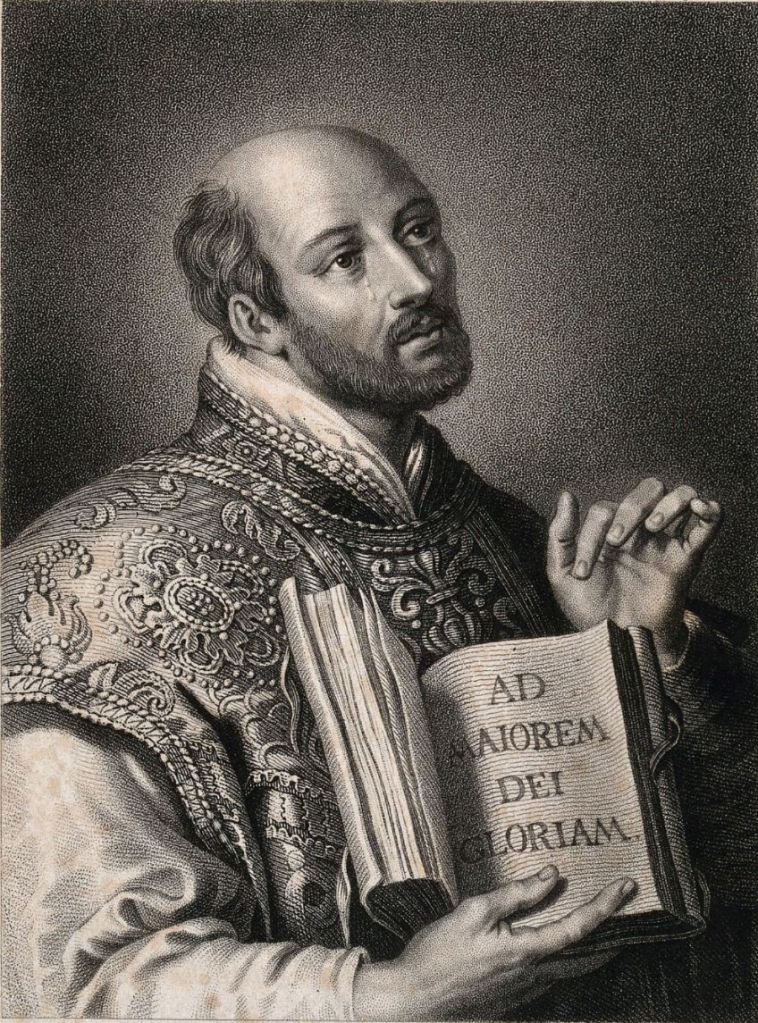
When I reread these stories, and I do reread them because I have a personal rule to reread stories when I encounter them again in another anthology, I know what’s coming so I try to look for interesting bits along the way to the ending. This time I liked the Jesuit, and that he has a copy of Ruben’s engraving of Loyola in his cabin.

On the other hand, is this enough to keep reprinting “The Star?” If science fiction is mostly neat ideas and surprise endings is that enough for us to keep reading it. Shouldn’t we want more? What did Clarke give the science fiction world to make him famous?

I fear most science fiction has little lasting value. That’s why we see all its themes recycled for each new generation reclothed in current fashions. I wonder if “The Star” survives because no later generation has come up with this same trick ending?

If I was anthologizing SF stories from the 20th century and wanted to include an Arthur C. Clarke story, I’d use “Rescue Party.” I’ve read that Clarke was annoyed by the number of people who told him their favorite story of his was “Rescue Party” because it meant his career had been going down since his first professional sale. “The Star” is much better written, but if we’re going for unique ideas, “Rescue Party” has more. A race of aliens come upon the Earth but there’s no sign of humanity. The aliens poke about our remains wondering who we were. This is the inverse of the theme I like so much. A very nice twist. We have abandoned the solar system like the beings of “The Star” should have. Near the end of the story, the aliens discover we’d left monitoring equipment to record the end of our world, and followed the direction in which it was beaming data. The story ends with them going off to find us.

The science fiction theme that humanity must leave the Earth and solar system to survive is a strong one. It’s part of the drive behind Elon Musk’s effort to colonize Mars. It promotes the belief that no matter what God or Nature throws at us, we will hang on. That’s a much more powerful message for Clarke to leave his readers.

To answer my original query I’m guessing Clarke became famous when a certain percentage of science fiction readers thought his ideas and stories were among the best. I’m guessing that happened between Childhood’s End (1953) and The City and the Stars (1956), maybe as late as 2001: A Space Odyssey (1968), and definitely by Rendezvous with Rama (1973).

Update:

I found this quote in I, Asimov: A Memoir where Isaac Asimov claims Clarke was famous by 1949. But I find that hard to believe, because that was before any of his famous stories.

There was no question that by 1949 I was widely recognized as a major science fiction writer. Some felt I had joined Robert Heinlein and A. E. van Vogt as the three-legged stool on which science fiction now rested. 

As it happened, A. E. van Vogt virtually ceased writing in 1950, perhaps because he grew increasingly interested in Hubbard’s dianetics. In 1946, however, a British writer, Arthur C. Clarke, began to write for ASF, and he, like Heinlein and van Vogt (but unlike me), was an instant hit. 

By 1949, the first whisper of Heinlein, Clarke, and Asimov as “the Big Three” began to be heard. This kept up for some forty years, for we all stayed alive for decades and all remained in the science fiction field. In the end, we all three commanded large advances and found our books on the best-seller lists. (Who would have thought it in the 1940s?)

I, Asimov (pp. 140-141). Random House Publishing Group. Kindle Edition. 

Main Page of Group Read

James Wallace Harris, 10/4/21