When Did Movies and Television First Portray a Science Fiction Fan?

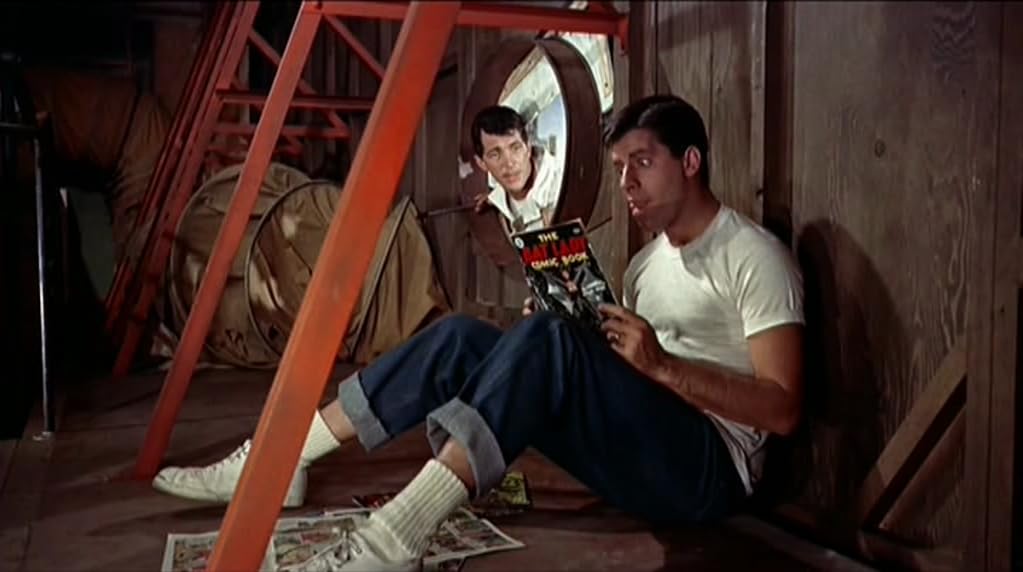
For years I thought Back to the Future was the first film to portray a science fiction fan. That 1985 movie featured Crispin Glover as George McFly, a nerdy kid who grows up to become a science fiction writer. Most of the action was set in 1955. Well, the other night I watched Artists and Models that came out in 1955. It features Jerry Lewis as Eugene, a nerdy guy who loves Bat Lady comics and talks about a lot of crazy science fiction stuff.

In neither role, does the science fiction fan come across as competent. They are goofy space cadets. Is this how the world thinks of us? Life Magazine introduced science fiction fandom to the world in a May 21, 1951, issue. (See my essay that reprints those pages.)

In the late 1950s, Philip K. Dick wrote a mainstream novel about a science fiction fan, Confessions of a Crap Artist. It’s my favorite PKD novel. The book was made into a 1992 French movie I’ve never seen.

Science fiction movies go back to the early days of film making, but readers and writers of science fiction have seldom been portrayed. Can you think of any other examples?

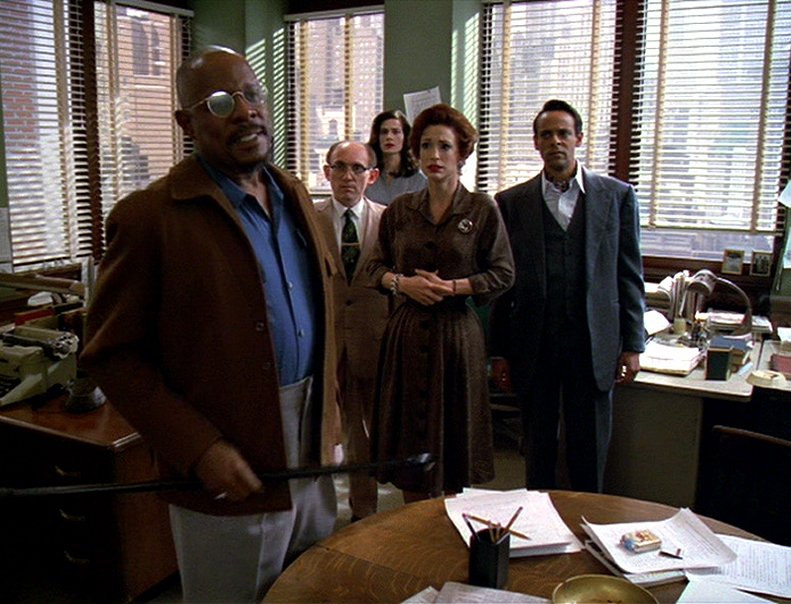
The most loving and positive example of science fiction I can think of is from television, the 1998 episode of Deep Space Nine called “Far Beyond the Stars.” In it, Captain Sisko is shown as a struggling African American science fiction writer working at a Galaxy-like SF magazine in 1953. There’s also a wonderful paperback novelization of the episode by Steven Barnes.

Let me know of any movies or television shows you know about that featured a science fiction reader or writer as a character, or even discussed the subject of science fiction?

James Wallace Harris, 11/1/23

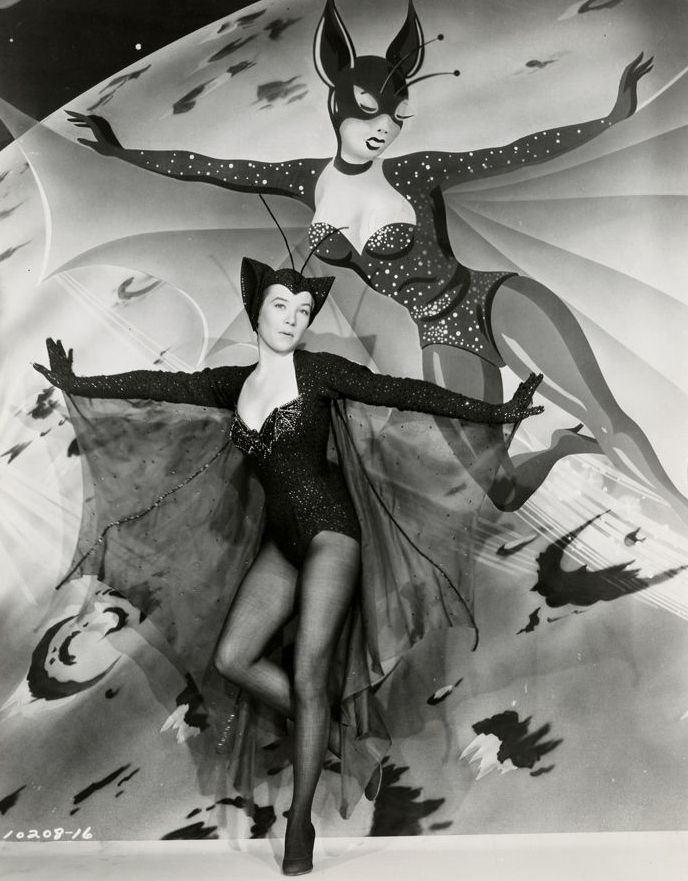
Artists and Models is quite silly, but very colorful. It’s Shirley MacLaine’s second film, and she’s the model for the Bat Lady.

Has Science Fiction Left Me Behind?

The above books were the finalists for the 2023 Hugo Awards. I have not read any of them. Nor do they look interesting to me. Each year the Hugo and Nebula award finalists seem further and further away from what I want to read.

The other day I went into a new bookstore for the first time in many months. I went up and down the aisles of the science fiction section and I was shocked by how many books were by authors that were unknown to me.

I turn seventy-two next month and I wonder if I’ve gotten too old for science fiction. Or, has the genre left me in the dust? I can accept that I might be too old to keep up. Could the genre have changed, and I’ve just lost interest? Who knows?

In the 20th century I’m sure I read at least a thousand science fiction books, probably many more. Here’s a list of the 69 SF&F books I’ve read in the 21st century:

  • 2000 – Harry Potter and the Goblet of Fire by J. K. Rowling (Hugo winner)
  • 2000 – Calculating God by Robert J. Sawyer (Hugo finalist)
  • 2001 – American Gods by Neil Gaiman (Hugo winner)
  • 2001 – Perdido Street Station by China Miéville (Hugo finalist)
  • 2002 – Altered Carbon by Richard K. Morgan
  • 2003 – The Time Traveler’s Wife by Audrey Niffenegger
  • 2004 – Cloud Atlas by David Mitchell
  • 2004 – Jonathan Strange & Mr. Norrell by Susanna Clarke (Hugo winner)
  • 2004 – The Plot Against America by Philip Roth
  • 2005 – Spin by Robert Charles Wilson (Hugo winner)
  • 2005 – Old Man’s War by John Scalzi (Hugo finalist)
  • 2005 – Never Let Me Go by Kazuo Ishiguro
  • 2006 – The Road by Cormac McCarthy
  • 2006 – Life As We Knew It by Susan Beth Pfeffer
  • 2007 – The Yiddish Policeman’s Union by Michael Chabon (Hugo winner)
  • 2008 – The Hunger Games by Suzanne Collins
  • 2008 – Little Brother by Cory Doctorow (Hugo finalist)
  • 2008 – Flood by Stephen Baxter
  • 2008 – Marsbound by Joe Haldeman
  • 2009 – The City & The City by China Miéville (Hugo winner)
  • 2009 – The Windup Girl by Paolo Bacigalupi (Hugo finalist)
  • 2009 – Boneshaker by Cherie Priest (Hugo finalist)
  • 2009 – Julian Comstock by Robert Charles Wilson (Hugo finalist)
  • 2009 – Catching Fire by Suzanne Collins
  • 2009 – Wake by Robert J. Sawyer
  • 2010 – Feed by Mira Grant (Hugo finalist)
  • 2010 – Mockingjay by Suzanne Collins
  • 2010 – Watch by Robert J. Sawyer
  • 2010 – Hull Zero Three by Greg Bear
  • 2011 – Among Others by Jo Walton (Hugo winner)
  • 2011 – Leviathan Wakes by James S. A. Corey (Hugo finalist)
  • 2011 – The Martian by Andy Weir
  • 2011 – Ready Player One by Ernest Cline
  • 2011 – Wonder by Robert J. Sawyer
  • 2012 – Redshirts by John Scalzi (Hugo winner)
  • 2012 – 2312 by Kim Stanley Robinson (Hugo finalist)
  • 2012 – The Dog Stars by Peter Heller
  • 2012 – The Age of Miracles by Karen Thompson Walker
  • 2012 – vN by Madeline Ashby
  • 2014 – The Three Body Problem by Cixin Liu (Hugo winner)
  • 2014 – Annihilation by Jeff VanderMeer
  • 2014 – Station Eleven by Emily St. John Mandel
  • 2014 – The Girl with All the Gifts by M. R. Carey
  • 2014 – The Book of the Unnamed Midwife by Meg Elison
  • 2014 – Yesterday’s Kin by Nancy Kress
  • 2015 – Seveneves by Neal Stephenson (Hugo finalist)
  • 2015 – Children of Time by Adrian Tchaikovsky
  • 2015 – Binti by Nnedi Okorafor
  • 2015 – Aurora by Kim Stanley Robinson
  • 2015 – The Water Knife by Paolo Bacigalupi
  • 2016 – All the Birds in the Sky by Charlie Jane Anders (Hugo finalist)
  • 2017 – New York 2140 by Kim Stanley Robinson (Hugo finalist)
  • 2017 – All Systems Red by Martha Wells
  • 2017 – Sea of Rust by C. Robert Cargill
  • 2017 – Under the Pendulum Sun by Jeanette Ng
  • 2017 – Noumenon – Marina J. Lostetter
  • 2018 – The Calculating Stars by Mary Robinette Kowal (Hugo winner)
  • 2018 – Semiosis by Sue Burke
  • 2018 – The Fated Sky by Mary Robinette Kowal
  • 2018 – The Feed by Nick Clark Windo
  • 2019 – Children of Ruin by Adrian Tchaikovsky
  • 2019 – Machines Like Me by Ian McEwan
  • 2020 – The Ministry for the Future by Kim Stanley Robinson
  • 2020 – The Midnight Library by Matt Haig
  • 2021 – Project Hail Mary by Andy Weir (Hugo finalist)
  • 2021 – Klara and the Sun by Kazuo Ishiguro
  • 2022 – Babel by R. F. Kuang
  • 2022 – The Mountain in the Sea by Ray Nayler
  • 2022 – Sea of Tranquility

That’s an average of 2.8 SF&F books a year. Assuming I read a thousand SF books from 1963-1999, means I averaged 27.78 SF books a year. I think I could have easily read 1,500 SF books, or 41.67 SF books a year. In other words, I don’t read SF like I used to. And my 21st century list includes quite a few fantasies. I rarely read fantasy in the 20th century. I really don’t like fantasy books. I only read them when they reach a certain pop culture status.

One reason for the shift is I read more literary works and nonfiction books. Another reason is after reading thousands of science fiction books, I seldom read reviews of new science fiction books that sound different enough to be appealing.

I used to keep up with the genre by belonging to the Science Fiction Book Club, which offered two new titles a month. I subscribed to several science fiction magazines and fanzines that reviewed new books. And I would visit one or two new bookstores a week.

Fanzines disappeared, and I stopped having time for the prozines even though I still subscribed. After Amazon and Audible, I stopped shopping in new bookstores, and they eventually disappeared. Back in the 1970s I went to conventions and even published fanzines. In the 1980s I ran a BBS devoted to science fiction. Since the 1990s I’ve run websites and databases devoted to SF. Once upon a time all my friends were SF readers. But active participation in fandom ended when I got married and settled down to work in 1978. I became a different person socially.

Since 2002, I’ve been rereading the science fiction I first read in the 20th century by listening to audiobook editions from Audible.com. It’s a kind of nostalgic trip. I also caught up on a lot of 20th century science fiction I missed. That also kept me from reading many new SF books.

But in all honesty, I prefer old science fiction to new science fiction. There’s been some great exceptions, but I think that’s the real reason I’ve let the genre pass me by.

I wish the Science Fiction Writers of America never embraced fantasy. I wish the Hugo Awards had focused exclusively on science fiction. Fantasy should have their own fan-based award. I can’t help but wonder if the science fiction genre would be more vibrant today if it hadn’t been married to the fantasy genre. Even books marketed as science fiction often feel like fantasies. Looking back, I would have preferred a smaller, focused SF genre, one I could have kept up with.

Science fiction used to have some realism, or at least some speculative integrity. Now, any old wild idea works. Science fiction used to be inspired from reality, now new writers are inspired mostly by science fiction movies. It’s as if all science fiction is recursive science fiction.

Who knows, maybe I left science fiction behind.

James Wallace Harris, 10/22/23

1955 Astounding Overview

As I’ve described before, our reading group is covering the best science fiction short stories of 1955. To supplement the discussion, I’m creating .pdf files for each science fiction magazine that includes their cover, table of contents, and some departments such as book reviews, fanzine reviews, and letters to the editor. Sometimes I even include interesting ads or other artifacts that add to the discussion of science fiction in 1955. I just created “1955 Astounding Overview” to go with the ones for Amazing and IF. I’ll be doing more magazines in the future. You can download what I’ve done so far here:

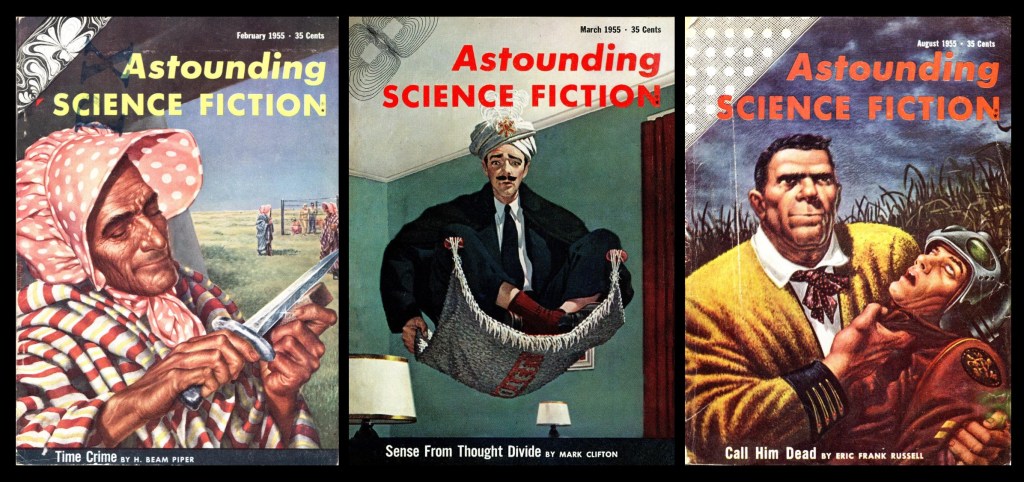
The general belief was Astounding Science Fiction was in decline in the 1950s but looking through the 1955 issues I’m not so sure. Our group wondered why “Allamagoosa” by Eric Frank Russell won the Hugo for best short story in 1955 when there were so many other great short stories. It was in the May issue. I noticed when going through the issues of Astounding that Russell had four short stories in that magazine for 1955, and one 3-part serial, meaning he was in seven of the twelve issues. The guy was just popular and that might have gotten him votes. However, “Allamagoosa” is a fun story.

Astounding also published the Best Novelette winner too, for “The Darfsteller” by Walter M. Miller, Jr. in the January issue. Astounding also had the winning novel, They’d Rather Be Right, which was serialized in 1954. “The Darfsteller” is magnificent, but They’d Rather Be Right is considered by many to be the worst novel to win the Hugo Award. See “Hugo Nominees: 1955” by Jo Walton about that controversy. (You can get both the Mark Clifton novels discussed in that essay at Amazon for ninety-nine cents.)

Of the fourteen stories we’ll be reading for Group Read 63, five were from Astounding, three from Galaxy, and four from F&SF. The other two were from other sources. We have already read eight other stories from 1955 in other group reads, but I’ve forgotten their sources.

For me, the best thing about the “1955 Astounding Overview” that I created are the book reviews by P. Schuyler Miller. His column, “The Reference Library” is my favorite way to look back over science fiction in the 1950s. Not only did Miller review books, but often wrote about the state of science fiction and publishing. Some of the books he reviewed that I’ve read, or own and hope to read are:

  • Science-Fiction Thinking Machines edited by Groff Conklin
  • Born of Man and Woman by Richard Matheson
  • One in Three Hundred by J. T. McIntosh
  • Brain Wave by Poul Anderson
  • The Immortal Story by Sam Moskowitz
  • The Best Science-Fiction Stories: 1954 edited by Bleiler & Dikty
  • The Stars Are Ours by Andre Norton
  • The Forgotten Planet by Murray Leinster
  • The Star Beast by Robert A. Heinlein
  • Star Short Novels edited by Frederik Pohl
  • The Best from Fantasy and Science Fiction: Fourth Series edited by Anthony Boucher
  • Shadows in the Sun by Chad Oliver
  • Earthlight by Arthur C. Clarke
  • More Adventures in Time and Space edited by Healy & McComas
  • Earthman, Come Home by James Blish
  • The Mouse That Roared by Leonard Wibberley
  • Northwest of Earth by C. L. Moore
  • Assignment in Tomorrow edited by Frederik Pohl
  • To Walk the Night by William Sloane
  • The Exploration of the Moon by Arthur C. Clarke
  • Of All Possible Worlds by William Tenn
  • Hell’s Pavement by Damon Knight
  • Who Goes There? by John W. Campbell
  • The Body Snatchers by Jack Finney
  • Re-Birth by John Wyndham
  • The Edge of Running Water by William Sloane
  • Solar Lottery by Philip K. Dick
  • The Martian Way and Other Stories by Isaac Asimov
  • The Fittest by J. T. McIntosh

Each of Miller’s columns begins with several pages on a generalized topic. This also conveys a lot about science fiction in 1955.

James Wallace Harris, 9/9/23

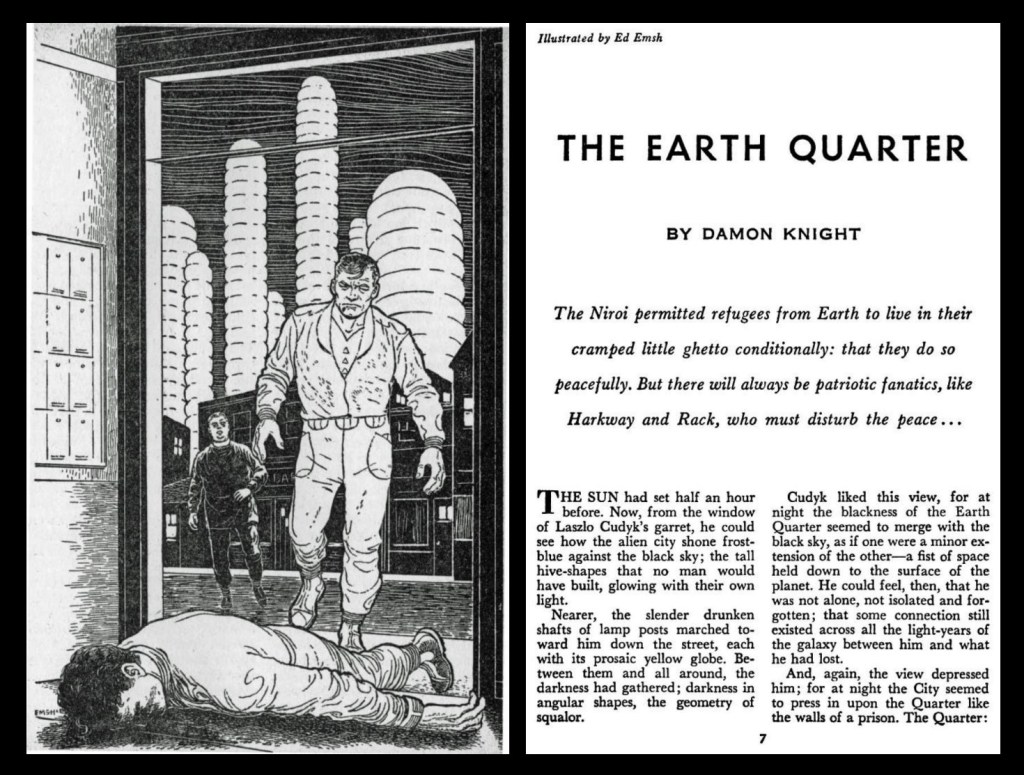
“The Earth Quarter” by Damon Knight

Starting September 7th, our science fiction short story group will be discussing the best short science fiction of 1955. Read about the details here if you want to participate. We used CSFquery to identify twenty-two stories to read and discuss. However, I put a challenge to the group to find worthy stories that have gone mainly unrecognized. I found my first forgotten classic today, “The Earth Quarter” by Damon Knight. The only recognition I could find that remembers this story is in a list of 50 SF short stories that were Gardner Dozois personal favorites. (I’m going to have to read more of the stories from that list that aren’t famous.)

I thought “The Earth Quarter” was one of the most cynical science fiction stories I’ve ever read. You know how Campbell and Heinlein were so pro-human? Well, Knight takes the opposite stance. I don’t want to say too much — and you might want to go read the story here before you read on.

Knight sets up the story where a group of humans live in a ghetto on another planet, one they call Earth Quarter. He pictures humans attaining interstellar flight and spreading out across the galaxy, but discovering it’s well occupied by intelligent beings more advanced than us. Humans can’t handle this. Earth itself falls back into barbarism, while enclaves of humans on various planets bicker amongst themselves.

“The Earth Quarter” is told from the point-of-view of Laszlo Cudyk, a fifty-year old man who tries to stay neutral among several highly polarized political factions. Liberals want to find a way to live peaceably with the aliens, while various conservative groups want to bring back the glory of Earth and conquer the galaxy.

The Earth Quarter is roughly sixteen square city blocks, containing 2,300 humans of three races, four religions, and eighteen nationalities. The human ghetto is sanctioned by a race of aliens called the Niori, but only if they live peaceably, which humans can’t seem to do. Knight makes a case that humans just can’t get along no matter what.

Life in the Earth Quarter reminds me of the prisoner of war camp in J. G. Ballard’s Empire of the Sun, but the Niori are enlightened beings who are kind rather than cruel. In another way, the story reminds me of Katherine Anne Porter’s Ship of Fools.

What I really liked about this story was the characterization — sure it’s pulp fiction, but I think good pulp fiction. Knight creates many distinctive characters who are vivid from little description. Sure, he employs stereotypes, but not too offensively. I can easily picture “The Earth Quarter” being made in a 1950’s noir sci-fi flick with all the standard noir actors like Humphrey Bogart, Robert Ryan, Robert Mitchem, Peter Lorre, Sidney Greenstreet, Barten MacLane, Elisha Cook, Jr. — and it would have to be filmed in black and white.

My guess was Damon Knight got disgusted with humans in 1955 when he wrote this story. We were in the middle of the cold war and humanity was providing just the right inspiration.

UPDATE – 9/4/23

It turns out that Rich Horton also likes “The Earth Quarter.” See his essay about his picks for the 1956 Hugo awards (which cover 1955). But he also reviewed the story when it was expanded and renamed into one-half of an Ace Double called The Sun Saboteurs.

James Wallace Harris, 9/3/23

1955: Amazing Stories

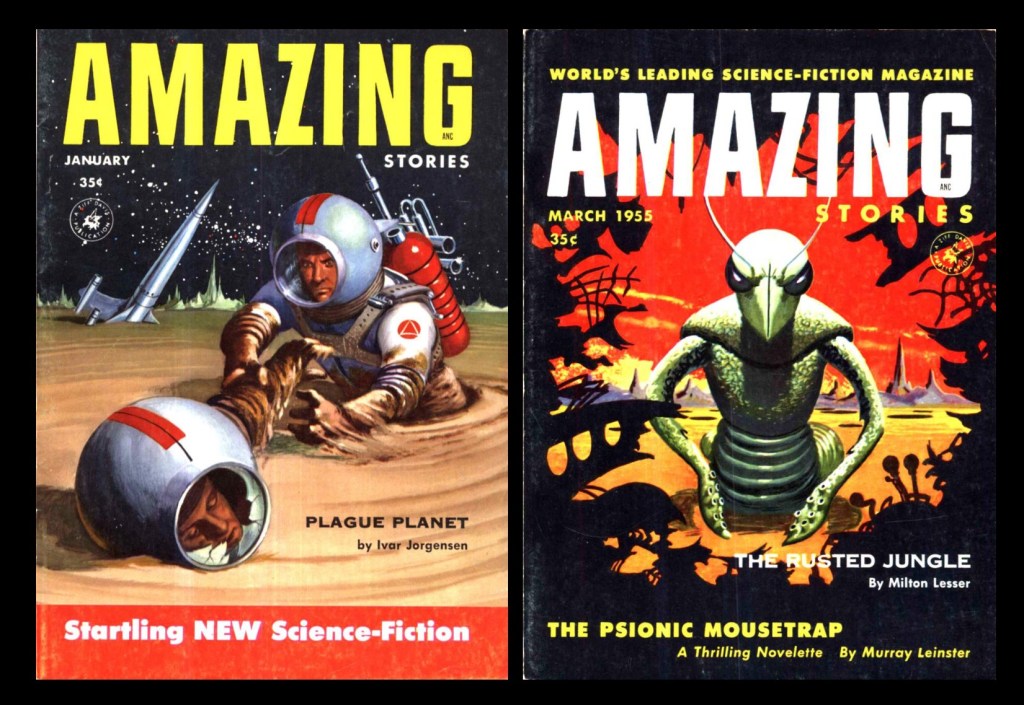
For our Best of 1955 group read I thought I’d look over some of the less successful science fiction magazines published that year. I started with Amazing Stories. Howard Browne had been editing the magazine since 1950 but would leave in 1956 to move to Hollywood to become a moderately successful TV scriptwriter (Maverick, Cheyenne, Bourbon Street Beat, 77 Sunset Strip, Mission Impossible, Mannix, The Rockford Files). Browne helped Amazing Stories transition away from the pulp format and its obsession with the Shaver Mystery. He began 1955 with this editorial:

In the following issue Browne promised further improvements which included a book review column and a fanzine review column. Throughout 1955 the letter column kept growing, and it was apparent that Amazing Stories had its faithful fans. To help members of my reading group get a sense of the magazine, I made a .pdf file that had the covers, table of contents, book reviews, fanzine reviews, and some letters of comments from the seven issues of Amazing Stories from 1955. Get the file: 1955: Amazing Stories Overview. If you want, you can read the seven 1955 issues at the Internet Archive.

Despite Amazing Stories being the first magazine devoted to publishing exclusively science fiction, and its fame in science fiction history, damn few stories have been reprinted from its pages. In its early years, Amazing mostly published classic reprints by Wells, Verne, and others. Just look at the table of contents from two anthologies devoted to collecting the best of its stories:

Amazing Stories: 60 Years of the Best Science Fiction (1985) edited by Isaac Asimov and Martin H. Greenberg.

  • The Revolt of the Pedestrians • (1928) • novelette by David H. Keller, M.D.
  • The Gostak and the Doshes • (1930) • short story by Miles J. Breuer, M.D.
  • Pilgrimage • (1939) • novelette by Nelson S. Bond
  • I, Robot • (1939) • by Eando Binder
  • The Strange Flight of Richard Clayton • (1939) • short story by Robert Bloch
  • The Perfect Woman • (1953) • short story by Robert Sheckley
  • Memento Homo • (1954) • short story by Walter M. Miller, Jr.
  • What Is This Thing Called Love? • (1961) • short story by Isaac Asimov
  • Requiem • (1962) • short story by Edmond Hamilton
  • Hang Head, Vandal! • (1962) • short story by Mark Clifton
  • Drunkboat • (1963) • novelette by Cordwainer Smith
  • The Days of Perky Pat • (1963) • novelette by Philip K. Dick
  • Semley’s Necklace • (1964) • short story by Ursula K. Le Guin
  • Calling Dr. Clockwork • (1965) • short story by Ron Goulart
  • There’s No Vinism Like Chauvinism • novelette by John Jakes
  • The Oögenesis of Bird City • (1970) • short story by Philip José Farmer?
  • The Man Who Walked Home • (1972) • short story by James Tiptree, Jr.
  • Manikins • (1976) • short story by John Varley
  • In the Islands • (1983) • short story by Pat Murphy

The Best from Amazing Stories (1973) edited by Ted White

  • No Charge for Alterations • (1953) • novelette by H. L. Gold
  • The Augmented Agent • (1961) • novelette by Jack Vance
  • The Misfit • (1963) • short story by Roger Zelazny
  • The Dowry of Angyar • (1964) • short story by Ursula K. Le Guin
  • Placement Test • (1964) • novelette by Keith Laumer
  • The Horn of Time the Hunter • (1963) • short story by Poul Anderson
  • Phoenix • (1963) • short story by Marion Zimmer Bradley and Ted White
  • Rogue Psi • (1962) • novelette by James H. Schmitz

Not exactly classics, are they? And most of the stories by well-known authors were early works. So, I wasn’t expecting much when I went looking through the issues that came out in 1955. I found that most of the stories have never been reprinted since their publication in Amazing in 1955. And those few that were reprinted were reprinted in Amazing or other cheap reprint magazines.

I’ve always wondered why stories from Astounding/Analog, F&SF, and Galaxy have dominated the table of contents of anthologies published before 1970. Still, since my reading group will be discussing the best science fiction short stories from 1955, I thought I’d give Amazing Stories a look over. The first story of 1955 was:

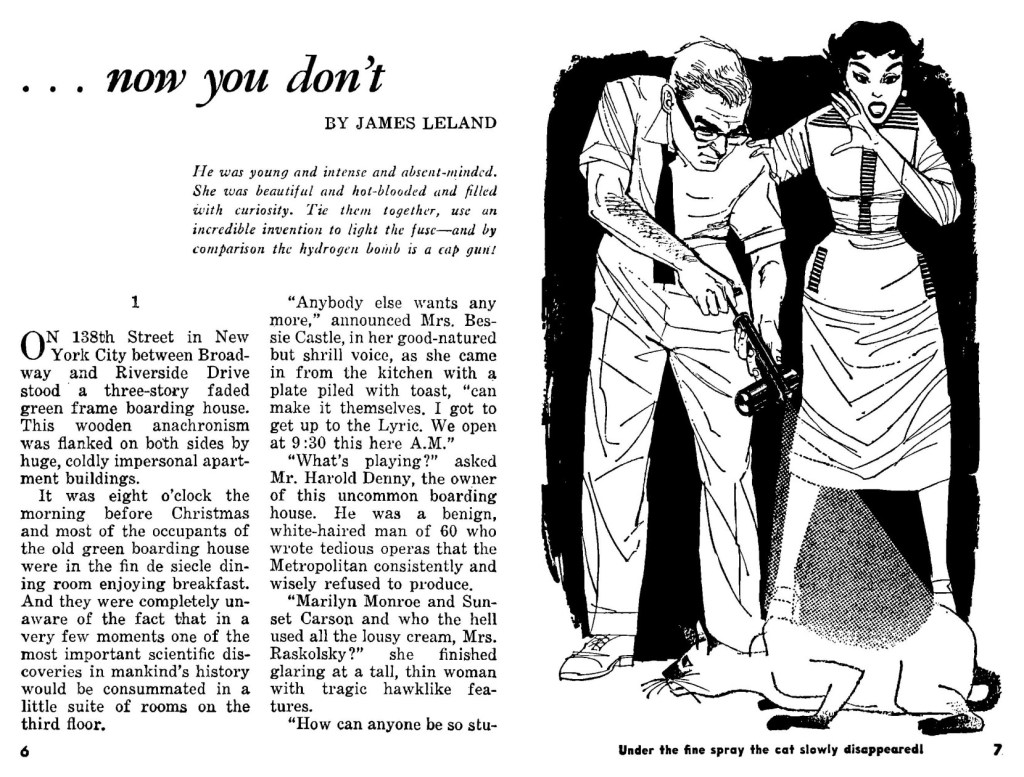
I read “. . . now you don’t” by James Leland, to get the feel for things. You can read it online. This story is Leland’s only entry in ISFDB.org, and it gives no biographical data, so I don’t know how old he was. In 1955, most of the stories in Amazing were written by just a few writers, with several of them also packing the issues with pseudonyms. I’m guessing Leland was made up name. Since many of the stories have a New York City connection, and written by a small group of writers, I’m assuming they all knew each other and the editor. They appear to be young, smart, and precocious, but not very experienced or sophisticated. Maybe a little street wise, or trying to pass that off.

The writing for “. . . now you don’t” is not good, but it is readable, and even fun. I’d call it good bad writing. Leland has obviously seen the Frank Capra film, You Can’t Take It with You, and builds the setting and mood of “. . . now you don’t” around it. To add science fiction, he took H. G. Wells’ The Invisible Man and spiced it up with some Thorne Smith naughtiness. The story is just a tiny bit risqué, throwing in a few bits of innuendo. Leland tries to sound well-read by throwing in references to novels people read in college, but the story really reflects being well-read in pulp fiction.

I get the impression from looking through the stories that these guys were mostly would-be writers and used Amazing Stories as a practicum. Quite a few famous writers got their start with Amazing, but quickly moved on. There were no famous names in the 1955 issues, but there were in the 1954 and 1956 issues — such as Philip K. Dick and Frank Herbert.

The writer I was most interested in was Paul W. Fairman, who would become the editor of Amazing and Fantastic after Browne left in 1956. He was also the first editor of If. Fairman sometimes used the house name Ivar Jorgensen, which other writers also used. Using the Jorgensen name, Fairman published “Deadly City” in the March 1953 issue of If. That was one of my favorite stories from 1953, and it was made into the film Target Earth in 1954. That was one of the first science fiction movies I saw as a kid back in the 1950s. Fairman also wrote about twenty forgotten SF novels, many coauthored with Lester del Rey.

Fairman had seven stories published in 1955, three in Amazing and four in Fantastic. I figured I would start with those three stories to see if any of them were worth remembering in 2023. Amazing Stories was a decent place to start a writing career but a terrible place to be left behind.

Fairman published “The Cosmic Frame” in May, a story about two teenagers on a date who run over an alien in a Packard. The alien’s companions take an interesting revenge on the kids. In September, Fairman wrote about a more complicated alien invasion in “One Man to Kill.” Finally, in November, he told a man from Mars story, “The Man in the Ice Box” — although the superintelligent alien in this story wasn’t really from Mars. Because the four stories I’ve read by Fairman all involve invasions from space I could think of him as Mr. Alien Invader.

The three Fairman stories from 1955 Amazing were all readable and entertaining enough if you shut your critical eye. They were about as good as an average TV show from the 1950s. All three would have made middling episodes of The Twilight Zone, especially “The Man in the Ice Box,” which started out like a humorous TZ but ended with a nice philosophical punch. “The Cosmic Frame” would have made a TZ episode with a horrifying twist ending.

However, none of the stories I’ve read out of Amazing from 1955 have any sparkle or pizzazz. They were okay hack writing. Back in the 1960s when I first discovered Amazing and Fantastic, it was in used bookshops, and I could get them for a dime. I like the ones edited by Cele Goldsmith. Then I started buying the new ones edited by Ted White. They were never as good as F&SF, Galaxy, or Analog, but they were fun. I don’t know if I should admit it, but I found the stories from Amazing 1955 more entertaining than many of the intellectual/literary stories in The Big Book of Science Fiction or The World Treasury of Science Fiction — both anthologies that tried to impress that science fiction is sophisticated, worldly, and diverse.

If you liked the old Winston Science Fiction series from the 1950s, you might like Amazing Stories from the 1950s too.

I haven’t found a story yet that I’d make a case it was one of the best SF stories of 1955. I’d rate them all 2+ stars, which is my way of saying they were less than professionally written, but likeable. I consider 3-stars to be competent and professional. A plus means I found a story likeable. I’m going to keep reading from 1955 Amazing for a bit longer.

James Wallace Harris, 8/26/23

“Weihnachtabend” by Keith Roberts

If not read carefully, “Weihnachtabend” by Keith Roberts will come across as just another alternate history about Hitler winning WWII. “Weihnachtabend” is more subtle, it’s an alternate history where England and German never fought, but made an alliance, and eventually ruled over Europe together. They called their alliance the Two Empires, graphically symbolizing it with the Lion, and the Eagle.

I have read many books and watched many movies and television shows set in England in the mid-20th century. And one historical event that has come up often is when Neville Chamberlain signed the Munich Agreement in 1938. Roberts imagines what if peace between Germany and England had played out, and, if the English fascists had come to power. In the alternate history timeline of this story the Munich Agreement is The Cologne settlement.

Roberts writes beautifully, painting with impressionistic details rather than flatly telling us what happened.

“Weihnachtabend” by Keith Roberts is story #44 of 52 from The World Treasury of Science Fiction edited by David G. Hartwell (1989), an anthology my short story club is group reading. Stories are discussed on Tuesdays, Thursdays, and Saturdays. “Weihnachtabend” was first published in New Worlds Quarterly 4 (1972) edited by Michael Moorcock. You can read it here. “Weihnachtabend” is also in The Grain Kings, which collects seven of Keith Roberts stories. It’s currently available for $1.99 at Amazon for the Kindle edition.

I highly recommend reading “Weihnachtabend” before reading my essay for two reasons. First, this story is a masterpiece of alternate history and is well-worth reading. Second, it’s a test of reading ability. The story is not hard to read, but instead of just telling what’s happening, Keith Roberts gives us pieces to put a mental jigsaw puzzle together. The story is dense with clues and implications about history and people.

“Weihnachtabend” tested my reading ability, and I didn’t do very well on my first reading. The title means Christmas Eve — I had to look that up. I read the story slowly, trying my best to understand it, but it wasn’t until afterwards that all the subtle aspects were revealed when I read Paul Kincaid’s review. I was further enlightened by Joachim Boaz’s review.

Clarity came with my second reading, and even then, I’m not sure I saw everything Roberts intended. I’m learning in old age that fiction needs two readings before you begin to understand it. It’s a shame that knowledge has come so late in life. No matter how hard I try to become a better reader, and I’ve been trying my whole life, the only thing I keep learning is how bad my reading ability still is and how much more I need to learn.

Keith Roberts’ fiction is a great test for understanding what you read. I’ve read his fix-up novel Pavane and a couple other stories. His prose is dense with layers and depth. Roberts also has a great imagination and creates beautifully visual scenes. If only someone would film his stories.

“Weihnachtabend” opens as Richard Mainwaring and Diane Hunter approach Wilton Great House while riding in a chauffeured Mercedes. Right from the beginning Roberts presents the constant presence of paranoia. Richard notices that the communication channel between the back of the car and the chauffeur is always open, and the chauffeur is listening. Before they get to the country house — I picture it as a manor house of the aristocracy, they come to a wall with watchtowers and pillboxes, and guards with machine guns. The guards speak German.

Richard gives his identity card which says: “Die rechte Hand des Gesandten.” We learn that Richard is the right-hand man of the messenger, and we’re eventually told his title is “Personal Assistant to the British Minister of Liaison.” The identity card also tells the guard Miss Hunter is from his department. (I’ve completely forgotten my high school German, so I had to depend on Google to translate. Knowledge of most of the German phrases in the story aren’t needed to understand the story, but not all.)

Diane is extremely nervous, but then so is Richard. Why is he nervous if he’s a top dog in the ruling political party? Diane is a beautiful blonde who Richard had known long ago. She belongs to someone he knew, a man named James, but for this trip, she is with him.

As the story progresses, we learn we’re in England, but it’s years after the period we know as WWII. England and Germany rule Europe. They fear America. But for some reason, the alliance is dominated by Germany, and the English leadership speak German. There is unrest in England and elsewhere, but the leadership maintains order much like the authoritarian rule in Nineteen Eighty-Four. At the top is King Edward VIII and a Fuehrer named Ziegler (I think. It’s confusing about what happened to Hitler, or who is the Fuehrer. Hess is deputy Fuehrer.) We know it’s decades later because they have large screen televisions, and rollneck shirts. I assume this means a turtleneck which was trendy in the 1960s, and around the time Roberts wrote the story.

Roberts doesn’t have a specific message in this story. He just paints a tableau. Richard, in the end, has something to say to the reader, but what he says, we’ve known all along from our history.

What makes the story compelling to read is figuring out what is happening to Richard. At first, it’s just a Christmas Eve party for extraordinarily rich people. Richard is given a Lamborghini by his boss. There is a description of a brutal hunt, and a bizarre Christmas tradition for children. Richard and Diane have sex, and we feel they are old lovers who are finally going to get together. Then Diane disappears and Richard becomes unhinged, eventually confronting his boss with a Lüger.

As I’ve said, the story has many layers. Like in Philip K. Dick’s novel, The Man in the High Castle, there’s a meaningful-to-the-story book like The Grasshopper Lies Heavy. However, instead of being from another timeline, Toward Humanity is from Richard’s own timeline. The writer’s name is Geissler, and his book is banned. Richard finds this dangerous volume planted in his room. It’s published by the Freedom Front. Richard doesn’t know if his party is testing him or if the opposition is trying to recruit him.

And Richard wonders why he’s so lucky to suddenly acquire a beautiful blonde. Is she who she says she is, or is she a plant from his party to test him, or an agent of the Freedom Front? Blondes are a reward to good party men, easily bought and traded. When Richard’s blonde goes missing everyone wants to pretend, she never existed.

Along the way, we are given clues about this world with quotes from Toward Humanity. Here are three quotes:

The Cologne settlement, though seeming to offer hope of security to Jews already domiciled in Britain, in fact paved the way for campaigns of intimidation and extortion similar to those already undertaken in history, notably by King John. The comparison is not unapt; for the English bourgeoisie, anxious to construct a rationale, discovered many unassailable precedents. A true Sign of the Times, almost certainly, was the resurgence of interest in the novels of Sir Walter Scott. By 1942 the lesson had been learned on both sides; and the Star of David was a common sight on the streets of most British cities.

---

In 1940, her Expeditionary Force shattered, her allies quiescent or defeated, the island truly stood alone. Her proletariat, bedeviled by bad leadership, weakened by a gigantic depression, was effectively without a voice. Her aristocracy, like their Junker counterparts, embraced coldly what could no longer be ignored; while after the Whitehall Putsch the Cabinet was reduced to the status of an Executive Council …

 
---

Against immeasurable force, we must pit cunning; against immeasurable evil, faith and a high resolve. In the war we wage, the stakes are high; the dignity of man, the freedom of the spirit, the survival of humanity. Already in that war, many of us have died; many more, undoubtedly, will lay down their lives. But always, beyond them, there will be others; and still more. We shall go on, as we must go on, till this thing is wiped from the earth. Meanwhile, we must take fresh heart. Every blow, now, is a blow for freedom. In France, Belgium, Finland, Poland, Russia, the forces of the Two Empires confront each other uneasily. Greed, jealousy, mutual distrust; these are the enemies, and they work from within. This, the Empires know full well. And, knowing, for the first time in their existence, fear …

We doubt Richard is persuaded by this political rhetoric. The ending of the story is quite dramatic. The final scene also reminds me of the final message of Nineteen Eighty-Four. I must wonder if Keith Roberts was commenting on the current political climate in England of 1972 when and where he wrote “Weihnachtabend.”

I know in 2023 there is much distrust of government everywhere. Was Robert’s paranoia any different than an average citizen? Who really controls us?

James Wallace Harris, 8/16/23

A Time Before Science Fiction

I believe young people can’t imagine what life was like before the Internet, smartphones, or personal computers. I can’t imagine what my parents’ lives were like living before television, or my grandmother’s life before airplanes, cars, radios, movies, and all the inventions that my parents grew up with. My mother’s mother was born in 1881.

Lately, I’ve been trying to imagine what life was like before science fiction. There have always been stories that had science-fictional elements. Isn’t Noah’s Ark really a post-apocalyptic tale? I’m talking about science fiction as a defined category, a genre.

Life Magazine had to explain science fiction to its readers in its May 21, 1951 issue. It covered books, magazines, movies, and even fandom. Science fiction as a term had been used for the genre for about twenty years before that, but mainly in pulp magazines, and with a very small group of Americans. It’s like how the internet and network computers were used by a small subset of the population for a couple decades before the public was introduced to the World Wide Web with Mosaic in 1993. (See my essay: “When Mainstream America Discovered Science Fiction.”)

I’m theorizing it was the paperback book that got America to discover science fiction. The technology of the mass-market paperback was like when the technology of the Netscape browser got America to discover the World Wide Web.

I consider the science fiction pulp magazines of 1926-1950 to be like the internet before the World Wide Web when few people used it and all the tools were text-based. In the late 1940s and early 1950s science fiction fans created small-press publishing houses to reprint pulp magazine science fiction stories in hardback. Print runs were typically 1,500-3000, and the books were sold mainly to fans, and some libraries. I consider this era to be like the short-lived Gopher technology on the internet. (See my essay: “Remember Fantasy Press, Arkham House, Primes Press, Gnome Press, Shasta Publishers, and Others.”)

My guess is the American public noticed science fiction when science fiction movies came out in the early 1950s and when Ballantine Books, Ace Books, Pocket Books, and others brought out lines of paperback books devoted to science fiction in 1953. Movies were everywhere, and twirling paperback racks were everywhere. By the way, there was a time before mass-market paperbacks. Paperbacks as we know them began appearing in the late 1930s, were widely distributed to soldiers during WWII, and exploded on the scene in the early 1950s. Read Two-Bit Culture: The Paperbacking of America by Kenneth Davis for an excellent history of the paperback.

My guess is if you asked the average American what science fiction was before 1950 most would not know, and some might say when you mentioned space travel, “You mean that Buck Rogers stuff?” My parents grew up before science fiction. I was born in 1951, and I didn’t understand the term until 1963 when I was eleven. I had encountered plenty of science fiction on television, but I didn’t think of it as a specialized subject, genre, or art form. I didn’t go to a new bookstore until 1967 when I was 16. My first bookstores were all used bookstores, and I didn’t discover them until 1965.

Even though I was born in 1951, after the time I said was the beginning of the time when the American public started to think of science fiction as a thing, I didn’t learn it myself until 1963, and even then I had to figure it out on my own. It wasn’t until 1964 that I discovered science fiction sections in libraries. Because I had trouble comprehending science fiction as a genre in 1963 at age 11, I imagine many people in the 1950s and 1960s still didn’t comprehend it fully either.

I don’t think it was until the 1970s, when shopping malls became common, and chain bookstores were popping up everywhere, that the public began to see science fiction book sections. The used and new bookstores I shopped at in the 1960s had science fiction sections, but the bookstores were tiny, and the science fiction sections were really just two or three shelves of books. Before March 1967 I had no friends who read science fiction. That’s when I met my lifelong friend Jim Connell. Before that, the only science fiction fan I met was on a Greyhound Bus, when I struck up a conversation with a soldier.

I have to wonder what the average American thought when they saw Destination Moon in 1950 or The Day the Earth Stood Still in 1951? Was it mind-blowing? Or just silly kid stuff? I remember talking to my grandmother in 1968 about the space program and the planned Moon landing. She said it wouldn’t happen, that God would stop it.

It’s hard for me to imagine life before I was born in 1951. I think it’s harder for anyone growing up in the 21st century. We get our conception of life before 1950 in old movies, mainly ones in black and white. And think about it — have you ever seen any character in any of those old movies ever mention science fiction, or even talk about a science-fictional subject?

It was a different world back then. A much different world. A world most of us can’t comprehend. But try to imagine people of different ages visiting a drugstore back in 1953 and finding these books on a twirling rack. Especially, people who lived in small towns and suburbs. Imagine young kids, working-class men, and young housewives. What would they think if they picked up one of these books? And what would it do if they bought one, took it home, and read it?

When I read Red Planet by Robert A. Heinlein in 1964 when I was twelve, that was when I knew science fiction was my genre. I was a convert. Even by 1964, the percentage of science fiction converts in the American population was very small. And the conceptual umwelt I experienced from reading that 1949 book in 1964 must have been far different from the mind-expanding experiences of twelve-year-olds reading it in 1949, or even what Heinlein felt writing it. When did you discover science fiction as a genre, and what was the book that converted you?

I picked 1953 as the year America discovered science fiction because that’s when Ballantine Books and Ace Books began publishing science fiction, and near the beginning of the general paperback boom. Science fiction paperbacks existed before 1953, but they were much fewer. 1953 was also a boom year for science fiction magazines. (See my essay: The 1953 SF&F Magazine Boom.)

I wrote this essay because I’m learning that the umwelt of every person is different. Not only for how we perceive reality but how our biological sensory inputs lead to comprehending different abstract concepts. We have a tendency to assume everyone sees and knows what we know, and that’s so wrong. What’s amusing me to contemplate is thinking about how we perceive things at different ages and in different generations. Science fiction is just one example. What’s weird to grasp is authors work to code their umwelt into a story but the umwelt the reader decodes isn’t the same. I wish I could have gotten my parents and grandparents to read one of my favorite science fiction books when I was a kid and then ask each of them how they interpreted it.

James Wallace Harris, 7/15/23
Which Writers Would Be Included In A Group Biography/History of 1950s Science Fiction?

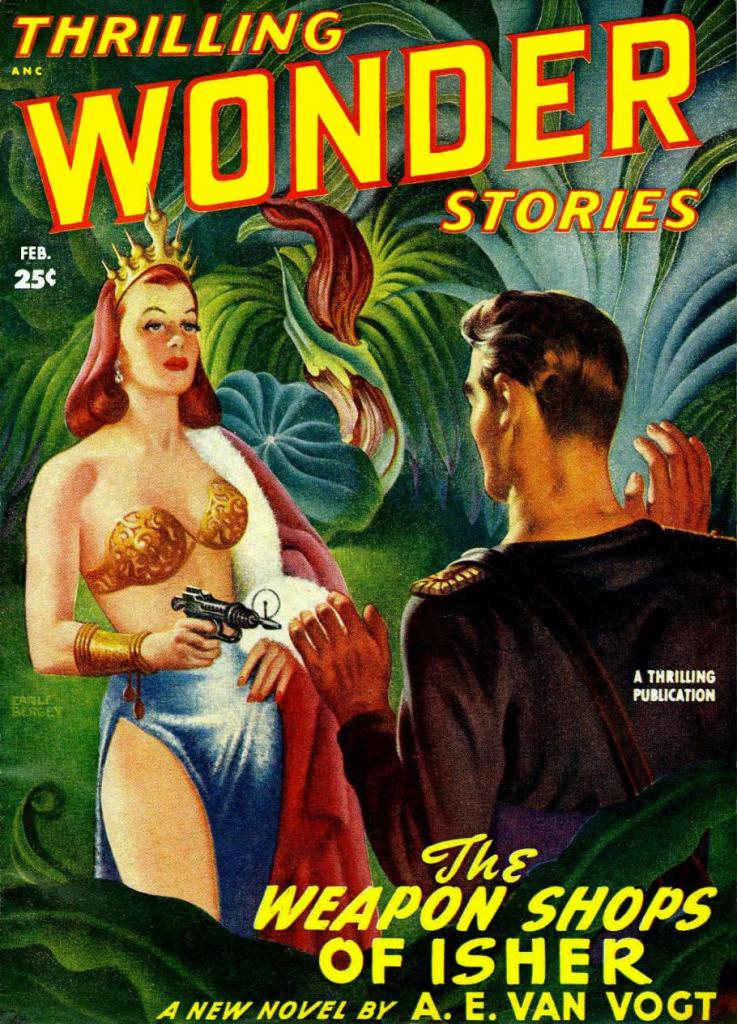
The World Beyond the Hill by Alexei and Cory Panshin and Astounding Alec Nevala-Lee were two huge histories of science fiction in the 1940s. Both books focused on the magazine Astounding Science-Fiction, where John W. Cambell was a genre-shaping editor. The Panshins concentrated on three writers: Heinlein, Asimov, and van Vogt, while Nevala-Lee dwelt on Heinlein, Asimov, and L. Ron Hubbard. The Panshins volumes were more about the stories, with some biographical details. Nevala-Lee spent more words on the biographies of the four men, with less prose about their stories. Combined, the two volumes make a great overview of Astounding Science-Fiction in the 1940s.

What if a similar group biography/history was written about science fiction in the 1950s? I already own a bookcase full of books about science fiction but they aren’t the kind I want. The book I ache to read is a biography/history on the impact of science fiction in the 1950s that’s as impressive as biographies/histories written by Walter Isaacson, Robert A. Caro, or Doris Kerns Goodwin. I want to read a biography/history that would make the subject interesting to the general reader. I just finished Tune In by Mark Lewisohn, a giant history of The Beatles that only covered their career until 1962. That’s the kind of high-quality biography/history of 1950s science fiction I want to read.

Alec Nevela-Lee’s biographies approach that league. He could write the book I want, but I don’t think he would because he probably knows the market for such a volume isn’t very big. And I wonder if science fiction fans would want a history of science fiction in the 1950s by him. His books Astounding and Inventor of the Future were hard on his subjects. I thought them honest appraisals, but he may have done in John W. Campbell’s reputation, and he didn’t help Heinlein’s or Asimov’s. I ended up feeling Buckminister Fuller was brilliant but not very successful, and a bit of a nut or crank after reading Inventor of the Future. However, any honest biography of the influential science fiction writers of the 1950s is going to unearth some worms.

The whole phenomenon of science fiction in the 1950s could be fascinating to the general reader if it was written in the right way. Look how pervasive science fiction has become. Science fiction as a subculture actually had a far more lasting cultural impact than The Beats in the 1950s and The Hippies in the 1960s, yet those movements are more studied and written about. Organized science fiction fandom has since inspired many other forms of organized fandoms. There are connections between science fiction and the space program and computers, both of which also started in the 1950s. And as a pop culture art, science fiction might be bigger than rock. Rock music is fading, while science fiction is still big business.

So, who were the movers, shakers, and creators of 1950s science fiction? I don’t think the major players are as obvious as they were in the 1940s.

As a science fiction fan back in the 1960s I was commonly told that Heinlein, Asimov, and Clarke were the Big Three Authors of science fiction. Looking at our CSFquery database, which uses various forms of citations to remember short stories and novels, I’m not sure it backs up that common knowledge. Look at the results. I’ve set the citation level at 3 or more citations. (Short stories are within double quotes, and novels are italicized. Clicking on the number of citations will show you the individual citations.)

The three writers with the most citations were Heinlein with eleven, and Bradbury and Asimov with eight each. However, some of those cited stories first appeared in the 1940s. After that, three authors have six titles on the list: Alfred Bester, C. M. Kornbluth, and Fritz Leiber.

Before looking at this data, I would have said Philip K. Dick, Alfred Bester, John Wyndham, and Walter M. Miller, Jr. were the breakout science fiction authors of the 1950s. Another indication of their popularity is how many photographs I can find of these men, especially ones taken in the 1950s. I’m guessing since photographs are hard to find, then details about their lives will be just as hard to find. That suggests any history of science fiction that focuses on anyone other than Heinlein, Bradbury, and Asimov will be covering events in the shadows of history.

If we alter the search to allow any work with two or more citations we see other authors standing out, but I’m not sure if it would change the overall apparent rankings. Thirteen women writers are on this list, but none have very many stories listed. I’m afraid the 1950s was still a male-dominated decade for science fiction.

And what about editors? Many histories of science fiction claim that John W. Campbell wasn’t as influential in the 1950s. But who was then? H. L. Gold at Galaxy is often mentioned. Anthony Boucher, and maybe J. Francis McComas at The Magazine of Fantasy and Science Fiction. There were dozens of science fiction magazines published during the 1950s, and I’m not sure if any other editor stood out. But then I haven’t researched it. However, I would say the 1950s were still a magazine-driven era for science fiction.

The Panshins and Nevala-Lee had Astounding Science-Fiction to anchor their history/biographies of the 1940s. The Magazine of Fantasy and Science Fiction, Galaxy, and Astounding Science Fiction dominated the 1950s, but there were many other magazines that published significant science fiction and influenced the genre. I don’t know if a history of science fiction of the 1950s could be as focused as The World Beyond the Hill and Astounding. The genre just exploded in too many different directions.

The small press or fan press science fiction publishers of the 1950s are legendary, especially to collectors, but I don’t know if any of their editors had that much influence. I would think the editors at Doubleday and the Science Fiction Book Club could be a consideration if I knew who they were. Another consideration is Donald A. Wollheim. His work at Ace Books was both influential and widespread.

If a single volume could be written about science fiction in the 1950s it might need to be divided into twelve chapters, one for each year, or into 120 chapters, based on the months. A linear progression through the decade might be the best way to capture the history of science fiction in the 1950s. And the book would have to be big, maybe a thousand pages.

There is one significant book about science fiction history in the 1950s that I know about, Transformations: The Story of the Science Fiction Magazines – From 1950 to 1970 by Mike Ashley. I have quite a few other books that cover that era in science fiction, but none are of the scope I’m talking about. I wish Ashley’s books were available in cheap Kindle editions so more people would read them.

And should we also add the impact of the movies and television? Should we consider George Pal and Rod Serling as movers and shakers of 1950s science fiction, for this book I want to read? An Astounding-like biography/history of science fiction in the 1960s would include Gene Roddenberry and one for the 1970s would have to include George Lucas and Steven Spielberg.

I wish I had the skill and stamina to write a history of science fiction in the 1950s. I’m in awe of the work done by the Panshins and Nevala-Lee. I would love to read a book about 1950s science fiction like I’ve described, so if you’re a writer looking for a topic, here’s one. I don’t know how many copies it would sell. Sadly, the audience for such a history is getting old and dying. I wrote this essay to gauge interest in such a book, but I’m not finding much so far. However, a good biographer can make any person or topic into a page-turner.

James Wallace Harris, 7/11/23

“The Hurkle is a Happy Beast” by Theodore Sturgeon

The Hurkle is a Happy Beast” by Theodore Sturgeon is story #29 of 52 from The World Treasury of Science Fiction edited by David G. Hartwell (1989), an anthology my short story club is group reading. Stories are discussed on Tuesdays, Thursdays, and Saturdays. “The Hurkle is a Happy Beast” appeared in the very first issue of The Magazine of Fantasy and Science Fiction (Fall 1949) when it had the title The Magazine of Fantasy.

“The Hurkle is a Happy Beast” is a cute story about a creature from another dimension thrown onto Earth. The Hurkle is blue, has six legs, and is kitten-like. It follows a theme of things discovered by humans in the present that come from other times and dimensions, however, it’s not up to the classics of this theme like “Mimsy Were the Borogoves,” “The Twonky,” or “The Little Black Bag.”

Even though “The Hurkle is a Happy Beast” is a slight effort by Sturgeon, it has been often reprinted. However, our discussion group wondered why Hartwell selected a second story by Sturgeon for The World Treasury of Science Fiction. It definitely wasn’t one of Sturgeon’s better efforts.

This listing from CSFQuery shows Sturgeon’s most recognized short stories. If Sturgeon deserved two stories in this monumental anthology, I would have picked “Thunder and Roses” or “A Saucer of Loneliness” because their lengths were close to “The Hurkle is a Happy Beast.” But why give Sturgeon two stories. Wasn’t there a better option from 1949?

Well, not exactly. However, my guess is Hartwell wanted to lighten things up by using Hurkle. To me, the obvious substitute for a cute science fiction story with an animal would be “Bears Discover Fire” by Terry Bisson, unfortunately, it came out the year after Hartwell’s anthology. Another possibility is “The Ugly Chickens” by Howard Waldrop, it came out in 1980, so it was available. Or maybe “The Star Mouse” by Fredric Brown?

“The Hurkle is a Happy Beast” is not a bad story. It’s cute enough, but it’s lightweight. This got me thinking about being a science fiction writer in 1949 and having to crank out short stories to make a living. Imagine sitting at a typewriter and knowing your survival depends on your writing a story that will impress editors and readers. I doubt Theodore Sturgeon was thinking he needed to hit one out of the park for future editors of retrospective anthologies. He just needed to sell a story to earn a penny or two a word. There were damn few science fiction writers who lived solely off selling fiction. Sturgeon may have been one since he was so prolific.

In 1949 Sturgeon sold ten short stories according to ISFDB:

  • “Farewell to Eden” – Invasion From Mars edited by Orson Welles (anthology)
  • “Messenger” – Thrilling Wonder Stories (February 1949)
  • “The Martian and the Moron” – Weird Tales (March 1949)
  • “Prodigy” – Astounding Science Fiction (April 1949)
  • “Die, Maestro, Die!” – Dime Detective (May 1949)
  • “Scars” – Zane Grey’s Western Magazine (May 1949)
  • “Minority Report” – Astounding Science Fiction (June 1949)
  • “One Foot and the Grave” – Weird Tales (September 1949)
  • “The Hurkle is a Happy Beast” – The Magazine of Fantasy (Fall 1949)
  • “What Dead Men Tell” – Astounding Science Fiction (November 1949)

Is it really fair to judge “The Hurkle is a Happy Beast” at all? We think because a story is in Hartwell’s anthology it must be one of the best SF short stories from around the world from the 20th century. But should we think that?

After our reading group has plowed through many of these gigantic SF anthologies I’m starting to wonder about their value and their goals. The Big Book of Science Fiction turns out to be a very accurate title, and by that consideration, an honest one. My problem, and for my fellow group members, I believe, is the phrase “World Treasury” gives us great expectations.

“The Hurkle is a Happy Beast” is a pleasant enough story. I would have been fine reading it in any magazine in 1949. Even though Bleiler & Dikty and later Asimov & Greenberg picked it for their annual best-of-the-year anthologies, which I’ve both read, I don’t think Sturgeon’s story was even at that level. If I had read it in a theme anthology about cute alien creatures it might have been acceptable. It was in two of those, The Science Fiction Bestiary edited by Robert Silverberg, and Zoo 2000 edited by Jane Yolen.

If you follow the links to those two anthologies you’ll find lists of not-so-famous stories. Evidently, this theme isn’t a gold mine for classic SF stories. My favorite alien pet is Willis from Heinlein’s Red Planet. Heinlein and Norton often added cute aliens to their young adult books.

Just for grins, here are some of the covers for Sturgeon’s 1949 publications.

James Wallace Harris, 7/11/23

Futures Past: 1928

Futures Past – Link to website for ordering softbound, hardbound, and digital copies. Jim Emerson writes and publishes Futures Past. Read Emerson’s About page to find out more about him and his future plans. Jim hopes to eventually publish volumes for the years 1926-1975. Even if Jim cranks out two volumes a year, I don’t know if I can live that long, but I hope I can live long enough to read those for the 1940s and 1950s. A .pdf file of the 1926 volume is available as a free download.

Jim has just published the third volume in his history of science fiction, Futures Past: A Visual History of Science Fiction. This 194 book is a visual delight, full of color photographs of book and magazine covers, as well as old black and white photographs of the people who created them. There’s an extensive history of space opera, including long profiles of the pioneers of the subgenre, E. E. “Doc” Smith, Jack Williamson, and Edmond Hamilton. I’ve been reading about the history of science fiction all my life, but I still found plenty of new information to discover in Futures Past. See my review of the earlier 1926 and 1927 volumes. Here’s the full table of contents to 1928.

1928 will be ancient history to most young science fiction fans, so they will find that year to be full of obscure details. However, the main articles in this volume, cover more than just the year 1928. The piece on space opera mentions books from 1802 to 1998, and the profiles of Smith, Hamilton, and Williamson cover their entire careers. That means pages 15-151 cover a good portion of the history of science fiction, especially the 20th century.

Content that’s exclusively on the year 1928 is on pages 8-14, 152-188. My favorite section in Futures Past is the section devoted to the books of the year. Most of the novels Emerson describes are long out of print and forgotten, yet some of them sound intriguing and make me want to track them down. Futures Past was first a fanzine in the early 1990s, and one mention in the 1926 volume, told about Phoenix by Lady Dorothy Mills. That one paragraph got me on a decades-long search for the novel. In fact, that mention made me become a collector of books by Lady Mills and inspired by to create a website devoted to her.

I’m intrigued by Tom Swift and His Talking Pictures, where Tom invents a large screen color TV and the movie moguls try to put him out of business because they fear TV will ruin their industry. Elsewhere in Futures Past 1928, Emerson mentions that May 10, 1928, was the first broadcast of a regularly scheduled TV program from W2XB, a General Electrics station in Schenectady, New York. I had no idea that television began so early. That makes me want to read more about it. I wish Emerson could have published their TV schedule. I did find out that W2XB broadcast the first drama, The Queen’s Messenger on September 11, 1928. This is leading me down a rabbit hole of researching early TV.

I expect readers of Futures Past will do the same thing, find an intriguing bit of history, and go follow it. I always thought The Skylark of Space was the first science fiction novel that features interstellar travel. That’s not true. Emerson says Les Posthumes by Nicolas Restif de la Bretonne, a French novelist, is considered the first space opera and was published in 1802. But I’m intrigued by his mention of The Struggle for Empire: A Story of the Year 2236 by Robert William Cole published in the year 1900.

I’m curious how many people will buy Futures Past. It means they are interested in the history of science fiction. And more than likely, readers of old science fiction. I expect Baby Boomers who discovered science fiction in the 1950s and 1960s will be the most ardent fans of this publication, mainly for nostalgic reasons.

One fact that Emerson notes is Amazing Stories started publishing the full names and addresses of readers who wrote letters to the letter column. This allowed early science fiction fans to contact one another and led to the creation of fandom and fanzines. I expect his yearly volumes to start chronicling the rise of fandom in the 1930s.

As each year progresses, I believe there will be more and more content specific to that year. I’m looking forward to that. It will be a tremendous amount of work to gather such information. Maybe Emerson could use some help or ideas.

What I would like to see is a month-by-month chronicle of the best content published in magazines and fanzines. Most of the magazines and many of the fanzines from the 1930s are online. Knowing what’s worthy of reading is the key to using those libraries. Emerson has a start of that for Amazing Stories and Weird Tales. However, I’d want more details. Sort of like A Requiem for Astounding by Alva Rogers, which mentions the best stories and illustrations from each issue.

I’m less concerned with the table of contents from each issue shown on the right than what Emerson comments on the left. ISFDB lists the contents of magazines, but I never know what’s worth reading. What would be worth knowing is the outstanding stories from each prozine and the commentary about them from the fanzines.

What I use Futures Past for is finding old forgotten science fiction that I think might be worth tracking down and reading. The trouble is the amount of content coming out each year grows larger and larger, making Emerson’s job harder and harder. By 1953-1954, a 200-page book could be published on what went on each month in science fiction. That was when a science fiction boom happened when almost 40 SF magazines were coming out.

James Wallace Harris, 7/7/23