“Vintage Season” by C. L. Moore and Henry Kuttner

I’ve always wanted to visit the future — but what if the future visited me? “Vintage Season” by Lawrence O’Donnell (C. L. Moore and Henry Kuttner) is about people from the future visiting the present. We don’t know when and where this story takes place, but we identify with it as now. The sense of wonder “Vintage Season” generates comes from imagining visitors from the future and why they would hang with us.

Science fiction’s foundation is built on four pillars: space travel, time travel, aliens, and robots. Two stories get closest to the heart of time travel. The first is, “The Time Machine,” by H. G. Wells. The second is “Vintage Season.” I’m not sure any other time travel story even comes close.

There is a mystery about “Vintage Season” — who wrote it — Moore or Kuttner or both. Does it really matter? Can’t we consider the couple one creative god and let it go at that? I have read accounts of how Catherine and Henry would leave a story in a typewriter and either one of them would stop and work on it. I’m not sure if I believe that myth, or at least how it stands.

In writing classes, they talk about two kinds of writers: pantsers and plotters. Pantsers write by the seat of their pants just letting stories unfold and go where they want. Plotters are writers who outline before they start writing. “Vintage Season” was written by a plotter. It’s a three-dimensional puzzle that depends on every piece fitting together perfectly, and it does. Leaving a story in a typewriter for whomever to finish is a pantser technique. Generally, when I read Kuttner stories they feel like a pantser story. When I read a Moore story, they feel like a plotter story. It reminds me of Moore’s “No Woman Born” and maybe “Greater Than Gods”

Vintage Season” is story #51 of 52 from The World Treasury of Science Fiction edited by David G. Hartwell (1989), an anthology my short story club is group reading. Stories are discussed on Tuesdays, Thursdays, and Saturdays. “Vintage Season” was first published in Astounding Science-Fiction (September 1946).

“Vintage Season” is an outstanding story. To me, it’s the absolute best science fiction story from the Golden Age of Astounding Science-Fiction in the 1940s. I’ve read it many times over many decades. I also consider “Vintage Season” one of the best science fiction stories ever written.

I love listening to the narration of it from the audiobook edition of The Science Fiction Hall of Fame, v. 2a. In fact, I feel sorry for anyone who hasn’t listened to that audio edition of “Vintage Season” — it was pitch perfect. As I listened to it, I marveled at how “Vintage Season” was so damn well-written.

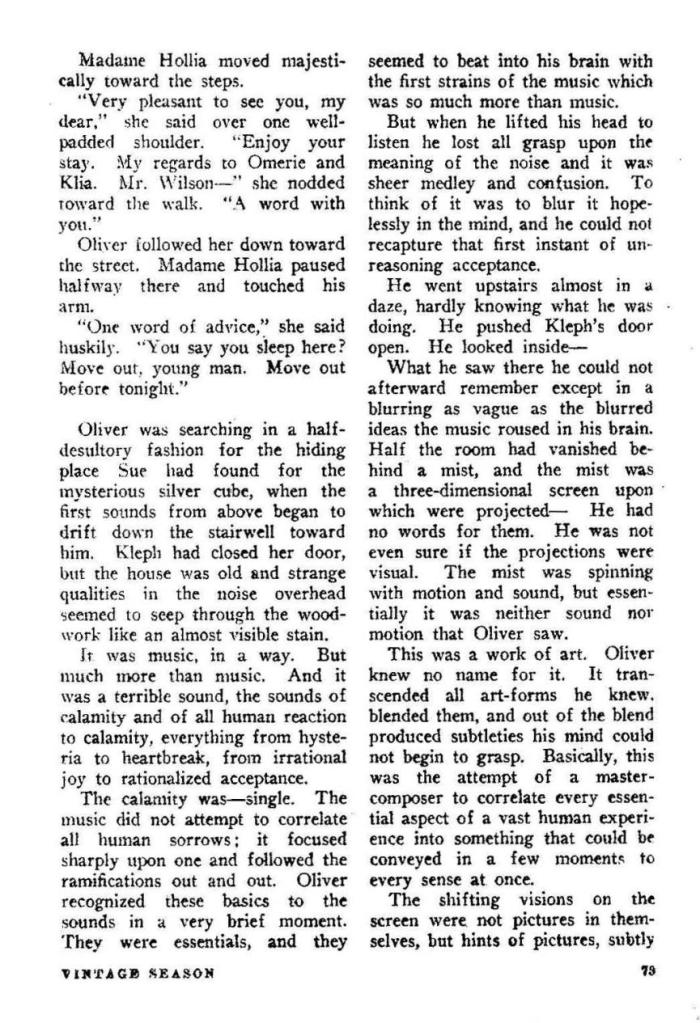
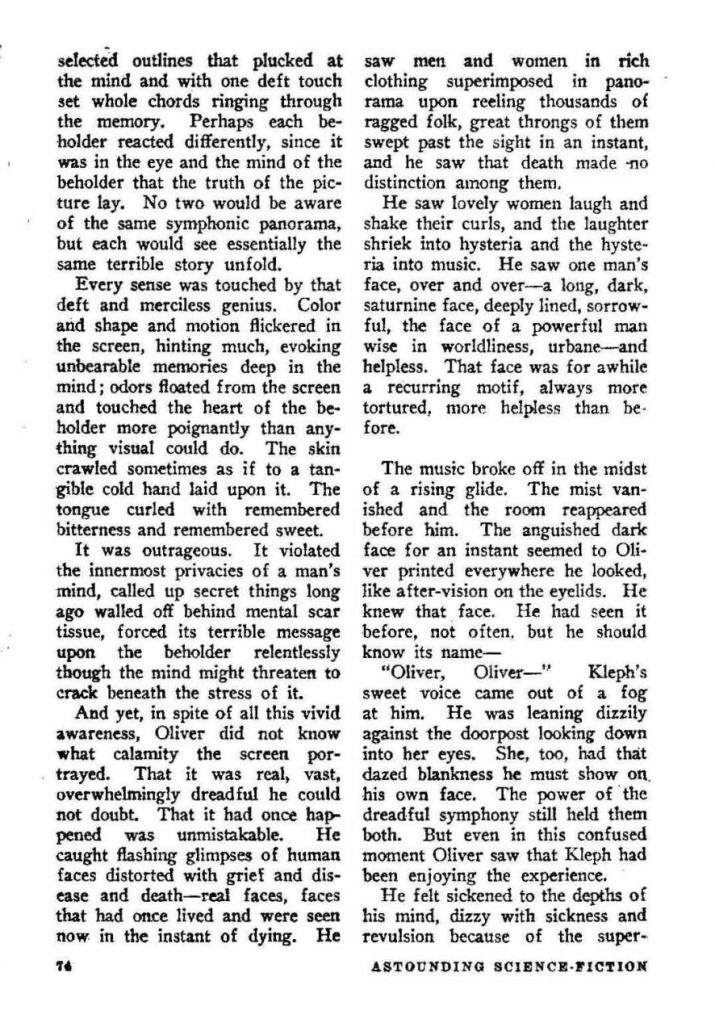
One of the hardest things to write in science fiction is what readers can’t know — what the future is like, how an alien thinks, or how an artificial mind will relate to us. Science fiction writers must make those things up. This is why I believe Moore and Kuttner were so successful in “Vintage Season.” Start reading with “Oliver was searching” and read until “The music broke off.” Oliver goes into Kleph’s room where she’s playing a work of art composed by a fellow time traveler. We need to remember this was written in 1946 and most people did not know about most science fiction concepts. Moore, and I believe she wrote most of “Vintage Season,” especially the parts about people’s emotions. Think of this passage as someone trying to describe an LSD trip, and how hard it would be to put it into words. Moore does a fantastic job.

Few science fiction writers attempt anything like this. Everything in the story led to Oliver being able to experience that moment. It’s also key to the ending. Everything in the story is built to support every other part. We need Oliver’s experience with the euphoria tea. We need the tension over Sue wanting Oliver to sell the house. We need all the clues Oliver is picking up. We need Oliver to be attracted to Kleph. Every bit of this story leads up to the ending.

And if Kuttner wrote the last story I reviewed, “The Proud Robot” by himself, it shows nothing of that kind of writing. Kuttner wrote a series of scenes, each one a little battle of wits. He keeps giving us scenes with conflicts and solving them. Eventually, he wraps things up. He tells us Gallegher invented Joe the robot as a can opener. It fits with the other scenes, but the other scenes don’t require that ending. And almost any scene could be removed, and the story would still work. That’s how pantser plotting works.

I wish I had the time and psychic energy to mind map “Vintage Season” and show how tightly connected every element of the story is with the other elements. But such an effort could take days. Just read the story.

I wish I had the time and psychic energy to be more of a literary scholar. I could spend weeks analyzing “Vintage Season.” Instead, I write these essays over a couple of hours hoping to say just enough to get people to read the story. I write these essays to focus my mind and organize my thoughts about a story. If I didn’t exercise my mind this way, I think it would deteriorate.

When I listened to “Vintage Season” this time the reading experience was something significant. I wish I could put that into words. Reading science fiction has been an essential part of my life, but not all science fiction reading is essential. Most of it is a waste of time. “Vintage Season” is not. Understanding why would tell me something. Maybe I’ll write about that someday.

James Wallace Harris, 8/31/23

Group Read 63: The Best SF Short Stories of 1955

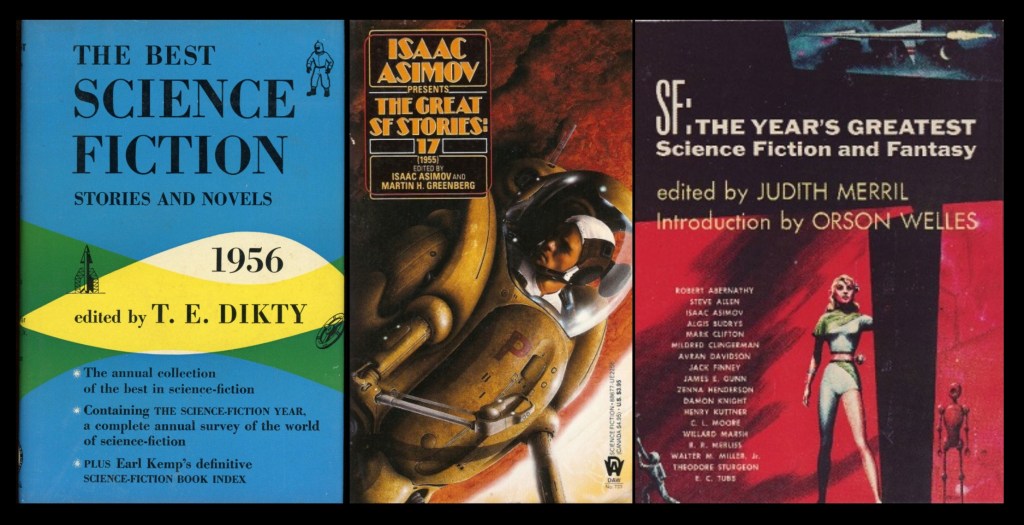
Over at the Facebook group Best Science Fiction and Fantasy Short Fiction I’m about to lead Group Read 63 starting September 7th. It will be devoted to the best short SF stories from 1955. We have four moderators, of which I’m one. We take turns leading our Facebook group in reading an anthology, or other collections of SF short stories. I’ve decided my group reads will become an ongoing project of reading the best short SF of the year starting in 1955 (which was when the Hugo Awards began). We won’t use a specific anthology but use the Classics of Science Fiction database. Most of the stories will come from the anthologies pictured above, but we hope they are widely found in many anthologies and online. Participation often depends on the availability of stories.

To keep Group Read 63 reading list short, to around 15-20 stories for each year, the minimum number of citations in the database was set to 2. You can use the List Builder to see the stories for each year. Set the Start Year and End Year to the same year (in this case “1955”), the Minimum Citations to “2,” and Citation Type to “Story.” If you set the citation to one, you’ll see all the stories in the database from 1955. If you click on “Show Citation” you will see the citation sources.

Here’s our reading list for 1955 ordered by number of citations. That gives us twenty-two stories, of which we’ve previously read and discussed seven. For Group Read 63, we’ll read the fifteen we haven’t discussed before. Here they are with their start discussion dates:

  • 09/07/23 – “Allamagoosa” by Eric Frank Russell
  • 09/09/23 – “Nobody Bothers Gus” by Algis Budrys
  • 09/12/23 – “The Tunnel Under the World” by Frederik Pohl
  • 09/14/23 – “A Canticle for Leibowitz” by Walter M. Miller, Jr.
  • 09/16/23 – “One Ordinary Day, with Peanuts” by Shirley Jackson
  • 09/19/23 – “The Cave of Night” by James E. Gunn
  • 09/21/23 – “The Darfsteller” by Walter M. Miller, Jr.
  • 09/23/23 – “The Dead Fish” by Boris Vian
  • 02/26/23 – “Delenda Est” by Poul Anderson
  • 09/28/23 – “Dreaming Is a Private Thing” by Isaac Asimov
  • 09/30/23 – “Home There’s No Returning” by Henry Kuttner, C. L. Moore
  • 10/03/23 – “Judgment Day” by L. Sprague de Camp
  • 10/05/23 – “The Short Life” by Francis Donovan
  • 10/07/23 – “The Short-Short Story of Mankind” by John Steinbeck
  • 10/10/23 – “Who?” by Theodore Sturgeon

The seven previously discussed stories will be reviewed on 10/12/23. They are (with previous discussion link):

My turn to lead a group read comes up about four times a year, which means the years 1956-1959 will be covered next year in 2024. That’s assuming the group likes this idea.

I plan during the weeks we’re discussing the stories from 1955 to have an ongoing thread where people can write about any story they’ve read and admired from 1955. And I will have another thread discussing what was happening with science fiction in general in 1955, with a focus on SF magazines.

What I’m hoping to achieve is an ongoing study of the evolution of science fiction starting with the year 1955. The Facebook group is open to anyone, but if you join, please answer the two questions. We use those two questions to weed out spammers and let people know our group is focused on science fiction short stories. (For people who hate Facebook, we try hard to police the group and keep out spammers, trolls, self-promoters, and off-topic comments that ruin the atmosphere of the group.)

Here are the posts we’ve made planning the project. As we discuss stories they will be automatically added to that link.

To get you interested in 1955, here’s Rich Horton’s review of the 1956 Hugo Award. He goes over the winners, finalists, and stories he thought should have been considered.

I also hope to review the stories individually here for this blog.

James Wallace Harris, 8/24/23

“Weihnachtabend” by Keith Roberts

If not read carefully, “Weihnachtabend” by Keith Roberts will come across as just another alternate history about Hitler winning WWII. “Weihnachtabend” is more subtle, it’s an alternate history where England and German never fought, but made an alliance, and eventually ruled over Europe together. They called their alliance the Two Empires, graphically symbolizing it with the Lion, and the Eagle.

I have read many books and watched many movies and television shows set in England in the mid-20th century. And one historical event that has come up often is when Neville Chamberlain signed the Munich Agreement in 1938. Roberts imagines what if peace between Germany and England had played out, and, if the English fascists had come to power. In the alternate history timeline of this story the Munich Agreement is The Cologne settlement.

Roberts writes beautifully, painting with impressionistic details rather than flatly telling us what happened.

“Weihnachtabend” by Keith Roberts is story #44 of 52 from The World Treasury of Science Fiction edited by David G. Hartwell (1989), an anthology my short story club is group reading. Stories are discussed on Tuesdays, Thursdays, and Saturdays. “Weihnachtabend” was first published in New Worlds Quarterly 4 (1972) edited by Michael Moorcock. You can read it here. “Weihnachtabend” is also in The Grain Kings, which collects seven of Keith Roberts stories. It’s currently available for $1.99 at Amazon for the Kindle edition.

I highly recommend reading “Weihnachtabend” before reading my essay for two reasons. First, this story is a masterpiece of alternate history and is well-worth reading. Second, it’s a test of reading ability. The story is not hard to read, but instead of just telling what’s happening, Keith Roberts gives us pieces to put a mental jigsaw puzzle together. The story is dense with clues and implications about history and people.

“Weihnachtabend” tested my reading ability, and I didn’t do very well on my first reading. The title means Christmas Eve — I had to look that up. I read the story slowly, trying my best to understand it, but it wasn’t until afterwards that all the subtle aspects were revealed when I read Paul Kincaid’s review. I was further enlightened by Joachim Boaz’s review.

Clarity came with my second reading, and even then, I’m not sure I saw everything Roberts intended. I’m learning in old age that fiction needs two readings before you begin to understand it. It’s a shame that knowledge has come so late in life. No matter how hard I try to become a better reader, and I’ve been trying my whole life, the only thing I keep learning is how bad my reading ability still is and how much more I need to learn.

Keith Roberts’ fiction is a great test for understanding what you read. I’ve read his fix-up novel Pavane and a couple other stories. His prose is dense with layers and depth. Roberts also has a great imagination and creates beautifully visual scenes. If only someone would film his stories.

“Weihnachtabend” opens as Richard Mainwaring and Diane Hunter approach Wilton Great House while riding in a chauffeured Mercedes. Right from the beginning Roberts presents the constant presence of paranoia. Richard notices that the communication channel between the back of the car and the chauffeur is always open, and the chauffeur is listening. Before they get to the country house — I picture it as a manor house of the aristocracy, they come to a wall with watchtowers and pillboxes, and guards with machine guns. The guards speak German.

Richard gives his identity card which says: “Die rechte Hand des Gesandten.” We learn that Richard is the right-hand man of the messenger, and we’re eventually told his title is “Personal Assistant to the British Minister of Liaison.” The identity card also tells the guard Miss Hunter is from his department. (I’ve completely forgotten my high school German, so I had to depend on Google to translate. Knowledge of most of the German phrases in the story aren’t needed to understand the story, but not all.)

Diane is extremely nervous, but then so is Richard. Why is he nervous if he’s a top dog in the ruling political party? Diane is a beautiful blonde who Richard had known long ago. She belongs to someone he knew, a man named James, but for this trip, she is with him.

As the story progresses, we learn we’re in England, but it’s years after the period we know as WWII. England and Germany rule Europe. They fear America. But for some reason, the alliance is dominated by Germany, and the English leadership speak German. There is unrest in England and elsewhere, but the leadership maintains order much like the authoritarian rule in Nineteen Eighty-Four. At the top is King Edward VIII and a Fuehrer named Ziegler (I think. It’s confusing about what happened to Hitler, or who is the Fuehrer. Hess is deputy Fuehrer.) We know it’s decades later because they have large screen televisions, and rollneck shirts. I assume this means a turtleneck which was trendy in the 1960s, and around the time Roberts wrote the story.

Roberts doesn’t have a specific message in this story. He just paints a tableau. Richard, in the end, has something to say to the reader, but what he says, we’ve known all along from our history.

What makes the story compelling to read is figuring out what is happening to Richard. At first, it’s just a Christmas Eve party for extraordinarily rich people. Richard is given a Lamborghini by his boss. There is a description of a brutal hunt, and a bizarre Christmas tradition for children. Richard and Diane have sex, and we feel they are old lovers who are finally going to get together. Then Diane disappears and Richard becomes unhinged, eventually confronting his boss with a Lüger.

As I’ve said, the story has many layers. Like in Philip K. Dick’s novel, The Man in the High Castle, there’s a meaningful-to-the-story book like The Grasshopper Lies Heavy. However, instead of being from another timeline, Toward Humanity is from Richard’s own timeline. The writer’s name is Geissler, and his book is banned. Richard finds this dangerous volume planted in his room. It’s published by the Freedom Front. Richard doesn’t know if his party is testing him or if the opposition is trying to recruit him.

And Richard wonders why he’s so lucky to suddenly acquire a beautiful blonde. Is she who she says she is, or is she a plant from his party to test him, or an agent of the Freedom Front? Blondes are a reward to good party men, easily bought and traded. When Richard’s blonde goes missing everyone wants to pretend, she never existed.

Along the way, we are given clues about this world with quotes from Toward Humanity. Here are three quotes:

The Cologne settlement, though seeming to offer hope of security to Jews already domiciled in Britain, in fact paved the way for campaigns of intimidation and extortion similar to those already undertaken in history, notably by King John. The comparison is not unapt; for the English bourgeoisie, anxious to construct a rationale, discovered many unassailable precedents. A true Sign of the Times, almost certainly, was the resurgence of interest in the novels of Sir Walter Scott. By 1942 the lesson had been learned on both sides; and the Star of David was a common sight on the streets of most British cities.

---

In 1940, her Expeditionary Force shattered, her allies quiescent or defeated, the island truly stood alone. Her proletariat, bedeviled by bad leadership, weakened by a gigantic depression, was effectively without a voice. Her aristocracy, like their Junker counterparts, embraced coldly what could no longer be ignored; while after the Whitehall Putsch the Cabinet was reduced to the status of an Executive Council …

 
---

Against immeasurable force, we must pit cunning; against immeasurable evil, faith and a high resolve. In the war we wage, the stakes are high; the dignity of man, the freedom of the spirit, the survival of humanity. Already in that war, many of us have died; many more, undoubtedly, will lay down their lives. But always, beyond them, there will be others; and still more. We shall go on, as we must go on, till this thing is wiped from the earth. Meanwhile, we must take fresh heart. Every blow, now, is a blow for freedom. In France, Belgium, Finland, Poland, Russia, the forces of the Two Empires confront each other uneasily. Greed, jealousy, mutual distrust; these are the enemies, and they work from within. This, the Empires know full well. And, knowing, for the first time in their existence, fear …

We doubt Richard is persuaded by this political rhetoric. The ending of the story is quite dramatic. The final scene also reminds me of the final message of Nineteen Eighty-Four. I must wonder if Keith Roberts was commenting on the current political climate in England of 1972 when and where he wrote “Weihnachtabend.”

I know in 2023 there is much distrust of government everywhere. Was Robert’s paranoia any different than an average citizen? Who really controls us?

James Wallace Harris, 8/16/23

Adult Science Fiction

John Brunner was the James Burke (Connections) of science fiction about the near future. Brunner was a polymath who used his diverse sources of knowledge to write four novels (Stand on Zanzibar (1968), The Jagged Orbit (1969), The Sheep Look Up (1972), and The Shockwave Rider (1975)) that extrapolated on everything he knew to envision the early 21st century. No one can predict the future, and Brunner gets all the details wrong in these novels, yet they eerily foretell the problems we face today. They are sometimes called Brunner’s Club of Rome Quartet, inspired by the famous Club of Rome from the 1960s, a think tank devoted to global problems of that day. Its most famous report, The Limits of Growth has been vilified over the decades, but time has proven it wasn’t wrong.

Brunner obviously wanted us to confront those problems before they happened. Of course, we haven’t. Even though some of Brunner’s novels won critical praise when they came out and Stand on Zanzibar won a Hugo, they were never popular. Brunner aimed as high as George Orwell, but his books never reached Nineteen Eighty-Four‘s impact. The Jagged Orbit was nominated for the Nebula and won the BSFA award, The Sheep Look Up was nominated for the Nebula, and The Shockwave Rider came in 2nd for the Locus Award for SF Novel. These four novels were mostly respected by critics, but they never became popular with science fiction readers. And as many brilliant science fiction writers know, science fiction gets no respect outside the genre.

I’ve always considered those Brunner novels to be adult science fiction and most science fiction fans don’t want adult literature. Most science fiction fans read science fiction for fun, for escape, and aren’t looking for serious speculation about present-day life or the near future.

When I use the term adult science fiction, I don’t mean Sci-Fi with X-rated content. Young adult fiction has become very popular and successful, even with adult readers. Young adult fiction usually means protagonists are in their teens. But I think the label should apply to any theme or subject that mostly appeals to young adults. Most science fiction is aimed at adolescent readers, or older readers who prefer not to grow up. And in our society, adolescence has extended into the twenties, and even later for many people. There are some awfully big kids still playing with their Star Wars toys.

To me, adult literature deals with the problems of being an adult in our current reality. That apparently doesn’t leave much territory for adult science fiction since it’s usually not set in our current reality. But let me give you an example of how a novel set in the future can be adult science fiction.

The Shockwave Rider came out in 1975, and its setting is the United States in the early 21st century. In other words, our current reality. Now I don’t mean adult science fiction is only stories set in our current day, the setting can be anytime or place in the universe so long as the reader finds something useful in the story that gives insight into being an adult. The Shockwave Rider was adult science fiction in 1975 and will probably continue to be for years to come. Unfortunately, after decades of knowing about the problems presented in the novel, we ignore them. We don’t want to grow up.

Brunner’s novel is extrapolation. He was inspired by the 1970 nonfiction book, Future Shock by Alvin Toffler. Brunner asked: how can humans survive in a world that is growing ever more complex and stressful, living with ever more information, coexisting with computers and automation, dealing with environmental decline, epic natural catastrophes, growing insanity, political corruption, constant surveillance, and ever-changing job requirements. Exactly, what we’re experiencing now. Brunner asks how society and citizens cope?

The plot of The Shockwave Rider deals with Nick Haflinger, who is a computer hacker on the run. He was a prodigy raised by the government to be an elite leader in the future, but he rejects that upbringing, and escapes. The plot is complicated by flashbacks. Part of the narrative deals with Nick being psychoanalyzed after being recaptured. While he is on the run he meets Kate Grierson, a brilliant young woman who gets Nick faster than he gets himself. While they are on the run they live in two different utopian communes that offer alternative lifestyles to what the cyber-controlled government wants.

Throughout the course of the novel, Brunner throws out concepts and gadgets he thinks will be developed by the early 21st century. He was right in imagining we’d have a gadget-oriented future, but for the most part, he pictured us with different kinds of gadgets. However, Brunner almost imagines the smartphone. He pictures a palm size with a flip-up screen. Nick does much of his hacking on such a device. People do have desktop-type computers too in The Shockwave Rider, but Brunner pictures them as smart network terminals. That’s because in the 1960s and early 1970s time sharing computers were all the rage. He doesn’t foresee the laptop.

Even though The Shockwave Rider was hard to read, confusing at times plotwise, and with less than fully developed characters, it is chock full of brilliant speculation. Reading it made me realize just how hard Brunner thought about the future, and how hard we should have been thinking about it too. The tragedy of our times is we knew all this bad stuff was coming and we didn’t do shit about it.

Cli-Fi is becoming more common now, but it’s not always handled in a serious way. Often it’s just a setting for young adult adventure. The best current example, which I would consider an adult science fiction novel is The Ministry for the Future by Kim Stanley Robinson.

The Shockwave Rider is not the kind of science fiction most science fiction fans want to read. They want adventure, rebellion, thrill rides, etc. Young people love blows against the empire stories. If you’re reading a story about zooming around the galaxy, then you’re reading young adult fiction. If you’re reading about surviving in dystopia, that’s not ours, then you’re reading young adult fiction. If you’re reading about being an old person whose mind is downloaded into a clone body, then you’re reading young adult fiction. Most far-out science fictional ideas are ones that appeal to the young adult in us. And I’m not being critical. I still love that stuff too, and I’m 71.

The Shockwave Rider is hard to read. Not just because it explores surviving in this reality, but because its storytelling structure is convoluted and hard to understand. Today, this novel is mostly unknown, but what little fame it does have, is because it’s credited as a work of proto-cyberpunk fiction. And Brunner gets credit for the term “computer worm.” But it’s much more than that.

Brunner was one of those writers who was way smarter than his readers. He was smarter than most people. Unfortunately, being smart doesn’t bring happiness. From 1968-1975, Brunner wrote a series of novels in which he seriously worried about life in the 21st century. There’s a monograph on Brunner in the Modern Masters of Science Fiction series called John Brunner by Jad Smith that I found rewarding. In some ways, Brunner comes across as a tragic figure in this study.

Brunner’s books are full of ideas, and reading about them made me want to read them. Unfortunately, they often fail to entertain. And I think that’s why most adult science fiction fails. It’s hard to pull off a serious book about serious problems and still be entertaining. It can be done. Nineteen Eighty-Four is an excellent example. So is Earth Abides by George R. Stewart.

True adult literature tends to come across as biographical because becoming an adult involves becoming mature. In adult novels, we learn so much about the main character and their growth that we feel we know them. Brunner never could bring this off. His characters are adults, and they struggle with adult problems, but we never feel them growing or even being real. They are puppets Brunner uses to act out situations he wants to intellectually explore.

Science fiction writers have the problem that they are seldom taken seriously by the literary world. They often complain that this lack of recognition keeps them from becoming financially successful. This was true of Brunner too. Despite winning awards and gaining a certain amount of respect and fame within the genre, his writing never provided the kind of money and respect he thought he deserved. I’ve wondered if it’s time to reevaluate Brunner’s work.

I found it very difficult to get into The Shockwave Writer. I had to try several times. I had to push myself to keep reading, but as I went along it became more rewarding. The Shockwave Writer is not a page-turner. But neither are Edith Wharton and Henry James. I don’t think his work will ever appeal to science fiction fans who crave young adult science fiction. And I don’t think there are many fans of adult science fiction. Kim Stanley Robinson writes adult science fiction and gets a certain amount of recognition. But his books just aren’t fun to read like the science fiction books that are popularly discussed on YouTube.

Ultimately, I’m not sure science fiction is the venue for adult literature. Brunner should have written speculative nonfiction. Science fiction works best at delighting our youthful sense of wonder. Aging makes us cynical and realistic.

For now, my favorite example of adult science fiction is Earth Abides. Its main character, Isherwood Williams, grows throughout the novel, and the ending is especially adult. But I’m open for you to leave comments about SF novels you think are adult in the comments.

James Wallace Harris, 7/18/23

Which Writers Would Be Included In A Group Biography/History of 1950s Science Fiction?

The World Beyond the Hill by Alexei and Cory Panshin and Astounding Alec Nevala-Lee were two huge histories of science fiction in the 1940s. Both books focused on the magazine Astounding Science-Fiction, where John W. Cambell was a genre-shaping editor. The Panshins concentrated on three writers: Heinlein, Asimov, and van Vogt, while Nevala-Lee dwelt on Heinlein, Asimov, and L. Ron Hubbard. The Panshins volumes were more about the stories, with some biographical details. Nevala-Lee spent more words on the biographies of the four men, with less prose about their stories. Combined, the two volumes make a great overview of Astounding Science-Fiction in the 1940s.

What if a similar group biography/history was written about science fiction in the 1950s? I already own a bookcase full of books about science fiction but they aren’t the kind I want. The book I ache to read is a biography/history on the impact of science fiction in the 1950s that’s as impressive as biographies/histories written by Walter Isaacson, Robert A. Caro, or Doris Kerns Goodwin. I want to read a biography/history that would make the subject interesting to the general reader. I just finished Tune In by Mark Lewisohn, a giant history of The Beatles that only covered their career until 1962. That’s the kind of high-quality biography/history of 1950s science fiction I want to read.

Alec Nevela-Lee’s biographies approach that league. He could write the book I want, but I don’t think he would because he probably knows the market for such a volume isn’t very big. And I wonder if science fiction fans would want a history of science fiction in the 1950s by him. His books Astounding and Inventor of the Future were hard on his subjects. I thought them honest appraisals, but he may have done in John W. Campbell’s reputation, and he didn’t help Heinlein’s or Asimov’s. I ended up feeling Buckminister Fuller was brilliant but not very successful, and a bit of a nut or crank after reading Inventor of the Future. However, any honest biography of the influential science fiction writers of the 1950s is going to unearth some worms.

The whole phenomenon of science fiction in the 1950s could be fascinating to the general reader if it was written in the right way. Look how pervasive science fiction has become. Science fiction as a subculture actually had a far more lasting cultural impact than The Beats in the 1950s and The Hippies in the 1960s, yet those movements are more studied and written about. Organized science fiction fandom has since inspired many other forms of organized fandoms. There are connections between science fiction and the space program and computers, both of which also started in the 1950s. And as a pop culture art, science fiction might be bigger than rock. Rock music is fading, while science fiction is still big business.

So, who were the movers, shakers, and creators of 1950s science fiction? I don’t think the major players are as obvious as they were in the 1940s.

As a science fiction fan back in the 1960s I was commonly told that Heinlein, Asimov, and Clarke were the Big Three Authors of science fiction. Looking at our CSFquery database, which uses various forms of citations to remember short stories and novels, I’m not sure it backs up that common knowledge. Look at the results. I’ve set the citation level at 3 or more citations. (Short stories are within double quotes, and novels are italicized. Clicking on the number of citations will show you the individual citations.)

The three writers with the most citations were Heinlein with eleven, and Bradbury and Asimov with eight each. However, some of those cited stories first appeared in the 1940s. After that, three authors have six titles on the list: Alfred Bester, C. M. Kornbluth, and Fritz Leiber.

Before looking at this data, I would have said Philip K. Dick, Alfred Bester, John Wyndham, and Walter M. Miller, Jr. were the breakout science fiction authors of the 1950s. Another indication of their popularity is how many photographs I can find of these men, especially ones taken in the 1950s. I’m guessing since photographs are hard to find, then details about their lives will be just as hard to find. That suggests any history of science fiction that focuses on anyone other than Heinlein, Bradbury, and Asimov will be covering events in the shadows of history.

If we alter the search to allow any work with two or more citations we see other authors standing out, but I’m not sure if it would change the overall apparent rankings. Thirteen women writers are on this list, but none have very many stories listed. I’m afraid the 1950s was still a male-dominated decade for science fiction.

And what about editors? Many histories of science fiction claim that John W. Campbell wasn’t as influential in the 1950s. But who was then? H. L. Gold at Galaxy is often mentioned. Anthony Boucher, and maybe J. Francis McComas at The Magazine of Fantasy and Science Fiction. There were dozens of science fiction magazines published during the 1950s, and I’m not sure if any other editor stood out. But then I haven’t researched it. However, I would say the 1950s were still a magazine-driven era for science fiction.

The Panshins and Nevala-Lee had Astounding Science-Fiction to anchor their history/biographies of the 1940s. The Magazine of Fantasy and Science Fiction, Galaxy, and Astounding Science Fiction dominated the 1950s, but there were many other magazines that published significant science fiction and influenced the genre. I don’t know if a history of science fiction of the 1950s could be as focused as The World Beyond the Hill and Astounding. The genre just exploded in too many different directions.

The small press or fan press science fiction publishers of the 1950s are legendary, especially to collectors, but I don’t know if any of their editors had that much influence. I would think the editors at Doubleday and the Science Fiction Book Club could be a consideration if I knew who they were. Another consideration is Donald A. Wollheim. His work at Ace Books was both influential and widespread.

If a single volume could be written about science fiction in the 1950s it might need to be divided into twelve chapters, one for each year, or into 120 chapters, based on the months. A linear progression through the decade might be the best way to capture the history of science fiction in the 1950s. And the book would have to be big, maybe a thousand pages.

There is one significant book about science fiction history in the 1950s that I know about, Transformations: The Story of the Science Fiction Magazines – From 1950 to 1970 by Mike Ashley. I have quite a few other books that cover that era in science fiction, but none are of the scope I’m talking about. I wish Ashley’s books were available in cheap Kindle editions so more people would read them.

And should we also add the impact of the movies and television? Should we consider George Pal and Rod Serling as movers and shakers of 1950s science fiction, for this book I want to read? An Astounding-like biography/history of science fiction in the 1960s would include Gene Roddenberry and one for the 1970s would have to include George Lucas and Steven Spielberg.

I wish I had the skill and stamina to write a history of science fiction in the 1950s. I’m in awe of the work done by the Panshins and Nevala-Lee. I would love to read a book about 1950s science fiction like I’ve described, so if you’re a writer looking for a topic, here’s one. I don’t know how many copies it would sell. Sadly, the audience for such a history is getting old and dying. I wrote this essay to gauge interest in such a book, but I’m not finding much so far. However, a good biographer can make any person or topic into a page-turner.

James Wallace Harris, 7/11/23

“The Hurkle is a Happy Beast” by Theodore Sturgeon

The Hurkle is a Happy Beast” by Theodore Sturgeon is story #29 of 52 from The World Treasury of Science Fiction edited by David G. Hartwell (1989), an anthology my short story club is group reading. Stories are discussed on Tuesdays, Thursdays, and Saturdays. “The Hurkle is a Happy Beast” appeared in the very first issue of The Magazine of Fantasy and Science Fiction (Fall 1949) when it had the title The Magazine of Fantasy.

“The Hurkle is a Happy Beast” is a cute story about a creature from another dimension thrown onto Earth. The Hurkle is blue, has six legs, and is kitten-like. It follows a theme of things discovered by humans in the present that come from other times and dimensions, however, it’s not up to the classics of this theme like “Mimsy Were the Borogoves,” “The Twonky,” or “The Little Black Bag.”

Even though “The Hurkle is a Happy Beast” is a slight effort by Sturgeon, it has been often reprinted. However, our discussion group wondered why Hartwell selected a second story by Sturgeon for The World Treasury of Science Fiction. It definitely wasn’t one of Sturgeon’s better efforts.

This listing from CSFQuery shows Sturgeon’s most recognized short stories. If Sturgeon deserved two stories in this monumental anthology, I would have picked “Thunder and Roses” or “A Saucer of Loneliness” because their lengths were close to “The Hurkle is a Happy Beast.” But why give Sturgeon two stories. Wasn’t there a better option from 1949?

Well, not exactly. However, my guess is Hartwell wanted to lighten things up by using Hurkle. To me, the obvious substitute for a cute science fiction story with an animal would be “Bears Discover Fire” by Terry Bisson, unfortunately, it came out the year after Hartwell’s anthology. Another possibility is “The Ugly Chickens” by Howard Waldrop, it came out in 1980, so it was available. Or maybe “The Star Mouse” by Fredric Brown?

“The Hurkle is a Happy Beast” is not a bad story. It’s cute enough, but it’s lightweight. This got me thinking about being a science fiction writer in 1949 and having to crank out short stories to make a living. Imagine sitting at a typewriter and knowing your survival depends on your writing a story that will impress editors and readers. I doubt Theodore Sturgeon was thinking he needed to hit one out of the park for future editors of retrospective anthologies. He just needed to sell a story to earn a penny or two a word. There were damn few science fiction writers who lived solely off selling fiction. Sturgeon may have been one since he was so prolific.

In 1949 Sturgeon sold ten short stories according to ISFDB:

  • “Farewell to Eden” – Invasion From Mars edited by Orson Welles (anthology)
  • “Messenger” – Thrilling Wonder Stories (February 1949)
  • “The Martian and the Moron” – Weird Tales (March 1949)
  • “Prodigy” – Astounding Science Fiction (April 1949)
  • “Die, Maestro, Die!” – Dime Detective (May 1949)
  • “Scars” – Zane Grey’s Western Magazine (May 1949)
  • “Minority Report” – Astounding Science Fiction (June 1949)
  • “One Foot and the Grave” – Weird Tales (September 1949)
  • “The Hurkle is a Happy Beast” – The Magazine of Fantasy (Fall 1949)
  • “What Dead Men Tell” – Astounding Science Fiction (November 1949)

Is it really fair to judge “The Hurkle is a Happy Beast” at all? We think because a story is in Hartwell’s anthology it must be one of the best SF short stories from around the world from the 20th century. But should we think that?

After our reading group has plowed through many of these gigantic SF anthologies I’m starting to wonder about their value and their goals. The Big Book of Science Fiction turns out to be a very accurate title, and by that consideration, an honest one. My problem, and for my fellow group members, I believe, is the phrase “World Treasury” gives us great expectations.

“The Hurkle is a Happy Beast” is a pleasant enough story. I would have been fine reading it in any magazine in 1949. Even though Bleiler & Dikty and later Asimov & Greenberg picked it for their annual best-of-the-year anthologies, which I’ve both read, I don’t think Sturgeon’s story was even at that level. If I had read it in a theme anthology about cute alien creatures it might have been acceptable. It was in two of those, The Science Fiction Bestiary edited by Robert Silverberg, and Zoo 2000 edited by Jane Yolen.

If you follow the links to those two anthologies you’ll find lists of not-so-famous stories. Evidently, this theme isn’t a gold mine for classic SF stories. My favorite alien pet is Willis from Heinlein’s Red Planet. Heinlein and Norton often added cute aliens to their young adult books.

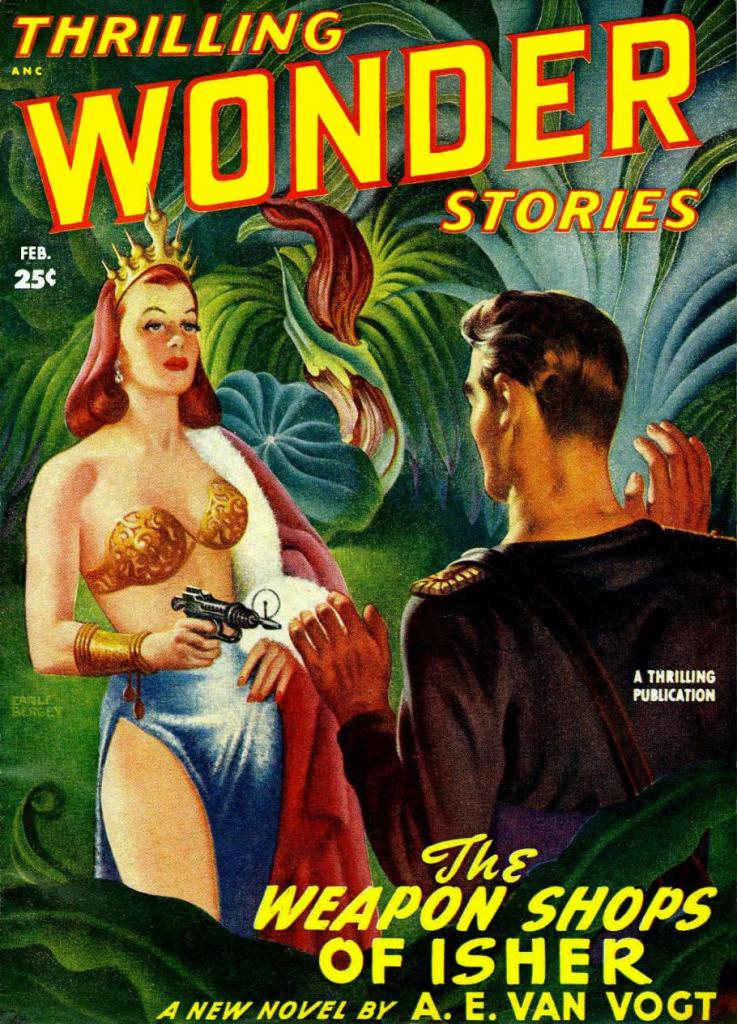
Just for grins, here are some of the covers for Sturgeon’s 1949 publications.

James Wallace Harris, 7/11/23

Futures Past: 1928

Futures Past – Link to website for ordering softbound, hardbound, and digital copies. Jim Emerson writes and publishes Futures Past. Read Emerson’s About page to find out more about him and his future plans. Jim hopes to eventually publish volumes for the years 1926-1975. Even if Jim cranks out two volumes a year, I don’t know if I can live that long, but I hope I can live long enough to read those for the 1940s and 1950s. A .pdf file of the 1926 volume is available as a free download.

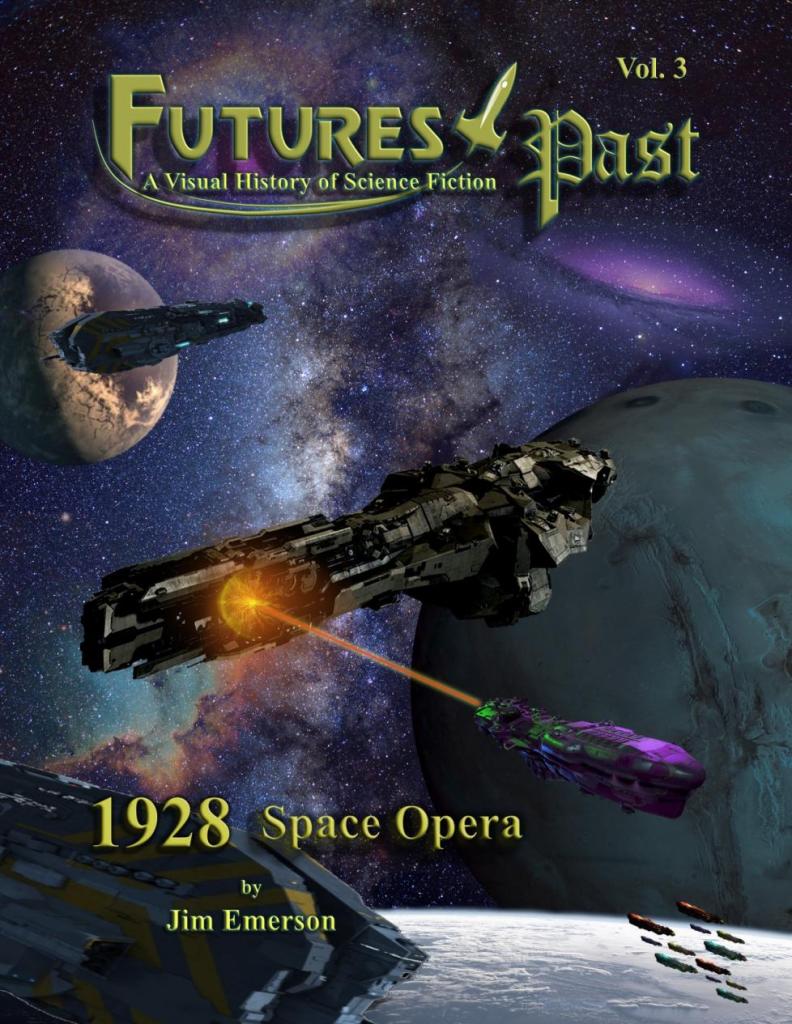
Jim has just published the third volume in his history of science fiction, Futures Past: A Visual History of Science Fiction. This 194 book is a visual delight, full of color photographs of book and magazine covers, as well as old black and white photographs of the people who created them. There’s an extensive history of space opera, including long profiles of the pioneers of the subgenre, E. E. “Doc” Smith, Jack Williamson, and Edmond Hamilton. I’ve been reading about the history of science fiction all my life, but I still found plenty of new information to discover in Futures Past. See my review of the earlier 1926 and 1927 volumes. Here’s the full table of contents to 1928.

1928 will be ancient history to most young science fiction fans, so they will find that year to be full of obscure details. However, the main articles in this volume, cover more than just the year 1928. The piece on space opera mentions books from 1802 to 1998, and the profiles of Smith, Hamilton, and Williamson cover their entire careers. That means pages 15-151 cover a good portion of the history of science fiction, especially the 20th century.

Content that’s exclusively on the year 1928 is on pages 8-14, 152-188. My favorite section in Futures Past is the section devoted to the books of the year. Most of the novels Emerson describes are long out of print and forgotten, yet some of them sound intriguing and make me want to track them down. Futures Past was first a fanzine in the early 1990s, and one mention in the 1926 volume, told about Phoenix by Lady Dorothy Mills. That one paragraph got me on a decades-long search for the novel. In fact, that mention made me become a collector of books by Lady Mills and inspired by to create a website devoted to her.

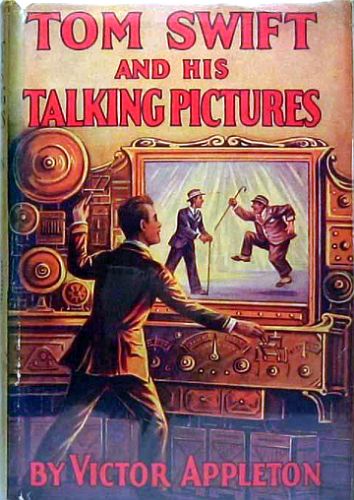
I’m intrigued by Tom Swift and His Talking Pictures, where Tom invents a large screen color TV and the movie moguls try to put him out of business because they fear TV will ruin their industry. Elsewhere in Futures Past 1928, Emerson mentions that May 10, 1928, was the first broadcast of a regularly scheduled TV program from W2XB, a General Electrics station in Schenectady, New York. I had no idea that television began so early. That makes me want to read more about it. I wish Emerson could have published their TV schedule. I did find out that W2XB broadcast the first drama, The Queen’s Messenger on September 11, 1928. This is leading me down a rabbit hole of researching early TV.

I expect readers of Futures Past will do the same thing, find an intriguing bit of history, and go follow it. I always thought The Skylark of Space was the first science fiction novel that features interstellar travel. That’s not true. Emerson says Les Posthumes by Nicolas Restif de la Bretonne, a French novelist, is considered the first space opera and was published in 1802. But I’m intrigued by his mention of The Struggle for Empire: A Story of the Year 2236 by Robert William Cole published in the year 1900.

I’m curious how many people will buy Futures Past. It means they are interested in the history of science fiction. And more than likely, readers of old science fiction. I expect Baby Boomers who discovered science fiction in the 1950s and 1960s will be the most ardent fans of this publication, mainly for nostalgic reasons.

One fact that Emerson notes is Amazing Stories started publishing the full names and addresses of readers who wrote letters to the letter column. This allowed early science fiction fans to contact one another and led to the creation of fandom and fanzines. I expect his yearly volumes to start chronicling the rise of fandom in the 1930s.

As each year progresses, I believe there will be more and more content specific to that year. I’m looking forward to that. It will be a tremendous amount of work to gather such information. Maybe Emerson could use some help or ideas.

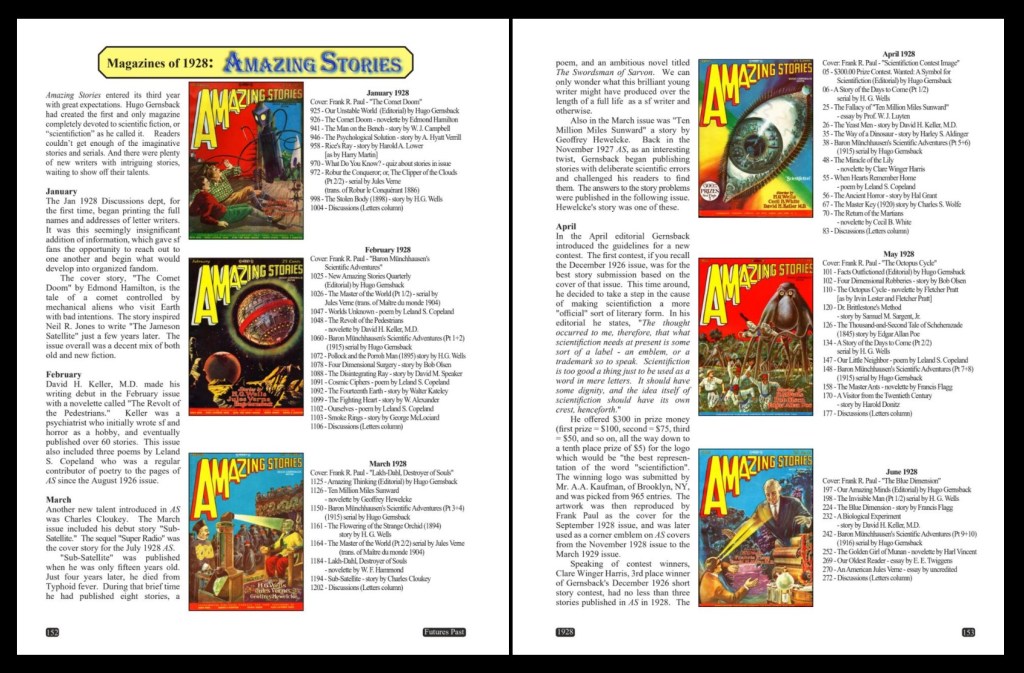
What I would like to see is a month-by-month chronicle of the best content published in magazines and fanzines. Most of the magazines and many of the fanzines from the 1930s are online. Knowing what’s worthy of reading is the key to using those libraries. Emerson has a start of that for Amazing Stories and Weird Tales. However, I’d want more details. Sort of like A Requiem for Astounding by Alva Rogers, which mentions the best stories and illustrations from each issue.

I’m less concerned with the table of contents from each issue shown on the right than what Emerson comments on the left. ISFDB lists the contents of magazines, but I never know what’s worth reading. What would be worth knowing is the outstanding stories from each prozine and the commentary about them from the fanzines.

What I use Futures Past for is finding old forgotten science fiction that I think might be worth tracking down and reading. The trouble is the amount of content coming out each year grows larger and larger, making Emerson’s job harder and harder. By 1953-1954, a 200-page book could be published on what went on each month in science fiction. That was when a science fiction boom happened when almost 40 SF magazines were coming out.

James Wallace Harris, 7/7/23

“The Gold at the Starbow’s End” by Frederik Pohl

The Gold at the Starbow’s End” by Frederik Pohl is story #24 of 52 from The World Treasury of Science Fiction edited by David G. Hartwell (1989), an anthology my short story club is group reading. Stories are discussed on Tuesdays, Thursdays, and Saturdays. “The Gold at the Starbow’s End” first appeared in Analog (March 1972). It’s currently available in Platinum Pohl: The Collected Best Stories. Right now the Kindle edition is only $3.99. The story is also available as a standalone novella for $2.99 for the Kindle edition, but Kindle Unlimited members can read it for free.

I was surprised to discover that I had never read “The Gold at the Starbow’s End” before, especially since it’s such a great read. I never knew how involved Frederik Pohl was in the history of science fiction until I read his memoir, The Way the Future Was. I haven’t read much of Pohl’s fiction, but whenever the reading group covers one of his stories I’m always impressed. I highly recommend his memoir.

“The Gold at the Starbow’s End” was a finalist for a Hugo and Nebula and came in #1 in the 1973 Locus Poll for best novella. It’s not widely reprinted, probably because it’s so long, but it was included in Wollheinm’s The 1973 World’s Best Annual Best. The World Treasury of Science Fiction from 1989 is the last major anthology that remembers it, which is a shame since the story is so much fun to read.

I’m disappointed there is no audiobook of this story. Before I actually discuss the story, I’d like to talk about that. I love listening to science fiction short stories read by professional narrators. A great reader can make the story come alive in ways my poor internal reading voice can’t. Unfortunately, short stories are the red-headed stepchildren of the literary world. They are lucky if they get reprinted at all.

In the science fiction world, short stories get treated better than other genres — well, it used to be that way. The best stories were often regularly reprinted in retrospective anthologies. Those anthologies don’t get published very often anymore. In times past, there was a huge retrospective anthology about every five years, so over the course of twenty years most of the best science fiction short stories from the past were reprinted. This gave each new generation of readers a chance to read the classics and gain a sense of the evolution of the genre. Unfortunately, those huge retrospective anthologies didn’t stay in print (except for The Science Fiction Hall of Fame volumes 1, 2a, and 2b).

What I would love to see is a ten-volume The Best Science Fiction Short Stories of the 20th Century that would stay in print as printed books, ebooks, and audiobooks. Those volumes should collect these 251 stories. I would buy all ten volumes in all three formats.

Like many classic science fiction stories, “The Gold at the Starbow’s End” is about transcendence, especially the kind readers of Astounding Science-Fiction in the 1940s loved. The story is told through two alternating narratives. First first, are messages sent from the first interstellar mission to Alpha Centauri, crewed by six men and women. The second follows Dieter von Knefhausen, a Dr. Strangelove-like character who advises the president on the mission. Knefhausen designed the mission so the highly intelligent crew wouldn’t have much to do during their ten-year voyage but study. He hoped such isolation and focus would cause them to leap ahead of current scientific knowledge.

While civilization on Earth delines during the ten-year period, civilization on the spaceship Constitution evolves dramatically. “The Gold at the Starbow’s End” reminds me of children in “Mimsy Were the Borogoves,” More Than Human, Childhood’s End, and Valentine Michael Smith of Stranger in a Strange Land. Knefhausen not only reminded me of Dr. Strangelove, but Henry Kissinger. The politics in the Washington side of the story devolve so greatly, that it reminded me of “The Marching Morons” by C. M. Kornbluth.

The Earth side narrative is obvious satire, but what about the spaceship side of the story? It represents the hope of SF fans. Knowing Pohl’s other work, I have to assume it’s also satire, even though it plays up to some of the most treasured ideas in science fiction.

I can’t decide if “The Gold at the Starbow’s End” isn’t Pohl preaching the gospel of science fiction or making fun of it. Science fiction fans have always wanted to be slans. It’s surprising how much Campbell and Heinlein wanted transcendence in the 1940s, and Clarke wanted it in the 1950s and 1960s. Was Pohl continuing the dream in this story, or turning on it?

“The Gold at the Starbow’s End” is so cynical that it’s hard to believe it’s aspirational. And am I being cynical when I wonder if certain science fiction writers like Pohl and Bester are secretly making fun of science fiction by pushing the very emotional buttons in their readers that they themselves are sneering at? Pohl and Bester were way smarter than most of us.

“The Gold at the Starbow’s End” is an outstanding piece of writing on Pohl’s part. Working out how to convey Human 2.0 behavior isn’t easy, and Pohl does an impressive job here. The Washington/Knefhausen side of the story is as equally worked out, revealing the egocentric madness of people in power. I wish Stanley Kubrick could have filmed “The Gold at the Starbow’s End.” It would be a combination of Dr. Strangelove and 2001: A Space Odyssey. And I have to wonder if Pohl wasn’t using both as inspiration.

James Wallace Harris, 6/29/23

Resonating With Malzberg

The writer I feel the most philosophically in tune with at the moment is Barry N. Malzberg, especially while reading his 2018 collection of columns from Baen’s Universe (2007-2010) and Galaxy’s Edge (2010-2017) titled The Bend at the End of the Road. I woke up this morning thinking I would write an essay titled “The Skeptics of Science Fiction” about science fiction writers who have come to doubt their genre, or “Why I Read Science Fiction in My Seventies” about how I no longer read science fiction to enjoy the story but to study each story as part of a science fiction history.

Malzberg’s essays do both, and I might still write those essays even though I feel Malzberg has already blazed those trails thoroughly. I have not finished the over forty essays in the collection, but I’ve read enough to sense a common feeling that I think Malzberg and I share about science fiction. I’m going to try and describe that feeling. Malzberg is 12 years older than I am, far more knowledgeable about science fiction, and further down the road of experience.

What I say won’t be what Malzberg says, but I think we’re in the same club. There’s enough resonance that I must wonder if we aren’t in essential agreement. I am not paraphrasing his book, but I’m going to describe how I feel which I believe is how he might feel using different words. Which may be how you feel and convince you to buy his book.

Our reality does not come with a prescribed meaning or purpose. We are all existentialists who must create our own meaning in life. When I was twelve I rejected the religion that was being forced on me and embraced science fiction instead. It wasn’t conscious on my part, and only understandable in hindsight but it’s understandable for the times, 1963. Science fiction, if you understand how I read it makes a good substitution for religion. I thought science fiction was a roadmap to reality and it became my mentor and guidance counselor.

Over the decades I realized this was silly, but I never could shed my love of science fiction. It was my chosen compass and I couldn’t stop using it to guide me even though I eventually became an atheist of my chosen religion. Science fiction promised transcendence and I never forgot that hope. I am like the characters in Hermann Hesse’s Journey to the East who have fallen off the path of enlightenment but achingly and vaguely remember it, and who keep searching to find it again.

Now that I’m older and rereading the science fiction from the 1940s, 1950s, 1960s, and 1970s, the works that shaped my soul, I’ve discovered how I was programmed and have been deprogramming myself. However, I just can’t let my love of those works go. I no longer admire them for what they meant to me when I was young but find meaning in understanding them as a subject of literary scholarship.

Malzberg goes back again and again to examine old science fiction stories that we both read, admired, or disliked. He keeps finding new personal revelations in that effort, and that’s where I’m at too. I often share his insights in stories I’ve reread and am intrigued by the insights in the stories I haven’t, but now plan to.

An important part of the equation is aging. Malzberg and I revere old science fiction and feel modern science fiction has lost its way. But young readers have become the new faithful and reject old science fiction, the old faith. I grew up at a time when science fiction was the bible stories preaching the gospel of the final frontier. The reality of space travel and science fiction parted from each other decades ago. And what science fiction has become is something I can’t believe in.

So Malzberg, and I, and I imagine many others from our generations, have become scholars of science fiction. We’re non-believers like Bart D. Ehrman who specializes in Biblical studies. On one hand, we enjoy the storytelling techniques of a bygone era and we like to understand the stories in their historical context. On the other hand, we are self-psychoanalyzing our own youth and development.

We used to believe we were part of an important movement, but now realize it was very tiny. And that our movement was taken over by the entertainment industry and made into a new opium of the masses.

We all want to believe what we love to read. We all want to believe we have something in common with authors whose fiction and nonfiction we think we agree with. We can never know what something meant in their writing, but human nature makes us want to find people like ourselves. For a while, science fiction gave some of its fans hope of transcendence and a shared belief system. Like most beliefs in this reality, it was mostly illusions, if not all.

I don’t think I could ever write a proper review of The Bend at the End of the Road because Malzberg covers too many topics that I’d want to discuss in detail. I could probably write at least one essay, if not several from reading each of his essays.

James Wallace Harris, 6/24/23

“Captain Nemo’s Last Adventure” by Josef Nesvadba

Captain Nemo’s Last Adventure” by Josef Nesvadba is story #22 of 52 from The World Treasury of Science Fiction edited by David G. Hartwell (1989), an anthology my short story club is group reading. Stories are discussed on Tuesdays, Thursdays, and Saturdays. “Captain Nemo’s Last Adventure” first appeared in Nesvadba’s 1960 collection, Einsteinův Mozek. It was translated into English for the 1973 anthology edited by Franz Rottensteiner, View From Another Shore, and it was selected in 1974 for Best SF: 1973 edited by Harry Harrison and Brian Aldiss. (Follow the link to the story title to see where it’s been anthologized if you want to find a copy to read. However, The Treasury of World Science Fiction is widely available in used copies and is probably the cheapest way to get this story, along with 51 others.)

David G. Hartwell had so much to say about “Captain Nemo’s Last Adventure” in his introduction that I thought I’d just reprint it here.

I don’t know if I agree with Hartwell when he says “Captain Nemo’s Last Adventure” is a satire on stories from John W. Campbell’s era, or that Nesvadba uses the tropes and conventions of 1940s science fiction. I’m not even sure “Captain Nemo’s Last Adventure” is even an ironic work of criticism. I’m not saying it’s not, but I want to propose an alternate theory.

What if science fiction evolved separately in Czechoslovakia? And what if its evolution sometimes paralleled American pulp science fiction? Evidently, “Captain Nemo’s Last Adventure” was written after Sputnik but before Gargarin’s famous ride. Would Josef Nesvadba have access to old American pulps or even 1950s anthologies that reprinted them?

The prose of “Captain Nemo’s Last Adventure” doesn’t come across like the prose in pulp fiction. Like many of the foreign language science fiction stories we’ve been reading, it’s mostly told and not shown. However, it is longer, and that lets it become a fuller story than the shorter works we’ve read. I wonder if Nesvadba wasn’t inspired by Soviet science fiction or the Polish Stanislaw Lem?

“Captain Nemo’s Last Adventure” is about the super-heroic Leonard Feather and chronicles his feats of always needing to save the day, and eventually the Earth. Yes, we could compare him to Kimball Kinnison and the Lensman series. But Feather could just as easily be compared to Homer’s Ulysses.

I do think Nesvadba was making fun of spacemen, and the kind of macho men who need to always be on an adventure. Feather is a womanizer who makes his wife unhappy, as well as his mistresses, and he can’t understand why his son isn’t like him. Nesvadba is satirizing a certain kind of man that has existed in all genres of literature.

Nesvadba also appears to be attacking the call of the high frontier, robotics, and the never-ending quest to conquer and engineer. When Captain Feather, aka, Captain Nemo meets another intelligent race, he can’t understand what they are after. When he returns to Earth and is forced to stay put, Feather begins to see the need for philosophy and art.

There are parallels to American science fiction in this story. Heinlein, Campbell, Hamilton, and others all wrote stories about meeting super-advanced aliens back in the 1940s. The robots in “Captain Nemo’s Last Adventure” remind me of Jack Williamson’s The Humanoids. This story even reminds me just slightly of Robert Sheckley in the 1950s.

But, Captain Feather and his crew mostly remind me of Space Chantey by R. A. Lafferty, which is a science fiction parody modeled on Homer. My guess is that Nesvadba’s story was really inspired by Lem’s The Star Diaries, which came out in the 1950s?

Still, “Captain Nemo’s Last Adventure” is a good tale. It’s not told dramatically, which disappoints me, but its length allowed it to cover a number of interesting science-fictional topics that were enjoyable to me.

James Wallace Harris, 6/23/23