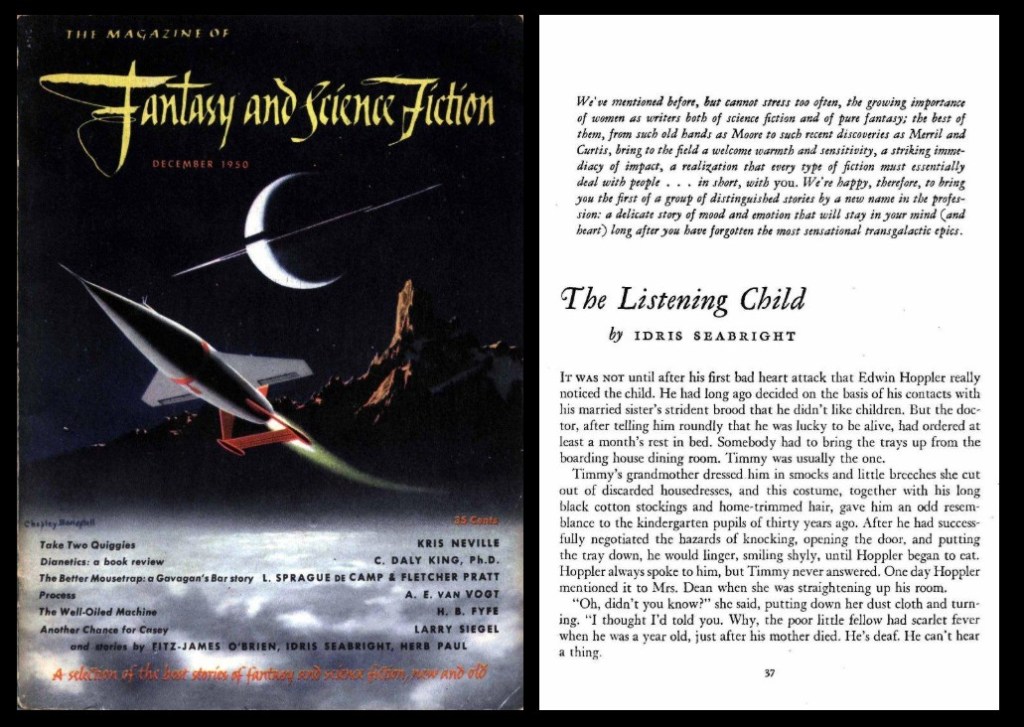
“The Listening Child” was first published in The Magazine of Fantasy and Science Fiction (December 1950) by Margaret St. Clair using the pseudonym Idris Seabright. You can read it online here. It is short story #1 of 25 that our Facebook group will be discussing as Group Read 92. (See the reading schedule at the end of this review.) Group Read 92 consists of 25 stories picked by five group members that we haven’t read before. That was a challenge since we’ve been discussing a short story daily for years. The group is public.
In the 1950s, extrasensory perception (ESP) was a popular theme in science fiction and fantasy magazines. It was often speculated that people with physical or mental abnormalities might have additional senses to compensate for the loss of one of their primary senses. I assume the assumption came from blind people who had keener hearing.
After Hiroshima, science fiction and comic book writers often used radiation as a cause of ESP. However, in the 1930s and 1940s, John W. Campbell was impressed by the Rhine experiments, and science fiction writers often supposed that advanced aliens had psychic powers. Arthur C. Clarke, who was normally a hard SF writer, proposed that the evolution of human development led to ESP in two of his most famous novels, Childhood’s End and 2001: A Space Odyssey. Soft science and fantasy writers leaned towards psi-powers in physically and mentally damaged humans, like Theodore Sturgeon’s More Than Human.
Margaret St. Clair imagines a deaf mute having a rather unique ESP talent. Timmy can “hear” when death is near. Many famous stories personify death, so this isn’t too out there, but it’s not as believable as other ESP talents, even though it is well proven that ESP does not exist. Still, hearing death makes for a nice story idea.
St. Clair’s setup for her story is rather quaint. Edwin Hoppler is 63 and suffers from a weak heart. He lives in a boarding house. Boarding houses have disappeared, but were common in old movies and science fiction short stories before the 1960s. Quite a few episodes of The Twilight Zone were set in boarding houses. It’s a shame they don’t still exist. Living with several other individuals who ate communal meals fixed by a nice old lady sounds pleasant.
Timmy is the landlady’s grandson, and Edwin feels sorry for him. Edwin befriends Timmy when he realizes that the other kids don’t play with Timmy. Edwin notices that Timmy “listens” intently at times, and eventually notices that these listening moments precede a person or animal dying. Edwin decides to use Timmy as the canary in a coal mine to detect his own impending heart episodes.
“The Listening Child” is a pleasant little story, but rather slight. Timmy and Edwin are only developed enough as characters to present the idea for the story. There’s little conflict or tension. The story also lacks color or voice. The idea is slight, but writers can flesh out simple ideas into complex characterization and plots. For example, compare it to “Jeffty is Five” by Harlan Ellison. Jeffty is a boy who is perpetually five, and always lives in the year he was five, with the popular culture never changing. Or read “Baby is Three” by Theodore Sturgeon; it’s tremendously dramatic for a boy with psychic powers talking to a psychiatrist.
I don’t want to tell you the ending, but I expected St. Clair thought her readers would find it emotional and poignant. It was presented too casually for me to be moved, but I’m curious if other members from our short story reading group will be moved. I wanted the ending to be like in Platoon when we see Elias still alive, and the emotional impact we felt watching him die.
I’m working on a project to find my all-time favorite science fiction stories I’ve read over the past sixty years. Identifying such stories means learning what makes a story work. Most published stories succeed at a basic three-star level, which is how I’d rate “The Listening Child.”
For this story to reach the four-star level, Timmy and Edwin would need to become vivid characters. To make it to a five-star story would require elevating the story gimmick of hearing death into something metaphorical and philosophical that I would want to contemplate over several readings.
James Wallace Harris, 4/21/25
Group Read 92 Schedule
01 (04/22/25) – The Listening Child, by Margaret St. Clair (ss) F&SF, December 1950 (DH)
02 (04/24/25) – Brightness Falls from the Air, by Margaret St. Clair (ss) F&SF, April 1951 (FP)
03 (04/26/25) – The Rose, by Charles L. Harness (na), Authentic Science Fiction, 15 March 1953 (PF)
04 (04/29/25) – The Last Day, by Richard Matheson (ss), Amazing, April/May 1953 (FP)
05 (05/01/25) – Watershed, by James Blish (ss), If, May 1955 (RH)
06 (05/03/25) – The Certificate, by Avram Davidson (ss), F&SF, March 1959 (FP)
07 (05/06/25) – To See the Invisible Man, by Robert Silverberg (ss), Worlds of Tomorrow, April 1963 (FP)
08 (05/08/25) – A Two-Timer, by David I. Masson (nv), New Worlds 159, February 1966 (PF)
09 (05/10/25) – The Adventuress, by Joanna Russ (nv), Orbit 2, ed. Damon Knight (Putnam, 1967) (RH)
10 (05/13/25) – No War, or Battle’s Sound, by Harry Harrison (nv), If, October 1968 (FP)
11 (05/15/25) – The Milk of Paradise, by James Tiptree, Jr. (ss), Again, Dangerous Visions, ed. Harlan Ellison (Doubleday, 1972) (RH)
12 (05/17/25) – Pale Roses, by Michael Moorcock (nv), New Worlds 7, ed. Hilary Bailey & Charles Platt (Sphere, 1974) (PF)
13 (05/20/25) – Concepts, by Thomas M. Disch (nv), F&SF, December 1978 (PF)
14 (05/22/25) – Gate of Faces, by Ray Aldridge (nv), F&SF, April 1991 (PF)
15 (05/24/25) – On Sequoia Time, by Daniel Keys Moran (ss), Asimov’s, September 1996 (PN)
16 (05/27/25) – Journey into the Kingdom, by M. Rickert (nv), F&SF, May 2006 (PN)
17 (05/29/25) – Roxie, by Robert Reed (ss), Asimov’s, July 2007 (PN)
18 (05/31/25) – 26 Monkeys, Also the Abyss, by Kij Johnson (ss), Asimov’s, July 2008 (DH)
19 (06/03/25) – Passage of Earth, by Michael Swanwick (ss), Clarkesworld 91, April 2014 (PN)
20 (06/05/25) – Cimmeria, by Theodora Goss (ss), Lightspeed 50, July 2014 (RH)
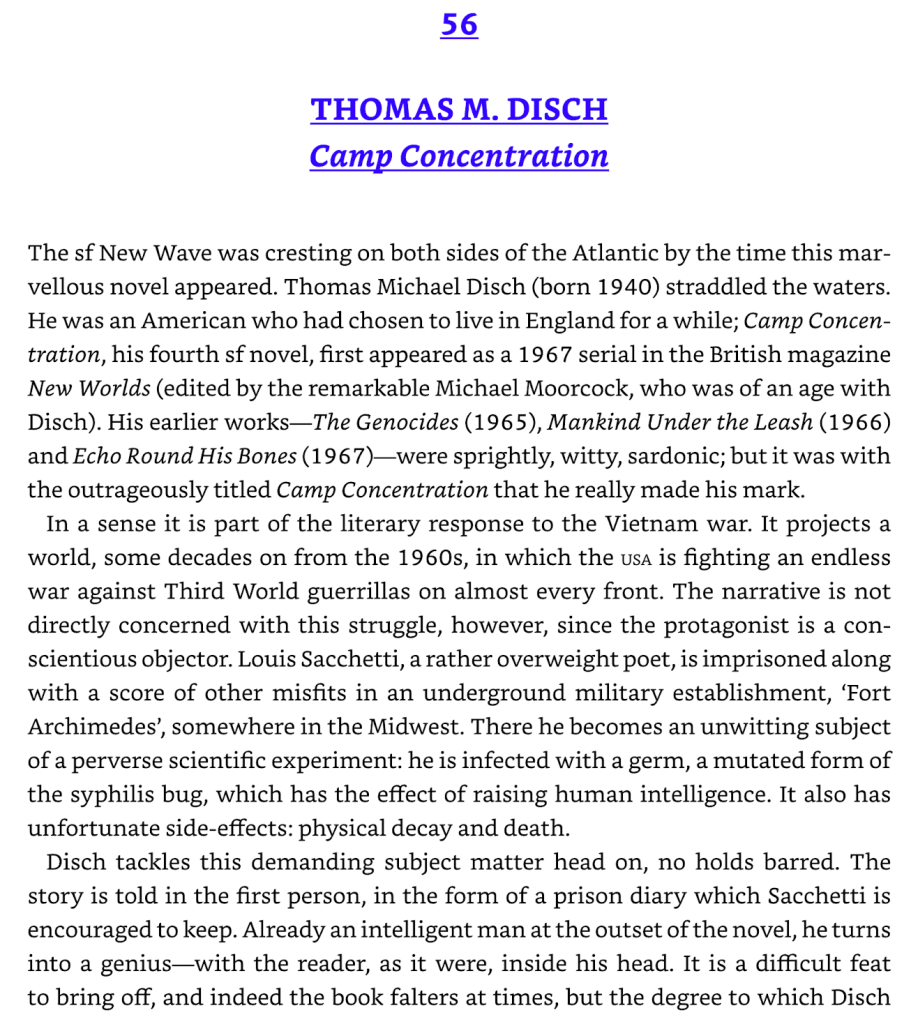
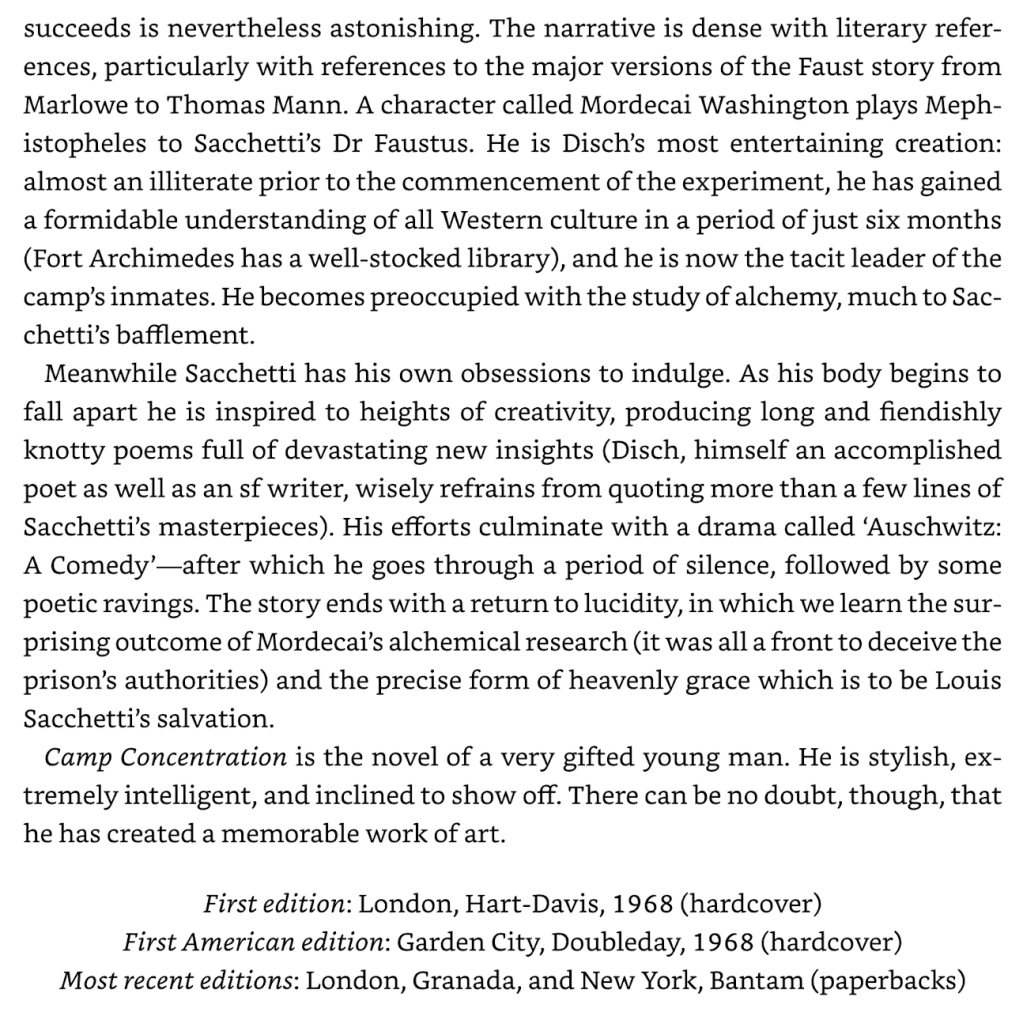
The first time I read Camp Concentration by Thomas M. Disch, I was around 20 and proud of myself for reading one of those New Wave science fiction novels I had been reading about in fanzines. It wasn’t much fun to read. It was overly intellectual – well beyond my level of comprehension. After reading thousands of other books over the last fifty-plus years, Camp Concentration made much more sense. I actually enjoyed the story. I enjoyed it a lot. But please, don’t buy a copy without carefully reading this review.
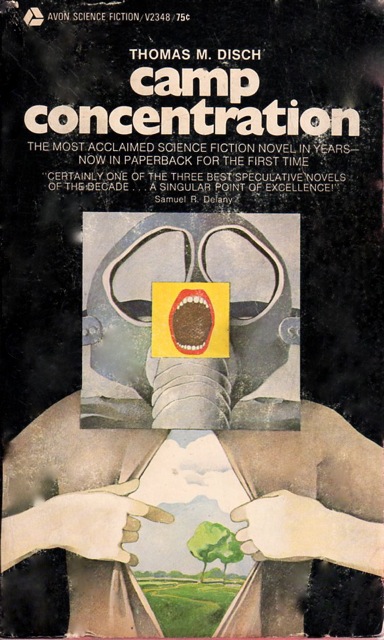
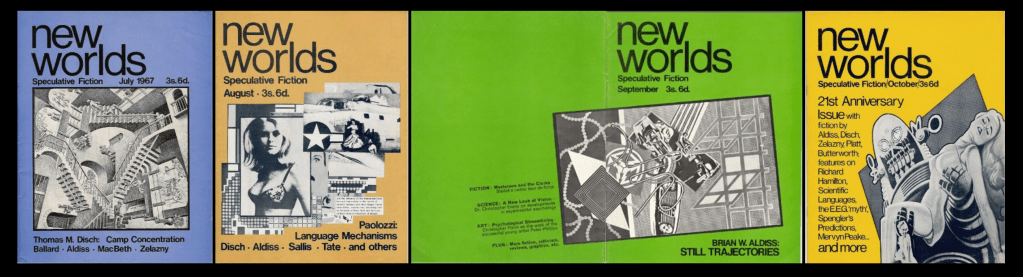
It’s important to know that Camp Concentration first appeared in the July, August, September, and October 1967 issues of New Worlds. It suggests it was written in 1966 or early 1967 and published first in England, in a magazine that promoted the New Wave. To fully appreciate this novel, you must remember when it was written and what happened in the United States in 1966 and 1967. The first hardback came out in England in 1968, and it wasn’t until 1969 when it was published in America. I didn’t read it until after the 1971 Avon paperback, cover shown above.
I’d love to hear an audiobook version of Camp Concentration. However, a highly skilled narrator would be needed to handle all the accents, poetry, foreign language quotes, and characterizations. It would also make a wonderful movie. Unfortunately, the audience for either the audiobook or film would be small.
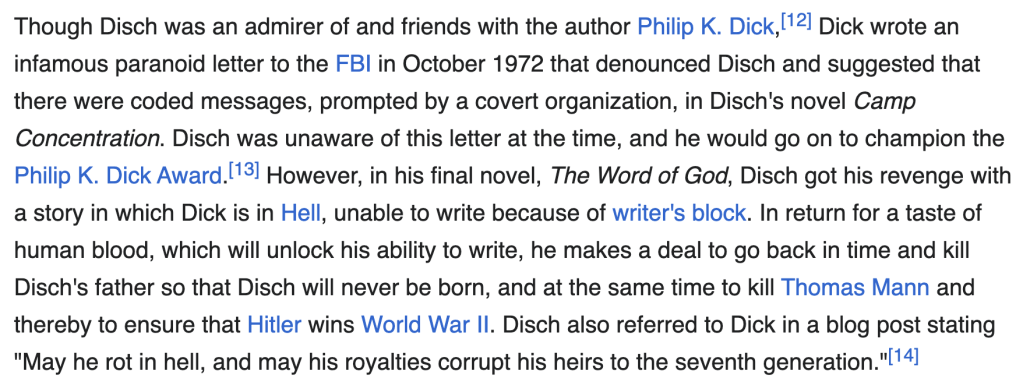
Back in the 1970s Camp Concentration was greatly admired. Philip K. Dick loved the book so much he promoted to friends and suggested it be made into a movie to a producer interested in his own work. But there’s a bizarre story here. Dick, who was paranoid, started seeing things in Camp Concentration and wrote a letter to the FBI claiming it had secret intel. You can read that letter here. Eventually, Disch found out about this and didn’t take it kindly. Wikipedia describes what happened:
I mention this early in the review because it helps set up how strange Camp Concentration is as a novel. It’s quite readable, but it has so many references to literature, music, philosophy, poetry, etc., that you might feel it has some deeper message. Even though I just finished the novel, I’m already looking forward to rereading it again. However, before I can do that, I need to study first. At minimum I should read Christopher Marlowe’s play Doctor Faustus, and Thomas Mann’s novel Dr. Faustus. In fact, I need to go through Camp Concentration, make a list of all the works Disch mentions, and at least read their Wikipedia pages about them.
Louis Sacchetti is a conscientious objector, and Camp Concentration is the journal he writes while imprisoned in two locations. Disch wrote the novel while LBJ was president, and before Nixon. The story is set somewhat in the future, and Robert McNamara is President. McNamara was the Secretary of Defense under JFK and LBJ. McNamara played a major role in promoting the Vietnam War. To get the fullness of Camp Concentration, you need to read the Wikipedia link to McNamara. It also helps to see The Fog of War: Eleven Lessons from the Life of Robert S. McNamara, a 2003 Academy Award winning documentary.
Camp Concentration is a deeply cynical view of the United States in 1967. Louis is a war resister, at first imprisoned in an ordinary prison. He accepts that. But the novel is about when he is transferred to another prison, a military prison, where an experimental drug is used on the inmates by the U.S. Army. Most of the prisoners had committed crimes while in the Army, but Louis is a special civilian prisoner. The army believes it has synthesized a drug that will enhance intelligence. It was derived from a strain of syphilis.
The U.S. Army conducted experiments with LSD from 1955 to 1967. From 1932 to 1972, the U.S. government studied the effects of syphilis on black people after telling them they were being treated. These are just two examples of unethical experiments by our government. It’s not hard to believe the setup for Camp Concentration.
Camp Concentration reminds some readers of Flowers for Algernon because it’s about a treatment that makes people smarter. Over one hundred journal entries, we see Louis and the other prisoners change and become brilliant. I felt the characters did change, but my friend Mike, who got me to reread the novel, says he didn’t. Writers find it hard to describe humans with superintelligence. I’ve written about that recently. I thought Disch pulled it off, Mike didn’t.
Most of the novel is intellectual discussions about art, literature, poetry, theater, music, religion, philosophy, Alchemy, and other medieval beliefs. Mike thought all this discussion was boring, I was fascinated. I feel it helps to have a classical education to appreciate Camp Concentration. I don’t, but I’ve read enough to wish I had.
While reading Camp Concentration I was reminded of another book I read in the 1970s, Where the Wasteland Ends: Politics and Transcendence in Post Industrial Societyby Theodore Roszak. I’m not saying the two books are about the same things, but as the characters evolve intellectually, they start sounding like Roszak.
Read Disch’s Wikipedia entry, you’ll see that Thomas M. Disch and Louis Sacchetti have much in common. Louis is a poet, and Disch wrote The Castle of Indolence: On Poetry, Poets, and Poetastes.
In the novel, the drug makes the test subject smarter, but it also kills them within months. As the characters grow more brilliant, they realize they have much more to live for and become bitter. Disch appears to equate higher IQ with depression and cynicism.
Disch does not suggest that superintelligence leads to super-powers. The test subjects only become more academic in their communication with each other. As they evolve mentally, their use of intellectual ideas to express themselves becomes more dense. This is subtle, and it may be hard to believe they are more intelligent. It seems that most of their references are to ideas covered in Classical studies or Medieval studies.
If you are prone to depression, I would not read this novel. If you are among the faithful, I would not read this novel. If you prefer tightly plotted stories, that are easy to read, and enjoy action, don’t buy this book.
On the other hand, if you’re into the history of science fiction, the New Wave, or the 1960s, Camp Concentration might be a good one to read. Science fiction changed in 1967-1968. I believe several young prodigies like Disch and Delany took the genre in new directions, and older writers like Silverberg, Brunner, and Ellison decided they were tired of where science fiction was going too.
From 1945 to 1975, P. Schuyler Miller reviewed science fiction books for Astounding Science Fiction and Analog Science Fiction. He died in October of 1974. I stumbled upon an online PDF collection of those reviews from 1945-1967. You can download that file here. (Warning – it’s 235MB.)
Unfortunately, the individual reviews aren’t dated and the run is far from complete. However, the PDF is searchable, and you can use ISFDB.org to date an individual review. Just look up the book title, then scroll down to the Reviews section, and find the one for Miller. Someday I’d like to create a file of all of Miller’s reviews from 1945-1975.
I put this PDF on my iPad and read it like a book. It’s wonderful. The reviews start before science fiction was regularly published in book form. Whoever collected these reviews evidently picked those they thought interesting to modern readers. Collectively, they have a history of science fiction published before 1968. For example, the early reviews cover books published before science fiction was a genre. Then we started seeing books from Gnome and Fantasy Press, essentially fan publishers. After that, we slowly see big name New York publishers take chances on the genre along with the rise of mass market paperback publishers.
We get to read the original reviews of books now remembered as genre classics and books that have since been forgotten. Often I read reviews of forgotten books that sound interesting enough to track down.
The first two reviews are books by Vardis Fisher: Darkness and the Deep and The Golden Rooms (April 1945). These books imagine life when Neanderthals and Cro-Magnon coexisted. Popular writers like H. G. Wells, Jack London, and Stephen Vincent Benet, also wrote on this theme. It wasn’t considered science fiction then, but our genre has claimed that theme since.
Here’s that first review:
Most book reviews in science fiction magazines are short blurbs. Miller writes comprehensive essays. As the years progress, Miller’s reviews become more elaborate, longer, often beginning with some science fiction history. The next review is of The Time Stream by John Taine (March 1947). Miller does more than describe and react to the novel, giving the background of how that story fits in the genre, and biographical information on the author. He compares Taine’s work to A. Merritt’s, and points out how Taine’s work originally appeared in hardback, while Merritt’s stories were serialized in magazines first. I’ve not read Taine or Merritt, but I’ve often read about both in histories of science fiction. This review makes me want to try The Time Stream. These reviews also give me information about collecting original editions. (Amazon has a Kindle edition of The Time Stream for $2.99.) Here’s Miller’s review.
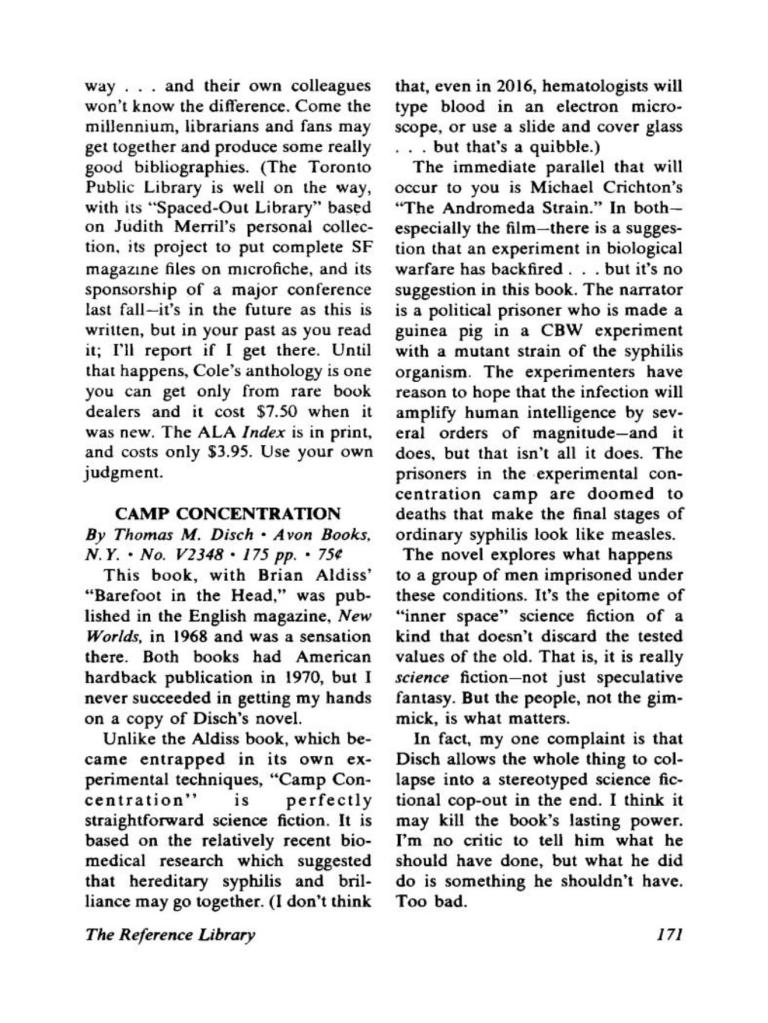
I decided to jump to June 1954 and read the review for The Lights in the Sky are Stars by Fredric Brown, the science fiction novel I’m currently reading. By now Miller’s columns are longer. He reviews more books each month, so each review is shorter. That’s because far more SF books are being published every month. Since October 1951, they come under the title “The Reference Library.” (That’s where I steal the image above for this post.) Miller often begins his columns with a digression exploring topics related to current publishing.
I thought I’d test Miller on something hard. This is his review for Stranger in a Strange Land by Robert A. Heinlein from the January 1962 issue of Analog. I’m including his essay in the introduction as a sample of how he composed his columns.
That should give you enough examples to decide on downloading the entire collection of Miller’s reviews. If you’re reading on a computer with a large monitor, I have a page I’m working on that links to Miller’s reviews in issues of Astounding and Analog at Archive.org. You can read each column one at a time on screen.
P. Schuyler Miller also wrote some science fiction. I own this first edition of The Titan with a beautiful Hannes Bok cover.
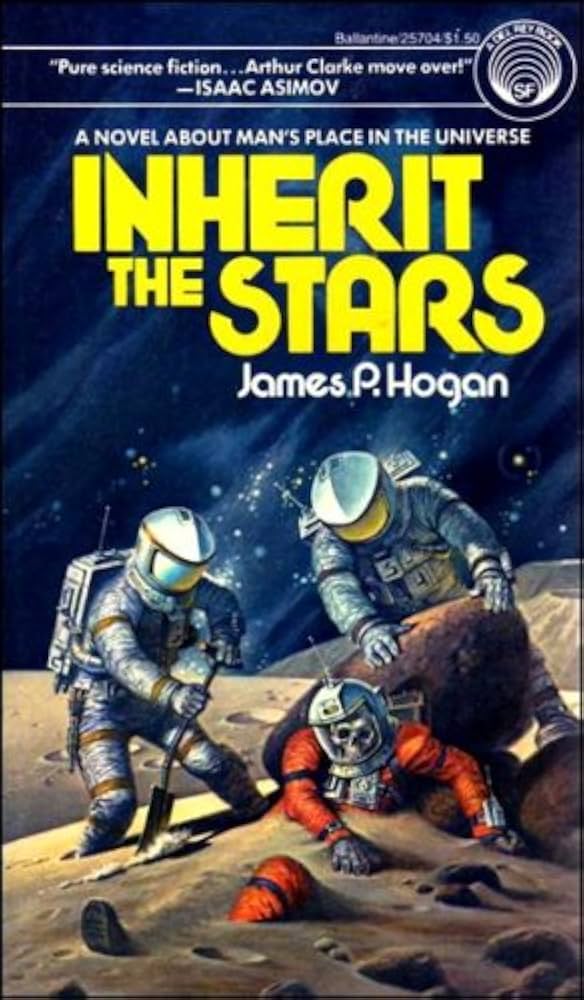
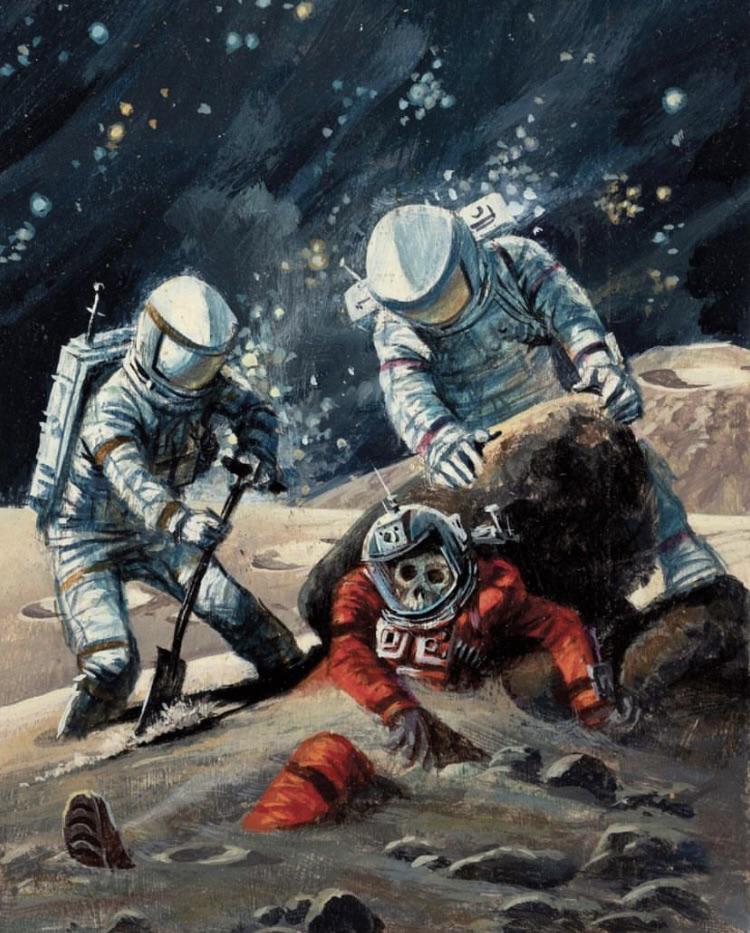
The original paperback, Inherit the Stars by British writer James P. Hogan (1941-2010), had a terrific cover – the kind that made you buy the book. The artwork appears to show astronauts on the Moon finding a dead astronaut, but that is deceptive. Hogan creates a scientific mystery because the dead astronaut has been there for 25,000 years.
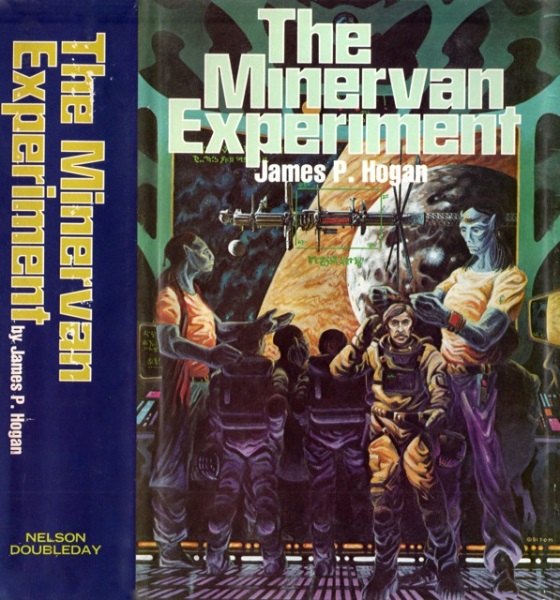
I first read Inherit the Stars in 1992 but after seeing Whitney’s review on YouTube, I wanted to reread the story. I went to Amazon but couldn’t find the book. Was it out of print? I did find it on Audible. Later, I discovered that Inherit the Stars and its sequel The Gentle Giants of Ganymede are now being sold together as The Two Moons for the Kindle. A bargain for $6.99, especially since Whitney also praised the second book. It turns out that there are five books in the series being sold as three Kindle editions. The series is called Giants. Only the first three novels are available on Audible. The Science Fiction Book Club once published the first three novels as The Mirnervan Experiment. Ballentine also published a paperback called The Giants Novels that contains all three.
Before anyone rushes out to buy Inherit the Stars, I need to describe it more, but not enough to give spoilers. Hogan’s story is the kind you want to figure out for yourself. It kept me guessing for the entire novel even though I had read it before. That worried me. Why wasn’t it more memorable? Was that an indication it was a bad book? I don’t think so. How the story is told isn’t very memorable, but the ideas are big-time fun. I did remember some of those, but not connected to the book.
Inherit the Stars is basically scientists talking about one mystery after another. There’s no real plot. A lot happens, but it’s not dramatic. With each discovery, there’s a new puzzle, which makes you think and try to guess what caused each mystery. Inherit the Stars is science fiction focused on ideas and not storytelling. I’ve told you the first mystery, but I don’t want to give away any others.
However, I will give you some fun clues. Inherit the Stars reminds me a lot of Rendezvous With Rama by Arthur C. Clarke. Hogan’s prose is similar to Clarke’s. At one point, the story reminded me of the classic short story “Omnilingual” by H. Beam Piper. The novel also triggered memories of Gateway by Frederik Pohl. At other times it reminded me of the Winston Science Fiction, a series of young adult SF that came out in the 1950s, especially the entries where the protagonists find relics of ancient alien technology. If you love alien archeology stories, you might like Inherit the Stars.
I call Inherit the StarsPre-NASA Science Fiction, by which I usually mean science fiction written before Mariner 4 photographed Mars in July 1965. Until NASA started exploring the solar system with robotic probes, many people hoped that we would find life, even intelligent life somewhere on other planets in our solar system. For example, Heinlein’s Stranger in a Strange Land from 1961 imagines Mars being inhabited by a dying race. However, after Mariner 4, serious science fiction assumed we were alone in the solar system. (I must admit, that I still love Pre-NASA science fiction. Growing up in the 1950s and 1960s, I desperately wanted us to find Martians.)
I consider Hogan’s 1977 Inherit the Stars Pre-NASA Science Fiction because Hogan maintains the hope that we had neighbors. However, some readers might feel Hogan’s ideas might come across like those of Erich von Däniken, who wrote Chariot of the Gods? Another reviewer dismissed this book as unbelievable. Personally, I find Erich von Däniken’s theories to be insulting to humanity. But I consider Hogan’s speculation to be great science fictional fun.
Most science fiction stories seem to go stale after a couple decades. This week, I listened to The Heads of Cerberus by Frances Stevens, initially published 106 years ago. The story had passed its expiration date decades ago, but I still found it mildly enjoyable as a historical curiosity.
If you’re not fascinated by the evolution of science fiction, I’ll understand you leaving this essay now. The Heads of Cerberus is not a forgotten classic. It gets points for being an early example of time travel and dystopian fiction written by a woman, but it’s not a good example. At best, it’s a sample from 1919, the kind that MIT Press is reprinting in its Radium Age science fiction series.
Gertrude Barrows Bennett (1884-1948) published several fantasy and science fiction stories between 1917 and 1923 as Francis Stevens. This makes her a pioneering author in the pre-Amazing Stories era, especially as a woman writer, but she is practically forgotten today. I just learned about Francis Stevens by reading a two-part review of “Sunfire” on Science Fiction and Fantasy Remembrance (Part 1, Part 2) by Brian Collins. That review inspired me to research her, and what I learned inspired me to read The Heads of Cerberus.
The Heads of Cerberus was first serialized in five 1919 issues of The Thrill Book. It was first printed in hardback in 1952. It’s been reprinted at least a dozen times since.
I listened to a free copy on LibriVox. There are several public-domain ebook editions available, here is one at Gutenberg Australia. Lisa Yaszek who edited The Future is Female! series for theLibrary of America recently published a collection of Francis Stevens’ stories at MIT Press Radium Age series called The Heads of Cerberus and Other Stories. Gertrude Barrows Bennett is getting rediscovered. However, she’s been rediscovered before, it just never sticks.
The Heads of Cerberus is about three people from 1918 Philadelphia traveling to Philadelphia in 2118. Bob Drayton is a disbarred lawyer. Terry Trenmore is his Irish friend who is a powerfully built giant. And Viola Trenmore, Terry’s beautiful little sister, and just seventeen. In 2118 they find a dystopian society run by a handful of weird characters. The story is painfully simple, although I enjoyed it somewhat. The fun in reading these old science fiction tales is not the storytelling, but seeing how people imagined science fictional ideas before the concept of science fiction was invented.
The 19th century had several tales of people traveling to the future that could have inspired Bennett, each with a unique method of time travel. In “Rip Van Wrinkle,” Washington Irving has his title character sleep for twenty years after drinking potent liquor. Edward Bellamy had Julian West sleep for 113 years via hypnosis in Looking Backward. Frances Stevens has her characters jump ahead two hundred years by sniffing grey dust from a vial of mysterious ancient origins. The vial’s stopper is shaped like Cerberus.
As I said, The Heads of Cerberus isn’t very sophisticated. Its tone reminded me of the Oz books by L. Frank Baum, which were for children. Those books were often about ordinary people meeting extraordinary beings in strange places. Bennett’s imagined future is minimalistic, and somewhat goofy, reminding me of Alice’s Adventures in Wonderland. However, Stevens lacks the creative imagination of Baum and Carroll.
Edward Bellamy created a complex economic system for his future society that inspired many readers in the 19th century to form over five hundred Nationalist Clubs based on socialist ideas in Looking Backward. Francis Stevens imagines an economy based on the number of hours worked. Her society was ruled by an elite called The Superlatives. Ordinary people didn’t have names but numbers, and the Superlatives had names based on cardinal virtues like the Loveliest, The Bravest, the Fastest, the Strongest, etc.
The main problem with Stevens’ science fiction is her future society isn’t a philosophical idea she believed in or promoted, but merely conjured up quickly to fit a plot. Bennett was a young widow, with a child and mother to support after her dad died. She was a stenographer but made extra money by writing for the pulps. She quit writing after her mother died. The Thrill Book that serialized The Head of Cerberus was a low-paying market, but Stevens sold three novels to Argosy, a much-admired pulp after it. They were Claimed, The Citadel of Fear, and Possessed: A Tale of the Demon Serapion. Even though they are dark fantasies, a genre I’m uninterested in, I should try one to see if her writing improved. Her first serial, The Labyrinth, was to All-Story in 1918, another legendary pulp.
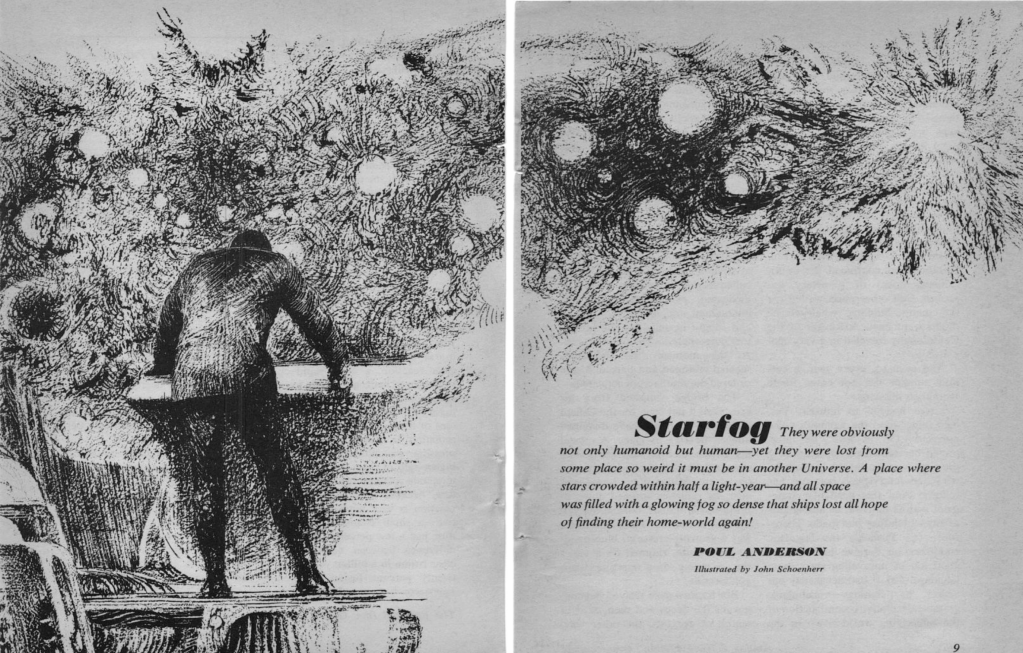
If I was pitching “Starfog” by Poul Anderson to a movie producer, I say “Two women are in love with Daven Laure, one is a spaceship computer and the other a mutant human who claims to be from another universe.” I also mention it’s a hard science fiction space opera dealing with a rare astronomical phenomenon reminiscence some episodes of Star Trek: The Next Generation on one hand with the scope and speculation of the Culture Novels of Iain M. Banks on the other.
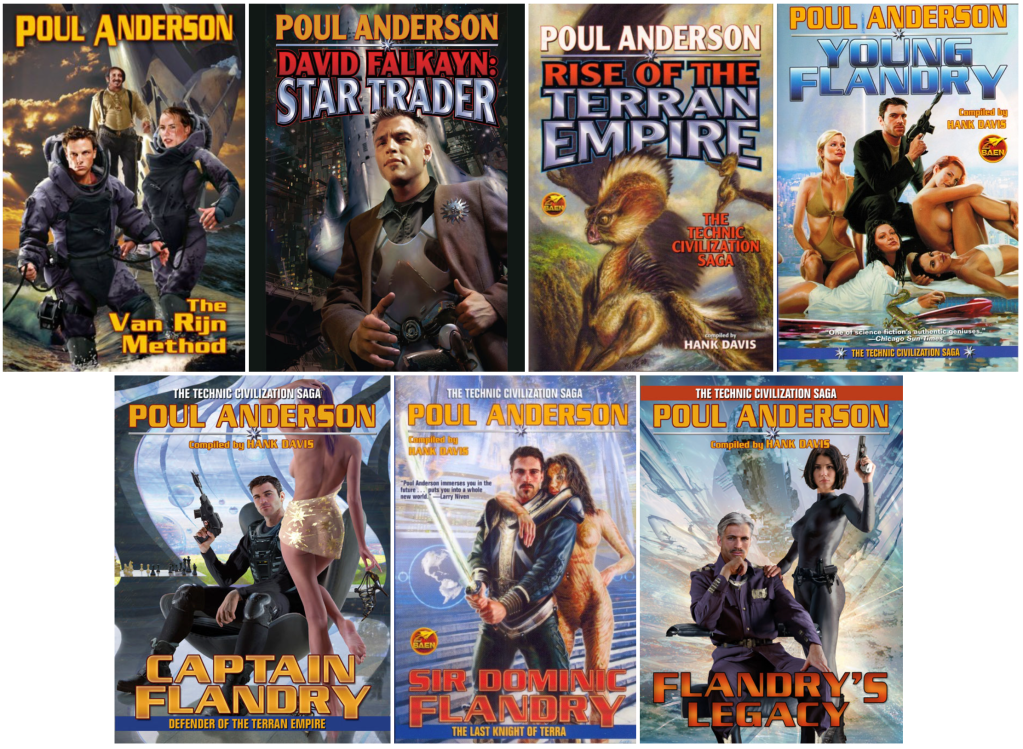
“Starfog” is the last story in the seventh and final volume of the Technic Civilization Saga, the one called Flandry’s Legacy. (Available in paper, ebook, and audiobook at Amazon.) See the ISFDB.org listing of all the Technic Civilization stories here.
Theoretically, “Starfog” might make a good science fiction adventure movie if they could drastically reduce Anderson’s talky dialog and somehow make the characters endearing. I confess that I’ve never felt any emotional attachment to any of Poul Anderson’s characters. His science ideas are often epic, but his political philosophizing gets crusty.
The setup for the story is a compelling mystery. A spaceship is discovered with a crew that appears human, and despite their strange language, seem to have cultural hints of Earth’s past. But they claim they come from a different universe where space is radically different.
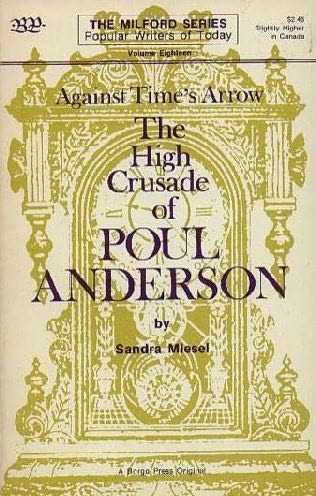
“Starfog” is set five thousand years after Earth achieves space travel according to Sandra Miesel’s chronology of the Technics Civilization stories in Against Time’s Arrow: The High Crusade of Poul Anderson. (You can check it out at Archive.org.) Paul Shackley writes about Miesel’s timeline here and updates it. Baen includes the timeline in the books of the series.
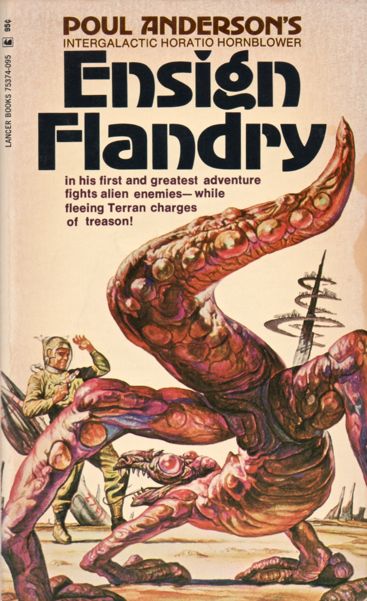
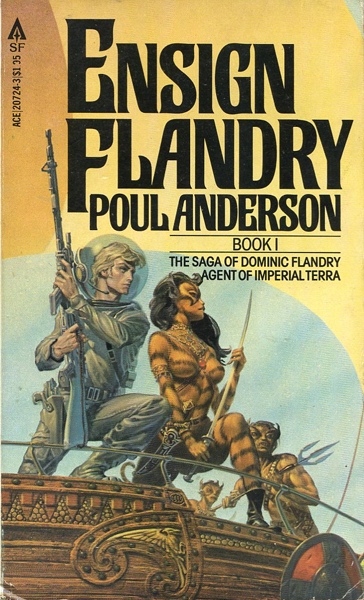
Daven Loure, and his intelligent spaceship Jaccavrie are explorers in a new galactic civilization of humanity called the Commonality. The other stories are about Van Rijn, David Falkayn, and Dominic Flandry written over four decades. I’m afraid the current covers of the books (see above) imply a different feel than the actual stories. However, older covers are just as cheesy.
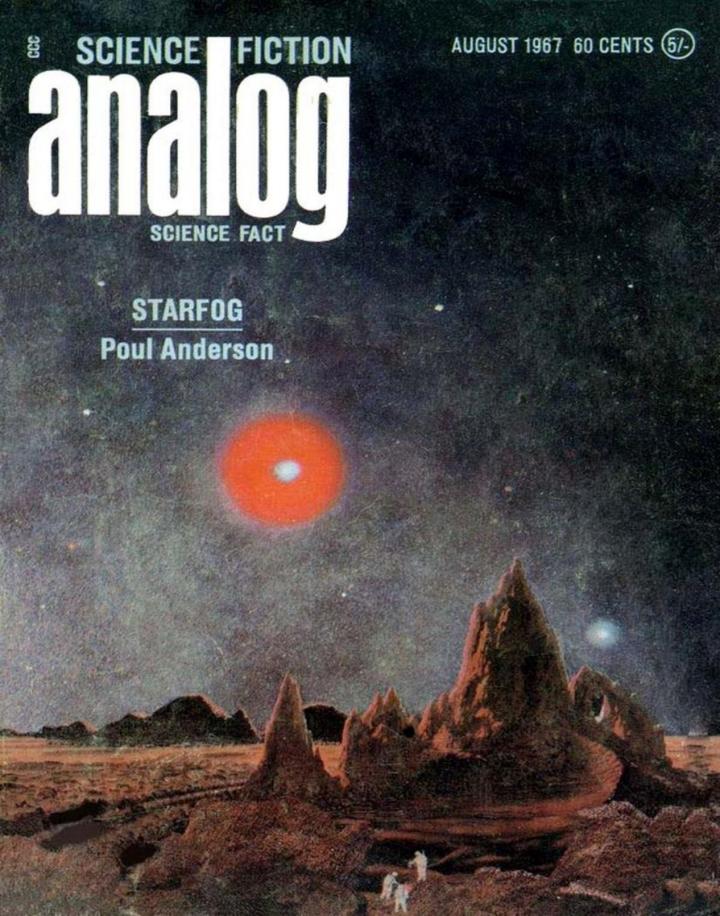
“Starfog” doesn’t come across like these covers. It’s just a little less dignfied than the Analog cover from when it was first published in August 1967.
Although I haven’t read the series but from reading about the various stories, I’m guessing the quality of storytelling is somewhat like Larry Niven’s Known Space stories. I might read more of Flandry’s Legacy, which includes three novels, two novellas, and one novelette in the series.
However, Anderson’s stories don’t fit my current craving for science fiction. Everyday life in 2025 is wilder than fiction, wilder than science fiction. Sadly, “Starfog” just seemed dull in comparison. Events of recent years is making me rethink about science fictional futures. Most science fiction just doesn’t have the cutting edge of our ever sharpening reality.
Most science fiction is perfect for escaping from reality. But I’m craving the kind of science fiction that plays off of reality. Nothing I’ve found lately says anything about our present and near future. We need the kind of vicious writers who can extrapolate and speculate about our exploding society. Sharp tongue writers like Mark Twain, Gore Vidal, Kurt Vonnegut, Barry Malzberg, Oscar Wilde, Aldous Huxley, Jerzy Kosinksi, Dorothy Parker, George Orwell, Joseph Heller, and Philip K. Dick.
We don’t need science fiction that gives us grownup fairytales about the far future. We need writers that cane us about our head and shoulders like a great Zen Master. We need to read books that pistol whip us until we accept reality and reject our delusions.
Science fiction is best when it’s full of wonder. When I first read The Time Machine by H. G. Wells, I was awed by the idea of time travel, but two other ideas wowed me even more. Wells got me to imagine future human evolution and posthumans, and he introduced me to the idea that the Earth would someday end. It was easier to imagine the Earth being created, but it was overwhelming to think about it dying.
Hothouse by Brian W. Aldiss is one of the great works of the Dying Earth subgenre of science fiction. There are various ideas about what constitutes a dying Earth setting. Some people consider it to happen when humanity dies off. I like to think it’s when the Earth is about to be destroyed. That’s the approach Aldiss takes in Hothouse. He tells us the Sun will go nova in a few generations, but Aldiss doesn’t quite take us to Earth’s death
Jack Vance’s famous novel The Dying Earth (1950) is set in the far future, too. The sun is nearing the end of its life, and the Earth and humanity have drastically changed. In The Time Machine, the Time Traveler visits the far future just before the sun, as a red giant destroys the Earth. In The Night Land (1912) by William Hope Hodgson, the Sun Is going dark, and humanity is almost gone.
Only Wells and Aldiss imagined the final productions of evolution. Olaf Stapledon pictures eighteen more species of humans coming after us in Last and First Men (1930). Aldiss imagines a variety of descendants for humanity in Hothouse, all exceedingly small. He also imagines the plant kingdom going bonkers, which reminded me of The Forgotten Planet (1954) by Murray Leinster. That novel was based on three stories, first published in 1920, 1921, and 1953. It was about a world we had colonized. Those explorers eventually evolved becoming tiny beings, competing with giant plants and insects for survival.
I reread Hothouse by Brian W. Aldiss because it was recently released in an audiobook edition on October 15, 2024. It’s a novel I’ve been waiting years to hear. I first read Hothouse in 1996 and thought it was an amazing story full of colorful imagery and adventure. I wanted to see it as a movie because of Aldiss’ powerful visual imagination. After I got into audiobooks in 2002, I wanted to reread all my favorite science fiction books by listening to them. I finally got my wish with Hothouse, with excellent narration by Nick Boulton.
In this fix-up novel, the sun is swollen, and Earth’s rotation is locked so only one side faces the Sun. The Moon trails the Earth’s orbit in a Trojan orbit that keeps it stationary in the sky. Earth is a riot of vegetation that has supplanted most of the animal kingdom. Humans have evolved into tiny beings one-fifth our size, while insects have grown monstrously large. Plants have mutated into countless strange configurations, including those that traverse between the Earth and the Moon on giant webs.
Hothouse is a fixup novel composed of five stories that appeared in The Magazine of Fantasy & Science Fiction in 1961.
“Hothouse” (novelette)
“Nomansland” (novelette)
“Undergrowth” (novella)
“Timberline” (novelette)
“Evergreen” (novella)
Hothouse was originally published in the United States as The Long Afternoon of Earth in a slightly abridged format. At the 1962 Worldcon, the five stories as a series won the Hugo Award for best short story. I prefer the forgotten American title, it’s more poetic.
I thoroughly enjoyed listening to this novel, but it didn’t have the impact it had on first reading. (Imagine watching The Sixth Sense for a second time.) Aldiss produces some wonderful science fictional ideas in this story, ones I won’t mention because that might spoil the story. This is one of those tales you should experience without knowing too much. The story feels like a children’s fantasy with all the funny names for evolution’s new creations, but I believe Aldiss was serious in trying to make it science fiction.
Think of the writing challenge of describing an impossible-to-imagine far future. Jack Vance pictured humans with magical powers as if evolution would eventually create them. Magic makes his Dying Earth stories fun, but not realistic. William Hope Hodgson imagined Earth in darkness where humanity clings to one giant city. I guess Clarke did that too. Aldiss imagines species descendants from us living in another kind of Garden of Eden, a very violent one. We could call it Darwin’s Eden, rather than God’s.
Hothouse is mostly a forgotten classic. I seldom meet people who have read it. Brian W. Aldiss’s reputation and back catalog aren’t well-remembered in today’s popular culture. Now that several of his books have been republished in audio, I’m giving him another chance. I hope other SF fans do too.
My favorite work by Aldiss is “An Appearance of Life” which I’ve reviewed three times. I keep hoping to find more Aldiss stories that impress me as much. Hothouse comes close. So does “The Saliva Tree.” Greybeard isn’t on the same level as those tales, but it’s still thought-provoking.
If you love reading about the history of science fiction, you should love reading Jim Emerson’s series Futures Past. I’ve previously reviewed the volumes for 1926 & 1927, and 1928. In the early 1990s Emerson started this project as a fanzine focusing on the history of science fiction, and published four issues: 1926, 1927, 1928, and 1929 before he had to stop. Then a few years ago when he retired Emerson started over with 1926 and expanded each fanzine issue to a softbound book. The latest volume, 1929, is 222 pages. The largest volume yet. Jim says 1929 should be ready to ship in mid-October. You can order pdf, softbound, and hardbound editions here.
Jim writes all the content, and I’m jealous of his knowledge of science fiction’s history. Each volume contains a Year in Review section that covers science fiction books, magazines, plays, and movies of the year, while documenting the people and events related to that year. But more than, that, Emerson includes in each volume a handful of long articles about the history of specific science fictional subjects that lead up to that year.
For example, the 1929 volume has a ninety page overview of women science fiction writers from 1666-1925. I’ve read a lot of SF history and I didn’t know about most of these books or their writers. Our collective culture forgets so much – why did they forget all these women writers?
Other significant articles include the “Evolution of the SF Name” which unearthed far more old examples of the term than I’ve previously known about. In the “Gernsback Bankruptcy” Emerson explains how Hugo Gernsback lost control of Amazing Stories and immediated create Science Wonder Stories. Hugo was a wheeler-dealer, and somewhat shady. Besides his magazines he had a radio station, and was an early broadcaster of TV. It blew my mind that Gernsback was paying himself $50,000 a year. That was a tremendous salary in the 1920s when the average worker was proud to make $25 a week.
I’ve always been fascinated by the history of science fiction. We tend to live in an awareness bubble that extends from decade or two before we start reading science fiction to when we lose contact with the genre as we age out. I grew up in the 1950s, starting to read science fiction in 1962, but I was reading stories that were mostly published in the 1950s, and some from the 1940s. I’m in my seventies now, but I’ve mainly lost contact with what’s going on in the genre in the early 2000s. Futures Past portrays the genre in the 1920s, and very early 1930s, and it’s very different. Have you ever thought about what being a science fiction fan in the Roaring Twenties?
One reason I like reading about the history of science fiction is discovering what science fiction fans and writers were like before my bubble of awareness began. The genre has changed several time over the course of my reading lifetime. And reading Futures Past shows how science fiction changed several times before it became the science fiction I knew as science fiction in the 1960s. Reading through the descriptions of the SF books of 1929, or the descriptions of the SF books written by women from 1666 to 1925 reveals that people have always had a fascinating with the fantastic and they’ve always speculated about the possibilities. But how they speculated depended on the common knowledge of the day. In 1929, people still thought there were things and places on Earth still to be discovered, including other intelligent beings.
Well, 1929 was also when the first science fiction clubs and fanzines were formed. Fandom arose concurrently with the early days of rocketry clubs, which were sprouting up around the world, and Emerson has articles covering the histories of both. All of that is fascinating to me. The 1920s and 1930s were when my parents grew up. I wonder if they even knew about science fiction.
For most science fiction fans this history will be too far in the past. So far in the past that it’s an alien landscape. They might be shocked by the weird ideas writers used to create their science fiction, such as lost races, hidden species, about prehistory civilizations like Atlantis and Mu, rejuvenation, utopias, eugenics, future wars, spiritualism, the occult, strange mutations, and so on. They just didn’t have the science we do now. And they believed that all the planets of the solar systems and their moons could harbor intelligent life.
With the aid of the internet, The Internet Archive, and YouTube, you can read the futures past science fiction in old books, magazines, fanzines, and watch the old movies. Emerson summarizes every issue from six SF magazines from 1929: Amazing Stories, Amazing Stories Quarterly, Science Wonder Stories, Air Wonder Stories, Science Wonder Quarterly, and Weird Tales, and quickly covers several general pulp magazines that featured science fiction. He also reviews the science fiction books that came out that year too. 1929 will go into public domain in January, but most of the magazines are already available online at the Internet Archive. Just search on the magazine’s name plus 1929. Search for book titles on Google and the Internet Archive. Search for the films on YouTube.
By the way, the YouTube channel, Mars Wants Movies, is running a history of science fiction films, and is currently up to the year 1948. It covered the 1920s in six episodes, and devoted a whole episode to 1929. This makes a great supplement to Futures Past with links to those old movies you can watch on YouTube.
Also, you can read the early fanzines at Fanac.org, including The Comet v. 1 n. 1. mentioned in Emerson’s article on the first science fiction clubs.
Here’s Volume 4’s Table of Contents:
I subscribed to Futures Past when it was a fanzine back in the early 1990s. I was disappointed when it stopped publication at 1929. Jim tells me he’s hard at work on 1930 already, and plans to cover many more years in his retirement. I’m really looking forward to the 1930s. I used to think of the 1930s as the early days of science fiction, but Futures Past shows that the origins of science fiction go way back. Emerson’s etomological search for the origins of the phrase science fiction reveals it began way before Amazing Stories.
“Earth for Inspiration” is a comic science fiction story by Clifford Simak set millions of years into the future about a science fiction writer and his robot visiting a forgotten Earth. The pair go there hoping to find inspiration to write new science fiction stories. You can read it online in the April 1941 issue of Thrilling Wonder Stories.
I read “Earth for Inspiration” by Clifford D. Simak because I read When the Fires Burn High and the Wind is From the North: The Pastoral Science Fiction of Clifford D. Simak by Robert J. Ewald. I bought that book after I read and reviewed A Heritage of Stars by Simak which made me want to know more about Clifford D. Simak. I mentioned my interest in Simak on the Clifford Donald Simak Facebook group and the Ewald book was one of two books about Simak that was recommended. I forgot I already owned the second book, Clifford Donald Simak: An Affectionate Appreciation by Francis Lyall. I haven’t read that one yet because I leant it to my friend Mike who had recently read the twelve volumes of Simak’s short stories. Mike is who got me to read A Heritage of Stars in the first place. I guess that puts me into some kind of inspiration loop.
A Heritage of Stars involved a post-apocalyptic America with few humans and some robots. In that story, most robots had been destroyed except for their brain cases which were saved as trophies after a war with the robots. Unknown to the humans, the robots continued to be conscious inside their brain cases for a thousand years. That idea of a conscious mind without outside sensory data intrigued me. Then I read in the Ewald monograph about “Earth for Inspiration,” involved a dying Earth, robots, and isolated robot brain cases. I had to read it. The story is also included in Simak’s collection Earth for Inspiration and Other Stories: The Complete Short Fiction of Clifford D. Simak Volume Nine. Amazon now sells 14 volumes in the complete stories. Audible.com now offers ten of those volumes in audiobook editions.
Version 1.0.0
Most of the famous science fiction short stories we remember from the 1940s were first published in Astounding Science Fiction. Thrilling Wonder Stories was aimed at younger, less educated science fiction fans, and we seldom see reprints from that pulp magazine. For the most part, its stories are less sophisticated with far more action. And that’s true for “Earth for Inspiration.” I thought it was a funny story, but somewhat simple and hyper paced. It has an old fashion voice because of all old-timey colloquialisms. Simak is known for his pastoral prose and midwest settings.
“Earth for Inspiration” was more fun than I expected to find in Thrilling Wonder. Usually, when we think about robots in science fiction, we think of Isaac Asimov, but I’m seeing how important robots were to Simak stories.
When I read it with my eyes, “Earth is Inspiration” felt like cliched pulp science fiction from the 1930s. However, when I listened to the story after buying the audiobook edition, I thought the writing was much better than my first impression, except for all the saidisms. (I think the worse was — “Look at that, will you!” he jubilated.) The second reading with my ears made me notice how many ideas Simak was using to develop the story. It’s a satire on writing science fiction, maybe even the first example of recursive science fiction.
However, “Earth for Inspirations” gives us a few clues about how Clifford D. Simak thought when comparing them to his other work. The more Simak I read, the more I spot common ideas, characters, and elements that he used and reused.
The Ewald monograph has a few pages of biographical information, almost just a list of dates. Most of the 155 pages describe Simak’s stories and novels. I was hoping to find a biography of Simak, something like William H. Patterson did for Heinlein, but such a book doesn’t exist as a far as I can tell for Simak. Second to that, I was hoping to find an analysis of the impact of Simak’s stories, like what Alexei and Cory Panshin did for Heinlein, Asimov, and van Vogt in The World Beyond the Hill. It’s not that either. When the Fires Burn High and the Wind is From the North, is a standalone journal, volume 73 of The Milford Series: Popular Writers of Today. The content is like Alva Rogers A Requiem for Astounding, which is a description of the stories in all the issues of Astounding Science Fiction in chronological order.
I thought it fascinating that Simak was thinking of robots in the same way in 1941 and 1977. He obviously had a fondness for the idea of robots and had developed an idea of what they would be like early in his career and stuck with it until he died. Robots were faithful servants who were also friends. Simak imagines them with bodies that can break down, but with nearly indestructible brain cases. I assume those brain cases have an internal power supply that could last for millions of years. A couple years ago I read a collection called The Complete Robot by Isaac Asimov. I wonder if Simak has enough robot stories to warrant such a collection?
Reading Simak, we can assume he didn’t like cities or corporations and had a low opinion of mankind’s ability to survive in the long run. Although, “Earth for Inspiration” is set millions of years in the future after humans have colonized the galaxy, but long after we’ve used up Earth’s resources and abandoned it.
The first scene of “Earth for Inspiration” opens with a short tale about a robot named Philbert who became inert after his body rusted up. Eventually, his body rusted away and Philbert lived inside his braincase for millions of years. This reminds me of the Tin Woodsman of Oz.
The second scenes jumps to Jerome Duncan, a once successful science fiction writer who is again getting rejection slips after a successful career. Duncan lives millions of years from now. It’s amusing that Simak thinks science fiction will last that long.
Anyway, Duncan’s robot Jenkins suggests going to Earth to get inspiration for writing a new story. Jenkins is also the name of the robot in City, Simak’s most famous book, a fix-up-novel. Duncan is famous for writing Robots Triumphant. I won’t tell you what it was about because it becomes part of the story.
The next scene has Duncan and Jenkins arriving on Earth with a lot of camping equipment and meeting an old-timer, Hank Wallace, who has been waiting for new tourists for over a thousand years. He manages the Galactic Trainsport station, but no one informed him that the line had been shut down a thousand years earlier. Duncan and Jenkins had hired a private rocket. This points to another idea that Simak loved, that humans would eventually have very long lives. In this story, we last for ten thousand years. And his second most famous novel, Way Station, is about an old-timer who manages a transport station and who doesn’t age. By the way, the old-timer in that novel was named Enoch Wallace.
Should we assume that Simak had been thinking about writing his most famous novels for years?
I don’t think I should tell you any more of “Earth for Inspiration.” It’s a fun enough story so that I shouldn’t spoil it for you. I’ll just hint at a few more scenes. Earth in the far future is dry, and has lost most of its air. There’s a confrontation with humans living in primitive tribes in dry deep sea canyons where the air is thicker. That makes it a dying Earth story. There are slapstick scenes with a crazy robot and another confrontation with horde of runaway robots.
“Earth for Inspiration” has decent humor, although not sophisticated. It would make a great humorous episode for Love Death & Robots. The humor is slapstick Sheckley with a touch of Frederic Brown’s ironic weirdness. I’m not sure if Simak intended it to be entirely comic, although, he probably did, but I bet a lot of young readers in 1941 took it straight realistic action.
My friend Mike and I decided to pursue the same reading goal separately, probably because we each discovered book YouTuber Benjamin McEvoy on our own. We both concluded we wanted to become better readers, diving deeper into the books, to develop a note-taking system, and remember more of what we read. Mike brought it all up with me when he told me about reading A Heritage of Stars by Clifford D. Simak. I told him I would read the same book, develop a note system, and then we could compare notes and methods of taking notes when I finished.
Mike also told me about different videos he was watching about taking notes while reading. One covered writing notes in the book while you read. I could never do that. Another suggested stopping at the end of each page you’ve read and jotting down some notes. That’s too much for me. Another suggested making notes after reading each chapter. That’s the method I’m trying here.
A Heritage of Stars came out in 1977, near the end of Simak’s career, and it’s one of many of his forgotten novels. Simak is most famous for his award-winning books City and Way Station. A Heritage of Stars is currently available on Amazon as a $1.99 ebook, but there’s also an audiobook edition on Audible.com. I don’t recommend you buy either until you’ve read some of my notes. A Heritage of Stars is not a worthy read unless you have the right reading background.
I discovered I already owned the Kindle and Audible edition, but I don’t remember reading either, but my reading log says I’ve listened to it twice, first on 12/1/15 and again on 6/1/16. That’s damn weird that I’ve listened to it twice, just six months apart, and don’t remember it at all.
This makes it a perfect book for this experiment in deep reading. One of my goals for becoming a better reader at age 72 is to at least remember that I read the book, and to remember at least one significant detail about the book. My ambition for developing a note taking system is to write down enough to trigger the memory of reading the book.
Starting this goal at 72 is probably a bad idea since I obviously have a memory problem, but that’s also part of my ambition to improve my memory. I want to read fewer books but get so deeply into them that I remember something about them. I’m tired of remembering reading books in the same way I remember each potato chip I’ve eaten.
What’s even crazier, after doing a web search I discovered I wrote a long review of A Heritage of Stars for the Worlds Without End website. This changes the whole deep reading project. If I can’t remember what I read, then note taking becomes more important. I’ve thought in recent years that maybe I need to make a wiki of my thoughts as an external memory. I’ve started using Obsidian, a note taking program that hyperlinks ideas, but I’ve only piddled with it. Obviously, I need to get serious and use it faithfully. This is not the first time I’ve discovered I read a book and wrote a review and completely forgotten both. It’s not even the second or third time. I’ve lost count.
My plan for this essay is to read A Heritage of Stars and take notes chapter by chapter giving a synopsis, my reaction, and maybe some quotes. I’m going to use screenshots for quotes to say me typing. I wish I could write concise synopses like I see in Wikipedia, but that’s going to take some time to train myself.
A Heritage of Stars
Chapter 1
This sets up the story as a post-apocalyptic novel. It also zeroes in on the theme that our civilization is long gone and we’re mostly forgotten. What people know of us is more like the histories of Herodotus or myth.
The image of pyramids of robot brain cases is quite striking. It suggests the collapse might have been due to a war with robots, making this novel a little more appealing to today, since real robots are just around the corner.
Chapter 2
We’re introduced to Thomas Cushing, who farms potatoes. Times are tough, he must fight potato beetles by hand and worries that roving bandits will steal his crop. Food is limited.
Thomas Cushing is also a writer and scholar, who studies Wilson’s history, which was written in ancient times. Cushing has access to Wilson’s notes and contemplates a myth that Wilson left out of his history, one about “the Place of Going to the Stars.”
Cushing is at a university and has access to the library stacks. It might be the last university left, and it’s protected by fortified walls and geography.
Thomas was sponsored by Monty and Nancy Montrose, becoming their unofficial adopted son. As Cushing became a scholar he became obsessed with Wilson’s history, especially about the Place of Going to the Stars.
This chapter reminds me of A Canticle for Leibowitz. Cushing lives a kind of monastic life, doing subsistence farming while also working as a scholar by candlelight reading ancient books. This is one of my favorite themes in science fiction, where people thousands of years in the future try to figure out what our civilization was like.
Chapter 3
We learn that Wilson’s first name is Hiram, and he started his history on the first day of October in 2952 at the University of Minnesota. That’s a thousand years into our future, but our civilization had collapsed five hundred years earlier. Hiram Wilson writes this in his introduction to his history:
We also learn that nearly all texts concerning technology, and any references to technology in other books were destroyed. Wilson is piecing together from scant sources what our technology must have been like. He says the censorship over technology came from extreme fanaticism and hatred. He figured the collapse was due to the depletion of non-renewable resources, pollution of the environment, and massive unemployment. He also deduces that our civilization got too big to manage, especially the corporations and governments. Evidently automation and robots were involved, and there was a revolt. The rebellion destroyed the robots and technology. This caused the collapse that killed billions, and mankind went back to subsistence farming, simple villages, and nomadic raiders. Isolated communities survive behind walls while chaos ruled beyond the walls. Wilson struggles to survive at the university. Evidently some universities were able to create protected communities so mankind could survive the new Dark Ages. Often the universities were the target of attacks and they were destroyed or reduced to tiny enclaves.
This reminds me of The Stars Are Ours by Andre Norton, which was about a post-apocalyptic religious society that hated all science. It also reminds me of The Long Tomorrow by Leigh Brackett.
Chapter 4
We learn that Monty’s full name is Dwight Cleveland Montrose. That Monty and Nancy’s dead son would have been the same age as Thomas Cushing, but he had died of measles, along with sixteen other people in the enclave.
The three talk about the Place of Going to the Stars. We learn that our civilization had gone to the Moon and Mars, and maybe to the stars. Monty and Nancy let Thomas know they understand why he wants to leave and search for the Place of Going to the Stars.
The old couple say they wanted Thomas to stay with them but could see he was restless to find out about the Place of Going to the Stars and suggests he get it out of his system.
Thomas tells the old couple about how he grew up where the farming, fishing, and hunting was good, and he lived in a small community. It’s very prosaic. It describes a way of life that I imagine Clifford Simak did growing up in Wisconsin where he was born in 1904. But we eventually learn that Tom’s family all died. From stories his grandfather told, Thomas learned of the university enclave. After his grandfather died, Thomas traded the farm and left, taking to the road, and leading a life of “woods runner” at age sixteen. But finally remembered the university and went there. Now, he was ready to go roaming again. I figure Thomas is about 21-23.
Chapter 5
The point of view shifts to two aliens, #1 and #2. They refer to the Ancient and Revered (A and R) who is a robot. #1 insists that humanity has reached a decline that it will not recover from. #2 says there might be more than meets the eye because of their interviews with the robots on Earth. #1 replies the Earth’s robots are not reliable because they are incoherent telling meaningless stories.
Of course this reminds me of Simak’s classic fix-up novel, City, where dogs and robots remain on Earth after humanity has gone off to the stars.
Chapter 6
Thomas Cushing is on the move. He silently travels at night across a river, and up a stream to an abandoned city. There he follows a road until he is almost killed by an arrow shot from a device set off by trip wire. After that Thomas must travel over the rough land of decayed houses, fallen trees, and worry about the pits of old basements.
Thomas hears drumming and sounds of a tribal celebration. He sneaks up on their fires and sees primitive dancing around a pyramid of robot skulls. This scares Thomas and he backs off, sneaking away as fast and far as possible. He takes shelter in a depression hidden by a thicket of trees near an abandoned mansion, one that had obviously been looted many times long ago.
I think it’s significant that the city is collapsed and decayed. Simak often writes science fiction about people who live away from cities. In the first City story, written in the 1940s, Simak predicted that our society would spread out and abandon cities because of the helicopter.
There is a common thread in post-apocalyptic stories, a fantasy to live without people, or at least many people. That for readers who love this sub-genre, they have a secret desire for civilization to go away.
When Thomas leaves the thicket the next afternoon an old woman is waiting for him. She calls herself “Ole Meg, the hilltop witch.” She claims she sensed Thomas sneaking through the woods. She tells him he has the mark of greatness. Meg informs Thomas that she is coming with him, along with her horse Andy, and Thomas adamantly refuses. But as we learn in chapter 7, they all go off together to avoid the approaching horde. Meg knows a lot, and has powers.
Chapter 7
We are now in The Wizard of Oz territory. Thomas Cushing is off to see the Place of Going to the Stars and he’s acquired company for his quest, a witch with magical powers and friendly horse.
Chapter 8
This reminds me of all the young adult science fiction I read as a kid that was first published in the 1950s, the Heinlein juveniles, all the early science fiction of Andre Norton, and the Winston Science Fiction series. Of course, it also recalls The Hero With A Thousand Faces by Joseph Campbell about the hero’s journey in storytelling.
Again, this story reminds me of The Wizard of Oz. Thomas is Dorothy, Meg is the Scarecrow, Andy is nothing yet. Soon we will meet the Tins Woodsman.
Simak would have been around seventy-three when he published A Heritage of Stars, around my age right now. Who was he writing for? Is it an escapist fantasy he thought readers wanted, or was it a daydream that he enjoyed himself?
Chapter 9
Thomas scouts ahead leaving Meg and Andy hidden. There’s a nice scene of Thomas observing nature including a fox, deer, and a badger. He also spots a band of twenty riders heading east. This scene is one of two in the book that I thought was well described. For the most part, Simak doesn’t spend much time describing scenes or developing his characters.
Thomas Cushing knows the raiders are heading towards the town where he saw the dancers, figures they plan to sack them. Returning to Meg and Andy, Thomas hears a voice call him for help. It turns out to be a robot named Rollo trapped under a fallen tree because of a tornado. This really is getting into The Wizard of Oz territory. Rollo even has rust problems and has survived for hundreds of years because he’s learned to make lubricant from bear fat. Simak was known for his robots, and this paragraph recalls old science fiction stories. Is Simak trying to recapture his own past?
Like Baum’s Tin Woodsman, Rollo didn’t want to kill humans or animals. But to survive, he defended himself in a bear attack and broke his programming when he killed the bear.
Chapter 10
This chapter is from the perspective of trees. Simak is mystical here.
We’ve had one chapter with two aliens observing us, and now we have a chapter with trees. Civilization is gone. Technology is gone. Humans are roaming bands of plunderers, tribes of living off the land like Native Americans before Europeans, and monastic enclaves of scholars.
Chapter 11
In this chapter Rollo tells us about his past. He was a yard robot before the fall, but he has lived for centuries by avoiding humans for the most part. Rollo is excessively talkative, from all the loneliness. Rollo confirms the stories Thomas has heard about a Place of Going to the Stars. He’s able to give a few additional details, that it’s out on the Great Plains atop Thunder Butte.
Chapter 12
This chapter is another excerpt of Wilson’s History. It’s about psychic powers. ESP was a cherished topic of 1950s science fiction. It was equated with evolved humans. Wilson suggests that our scientific society suppressed psychic abilities, and now that our technological civilization is gone, they have reemerged.
Chapter 13
Rollo tells us about the collapse, how after the collapse humans started destroying the robots, and eventually how people started collecting robot brain cases. He even carries a brain case he’s found. Here we learn something special.
Where is Simak going with the story? Is it just a book he’s thrown together to make another sale, one which is assembled from standard off the shelf parts? Simak dies in 1988, eleven years after this book was published. He’s essentially living in the last decade of his life. Is Simak making a philosophical statement about science fiction in this novel? Or was he like Robert A. Heinlein, who would also die in 1988, writing personal fantasies for his own pleasure? Heinlein’s last books recycled all his old favorite characters he had created. It seems like here, that Simak is recycling all his favorite science fictional concepts. Or do old writers get to a place where they can’t create anything new?
Cushing, Meg, Rollo, and Andy must hide from marauders, about forty strong. After the horde leaves, Cushing finds a leather pouch left behind. It contains some knives, a children’s book, and four maps. One of them shows where Thunder Butte lies, the place Rollo believes is where the Place of Going to the Stars is located. This is another hard-to-believe coincidence in this story, and they eventually stack up.
Chapter 14
The group is crossing some rough land without water. At one point Cushing offers his buckskin pants to make water bags, but the others say he shouldn’t risk weather exposure on the chance they could carry some water. This chapter is about hardships, dealing with heat, drought, rattlesnakes, lack of food, and so on. The Shivering Snake that follows Rollo stays with them now, and they are trailed by shadowy shapes they start calling the Followers who Meg says will eat their souls and minds. Rollo’s bear grease is running out and he hopes to find a grizzly bear. This chapter is full of woo-woo stuff.
Then they come across an old man and his granddaughter. They find the old man, Ezra, standing in a hole staring at sunflowers. It turns out the old man talks to plants, and his granddaughter, Elayne, is some kind of weird psychic. So the motley crew grows to seven.
I have to wonder if Simak was influenced by the New Age book called The Findhorn Garden that came out in the 1970s. I remember people back then talking about plants having consciousness.
Chapter 15
This is another transitional chapter where we mainly learn more about Ezra and Elayne. We also learn that Rollo only wants grizzly bear fat, and now black bear or deer. Thomas tells him all animal fat is the same, but Rollo seems to prefer grizzly bear because they are fierce fighters, and he feels killing an animal should involve some risk to himself.
The Tin Woodsman in The Wizard of Oz did not eat meat and wouldn’t kill animals, or even insects.
Chapter 16
The group finally reach Thunder Butte by are met by five wardens who guard it. The wardens believe for centuries they are the designated guardians of Thunder Butte where strange beings sleep. The sleepers are destined to take over the world from men, so they don’t want anyone to awaken them. The wardens say Thunder Butte is also guarded by intelligent trees and rocks that can move.
Ezra tells the wardens that he can talk to the trees, and they will let them though. It’s quite a coincidence that Cushing and comrades found a person that spoke tree. I wonder if Simak was into plant consciousness. In the 1970s, there were lots of New Age theories about that.
By luck (or coincidence) a grizzly bear attacks the wardens and their horses, and they run off. Rollo, Cushing, and Andy kill the bear, and head towards the trees guarding the Butte.
Chapter 17
They make it the trees that block their way, and the living rocks circle behind our troop of characters. Ezra can talk the trees into letting them pass, which disturbs the wardens who have regathered back a way to watch. There is a bit of mystical mumbo-jumbo. Makes me wonder if Simak was a New Ager himself, or was he just using these ideas because they were popular with young people and the counter-culture.
Chapter 18
This is another transitional chapter where our characters talk philosophy amongst themselves and ponder what has happened to them so far.
Then they discover cylinders hovering above them. They have lots of eyes, but no mouth, yet they broadcast strange speeches to the group.
This is weird gobbledygook. However, it will make more sense when it’s explained in a later chapter. But what is your guess now? Our heroes suffer from all this machine chatter, and again do a lot of speculation amongst themselves.
Chapter 19
Next, our heroes head up the butte towards the buildings they’ve spotted.
Our group finally meets the aliens #1 and #2 that we encountered in that early chapter. They call the aliens collectively, The Team. The aliens tell our humans how they are explorers studying collapsed technological civilizations. One of them believes such civilizations never recover, and the other wonders if it might be possible. They mention the Ancient and Revered, a robot that’s been teaching them about Earth. Our group asks about meeting the A & R, but the aliens tell them it’s hard to get an audience with him. Do I have to say it again? (The Wizard of Oz.)
Chapter 20
Our group explores the outside of the city trying to find a way in. There is a lot of speculation about the city, and history. Cushing finds an immense door. He goes in a way and finds hundreds of shining snakes. He tries to go further in, but can’t. Elayne comes up behind him and tells Cushing that they are standing on the edge of eternity.
This reminds me of Methuselah’s Children by Robert A. Heinlein. At one point, Lazarus Long and gang meet aliens that are so far ahead of humans that meeting them directly face to face causes humans to go insane. Back in the 1940s and 1930s, some science fiction writers worried about meeting advanced beings. But that stopped for the most part in Astounding in the 1950s. Various writers have said that John W. Campbell, Jr. didn’t like the idea of any aliens being superior to humans. Simak, in 1977 hasn’t given up on that idea.
Then a cylinder appeared and informed the group that A and R would like to meet them.
Chapter 21
Three days later, we still haven’t got to meet the Wizard. The Ancient and Revered. But first the group has another conversation with the aliens, #1 and #2. The aliens want to know how humans could imagine being replaced by a later evolved species. The aliens haven’t found that to be a common realization.
This is one of my favorite science fiction themes, but it’s seldom explored in SF.
This chapter goes on with more effort to explore the city, and more conversations with the aliens. Ezra learns that the guardian trees are from outer space. I had already assumed that. The group ponders that. And the living rocks. A lot of this pondering is things I’ve already assumed. Did Simak think only people who didn’t know much about science fiction would be reading this book?
Chapter 22
This chapter involves a long psychic session by Elayne trying to break into the city. She fails. Then Meg tries. She makes psychic contact that she describes as a million little bugs.
Can you guess what this is? I did. I won’t say yet.
At one point, Rollo gives Meg the robot brain case he owns to act as her crystal ball. The robot inside the case combined with Meg’s psychic ability finally contacts the Ancient and Revered. He invited them in.
Chapter 23
The A and R explains everything. The cylinders are space probes returned from the stars, each reporting what they found. Their findings are stored in a giant database, which is what Meg had contacted. The A and R has no machines left that can retrieve information from the database. However, the group figures with more psychics like Meg and Elayne, each with a robot brain case, they could mine the data and start rebuilding civilization.
We learn about the fall of civilization. Our efforts to explore space. And the state of the world. We learn that the A and R has a library that hasn’t been censored of technical information. The group decides they also need to find people who can read.
Chapter 24
Short chapter where Cushing argues he alone must confront the wardens.
Chapter 25
This is a nice chapter. It’s also the second example of good description that I mentioned earlier. Simak also wrote westerns, and you get a feel for that here as Cushing walks into the camp of the wardens. It’s a shame this story didn’t have more of this kind of writing.
There’s a lot of action in this chapter, but ultimately, they fail to convince the wardens to help.
Chapter 26
Everything wraps up here, and it’s incredibly positive and gung-ho. They return to Cushing’s old university to get people who can read. But they still worry about technology.
Most of Simak’s science fiction had an anti-technology feel to it. The Heritage of Stars is an interesting book to read today since civilization is heading towards a collapse just as we’re about to give birth to AI and intelligent robots. This novel is relevant to today, but I also think it might be too dated. The New Age died back in the 1970s. There are esoteric believers still around, but they aren’t common.
Final Thoughts
This novel touches on many of the themes in science fiction. It’s almost like a New Testament of science fiction because of its faith in science fictional ideas. But it’s also transcendental, suggesting there’s more to outer space than stars and planets. There’s a lot of woo-woo in the book.
I’ve read all the Oz books when I was a kid. Back in the 1950s some libraries started banning Oz books because librarians felt those books gave young people unrealistic expectations about life. I completely agree because I embraced those unrealistic expectations when I read the Oz books. And I believe science fiction also promotes the same unrealistic expectations.
I believe The Heritage of Stars is Clifford Simak’s version of Heinlein’s The Number of the Beast. Both books are flawed. Both books are personal fantasies by fantasy writers that reference their own work and the formative fiction they read as kids growing up.
James Wallace Harris, 9/10/24
p.s.
I reread my original review and its very similar to what I’ve written here. I did make at least one mistake. I thought #1 and #2 were robots. On this reading, I don’t think they are. I also thought I’d remember this book, but I didn’t. I did predict I would return to it someday, so I was right on that account.