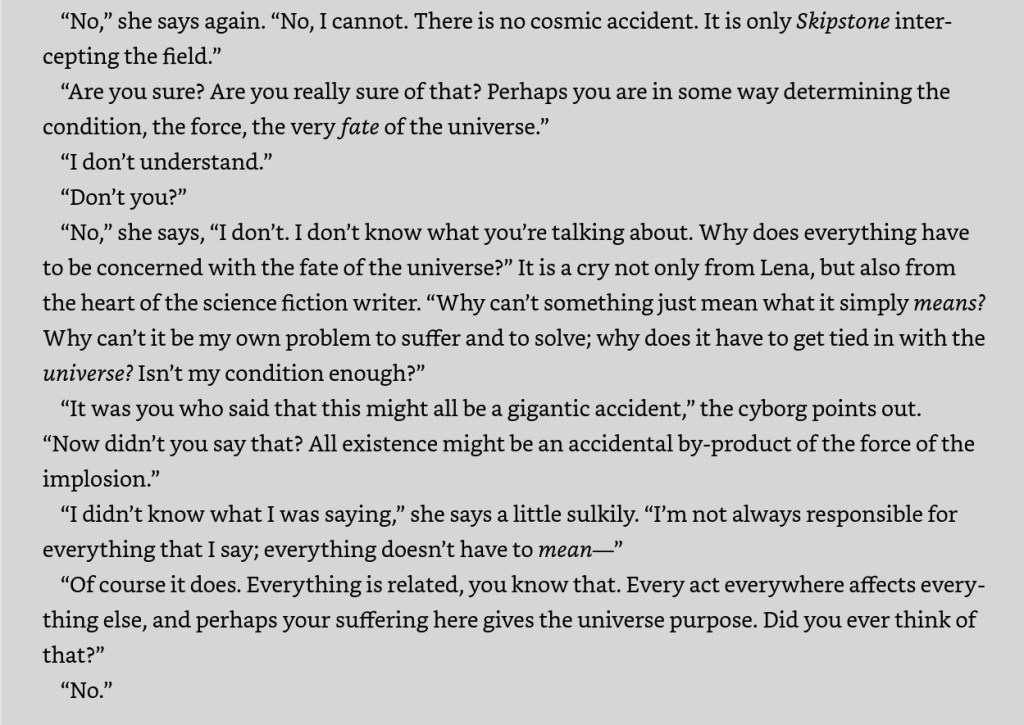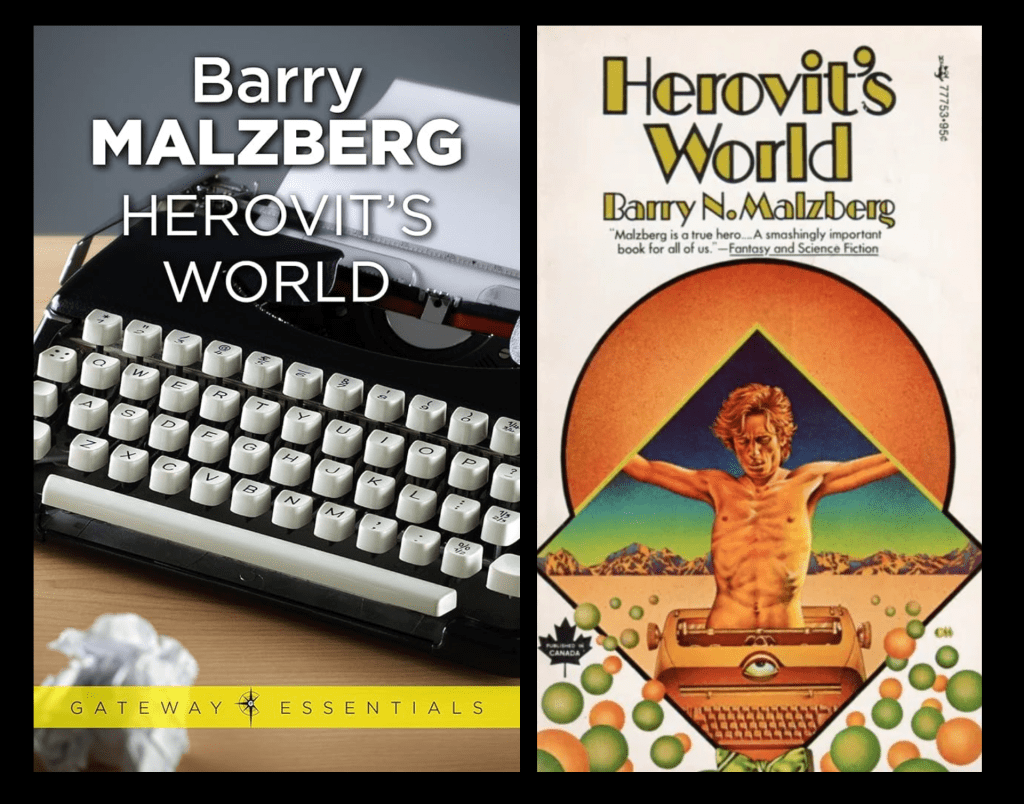
HEROVIT’S WORLD by Barry N. Malzberg

Back in the 1960s when other teens fantasized about becoming rock stars, playing for the NFL, or being seen on the silver screen, I dreamed about becoming a science fiction writer. After reading the 1973 satire on science fiction writers, Herovit’s World by Barry N. Malzberg, I see that I was much better off working with computers at a university for thirty-five years and retiring with a pension. You can currently buy the Kindle edition for $1.99. But read my review carefully before you risk even that little money. It’s a good read for only certain kinds of science fiction fans.

Barry N. Malzberg died on December 19, 2024, at 85. Although prolific, he was never a famous science fiction writer. Malzberg’s most successful books were written in the 1970s, and Barry is mostly forgotten today. He is getting some attention on YouTube as a few reviewers rediscovering him. Malzberg has a reputation as being the curmudgeon of science fiction. Malzberg often relies on satire, but his stories were never fun like the satires of Kurt Vonnegut. Malzberg wrote dark, edgy, and psychological fiction like Philip K. Dick, but he never developed a cult following.

Recently, Bookpilled on YouTube declared that Malazberg was his new favorite science fiction writer. Bookpilled skews towards literary and dark SF, often from the 1970s. But to be honest, Malzberg is very hit-and-miss. Joachim Boaz, a true connoisseur of seventies science fiction, found little to love in The Many Worlds of Barry Malzberg. Boaz considered most stories good but rated “Death to the Keeper” brilliant. Boaz also called Malzberg’s most notable novel Beyond Apollo brilliant, giving it a 5 out of 5 rating.

Be sure to read MPorcius’ extensive review who believes Herovit’s World was overpromoted by Robert Silverberg and Harlan Ellison, but he did like it a lot.

And if you pay attention, Malzberg is mentioned occasionally on YouTube, print reviews, blogs, and podcasts. Three years ago, the biographer Alec Nevala-Lee interviewed Malzberg for two hours.

Herovit’s World is a short novel, 160 pages in paperback, and just under six hours on audio. Jonathan Herovit, our protagonist, has written 92 science fiction novels in the past but struggles to finish his latest book. It’s overdue. He only has thirty pages and his editor is hounding him. His wife is hounding him. He’s stuck in a small apartment with a new baby who cries endlessly. Herovit is approaching forty, well on the road to being an alcoholic, depressed, delusional, and coming apart mentally.

Herovit wants to be like Mack Miller, the fictional action hero of his endless Survey Team novels. Herovit wants to be like the decisive Kirk Poland, his alter-ego and pen name for his books. Jonathan Herovit has turned Kirk Polan into an imaginary friend, one that’s become an abusive second personality.

Malzberg uses this novel to satirize editors, publishers, authors, readers, fans, conventions, writer conferences, writer associations, and the science fiction genre. We never know if Herovit’s World is autobiographical. Herovit is self-loathing. Is this Malzberg confessing his own feelings, or just creating a character. But if you read Malzberg’s three books of essays, The Engines of the Night: Science Fiction in the Eighties (1982), Breakfast in the Ruins (2007), or The Bend at the End of the Road (2019) you’ll get the feeling that he did use his own life for inspiration.

Malzberg is confusing. He has stated that he loves science fiction and the genre. Listen to the podcast above. But science fiction also depressed him, even tormented the poor guy. Herovit’s World is recursive science fiction. That is science fiction about science fiction. Often recursive science fiction is fun, even zany, like What Mad Universe by Fredric Brown or God Bless You, Mr. Rosewater by Kurt Vonnegut. Herovit’s World is full of creative ideas and psychological observations, but they’re not fun. Malzberg feels more like Kafka.

Malzberg and Herovit are hack writers. They pride themselves on cranking out any style or type of fiction and getting paid for first drafts. However, Herovit’s World reads quite well. It has its literary aspects and is full of fun experimentation. I’m glad I read it even though it’s about an unhappy man going down the tubes. And it does make you think about science fiction.

Malzberg was several years younger than Herovit. Herovit’s writing career began in the 1950s, while Malzberg started publishing in the 1960s. Herovit remembers the science fiction magazine boom of 1953. Herovit was a disciple of John Steele, who I assume is based on John W. Campbell. So is Malzberg really making fun of 1950s science fiction? At one point in an argument with his wife Janice, she gives a bit of a speech which might be the key to the whole story:
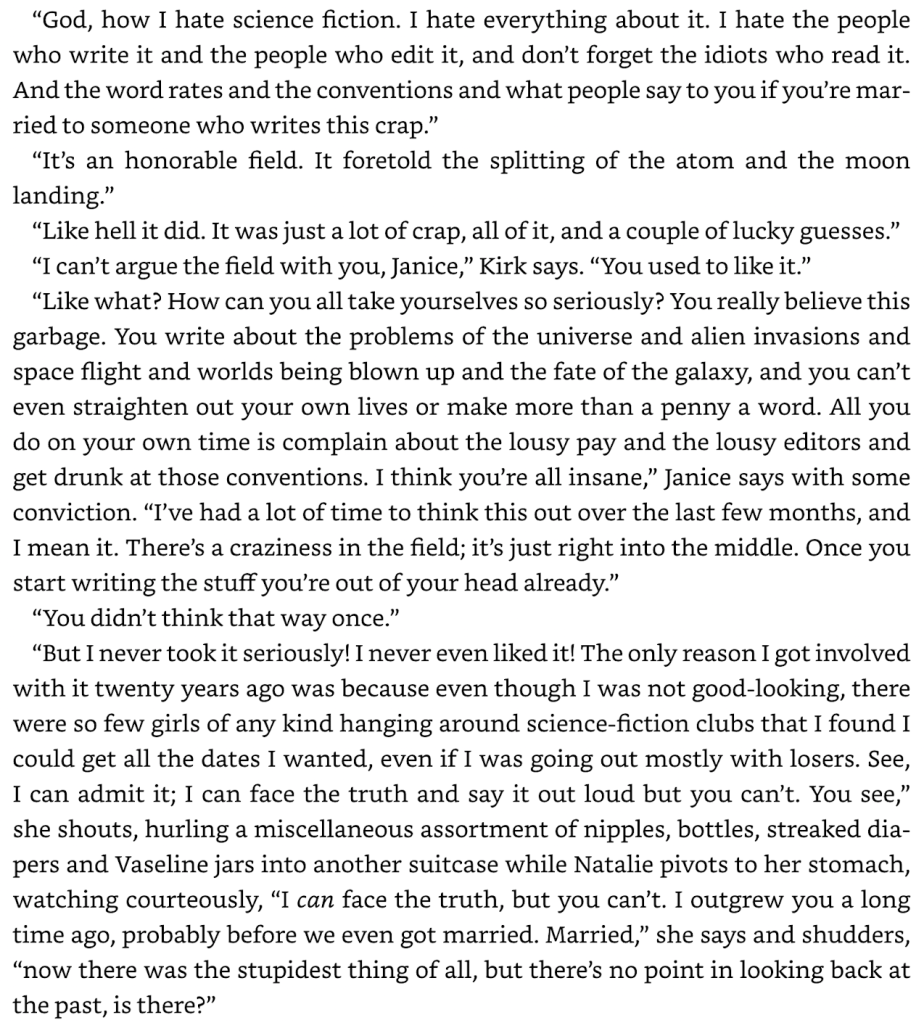
I also remember when there were very few females at science fiction clubs and conventions. Boy have things changed. We must acknowledge that Malzberg skewers SF of the 1950s or 1960s in Herovit’s World. But we should also ask: “How would a disgruntled SF writer skewer the genre today?”

There is a dream sequence late in the novel where Herovit is having tremendous sex with a college coed. He had been invited to a conference and the coed approached him telling Herovit that Kirk Poland was her favorite writer. It turns out she was paid by the university to seduce Herovit so he could be studied for academia. Science fiction was getting noticed by the academic world in the early 1970s. Many writers and fans felt vindicated. However, other writers claimed science fiction was better left in the gutter. Malzberg uses this scene to give his opinion:
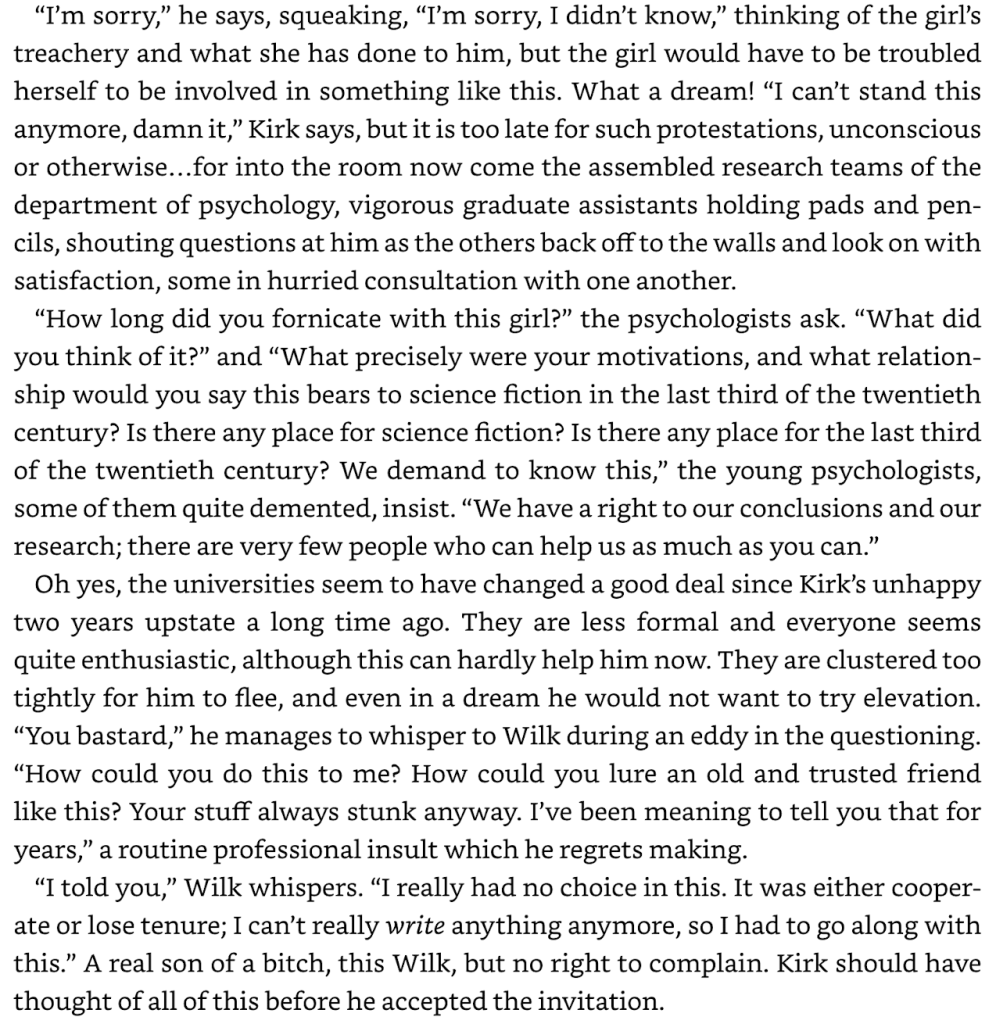
Herovit and Malzberg regretted giving so much of their creative effort to a genre that gets so little respect. They know they are writing escapism for adolescents. I think the genre has changed a lot since the 1970s. It does get more respect and it’s taken more seriously, probably because it deserves it. However, some of Malzberg’s criticisms might still be true, especially once you analyze why certain stories and themes are so popular with science fiction fans.

A good deal of Herovit’s World is about marriage. Herovit routinely cheats on his wife at science fiction conventions and neglects her at home. I’ve heard plenty of gossip about science fiction writers at conventions and conferences. But there is a non-SF connection here. There are many literary novels about blocked writers and failed marriages. I can’t tell if Malzberg is satirizing them too, or padding his SF novel. Both Herovit and Malzberg have bragged about being able to pad their fiction. My favorite novel on this theme is Wonder Boys by Michael Chabon, who writes in literary and SF genres.

Herovit’s World also contains a lot of sex. Malzberg got his start as a writer cranking out soft-core porn paperbacks. I don’t know if he’s saying that science fiction writers are sex obsessed, or sexually frustrated, or if he was merely padding his story because he didn’t have enough to say about science fiction to fill out the novel length. I do know that Portnoy’s Complaint by Philip Roth had come out a few years earlier and had become a bestseller dealing with sex honestly. As they say, “sex sells,” and Malzberg was hoping to break out of the science fiction ghetto.

Overall, Herovit’s World is mildly amusing. Most readers at Goodreads give it three stars, but a few love it giving it five stars. My rating would be ***+. I thought it was written well enough (***) and I liked it (+), but I wouldn’t ever reread it. That’s my main problem with Barry N. Malzberg. His books are interesting, but they never reach my next rating level. I give **** to books I know I’ll want to reread.

If Herovit’s World was less padded with sex scenes and had more satire about science fiction, it could have been a **** novel with me. If Malzberg had tried harder, gone beyond a first draft maybe, and really thought about the purpose of this novel, it could have been far better.

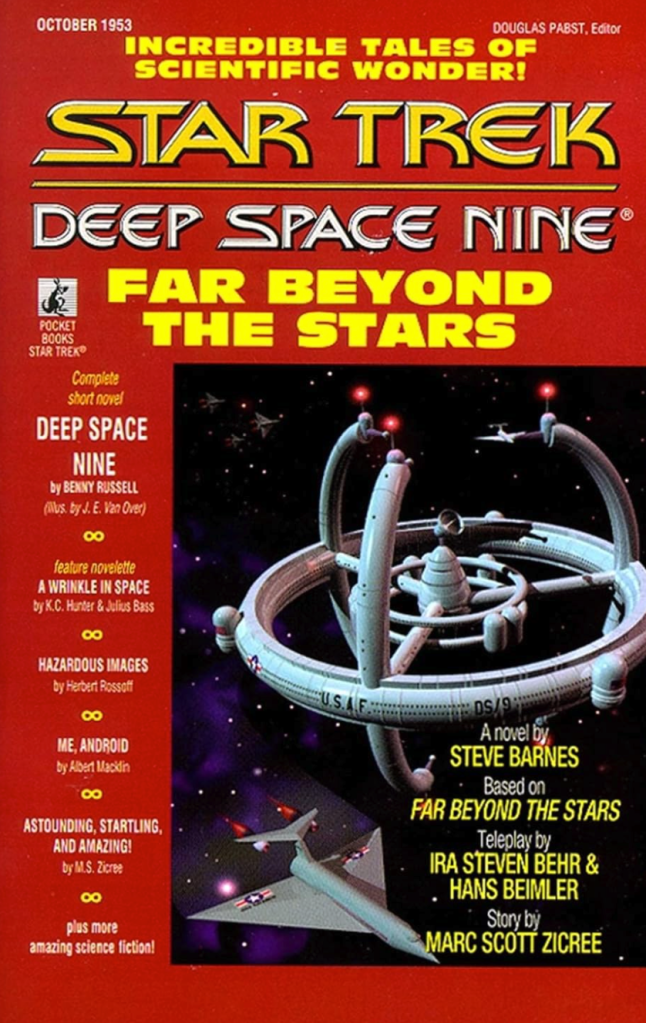
Malzberg focused on the pathetic without ever showing what we love about science fiction. His novel could have been elevated by showing Malzberg/Herovit’s passion for the genre. Far Beyond the Stars by Steven Barnes is a recursive science fiction novel that does just that. The story is a novelization of a Star Trek: Deep Space Nine episode where the DS9 crew are shown working at a 1950s science fiction magazine much like Galaxy Science Fiction. The story criticizes the racism in the genre back then yet still shows a love for science fiction.
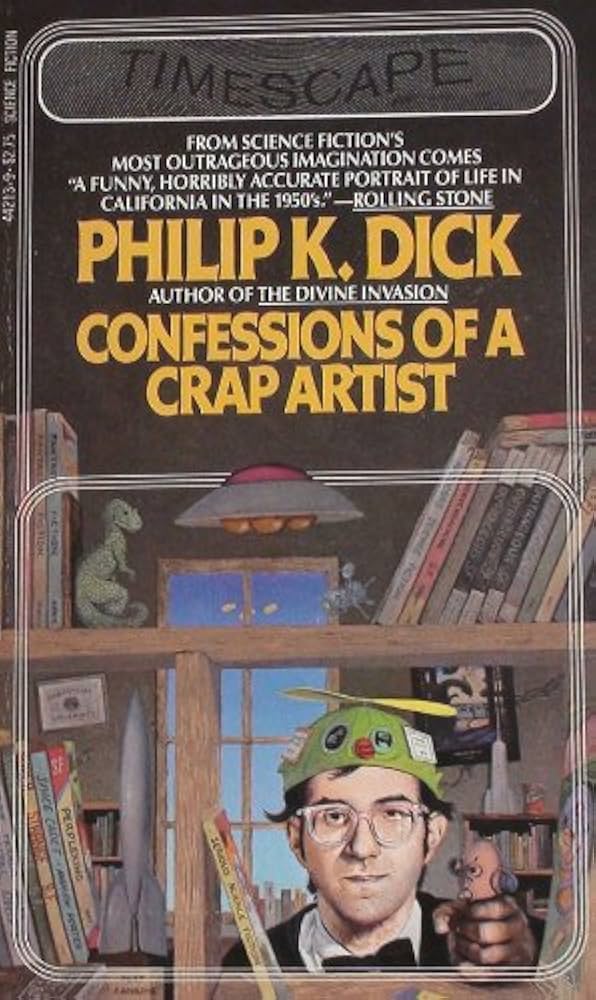
No matter how much I criticize science fiction, I can never forget how much Heinlein’s juveniles meant to me as a kid. I could write a satire on the genre, but I hope I wouldn’t do what Malzberg did in Herovit’s World, by making it all feel slimy and depressing. One reason why my favorite Philip K. Dick novel is Confessions of a Crap Artist is even though it criticizes science fiction fans, it does it with love. It’s a superior recursive science fiction novel.
James Wallace Harris, 2/11/25

“Evensong” by Lester del Rey

For me, the most rewarding pages of Dangerous Visions were the introductions by Harlan Ellison and the afterwards by the authors. When I first read this anthology back in the late 1960s, I felt those introductions gave me insight into the family of science fiction writers, one I wanted to join. At the time I was sixteen and I totally bought Ellison’s enthusiasm and promises. Fifty-six years later, I reacted to this anthology and its stories very differently.

Ellison honors del Rey by putting his story in the pole position, and he praises his friend and mentor Lester for being a giant of the genre. Back in 1968, Lester del Rey was not a major figure to me. I had read some of his Winston Science Fiction juveniles, but unknowingly, because they were published under his pen names. However, one had his name on the cover, Marooned on Mars. It wasn’t a standout, and I didn’t remember he wrote it. Lester del Rey was not a giant in the field to me. Later on, I’d discover he wrote “Helen O’Loy” and “Nerves” when I read The Science Fiction Hall of Fame anthologies. I don’t think Lester del Rey was ever a great writer of science fiction, but he became a great editor and publisher.

Ellison hyped Dangerous Visions for publishing stories that editors couldn’t or wouldn’t because they contained ideas that challenged the norms of society, or were too mature for the typical youthful science fiction reader, or were written in creative styles that average science fiction reader would reject.

“Evensong” is about hunting down a fugitive. That fugitive was God. At sixteen that excited my young atheist mind. But at seventy-two, it felt like Mad Magazine’s Alfred E. Neuman saying, “What, me believe?”

Was that really a dangerous vision that no publisher would accept? Then how could Fred Pohl publish del Rey’s “For I Am a Jealous People!” in Star Short Novels in 1954? In that story, mankind is fighting aliens and learns that God has sided with the enemy, so humans declares God is their enemy too. In other words, del Rey gave Ellison a dangerous vision that he’d already used years earlier.

That’s something I keep finding as I reread Dangerous Visions. Ellison was wrong that science fiction publishers wouldn’t take them. It made me wonder if Ellison could have assembled a reprint anthology called Dangerous Visions and collected all the science fiction stories that were published that had been quite startling for the times. Many classics come to mind that I think had more impact than those in Dangerous Visions, such as “Fondly Fahrenheit” by Alfred Bester and “Lot” by Ward Moore. I also think “For I Am a Jealous People!” is a better story than “Evensong.”

Ellison quotes del Rey’s letter to him about the afterward he wrote for the anthology. I thought this part was rather telling:

The afterword isn’t very bright or amusing, I’m afraid. But I’d pretty much wrapped up what I wanted to say in the story itself. So I simply gave the so-called critics a few words to look up in the dictionary and gnaw over learnedly. I felt that they should at least be told that there is such a form as allegory, even though they may not understand the difference between that and simple fantasy.

I was bothered that del Rey didn’t think critics wouldn’t know what an allegory was and couldn’t tell it from fantasy. That suggests del Rey felt a naive self-importance about his writing. But I also felt that Ellison showed a naive sense of self-importance about Dangerous Visions.

Allegory always seemed to me to be lazy way to tell a story in modern times. And I don’t think “Evensong” is total allegory either because we’re told God’s thoughts and perspective. Would John W. Campbell (Analog), Frederik Pohl (Galaxy), or Edward L. Ferman (F&SF) have rejected “Evensong” in 1967 because it was too dangerous? My guess is they would have run it because of del Rey’s name, although they might have rejected it for being too bland and simple in construction. It’s not a very sophisticated story and comes across as something a precocious student would write who was trying to be daring.

In 1967 revolution and rebellion were in the air. The youth of the 1960s were revolting against the status quo. Looking back, I feel Ellison was trying to do the same thing in the science fiction genre. Ellison was loud, outrageous, and pugnacious, so we might consider him the Abbie Hoffman of the science fiction counter-culture.

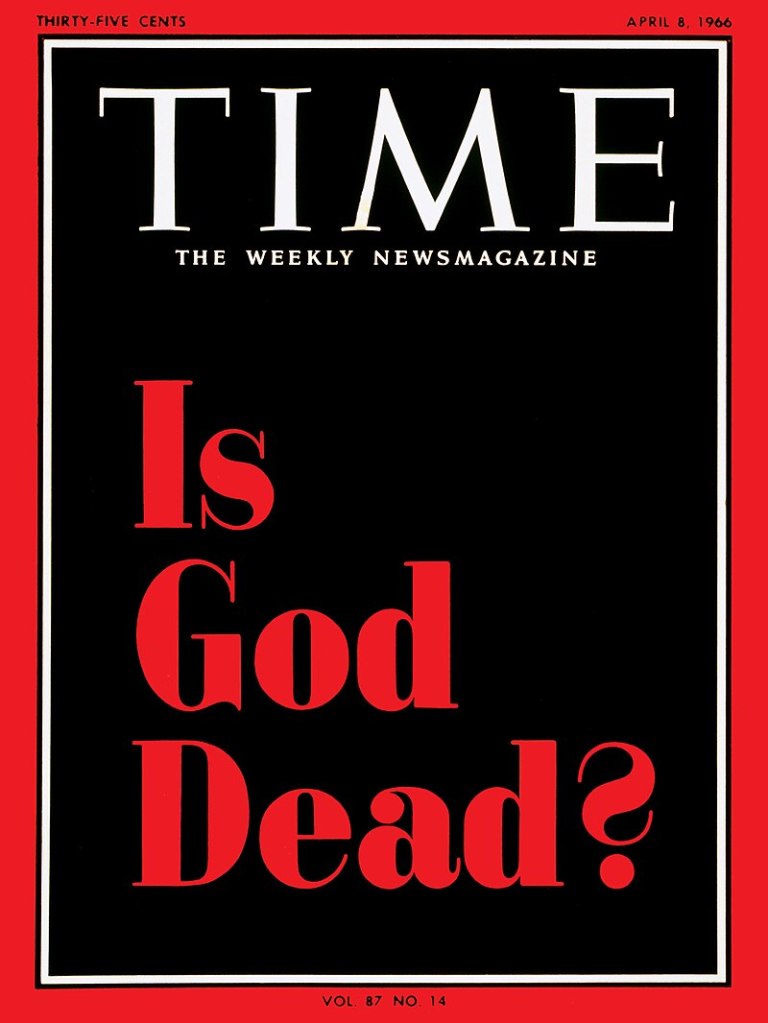
As I go through the stories in Dangerous Visions I’m expecting to find psychological snapshots of Ellison, the genre, the writers, and the times. The April 8, 1966, cover of Time Magazine asked if God was dead. Had del Rey forgotten his earlier story and “Evensong” was merely a science fiction riff on the Time cover?

Were the writers in Dangerous Visions thinking about old science fiction, or current events? Was Dangerous Visions anticipating the future, or reacting to an already fading pop culture rebellion?

JWH

“The Open Road Leads to the Used Car Lot” by John Alfred Taylor

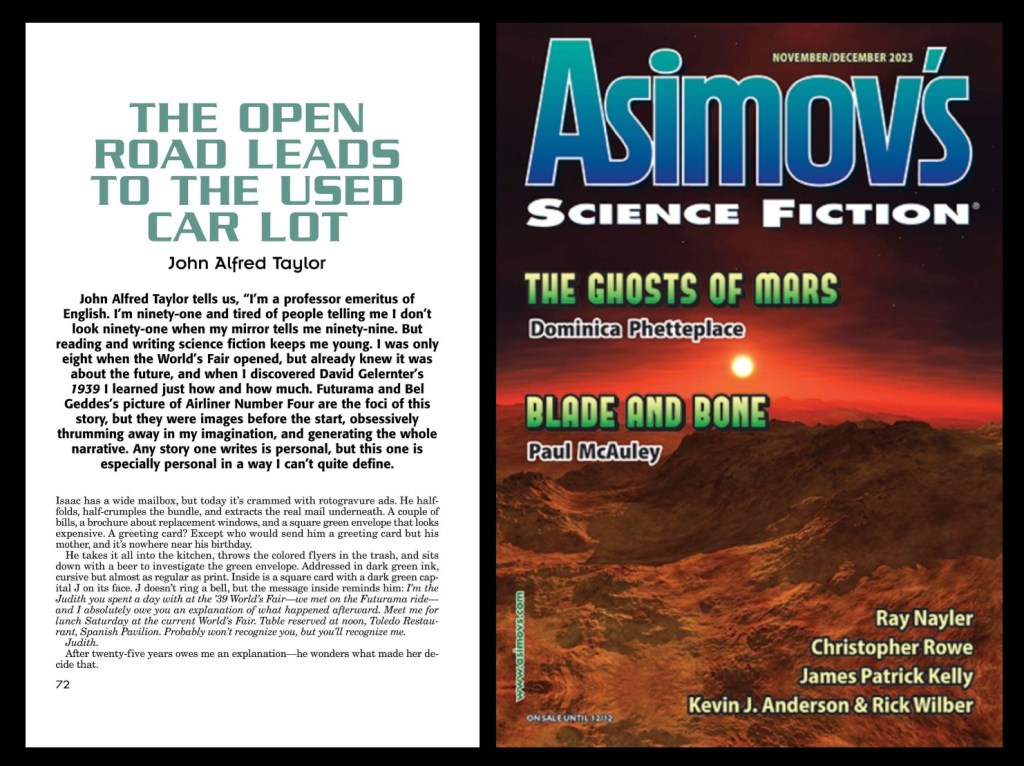
[I was excited when I discovered that John Alfred Taylor was ninety-one when he wrote “The Open Road Leads to the Used Car Lot.” Since I’m seventy-two I have an afinity for old science ficton readers and writers. Sadly, I just learned John Alfred Taylor died on October 7, 2023, before the November 2023 issue of Asimov’s Science Fiction was published.]

When I was about to give up reading new science fiction magazines, I discover a story that brought tears to my eyes. I had to wipe them several times while reading “The Open Road Leads to the Used Car Lot” by John Alfred Taylor. In the editor’s blurb Taylor is quoted as being eight years old when the 1939 World’s Fair opened. That 1939 World’s Fair is at the heart of this story.

I was born in 1951 and have often wished I could time travel to that fabulous event. And that’s part of this story too. “The Open Road Leads to the Used Car Lot” is also set during the 1964 World’s Fair. I was living out in the country in South Carolina at the time, and wanted to go to that fair so bad. I never did. I was just twelve, but then twelve is the real Golden Age of Science Fiction, isn’t it. I’ve never been to any World’s Fair. About the closest I’ve come is going to Epcot. I’ve been to the 1939 World’s Fair several times in fiction and memoirs. I don’t know if John Alfred Taylor got to visit the 1939 World’s Fair when he was eight, but his character does.

Taylor uses science fiction for a personal fantasy and that’s why I identify so strongly with this story. Science fiction has always been my fantasy portal.

Reading “The Open Road Leads to the Used Car Lot” for me was like playing a pinball machine as a teen, when you’re in the zone, keeping the ball in play forever, feeling one with the machine, not even aware of activating the flippers, mesmerized by the flashing lights, dings, bells, buzzers, and mechanical music. This story pushed all the buttons that make science fiction zing for me.

This is the kind of story I’m forever seeking — science fiction that I resonate with personally. I can’t say it’s a great story, but it was an exceptional story for me on this Wednesday afternoon in November. I read it while I played my “TOP 1000 4 Jim” playlist at full volume, waiting for my wife to come back from her lunch with a friend. You never know when a story is going to work or why. Read on another day, “The Open Road Leads to the Used Car Lot” could have crashed and burned. It didn’t today. It soared.

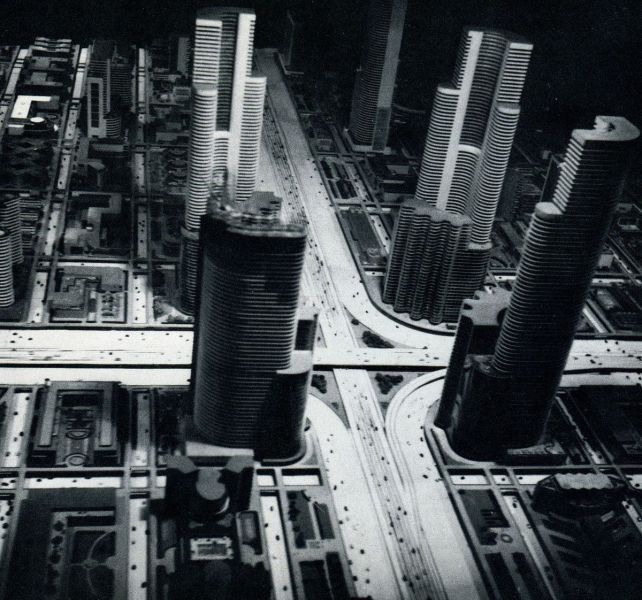
The story is about a young man, Isaac, meeting a young woman, Judith, a time traveler back in 1939, while waiting in line to ride through the Futurama exhibit at the 1939 World’s Fair. This reminded me of John W. Campbell’s “Twilight,” a story from the 1930s about a person meeting a hitch-hiker who is a time traveler. Time travel is a hard theme to pull off. However, I think time travel is the most powerful of all science fiction themes, even more powerful than space travel and aliens. That is if its sense of wonder hits you just right. I’ve always thought The Time Machine was more epic than The War of the Worlds. And time travel is at its most powerful when dealing with the future. This story uses the past to talk about the future.

My guess is this story will be a minor, sentimental story to young readers. I think you need to be old to appreciate it. What will future science fiction fans in the nineties who are eight today remember about now? What will make them sentimental and weepy eyed?

“The Open Road Leads to the Used Car Lot” conjures nalstagia for old science fiction and the old memories of the future. I’m twenty years younger than Taylor when he wrote this story, but I know where he’s coming from. Like they say, the future was so bright when we were adolescents, we had to wear shades. I now know that Taylor was a dying man looking backwards. At seventy-two I still look forward sometimes, but I do a lot of looking over my shoulder.

I’m sad I missed reading John Alfred Taylor while he was alive. I’ll need to go back and try some of his other stories. ISFDB only lists one book by him, Hell is Murky, a collection of twenty stories. The flap has the only photo I can find for him. ISFDB lists over sixty stories published from 1971-2023. “The Open Road Leads to the Used Car Lot” might be his last, but maybe not. I’ll keep looking.

James Wallace Harris, 11/15/23

Has Science Fiction Left Me Behind?

The above books were the finalists for the 2023 Hugo Awards. I have not read any of them. Nor do they look interesting to me. Each year the Hugo and Nebula award finalists seem further and further away from what I want to read.

The other day I went into a new bookstore for the first time in many months. I went up and down the aisles of the science fiction section and I was shocked by how many books were by authors that were unknown to me.

I turn seventy-two next month and I wonder if I’ve gotten too old for science fiction. Or, has the genre left me in the dust? I can accept that I might be too old to keep up. Could the genre have changed, and I’ve just lost interest? Who knows?

In the 20th century I’m sure I read at least a thousand science fiction books, probably many more. Here’s a list of the 69 SF&F books I’ve read in the 21st century:

  • 2000 – Harry Potter and the Goblet of Fire by J. K. Rowling (Hugo winner)
  • 2000 – Calculating God by Robert J. Sawyer (Hugo finalist)
  • 2001 – American Gods by Neil Gaiman (Hugo winner)
  • 2001 – Perdido Street Station by China Miéville (Hugo finalist)
  • 2002 – Altered Carbon by Richard K. Morgan
  • 2003 – The Time Traveler’s Wife by Audrey Niffenegger
  • 2004 – Cloud Atlas by David Mitchell
  • 2004 – Jonathan Strange & Mr. Norrell by Susanna Clarke (Hugo winner)
  • 2004 – The Plot Against America by Philip Roth
  • 2005 – Spin by Robert Charles Wilson (Hugo winner)
  • 2005 – Old Man’s War by John Scalzi (Hugo finalist)
  • 2005 – Never Let Me Go by Kazuo Ishiguro
  • 2006 – The Road by Cormac McCarthy
  • 2006 – Life As We Knew It by Susan Beth Pfeffer
  • 2007 – The Yiddish Policeman’s Union by Michael Chabon (Hugo winner)
  • 2008 – The Hunger Games by Suzanne Collins
  • 2008 – Little Brother by Cory Doctorow (Hugo finalist)
  • 2008 – Flood by Stephen Baxter
  • 2008 – Marsbound by Joe Haldeman
  • 2009 – The City & The City by China Miéville (Hugo winner)
  • 2009 – The Windup Girl by Paolo Bacigalupi (Hugo finalist)
  • 2009 – Boneshaker by Cherie Priest (Hugo finalist)
  • 2009 – Julian Comstock by Robert Charles Wilson (Hugo finalist)
  • 2009 – Catching Fire by Suzanne Collins
  • 2009 – Wake by Robert J. Sawyer
  • 2010 – Feed by Mira Grant (Hugo finalist)
  • 2010 – Mockingjay by Suzanne Collins
  • 2010 – Watch by Robert J. Sawyer
  • 2010 – Hull Zero Three by Greg Bear
  • 2011 – Among Others by Jo Walton (Hugo winner)
  • 2011 – Leviathan Wakes by James S. A. Corey (Hugo finalist)
  • 2011 – The Martian by Andy Weir
  • 2011 – Ready Player One by Ernest Cline
  • 2011 – Wonder by Robert J. Sawyer
  • 2012 – Redshirts by John Scalzi (Hugo winner)
  • 2012 – 2312 by Kim Stanley Robinson (Hugo finalist)
  • 2012 – The Dog Stars by Peter Heller
  • 2012 – The Age of Miracles by Karen Thompson Walker
  • 2012 – vN by Madeline Ashby
  • 2014 – The Three Body Problem by Cixin Liu (Hugo winner)
  • 2014 – Annihilation by Jeff VanderMeer
  • 2014 – Station Eleven by Emily St. John Mandel
  • 2014 – The Girl with All the Gifts by M. R. Carey
  • 2014 – The Book of the Unnamed Midwife by Meg Elison
  • 2014 – Yesterday’s Kin by Nancy Kress
  • 2015 – Seveneves by Neal Stephenson (Hugo finalist)
  • 2015 – Children of Time by Adrian Tchaikovsky
  • 2015 – Binti by Nnedi Okorafor
  • 2015 – Aurora by Kim Stanley Robinson
  • 2015 – The Water Knife by Paolo Bacigalupi
  • 2016 – All the Birds in the Sky by Charlie Jane Anders (Hugo finalist)
  • 2017 – New York 2140 by Kim Stanley Robinson (Hugo finalist)
  • 2017 – All Systems Red by Martha Wells
  • 2017 – Sea of Rust by C. Robert Cargill
  • 2017 – Under the Pendulum Sun by Jeanette Ng
  • 2017 – Noumenon – Marina J. Lostetter
  • 2018 – The Calculating Stars by Mary Robinette Kowal (Hugo winner)
  • 2018 – Semiosis by Sue Burke
  • 2018 – The Fated Sky by Mary Robinette Kowal
  • 2018 – The Feed by Nick Clark Windo
  • 2019 – Children of Ruin by Adrian Tchaikovsky
  • 2019 – Machines Like Me by Ian McEwan
  • 2020 – The Ministry for the Future by Kim Stanley Robinson
  • 2020 – The Midnight Library by Matt Haig
  • 2021 – Project Hail Mary by Andy Weir (Hugo finalist)
  • 2021 – Klara and the Sun by Kazuo Ishiguro
  • 2022 – Babel by R. F. Kuang
  • 2022 – The Mountain in the Sea by Ray Nayler
  • 2022 – Sea of Tranquility

That’s an average of 2.8 SF&F books a year. Assuming I read a thousand SF books from 1963-1999, means I averaged 27.78 SF books a year. I think I could have easily read 1,500 SF books, or 41.67 SF books a year. In other words, I don’t read SF like I used to. And my 21st century list includes quite a few fantasies. I rarely read fantasy in the 20th century. I really don’t like fantasy books. I only read them when they reach a certain pop culture status.

One reason for the shift is I read more literary works and nonfiction books. Another reason is after reading thousands of science fiction books, I seldom read reviews of new science fiction books that sound different enough to be appealing.

I used to keep up with the genre by belonging to the Science Fiction Book Club, which offered two new titles a month. I subscribed to several science fiction magazines and fanzines that reviewed new books. And I would visit one or two new bookstores a week.

Fanzines disappeared, and I stopped having time for the prozines even though I still subscribed. After Amazon and Audible, I stopped shopping in new bookstores, and they eventually disappeared. Back in the 1970s I went to conventions and even published fanzines. In the 1980s I ran a BBS devoted to science fiction. Since the 1990s I’ve run websites and databases devoted to SF. Once upon a time all my friends were SF readers. But active participation in fandom ended when I got married and settled down to work in 1978. I became a different person socially.

Since 2002, I’ve been rereading the science fiction I first read in the 20th century by listening to audiobook editions from Audible.com. It’s a kind of nostalgic trip. I also caught up on a lot of 20th century science fiction I missed. That also kept me from reading many new SF books.

But in all honesty, I prefer old science fiction to new science fiction. There’s been some great exceptions, but I think that’s the real reason I’ve let the genre pass me by.

I wish the Science Fiction Writers of America never embraced fantasy. I wish the Hugo Awards had focused exclusively on science fiction. Fantasy should have their own fan-based award. I can’t help but wonder if the science fiction genre would be more vibrant today if it hadn’t been married to the fantasy genre. Even books marketed as science fiction often feel like fantasies. Looking back, I would have preferred a smaller, focused SF genre, one I could have kept up with.

Science fiction used to have some realism, or at least some speculative integrity. Now, any old wild idea works. Science fiction used to be inspired from reality, now new writers are inspired mostly by science fiction movies. It’s as if all science fiction is recursive science fiction.

Who knows, maybe I left science fiction behind.

James Wallace Harris, 10/22/23

Could I Write a Science Fiction Story at 72?

In my teens, twenties, and thirties I desperately wanted to be a science fiction writer. At least I thought I did until I got married and got a job I liked. I still took creative writing classes and even attended Clarion West in 2002 when I was fifty-one. However, I never could stick with writing until I had a polished story. I’m just too lazy. Writing science fiction has always been more of a fantasy than a reality. I turn seventy-two next month, and I wonder if I’m too old to even dream that old dream. Why hasn’t it just faded away? (I wish it had — I could use the peace of mind.)

In recent years, I’ve often wondered if I could make myself write one story worthy of an editor’s acceptance? I have ideas, lots of ideas. Lots of finished but unpolished stories. I don’t know if I have any talent, but I do know I lack focus and perseverance to stick with writing a story until it’s worth submitting. But let’s imagine if I could muster up some discipline, what would I write about?

I no longer like science fiction the way I liked it when I was younger. For the most part, I don’t even like reading modern science fiction. And I’m not talking about plot ideas or prose styles. I always assumed I could never completely finish any of my stories because I didn’t like them enough.

It looks like I have two desires: one to write a story I love, and second to write a story an editor will buy. But that’s wrong too. Maybe I shouldn’t be thinking about editors and instead just try to please myself.

Putting it that way, I can see why I’ve always given up. I love very few stories. Writing something I loved will take a huge effort, maybe even an impossible one. Is this an ego problem I’m having, or am I just chicken about rejection? Probably all writers who got published just wrote stories until they found an audience and didn’t worry about who would like them. I should do that too, but I don’t know if I can. Knowing that advice is not enough to inspire me to keep working.

I’ve read many books advising would-be writers. They all say to not wait for inspiration, but just develop the discipline to write daily. This probably explains my failure. I don’t like writing fiction, it’s demanding work. The people I know that became successful fiction writers started writing stories early in life and always kept at it. They couldn’t stop writing. Evidently, wanting to do something is much different from doing something.

I’ve tried to forget this desire to write fiction for most of my life. It won’t go away. It just keeps gnawing at me. I knew one woman who had a science fiction story published and then never tried again. I wonder if that would free me too.

When I was young, I wanted to be a successful writer to make money, so I wouldn’t need to work a 9 to 5 job. But I’m retired now, and money and jobs aren’t an issue. At 72, I’d be writing just to write. I do write by blogging. Evidently, there’s something special about fiction that blogging doesn’t satisfy.

Is it an urge to create? To leave something behind? I’ve always been fascinated by those writers I find on ISFDB.org that have just a few stories listed. A fitting example is “The Short Life” by Francis Donovan which I wrote about last time. Donovan has one published story. Did he encapsulate everything he wanted to say about reality with that one fictional statement? That might come closest to explaining my urge to write a science fiction story. I want to say something that will be remembered.

Of course, having a science fiction story published isn’t like writing hieroglyphics on a pyramid. Still, I think I’ve dug up a clue about my life-long hankering to crank out a science fiction story. And it might also explain why I’d need to love it. Who wants to write a crappy epitaph for themselves?

I wish I could write something like “The Star Pit” by Samuel R. Delany. Or “An Appearance of Life” by Brian W. Aldiss. Or “Vintage Season” by C. L. Moore. Or even something short, like “The Light of Other Days” by Bob Shaw. Those would all be epitaph-worthy stories.

[Thank you for being my psychiatrist or priest and listening to my confessions.]

James Wallace Harris

What Motivated Heinlein to Write Science Fiction?

To get the most out of my rereading Heinlein project, I figure I need to hold up on reading the stories and get an idea of why Heinlein wanted to write. There are two schools of thought on studying literature. One holds that a work of fiction must stand on its own. I can buy that. But second, believes in knowing as much as possible about the context in which the work was created. And I can buy that too. For my rereading Heinlein project, I’ve decided to get to know as much about Heinlein as possible and to study what others have written about Heinlein.

This effort is going to be rather haphazard because I don’t plan to devote all my time to studying and reading Heinlein. Nor am I scholarly or disciplined enough to systematically collect and analyze data. I shall alternate between reading about Heinlein, reading a story by Heinlein, and writing about my reaction to the two. I will probably revise what I blog as I go along and learn more.

Over the years I’ve had a love-hate relationship with reading Heinlein. As a kid, I wanted to grow up and be like him, a science fiction writer. He was my hero. But, by the time I graduated high school and started college, I realized Heinlein was on the far side of the 1960s generation gap. He was now the enemy. Heinlein was pro-Vietnam war. I was against it. Heinlein was in the Old Wave of science fiction writers. I sided with the New Wave writers. When I was young, Heinlein felt like a liberator of thoughts, but by my late teens, he seemed like an oppressor. What really turned me off to Heinlein was I Will Fear No Evil which came out in 1970. He had changed. But then, so had I.

My father died in 1970 when I was 18. We often locked horns over the same social and political issues that turned me against Heinlein. When I got older, I often wondered what my dad was really like because I eventually realized I had never gotten to know him. I had rebelled against his older self, and one I judged too quickly because I was young and impatient. I had no clue about my dad’s younger self. The same was true for Heinlein. Now that I’m old myself, I believe I need to go back and figure out these men. What did they originally want? I don’t have much evidence for who my father was, but I do for Heinlein.

While reading Heinlein’s early stories I get the impression he wasn’t like the other science fiction writers. I assumed he had grown up reading science fiction and science fiction was the obvious choice when Heinlein decided to make money by writing. Samuel Johnson is famous for saying, “No man but a blockhead ever wrote except for money,” but that doesn’t explain what they choose to write about. I’m starting to doubt if Heinlein was a trufan of science fiction because he had so many other interests. I wondered if he considered writing in other genres or even writing nonfiction? I know Heinlein read science fiction, but he also read lots of other kinds of fiction and especially nonfiction. Heinlein had diverse interests, and even though he read and wrote science fiction, and occasionally interacted with fandom, I’m not sure if he really thought of himself as a science fiction fan and writer.

All the details I cite below about Heinlein’s life come from Robert A. Heinlein: In Dialogue with His Century, Volume 1 by William H. Patterson.

From 1925 to 1934 Heinlein’s goal was to be a naval officer. In 1934 he was forced to retire because of TB. This military experience provided great knowledge for his later writing career, but I don’t think he would have become a writer while in the Navy. Although he did get experience writing for his ship’s newspaper. Heinlein trained as an engineer at Annapolis and became a ballistic officer with special training on a new computing machine. Heinlein like doing.

In the 1920s Heinlein started reading science fiction when The Skylark of Space was serialized in Amazing Stories. Over the years he read various SF magazines, but I don’t know how often. Heinlein was widely read in other areas. But most writers end up writing what they like to read, so I assume Heinlein had a science fiction addiction too.

In 1930 Heinlein became the 22nd member of The American Rocket Society. Right from the beginning, they were thinking about traveling to the Moon. Quite a few of Heinlein’s stories were set on the Moon.

In 1932 Heinlein met and married Leslyn MacDonald, who was 26, and he was 23. Leslyn had a master’s in philosophy, was very liberal politically, acted in local theatrical productions, directed workshops in experimental theater, was a published writer, had a job as Assistant Director of the Music Department at Columbia Pictures, and maybe even did some script doctoring for them. The Heinleins had an open marriage, and belong to nudist colonies in Colorado and California. Leslyn was an equal partner, even though she was probably better educated, smarter, and far more philosophical. And she probably had more worldly experience. Leslyn also had an interest in mystical and spiritual traditions, and her mother was a Theosophist. Heinlein read to her The Time Stream by John Taine which was being serialized in Science Wonder Stories (December 1931- March 1932). She got him to read Tertium Organum by P. D. Ouspensky, a student of George Gurdjieff. Leslyn had a tremendous impact on Heinlein becoming a science fiction writer, and even the subjects we wrote about. At the time both were left-leaning socialists who shared progressive political ideas and New Age and occult philosophies.

Heinlein’s ambition after leaving the Navy was to start on a master’s and work up to a Ph.D. in physics or astronomy at Caltech. Unfortunately, at the time he graduated from the Navy college at Annapolis, it didn’t confer bachelor’s degrees, so he couldn’t go directly into graduate school. If he could have followed this path he might have eventually become an SF writer on the side, but I tend to doubt it. Again, Heinlein’s drive was to do. However, the failure to become a scientist seems to be a common trait among science fiction writers.

Next, Heinlein and Leslyn threw themselves in the 1934 election for California’s governor. The Heinleins backed Upton Sinclair, the famous muck-raking writer and socialist turned democrat to run for governor of California. The Republicans launch an all-out smear campaign against Sinclair. This taught Heinlein a lot about dirty politics. After Sinclair lost, he pushed ahead with EPIC (End Poverty in California) and the Heinleins joined that crusade. They worked with Sinclair and got to know him, and Sinclair admired their dedication to the cause and put Heinlein in some higher-up positions. Heinlein got to work with Oakies and immigrants, as well as Hollywood star do-gooders. He saw the horrors of how the poor were treated. Heinlein even ran for a local position and lost, but learned a great deal about grassroots politics. All of this was grist for the meal of his first novel, For Us, The Living. Heinlein had gotten more writing experience working on EPIC publications. That experience was starting to add up.

The Heinleins had bought a small house in Laurel Canyon, but one they really couldn’t afford on just his military retirement paycheck. Heinlein’s health depended on a low-stress life, so he couldn’t handle regular work. This is when he decided to try writing for a living. He wrote For Us, The Living, but it failed to sell. That novel really wasn’t science fiction, even though it was about the future. It was Heinlein presenting ideas on how to create a better America. The novel promoted concepts like guaranteed incomes and psychiatric rehabilitation instead of prison for criminals. Heinlein could have become a nonfiction writer instead of a fiction writer. This explains why there is so much infodumping, lecturing, and even preaching in his books.

There was practically no science fiction being published in book form in the 1930s. Heinlein wanted to be a futurist, but they didn’t exist back then. Being an officer in the Navy, or a politician meant being a leader, a man of action, and a doer. I felt from the biographical material I’ve read, that Heinlein wanted to lead, influence, build, and especially, invent. However, he was out of options. Maybe he could at least be an influencer by writing.

All along, Heinlein had been reading science fiction, but I’m not sure how much. When he sold “Life-Line” to Astounding for $70, he discovered he had a platform for his progressive ideas and a way to pay his mortgage. John W. Campbell, Jr. had higher ambitions too. Both men wanted to do something real but found their niche in writing and publishing fantasies about the future.

As I reread Heinlein’s fiction I need to remember what Heinlein really wanted. I’m sure this bled out in his stories. Samuel Goldwyn is famous for a quote he probably didn’t say, “If you have a message, call Western Union.” Heinlein always had a message. Sometimes I’ve held that against him, but I realize now, all the best stories do have a message.

Some fiction is just a story. Something entertaining to occupy your time. But all the best writers have something to say. The true art of fiction is to communicate a great deal without the reader feeling they are being lectured.

In judging Heinlein’s stories as I read them, I need to decide how well he wove his message into his fiction. I need to come up with a method to evaluate stories on several levels at once. But that’s another essay.

James Wallace Harris, 10/8/22

“The Curse of the Mhondoro Nkabele” by Eric Norden

What if our pleasure in life is wallowing in the minutiae of our favorite subject? I follow a lot of YouTubers and most of their channels are about going deeper and deeper into a beloved special interest. When we are young we pursue pleasures of the flesh, but as we get older we follow our Alice of interest down a rabbit hole. This lets us find our true tribe, our people.

I feel like I’m among a few survivors of a tribe that is dying out. I lament that our culture and language are disappearing. My tribe is those beings who grew up reading science fiction magazines in the mid-20th century. I know that tribe was never very large and that all the various tribes of pop culture eventually fade from the collective memory of the present. But this sense of passing is why I find myself enjoying recursive science fiction so much now. Recursive science fiction is science fiction about science fiction, and quite often it remembers the genre’s past. And to enjoy such stories requires either a direct experience of the past or a good education about that past.

One of the funniest recursive science fiction stories I’ve ever read is one that seems to parody/remember more of the genre than any other recursive science fiction story I’ve read. The story is “The Curse of the Mhondoro Nkabele” by Eric Norden (Eric Pelletier 1899-1979). Unfortunately, it’s been a long time since this story has been reprinted, meaning if you want to legally read it, it will require tracking down a used copy of F&SF for September 1980, The Best from Fantasy and Science Fiction 24th Series edited by Edward L. Ferman in 1982, or Inside the Funhouse: 17 SF Stories about SF edited by Mike Resnick in 1992. If you have a free account with the Internet Archive you can check out The Best of F&SF 24th for one hour. Since this story hasn’t been reprinted in 30 years, and its author has been dead for 43 years, I hope their heirs won’t mind me offering you a pdf copy. (If you do, let me know and I’ll take it down, but I doubt if six people will read it.)

Of course, not everyone will find this story funny or meaningful. It depends on you knowing a good deal about the genre’s history. I thought I’d review the story by providing links to the pertinent bits of history that knowing will let the reader appreciate the story.

The story is an exchange of letters between Oginga Nkabele, a young man from Africa studying in America, and Edward L. Ferman, the editor of The Magazine of Fantasy and Science Fiction (F&SF). Nkabele, from the tribe of Diolas in Senegal, Africa, was educated by French and Belgian missionaries who he refers to as the Holy Ghost Fathers. One of his teachers, Father Devlin brought three steamer trunks containing over five hundred pulp science fiction magazines from 1936-1952. Nkabele has read these magazines so thoroughly that he’s even memorized some of his favorite stories. Nkabele feels he’s an expert on science fiction and decides to become a rich science fiction writer while in America.

Unfortunately, the stories he submits to Ed Ferman are modeled on the writing styles that were heavily criticized for bad writing when they were new and are now so out of fashion as to be glaringly awful. Ferman is appalled by Nkabele’s stories and rejects them immediately. Nkabele feels the rejection letter is a mistake and keeps pestering Ferman with more letters. In fact, he never accepts any rejection and keeps trying to convince Ferman his stories are brilliant and will make him famous and promises they’ll help sell more copies of F&SF.

Through the exchange of letters, two fun plots emerged. One is a horror tale for SF magazine editors which is hilarious if you’re not an editor, and the other is about how the genre has changed drastically from its past which is still wistfully nostalgic for some.

First, it’s important to know the magazines Nkabele admires. It’s notable that Father Devlin did not subscribe to Astounding Science-Fiction, the magazine revered until recent decades (another irony of this tale). Nkabele’s favorites are:

Nkabele’s favorite writers are Richard Shaver, L. Ron Hubbard, and Stanley G. Weinbaum, but is also a fan of Robert Moore Williams, E. E. “Doc” Smith, Nelson Bond, Ray Cummings, Eric Frank Russell, P. Schuyler Miller, and Raymond Z. Gallum. Although not specific to this story, if you know about The Shaver Mystery you’ll have a sense of the kind of thinking fans of these magazines pursued.

Most telling of all is that Nkabele’s favorite editor is Raymond A. Palmer. That’s quite revealing. Young science fiction writers today want to erase the memory of John W. Campbell, but when I was growing up, science fiction fans wanted to forget Ray Palmer’s impact on the genre.

To understand Nkabele’s taste in science fiction, even more, is to know the names of the three stories he keeps submitting:

  • “Astrid of the Asteroids”
  • “Slime Slaves of G’Harn”
  • “Ursula of Uranus”

The magazines Nkabele loved were the ones that appealed most to adolescents featuring exotic interplanetary adventure stories told in purple prose. The exact kind of science fiction John W. Campbell was fighting against in our Golden Age of Science Fiction. But Nkabele considers his science fiction the actual Golden Age of Science Fiction. Over the decades, different generations have defined their own Golden Age of Science Fiction. Youth always reject the past. Nkabele can’t fathom why Ferman is rejecting his Golden Age.

It helps to know a little about Edward L. Ferman since he’s a major character, but it’s very important to know about Harlan Ellison. Ferman panics and gives Nkabele Ellison’s address and phone number to get rid of him. Ferman tells Nkabele about Ellison’s legendary SF anthology Dangerous Visions. Now Harlan Ellison starts writing letters and Eric Norden parodies Ellison’s writing style in an over-the-top style that wasn’t far from Ellison’s own. They even rope in Isaac Asimov. Norden does a great job of making each letter writer sound like a distinct personality. Sometimes the epistolary caricatures aren’t so flattering and it’s a wonder Norden didn’t get sued by Ellison who was known for his litigious wrath.

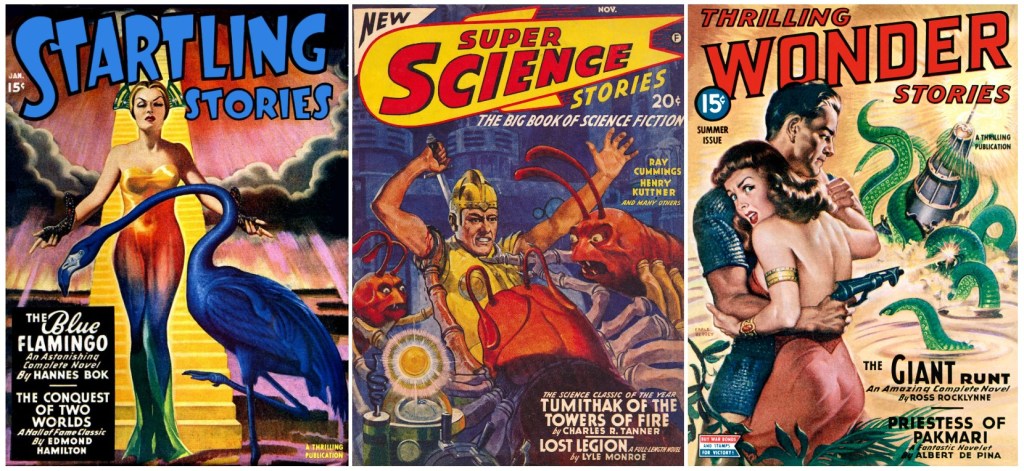
It also helps to know about BEMs – Bug Eye Monsters – especially SF covers that showed BEMs running off with mostly naked Earth women. BEMs in SF anticipated the whole abductee theme of UFO fanatics. And Ray Palmer turned his SF magazines into UFO fanaticism.

Parodying science fiction has been around for a long time, and Norden mentions a classic, Venus on a Half Shell by Kilgore Trout. Kilgore Trout is a character in many of Kurt Vonnegut’s novels. But I’ll have more to say about such other fun novels and stories soon.

I’m not sure how many current SF readers will enjoy “The Curse of the Mhondoro Nkabele” by Eric Norden. Is the pop culture that it skewers too oldy moldy? I tend to think the people who will enjoy it most are the people of my tribe.

James Wallace Harris, 7/24/22

“A Galaxy Called Rome” and Galaxies by Barry N. Malzberg

I’ve been reading recursive science fiction lately, and one of the most famous recursive science fiction stories is Barry N. Malzberg’s “A Galaxy Called Rome.” Recursive science fiction is science fiction about science fiction. Sometimes this is a story that mentions science fiction, sometimes it’s a story about science fiction writers, their fans, and science fiction conventions, and sometimes it’s in-jokes about the genre, other times recursive science fiction is about the writing of science fiction, and that’s the case with “A Galaxy Called Rome.”

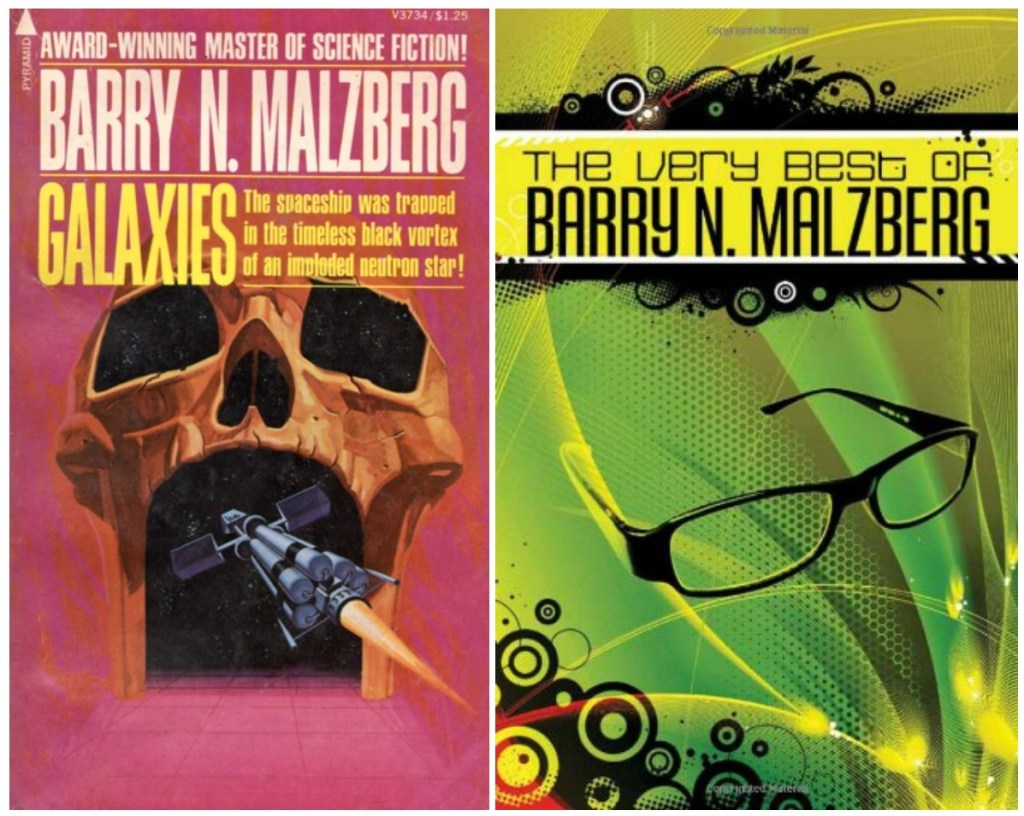
“A Galaxy Called Rome” has been reprinted often you can find it in these anthologies and collections. I read it in the anthology Inside the Funhouse: 17 SF Stories About SF edited by Mike Resnick in 1992. I highly recommend that volume if you can find it, but it was only published once by Avon. Probably the cheapest collection of Malzberg’s stories is The Very Best of Barry N. Malzberg because the Kindle edition is only $4.99. However, Malzberg expanded “A Galaxy Called Rome” into a short novel, Galaxies, and it’s available for $1.99 for the Kindle edition at Amazon.

Malzberg is known for his recursive science fiction, especially since he seems to have experienced a great deal of existential angst over being a science fiction writer. NESFA even came out with a collection of his recursive SF called The Passage of the Light: The Recursive Science Fiction of Barry N. Malzberg.

“A Galaxy Called Rome” is a novelette composed of 14 short chapters. It first appeared in the July 1975 issue of F&SF and has been anthologized a number of times. It is probably Malzberg’s most famous work of short science fiction. 

Malzberg expanded the same story into 49 chapters for a 1975 short novel version retitled Galaxies. Malzberg gained attention for a handful of science fiction novels in the first half of the 1970s. He won the John W. Campbell Award for Beyond Apollo but got a fair amount of recognition for Galaxies, The Falling Astronauts, and Herovit’s World. He went on to publish prolifically in and outside of the genre

“A Galaxy Called Rome” and Galaxies are also works of what the literary world calls metafiction – fiction about fiction. I prefer the novelette version of the story because the novelette is my favorite length for science fiction. However, the longer version of the story, Galaxies, lets Malzberg dig deeper into the nature of writing science fiction.

I want to recommend this story, but with carefully considered restrictions. If you read science fiction for escape this story isn’t for you. Well, if you want to know why you read science fiction for escape, then you might want to read it. This story is for people who like to intellectually examine everything and take things apart. This story is for readers who love academic exercises in cleverness. This story is for readers who want to know how magic tricks work.

I alternated reading Galaxies with listening to Red Rising by Pierce Brown. It was an excellent contrast. Red Rising is exactly what most science fiction readers want to read. The story immediately sucks the reader into a fantasy reality. It’s designed for your mind to forget the real world and immerse yourself in a fantasy about Mars. The reader is expected to buy into its make-believe. Galaxies on the other hand constantly remind the reader of our reality while describing how a science fiction writer goes about their business of fooling the reader.

Reading “A Galaxy Called Rome” or Galaxies could ruin your love of science fiction. Or it could make you appreciate escapist literature all the more. I know when I would switch to Red Rising after reading a dozen chapters of Galaxies I felt like that guy in The Matrix, Cypher, who wanted to take the blue pill and enjoy the juicy steak. And that might be a good analogy. Reading Malzberg is like taking the red pill and seeing an ugly reality. It might be philosophically enlightening to know the realness of reality, but it’s still grim and gritty.

This is probably why Malzberg never became a popular sci-fi writer, he was too hung up on reality. Most of the recursive science fiction I read in Inside the Funhouse was big fun. Recursive science fiction comes in many flavors but they can be roughly divided into two kinds. One kind celebrates our addiction, and the other makes you feel like you’re withdrawing from heroin. Reading “A Galaxy Called Rome” is like learning about Santa Claus as a kid, it hurts but makes you feel grown up. Reading Galaxies can feel like the agony of soul searching before deciding on becoming an atheist.

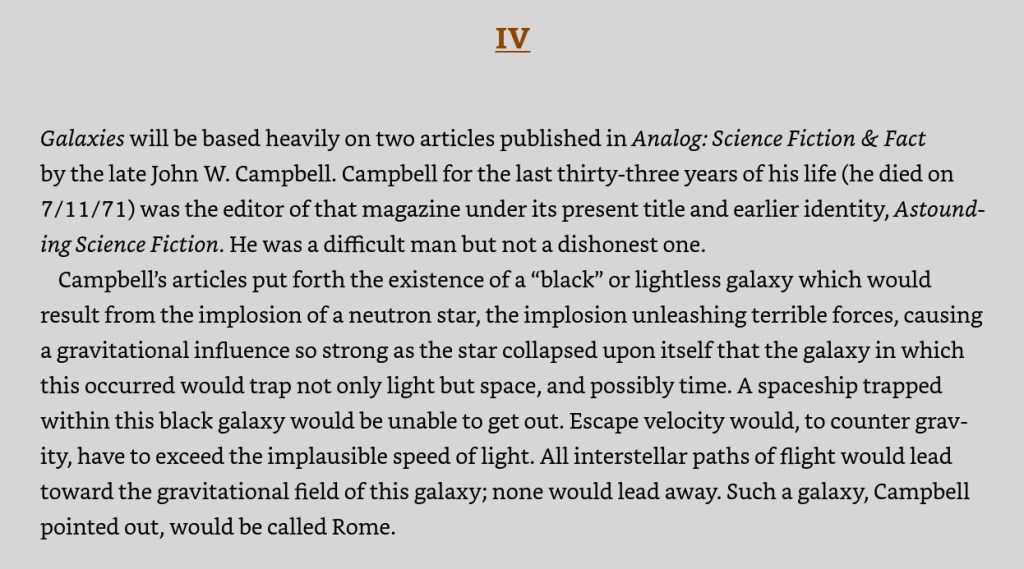
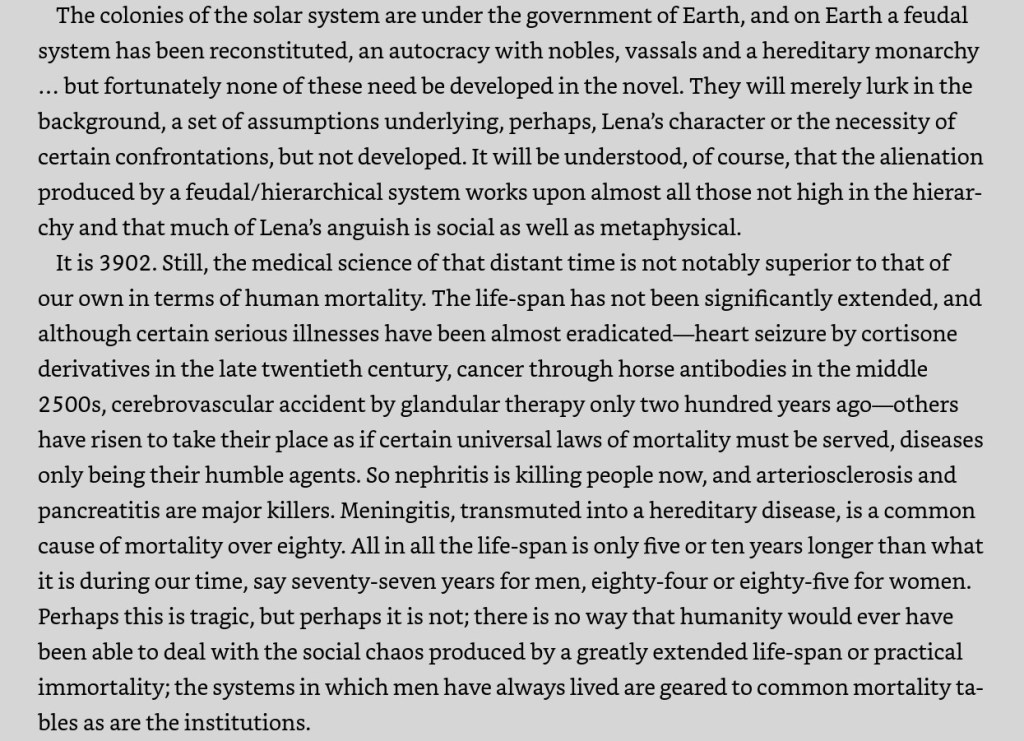
I ended up highlighting almost ten percent of Galaxies when reading the Kindle version. I won’t show all these quotes because that would probably be a copyright violation, but I do want to show enough of them to give people a chance to understand what Malzberg is doing. Malzberg is very open and straightforward with his intentions as stated in this first section.

It’s rather interesting that Malzberg tells us how the idea of the story within a story came to him. Well, the idea for the story he’s going to use to discuss writing. In the course of reading a novel about writing a novel, we will develop a whole story with characters, setting, plot, and conflict. However, we won’t experience that story like we normally do. Imagine being served a meal and instead of enjoying eating it, we put it under scientific analysis.

One thing Malzberg doesn’t do is try to imagine what we readers think while reading all of this. We readers are also part of the process. As I read Galaxies I got the idea that Malzberg both loved and hated science fiction. I got the impression he wanted to be a respected writer of hard SF, but his sense of reality conflicted with the fantasy nature of writing escapist literature.

These early sections are quite seductive, but I must warn anyone considering buying Galaxies that the going will get tough. “A Galaxy Called Rome” is the light fluffy version to read for those who aren’t ready to climb a mountain. Even though Galaxies is only 154 pages long, it’s a Ph.D. dissertation on deconstructing science fiction novel writing.

The story within this novel is about Lena Thomas who is the only living crew member of an FTL spaceship, Skipstone, that carries a cargo of 515 dead people in cryonic suspension. The year is 3902. Like in Heinlein’s novel, The Door Into Summer, rich people with diseases invest their estates and freeze their bodies in the hopes of one day being revived and cured. Those estates pay for the development of interstellar travel. Those dead people will eventually communicate with Lena like the dead in PKD’s Ubik when Lena and the Skipstone get trapped in the black galaxy. This allows Malzberg to explore metaphysical and religious themes in writing a novel. The ship also has robots programmed with human minds that help Malzberg explore other science fictional themes. His story notes get more and more extensive while getting more and more complicated. This also allows Malzberg to show how worldbuilding and plotting are developed as a writer tells their story.

Malzberg uses all this exploration in writing a science fiction novel to also speculate about the future. He imagines our civilization collapsing and being completely forgotten and a new world civilization rising in the following nineteen centuries. Malzberg imagines we’ll face limitations we can’t overcome and wild possibilities that far exceed today’s limitations.

Much of this novel is about being a writer, and specifically a writer of science fiction. You get hints along the way that Malzberg might be jealous of famous literary writers like Cheever and Updike, at other times you might feel his resentment at not being more successful at being a science fiction writer. But Malzberg is confident of his own gifts too.

In some of the actual passages of the novel, the dialog reminds me of Sheckley or Adams, or maybe even PKD, and even then Malzberg keeps making digs at science fiction.

Over time, the conflicts Malzberg provides for Lena’s story become repetitious. He knows he’s padding this novel, and even talks about how writers do pad their novels. The second half of Lena’s story becomes one long dark night of her soul struggling to escape the black galaxy. I have to wonder if such soul searching also plagues Malzberg.

Eventually, you wonder if Malzberg can find an ending to Lena’s story. Chapter after chapter he tortures the poor woman, and we can’t imagine any possible happy ending. Yet, Malzberg gives us a very strange ending that I was quite happy to read. I guess he took pity on us.

Reading Galaxies makes me doubt reading science fiction, but then I’ve doubted my addiction to our genre for decades. As a young person back in the 1960s and 1970s I thought science fiction was a wonderful tool for thinking about all the possibilities of the future, both good and bad. But after living to the year 2022, which was a very futuristic sounding year back in 1965, I know the future is everything we never imagined.

Contrasting Galaxies with Red Rising it’s quite obvious that science fiction’s purpose is escape. And the genius of writing science fiction is creating stories set in fictional worlds that are so compelling we forget this one. By Malzberg intruding into his novel and telling us everything only shows we don’t want the author intruding into our stories. Some philosophers have speculated that God invented our reality and walked away from his creation and that’s a great thing. That knowing God’s intention would ruin his/her/its art. I always felt Heinlein destroyed his career after he started poking his nose into his stories.

“A Galaxy Called Rome” and Galaxies were written as the New Wave in science fiction was fading and postmodernism fiction in the literary world was becoming old hat. It was an impressive experiment of the times, but as far as I know, readers have lost interest in such experiments. The Post Moderns of our times demand wokeness in fiction but not the metafictional kind. If anything, modern SF readers want longer voyages of fictional escape with far greater feats of worldbuilding.

It would be interesting to see someone write a version of Galaxies today that reveals what today’s SF writers go through to entertain their readers in the 2020s.

James Wallace Harris, 7/23/22

Science Fiction Writers in Conversation with Each Other

Imagine a world where science fiction had never been invented. Could you have written the first science fiction story? Be honest now, and think hard about yourself and what I’m asking. Before Galileo, did anyone think the Moon was a world that could be visited? Once people heard Galileo saw mountains on the Moon with his telescope they began to imagine going there. Science fiction needed certain kinds of seed ideas to begin. When the seeds come from reality I’ll call that Stage 1 science fiction. We don’t see a lot of that kind of science fiction anymore. Maybe The Martian by Andy Weir when he tried to realistically portray growing potatoes on Mars or when a writer extrapolates on current events like John Brunner did in Stand on Zanzibar back in 1968 or what Kim Stanley Robinson did in The Ministry for the Future in 2020.

Once the genre got rolling, science fiction seeded itself. One story about a trip to the Moon inspired an infinity. I call that Stage 2 science fiction. In Stage 2 writers try to stick to reality but work off the collective knowledge of the genre. Eventually, science fiction was making copies of copies, where the inspiration had no connection with reality. I’ll call that Stage 3 science fiction.

Early stories about traveling to the Moon were Stage 1 because it’s not likely the authors had read each other’s work. But when Verne and Wells wrote their novels of lunar exploration a lot of their inspiration was Stage 2. When John Varley wrote his stories about a lunar colony, most of the science-fictional concepts within those stories had been germinating for generations in the genre – Stage 3.

I believe science fiction writers have an ongoing conversation that never ends. To take part in this conversation, publish a story. It can be Stage 1, 2, or 3. To be heard and answered requires writing something in Stage 1 or 2, or a very creative Stage 3.

This is why I’ve become fascinated by the forgotten writer Walter F. Moudy. The 1950s and 1960s were a fertile time for Stage 1 and Stage 2 stories. By the second half of the 1960s and early 1970s writers who made themselves noticed were writing a baroque Stage 3 science fiction to attract attention. For example, the works of Samuel R. Delany, Roger Zelazny, and Robert Silverberg were based on old SF ideas told with new writing styles. Unfortunately, Moudy wrote Stage 3 stories in the same prose style that the classics of Stage 2 were written. His 1964-65 stories feel like they were written in 1954. One reason the New Wave writers of the 1960s were so important is they recognized that retelling Stage 2 stories in the same way, would get them ignored. The reason why Heinlein blazed onto the scene in 1939 is that he wrote Stage 1 stories with a new writing style, making his stories stand out.

I enjoy reading Walter F. Moudy in 2022 because I doubt I could write any better than he did, and he was responding to the stories I admired back then. His writing ability and knowledge of the genre were just good enough to get five works published and then become forgotten. As a would-be science fiction writer, I greatly identify with that. He wanted to join the conversation and made the effort to have his say. He just wasn’t heard, but now after decades, I’m listening.

While reading Walter F. Moudy’s meager output of science fiction I kept feeling his stories were inspired by the science fiction he and I both read. They made me wonder what he was trying to say in the ongoing conversation.

Of the five science fiction stories, I’ve read by Walter F. Moudy, “The Search for Man” is my favorite, although if I reread “The Survivor” or No Man On Earth I might change my mind. All were good fun, old-fashion science fiction, the kind my nostalgia loves. As I read “The Search for Man,” I kept wondering what science fiction Moudy had read that inspired this story. I can’t say for sure but this story about robots speculating about long-dead or gone humans reminded me of City by Clifford Simak. That “The Search for Man” set hundreds of years into the future speculated about our times and turned us into a religion reminded me of A Canticle for Leibowitz. That both the protagonists of No Man On Earth and “The Search for Man” were about a super-human and a super-robot reminded me of The Hampdenshire Wonder, Slan, Odd John, Chocky, Stranger in a Strange Land, and all the other science fiction stories about next-stage beings. Reading those two Moudy stories made me think about how I would have written a story on that theme. How much could I base it on reality, and how much would be inspired by other science fiction?

“The Search for Man,” begins with a baby being born, but it’s a strange birth, a kind of decanting that made me think of Brave New World. Then we learn the baby will only have three senses, and it will be put into a robotic baby’s body, the first of four body types it will use.

Moudy sets up a good mystery for us. Humans died out hundreds of years earlier, with all other animal life. The humans had tried to travel to the stars, but it appears their three missions had failed. The robot brains have improved their brains with genetics found in 12 human brains that had been preserved. The robots have found long-dead humans in various kinds of chambers that tried to create suspended animation. Their hope is to find a chamber with a viable human to resurrect. There are classes of robots that are archeologists and others that are priests that teach a strange religion based on their theories about humans. All of that is a very appealing setup for a story, at least for me.

I’m not sure Walter F. Moudy would have written “The Search for Man” without reading a lot of science fiction. Part of the conversation science fiction writers have is about science fictional ideas, but the other part is about how to present those ideas in a story. I felt “The Search for Man” was Moudy’s reply to both but in the language of 1950s science fiction. I wonder if he had been more of a stylist would he have made a greater impact?

“The Search for Man” was published in an original anthology In The Wake of Man that’s never been reprinted. I’ve been trying to get a copy, but it’s expensive, starting at $75 used. I had found a $10 copy for sale, but my order was canceled a couple days after I ordered it. Right now the only source for this story is a copy of In The Wake of Man at Archive.org. If you are a member, which is free, you can check it out for an hour to read online. Thanks to Joachim Boaz for finding that link.

Joachim Boaz and Rich Horton have also been writing about Walter F. Moudy. Rich is planning to review all of Moudy’s work soon.

James Wallace Harris, 6/30/22

Why Did I Like This Story?

Have you ever spent time thinking about why you like a particular story, movie, television show, song, photograph, painting, etc.? I believe most of us assume the critical ingredient is in the artwork itself. What if that’s not altogether true? What if our admiration also depends on what’s inside ourselves too?

I just read “Minla’s Flowers” by Alastair Reynolds in The New Space Opera edited by Gardner Dozois and Jonathan Strahan. It was the eleventh story in the anthology and the first one that grabbed me. The other ten were well-told tales, but they just didn’t resonate with my Sci-Fi soul. And that’s a hint at what I’m talking about. “Minla’s Flowers” pushed my buttons, but which buttons, and where did they come from?

People turn to genealogy when they want to know how their body got here, but it doesn’t explain the programming that went into creating their personality. What if we use the Butterfly Effect to explain the lineage of our personality and show where all beliefs, opinions, likes, dislikes, prejudices, loves, hates, fears, etc. that went into making who we think we are. What if the Big Bang origin of all our traits can be traced back to specific triggers, whether huge emotional explosions or tiny seeds of inspiration? Can we ever trace specific emotions back to the first flutter of butterfly wings?

This theory started taking form a few years ago when I realized I didn’t enjoy modern science fiction short stories as much as I loved older SF stories. Had I changed, or science fiction? It’s been sixty years since I started reading SF. It seems obvious that both myself and the genre have changed, but have we? The macro aspects of my personality and the genre haven’t I don’t think. But how many micro details reveal any real change? Both are complex system not easily understood, so my Freudian-like analysis will only be guesswork.

One hypothesis I’ve considered deals with information density. I know a lot more in 2021 than I did in 1962, and so does science fiction. My mind reads with a greater density of relatable knowledge, and modern SF prose is often written with a greater density of information and science fictional speculation. Yet science fiction themes don’t seem to change over time. About the only new themes to emerge during my lifetime is digital worlds and brain downloading/uploading, and both probably had precursors if I researched it enough. Last night I watched the 2019 British miniseries of The War of the World, and then started rereading the novel. It only reminds me of how I’ve been seeing shadows of Wells my whole life.

When I grew up SF stories had basic plots that exposed ordinary humans to usually one far-out bit of speculation. Now SF stories are written with a Phil Spector-like Wall of Speculation approach, embedding the plot and far-from-ordinary-humans into narratives of greater information density, especially the New Space Opera stories about the far future.

First off, I didn’t feel “Minla’s Flowers” was a five-star story, but I did feel it deserved a solid four-stars, mainly because I knew I’d want to reread it someday. In fact, I’ve already reread parts of it to compose my comment for our reading group at Facebook. That’s when I realized something. I liked “Minla’s Flowers” because it reminded me of so many other science fiction stories. Here’s my comment to the group:

Alastair Reynolds begins "Minla's Flowers" with a lone adventurer, Merlin, and his AI spaceship, Tyrant, falling out of subspace, Waynet, to make repairs on a planet, Lecythus, only to discover it inhabited by humans who had colonized it thousands of years ago and are currently at war, where he befriends an old scientist, Malkoha, and his daughter Minla.

I have to say all this triggered memories of Flash Gordon/Buck Rogers, Dr. Zarkov/Dr. Huer, and Dale Arden/Wilma Deering. "Minla's Flowers" is the first story in this collection that feels like Old Space Opera, and it was a lot of fun.

I thought for sure Reynolds was going to arrange for Merlin and Minla to become lovers ala cold sleep (think THE DOOR INTO SUMMER), but that didn't happen. Minla became his rival, even the antagonist of the story. Eventually, the plot of "Minla's Flowers" turns into the plot of WHEN WORLDS COLLIDE, escaping a doomed planet by building a spacefaring nation in seventy years.

Since Merlin is needed for a future adventure by Reynolds, he undergoes a series of cold sleep timeouts, and only ages a few months during this story, while Minla reaches 80. That should remind me of several SF stories, but I can't recall any at the moment. (INTERSTELLAR?)

Reynolds extends this story time and again through philosophical and ethical issues of helping a civilization speed up its development. In this regard, Merlin's and Tyrant's roles remind me of Klaatu and Gort from the film THE DAY THE EARTH STOOD STILL.

Because Reynolds embeds so much of the science fiction mythos into his story it caused the science fiction region of my soul to resonate with it. I know I will reread this story in the future, and it might even resonate more, but for now...

Rating: ****

Science fiction speculates on a limited number of subjects. One of the reasons I didn’t enjoy many of the ten stories before this one in The New Space Opera is because they speculated about topics I either discount, or I believe are too overused. Many of the stories in this anthology assume in the far future humans will have colonized the galaxy, and we’ll share it with aliens, intelligent robots, androids that look like us, cyborgs, humans that have achieve immortality, posthumans, transhumans, and downloaded humans. Decades ago it was common to see one of these elements as the basis of a science fiction story, but now it seems science fiction writers assume they will all coexist in the future, and somehow they must all be mentioned whenever writing a story about the far future. Actually, I’d find it a reading thrill for a writer to challenge these assumptions. It’s why I loved Aurora by Kim Stanley Robinson.

New science fiction writers have to recycle old themes because developing new ones are next to impossible. And as a reader, at least for me, if I encounter too many stories using the same concepts, I get bored with them. I should probably avoid theme anthologies like The New Space Opera. Yet, I responded positively to “Minla’s Flowers” because it caused me to resonate with old SF I loved in adolescence. Freud was a big explorer of our subconscious mind, but did he ever suggest early sense of wonder experiences would create chimes in our personality that would ring in later years if we encounter similar wonders on the same wavelength?

Of course, I might need to be careful with line of self-analysis, or I might find out that everything I love and believe originated in old science fiction stories I first encountered in youth. I’ve often thought science fiction was my substitute for religion when it didn’t take when I was a kid.

“Minla’s Flowers” has one human, one AI spaceship, and an alien world populated by humans that colonized the planet so long ago they’ve forgotten how they got there. This simplicity of story elements reminds me of Old Space Opera. (Although Reynolds does keep trying to cram in even more science fictional elements I felt diluted the story.)

At the plot’s core, “Minla’s Flowers” is about a civilization that needs to flee its home planet to find a new world because their sun will be destroyed in seventy years. One of the first SF books I read with this theme was the omnibus When Worlds Collide and After Worlds Collide by by Edwin Balmer and Philip Wylie. Has that story I read at age twelve shaped my response to future fiction? All my life I’ve thought humanity should colonize space to protect itself from extinction. Did that too come from Balmer and Wylie? Thinking about it now, I’m not sure it’s a practical or realistic idea. We were evolved for living on Earth, and all our space exploring fantasies may just be that.

Merlin fits the archetype for the science fiction hero, as does his sidekick. Where Reynolds took his story in an anti-tradition was with Minla, and that also thrilled me too. Is the right mixture for entertaining new science fiction a good bit of the tried and true, with a touch of the contrary?

Fiction is still magical. I don’t know how it works its spells. But now that I’m much older, and have consumed vast quantities of the genre, I sense patterns that my unconscious mind likes. It’s almost as if my unconscious mind learns and evolves, and maybe even has its own logic. I’m old and tired, and have a difficult time finding stories I still love, but every once in a while, something clicks. It’s a weird unexplainable experience.

James Wallace Harris, 6/19/21